
Physiology
The Strongman Laboratory: What We Can Learn About an Athlete from Inside the Body - Episode 8: Blood Glucose, Insulin and HbA1c
September 7, 2026
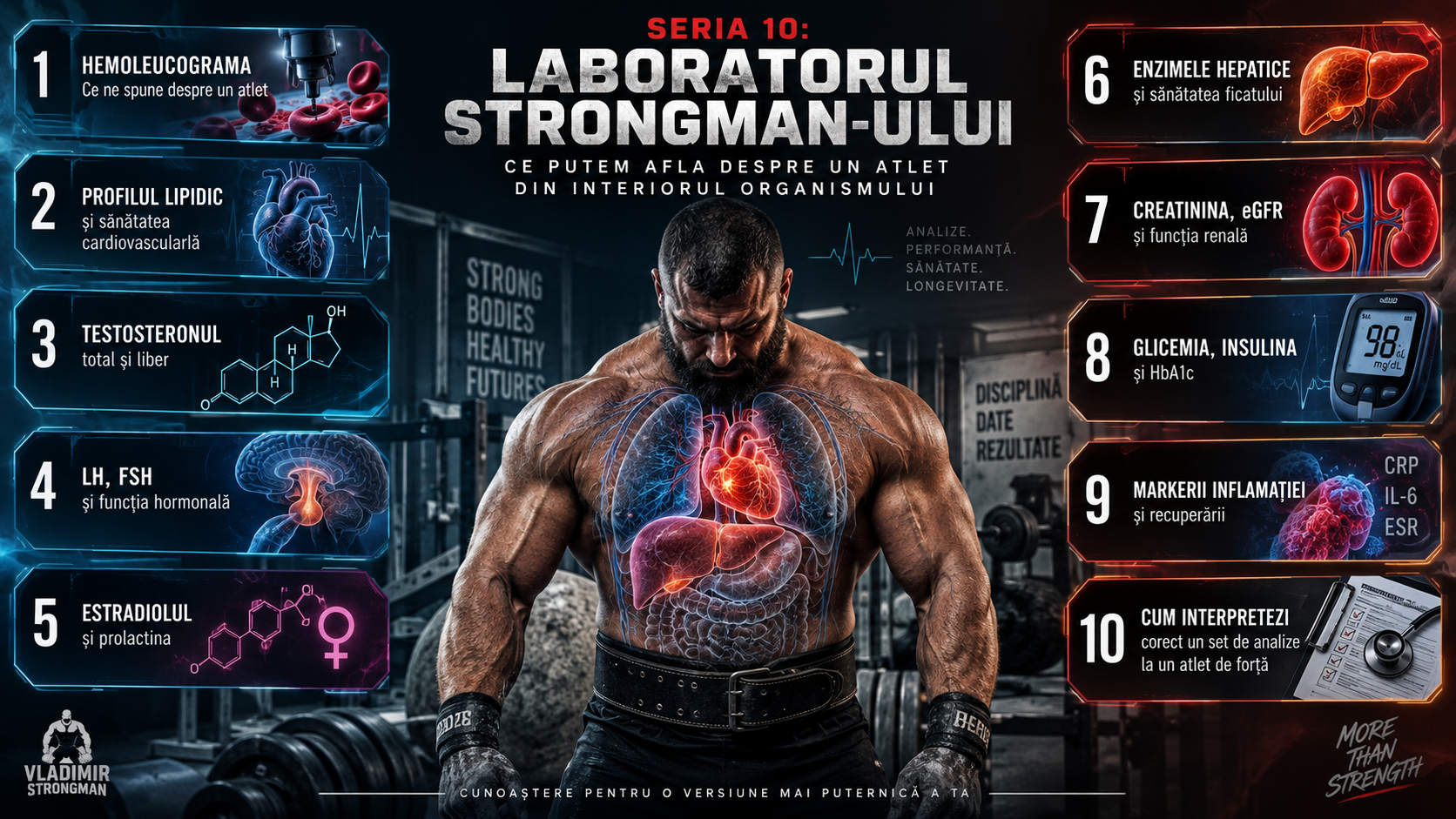
1. Blood glucose, insulin and HbA1c: three tests, three windows into metabolism
For a strength athlete, blood glucose, insulin and HbA1c are much more informative than their simple appearance on a laboratory report suggests. They do not measure the same thing and should never be reduced to one score of metabolic health. Blood glucose shows the concentration of glucose in the blood at a particular moment. Insulin tells us about the hormonal response that helps the body manage energy. HbA1c provides an integrated view of glucose exposure over recent weeks and months. Together, these markers can reveal how the body responds to food intake, exercise, sleep, stress, changes in body weight and body composition.
2. Why a strongman has unusual metabolic physiology
Strength sport creates an unusual physiological context. Muscle mass is high, energy requirements can be enormous, training may combine very intense efforts with substantial volume, and during some phases calorie intake is deliberately elevated. The season can also alternate between gaining mass, maintenance, weight loss and competition preparation. For that reason, the same laboratory value must be interpreted in relation to the season phase and the conditions around the blood draw.
3. What glucose is
Glucose is an important energy substrate for many tissues. Blood glucose concentration reflects a balance among food intake, intestinal absorption, hepatic glucose production and tissue utilization. During fasting, the liver can release glucose to maintain availability. After a meal, carbohydrate absorption rises, the pancreas responds by secreting insulin, and tissues change how they use and store energy.
4. Skeletal muscle is one of the major glucose reservoirs
For a strongman, muscle is central to the story. Skeletal muscle stores glycogen and can use glucose during exercise. Muscle contraction stimulates glucose transport into muscle fibers through pathways that are not entirely dependent on insulin, which helps explain why physical activity is such a powerful metabolic intervention. A large amount of muscle can represent a substantial metabolic reservoir, but it is not an absolute guarantee against insulin resistance or other metabolic problems.
5. What insulin does
Insulin is produced by pancreatic beta cells. It helps promote nutrient use and storage, facilitates glucose uptake in insulin-sensitive tissues, and contributes to suppression of hepatic glucose production. In sport, insulin should not be labeled simply as good or bad. A rise after a meal is normal physiology. The concern is persistent dysregulation of glucose control.
6. What happens after a carbohydrate-rich meal
After carbohydrate intake, absorbed glucose enters the circulation. The pancreas detects the rise and increases insulin secretion. Muscle and adipose tissue change glucose transport and utilization, while the liver changes its metabolic flux. In a healthy system, blood glucose rises, the hormonal response adapts, and the system moves back toward equilibrium. A normal post-meal rise is not, by itself, evidence of disease.
7. Fasting glucose: the morning snapshot
Fasting plasma glucose is useful because it simplifies the metabolic experiment: there has been no recent caloric intake to immediately explain the change. At the same time, the result is a snapshot, not the entire day's story. Sleep, stress, a hard session the day before, a very late meal, acute illness and recent changes in body weight can alter the context. An isolated value should therefore not carry the whole interpretation.
8. Clinical thresholds are not performance targets
Clinical medicine uses thresholds for prediabetes and diabetes. In 2026, ADA criteria include prediabetes with HbA1c 5.7-6.4%, fasting plasma glucose 100-125 mg/dL and two-hour glucose during an OGTT of 140-199 mg/dL. Diabetes is defined at higher thresholds, including HbA1c of at least 6.5% or fasting plasma glucose of at least 126 mg/dL, and in the absence of unequivocal hyperglycemia an abnormal result requires confirmation. These thresholds are clinical categories, not strength-sport performance zones.
9. Why a fasting glucose of 102 mg/dL does not automatically mean diabetes
A fasting glucose of 102 mg/dL falls within the ADA range associated with prediabetes, but it does not automatically mean that the athlete has diabetes. The distinction between categories matters. A borderline result should be interpreted in context and, when appropriate, confirmed by repeating the test or using another eligible test.
10. HbA1c: the memory of glucose exposure
HbA1c is glycated hemoglobin. Circulating glucose can attach to hemoglobin inside red blood cells, and HbA1c provides an integrated estimate of glucose exposure over approximately the previous three months, with a greater contribution from more recent exposure. This makes HbA1c more stable than one morning glucose value and useful for identifying longer-term metabolic trends.
11. HbA1c is not a perfect diary of every glucose value
HbA1c is an integrated marker, not a continuous glucose graph. It does not show every peak or dip, and it can become less reliable when red-cell lifespan is altered or certain hemoglobin variants and hematologic conditions are present. When glucose and HbA1c are persistently and substantially discordant, the discordance should be investigated instead of simply choosing the test that looks better.
12. The connection to Episode 1 and the complete blood count
This is one reason the episodes in the series must be read together. HbA1c depends on hemoglobin within red blood cells, and major changes in red-cell turnover can change the relationship between HbA1c and true glucose exposure. A metabolic test can therefore depend on hematologic information discussed earlier in the series.
13. Fasting insulin: useful context, less standardized
Fasting insulin can provide context about pancreatic response, but it is less standardized than glucose and HbA1c. The result depends on collection timing, fasting duration, laboratory method and individual physiology. A single value should not be turned into a universal diagnosis of insulin resistance.
14. What insulin resistance means
Insulin resistance describes a state in which certain tissues respond less effectively to insulin. For a time, the body may compensate by secreting more insulin and keep blood glucose apparently normal. Metabolic efficiency can therefore deteriorate before glucose enters an obvious clinical category. Insulin resistance is not synonymous with diabetes.
15. HOMA-IR: why it requires caution
HOMA-IR can be calculated from fasting glucose and insulin and may be useful for some metabolic assessments or research settings. However, there is no single universal cutoff that functions as a diagnosis for every individual, population and laboratory. HOMA-IR can help describe a trend, but it should not be mistaken for an independent medical verdict.
16. Why low insulin is not a trophy
Online discussions sometimes portray insulin as a hormone that should always be kept as low as possible. Physiologically, that is not correct. After a meal, insulin is supposed to rise. Metabolic health is better described as flexibility: an appropriate hormonal response when energy arrives and a return toward baseline when nutrient availability and demand decline.
17. Why high insulin does not automatically mean disease
Higher insulin can reflect compensation for reduced insulin sensitivity, but biological variation and laboratory method also matter. Without glucose, collection context and other metabolic information, one insulin value has limited explanatory power. Good interpretation looks for coherence, not drama.
18. High muscle mass helps, but does not erase metabolic risk
Large muscle mass can be metabolically favorable through glycogen storage and glucose utilization. Yet a strongman may simultaneously have very high energy intake, increased visceral adiposity, limited conditioning, poor sleep or other risk factors. “I have a lot of muscle” is not a laboratory test and cannot replace metabolic data.
19. Visceral adipose tissue matters
Fat distribution matters for metabolic risk. Visceral adipose tissue is associated with a less favorable metabolic environment and signaling that can affect insulin sensitivity. In a sport where body mass can become very high, waist circumference, body composition, blood pressure and lipids provide context that fasting glucose alone cannot.
20. Prolonged caloric surplus
An energy surplus can be a legitimate strategy for gaining mass and supporting training. Concern increases when the surplus is chronic and accompanied by substantial fat gain, declining conditioning and a progressive deterioration in cardiometabolic markers. A high carbohydrate intake is not itself a disease. Energy balance and individual response are decisive.
21. Carbohydrates are not the enemy
In strongman, carbohydrates can play an important role in supporting training and glycogen restoration. A post-meal rise in insulin is normal physiology. The useful question is not “how do I eliminate insulin?” but “how does my metabolism behave over time, and how well does my body handle the energy I provide?”
22. Muscle glycogen and recovery
After exercise, muscle must restore glycogen stores. Carbohydrate availability and the insulin response contribute to this process. An insulin response after training is not a metabolic defect. For the athlete, the key is the integration of recovery nutrition, total intake, body composition and long-term metabolic health.
23. Insulin resistance is not identical to poor conditioning
Cardiovascular conditioning and physical activity support insulin sensitivity and substrate utilization, but metabolic health cannot be reduced to how quickly someone runs or pedals. A strongman can have good conditioning and other risk factors, or exceptional strength performance alongside a less favorable metabolic profile.
24. Exercise and blood glucose
During and after exercise, glucose flux changes to meet energy demand and restore reserves. Intensity, duration, meal timing and stress can influence the result. A glucose measurement taken immediately after hard training is not equivalent to a fasting glucose obtained on a stable morning.
25. Stress, catecholamines and cortisol
Physiologic stress can increase energy availability through hormones such as catecholamines and cortisol. Before competition, after poor sleep, or during excessive training stress, this context can influence glucose. A slightly higher value in such a setting should not instantly become a disease label, but neither should stress become the explanation for a repeated unfavorable trend.
26. Sleep and glucose metabolism
Sleep affects energy regulation, insulin sensitivity and stress responses. For strongman athletes, the schedule may be complicated by late training, travel, competitions and large meals. When tracking metabolic trends, it is useful to record sleep quality alongside the laboratory result.
27. Dinner and the next morning's laboratory
A very large late dinner does not automatically create metabolic disease, but it can change the metabolic context of the following morning. Meal composition, alcohol, sleep and the timing of the last training session can affect comparison with a test performed under different conditions. For monitoring, consistency is more useful than laboratory perfection.
28. Hydration and interpretation
Hydration can influence blood concentration and often changes together with heat, sweating and physical stress. Not every glucose change is explained by hydration, and “I was a little dehydrated” should not become a universal excuse. It is one piece of the pre-analytic context.
29. HbA1c and recent diet changes
Because HbA1c integrates glucose exposure over months, a dietary change made only a few days before the blood draw cannot instantly rewrite the result. Recent exposure contributes more than distant exposure, but the marker remains integrated. This is why HbA1c is useful for following longer-term strategy changes.
30. When HbA1c and glucose disagree
A strongman may have an apparently good fasting glucose but a higher-than-expected HbA1c. There may be daily glucose variation that a morning sample misses, or a factor affecting HbA1c. Conversely, a favorable HbA1c does not exclude every period of hyperglycemia. Persistent discordance means the context needs to be reconsidered rather than one marker simply being selected.
31. OGTT: a metabolic challenge test
An oral glucose tolerance test measures how the body responds to a standardized glucose load. It can identify people who would be categorized differently by fasting glucose or HbA1c alone. It is less convenient than a simple blood draw, but it can be useful in selected clinical settings.
32. CGM: fascinating graphs, but not a diagnostic verdict
Continuous glucose monitoring can display glucose dynamics across the day and may be interesting for an athlete. However, having many data points does not automatically turn CGM into a standard diagnostic test for prediabetes or diabetes. In 2026, diagnosis remains anchored in validated criteria and clinical assessment.
33. Compare with personal history
A good result today is reassuring, but it does not erase history. If fasting glucose rises progressively, HbA1c moves in the same direction, triglycerides increase, blood pressure worsens and waist circumference grows, the signal is stronger than any of those numbers viewed in isolation.
34. Lipids complete the story
Glucose should not be read separately from lipids. Triglycerides, non-HDL cholesterol and LDL-C can add information about the cardiometabolic environment. In a strength athlete, a combination of unfavorable glucose, elevated triglycerides, high blood pressure and increasing adiposity is more informative than any single result.
35. The liver and glucose metabolism
The liver is a major control center for glucose. It produces glucose during fasting and changes fuel storage and use after meals. With hepatic insulin resistance, suppression of glucose production may become less effective. This is why the liver and metabolic episodes are directly connected.
36. MASLD and the metabolic profile
Metabolic dysfunction-associated steatotic liver disease can occur in contexts of excess adiposity and cardiometabolic risk. Transaminases can be normal even when steatosis is present, so a reassuring liver-enzyme panel is not enough to rule out metabolic liver disease. When glucose, triglycerides, weight and liver markers change together, the signal becomes clearer.
37. Blood pressure belongs to the same network
Blood pressure and glucose do not measure the same thing, but they can be influenced by the same cardiometabolic environment. A very strong athlete can perform at an elite level and still have persistent hypertension. Glucose should be interpreted alongside blood pressure, lipids, body weight and liver health.
38. Genetics and family history
Genetic predisposition influences the risk of dysglycemia. Two athletes with similar body weight and food intake can have different metabolic responses. A family history of type 2 diabetes or cardiometabolic disease may lower the threshold for closer monitoring.
39. What a reassuring metabolic profile looks like
A reassuring profile is not just a good fasting glucose. It is a coherent combination of glucose, HbA1c, blood pressure, lipids, body composition, liver and kidney function, symptoms and trend over time. In a strongman, stability across the season is more valuable than one perfect blood draw.
40. What a profile that deserves attention looks like
When fasting glucose repeatedly rises, HbA1c moves upward or enters the prediabetes range, and triglycerides, blood pressure or waist circumference also worsen, the metabolic question becomes more important. It is not automatically diabetes, but it is a good reason for medical evaluation and a review of weight strategy, nutrition, sleep and activity.
41. What not to do with a borderline result
Do not turn a borderline value into a crisis and do not try to „correct” it the same day with extreme interventions. Record the context, review the history and follow the logic of confirmation. Biology should be reproducible, not manufactured by abrupt changes immediately before testing.
42. When symptoms change the priority
Marked thirst, frequent urination, unexplained weight loss, blurred vision, pronounced fatigue or signs of severe hyperglycemia change the priority. A symptomatic athlete should not wait for a blog or an app to turn laboratory data into a diagnosis.
43. Fasting, hydration and collection conditions
For fasting glucose, the test should be collected after the recommended period without caloric intake. Plain water is generally compatible with fasting, and for trend monitoring the conditions should be kept as comparable as practical. Coffee, caloric drinks, very poor sleep and major disruptions of routine can complicate comparisons.
44. Do not confuse fasting with starvation
An athlete may start to believe that the lowest possible glucose or increasingly long periods without food prove superior metabolic health. There is no universal rule of that kind. Inadequate energy availability can impair sleep, recovery, training and endocrine function. The goal is not the lowest glucose possible, but appropriate metabolic regulation.
45. The role of reducing excess adipose tissue
In people with excess adipose tissue, sustained weight loss can improve insulin sensitivity and glucose control. For a strongman, the aim is not the lowest possible body weight but a body composition and weight that allow performance, recovery and long-term metabolic health.
46. What happens during mass-gain phases
During a gaining phase, body weight, carbohydrate intake and total energy intake can rise. Intelligent monitoring tracks more than the scale and PRs. Glucose, HbA1c, triglycerides, blood pressure and liver markers can reveal whether the strategy remains biologically sustainable.
47. What happens during weight-loss phases
During energy restriction, fuel flux and reserves change. Weight, performance and hydration can all shift. Not every glucose change is negative, and no marker should be interpreted without the rest of the picture. The athlete should avoid both chronic excess and extreme restriction.
48. Medications and supplements must be declared
Many medications can affect glucose. Some treatments and supplements may also influence metabolism or the interpretation of other laboratory tests. For a clinician, the complete list of substances used is part of the context, not a minor detail.
49. Exogenous substances do not permit simple predictions
For athletes using exogenous hormonal or androgenic substances, metabolism may be influenced through changes in body composition, blood pressure, lipids and other systems. Effects vary by individual. These situations call for integrated medical assessment rather than attempts to optimize one isolated metabolic marker.
50. Why trends matter more than a snapshot
Imagine two identical laboratory values. In one athlete, it is the first deviation after a year of stable results. In another, it is part of a slow rise seen across five blood draws. These do not carry the same interpretive weight. Trends turn numbers into information about direction.
51. Build your personal data history
Record the date, time, body weight, season phase, fasting conditions, recent training, sleep and key laboratory values. There is no need for obsession. Consistency is enough. After six or twelve months, you can see how changes in strategy relate to biological response.
52. Example: normal glucose and normal HbA1c
This profile is generally reassuring for glycemic control, but it does not mean overall metabolic risk is zero. Blood pressure, lipids, body composition, liver health and family history remain relevant.
53. Example: normal glucose, higher fasting insulin
This pattern can raise the question of compensatory insulin secretion, but it does not prove insulin resistance on its own. Glucose, collection conditions, history and other metabolic markers matter. A HOMA-IR calculated from one blood draw should not be treated as a universal diagnosis.
54. Example: repeatedly high fasting glucose and rising HbA1c
When two independent windows begin moving in the same direction, the signal is stronger. At that point the conversation is no longer about making the next test look better, but about confirmation, clinical context and identifying contributing factors.
55. Example: elevated HbA1c with good morning glucose
The first question is whether morning glucose captures the whole story. The second is whether a hematologic factor could affect HbA1c. Repetition and correlation with other data can clarify the discordance. Do not automatically choose the result that makes you feel better.
56. Example: good HbA1c but large daily fluctuations
An average marker can hide variability. When there is a clinical reason for more detail, additional measurements or temporary monitoring can add information. More data, however, do not replace validated diagnostic criteria.
57. Inflammation and metabolism are connected
Adipose tissue, liver, muscle and the immune system communicate through many signaling pathways. Low-grade metabolic inflammation can accompany visceral adiposity and insulin resistance. For the athlete, the practical point is that metabolism does not operate as sealed compartments.
58. Recovery is not reduced to a perfect glucose value
An athlete can have excellent glucose and HbA1c and still sleep badly, be overloaded or have inadequate energy availability. Metabolic markers are one component of monitoring, not a universal recovery detector.
59. What a strongman should follow long term
Depending on individual profile and medical guidance, a metabolic picture can include glucose, HbA1c, lipid profile, blood pressure, waist circumference and liver markers. Fasting insulin or an OGTT can be useful in selected contexts. The goal is not the largest possible laboratory panel, but useful answers to real questions.
60. The five basic questions
What does the test measure? Under what conditions was it collected? Where does it sit compared with my history? What do related markers say? Are there symptoms or trends that justify medical evaluation? These five questions are much more powerful than the search for a perfect number.
61. What not to do
Do not use the internet to turn a single result into a diagnosis. Do not chase the lowest possible insulin. Do not assume muscle mass protects you from every metabolic problem. And do not radically change your diet immediately before testing simply to obtain a more flattering result.
62. When confirmation is needed
In the absence of unequivocal hyperglycemia, abnormal diagnostic criteria should be confirmed. Confirmation may involve repeating the same test or using another eligible test, depending on context. This is one reason a laboratory report is not the same thing as a diagnosis.
63. What mature interpretation looks like
A mature interpretation may say: “the result is mildly abnormal, but the context could explain it; we will follow it and compare it with related tests.” Or it may say: “the result is repeated and is accompanied by other changes, so it deserves evaluation.” Both are better than “nothing is wrong” or “this is catastrophic” based on one number.
64. Conclusion: metabolism is not a dashboard with one warning light
Blood glucose, insulin and HbA1c describe different aspects of the same system. Glucose is the current snapshot. Insulin is part of the control response. HbA1c is a biological memory of recent glucose exposure. In strongman, these data should be linked to muscle mass, adipose tissue, liver, training, sleep, nutrition, blood pressure and lipids. The best interpretation is not the most spectacular number. It is a system that functions well and remains sustainable over time.
Editorial note
This article is educational and does not provide diagnosis or treatment. The thresholds presented reflect contemporary guidance for nonpregnant adults. Persistent, discordant or symptomatic results should receive clinician-led interpretation.
Primary sources
American Diabetes Association, Standards of Care in Diabetes 2026, section on diagnosis and classification of diabetes; NIDDK materials on diabetes testing and the A1C test; NIDDK information on glucose and metabolism; AASLD materials on MASLD and the relationship between liver health and metabolic risk.
More From The Journal

Training
The Science of Strongman Training - Episode X: Competition Programming
How to build a complete Strongman competition preparation block: calendar, events, volume, intensity, specificity, simulations, autoregulation, tapering and fatigue management.

Training
The Science of Strongman Training - Episode IX: Peaking
Peaking in Strongman: how to turn months of training into maximal competition performance by reducing fatigue, preserving adaptations and managing specificity.