
Physiology
The Strongman Laboratory: What We Can Learn About an Athlete from Inside the Body - Episode 7: Liver Enzymes and Liver Health
September 7, 2026
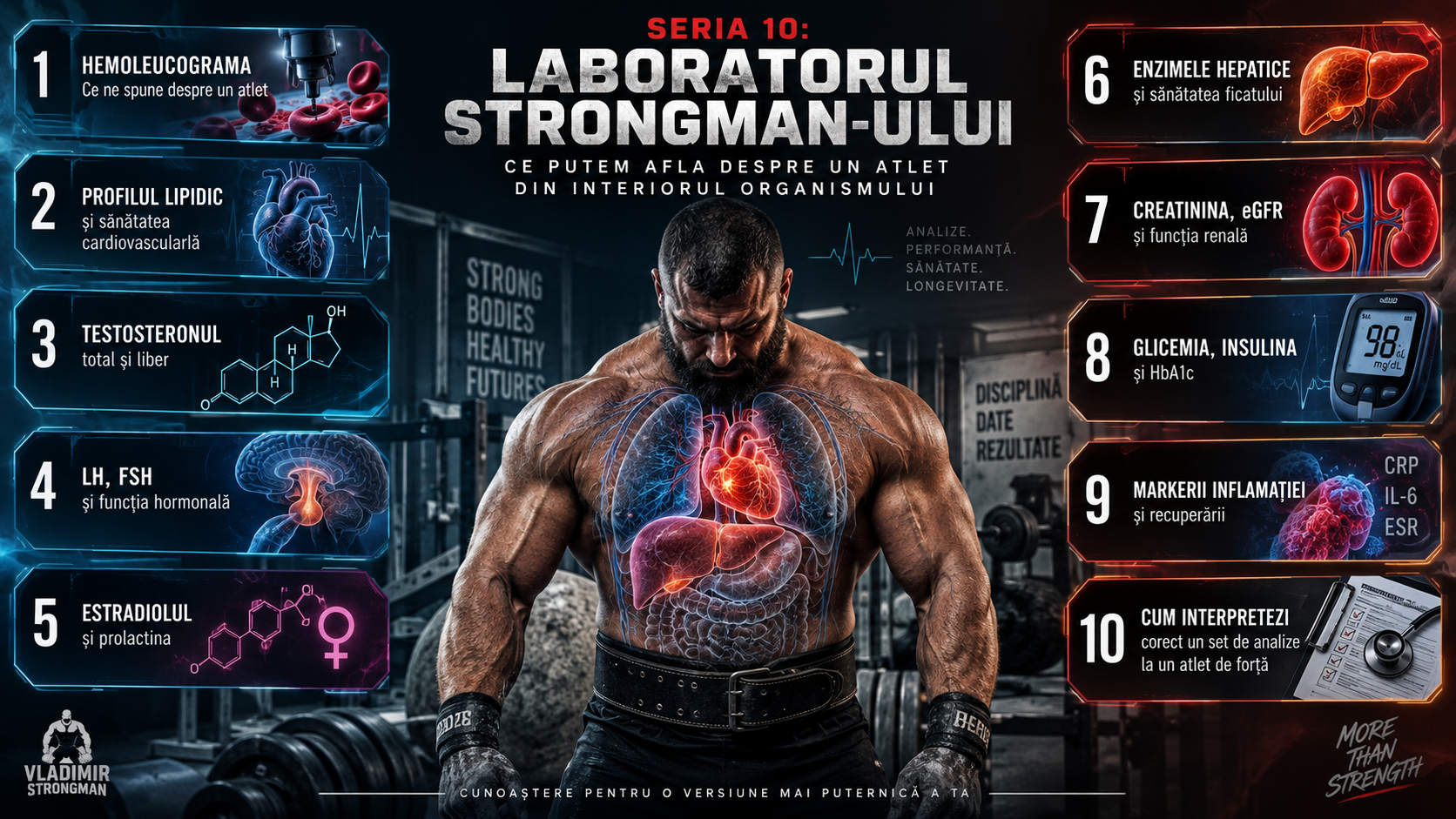
The Strongman Laboratory, Episode 7: the liver is more than a set of enzymes
The liver is one of the body's busiest organs. It processes nutrients, synthesizes proteins, participates in drug and hormone metabolism, produces and excretes components of bile, stores energy and coordinates countless metabolic processes. For a strongman, all of this meets an additional reality: high food intake, large body mass, extremely demanding training, supplements and sometimes exposure to substances that can alter laboratory results.
That is why an AST or ALT result should not immediately become the question «is the liver damaged?». AST and ALT are primarily markers of cellular injury, not direct scores of liver function. AASLD and gastroenterology guidance distinguish injury markers from tests that better reflect hepatic synthetic performance, such as albumin and prothrombin time/INR. citeturn0search1turn0search0
1. What do liver enzymes actually tell us?
ALT, or alanine aminotransferase, is concentrated primarily in hepatocytes and is considered more specific for liver injury than AST. AST, or aspartate aminotransferase, is also found in skeletal muscle, heart and other tissues. This is critical in strongman: an AST rise after a brutal training session can come partly from muscle rather than the liver.
Alkaline phosphatase has a different story. It can rise in hepatobiliary disease but can also be elevated because of bone processes. GGT can help establish a hepatobiliary source when alkaline phosphatase is elevated. Bilirubin adds another dimension, and fractionating it into direct and indirect forms can help guide the evaluation.
2. AST: the enzyme that can come from muscle
AST is one of the major interpretation traps for strength athletes. Skeletal muscle contains AST, and hard exercise can produce temporary aminotransferase elevations. If a strongman performs a heavy lower-body, back or full-body session and has blood drawn soon afterward, AST may partly reflect recent muscle stress.
That does not mean an elevated AST should be ignored. It means the result needs context. ALT, GGT, bilirubin, alkaline phosphatase, CK, recent training and the trend over time can help distinguish a muscular source from a hepatic one.
3. ALT: closer to the liver, but still not a verdict
ALT is more liver-specific than AST, but it should not be turned into a diagnosis by itself. Elevation can occur with metabolic dysfunction-associated steatotic liver disease, viral hepatitis, autoimmune disease, inherited disorders, drug-induced liver injury and other conditions.
The magnitude matters, but not in the simplistic way many athletes assume. AASLD notes that the degree of aminotransferase elevation does not directly correlate with the extent of liver injury. Advanced disease can sometimes coexist with modest enzyme abnormalities, while an acute episode can produce dramatic elevations that later resolve. citeturn0search1
4. AST and ALT together: the pattern matters
Interpretation is not simply «AST high» or «ALT high». The relative pattern, the degree above the laboratory upper limit and the other tests all matter. A predominantly hepatocellular pattern differs from a predominantly cholestatic pattern. The ACG guideline defines hepatocellular injury by disproportionate AST and ALT elevation compared with alkaline phosphatase, while cholestatic injury is characterized by disproportionate alkaline phosphatase elevation. citeturn0search0
Clinicians may also use the R-value, which compares ALT and alkaline phosphatase relative to their upper limits of normal. It is a classification tool for the pattern of injury, not a self-diagnosis calculator.
5. GGT: the piece that helps interpret alkaline phosphatase
Gamma-glutamyltransferase, or GGT, is associated with the hepatobiliary system. When alkaline phosphatase is elevated, GGT can help determine whether the source is likely hepatic or whether an extrahepatic source, such as bone, should be considered. AASLD describes this approach in the evaluation of elevated alkaline phosphatase. citeturn0search1
GGT should not be treated as an «alcohol detector». It can rise in many settings, including hepatobiliary disease and medication effects. An isolated GGT result cannot quantify alcohol intake or establish a single cause.
6. Alkaline phosphatase and cholestasis
Alkaline phosphatase can rise when bile flow or the hepatobiliary tract is affected, but it can also originate from bone. If alkaline phosphatase predominates, especially with direct bilirubin elevation, clinicians may consider a cholestatic pattern and use imaging such as abdominal ultrasound depending on the context.
For the athlete, the message is simple: an elevated alkaline phosphatase should not automatically be labeled a «liver problem». GGT, history and the rest of the biochemical profile help establish the source.
7. Bilirubin: what happens to hemoglobin after it is broken down?
Bilirubin is produced largely from heme breakdown, including the breakdown of aging red blood cells. Unconjugated bilirubin travels bound to albumin to the liver, where it is conjugated so it can be excreted through bile. Problems with production, uptake, conjugation or excretion can change the bilirubin pattern.
Direct and indirect bilirubin can tell different stories. Predominantly unconjugated hyperbilirubinemia can occur with hemolysis or impaired uptake or conjugation, while elevated conjugated bilirubin can point toward hepatocellular disease or cholestasis. citeturn0search1turn0search2
8. Albumin: where the discussion of synthetic function begins
Albumin is produced by the liver and is an important marker of synthetic capacity, but it is not liver-specific. Low albumin can also occur with inflammation, renal protein loss, malnutrition or fluid overload. It therefore should never be interpreted in isolation.
Albumin also has a relatively long half-life. AASLD notes that a fall related to liver disease generally reflects a process lasting longer than a few hours or days rather than an immediate response to an acute change. citeturn0search1
9. INR and the liver's ability to make clotting factors
The liver synthesizes many clotting factors. Prothrombin time and INR can therefore provide information about hepatic synthetic function. In severe liver injury, INR can change relatively quickly. However, INR can also be altered by vitamin K deficiency, anticoagulants and other conditions.
The distinction matters: an abnormal INR does not automatically mean liver failure, but an elevated INR in the setting of acute liver injury can be much more significant than an isolated ALT elevation.
10. «High liver enzymes» does not mean «the liver is destroyed»
The phrase «liver enzymes» creates a common misunderstanding. AST and ALT are better understood as markers of cellular injury. They are not a fuel tank that empties as the liver is destroyed, and they do not function as a percentage health score.
AASLD recommends separating injury markers such as AST and ALT from synthetic markers such as albumin and clotting factors, and from markers related to excretion or cholestasis such as bilirubin and alkaline phosphatase. citeturn0search1
11. Why training can change a strongman's laboratory results
A very hard strength session creates mechanical and metabolic stress in muscle. If blood is drawn too close to a maximal session, several laboratory values may temporarily differ from baseline. AST is particularly relevant because it is present in skeletal muscle.
For that reason, athletes monitoring liver health should record what they did in the days before testing. A panel drawn after heavy deadlifts, carries, stones, log pressing and high volume should not be compared without context with a panel obtained after several recovery days.
12. CK can help separate muscle from liver
Creatine kinase, or CK, is a marker associated with muscle tissue. When AST is elevated after hard training and CK is also markedly elevated, a muscular source becomes an important possibility. That association still does not automatically exclude liver disease.
The more coherent the overall profile, the better the interpretation. AST plus very high CK after exercise can be a different story from persistent ALT and GGT elevation accompanied by bilirubin abnormalities and abnormal imaging.
13. Diet and the strongman's liver
Strongman athletes may eat large amounts of food to support body mass and recovery. High energy intake is not itself a disease, but chronic energy surplus, visceral adiposity, insulin resistance and related metabolic factors can promote fat accumulation in the liver and metabolic dysfunction-associated steatotic liver disease.
AASLD notes that MASLD is often asymptomatic and may be discovered incidentally through laboratory abnormalities or imaging. Importantly, normal aminotransferases do not exclude MASLD. citeturn0search7
14. Fatty liver does not automatically mean cirrhosis
Hepatic steatosis means fat accumulation in the liver. It is not synonymous with cirrhosis. Between simple steatosis and advanced disease lies a spectrum that can include inflammation and fibrosis. Some people remain stable while others progressively accumulate fibrosis.
That is why an ultrasound report saying «fatty liver» should neither be dramatized nor ignored. Depending on metabolic risk and laboratory findings, a clinician may decide whether non-invasive fibrosis risk assessment is appropriate.
15. Fibrosis: the problem enzymes do not directly measure
Fibrosis is the progressive accumulation of scar tissue in the liver. AST and ALT do not directly measure how much fibrosis is present. An athlete can have relatively normal aminotransferases and still have clinically important fibrosis.
This is where non-invasive scores and transient elastography can become useful. AASLD describes transient elastography, including FibroScan, as a tool that can help risk-stratify liver disease by measuring liver stiffness and estimating steatosis. citeturn0search1
16. Alcohol: one factor, not the only explanation for GGT
Alcohol can injure the liver, and sustained heavy intake is associated with a spectrum of alcohol-associated liver disease. But an elevated GGT is not a test that measures how much alcohol someone drinks. Medications, cholestasis and other liver conditions can also raise GGT.
The AST/ALT ratio can provide clues in selected contexts, but it is not a magic formula. AASLD notes that an AST/ALT ratio above 2 is common in alcohol-associated liver disease, while a higher ratio can also occur in cirrhosis from other causes. citeturn0search1
17. Medications and supplements belong on the same list
Evaluation of elevated aminotransferases should include prescription medicines, over-the-counter products and supplements. The ACG guideline explicitly recommends this history because drug-induced liver injury can present with hepatocellular, cholestatic or mixed patterns. citeturn0search0
For an athlete, the list should be complete: performance products, weight-loss products, botanical extracts, analgesics, chronic medications and anything else used regularly. «Natural» does not mean «unable to affect the liver».
18. Exogenous androgens and liver interpretation
For athletes using exogenous androgens, liver evaluation needs to be placed within the broader risk profile. Some substances can directly or indirectly affect liver-related markers, while associated changes in body mass, blood pressure, lipids and multiple-product use can make the laboratory picture harder to interpret.
A laboratory result cannot identify the responsible substance by itself. A clinician therefore needs an accurate exposure history to evaluate possible drug-induced liver injury or other causes.
19. Acetaminophen and other common medicines
Some common medicines can become relevant to liver health at particular doses, combinations or clinical circumstances. A strongman with abnormal liver tests should therefore be asked not only about «strong» medications, but also about everyday products used for pain, colds or recovery.
This is not a reason to stop prescribed treatment independently. It is a reason to review the medication history with a clinician before assigning a cause to the laboratory abnormality.
20. Viral hepatitis cannot simply be forgotten
Persistent ALT or AST elevation has many possible causes, and viral hepatitis is among them. Guidelines recommend considering viral causes alongside metabolic, medication-related, autoimmune and inherited causes when evaluating hepatocellular injury.
Being young, muscular and asymptomatic does not exclude liver disease. The liver can tolerate substantial injury without producing obvious symptoms for some time.
21. Iron, ferritin and hemochromatosis
Ferritin can rise with inflammation, metabolic steatosis, infection and many other conditions. It should not automatically be interpreted as «too much stored iron». In selected contexts, clinicians may evaluate transferrin saturation and other studies to assess possible iron overload.
This is another good laboratory lesson: a marker becomes much more useful when it is interpreted next to the other markers and the person's history.
22. Autoimmune and less obvious causes
Autoimmune hepatitis, cholestatic diseases, Wilson disease and alpha-1 antitrypsin deficiency are among the possible causes in selected patterns. They do not all need to be tested in every athlete, but persistent or substantial abnormalities may justify a broader workup. citeturn0search0
In very young athletes with unexplained abnormalities, age and family history can change the diagnostic pathway. Good medicine is not ordering every possible test; it is choosing the tests that answer the right question.
23. Abdominal ultrasound: when blood tests are not enough
Blood tests cannot reveal every structural problem in the liver and biliary tract. Ultrasound can identify steatosis, gallbladder abnormalities, bile-duct dilation and other findings that can change the direction of an evaluation.
In a cholestatic pattern, ultrasound can be an important early step. AASLD notes that bile-duct dilation can point toward an extrahepatic cause and lead to further imaging when appropriate. citeturn0search1
24. What does a mild elevation mean?
A mild transaminase elevation is not equivalent to an emergency and is not proof of a healthy liver either. In many cases, the first steps are to confirm the result, review the context and look for common causes. Persistent abnormalities can then trigger a more targeted evaluation.
For a strongman, questions about recent training, hydration, diet, alcohol, medications and supplements are especially important. Sometimes repeating the panel under more standardized conditions clarifies how much of the original result was temporary noise.
25. When does the situation become urgent?
Very high aminotransferases, jaundice, altered mental status, unusual bleeding, significant abdominal pain, persistent vomiting or an elevated INR in the setting of acute liver injury warrant prompt medical evaluation. AASLD emphasizes acute liver failure when acute liver injury is accompanied by encephalopathy and other signs of severe dysfunction. citeturn0search1
This is not the moment to explain the result away with «I trained legs yesterday» or «it must be the supplement». The priority is medical assessment.
26. What does a reassuring profile look like?
A reassuring profile is not one number. In an appropriate context, normal AST and ALT, alkaline phosphatase and GGT, bilirubin, albumin and INR provide a much more useful picture than any isolated marker. History, symptoms and imaging when indicated complete the assessment.
Even then, normal blood tests do not exclude every liver condition. MASLD, for example, can occur with normal aminotransferases. Metabolic risk and the broader clinical picture therefore remain relevant. citeturn0search7
27. Example: high AST after a brutal training session
Imagine a strongman who performs a very hard session and has blood drawn the next day. AST is elevated, CK is markedly elevated, ALT is only mildly changed, GGT and bilirubin are normal, and the athlete has no symptoms. A muscular source becomes an important consideration and the clinician may decide to repeat the tests after recovery.
That is not a diagnosis and does not mean every post-training AST rise is harmless. It is an example of why context changes interpretation.
28. Another example: persistently elevated ALT and GGT
Now imagine another athlete with ALT and GGT elevated on repeated testing, steatosis on ultrasound and associated metabolic risk factors. The discussion shifts from «training raised my enzymes» toward evaluation for metabolic liver disease and fibrosis risk.
This is the difference between a snapshot and a film. A repeated abnormal result linked with imaging and risk factors tells a much clearer story.
29. The liver and recovery
The liver is part of the infrastructure of recovery. It participates in nutrient processing, plasma-protein synthesis, hormone metabolism and the biotransformation of many substances. When liver health is compromised, the consequences are not limited to one laboratory number.
At the same time, a mildly abnormal liver test does not prove that an athlete's recovery is impaired. The complete profile and the cause of the abnormality matter.
30. How should a strongman be monitored?
A sensible monitoring panel can include AST, ALT, GGT, alkaline phosphatase and bilirubin, with albumin and INR when clinically appropriate. Results should be considered alongside the CBC, metabolic profile, medication and supplement history, blood pressure, body weight and metabolic risk factors.
For persistent abnormalities, a clinician may add viral testing, iron studies, autoimmune markers, ultrasound, elastography or other investigations. There is no single «liver test» that answers every question.
31. What not to do with the results
Do not treat AST as a direct liver-health score. Do not treat ALT as a percentage of liver health. Do not use GGT alone to estimate alcohol intake. Do not assume fatty liver means cirrhosis. And do not assume normal enzymes exclude every liver disease.
Most importantly, do not independently change prescribed treatment and do not try to «detox» the liver with unverified products. When a laboratory abnormality persists, finding the cause is more valuable than adding another supplement.
32. Conclusion: read the liver as a system, not a number
For strongman athletes, liver chemistries are extremely useful when interpreted in context. AST can come from muscle. ALT is more liver-specific but does not independently measure severity. Alkaline phosphatase and GGT help identify cholestatic patterns. Bilirubin tells part of the story of heme processing and excretion, while albumin and INR add information about synthetic capacity, each with important limitations.
The central message of this episode is the same one that runs through the Strongman Laboratory: a laboratory result is not a verdict. It is a signal. When that signal is placed next to training, muscle mass, diet, hydration, medications, supplements, symptoms, imaging and the trend over time, the laboratory begins to tell a coherent story.
Editorial note
This article is educational and does not replace medical evaluation. Liver-related laboratory values should be interpreted by a qualified health professional in the context of history, symptoms, medications, supplements, training and other investigations.
Reference sources
AASLD, How to approach elevated liver enzymes; ACG Clinical Guideline: Evaluation of Abnormal Liver Chemistries; AASLD educational material on bilirubin and alkaline phosphatase; AASLD material on metabolic dysfunction-associated steatotic liver disease.
More From The Journal

Training
The Science of Strongman Training - Episode X: Competition Programming
How to build a complete Strongman competition preparation block: calendar, events, volume, intensity, specificity, simulations, autoregulation, tapering and fatigue management.

Training
The Science of Strongman Training - Episode IX: Peaking
Peaking in Strongman: how to turn months of training into maximal competition performance by reducing fatigue, preserving adaptations and managing specificity.