
Physiology
The Strongman Laboratory: What We Can Learn About an Athlete from Inside the Body - Episode 6: Creatinine, eGFR and Kidney Function
September 7, 2026
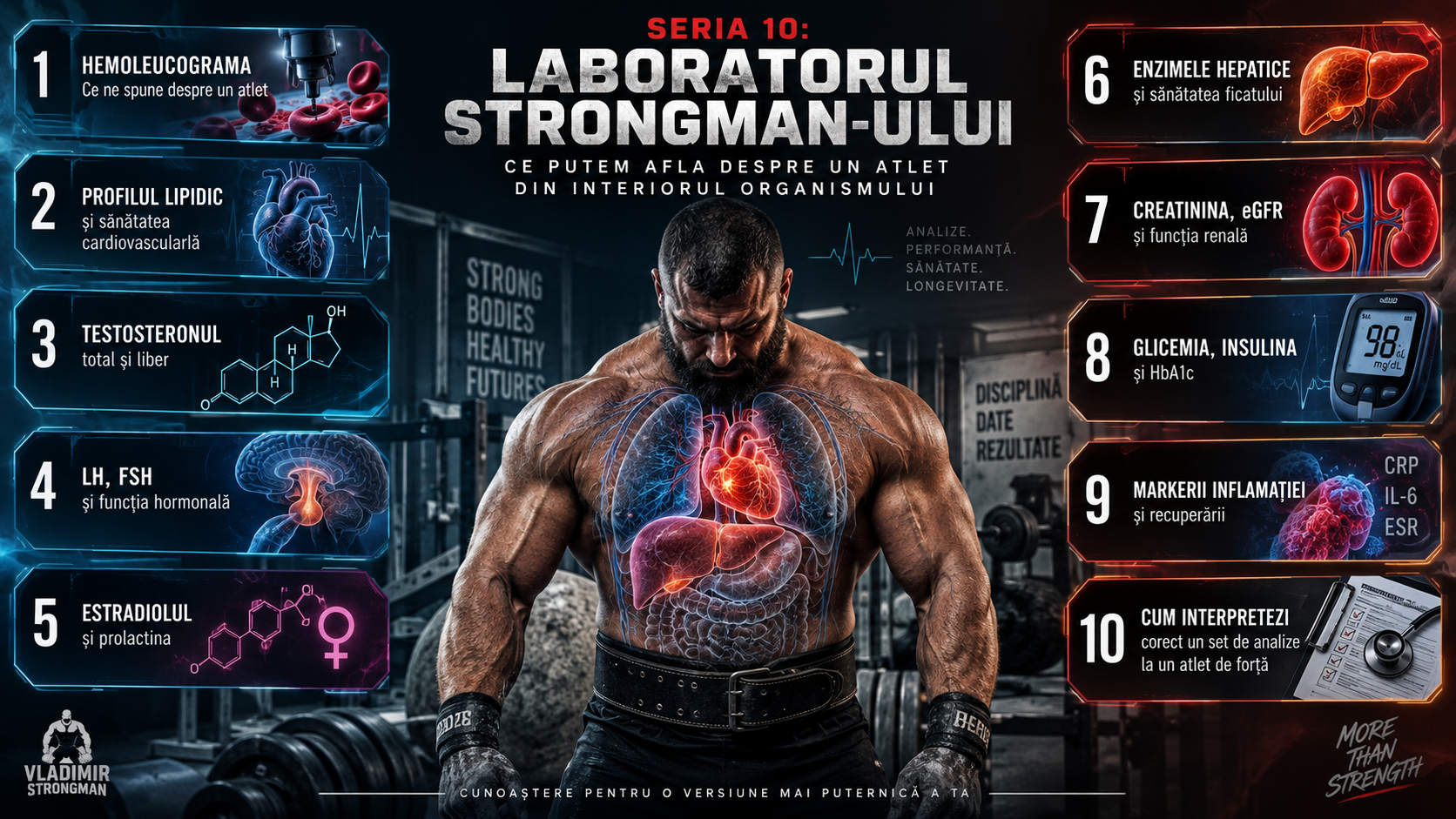
The Strongman Laboratory, Episode 6: when creatinine tells a more complicated story
In a sport where an athlete may carry a very large amount of muscle mass and repeatedly move through brutally demanding training sessions, blood tests need more context than a simple high-or-low reading. Creatinine is a perfect example. It is a breakdown product linked to the creatine-phosphocreatine system in muscle and is cleared mainly through the kidneys, which is why serum creatinine is used to estimate glomerular filtration. The catch is that blood creatinine reflects not only how well the kidneys clear it, but also how much creatinine the body produces.
For a highly muscular strongman, creatinine can sit above the population average without automatically proving kidney disease. On the other hand, a reassuring creatinine value by itself cannot exclude every form of kidney disease. This episode is therefore about the difference between a marker, an estimate and actual organ function.
1. What is creatinine?
Creatinine is a breakdown product associated with the creatine-phosphocreatine system in muscle. Under relatively stable conditions, daily production is influenced by muscle mass and muscle metabolism. Creatinine circulates in blood and is cleared mainly through renal filtration. When filtration falls, serum creatinine generally rises.
That relationship sounds simple, but physiologically it is a balance between production and clearance. Picture a bathtub with water entering through a tap and leaving through a drain. The water level depends on both sides. Creatinine can rise because the drain, meaning renal clearance, has slowed, but it can also rise because the tap, meaning production, is larger. In a very muscular athlete, the production side can matter.
2. Why does muscle mass matter so much in strongman?
Creatinine-based eGFR equations assume an average relationship between creatinine, age, sex and kidney filtration in the populations from which the equations were developed. NIDDK notes that creatinine-based estimates may be less accurate at extremes of body size and muscle mass, including bodybuilders. For strongman athletes, this is one of the most important ideas in the entire article.
Two people with the same true filtration rate may have different creatinine concentrations if their creatinine production is very different. A strongman with high muscle mass, a high-protein diet and creatine supplementation may have a higher serum creatinine than a much less muscular adult. That is not permission to ignore an abnormal result. It is a reason to interpret it in context.
3. Creatine supplementation and creatinine are not the same thing
Creatine monohydrate is widely used to increase availability of the phosphagen system. Some creatine and phosphocreatine undergo spontaneous conversion to creatinine. As a result, creatine supplementation can influence serum creatinine in some people without automatically meaning that true kidney filtration has fallen.
Context matters. An isolated change in creatinine after a recent change in supplementation, diet or training volume is not the same story as a progressive, persistent rise associated with other abnormal findings or symptoms.
4. Hydration can change the picture
Serum creatinine concentration is also influenced by hydration status. An athlete who arrives for testing after substantial sweating, lower fluid intake or acute water loss may have a different blood concentration than the same person when normally hydrated. In strongman, long sessions, hot environments and repeated high-effort work can make this variability relevant.
But dehydration should never become a universal explanation for an elevated creatinine. When a result is clearly abnormal or remains abnormal, it deserves proper follow-up rather than an automatic assumption that hydration explains everything.
5. What does eGFR mean?
eGFR means estimated glomerular filtration rate. It is not a direct measurement of filtration. It is a mathematical estimate generated from laboratory markers and demographic variables. Current adult equations include the race-free 2021 CKD-EPI equations, and combining creatinine with cystatin C can provide a more accurate estimate than creatinine alone in many situations.
So an eGFR number should be read as an estimate of a physiologic function, not as if a machine directly measured how many milliliters of plasma an individual kidney filters every minute.
6. Why can the same creatinine produce a different eGFR?
The equations include age and sex, and the result is generally reported normalized to a standard body-surface area of 1.73 m². eGFR therefore is not simply a creatinine-to-GFR ratio. Even with the same creatinine, age and sex can produce different estimated values.
eGFR is also a statistical estimate applied to an individual. It becomes less precise when a person differs from the characteristics of the population in which the equation performs best, and unusual muscle mass is one of the relevant factors.
7. When a low eGFR does not automatically mean chronic kidney disease
Chronic kidney disease is diagnosed on the basis of evidence of kidney damage and/or persistently reduced kidney function over time, not from one isolated laboratory value. An abnormal result may need repetition, additional testing and correlation with the medical history.
That is especially important in an athlete. A lower eGFR in a single test after a hard training block, variable hydration and a higher baseline creatinine due to muscle mass is not the same as an eGFR that repeatedly declines under standardized conditions and is accompanied by albuminuria or other evidence of kidney disease.
8. Cystatin C: the second instrument on the dashboard
Cystatin C is another biomarker used to estimate GFR. Its practical advantage is that it is generally less influenced by muscle mass than creatinine. NIDDK notes that equations combining creatinine and cystatin C are more accurate than creatinine alone in many circumstances.
Cystatin C is not perfect either. It can be affected by factors unrelated to GFR, and NIDDK lists steroid use, thyroid dysfunction, adiposity and inflammation among potential contributors to higher cystatin C levels. In a complex athlete, the best marker therefore depends on the full context.
9. Why creatinine plus cystatin C can be especially useful in a strongman
When creatinine production is unusual, a creatinine-only estimate can be harder to interpret. Combining creatinine and cystatin C uses two biological signals with partly different sources of error. When both point in the same direction, confidence in the estimate increases. When they disagree, the disagreement itself becomes useful information and may indicate that more context or additional testing is needed.
10. Urine albumin: the missing piece in many conversations
Kidney assessment should not be reduced to creatinine and eGFR. Urine albumin, especially the urine albumin-to-creatinine ratio, adds information about kidney damage and long-term risk. A relatively preserved eGFR does not mean the kidneys are entirely problem-free if persistent evidence of damage is present, and an apparently low eGFR should not be interpreted in isolation.
For an athlete, urine can become the second dashboard. Blood gives one part of the story, while urine provides another.
11. Dietary protein and interpreting creatinine
Strongman is a sport in which energy intake and protein intake can be high. Diet can influence creatinine and the interpretation of renal markers, and recent meals, especially those rich in meat, can temporarily affect some measurements. That is why collection conditions matter.
The point is not to frighten athletes away from protein. The point is to recognize that a laboratory result is not detached from the physiology that produced it. Testing under an unusual dietary situation can produce a different result from testing under standardized conditions.
12. Very hard training and creatinine
Intense exercise can temporarily change several laboratory markers. For a strongman, testing immediately after a very demanding training period may not represent the same picture as testing after recovery and relative physiologic stability. Creatinine should therefore be interpreted alongside recent training history, and concerning values should be confirmed under appropriate conditions.
Especially when there is severe muscle pain, weakness or very dark urine after unusual exertion, the clinical question changes. A clinician may also look for evidence of muscle injury and acute kidney injury rather than focusing on isolated creatinine alone.
13. Four different stories behind a high creatinine
The same numeric value can have very different meanings. The first story is increased production in a highly muscular athlete. The second is variation related to hydration, diet or supplementation. The third is genuine reduction in kidney filtration. The fourth is an acute situation in which kidney perfusion or kidney tissue is affected.
The laboratory cannot decide which story is true on its own. It provides clues that the medical history, examination and complementary tests must assemble.
14. Why the trend can matter more than the snapshot
NIDDK notes that trends over time can be more informative than a single eGFR estimate. For an athlete who monitors labs several times each year, comparing tests performed under reasonably similar conditions can turn a collection of numbers into a much clearer story.
Similar collection timing, reasonably consistent hydration, enough distance from an unusually hard session and a record of relevant supplements can reduce noise. The goal is not laboratory perfection. It is better signal.
15. eGFR and the limits created by extreme body size
eGFR is conventionally normalized to 1.73 m² of body surface area. For special clinical decisions, such as some medication-dosing situations, clinicians may need additional interpretation and sometimes adjustment to actual body surface area. This is another reason the laboratory number should not be treated as a universal score of kidney health.
16. When is a more complete evaluation warranted?
A closer evaluation becomes important when creatinine rises repeatedly, eGFR remains reduced, or there is albuminuria, blood in the urine, hypertension, electrolyte disturbance, edema or other clinical evidence of kidney disease. In an athlete, the history should include supplements, medications, recent weight changes, dehydration episodes, recent illness and unusually intense training.
When creatinine is difficult to interpret because of muscle mass or another non-GFR factor, cystatin C and the combined creatinine-cystatin C equation can be helpful. In selected circumstances, clinicians may consider a more direct measurement of GFR, although that process is more complex and less widely available.
17. Kidney function is not one number
The kidneys do much more than clear creatinine. They regulate water and electrolytes, participate in acid-base balance and blood-pressure regulation, and perform endocrine functions. When we talk about kidney function, we therefore need the whole dashboard rather than a single gauge.
18. Why blood pressure matters in strongman
Kidneys and blood pressure have a two-way relationship. Hypertension can contribute to kidney damage, while kidney disease can promote hypertension. In a sport that may involve maximal exertion, high body mass, acute stress and major shifts in fluid status, blood pressure deserves separate attention from blood tests.
19. Medications and substances that complicate interpretation
An athlete's full history should include medications and supplements, not only food. Some medicines can alter creatinine, kidney perfusion or the relationship between a marker and renal function. A kidney panel should therefore never be interpreted without knowing which substances are being used.
For athletes using exogenous androgens, the picture can become even more complex. These agents may affect muscle mass, blood pressure, hydration and other variables that complicate interpretation. An unusual creatinine result does not by itself prove a cause, and assigning it automatically to one compound is an oversimplification.
20. Which tests can complete the kidney picture?
Depending on context, clinicians may correlate creatinine and eGFR with cystatin C, urine albumin-to-creatinine ratio, urinalysis, electrolytes and other laboratory markers. In some circumstances renal ultrasound or more advanced investigations may be appropriate. The exact choice depends on the clinical question rather than a fixed checklist.
21. What would a smart strongman monitoring panel look like?
A useful panel would not simply say «creatinine: X». It could include creatinine, eGFR, cystatin C when appropriate, urine albumin-to-creatinine ratio, blood pressure, recent training history, hydration status and relevant information about diet, supplements and medications. Then, most importantly, it would compare the result with previous tests.
For a high-muscle-mass athlete, this approach reduces the risk of confusing a physiologic characteristic with disease, while also reducing the opposite risk of dismissing a real kidney problem with «I'm a strongman, my creatinine is always high anyway».
22. An example of interpretation
Imagine a young, highly muscular strongman with mildly elevated but stable creatinine, normal blood pressure, no albuminuria, and reassuring cystatin C and combined eGFR. Here, muscle mass and the athletic context may be highly relevant to the explanation, although the result should still be documented and followed.
Now imagine another athlete with rising creatinine, declining eGFR across multiple tests, new albuminuria and hypertension. That is a different story. We are no longer talking simply about «a strongman with high creatinine», but about a cluster that deserves medical evaluation.
23. What not to do when you see elevated creatinine
Do not automatically turn the value into a diagnosis. Do not compare it mechanically with a less muscular friend. Do not assume training explains everything without confirmation. Do not independently stop or change prescribed medication based on one result, and do not ignore clearly abnormal results or symptoms for months.
24. What to do instead
Keep the result in context. Look at the trend. Discuss the collection conditions with the clinician. Consider blood pressure and urine findings alongside serum markers. When muscle mass or diet makes creatinine hard to interpret, discuss cystatin C and, when appropriate, the combined estimate. That is what intelligent monitoring looks like.
25. The connection to the rest of the Strongman Laboratory
Creatinine connects naturally with the earlier episodes. The complete blood count showed how to read oxygen transport and blood-cell patterns. The lipid profile shifted attention toward cardiovascular health. Testosterone, LH, FSH, estradiol and prolactin showed how much hormonal interpretation depends on physiology and context. The kidney adds another lesson: the same number can mean different things depending on the biology of the athlete who produced it.
26. Conclusion: creatinine is a signal, not a verdict
For strongman athletes, creatinine and eGFR are useful but need intelligent interpretation. Creatinine reflects both production and clearance, and high muscle mass, diet, hydration, supplementation and training can affect the context. eGFR is an estimate rather than a direct measurement, and its precision can fall at extremes of muscle mass. Cystatin C, urine testing and longitudinal trends can add important pieces.
The central message is simple: do not ask only «what is the creatinine?». Ask «why is it at this level, how is it changing, what do the other markers show, and how well does the result fit the athlete's physiology?». That is where the real laboratory work begins.
Editorial note
This article is educational and does not replace medical evaluation. Laboratory values should be interpreted by a qualified health professional in the context of medical history, examination, medications and other investigations.
Reference sources
NIDDK, Clinical Measurements & eGFR Accuracy; NIDDK, eGFR Equations for Adults; KDIGO 2024 Clinical Practice Guideline for the Evaluation and Management of Chronic Kidney Disease; National Kidney Foundation, Estimated GFR.
More From The Journal

Training
The Science of Strongman Training - Episode X: Competition Programming
How to build a complete Strongman competition preparation block: calendar, events, volume, intensity, specificity, simulations, autoregulation, tapering and fatigue management.

Training
The Science of Strongman Training - Episode IX: Peaking
Peaking in Strongman: how to turn months of training into maximal competition performance by reducing fatigue, preserving adaptations and managing specificity.