
Physiology
The Strongman Laboratory: What We Can Learn About an Athlete from Inside the Body - Episode 3: Total and Free Testosterone
September 7, 2026
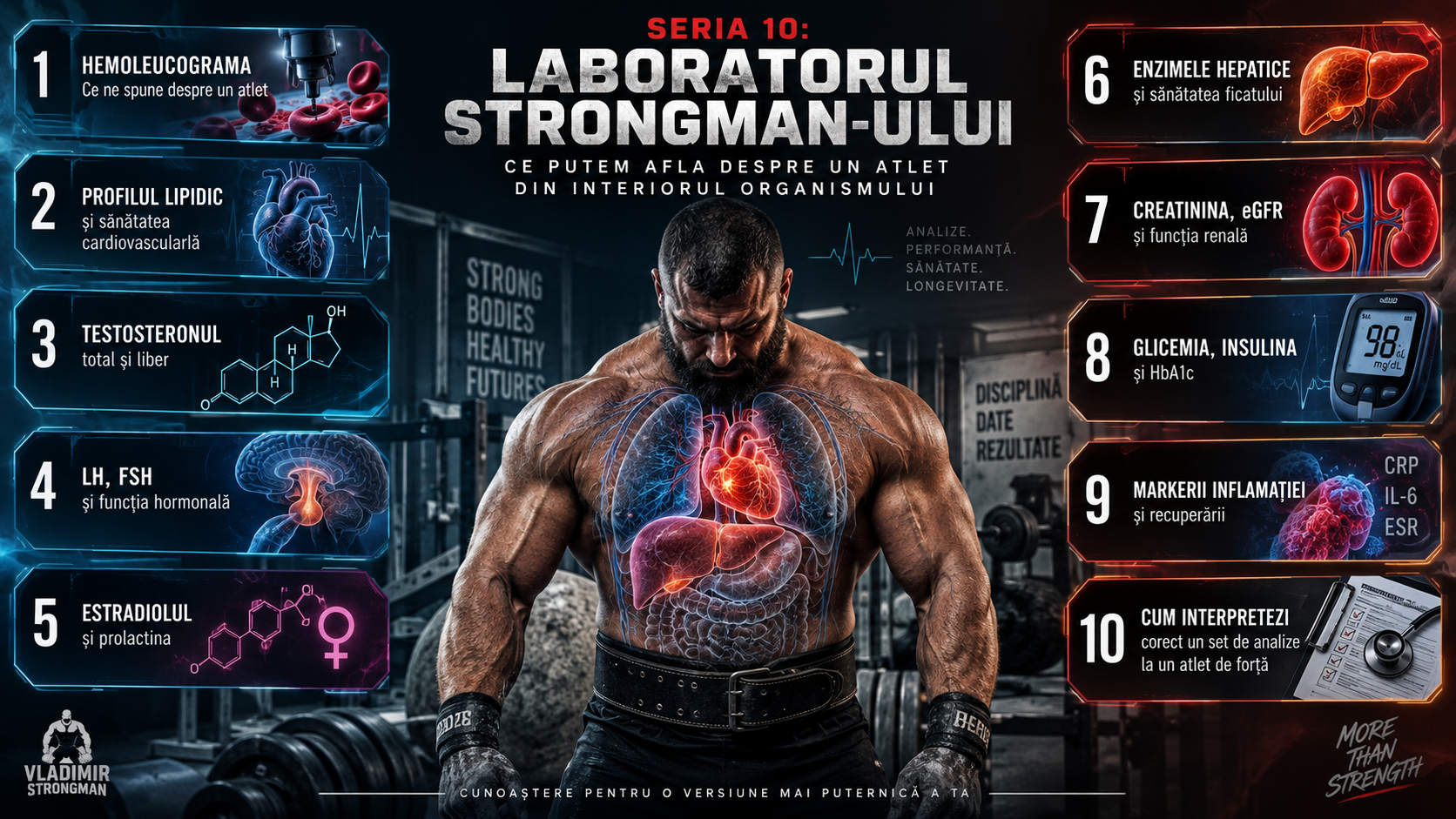
Episode 3: Total and Free Testosterone, Two Values That Need to Be Read Together
In strength sports, testosterone often gets treated like the main character. It is invoked for strength, muscle mass, recovery, libido, energy and body composition. But the laboratory does not see one magical number. Testosterone can be reported as total testosterone and, when indicated, free testosterone. The two measurements are related, but they are not identical.
Total testosterone represents testosterone circulating in the blood, including both protein-bound and free fractions. Free testosterone is the fraction that is not bound to circulating proteins. Interpretation becomes more interesting when SHBG enters the picture, because this binding protein changes the relationship between total testosterone and the free fraction.
For an athlete, this distinction matters. A laboratory result should not be treated like a competition score. Assay method, timing of collection, symptoms, medical history and physiological context all matter. Endocrine Society guidance emphasizes that male hypogonadism should be diagnosed using compatible symptoms together with unequivocally and consistently low testosterone measurements obtained appropriately.
1. What is testosterone?
Testosterone is the principal androgen produced by the testes in men, with smaller contributions from the adrenal glands and different sources depending on sex. In the body it contributes to sexual development and function, reproductive physiology, muscle mass and function, bone health and many other processes.
In a strongman athlete, testosterone matters, but it does not operate alone. Strength depends on the nervous system, muscle mass, technique, leverage, training, sleep, nutrition and many other factors. One testosterone result cannot predict who will win a deadlift.
2. Total testosterone: what does it measure?
Total testosterone includes free testosterone and testosterone bound to plasma proteins. Some is tightly bound to SHBG, while another portion is more loosely bound to albumin. Together, these forms make up the total testosterone reported by the laboratory.
Because much of testosterone circulates in bound form, changes in transport proteins can change total testosterone without producing the same change in the free fraction. Two people with the same total testosterone therefore do not necessarily have exactly the same hormonal distribution.
3. Free testosterone: what does it mean?
Free testosterone is the fraction not bound to proteins. It is a small part of total testosterone, but it can become especially useful when total testosterone is borderline or when there is reason to suspect altered SHBG.
This is where one common gym-floor misconception appears: that free testosterone is automatically more important than total testosterone. It is not that simple. Clinical testing depends on the context, the quality of the assay and the relationship among total testosterone, SHBG and albumin.
4. SHBG: the variable that changes the equation
SHBG, or sex hormone-binding globulin, is a protein produced mainly by the liver that binds sex hormones, including testosterone. When SHBG changes, the relationship between total testosterone and free testosterone can change as well.
That is why a total testosterone result in an apparently normal range does not always tell the entire story. When SHBG is abnormal, free testosterone measurement can add useful information. Endocrine Society guidance highlights free testosterone assessment when total testosterone is near the lower end of the range or when conditions that alter SHBG are suspected.
5. Why does collection time matter?
Testosterone varies during the day. In men, levels are generally higher in the morning and lower later in the day. That is why morning collection is important when evaluating possible testosterone deficiency.
Endocrine Society guidance recommends confirming a low result with a repeat morning total testosterone measurement under appropriate conditions. In 2026, the Society reiterated the need for accurate diagnosis based on symptoms plus consistently low values, generally requiring at least two early-morning tests.
For an athlete, this is practical. A sample collected late in the day, after inadequate sleep or during an unusual physiological period may not represent the individual's baseline very well.
6. Sleep, stress and low energy availability
Testosterone does not live in a laboratory isolated from the rest of the body. Insufficient sleep, acute illness, physiological stress and inadequate energy intake can temporarily alter hormone concentrations. In strength sports, these situations can appear during hard preparation, travel, aggressive dieting or accumulated fatigue.
A low result during severe energy restriction should not instantly become a permanent label. Context and repeat testing matter.
7. What does normal total testosterone with low free testosterone mean?
This pattern can occur when SHBG is elevated, because more testosterone may be bound to the protein, leaving a smaller free fraction. Exact interpretation depends on SHBG, albumin, assay method and the clinical picture.
This is why looking only at the total testosterone column and ignoring the rest of the panel can be misleading.
8. What does low total testosterone mean?
Low total testosterone has many possible causes. There may be testicular disorders, hypothalamic-pituitary problems, chronic disease, medications, obesity, inadequate energy availability or other endocrine influences.
That is why evaluation should not stop at the testosterone number. Guidance recommends looking for the underlying cause, including distinguishing primary from secondary hypogonadism, which may involve LH and FSH testing and additional investigation guided by the clinical situation.
9. Not every form of fatigue means low testosterone
Fatigue, low motivation, mood changes, poor recovery and reduced performance are nonspecific symptoms. They can result from inadequate sleep, excessive training volume, energy restriction, psychological stress, illness or many other medical problems.
Endocrine Society guidance emphasizes that symptoms alone do not establish the diagnosis. Hypogonadism requires compatible symptoms together with clearly and repeatedly low testosterone.
10. Testosterone and muscle mass
Testosterone contributes to the processes that support muscle mass and recovery, but it is not a remote control for hypertrophy. Training load, volume, protein intake, energy availability, sleep, genetics and many cellular pathways contribute to adaptation.
A strongman with testosterone in the laboratory reference range can be stronger than another athlete with a higher value because performance is an integrated phenomenon, not a one-variable equation.
11. Testosterone and recovery
When an athlete is deeply fatigued, the temptation is to blame hormones immediately. Recovery has several layers: nervous system function, muscle tissue, connective tissue, sleep, nutrition, psychological stress and energy status.
Low testosterone can be relevant, but normal testosterone does not guarantee perfect recovery. When performance falls, the investigation should remain broad.
12. Diet and testosterone
Energy availability matters. A prolonged severe energy deficit can impair hormonal function. On the other hand, deliberately increasing calories simply to chase a hormone number is not a universal medical strategy.
Overall diet quality, adequate micronutrients, sufficient protein and fat intake, body composition and management of excess adiposity can shape the endocrine context. But interpretation should remain systemic rather than blaming or crediting one food or supplement.
13. Testosterone, obesity and SHBG
Body composition can influence SHBG and therefore the relationship between total and free testosterone. In some settings, obesity and metabolic dysfunction are associated with altered SHBG and circulating testosterone.
For that reason, hormone results may need to be interpreted alongside glucose metabolism, liver function and kidney function when the clinical history indicates.
14. Assay method matters enormously
Not all testosterone assays have the same accuracy. Endocrine Society guidance recommends accurate methods for total and free testosterone and appropriate method-specific reference ranges.
For free testosterone, methods are not interchangeable. Equilibrium dialysis is considered a reference method, while free testosterone can also be estimated by validated calculation when SHBG and albumin are available.
This means two laboratories can report somewhat different values from the same sample. For longitudinal monitoring, comparisons are therefore stronger when the method and laboratory remain reasonably consistent.
15. Total and free testosterone: how should they be read together?
There are several patterns. Total and free may both be normal. Both may be low. Total may be borderline, making free testosterone useful for clarification. Or total testosterone may look normal while free testosterone is altered because SHBG is unusual.
There is no universal rule that says free testosterone always wins. Interpretation depends on symptoms, laboratory method, SHBG, albumin and the broader context.
16. What tests can complete the picture?
When a problem is suspected, a clinician may order LH and FSH to help identify the source, and in selected cases prolactin, SHBG, albumin and other relevant tests. Additional investigation depends on age, symptoms and medical history.
In an athlete, a CBC, liver and kidney tests, glucose, lipid profile and other markers can add context, but they should not become a rigid universal panel for every athlete.
17. Exogenous testosterone changes the interpretation completely
When an athlete uses exogenous testosterone or other androgens, the laboratory result no longer simply represents endogenous production under ordinary physiological conditions. The hormone axis can be suppressed, and the relationship among testosterone, SHBG, LH and FSH changes.
That is why an accurate medication and substance history is essential. Without it, the same laboratory value can be interpreted incorrectly.
18. Why a high level does not automatically mean health
In performance sports, testosterone is sometimes viewed as a score where higher automatically means better. Medically, that is not the goal. A supraphysiological level is not a marker of good health.
When testosterone is used without a medical indication, effects can include reduced fertility, increased hematocrit, blood-pressure effects, skin changes, mood effects and other system-level consequences. Hormone treatment should be prescribed and monitored medically, not adjusted based on one laboratory sheet.
19. Fertility and testosterone
Fertility is particularly important for younger athletes. Exogenous testosterone can reduce intratesticular testosterone production and spermatogenesis. Testosterone therapy is therefore generally not recommended for men who are planning fertility in the near term.
A good testosterone number does not tell you that sperm production is normal. These are different biological questions.
20. Hematocrit and testosterone
Testosterone therapy can increase hematocrit in some men. That makes the CBC discussed in the previous episode relevant here as well: hormones should not be interpreted separately from their effects on other systems.
This connection shows why athlete monitoring is not simply about getting testosterone as high as possible. It is about tracking the whole biological system.
21. An interpretation example
Imagine a strongman with persistent fatigue and lower libido. The first test shows total testosterone near the lower end of the range. Instead of immediately concluding that the athlete has low testosterone, repeat the morning measurement, assess symptoms, review SHBG and the broader context and, if the value remains low, investigate the cause.
That is how a laboratory result becomes medicine. The number starts the question; it does not finish it.
22. What can testosterone not tell you?
It cannot tell you how much you will lift in competition. It cannot diagnose every cause of fatigue. It cannot directly measure discipline, recovery quality, technique or training quality. And it cannot replace medical assessment.
For a strongman, testosterone is an important piece, but only one piece.
23. What does intelligent monitoring look like?
It means testing under appropriate, reasonably comparable conditions and looking at the trend. It also means recording context: sleep, illness, energy deficit, weight changes, medications, substances and symptoms.
For someone receiving testosterone treatment, monitoring is more complex and should be set with the clinician, including considerations related to formulation and individual risk.
24. When should you see a doctor?
When there are persistent symptoms suggestive of deficiency and repeatedly low results. When libido, sexual function, fertility, mood or energy change without a clear explanation. When unusual results occur during treatment. Or when multiple problems coexist and an integrated assessment is needed.
Urgent symptoms are different: chest pain, fainting, severe breathing difficulty or other acute symptoms should not be blamed on low testosterone and require appropriate medical evaluation.
25. The laboratory is not looking for a hero, it is looking for an explanation
In competition, a number tells you who won. In medicine, a useful number may only tell you what question to ask next. Total and free testosterone work exactly this way.
Total testosterone describes the overall amount circulating. Free testosterone describes the unbound fraction. SHBG explains part of the difference. Sampling time and assay method can change the result. Symptoms and context determine whether the number has clinical meaning.
26. Conclusion
Total and free testosterone are tools, not trophies. For a strongman, their value lies in helping identify endocrine problems when measured correctly and interpreted alongside symptoms and the rest of the biological context.
The central message is simple: do not diagnose hypogonadism from a single laboratory sheet. Repeat morning testing when indicated, account for SHBG and assay method, look for the cause if low values persist, and treat the athlete rather than the number.
Quick glossary
Total testosterone: free testosterone plus protein-bound testosterone. Free testosterone: the unbound fraction. SHBG: a transport protein that binds sex hormones. LH and FSH: pituitary hormones involved in regulation of testicular function. Hypogonadism: a syndrome involving compatible symptoms and insufficient gonadal function confirmed by appropriate testing.
Editorial note: this article is educational and does not replace individualized medical care. Testosterone interpretation and any decision about hormone treatment should be made by a clinician based on symptoms, repeated testing and medical context.
More From The Journal

Training
The Science of Strongman Training - Episode X: Competition Programming
How to build a complete Strongman competition preparation block: calendar, events, volume, intensity, specificity, simulations, autoregulation, tapering and fatigue management.

Training
The Science of Strongman Training - Episode IX: Peaking
Peaking in Strongman: how to turn months of training into maximal competition performance by reducing fatigue, preserving adaptations and managing specificity.