
Physiology
The Strongman Laboratory: What We Can Learn About an Athlete from Inside the Body - Episode 10: How to Correctly Interpret a Strength Athlete’s Blood Tests
September 7, 2026
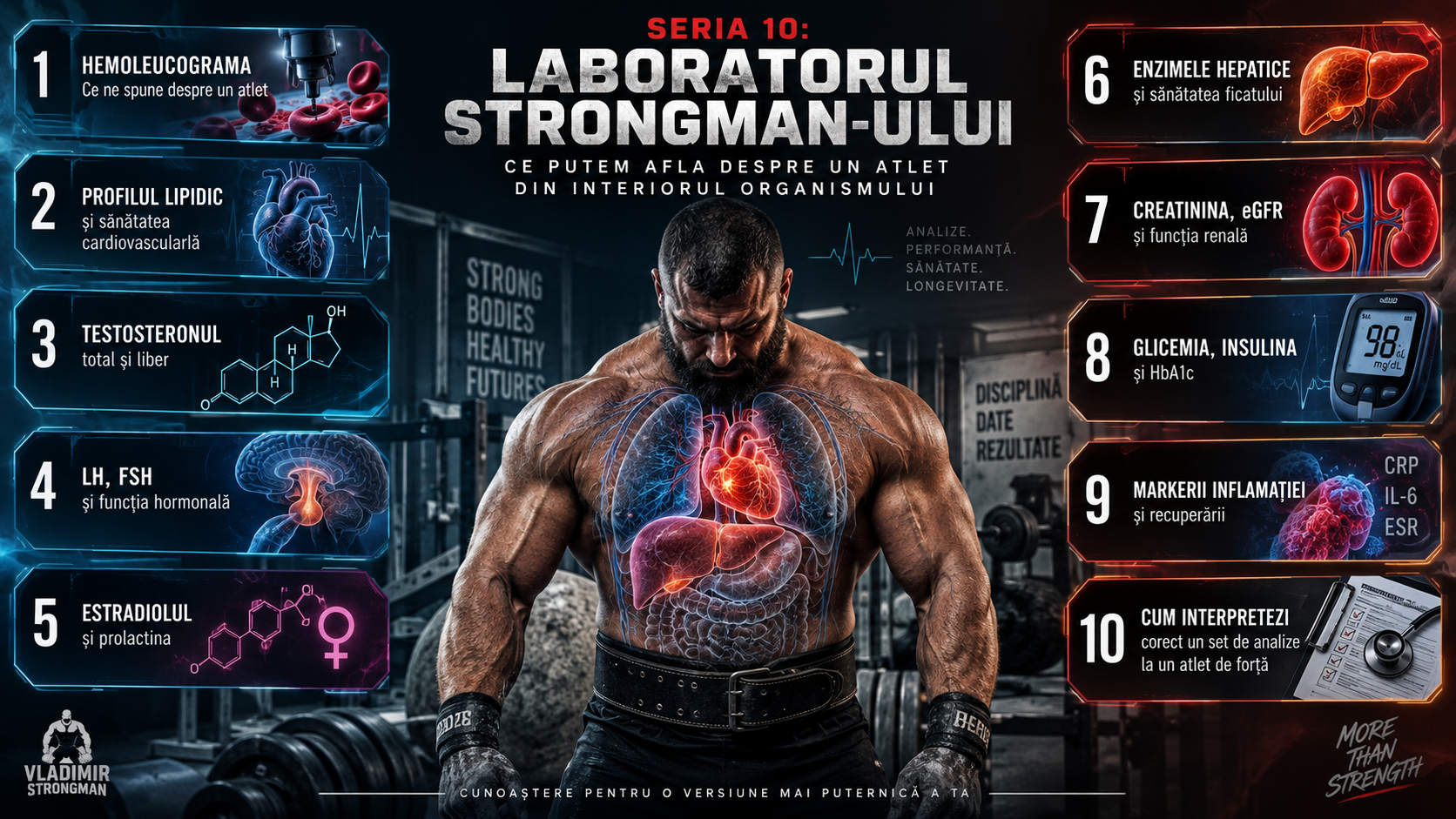
1. Why correct interpretation starts before the laboratory
A laboratory result is not just a number. It is a measurement taken at a particular time, under particular conditions, in a particular athlete. For a strength athlete, those conditions may include high muscle mass, very hard training, periods of caloric surplus, dehydration, variable sleep, travel, competition stress, medications, and supplements. The first step is therefore not to search whether a result is „good” or „bad”, but to ask what conditions produced it.
2. Rule number one: never interpret an isolated result
An isolated result can be real and still be insufficient for a conclusion. Creatinine can be influenced by muscle mass or creatine intake, AST can also come from muscle, and glucose can vary with fasting, stress, and timing. At the same time, athletic context must not become an automatic excuse for every abnormality. A result becomes more valuable when it is compared with previous results and with other markers describing the same physiology.
3. Always check units and the laboratory reference interval
Before interpretation, check the unit and the reference interval printed by the laboratory. The same analyte can be reported in different units, and reference ranges can vary with methods, populations, and laboratories. Directly comparing two results from different laboratories without considering methodology can create the false impression that physiology has changed dramatically.
4. The right question: laboratory deviation or biological signal?
A result outside a reference interval is not synonymous with disease. Likewise, a value inside the interval does not exclude every possible problem. Proper interpretation has three layers: what the test measures, how robust the result is in that context, and whether a coherent pattern exists elsewhere in the panel. Laboratory values are sensors, not final verdicts.
5. Put the collection context next to the result
For an athlete, record the collection date and time, fasting duration, most recent hard session, sleep in the preceding nights, body weight, season phase, and important changes in diet, medication, or supplements. When testing is repeated under broadly comparable conditions, differences between results become easier to interpret.
6. The complete blood count: the first chapter
The CBC describes red cells, hemoglobin, hematocrit, red-cell indices, white cells, and platelets. In a strength athlete it can inform oxygen transport, hematologic status, and some inflammatory or infectious contexts, but it does not directly measure strength, recovery, or systemic inflammation. Higher hemoglobin does not automatically mean better performance, and leukocytosis does not automatically mean infection.
7. Hemoglobin and hematocrit: look at context
Hemoglobin and hematocrit should be interpreted together with hydration, plasma volume, and the rest of the CBC. An apparently higher result can occur in a hemoconcentrated state. In an athlete with repeatedly elevated values or relevant symptoms, „not enough water” is not a sufficient explanation. Pattern and medical assessment determine the next step.
8. ESR and CRP are not synonymous with recovery
Inflammatory markers can be influenced by infection, injury, inflammatory disease, and other processes. CRP is a dynamic acute-phase marker, while ESR is influenced by hematologic factors as well. Neither can be turned into a simple recovered/not-recovered score. A brutal training session can alter multiple blood markers without indicating systemic inflammatory disease.
9. Creatine kinase: a muscle marker, not a universal trauma detector
CK can rise after muscular exercise, sometimes markedly, especially after unfamiliar or very demanding sessions. Therefore, a high CK in a strength athlete should not be interpreted without knowing what training occurred in the preceding days. However, very high values associated with severe muscle pain, weakness, dark urine, or systemic illness require prompt medical assessment.
10. AST and ALT: do not place muscle and liver in separate boxes
AST is also present in muscle, while ALT is more liver-specific, but interpretation should not rely on the rigid rule „high AST means muscle”. Correlate AST and ALT with CK, GGT, alkaline phosphatase, and bilirubin, as well as with recent training history. A persistent or disproportionate pattern deserves evaluation even in a highly muscular athlete.
11. GGT, alkaline phosphatase, and bilirubin change the liver story
GGT can support a hepatic or biliary source when alkaline phosphatase is elevated. Bilirubin should be interpreted in the context of direct and indirect fractions, while albumin and INR answer different questions about hepatic synthetic function. Saying „the enzymes are a little high” is not enough. The overall pattern matters.
12. Creatinine in a highly muscular athlete
Creatinine is influenced by creatinine production from muscle, and people with very high muscle mass can have values that make creatinine-based estimates of kidney function less precise. Interpretation should therefore include eGFR and its limitations, plus urine testing and albuminuria when indicated. Cystatin C can add information in selected contexts.
13. eGFR is an estimate, not a direct measurement
eGFR is calculated from biomarkers and patient characteristics and is useful for kidney assessment, but it remains an estimate. At extremes of muscle mass, creatinine may not reflect filtration in a simple way. Therefore, an apparently lower eGFR in a strongman should not be diagnosed without context, and a normal eGFR does not erase other evidence of kidney disease.
14. Albuminuria can complete the kidney story
Kidney assessment is not limited to blood. The urine albumin-to-creatinine ratio can identify abnormalities that are not visible from serum creatinine alone. For athletes with risk factors or persistent unusual results, blood and urine together can provide a stronger picture.
15. Lipid profile: LDL-C is not the only actor
Interpret LDL cholesterol together with non-HDL cholesterol, triglycerides, and, in selected situations, ApoB and Lp(a). For a strength athlete, high energy intake, changes in body weight, adipose distribution, conditioning, and family history can alter cardiovascular risk. Athletic performance does not neutralize a persistently unfavorable lipid profile.
16. Triglycerides: view them as part of an ecosystem
Triglycerides can respond to diet, alcohol, energy surplus, body composition, and metabolism. An elevated result becomes more informative when it appears alongside unfavorable glucose, elevated blood pressure, increasing waist circumference, or signs of metabolic liver disease.
17. Testosterone: the laboratory must be linked to symptoms
Total and free testosterone should not be treated as numerical trophies. Collection time, assay method, SHBG, gonadal function, and symptoms matter. A diagnosis of hypogonadism requires symptoms plus consistently low, accurately measured testosterone, not a single abnormal result.
18. LH and FSH indicate whether the problem is central or testicular
When testosterone is low, LH and FSH help orient the mechanism. The testes and pituitary participate in the same axis, and the hormone pattern can help distinguish primary from secondary dysfunction. Looking at testosterone alone can miss information about where the problem originates.
19. Estradiol and prolactin should not be managed by instinct
Estradiol has important physiologic roles in men, while prolactin can vary with stress, sleep, exercise, and medications. A mildly elevated result may sometimes need repeat testing under appropriate conditions before conclusions are made. Symptoms, testosterone, LH, and FSH provide more useful context than trying to „fix” an isolated number.
20. Glucose is a snapshot, HbA1c is a time window
Glucose can reflect metabolic state at the moment of collection, while HbA1c integrates glucose exposure over recent months. ADA 2026 uses HbA1c and plasma glucose criteria for diabetes diagnosis, and abnormal results generally require confirmation when unequivocal hyperglycemia is absent. Important discordance between glucose and HbA1c also warrants consideration of interference or another explanation.
21. Fasting insulin requires caution
Fasting insulin can provide context about pancreatic response, but it is less standardized and should not be turned into a universal diagnosis of insulin resistance from one number. HOMA-IR may be useful in selected contexts, but it is not a universal diagnostic label independent of assay, population, and clinical question.
22. Inflammation and recovery must be separated
An athlete can have muscle soreness, elevated CK, and transient blood changes after training without having systemic inflammatory disease. Conversely, a medical problem can exist with modest laboratory abnormalities. Sport recovery is a complex process involving sleep, energy availability, pain, performance, and response to training, not one blood marker.
23. Look for patterns, not convenient explanations
It is easy to choose an explanation that feels convenient: „it is from training”, „it is from supplements”, „it is from muscle mass”. Serious interpretation first considers the plausible alternatives. Then it asks which explanation best fits the complete data set and the time trend.
24. Example: elevated AST after hard training
Suppose AST is elevated 48 hours after a very hard session, CK is also elevated, GGT and bilirubin are normal, and ALT is only modestly changed. This pattern can support a muscular contribution, but it is not itself a diagnosis. Repeating the panel after recovery and correlating it with the training history can clarify whether the abnormality is transient.
25. Example: elevated creatinine with an otherwise stable picture
A highly muscular athlete can have higher creatinine than the general population. A stable result, appropriately interpreted eGFR, and normal urine albumin findings tell a different story from progressively rising creatinine accompanied by urinary abnormalities or other signs. Trend and concordance across markers matter.
26. Example: persistently elevated hemoglobin and hematocrit
It is not enough to assume the athlete is simply „better oxygenated”. Hydration, repeat testing, clinical context, and the rest of the CBC should be considered. Persistently elevated values deserve medical evaluation rather than being explained solely by athletic performance.
27. Example: high LDL in a highly performing athlete
An athlete can have exceptional exercise capacity and still have an unfavorable lipid profile. These are different axes. Mature interpretation does not use athletic performance to argue against cardiovascular data, and a high LDL should not be ignored because the athlete is strong.
28. Example: fasting glucose 102 mg/dL is not the same as diabetes
A fasting glucose of 102 mg/dL falls in the ADA impaired fasting glucose/prediabetes range, not the diabetes range. Diabetes uses higher thresholds and, when unequivocal hyperglycemia is absent, requires confirmation. A borderline result should be placed in context and repeated when appropriate.
29. Example: HbA1c and glucose do not match
When HbA1c and glucose measurements are repeatedly and substantially discordant, ADA recommends looking for a problem or interference. Hemolysis, transfusion, altered red-cell turnover, and some hemoglobin variants can change the relationship between A1c and glucose. Do not simply choose the marker that looks better.
30. Hard training can change a blood test without meaning disease
Intense exercise can change CK and some enzymes, while stress, sleep loss, and hydration changes can affect other parameters. For monitoring, comparison is easier when training phase and collection conditions are recorded. Still, training effect should not become a universal explanation for persistent or severe abnormalities.
31. Nutrition should be read across the whole season
A strongman may move through periods of caloric surplus, maintenance, weight loss, and competition preparation. Lipids, triglycerides, glucose, and liver markers can reflect these changes. It is not useful to judge the metabolic health of an entire year from a single blood draw performed during the athlete’s most disciplined week.
32. Sleep is part of the pre-analytic context
Sleep is not only a recovery target. It is also part of the physiologic context in which a blood test is obtained. A very poor night can alter stress responses and metabolism. For fine trend monitoring, tests obtained under reasonably comparable conditions are easier to interpret than a series collected after very different nights.
33. Medications and supplements must be declared
The actual history of substances used matters for interpretation. Some medications and supplements can affect liver enzymes, creatinine, glucose, lipids, or other markers. A medically useful interpretation requires a complete list, including over-the-counter products.
34. How to interpret a panel in five steps
Step one: identify the test and what it measures. Step two: verify the units and laboratory reference interval. Step three: record collection context. Step four: compare with previous results and related markers. Step five: ask whether the result has a plausible physiologic explanation or whether a pattern warrants medical assessment. This simple discipline avoids most „Google says disaster” interpretations.
35. Build a personal trend
Instead of constantly comparing yourself with an imaginary athlete, build your own history. Keep the date, body weight, training phase, collection context, and key laboratory values. A slow, consistent shift in one direction may matter more than a single outlier.
36. Not every test needs to be done at the same time
A huge laboratory panel does not automatically mean a better assessment. Useful tests are those that answer a question. For a strength athlete, the exact panel should be adapted to history, symptoms, risk factors, and medical recommendations. The goal is clarity, not collecting numbers.
37. What a „good” result means
A good result is one that is correctly interpreted and coherent with the rest of the picture. It is not necessarily the lowest, highest, or most central value in the reference range. For an athlete, a good result is one that supports a stable biological picture compatible with both performance and health.
38. What a „bad” result means
A genuinely concerning result is usually one that is severe, persistent, associated with symptoms, or part of a concordant pattern of abnormalities. Not all warning flags carry the same urgency, and not every abnormal value is an emergency. Importance depends on the test, magnitude, context, and symptoms.
39. When should a test be repeated?
Repeat testing makes sense when a result is unexpected, close to a clinical threshold, discordant with the rest of the data, obtained under unusual conditions, or part of a trend that needs confirmation. The goal is not to repeat until the number looks pretty. The goal is to determine whether the signal is real and reproducible.
40. When should rapid medical assessment be sought?
Symptoms such as chest pain, significant shortness of breath, fainting, confusion, severe weakness, dark urine with muscle pain, jaundice, persistent vomiting, or signs of severe hyperglycemia change the priority completely. In these situations, the athlete should not turn a laboratory report into a personal interpretation experiment.
41. What do you do when two results disagree?
When two tests tell different stories, do not automatically choose one. Check whether they measure different biology, whether collection conditions differed, and whether there are known interferences. In many cases, the disagreement is the most informative part of the case.
42. Why a reference interval is not a performance target
Reference intervals describe distributions in a reference population. They are not necessarily „optimal performance zones” for a strongman. Trying to move every marker toward a preferred point without a biological question can lead to unnecessary interventions.
43. Why online „optimal” ranges can be misleading
Online tables that assign an „optimal” range to every biomarker may mix populations, laboratory methods, and completely different objectives. Real medical interpretation is less flashy but more accurate: test, context, trend, symptoms, and individual risk.
44. How all laboratory episodes fit together
The CBC can affect HbA1c interpretation. Muscle mass can influence creatinine. Exercise can influence CK and AST. Diet and body composition can affect lipids, glucose, and the liver. Hormones connect with energy, sleep, and reproductive function. No episode should be read as an island.
45. A baseline monitoring panel is not a universal prescription
Depending on the athlete and the medical question, monitoring may include CBC, lipid profile, glucose and HbA1c, kidney function, liver markers, and hormone testing. Urine albumin-to-creatinine ratio, CK, or other tests may be useful in selected situations. The panel should be adapted rather than copied blindly.
46. Interpreting tests before and after competition
Results collected close to competition can reflect acute stress, travel, altered diet, dehydration, and recent exercise. They should not be treated as equivalent to a baseline health assessment. For health trends, it is useful to have additional blood draws during a more stable period.
47. Interpreting tests at the start of a mass-gain phase
At the start of a caloric-surplus phase, it is useful to follow not only body weight and performance but also relevant cardiometabolic markers. Rapid weight gain can contain different components, and persistent changes in lipids, glucose, or liver enzymes can indicate that the strategy has biological costs.
48. Interpreting tests during a weight-loss phase
During energy restriction, some values may change with intake, hydration, and training volume. Reduced performance, poor sleep, and signs of inadequate energy availability can matter as much as one laboratory marker. Do not turn every deviation into a target to „correct” with a rapid intervention.
49. What a coherent laboratory panel looks like
A coherent panel is one where markers describing related systems tell a compatible story. For example, a liver profile should be read as a pattern among AST, ALT, GGT, alkaline phosphatase, and bilirubin, not as one number. The same principle applies to kidney function, metabolism, and hormones.
50. The classic mistake: treating the number instead of the problem
One of the most dangerous interpretation errors is to see an out-of-range biomarker and immediately search for a drug, supplement, or dietary change that will „move” it. First identify the biological question. A good laboratory supports a decision; the decision should not serve the laboratory number.
51. The opposite mistake: „I am an athlete, so it does not apply to me”
Training changes physiology, but it does not suspend medicine. Athletes can have hypertension, dyslipidemia, metabolic liver disease, diabetes, kidney disease, or endocrine disorders. The difference is that sport adds context and sometimes makes interpretation more complicated.
52. Golden rule: compare with yourself, but check clinical criteria too
Personal history is highly valuable, but it does not replace clinical thresholds and criteria. The fact that a result is „normal for you” does not automatically make it insignificant. Conversely, moving away from your personal baseline does not automatically mean disease.
53. Conclusion: read a strongman’s laboratory as a system
Correct interpretation of blood tests in a strength athlete means joining biology, athletic context, and medicine. Start with the test and collection conditions, verify units and reference intervals, compare with history, look for patterns across related markers, and separate plausible exercise effects from signals that deserve evaluation. No result should be ignored because the athlete is strong, and no result should be dramatized simply because it is flagged red. The laboratory is a map. Its real value appears when you learn to read the whole route, not a single roadside sign.
54. Editorial note
This episode is educational and does not replace medical evaluation. Diabetes diagnostic criteria and HbA1c interpretation should be anchored to current medical guidance. ADA 2026 notes that HbA1c and glucose criteria capture different aspects of glucose metabolism, that abnormal results generally require confirmation when unequivocal hyperglycemia is absent, and that persistent substantial discordance between glucose and HbA1c should be investigated. Athletes with symptoms or persistently abnormal results should receive clinician-led interpretation.
Primary sources
American Diabetes Association, Standards of Care in Diabetes 2026, Section 2: Diagnosis and Classification of Diabetes; NIDDK materials on eGFR and creatinine accuracy; KDIGO 2024 Clinical Practice Guideline for the Evaluation and Management of Chronic Kidney Disease; AASLD, approach to abnormal liver tests and MASLD; ACG Clinical Guideline: Evaluation of Abnormal Liver Chemistries; Endocrine Society and AUA/ASRM guidance for interpretation of the male reproductive hormone axis.
More From The Journal

Training
The Science of Strongman Training - Episode X: Competition Programming
How to build a complete Strongman competition preparation block: calendar, events, volume, intensity, specificity, simulations, autoregulation, tapering and fatigue management.

Training
The Science of Strongman Training - Episode IX: Peaking
Peaking in Strongman: how to turn months of training into maximal competition performance by reducing fatigue, preserving adaptations and managing specificity.