
Training
History of Strongman - Episode V: The Evolution of Equipment and the Birth of Modern Implements
September 16, 2026
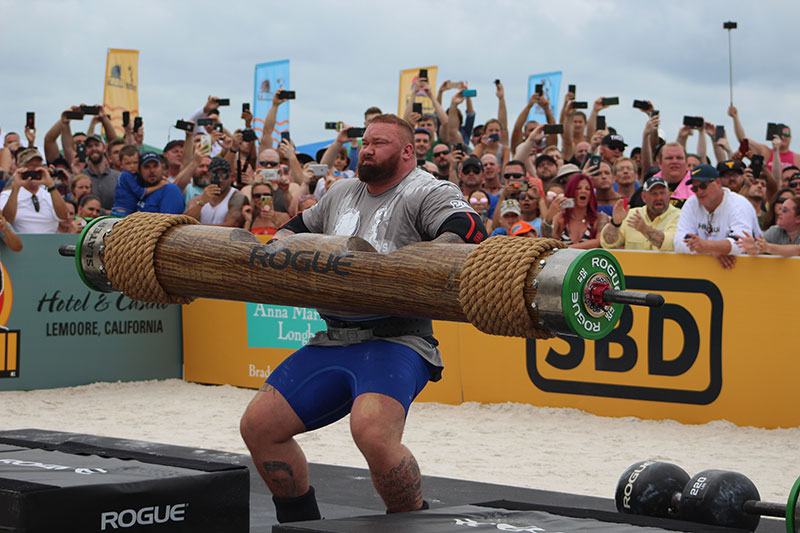
If the first episodes of this series followed the rise of the strongman, the birth of modern competition and the evolution of events, the next logical step is to examine the objects that made the sport possible. Strongman did not change only because athletes became stronger. It also changed because the equipment became smarter.
In early feats of strength, the object was simply whatever could be found: a stone, log, barrel, chain, vehicle or everyday object. In modern Strongman, equipment is designed to create a particular mechanical problem. The diameter of a log, the height of a yoke, the length of farmer handles, the thickness of an axle or the shape of a stone can completely change the demands of an event.
Biomechanical literature describes Strongman as a sport in which athletes lift, carry or pull heavy and awkward objects, often using horizontal and asymmetric loading and movement across multiple planes. Equipment is not decoration. It is part of the mechanics of the event.
1. From found objects to designed implements
In the early period of Strongman, the authenticity of the object was part of the spectacle. A real refrigerator, real car, barrel or stone had an immediate advantage: the audience understood that it was heavy. There was no need to explain what 400 kilograms meant on a specially built frame. The audience saw the object and recognized its difficulty.
As competitions became more professional, this approach created problems. Real objects are difficult to standardize. One refrigerator differs from another. One car has a different mass distribution from another. A natural stone can have a unique shape, surface and center of mass.
A crucial transformation followed: the object began to be recreated as an implement. The goal was no longer to use an object simply because it existed, but to build an object that reproduced a particular challenge and could be used repeatedly.
This change made possible a genuine Strongman infrastructure: logs with different diameters, axles, farmers, yokes, sleds, artificial stones, sandbags, kegs, circus dumbbells and specialized bars.
2. The yoke: from refrigerator to modern carrying system
The yoke is an excellent example of equipment evolution. At the first World's Strongest Man in 1977, heavy load carriage was represented by the famous fridge carry. Over time, the concept was transformed into a purpose-built frame that could be loaded and carried.
Historical Strongman sources document the progression from the fridge carry to events such as the car carry and later the Super Yoke. The change was more than cosmetic. A modern yoke allows control of load, height and geometry, making the event more reproducible and easier to scale for different levels of competition.
Biomechanically, the yoke creates the problem of carrying a mass that moves with the athlete. Frame oscillation, stride length, trunk stability and the ability to maintain a controlled path all influence performance. Equipment transformed a spectacular feat into an instrument for measuring usable strength.
3. The log and the emergence of Strongman-specific geometry
The Log Lift may be the clearest example of how the shape of an object can create a different movement. A modern log has a large diameter, fixed handles and geometry that places the load farther from the body than a conventional Olympic bar.
Originally, the idea was literally to use a log. Later, manufacturers began building steel logs with controllable dimensions and weights. The log became a training and competition tool rather than merely an exotic object.
Its large geometry changes elbow position, load-to-body distance, rack demands and the contribution of the legs and trunk to the drive. Consequently, an athlete can be extremely strong on a barbell press and still perform very differently on a log.
Equipment therefore created a new technical category. Athletes learned not simply to press, but to press a particular kind of object.
4. The axle: when diameter becomes an event
The axle looks simple: a thick bar. That simplicity is precisely what makes it interesting. Increasing diameter changes how the hand wraps around the bar, which can alter grip comfort, hand position and lifting strategy.
The axle became one of the tools through which Strongman separated general strength from the ability to apply force through a specific configuration. The athlete must not only be strong. He must produce force when the interface between hand and object is different.
The emergence of standardized axle equipment and specialized bars allowed organizers to build repeatable events and coaches to reproduce competition demands more accurately in training.
5. Stones: from nature to precision
Stones are a special case because the absence of a perfect handle is part of the challenge. Older stone-lifting traditions used natural stones, and Strongman preserved the idea of a round, heavy object that offers no convenient grip.
The World's Strongest Man identifies the Atlas Stones as having been introduced in 1986, initially using five spherical stones that increased in weight. In the early years, lifting all five was rare. Over time, stone weights and platform heights increased, and what was once a limit became an expectation for finalists.
This reveals a Strongman equipment paradox: as the sport becomes more modern, it sometimes tries to preserve the impression of a primitive object. The artificial stone is manufactured precisely, but it is designed to behave like an object that refuses to give the athlete a convenient grip.
The combination of manufacturing precision and functional awkwardness is one of the defining characteristics of Strongman equipment.
6. Farmer handles and the transformation of grip into equipment
Farmer’s Walk began with an extremely old idea: carrying a load in each hand. The modern implement, however, made exact control of the load possible.
Handle length, diameter, loading position and the distance between the implement and the body can dramatically change difficulty. Two pairs of farmers with the same nominal weight are not necessarily biomechanically equivalent.
This evolution allowed grip to be trained under highly specific conditions. The athlete can train not only squeezing strength, but also the ability to keep the hand closed while the entire body is moving.
In modern Strongman, the hand is no longer simply the end of the kinetic chain. It is the interface between the human and the equipment.
7. Circus dumbbell and implements that change unilateral movement
The circus dumbbell is another product of strength culture adapted to modern competition. Its large diameter, handle and loading geometry create a different problem from a conventional dumbbell.
Unilateral loading forces the athlete to control more rotation and trunk inclination. Instead of the system being symmetrical, one side of the body must manage a load that can create rotational moments around the body's axes.
In this case, equipment does not merely make the movement harder. It changes its nature.
8. Kegs, sandbags and deformable objects
A rigid bar gives predictable contact. A sandbag does not. A keg does not. These objects can shift, deform and change their apparent mass distribution during handling.
Modern equipment therefore did not move only toward greater precision. It also moved toward controlled unpredictability. Sandbags can be manufactured to standard weights, yet their contents can shift. Kegs can have different shapes and surfaces, and their position against the body can vary.
These implements increased the importance of coordination and technique. The athlete must feel the object, compress it, bring it close to the body and anticipate its movement.
9. Specialized bars and the problem of elasticity
Another stage in equipment evolution was the development of specialized bars. A bar is not mechanically neutral. Length, diameter, stiffness and behavior under load can change the feel and mechanics of a lift.
With a flexible bar, the load does not behave exactly like a rigid one. Flex can influence when the plates leave the floor, body position and the rhythm with which the athlete enters the effective lifting phase.
In Strongman, deadlift bars, axle bars and other specialized variants reinforced the idea that the same movement can become a different event when the mechanical interface changes.
10. Belts, wrist wraps, straps and suits: equipment worn by the athlete
Equipment evolution is not limited to the objects being lifted. A major part of it is the equipment worn by the athlete.
A belt can increase the sensation of trunk stability and support bracing strategies. Wrist wraps can assist position control in certain presses. Straps can fundamentally change the grip problem in some pulling events. Deadlift suits, where regulations allow them, add another elastic component to the lifting system.
This highlights an important distinction between equipment and physical capacity: equipment does not create biological force from nothing, but it can change how force is transmitted, stabilized or expressed.
That is why rules and equipment are inseparable. The same event can represent a different demand when straps, a suit, a belt or particular footwear are allowed.
11. Footwear: the overlooked interface with the ground
Footwear is one of the least spectacular parts of the equipment system, yet ground contact is fundamental. Sole construction, stiffness, heel height, traction and stability can alter body position and force transfer.
In deadlift, yoke, farmers and loading events, the athlete needs a stable interface between the body and the ground. If the foot slips, compresses excessively or changes angle under load, some ability to produce and transmit force is lost.
Footwear evolution therefore progressed alongside event evolution: more stability, more traction and greater control of body position.
12. The timer, platform and invisible equipment of competition
A less spectacular aspect of evolution is the development of measurement equipment. Timers, distance systems, controlled platform heights, calibrated bars and more precise judging methods transformed objects into comparison instruments.
This is essential for a competitive sport. It is not enough for an object to be heavy. You must be able to state how heavy it is, how high it is, how long the course is and how quickly the task was completed.
Modern competitions can combine weight, time, distance and repetitions in a single event. At the 2026 WSM Final, for example, the program included Monster Box Flip & Carry, Deadlift for Reps, Titan’s Toss, Max Log and Atlas Stones, each with its own equipment and measurement requirements.
13. From universal equipment to event-specific equipment
As the sport matured, the difference between generic equipment and event-specific equipment became increasingly important. A deadlift on a conventional bar is not identical to a deadlift on a specialized bar. A carry with farmers is not the same as a yoke carry. A stone is not a sandbag, even if both must be loaded.
This changed training. In the early years, many athletes came from powerlifting or weightlifting and added specific elements. Modern Strongman became a system in which implement training is a central component.
An elite athlete no longer prepares only for a physical quality. He prepares for the interaction between that quality and an object.
14. Equipment changed the athlete’s body too
When equipment changes, the training stimulus changes. The log can demand more stabilization and a different pressing position. Farmer’s Walk develops the combination of grip and locomotion. The yoke requires control of an oscillating mass. Stones demand body-object contact, hip and trunk contribution and coordination.
This helped create the modern Strongman athlete: not simply a person with high muscle mass and maximal strength, but an athlete adapted to a collection of mechanical interfaces.
Biomechanical research emphasizes this diversity. Strongman exercises use frames, kegs, bags, sleds, vehicles, stones, logs, tires and oversized dumbbells. They are not mechanically equivalent, and that difference is one reason the athlete profile is so hybrid.
15. Standardization made progression possible
One of the most important effects of modern equipment is controlled progression. If you have logs at 80, 100, 120 and 140 kilograms, you can build a progression. If you have an adjustable yoke, you can increase the load and alter height. If you have standardized stones, you can track progress over time.
This is a major difference from the random objects of the early period. An improvised object can be spectacular, but it is difficult to use as a programming tool.
Modern equipment transformed Strongman from a sport that could be imitated occasionally into a sport that could be trained systematically.
16. But equipment must not remove the Strongman character
There is a limit, however. If everything becomes so standardized that every object behaves perfectly and every movement becomes identical, the sport risks removing what makes Strongman distinct.
The sport needs tension between standardization and uncertainty. The athlete should know the category of problem, but still be capable of adapting to the object, surface, distance, sequence and context.
Modern equipment therefore did not kill the improvised character of Strongman. It refined it. It made it possible to construct uncertainty intentionally.
17. From props to sports technology
Viewed as a whole, Strongman equipment evolution can be divided into several broad stages. The first was the era of the real object: heavy, recognizable and difficult to standardize. The second was the era of the implement: objects built to reproduce a challenge. The third is the era of specialized equipment: tools designed to test specific combinations of strength, speed, grip, stability and endurance.
At the same time, equipment worn by athletes became more sophisticated and performance measurement became more precise. The result is a sport in which object and athlete have evolved together.
The World's Strongest Man now publishes records for Max Axel Press, Max Log Press, Max Atlas Stone, Max Circus Dumbbell and Max Deadlift. This shows how far implement specialization has progressed. The question is no longer simply “how much can a human lift?” It becomes “how much can a human do with this specific mechanical interface?”
18. Conclusion: equipment became part of the athlete
Equipment evolution is one of the hidden stories of Strongman. On the surface we see heavy objects. In reality, every object is a design decision.
A diameter changes grip. A height changes body position. A handle changes the hand interface. A flexible bar changes rhythm. A handle-less stone changes contact. A sandbag changes the center of mass. A yoke changes the relationship between force and locomotion.
Equipment is therefore not simply what the athlete lifts. It is the environment in which his strength must become performance.
That is one of the great differences between the strongman of the past and the modern Strongman athlete: the former demonstrated that he could defeat an object. The latter learns to understand the object, control it and convert its mechanical properties into a result.
Bibliography and sources
1. Keogh JWL, Winwood PW. The Biomechanics and Applications of Strongman Exercises: a Systematic Review. Sports Medicine - Open. 2019;5:49. DOI: 10.1186/s40798-019-0222-z.
2. Hindle BR, Lorimer AV, Winwood PW, Keogh JWL. A systematic review of the biomechanical research methods used in strongman studies. Sports Biomechanics. 2020;19(1):90-119. DOI: 10.1080/14763141.2019.1598480.
3. Winwood PW, Cronin JB, Brown SR, Keogh JWL. A biomechanical analysis of the farmers walk, and comparison with the deadlift and unloaded walk. International Journal of Sports Science & Coaching. 2014;9(5):1127-1143.
4. Winwood PW, Hume PA, Cronin JB, Keogh JWL. Retrospective injury epidemiology of strongman athletes. Journal of Strength and Conditioning Research. 2014;28(1):28-42.
5. The World's Strongest Man. Official event history, event descriptions and world records.
6. Strongman Archives. Historical event records and World's Strongest Man competition data.
7. Physical Culture Study. Historical research on the development and standardization of Strongman implements.
8. Lifting Stones. Historical timeline of Scottish and European stone lifting traditions.
9. Balshaw TG, Massey GJ, Miller R, McDermott EJ, Maden-Wilkinson TM, Folland JP. Muscle and tendon morphology of a world strongman and deadlift champion. Journal of Applied Physiology. 2024;137(4). DOI: 10.1152/japplphysiol.00342.2024.
10. Strongman biomechanics literature on loaded carries, tire flip, log lift, yoke walk and other implements.
More From The Journal

Training
The Science of Strongman Training - Episode X: Competition Programming
How to build a complete Strongman competition preparation block: calendar, events, volume, intensity, specificity, simulations, autoregulation, tapering and fatigue management.

Training
The Science of Strongman Training - Episode IX: Peaking
Peaking in Strongman: how to turn months of training into maximal competition performance by reducing fatigue, preserving adaptations and managing specificity.