
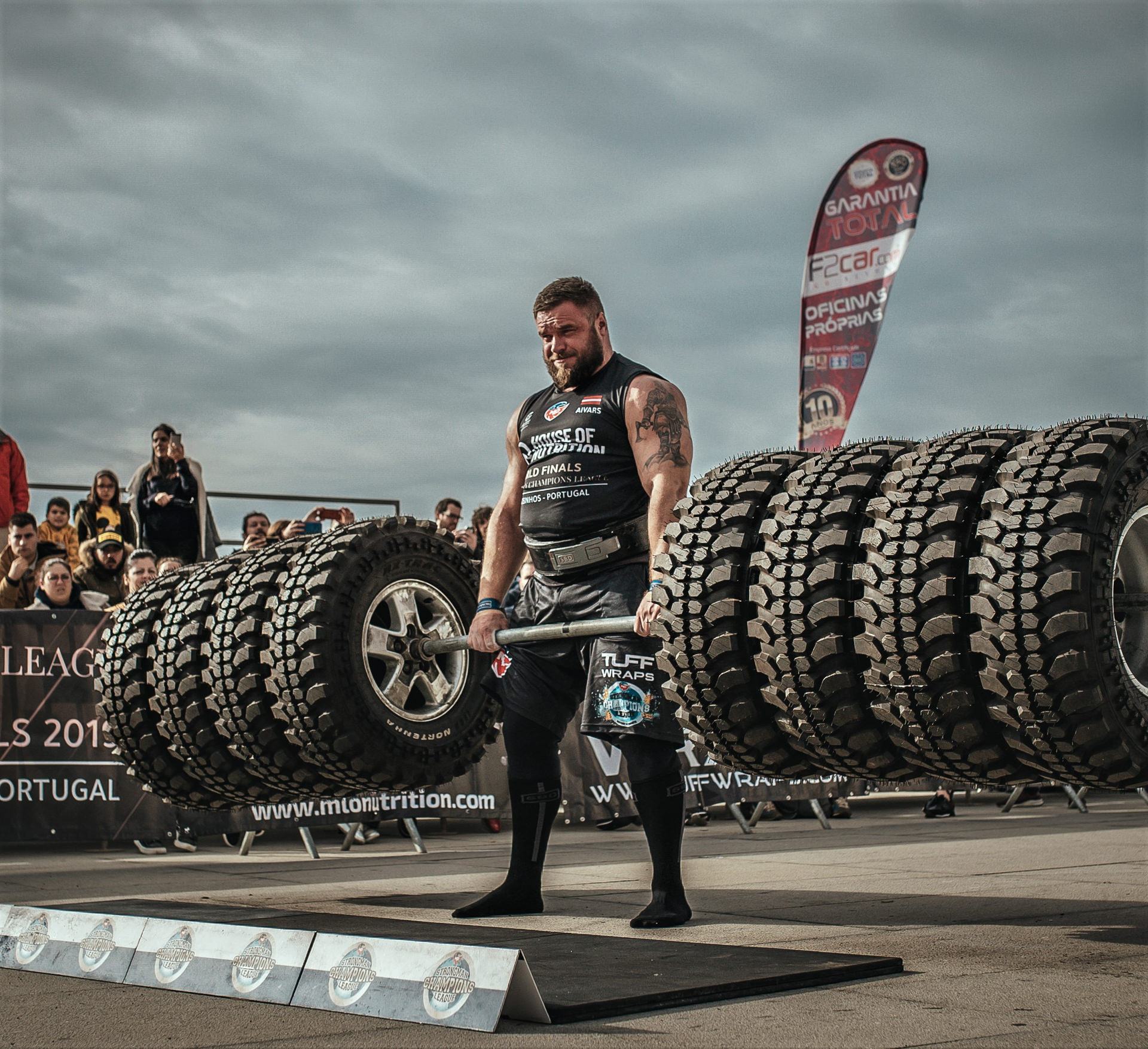
After more than forty years of World's Strongest Man, the rise of international circuits, the transformation of equipment, the professionalization of competitions and the evolution of great champions, modern Strongman no longer resembles the strength show from which it emerged. It has kept the impossible objects, enormous weights and image of the person capable of doing what seems impossible, but behind that spectacle now sits a much more sophisticated sport.
The modern athlete must be strong, but strength alone is no longer enough. He must accelerate a load, transport weight efficiently, manage grip, control the trunk, understand the technique of each implement, pace effort and recover between events. Biomechanical research shows that performance in events such as the Farmer's Walk, Yoke Walk, Tire Flip and Atlas Stones depends on a combination of factors rather than one physical quality.
1. Modern Strongman is no longer simply a very strong person
The classic image of Strongman is simple: a huge man lifts a huge weight. Competitive reality is much more complex. A modern contest may require maximal strength, power, speed, load carriage, local endurance, coordination, technique and decision-making in the same day.
This diversity is one of the characteristics separating Strongman from more standardized strength sports. A powerlifter can be evaluated through three main lifts, a weightlifter through two, while a Strongman must solve different mechanical problems from one event to the next. Biomechanical literature describes exactly this variety: carrying, pulling, static lifting, awkward objects and movement in multiple planes.
2. From raw strength to applied strength
Maximal strength remains the foundation. Without it, an athlete cannot manipulate extreme loads. But in Strongman, what matters is what the athlete can do with that strength. Enormous force that cannot be transferred efficiently into the ground, object or movement may produce a worse result than slightly lower force applied more effectively.
This appears clearly in Strongman research. In the Farmer's Walk and heavy sled pulls, higher-performing athletes have shown more efficient movement characteristics, including greater stride length and rate and reduced ground contact time. In the Tire Flip, the duration of the second pull phase is an important determinant of speed.
3. The modern athlete learns to move with the load
One of the largest conceptual changes in modern Strongman is the shift from lifting weight to moving with weight. Farmer's Walk, Yoke Walk, Super Yoke, sandbag carries and many medleys require the athlete to create force while the system's center of mass is moving.
The Yoke Walk is a perfect example. The athlete does not simply lift the frame. He must stabilize the load across the shoulders, control oscillations, maintain direction and produce sufficiently rapid steps. Biomechanical studies show that movement speed is associated with changes in stride length and rate and reduced stance duration.
4. Grip has become a discipline inside the discipline
In modern Strongman, the hand is not merely the contact point with the object. It can become the limit of the entire event. Farmer's Walk, Axle, Hercules Hold, thick-object deadlifts, Keg work and many forms of carrying can fail because of grip before the global musculature is unable to produce force.
This changes preparation. Grip must be trained across several dimensions: maximal force, isometric endurance, repeated-effort endurance, fatigue tolerance and the ability to maintain contact with objects of unusual geometry.
5. The trunk becomes the center of force transfer
A Strongman may have extremely strong legs and excellent grip, but if trunk position fails, the force-transfer chain can break. Heavy carries, deadlifts, Yoke Walks and objects held in front of or behind the body simultaneously challenge control of the spine, pelvis and rib cage.
This is why modern training cannot be reduced to a collection of exercises for individual muscles. The athlete must learn to transmit force through the whole system under fatigue and with objects that do not behave like an Olympic barbell.
6. Technique becomes the difference between two very strong people
As the level of the sport rises, absolute strength differences between competitors can become small. Technique then becomes enormously valuable. Starting position, object path, grip changes, step timing or turning mechanics can decide the ranking.
The Atlas Stone is a useful example. The lift can be divided into distinct phases, and research shows that phase durations and kinematic characteristics change as load and fatigue increase. The experienced athlete is not simply stronger. He knows how to organize the movement so available force is used efficiently.
7. Speed permanently changed the champion profile
One of the most important moments in Strongman's evolution was the emergence of the champion who could be both enormous and fast. An era in which an athlete could dominate mainly through absolute strength was followed by a period in which acceleration, mobility and efficiency became competitive weapons.
This does not mean muscle mass or strength became less important. It means they must be converted into movement. An athlete who can produce large force in a short time has an advantage in medleys, loading events, pulls and carries.
8. Modern competition tests several systems on the same day
A Strongman does not enter an event with a completely reset body. The result of one event affects the next. Heart rate, muscular fatigue, grip fatigue, mechanical stress and metabolic cost accumulate.
Modern Strongman is therefore also a sport of resource management. The athlete must know when to accelerate, when to conserve and where to accept a cost. Winning one event at any price can become a problem in the next.
9. Strategy becomes part of performance
Once a sport becomes competitive enough, the strongest athlete in absolute terms does not always win. The athlete who makes the better decision may win. Weight selection, pacing, step count, grip changes and the response to failure become components of the result.
This is one of the major differences between old and modern Strongman. The elite athlete must be both an executor and a manager of his own performance.
10. Science begins to enter the training room
Early Strongman generations built performance mainly through experience, observation and trial and error. Modern sport increasingly uses biomechanics, exercise physiology, video analysis, load monitoring and recovery research.
Yet Strongman research is still relatively young. A systematic review of biomechanical literature identified a limited number of studies and emphasized the need for more experienced athletes, more female athletes and more advanced measurement technologies. The sport is modern, but its scientific database is still being built.
11. The modern athlete becomes a biological laboratory
Recent studies of world-class athletes show how far adaptation can go. A world champion and deadlift champion examined with MRI had lower-limb muscle volumes approximately 96% above untrained controls, while maximal forces measured during the IMTP and peak power during the CMJ were extremely high.
Importantly, adaptation is not uniform. Some muscle groups were much more developed than others, and the patellar tendon did not increase proportionally with every muscular characteristic. The elite Strongman body is therefore a specialized system, not simply a scaled-up version of an ordinary body.
12. Body size remains important, but does not decide everything
Modern Strongman still favors large athletes. Studies of elite competitors have reported mean body masses above 150 kg in groups of top-level athletes. Mass can provide advantages in force production, stability, inertia and interaction with objects.
But size has costs. A larger body must be moved, fueled, recovered and maintained. Very high body mass can become disadvantageous in fast events or situations where mobility and endurance are decisive.
13. Professionalization also changes the person behind the athlete
The modern athlete no longer operates in isolation. Around him may be a coach, physiotherapist, nutrition professional, doctor, manager, commercial partners and support staff. The exact structure differs, but elite performance increasingly becomes a collective project.
This changes the definition of talent. Talent is no longer only the capacity to become strong. It also means the ability to learn, communicate, plan, respect recovery and turn information into decisions.
14. Digital media made Strongman permanently accessible
Television made Strongman famous, but the internet made it permanent. Today, a record can circulate within minutes, an event can be analyzed frame by frame, and an athlete can build his own audience.
This transformation brought fans closer to athletes. The audience no longer sees only the final contest. It can see training, recovery, diet, travel, injury, comeback and daily life. At the same time, the athlete enters a space where public image becomes part of the career.
15. Modern Strongman is more international than ever
If the first decades were dominated by a few geographic centers, modern Strongman is a global sport. Top champions and contenders come from different countries and sporting systems, while international competitions create a market in which training cultures meet.
Globalization also raises the level. An athlete can no longer assume that one local method is sufficient. Technique, equipment and training methods circulate quickly. What works for one champion is immediately studied by others.
16. More types of Strongman emerge
Modern Strongman is no longer exclusively the men's open category. The scientific literature highlights the development of women's, lightweight and Masters competitions. This diversification changes the culture of the sport by showing that Strongman principles can be adapted to different body sizes and experience levels.
At the same time, it creates more opportunities for athletes who do not have the extreme anthropometry of the open class. The sport becomes broader without losing its identity.
17. The cost of modernization: the body is asked to do more
Modernization has not eliminated risk. Elite sport pushes limits. Available epidemiological data have shown a meaningful burden of injury in Strongman, with the lower back, shoulder, biceps and knee among frequently affected regions and muscle and tendon injuries commonly reported.
The modern problem is not only how much an athlete can lift. It is how much he can produce, repeat and absorb without the system failing. Professionalization must therefore include risk management, otherwise short-term performance can destroy long-term careers.
18. What does it actually mean to be a modern Strongman?
It means turning strength into action. Lifting, carrying, pushing, pulling, throwing, stabilizing and repeating. Changing strategy when the event changes. Remaining efficient as fatigue rises.
Modern Strongman is, in essence, a hybrid sport. It is not simply powerlifting, weightlifting, sprinting or endurance sport. It borrows elements from all of these worlds and combines them into its own competitive form.
19. The future: more science, not less strength
The likely direction of the sport is not abandoning the extreme. If anything, better measurement can make training more precise. Video analysis, inertial sensors, force platforms, load monitoring and recovery analysis can help identify the small differences that separate elite athletes.
But technology will not replace Strongman's fundamental character. The audience comes for huge weights, awkward objects and people pushing limits. The future will likely be a combination of the raw spectacle that made the sport famous and the scientific precision demanded by professionalization.
20. Conclusion: modern Strongman is a mature sport still under construction
Strongman history began with the strongman who had to convince an audience that he could do something impossible. It then passed through World's Strongest Man, the era of great champions, the evolution of events and equipment, and the professionalization of circuits. Today, the athlete is no longer simply the strong man. He is a prepared, technical, strategic competitor connected to an international infrastructure.
Modern Strongman does not mean the sport has lost its roots. It means those roots produced something much more complex. Strength remains the center, but around it have grown speed, technique, strategy, recovery, science, media and professionalism.
Perhaps this is the most important transformation in the entire history of the discipline: Strongman no longer asks only, “How strong are you?” The modern question is, “How effectively can you turn what you have into performance, and then repeat that performance when it matters?”
Bibliography and sources
1. Hindle BR, Lorimer AV, Winwood PW, Keogh JWL. The Biomechanics and Applications of Strongman Exercises: a Systematic Review. Sports Medicine - Open. 2019;5:49. DOI: 10.1186/s40798-019-0222-z.
2. Hindle BR, Lorimer A, Winwood P, Keogh JWL. A systematic review of the biomechanical research methods used in strongman studies. Sports Biomechanics. 2020;19(1):90-119. DOI: 10.1080/14763141.2019.1598480.
3. Hindle BR et al. The Biomechanical Characteristics of the Strongman Yoke Walk. Journal of Strength and Conditioning Research. 2021. PMID: 33981993.
4. Hindle BR et al. The biomechanical characteristics of the strongman atlas stone lift. PeerJ. 2021;9:e12066. DOI: 10.7717/peerj.12066.
5. Winwood PW, Keogh JWL, Harris NK. Interrelationships between strength, anthropometrics, and strongman performance in novice strongman athletes. Journal of Strength and Conditioning Research. 2012;26(2):513-522. DOI: 10.1519/JSC.0b013e318220db1a.
6. Winwood PW et al. The strength and conditioning practices of strongman competitors. Journal of Strength and Conditioning Research. 2012.
7. Keogh JWL, Payne AL, Anderson BB, Atkins PJ. A brief description of the biomechanics and physiology of a strongman event: the tire flip. Journal of Strength and Conditioning Research. 2010;24(5):1223-1228. DOI: 10.1519/JSC.0b013e3181cc61cd.
8. Balshaw TG et al. Muscle and tendon morphology of a world strongman and deadlift champion. Journal of Applied Physiology. 2024;137(4):789-799. DOI: 10.1152/japplphysiol.00342.2024.
9. Winwood PW et al. Retrospective injury epidemiology of strongman athletes. Journal of Strength and Conditioning Research. 2014.
10. The World's Strongest Man. Official historical and competition information.
11. Giants Live. Historical material on World's Strongest Man and the international qualifying circuit.
12. Strongman Archives. Historical competition results, champions and records.
More From The Journal
Training
The Science of Strongman Training - Episode X: Competition Programming
How to build a complete Strongman competition preparation block: calendar, events, volume, intensity, specificity, simulations, autoregulation, tapering and fatigue management.
Training
The Science of Strongman Training - Episode IX: Peaking
Peaking in Strongman: how to turn months of training into maximal competition performance by reducing fatigue, preserving adaptations and managing specificity.