
Training
History of Strongman - Episode IV: The Evolution of Events and the Transformation of Strength into Sport
September 15, 2026
If the first episodes of this series followed the rise of the strongman and the birth of modern competition, we now reach the mechanism through which Strongman built its own language: the events.
A sport is not defined only by who competes or who wins. It is defined by the questions it asks of the human body. Strongman became a distinct sport because it began asking questions that weightlifting, powerlifting and bodybuilding did not ask in the same combination.
How much can you lift? How quickly can you carry? How long can you hold? Can you produce force from an awkward position? Can you accelerate a massive object? Can you repeat the effort after already spending a large part of your available resources? And, perhaps most importantly, can you do all of this in the same competition?
The evolution of the events therefore changed not only competitions, but also the athlete who competes in them.
1. From feats of strength to sporting events
Early forms of strength competition did not require a fixed repertoire. A strongman could demonstrate that he could lift a heavy object, bend metal, pull a load or carry a weight. The spectacle was partly the absence of standardization: the audience saw something unusual and tried to understand how difficult it was.
As Strongman became a competitive sport, that freedom created a problem. If every contest uses a different object, distance, rule and scoring method, comparison becomes difficult.
One of the most important transformations in the sport's history followed: the object stopped being merely scenery. It became a measuring instrument.
A log became the Log Lift. Two weights carried in the hands became the Farmer’s Walk. A loaded frame became the Yoke Walk. A spherical stone became the Atlas Stone. A tire became the Tire Flip. An object carried and placed onto a platform became a Loading Event.
The event acquired an identity that could be repeated, trained and compared.
2. Why Strongman did not simply copy powerlifting and weightlifting
Strongman developed alongside the classic strength sports, but it could not remain a simple collection of squat, bench press, deadlift or clean and jerk variations.
The reason is simple: real objects are not always symmetrical, perfectly grippable or easy to control. A refrigerator, keg, stone or log does not behave like an Olympic barbell.
Biomechanical research describes Strongman exercises as forms that combine lifting, carrying, pulling and manipulation of heavy or awkward objects. Compared with many traditional exercises, they can introduce horizontal, unilateral, asymmetric loading and movement across multiple planes.
This created a fundamental difference. In a classic lift, the object is often designed for the athlete. In Strongman, the athlete must adapt to the object.
That became one of the sport’s signatures: the object is part of the problem.
3. Farmer’s Walk: when grip became locomotion
Farmer’s Walk looks almost simple: pick up two weights and walk. In reality, it combines an unusually dense set of demands.
Grip must survive. The trunk must stabilize. The shoulder girdle must control the upper limbs. The hips and knees must produce force, while the legs convert that force into rapid movement.
Biomechanical research indicates that higher-performing Farmer’s Walk athletes tend to display combinations of greater stride length and stride rate with reduced ground-contact time. Performance is therefore not only about how much weight can be held, but also how efficiently that load can be converted into movement.
The event also changed how coaches think about grip. The hand was no longer merely a component that keeps a bar in place during a deadlift. It became the connection between force and locomotion.
That is why Farmer’s Walk became one of Strongman’s defining events: it is immediately understandable to the spectator and extremely complex for the athlete.
4. Yoke Walk: when weight must be carried, not merely lifted
Yoke Walk pushed the idea of load carriage to another level. The load rests on the athlete while the athlete moves an entire heavy system and controls posture and balance.
The goal is no longer simply to generate enough force to separate the load from the ground. Force must continue to be produced while the system is moving.
Every step becomes a small stability problem. The center of mass of the athlete and the load must be managed together. Oscillation, stride length, rhythm and the ability to maintain an efficient path can all influence the result.
Yoke Walk helped separate strength from usable strength. An athlete may possess enormous maximal force and still lose if he cannot control that force while moving.
This is a recurring Strongman lesson: when the object does not remain perfectly still, the athlete must become more than a force engine. He must also become a control system.
5. Log Lift: the awkward object that changed pressing
Log Lift is one of the clearest demonstrations that object shape can completely change a familiar movement.
An Olympic bar is relatively narrow and allows a close position to the body. A log has a large diameter, fixed handles and geometry that changes arm and trunk position.
The log also has to be brought from its initial position into a rack position before it can be pressed. This adds a clean and stabilization sequence before the pressing phase.
Comparative research shows similarities between the Log Lift and movements such as the clean and jerk or push press, but also important mechanical differences. The geometry of the log can alter joint range of motion and the way force is transferred through the kinetic chain.
Strongman therefore turned pressing into a problem of force, position and object control.
The athlete no longer asks only, “How much can I press?” The question becomes, “How much can I press from this position, with this object, after I have brought it into the rack?”
6. Atlas Stones: from strength stone to sporting signature
Atlas Stones have roots in older stone-lifting traditions, but Strongman turned them into a sophisticated competitive event.
The round shape changes the grip completely. There is no handle, no convenient edge and no surface designed for efficiency. The athlete must create contact between body and object, lift it, bring it into the lap and then load it.
Biomechanical analysis divides the movement into distinct phases, each demanding something different: breaking the stone from the ground, stabilizing it in the lap position, accelerating and extending, and finally loading it onto the platform.
This also reveals an important Strongman characteristic: technique can radically alter how much existing strength becomes performance.
Two athletes with similar strength can achieve very different results if one positions the body more effectively around the stone, uses the elastic properties of the system better or moves between phases more efficiently.
Atlas Stones therefore represent one of the best syntheses of Strongman philosophy: raw strength, technique, coordination, grip, trunk control and the ability to manipulate an object that does not cooperate.
7. Tire Flip and explosive events: when mass must be accelerated
Tire Flip introduced another question: not only can you lift the object, but how quickly can you change its state of motion?
A heavy tire cannot be efficiently moved by simply imitating a deadlift. The athlete must create enough impulse to move the tire through the critical point and then reposition the body to drive it over.
Biomechanical research has identified the second pull phase as an important determinant of Tire Flip performance, with differences between faster and slower athletes partly explained by the duration of this phase.
This shows why Strongman is not merely a maximal-strength sport. If you can produce large force but produce it too slowly or at the wrong moment, the object may not respond.
Events like this made rate of force development, coordination and the ability to transfer energy into an external object part of the athlete profile.
8. Loading Events, Keg, Sandbag and precision under fatigue
Loading events changed the problem again. The athlete does not merely lift an object. He must move it to a precise destination and place it there within a time limit.
This introduces coordination and pacing. Moving too slowly costs time. Moving too aggressively can waste energy or compromise the position needed for the next repetition.
Sandbags and kegs add the problem of deformable or unstable objects. The body must create a contact position rather than simply grab a handle. The arms may function almost like hooks while the trunk and hips perform much of the work.
In these events, technique begins to resemble an economy system. The efficient athlete is not necessarily the athlete who works less, but the athlete who loses less energy between actions.
This creates a Strongman-specific concept of efficiency: the same weight can cost two athletes very different amounts.
9. Deadlift, Holds, Presses and events that created specialization
As the sport matured, events did not evolve only toward exotic objects. Some of the most important events returned to fundamental movements and transformed them through context.
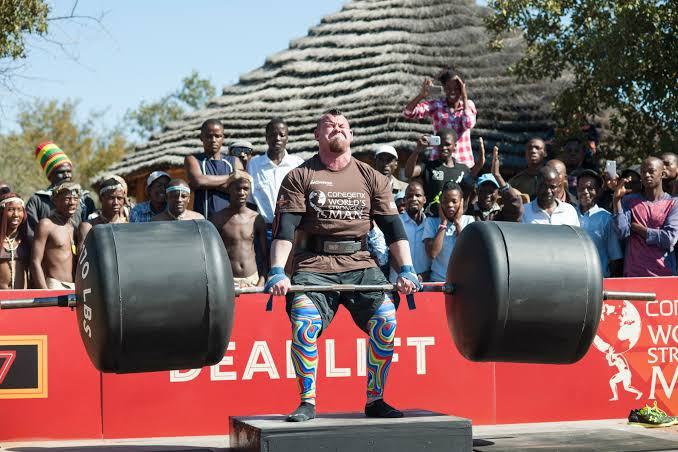
Deadlift can become a max lift, a timed repetition event, a deadlift from height, a specialized-bar event or an implement that changes body position. Pressing can become Log, Axle, Dumbbell or Viking Press. Holds can turn grip into a test of isometric endurance.
This variety made it difficult for a single specialist profile to dominate every situation. One athlete may be built for maximal strength, another for repetitions, another for speed or grip endurance.
At the same time, variety allowed organizers to construct balanced contests. If one event strongly favors a particular profile, the next can reward another.
This is the architecture of the modern contest: not simply choosing spectacular events, but building a set of questions that separates complete athletes.
10. Medleys and the next stage: several problems in one event
The medley may be the clearest expression of Strongman’s maturation. Instead of isolating one quality, the medley places several tasks consecutively inside one sequence.
An athlete may begin with a carry, continue with a drag, change implements, load an object and finish with another movement. Suddenly, transitions matter almost as much as individual movements.
This is where Strongman has moved furthest from the classic feat of strength. In a demonstration, an athlete may have time to prepare for one effort. In a medley, every effort changes the next one.
A fatigued grip changes the carry. Elevated breathing changes the next lift. Accumulated effort changes pacing. A small positional error at the first implement can become a problem at the third.
The medley therefore made fatigue part of the event rather than merely a side effect.
11. From spectacular objects to designed events
As the sport grew, organizers learned that a good event has to satisfy several conditions at once. It must be difficult enough to separate athletes, safe enough to be repeated, clear enough to judge and visible enough for the audience.
This is a major change. In the early period, an object might be chosen because it was spectacular. In a mature sport, the object is also chosen for what it measures.
A carry can be designed to separate speed from grip capacity. A deadlift can be calibrated for maximal strength or repetition endurance. A loading event can be built so that technique matters almost as much as strength.
Event evolution therefore became an evolution in competitive intelligence. The sport began designing problems rather than merely finding heavy objects.
12. How event evolution changed the Strongman athlete
The most important conclusion of this episode may be that events created the athlete just as much as the athlete created the events.
If the sport had remained focused exclusively on maximal lifts, maximal strength would have dominated the preparation. If it had been only about carrying, another profile would have been favored. If it had been only about unstable objects, technique and control would have become dominant.
Strongman combined them. The result is an athlete who must be strong, fast, resilient, technically skilled, capable of producing force from awkward positions and robust enough to tolerate repeated heavy loading.
Biomechanical research therefore shows such a diverse picture. Farmer’s Walk, Yoke Walk, Tire Flip, Log Lift, Atlas Stones and the other events are not simply the same movement performed with different objects. They are distinct problems sharing the same competitive platform.
That diversity is also why an elite Strongman cannot be reduced to one number. It is not only his deadlift. It is not only his log. It is not only his grip. It is the complete profile.
13. Standardization versus creativity: the problem that will remain
Event evolution also created a permanent tension. The more you standardize, the easier it becomes to compare performances. But the more you standardize, the greater the risk of losing one of Strongman’s defining characteristics: variety.
A deadlift with the same bar, height and rules is easier to compare. Yet a new implement can test a quality that the classic repertoire does not capture.
Modern Strongman lives in this compromise. It needs enough recognizable events to maintain identity, but enough creativity to preserve the idea that athletes must be prepared for uncertainty.
That is part of its competitive appeal. Athletes may know the category of problem, but not always exactly how the implement will feel, how it will react, how long the distance will be or how the sequence will be constructed.
14. The modern event no longer tests a single quality
Ultimately, event evolution changed the definition of strength itself. Maximal strength remains fundamental, but it is only one currency with which performance is purchased.
Power determines how quickly a load can be accelerated. Technique determines how effectively available strength is used. Grip determines whether the connection between body and object survives. The trunk determines how efficiently force is transferred. Work capacity determines what happens after the first effort. Recovery determines whether the athlete can reproduce performance the next day.
In this sense, event evolution transformed Strongman into a systems test.
We no longer ask only how strong the person is. We ask how much of that strength can be converted into a result when the object is heavy, awkward or unstable, time is limited and another event is waiting.
That is the difference between the strongman and the Strongman athlete.
Bibliography and sources
1. Hindle BR, Lorimer AV, Winwood PW, Keogh JWL. The Biomechanics and Applications of Strongman Exercises: a Systematic Review. Sports Medicine - Open. 2019;5:49. DOI: 10.1186/s40798-019-0222-z.
2. Hindle BR, Lorimer AV, Winwood PW, Keogh JWL. A systematic review of the biomechanical research methods used in strongman studies. Sports Biomechanics. 2020;19(1):90-119. DOI: 10.1080/14763141.2019.1598480.
3. Winwood PW, Cronin JB, Brown SR, Keogh JWL. A biomechanical analysis of the farmers walk, and comparison with the deadlift and unloaded walk. International Journal of Sports Science & Coaching. 2014;9(5):1127-1143.
4. McManus A, Wiles J, Coleman DA, O’Driscoll J. Strongman training and its rationale within strength and conditioning.
5. Berning JM, Adams KJ, Climstein M, Stamford BA. Metabolic demands of junkyard training: pushing and pulling a motor vehicle. Journal of Strength and Conditioning Research. 2007;21(3):853-856.
6. Harris NK, Woulfe CJ, Wood MR, Dulson DK, Gluchowski AK, Keogh JWL. Acute physiological responses to strongman training compared to traditional strength training. Journal of Strength and Conditioning Research. 2016;30(5):1397-1408.
7. Winwood PW, Hume PA, Cronin JB, Keogh JWL. Retrospective injury epidemiology of strongman athletes. Journal of Strength and Conditioning Research. 2014;28(1):28-42.
8. The World's Strongest Man. Official competition history and event archives.
9. Strongman Archives. Historical World's Strongest Man results and event records.
10. Balshaw TG, Massey GJ, Miller R, McDermott EJ, Maden-Wilkinson TM, Folland JP. Muscle and tendon morphology of a world strongman and deadlift champion. Journal of Applied Physiology. 2024;137(4). DOI: 10.1152/japplphysiol.00342.2024.
More From The Journal
Training
The Science of Strongman Training - Episode X: Competition Programming
How to build a complete Strongman competition preparation block: calendar, events, volume, intensity, specificity, simulations, autoregulation, tapering and fatigue management.
Training
The Science of Strongman Training - Episode IX: Peaking
Peaking in Strongman: how to turn months of training into maximal competition performance by reducing fatigue, preserving adaptations and managing specificity.