
Physiology
The Heart, Blood and Strongman - Episode 6: Blood Viscosity and Performance
September 5, 2026
Why does blood viscosity matter?
In the previous episode we followed hemoglobin and hematocrit into oxygen transport. Now we move into a less intuitive part of the story: blood must not only contain oxygen, it must also flow efficiently through the circulation. Viscosity describes, in simple terms, a fluid's internal resistance to flow. For blood, this property is influenced by hematocrit, plasma viscosity, red-cell deformability and red-cell aggregation, as well as by the conditions under which blood is flowing.
For a Strongman athlete, the concept matters because oxygen transport depends on two things working together: blood must have good oxygen-carrying capacity and it must be able to reach active tissues. Raising hemoglobin or hematocrit can increase oxygen-carrying capacity, but excessive increases in viscosity can make flow more difficult.
What is blood viscosity?
Viscosity is the resistance of a fluid to deformation and flow. Blood is much more complex than water because it contains cells and proteins suspended in a liquid phase. As a result, blood viscosity is not a fixed constant and does not behave identically in every vessel or at every flow rate.
Hematocrit is a central determinant because it represents the fraction of blood volume occupied by red blood cells. As hematocrit rises, whole-blood viscosity generally rises as well. But plasma properties, the mechanical characteristics of red cells and interactions between cells also matter.
Why blood does not behave like a simple fluid
Blood is a non-Newtonian fluid. Its flow properties change with shear rate. At lower shear rates, red cells may tend to aggregate. At higher shear rates, aggregates disperse and red cells align and deform to move through vessels more efficiently.
This is especially relevant in the microcirculation, where vessel diameter can approach the size of red blood cells. Red-cell deformability helps cells pass through small vessels and contributes to efficient oxygen distribution.
Hematocrit: more oxygen, but also more flow resistance
Hematocrit illustrates a fundamental physiological trade-off. More red-cell mass can increase oxygen-carrying capacity, but the same increase can raise viscosity and resistance to flow. The cardiovascular system must balance these effects.
That is why the idea that a higher hematocrit is always better is too simple. Hemorheology literature describes a trade-off between oxygen carriage and blood fluidity. The useful range depends on physiological context, and pathological or artificially induced increases are not automatically beneficial.
What happens during heavy exercise?
Strenuous exercise produces rapid circulatory changes. Water can shift temporarily from the vascular compartment into the interstitial space, favoring hemoconcentration and potentially raising hematocrit. Reviews of exercise hemorheology describe a transient rise in whole-blood viscosity during or shortly after strenuous exercise in some conditions.
This should not be treated as an absolute rule. The response depends on intensity, duration, temperature, hydration, posture and measurement method. Exercise hemorheology studies are heterogeneous.
Strongman: when maximal force also creates circulatory stress
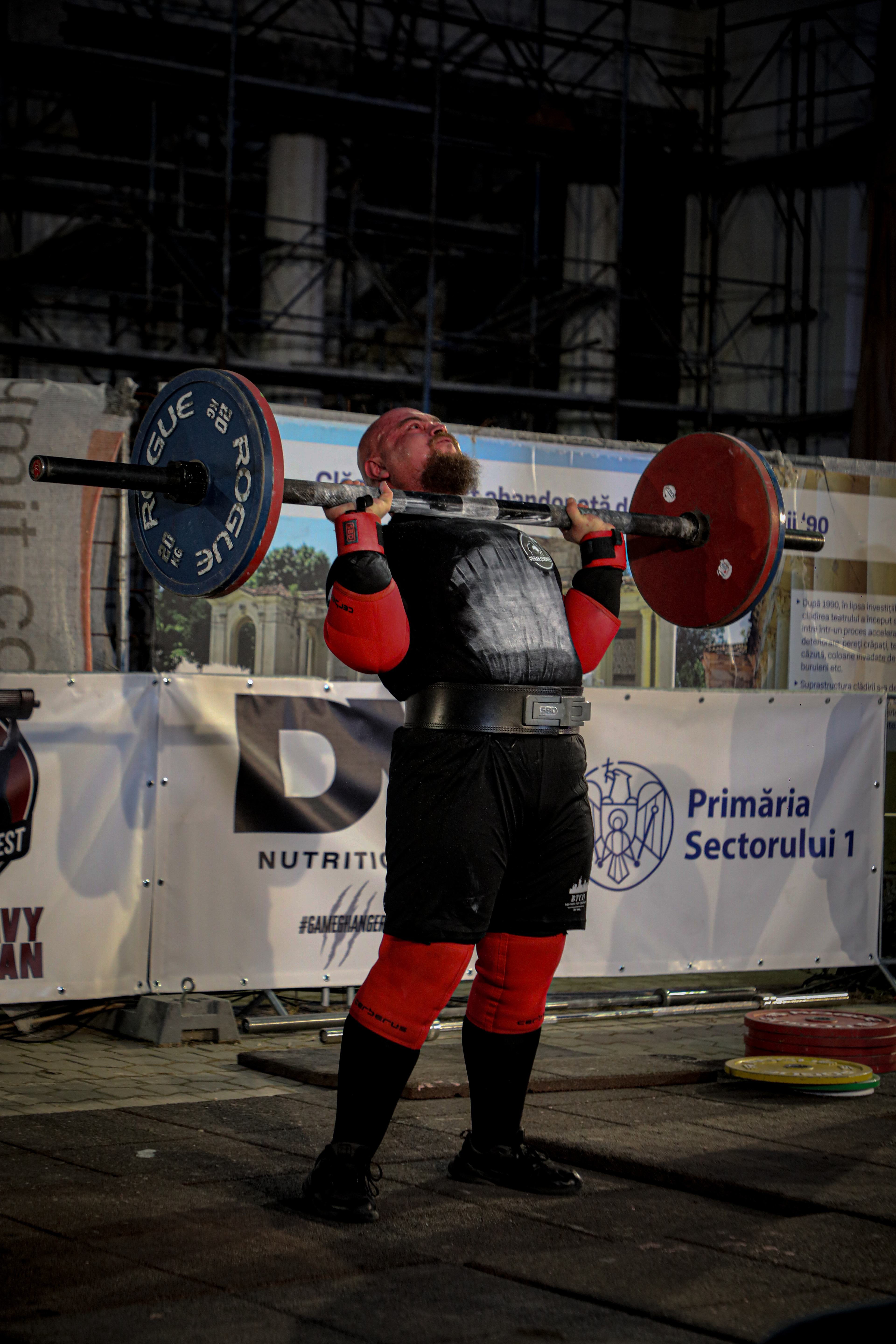
A Strongman event may combine very forceful contractions with locomotion, time under tension and incomplete recovery between events. Carries, medleys and loading or transport events can place substantial demands on blood flow and thermoregulation as exercise duration increases.
A short maximal effort is not physiologically identical to a long event. Yet after the effort ends, blood redistribution and local vasodilation can rapidly change flow conditions. Hemorheology is therefore best understood as part of dynamic circulation rather than as one resting laboratory number.
Dehydration and hemoconcentration
When an athlete loses plasma through sweating, blood becomes more concentrated. Hematocrit and hemoglobin may temporarily rise without any new red cells being produced. At the same time, the higher cellular concentration can contribute to increased viscosity.
This is particularly relevant in summer competitions. An athlete may finish the day with a higher measured hemoglobin than under normal hydration, but that value does not necessarily represent a new long-term hematological adaptation. It may simply reflect less plasma.
Red-cell deformability
A healthy red blood cell can change shape to pass through small vessels. Deformability matters for microcirculation because the cell must adapt mechanically when it moves through narrow capillaries.
Red cells can become temporarily less deformable in some exercise and oxidative-stress conditions, but findings are not perfectly consistent. Recent reviews emphasize that responses depend on exercise protocol, population and measurement method. It should not be assumed that every training session simply damages red-cell deformability.
Red-cell aggregation
Red cells can form aggregates, especially at low shear rates. Aggregation changes blood flow properties and may influence microcirculation. During intense exercise, findings vary and may depend on exercise type and on when the measurement is taken.
Over the long term, some meta-analytic evidence suggests that regular exercise can reduce red-cell aggregation and improve parts of blood rheology, but effects are heterogeneous and the evidence base is largely outside the specific Strongman population.
Plasma viscosity
Red cells are not the whole story. Plasma proteins, including fibrinogen and other macromolecules, contribute to plasma viscosity. Inflammation, metabolic status and some diseases can change these properties.
Therefore, two people with the same hematocrit can still have different hemorheological profiles. Hematocrit is important, but it is not synonymous with whole-blood viscosity.
Flow in small vessels: where the story gets really interesting
In small vessels, blood displays behaviors that cannot be explained only by the simplest equations for an ideal fluid. Red cells migrate toward the vessel axis, deform and interact with endothelium and plasma. These phenomena contribute to effective vascular resistance and oxygen distribution.
This means viscosity should not be viewed separately from vasodilation and vascular control. The body can respond to rheological changes by modifying vessel diameter and blood flow.
The hematocrit paradox
Exercise physiology contains a paradox: exercise can transiently raise hematocrit and viscosity, while the same changes may contribute to signals that promote vasodilation. Exercise hemorheology reviews describe this interaction as much more complex than the idea that increased viscosity automatically means reduced perfusion.
Some research suggests that changes in shear and red-cell properties may contribute to nitric-oxide signaling and vascular tone regulation. In other words, an acute rise in viscosity is not simply a problem, but can be part of a broader adaptive system.
What does this mean for performance?
Performance emerges from the balance between oxygen-carrying capacity and resistance to flow. If blood contains too little hemoglobin, oxygen-carrying capacity can fall. If hematocrit and viscosity become very high, flow may become more difficult.
Strongman, however, is not defined only by maximal oxygen consumption. Maximal strength, neuromuscular recruitment, anaerobic metabolism, tolerance to metabolite accumulation and recovery efficiency between events are major contributors. Hemorheology is one component, not the entire performance system.
What happens after exercise?
After a heavy effort stops, redistribution of blood flow can continue. Active muscle remains metabolically demanding, while skin blood flow may rise to dissipate heat. Restoration of plasma volume and fluid-electrolyte balance also influence blood properties.
In a multi-event competition, these processes overlap. This may help explain why an athlete can appear powerful in one event yet experience a decline in work capacity later in the contest, especially in heat or under inadequate hydration.
Long-term training and blood
Chronic exercise adaptations can favor a more favorable hemorheological profile. In studied populations, regular exercise is associated with changes in hematocrit, red-cell aggregation and viscosity, but results vary with training type and participant characteristics.
In endurance athletes, plasma-volume expansion can contribute to more dilute blood and lower values of some viscosity measures. Evidence specific to strength and power training is much more limited, so conclusions from running or cycling should not automatically be transferred to Strongman.
Large body mass and hemorheology
Strongman has a distinctive feature: body mass can be very high. This means substantial absolute circulatory demand, but it does not allow us to infer an ideal blood viscosity directly from body weight.
A large athlete can have a healthy or problematic hematological profile independently of size. Interpretation should be based on laboratory findings, history, hydration, blood pressure and clinical context, not assumptions derived from body mass.
Why artificially chasing hematocrit is risky
Artificially increasing red-cell mass can raise hemoglobin and oxygen-carrying capacity, but it can also increase blood viscosity and cardiovascular risk. Blood manipulation is not a safe physiological shortcut.
In elite sport, methods that artificially increase red-cell mass may also fall under anti-doping rules. From a medical perspective, persistently elevated hemoglobin or hematocrit should be evaluated rather than pursued as a performance target.
Hydration: simple in theory, more complicated in competition
For a Strongman athlete, hydration affects plasma volume and therefore hemoconcentration. In a long competition, repeated fluid losses can contribute to changes in circulation and exercise tolerance.
At the same time, excessive fluid intake is not universally beneficial. The goal is to maintain hydration appropriate to the environment and exercise demands, with electrolyte intake adapted to the situation, rather than simply drinking as much water as possible.
How does viscosity relate to oxygen transport?
Oxygen transport is a chain involving blood oxygen content, cardiac output, flow distribution and peripheral extraction. Viscosity sits within this chain because it can influence how readily blood moves through the circulation.
Extremely viscous blood cannot simply be compensated for by adding more hemoglobin. The cardiovascular system still has to deliver blood through capillaries, and capillaries must permit gas and nutrient exchange with tissue.
A simple Strongman framework
Think of blood as a compromise between cargo and fluidity. Hemoglobin and red cells provide oxygen-carrying capacity. Plasma, red-cell deformability and vascular control help blood move through the system. None of these components should be maximized blindly.
For a strength athlete, the better question is not "How high is my hematocrit?" but "Is my cardiovascular and hematological system functioning efficiently and safely?" That is a much more physiological performance target.
Conclusion
Blood viscosity is one of the variables connecting hematocrit, red-cell properties, plasma and peripheral circulation. During exercise, viscosity can change acutely, but the response is not uniform and should not be interpreted through a single rule.
In Strongman, performance depends on the blood's ability to carry oxygen and on the cardiovascular system's ability to distribute it to active tissues. Very high hematocrit is not automatically an advantage, and more fluid blood does not automatically mean better performance. Physiological context matters.
Ultimately, high-performing blood is blood that can fulfill several roles at once: transport, flow, vascular regulation and thermoregulation. In a multi-event contest, the ability to keep that system functioning may become decisive.
Selected bibliography
El-Sayed MS, Ali N, El-Sayed Ali Z. Haemorheology in exercise and training. Sports Med. 2005;35(8):649-70. PMID 16076228.
Connes P, Hue O, Tripette J, Hardy-Dessources MD. Exercise hemorheology: classical data, recent findings and unresolved issues. PMID 23042105.
Effects of exercise training on blood rheology: a meta-analysis. Clin Hemorheol Microcirc. PMID 22214690.
Brun JF, Varlet-Marie E, Aloulou I, et al. Hemorheological alterations related to training and overtraining. Biorheology. 2010;47(2):95-115. PMID 20683154.
Mairbäurl H. Red blood cells in sports: effects of exercise and training on oxygen supply by red blood cells. Front Physiol. 2013;4:332. PMID 24273518.
Optimal hematocrit theory: a review. 2024. PMID 38813609.
Exercise-induced redox modulation of red blood cell function in health and disease. Microvasc Res. 2026. PMID 42498178.
Deformability of different red blood cell populations and viscosity of differently trained young men in response to intensive and moderate running. Clin Hemorheol Microcirc. 2018;69(4):503-514. PMID 29710695.
More From The Journal

Training
The Science of Strongman Training - Episode X: Competition Programming
How to build a complete Strongman competition preparation block: calendar, events, volume, intensity, specificity, simulations, autoregulation, tapering and fatigue management.

Training
The Science of Strongman Training - Episode IX: Peaking
Peaking in Strongman: how to turn months of training into maximal competition performance by reducing fatigue, preserving adaptations and managing specificity.