
Physiology
The Heart, Blood and Strongman - Episode 2: Blood Pressure During Heavy Lifts
September 5, 2026

Blood pressure: the number you do not see while lifting
During a heavy lift, the body is not producing force alone. It is also producing an intense hemodynamic response in which arterial pressure can change very rapidly. For a Strongman athlete, this matters because many events combine large muscle mass, powerful contractions, isometric effort, a high rate of force production and, at times, Valsalva-type breath holding.
Blood pressure measured after several minutes of rest is not the same thing as arterial pressure during a near-maximal deadlift, a heavy push, or a loaded carry. During resistance exercise, pressure can oscillate rapidly, and the peak may be far higher than a resting reading. Modern reviews describe these acute increases as marked hemodynamic responses driven mainly by vascular resistance and intrathoracic pressure.
First, separate resting blood pressure from exercise blood pressure
A reading such as 120/80 mmHg describes a measurement obtained under standardized resting conditions. It does not describe what occurs during a maximal deadlift, a truck push, or a loaded stone lift. In these situations, arterial pressure is highly dynamic and can change from one phase of a repetition to another.
This is why normal resting blood pressure does not mean that pressure stays normal during a heavy set. At the same time, an acute rise in pressure during exercise does not automatically mean that the athlete has chronic hypertension. The two phenomena must be interpreted separately.
Why does pressure rise so much during heavy lifting?
One major reason is straightforward: strongly contracting muscle compresses blood vessels within the working tissue. The more intense the contraction and the greater the muscle mass involved, the greater vascular resistance can become. The cardiovascular system then has to generate enough pressure to maintain perfusion against that resistance.
At the same time, sympathetic activity increases. Heart rate and contractility are stimulated, and vessels in different vascular beds are regulated to support pressure and blood flow. Muscle receptors contribute to the exercise pressor response, and approaching failure can amplify the response.
The Valsalva maneuver adds another important piece
During very heavy lifts, many athletes briefly hold their breath and strongly brace the trunk. This raises intrathoracic pressure and contributes to trunk stability. Hemodynamically, however, it also changes the relationship between pressure inside the thorax and pressure inside the arteries.
Recent reviews show that at high relative intensities, the combination of muscular contraction, increased vascular resistance and the Valsalva maneuver can produce very large increases in arterial pressure. Importantly, the pressure measured inside an artery and the effective pressure across the vascular wall do not necessarily change in exactly the same proportion when intrathoracic pressure rises.
How high can blood pressure get during a heavy lift?
Historically, invasive intra-arterial measurements during resistance exercise have shown extremely high values. In a classic study, leg press performed to failure produced a mean pressure of about 320/250 mmHg, while one participant exceeded 480/350 mmHg. These figures should not be treated as “normal Strongman blood pressure,” because they came from specific experimental conditions and invasive methods, but they demonstrate how different exercise pressure can be from resting pressure.
Modern reviews confirm that heavy lifting can produce extreme arterial pressure elevations, particularly when large muscle groups are involved and a Valsalva maneuver occurs. The exact magnitude depends on the exercise, load, repetition number, proximity to failure, body position and breathing strategy.
Why does pressure not remain constant throughout the repetition?
Resistance exercise is phasic. During the concentric phase, vascular compression and sympathetic activation can increase pressure. As the mechanical phase changes, pressure can change as well. Invasive studies have shown rapid rises during concentric contraction and decreases during some parts of the movement.
For that reason, a reading obtained between repetitions or immediately after a set cannot be assumed to represent the true peak pressure that occurred during the repetition. In research, timing is critical.
The exercise matters: not all heavy lifts create the same response
The amount of active muscle mass is one important variable. Exercises that involve the legs, trunk and shoulder girdle together can produce a larger cardiovascular response than small isolated movements. Squats, deadlifts, heavy presses and some Strongman events are inherently demanding in this respect.
In Strongman, the situation becomes even more complex because some events are nearly continuous. A heavy carry, medley or loading event can combine repeated contractions with very little true relaxation. Pressure, heart rate and accumulating fatigue can therefore influence one another.
What happens as you approach failure?
As fatigue increases, the neural drive required to maintain force also rises. More motor units are recruited, intramuscular pressure increases, metabolites accumulate and muscle afferents contribute to the exercise pressor response. Recent hemodynamic work describes a progressive rise in the stimuli that keep arterial pressure elevated as effort approaches failure.
This helps explain why the final repetitions can feel not only more difficult muscularly but also more “expensive” cardiovascularly. The heart is not acting alone; the response emerges from interaction among muscle, brain, blood vessels and breathing mechanics.
The moment you stop can be almost as interesting as the moment you lift
After the final repetition, muscular contraction stops abruptly. Vessels in the previously active muscle can dilate, and this vasodilation can lower blood pressure rapidly. Changes in baroreflex control and venous return also contribute to the transition.
The result can be dizziness, blurred vision, weakness or a feeling that the lights are going out, especially if the athlete stands suddenly after an effort involving a large muscle mass. Modern reviews describe these rapid pressure swings as an important part of the acute hemodynamic response to resistance exercise.
Does this mean heavy lifting is dangerous for the heart?
That conclusion would be too simple. Resistance exercise produces real acute cardiovascular stress, but regular resistance training is also associated at the population level with cardiovascular benefits and modest reductions in blood pressure. A recent meta-analysis of 26 studies found modest reductions in ambulatory blood pressure after resistance exercise, with more consistent effects in people with chronic disease.
In other words, the acute response and the chronic training effect are not the same thing. Pressure can rise dramatically for a few seconds during a lift while a well-designed long-term program can contribute to better resting blood pressure.
Blood pressure and Strongman: why this matters even more
Strongman combines several kinds of stress in a single sport. One event may be extremely intense and brief, another may last considerably longer, and another may demand force production while moving under load. The hemodynamic profile of the sport is therefore highly variable.
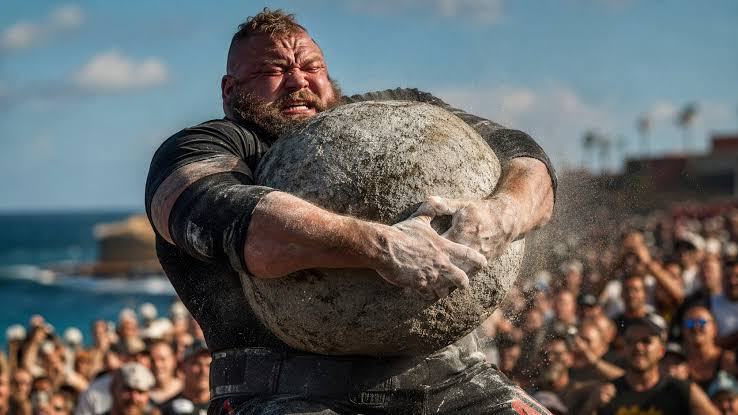
An Atlas stone, log press, deadlift, yoke carry and farmer's walk do not challenge the cardiovascular system in exactly the same way. Differences in posture, contraction type, duration and active muscle mass alter the cardiovascular response.
A post-set cuff reading is not necessarily the maximum pressure
In practice, a cuff measurement taken a few seconds after a set mainly captures recovery, not necessarily the peak pressure during the repetition. Standard noninvasive cuff measurement is not designed to faithfully capture every second-to-second pressure oscillation of a maximal lift.
That is why studies that directly measured pressure during lifting used specialized methods, including intra-arterial catheters. These findings are extremely useful for physiology, but they should not be mechanically applied as personal values to every athlete.
What role does breathing technique play?
Breathing affects intrathoracic pressure, venous return and trunk stability. At very high intensities, a brief Valsalva maneuver can be part of an athlete’s bracing strategy and force production. Cardiovascularly, however, it contributes to a more complex pressure profile.
There is no single breathing rule that fits every exercise, athlete and loading level. Athletes with known hypertension or cardiovascular disease need individualized exercise and breathing strategies under appropriate medical and coaching supervision.
Can resistance training lower blood pressure over time?
Yes. Aggregated evidence indicates that chronic resistance exercise can modestly reduce ambulatory blood pressure. In a meta-analysis published after searches through May 2025, resistance training reduced 24-hour ambulatory systolic blood pressure by about 4 mmHg and diastolic pressure by about 1.5 mmHg in the analyzed groups.
This is an important perspective: the same type of exercise can produce a very large acute pressure surge during the set and a favorable influence on resting blood pressure over the long term. The physiology is not contradictory; the answer depends on the time scale being examined.
After competition, pressure can remain altered
After a resistance session, blood pressure may temporarily fall below pre-exercise values. This is known as post-exercise hypotension. Meta-analyses have found reductions of a few mmHg in systolic and diastolic pressure in the hours following resistance exercise, with considerable individual variation.
During a competition day, this can overlap with sweating, fluid losses, fatigue, ambient temperature and abrupt transitions from exertion to rest. That is why post-event dizziness should not automatically be blamed on a single mechanism.
When should high blood pressure be treated as a warning sign?
A large rise during a maximal lift can be part of the normal acute response to resistance exercise. That does not mean that every value, symptom or athlete should automatically be labeled “normal.”
Exercise-related chest pain, fainting or near-fainting, unusual palpitations, disproportionate shortness of breath, persistently high blood pressure outside training, or a family history of sudden cardiac death or cardiomyopathy warrant medical assessment. Being a Strongman athlete is not, by itself, an adequate explanation for such findings.
Why does resting blood pressure matter if we are talking about maximal lifts?
Because resting blood pressure provides context. Chronically elevated arterial pressure increases the load on the heart and blood vessels, and an athlete with repeatedly elevated readings outside training should not attribute everything to an “athlete's heart.”
In practice, a series of properly measured resting readings is more useful for detecting hypertension than a number taken at a random moment immediately after heavy lifting. When hypertension is suspected, clinicians may recommend repeated standardized measurements or ambulatory monitoring.
The mechanism, seen from above
A heavy lift produces several events at once: muscle contracts and compresses vessels, sympathetic activity rises, intrathoracic pressure may increase, and cardiac output and blood-flow distribution change. As the lift continues, these components can intensify or alternate.
When the repetition ends, the mechanics change again. The muscle no longer compresses vessels in the same way, vasodilation occurs, and pressure can fall. This rapid transition helps explain why a Strongman athlete can experience what feel like two opposite phenomena: “enormous pressure” during the effort and a “hollow head” seconds later.
Conclusion
During heavy lifting, arterial pressure can rise dramatically for very short periods. The main contributors are intense muscular contraction, increased vascular resistance, sympathetic activation and, at very high effort, the Valsalva maneuver and increased intrathoracic pressure. Invasive studies and modern reviews show that these peaks can be far above resting blood pressure.
But the physiology does not stop when the bar is put down. Vasodilation can produce a rapid pressure drop after the set, while long-term resistance training can contribute modestly to lower resting blood pressure. For Strongman, the essential lesson is to separate the acute cardiovascular response of a maximal lift from the athlete’s everyday cardiovascular state.
Selected bibliography
McCartney N. Acute responses to resistance training and safety. Med Sci Sports Exerc. 1999;31(1):31-37. PMID 9927007.
Lalande S, et al. Arterial blood pressure response to heavy resistance exercise. J Appl Physiol. PMID 3980383.
The Acute Cardiorespiratory and Cerebrovascular Response to Resistance Exercise. Sports Med Open. 2021. PMID 34046740.
Effect of Acute Resistance Exercise and Resistance Exercise Training on Central Pulsatile Hemodynamics and Large Artery Stiffness: Part I. PMID 39991443.
Effect of Acute Resistance Exercise and Resistance Exercise Training on Central Pulsatile Hemodynamics and Large Artery Stiffness: Part II. PMID 39991442.
Effect of Resistance Exercise on Ambulatory Blood Pressure: Systematic Review and Meta-Analysis. PMID 40840538.
The blood pressure-lowering effect of a single bout of resistance exercise: A systematic review and meta-analysis of randomised controlled trials. PMID 27512052.
More From The Journal

Training
The Science of Strongman Training - Episode X: Competition Programming
How to build a complete Strongman competition preparation block: calendar, events, volume, intensity, specificity, simulations, autoregulation, tapering and fatigue management.
Training
The Science of Strongman Training - Episode IX: Peaking
Peaking in Strongman: how to turn months of training into maximal competition performance by reducing fatigue, preserving adaptations and managing specificity.