
Nutrition
Series: BODYWEIGHT: HOW DO YOU BUILD A STRONGMAN? - Episode 2: Calorie Surplus and Weight Gain
September 11, 2026
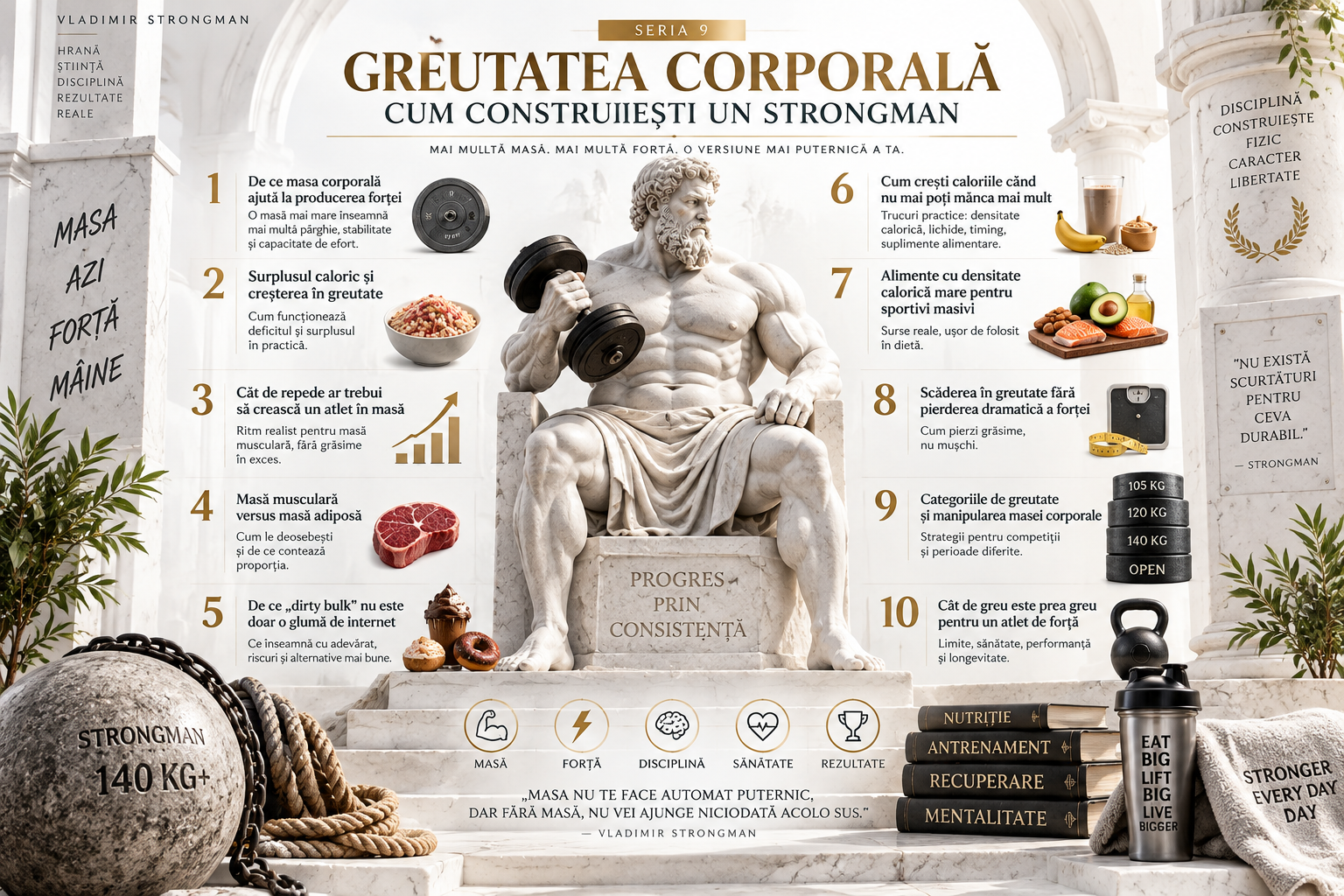
To build a larger strongman, the question is not only how much to eat, but how quickly body mass should rise. A calorie surplus is a tool: it provides energy for training, recovery and tissue construction, but it does not automatically turn every extra calorie into muscle.
A surplus that is too small may leave the athlete hovering around maintenance, especially when training volume is high. A surplus that is too large can push the scale upward quickly, but an increasing share of that speed may come from fat, water and gastrointestinal content rather than contractile tissue.
The practical goal is not to eat as much as possible, but to provide enough available energy for adaptation and then verify whether the new bodyweight buys performance. The literature provides good reasons to use a surplus, while also showing that the optimal surplus cannot be reduced to one universal formula [1][2].
1. What a calorie surplus actually is
A calorie surplus occurs when energy intake exceeds energy expenditure for long enough. The difference does not remain as an abstract sum of calories: the body distributes it among metabolic processes, thermogenesis, movement and tissue storage.
For that reason, a declared 400-kcal surplus does not mean exactly 400 kcal are stored each day. Energy expenditure can change with intake, activity and increasing body mass [8][9][15].
2. Energy balance is dynamic, not rigid accounting
Modern energy-balance models treat bodyweight as a dynamic system. As the body gets heavier, maintenance and locomotion costs rise, and the response to the same food intake can change [9].
This explains why a diet that initially produces rapid gain can later approach maintenance. There is no magic calorie number that remains the same surplus for months.
3. Why a surplus can support hypertrophy
Building muscle tissue has an energetic cost. Protein synthesis, tissue remodeling, high training volumes and recovery all require resources, and low energy availability can limit adaptation [1][5].
A moderate surplus can create an environment in which an athlete tolerates more work, recovers better and has energy available for tissue growth. But energy is permissive rather than sufficient: without progressive training, a surplus does not know that it should become quadriceps, back or triceps.
4. A surplus is not an anabolic switch
There is no simple metabolic transition from maintenance to muscle growth the moment intake exceeds requirements by 200 kcal. Hypertrophy depends on the training stimulus, protein, experience, genetics, sleep and the athlete's starting energy status [1].
That is why two people eating the same surplus can gain very different proportions of lean mass and fat. The body is not a 3D printer that converts excess calories into muscle at a fixed efficiency.
5. Muscle can be gained without a large surplus
Muscle gain can occur near maintenance, especially when the training stimulus improves, training experience is lower or sufficient stored energy is available. Recent research has observed increases in fat-free mass under isocaloric conditions [18].
For an advanced athlete trying to maximize hypertrophy, however, perfect maintenance may be less predictable. A surplus is useful partly because it reduces the risk that large and variable training demands turn apparently neutral days into an energy deficit.
6. Energy deficits show what happens when energy is missing
A meta-analysis found that energy deficits impair lean-mass gains from resistance training even when strength can continue to improve [5].
Its meta-regression estimated that a deficit of about 500 kcal/day was enough, on average, to prevent lean-mass gains in the analyzed data [5]. This does not prove that the opposite, +500 kcal, is ideal; it only shows that energy availability matters for hypertrophy.
7. Science still does not know the exact perfect surplus
A review devoted to this exact question concluded that the additional energy needed to maximize hypertrophy is poorly defined and that classic recommendations have not been sufficiently validated in trained populations [1].
The intelligent approach is therefore controlled: start conservatively, monitor rate of gain and performance, then adjust. It is easier to add energy later than to convert months of excessive surplus into a long cutting phase.
8. The study comparing small and large surpluses
In 2023, Helms and colleagues compared maintenance with targeted surpluses of roughly 5% and 15% in trained lifters over eight weeks [2]. Faster body-mass gain clearly predicted greater increases in skinfold thickness.
In contrast, advantages for muscle thickness or most strength measures did not increase proportionally with the surplus. The authors concluded that faster rates of gain tend primarily to accelerate fat gain [2].
9. What elite athletes show when intentionally gaining weight
In a study of elite athletes, the nutritionally guided group increased bodyweight by about 3.9%, compared with 1.5% in the ad-libitum group [3].
Fat mass increased much more in the group that gained weight faster, while lean-body-mass gain was not superior. In addition, 40-m sprint performance worsened in the more aggressive weight-gain group [3]. For strongman, that is a highly relevant warning.
10. Training experience changes the realistic rate
A beginner has far more potential for rapid muscle growth than an athlete who has trained seriously for ten years. The same surplus can be used more productively by a body that is early on its adaptation curve.
For this reason, recommendations for advanced athletes are more conservative. The closer you are to your individual ceiling, the larger the gap becomes between how quickly bodyweight can rise and how quickly muscle can be added [4].
11. Where the 10-20% surplus recommendation comes from
A review of natural bodybuilding in the off-season proposed roughly 10-20% above maintenance for novice and intermediate athletes, with more conservative approaches for advanced athletes [4].
That range is a starting point, not a strongman law. In a very large athlete with high energy requirements and years of training, 20% can become an enormous number of extra calories. Actual rate of gain and performance are better referees than the percentage alone.
12. The 0.25-0.5% bodyweight-per-week target
The same review suggested approximately 0.25-0.5% of bodyweight per week for novice and intermediate bodybuilders, with slower rates for advanced athletes [4].
This type of target is useful because it forces the athlete to look at the trend rather than stated calories. If bodyweight is rising twice as fast as planned, the real surplus is probably larger than needed.
13. In heavyweights, percentages can create surprising numbers
At 140 kg, 0.25% is about 0.35 kg per week and 0.5% is about 0.70 kg. At 150 kg, the same range becomes roughly 0.38-0.75 kg per week.
For an advanced strongman, the upper end may be too aggressive if sustained for months. The larger total body mass becomes, the more carefully one must ask whether rapid gain represents useful tissue or simply a higher scale reading.
14. Week one does not tell you how much muscle you built
When food intake rises, especially carbohydrate, bodyweight can climb quickly before there has been enough biological time for meaningful hypertrophy. Glycogen stores are replenished, body water changes and more food is present in the gastrointestinal tract [14].
Therefore, +2 kg in one week should not be interpreted as 2 kg of muscle, but it is not automatically 2 kg of fat either. The first weeks of a gaining phase contain substantial physiological noise.
15. Glycogen and water can move the scale
Muscle glycogen is associated with changes in muscle water, and carbohydrate loading can rapidly alter bodyweight and body-composition estimates [14]. The exact relationship between each gram of glycogen and water is not constant enough to serve as a universal formula.
For strongman, that can be good for performance because better glycogen availability can support training volume. For bulk monitoring, however, it means using weekly averages rather than reacting to one morning.
16. Sodium and gastrointestinal content also change bodyweight
A day with more salt, carbohydrate and large meals can temporarily increase measured body mass without new tissue being created. In large athletes, the difference in gastrointestinal contents between two days can be meaningful.
For useful comparisons, weigh-ins should occur under similar conditions, for example in the morning after using the bathroom and before eating, while decisions should come from 7-14 day trends.
17. Creatine can increase body mass without increasing fat
Modern meta-analyses show that creatine supplementation combined with resistance training increases body mass and fat-free mass without a corresponding increase in fat mass [13].
This complicates interpretation of the scale, but not in a negative way. Part of early gain can reflect intracellular water and changes in lean mass, while over the longer term creatine can support training and fat-free-mass gains [13].
18. Muscle grows more slowly than the scale can
The body's capacity to store energy as fat is much faster than its capacity to build functional muscle tissue. In overfeeding studies, a substantial portion of excess energy can inevitably enter fat stores, especially when intake is very high [7].
In a controlled study using roughly 40% overfeeding, fat accounted for about half to more than 90% of excess stored calories depending on dietary protein [7]. An aggressive bulk can therefore produce scale weight far faster than muscle.
19. Protein gives the surplus building material
Training provides the signal, energy provides the context and amino acids provide raw material. Meta-analyses show that additional protein can enhance gains in fat-free mass and strength during resistance training [6].
Morton and colleagues found an average breakpoint around 1.6 g protein/kg/day, with the upper confidence interval around 2.2 g/kg/day [6]. In very large athletes, these values should not be multiplied blindly without considering lean mass, total intake and digestive tolerance.
20. More protein does not rescue an excessive surplus
In Bray's overfeeding trial, normal and high protein intakes increased lean mass and energy expenditure more than very low protein, but fat accumulation was driven primarily by the energy excess [7].
A large surplus therefore does not automatically become lean simply because the diet contains 250 or 300 g of protein. Once protein needs are covered, control of total surplus still matters.
21. Carbohydrate supports training volume
Carbohydrate is a logical place for a substantial share of extra calories when sessions are long and contain many sets and events. It supports glycogen and can become increasingly important as volume rises [12].
However, the systematic review of strength literature does not show that more carbohydrate automatically improves every workout. Benefits are more likely with high volumes, glycogen depletion or multiple sessions [12].
22. Dietary fat increases energy density
For an athlete who struggles to reach energy needs, dietary fat is useful because it provides substantial energy in a small volume. Oils, nuts, nut butters, higher-fat dairy and other dense foods can reduce the burden of huge food volume.
But energy density is also why a surplus can easily escape control. Two or three calorie-dense additions can turn a moderate surplus into a massive one without making the plate look dramatically larger.
23. Where extra calories should come from
Once protein and essential fat needs are covered, much of the additional energy can practically come from carbohydrate to support training, with fat contributing energy density [4][12].
There is no single correct ratio. A strongman doing long yoke, farmer's and medley sessions may have different priorities from a low-volume powerlifter or a bodybuilder in a hypertrophy block.
24. Timing helps, but the daily total leads
A surplus does not need to be crammed into one meal. Spreading energy through the day can improve digestion, and a larger share of carbohydrate can be placed around demanding sessions.
Yet sophisticated timing cannot compensate for a weekly intake that is either insufficient or excessive. For weight gain, medium-term energy balance remains the foundation [9].
25. When liquid calories become useful
For athletes with very high energy needs, caloric drinks can be practical: milk, drinkable yogurt, shakes with fruit and cereal or other tolerated combinations can provide energy without the same chewing burden.
The problem begins when liquid calories become invisible in the accounting. It is easy to drink several hundred extra calories while keeping every solid meal unchanged, pushing the surplus far beyond target.
26. In very large athletes, digestion becomes part of the program
As energy requirements rise, the problem is no longer only which macronutrients to eat, but how much food volume the gastrointestinal tract can tolerate. Five thousand calories from bulky foods can feel very different from the same intake built with greater energy density.
A useful surplus must be repeatable day after day without chronic reflux, bloating or meals that compromise training. A diet that cannot be digested is a poor plan even if its mathematics looks perfect.
27. NEAT: why two people respond differently
Non-exercise activity thermogenesis, or NEAT, includes energy spent on spontaneous movement, standing, walking and fidgeting. In a classic overfeeding study, changes in NEAT explained an important share of individual differences in fat gain [8].
One athlete may become more active when eating more, while another may spontaneously move less. The same 400-kcal increase on paper can therefore produce very different bodyweight trends.
28. A heavier body costs more to maintain
As body mass increases, the energy required to maintain tissue and move the body also increases. Total energy expenditure does not remain fixed [9][15].
That is why a surplus that works at 120 kg can approach maintenance at 130 kg. The diet should be recalibrated from the response, not preserved out of loyalty to an old number.
29. Maintenance is a zone, not one perfect mathematical point
Daily expenditure varies with steps, temperature, training duration, stress and physical work outside the gym. Maintenance should therefore be estimated as an average rather than treated as an exact number.
A yoke and farmer's day may cost considerably more than a rest day. A good plan can keep intake constant for simplicity or periodize it, but the final judgment comes from the weekly trend.
30. Read the scale as a graph, not a daily verdict
Daily bodyweight is noisy. Water, sodium, carbohydrate, timing of the last meal and gastrointestinal transit can change the number even when meaningful tissue change has not occurred.
A seven-day moving average compared with previous weeks is far more useful. Calorie adjustments based on two strange mornings are an excellent way to turn a diet into a yo-yo.
31. Waist and skinfolds add context
If bodyweight rises while waist circumference or skinfolds also climb rapidly, it suggests the surplus is producing substantial fat gain. The 2023 study found a clear relationship between body-mass change and skinfold change [2].
No field method is perfect, but repeated measurements under the same conditions can complement the scale. The goal is not obsession with body-fat percentage, but detection of direction.
32. Performance must be tracked with bodyweight
A strongman bulk is justified when the athlete becomes better at what matters: more weight on log and deadlift, more repetitions at standardized loads, better or maintained carry times and greater tolerance for training volume.
If bodyweight rises steadily while strength stagnates and yoke or farmer's times worsen, the surplus may be producing the wrong adaptation for the sport even if the athlete looks larger.
33. Static events tolerate additional mass better
In maximal deadlift, maximal log or heavy holds, the cost of moving one's own body is smaller than in loaded carries. If a surplus produces muscle and strength, extra body mass can be easier to convert into performance.
That does not mean every gain is beneficial, only that the risk-benefit balance is different. A static-event specialist may tolerate more mass than an athlete who wins contests through speed and medleys.
34. Moving events tax every kilogram
In yoke, farmer's walk, sandbag carries and loading, the athlete must accelerate his own body as well as the implement. Greater body mass helps only when force, stiffness and work capacity rise enough to compensate for the locomotor cost.
That is why a good strongman surplus should also be judged by the stopwatch. Useful kilograms are not only the ones that move the bar, but the ones that do not unnecessarily slow the athlete.
35. Too much surplus can cost speed
Garthe's study in elite athletes matters here: the group that gained more weight accumulated more fat and showed worse 40-m sprint performance without a clear advantage in lean-mass gain [3].
Strongman is not sprinting, but yoke, farmer's and transitions demand acceleration. A stronger but much slower body can be a poor trade for the overall standings.
36. When calories should be increased
If average bodyweight is flat for two or three weeks, performance is not progressing, recovery is poor and intake is genuinely consistent, a modest calorie increase may be justified.
The adjustment should be small enough to evaluate. Large jumps make it impossible to know what dose was actually needed and increase the chance that excess energy is stored as fat.
37. When the surplus should be held or reduced
If bodyweight rises faster than planned, waist and skinfolds climb rapidly and performance is not keeping pace, the first response should not be another meal. The surplus may already exceed what the athlete can productively use.
At that point, holding intake steady or reducing it moderately can let performance catch up with body mass. The goal is development, not winning a race against the scale.
38. The practical formula: enough surplus, enough time, enough evidence
Building a strongman requires metabolic patience. A moderate surplus, sufficient protein, carbohydrate matched to volume, progressive training and trend monitoring provide a better chance of turning energy into useful mass than aggressive overfeeding.
The scale should rise slowly enough that training can plausibly explain as much of the gain as possible. The right question is not how many extra calories can I eat, but what is the smallest surplus that makes me bigger, stronger and still fast?
References / principal sources
[1] Slater GJ et al. Is an Energy Surplus Required to Maximize Skeletal Muscle Hypertrophy Associated With Resistance Training? Front Nutr. 2019;6:131. PMID: 31482093. [2] Helms ER et al. Effect of Small and Large Energy Surpluses on Strength, Muscle, and Skinfold Thickness in Resistance-Trained Individuals. Sports Med Open. 2023;9:102. PMID: 37914977. [3] Garthe I et al. Effect of nutritional intervention on body composition and performance in elite athletes. Eur J Sport Sci. 2013;13(3):295-303. PMID: 23679146. [4] Iraki J et al. Nutrition Recommendations for Bodybuilders in the Off-Season: A Narrative Review. Sports (Basel). 2019;7(7):154. PMID: 31247944. [5] Murphy C, Koehler K. Energy deficiency impairs resistance training gains in lean mass but not strength: a meta-analysis and meta-regression. Scand J Med Sci Sports. 2022;32(1):125-137. PMID: 34623696. [6] Morton RW et al. Protein supplementation and resistance training-induced gains in muscle mass and strength: systematic review, meta-analysis and meta-regression. Br J Sports Med. 2018;52(6):376-384. PMID: 28698222. [7] Bray GA et al. Effect of dietary protein content on weight gain, energy expenditure, and body composition during overeating. JAMA. 2012;307(1):47-55. PMID: 22215165. [8] Levine JA et al. Role of nonexercise activity thermogenesis in resistance to fat gain in humans. Science. 1999;283(5399):212-214. PMID: 9880251. [9] Hall KD et al. Energy balance and its components: implications for body weight regulation. Am J Clin Nutr. 2012;95(4):989-994. PMID: 22434603.
[10] Spillane M, Willoughby DS. Daily Overfeeding from Protein and/or Carbohydrate Supplementation for Eight Weeks in Conjunction with Resistance Training. J Sports Sci Med. 2016;15(1):17-25. PMID: 26957922. [11] Ribeiro AS et al. Effects of Different Dietary Energy Intake Following Resistance Training on Muscle Mass and Body Fat in Bodybuilders. J Hum Kinet. 2019;70:125-134. PMID: 31915482. [12] Henselmans M et al. The Effect of Carbohydrate Intake on Strength and Resistance Training Performance: A Systematic Review. Nutrients. 2022;14(4):856. PMID: 35215506. [13] Desai I et al. The Effect of Creatine Supplementation on Resistance Training-Based Changes to Body Composition: A Systematic Review and Meta-analysis. J Strength Cond Res. 2024;38(10):1813-1821. PMID: 39074168. [14] Muscle Glycogen Assessment and Relationship with Body Hydration Status: A Narrative Review. Nutrients. 2023. PMID: 36615811. [15] Changes in Energy Expenditure with Weight Gain and Weight Loss in Humans. Curr Obes Rep. 2016. PMID: 27739007. [16] Hypercaloric 16:8 time-restricted eating during 8 weeks of resistance exercise in well-trained men and women. 2025. PMID: 40241374. [17] Predicting Adaptations to Resistance Training Plus Overfeeding Using Bayesian Regression. Sports Med Open. 2021. PMID: 33919267. [18] Comparison of two nutritional protocols in body re-composition of resistance-trained participants. 2026. PMID: 41940947.
More From The Journal

Training
The Science of Strongman Training - Episode X: Competition Programming
How to build a complete Strongman competition preparation block: calendar, events, volume, intensity, specificity, simulations, autoregulation, tapering and fatigue management.

Training
The Science of Strongman Training - Episode IX: Peaking
Peaking in Strongman: how to turn months of training into maximal competition performance by reducing fatigue, preserving adaptations and managing specificity.