
Biomechanics
Series: BODYWEIGHT: HOW DO YOU BUILD A STRONGMAN? - Episode 1: Why Body Mass Helps Produce Force
September 11, 2026
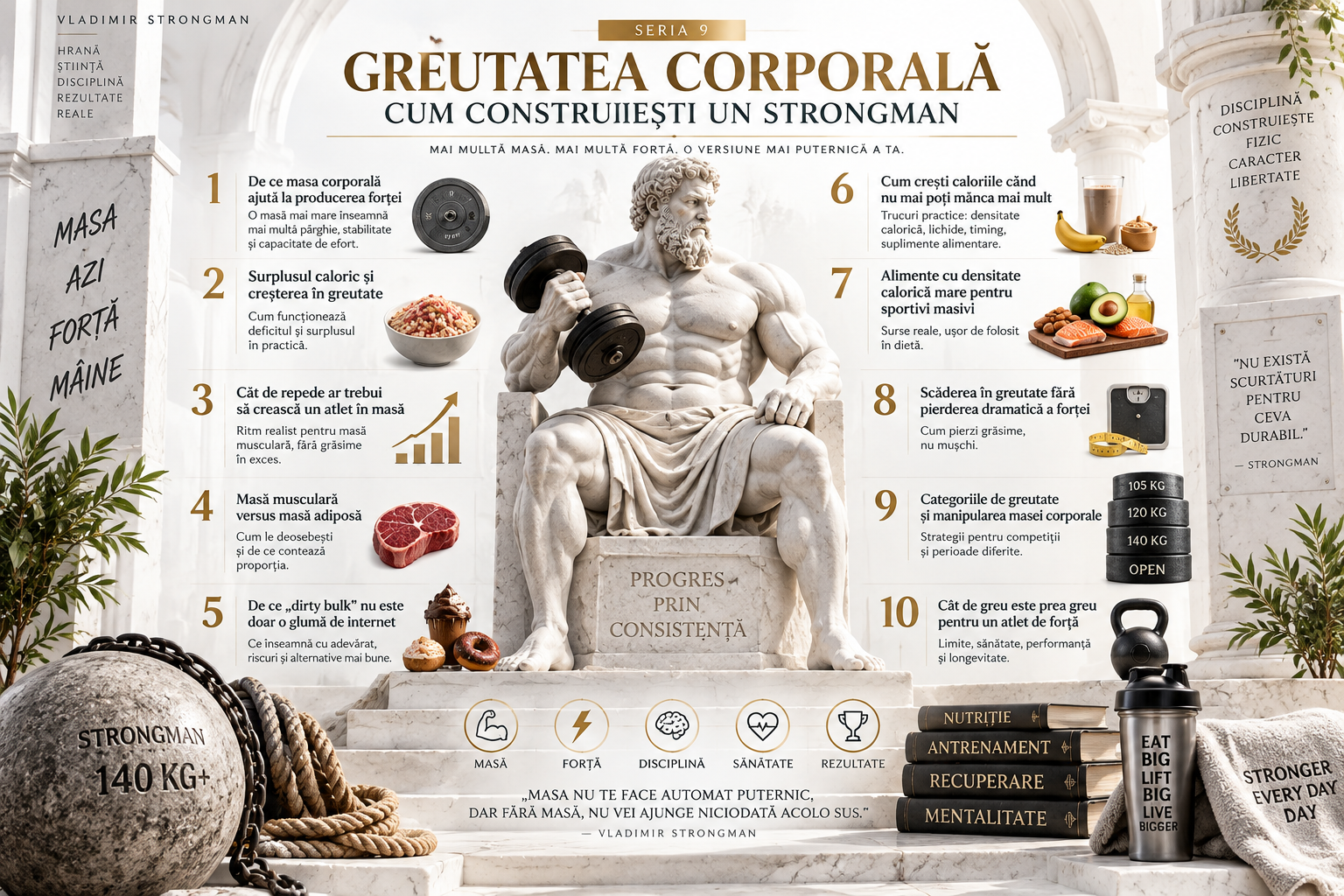
The scale does not produce force. An extra kilogram does not contract, generate tension or lift a log on its own. Yet in strength sports, larger athletes tend to produce more absolute force because greater body mass can come with more muscle tissue, a more robust structure and geometry that favors certain movements.
In strongman, the relationship is even more interesting. The athlete does not simply move a barbell: he pulls trucks, carries yokes and farmers, loads stones, stabilizes awkward objects and must turn the entire body into a platform capable of transmitting force.
But “heavier” does not automatically mean “stronger.” This episode separates mass that can contribute to performance from mass that merely appears on the scale and explains why muscle, cross-sectional area, leverage, trunk stiffness and event type matter more than the raw bodyweight number.
1. What it means to say body mass helps strength
The statement should be read as a biomechanical and physiological relationship, not as a simple law. Body mass is often an indirect marker of muscle size and body dimensions, and these features can permit greater absolute force production [1][3][4].
So when two athletes differ by 30 kg, the useful question is not only who weighs more, but what builds that difference: muscle, bone, water, adipose tissue and the biomechanical proportions created by that body.
2. Force begins in contractile tissue
Muscle is the mechanical engine of movement. Muscle fibers develop tension through actin-myosin interaction and tendons transmit that tension to the skeleton; adipose tissue does not have this contractile function.
Therefore, the relationship between body mass and strength is mediated largely by lean mass and the amount of muscle an athlete can recruit effectively, not by simply accumulating any kind of tissue [4][5][6].
3. Physiological cross-sectional area: “how many cables pull in parallel”
One of the most important determinants of a muscle's force capacity is physiological cross-sectional area, or PCSA. In simple terms, it reflects how much contractile tissue is arranged in parallel to pull in the same direction [1].
Think of a cable made from many strands. Cable length matters for other properties, but the number of strands pulling in parallel is fundamental to the total tension the system can tolerate.
4. Specific tension: why equal muscle area does not always mean equal force
Strength is not explained by size alone. “Specific tension” describes maximal force relative to muscle area, and a 2024 systematic review proposed about 26.8 N/cm² as a reference value for human muscle in vivo, while noting substantial variation across muscles and methods [1].
This helps explain why two people with similarly sized muscles can perform differently. Neural activation, architecture, joint moment arms, technique and tendon properties all change how much structural potential reaches the implement.
5. Bigger muscle, greater potential
Classic studies have found a positive relationship between muscle area and force. Maughan and colleagues reported that trained subjects had both a larger knee-extensor cross-sectional area and greater force than untrained subjects [2].
The relationship is not perfect, but the direction is robust: when training adds functional contractile tissue, the ceiling for absolute strength tends to rise.
6. What long-term trained athletes show us
In a study comparing long-term resistance-trained people with untrained controls, the trained group had roughly 60% greater maximal voluntary torque, 56% greater quadriceps volume and 41% greater PCSA [3].
Differences in specific tension and joint moment arm were much smaller than the difference in muscle volume. The message for strongman is important: useful hypertrophy is not decoration, it is one of the major structural foundations of strength.
7. Powerlifting data: muscle mass predicts kilograms lifted
In 20 elite male powerlifters, including world champions, skeletal muscle mass was strongly correlated with absolute performance: approximately r=0.93 for squat, 0.88 for bench press and 0.84 for deadlift [4].
Those correlations do not prove that every kilogram of muscle automatically adds a fixed number of kilograms to the bar, but they show how tightly muscle size and absolute strength are linked at high performance levels.
8. Lean mass tells us more than raw bodyweight
DXA data from powerlifting support the same idea. In a 2023 study, lean body weight strongly predicted the powerlifting total, with reported correlations around r=0.90-0.92 in the models used [5].
When some of the variability from fat mass is removed, the relationship between body size and strength becomes more coherent. For a strongman, the key question is therefore “how much functional mass do I have?”, not merely “how much do I weigh?” [6][11].
9. Strongman: the sport in which the whole body becomes a tool
Strongman demands integration of the entire body. In the study by Winwood and colleagues, body mass, fat-free mass and muscle mass showed moderate-to-large relationships with event performance, while the combination of body mass and squat 1RM, termed “system force,” had the strongest relationship with overall strongman performance [7].
That finding captures the sport well: how strong the athlete is matters, but so does how large and stable the system applying that force is.
10. What an elite strongman body looks like
A study of 18 elite strongmen reported averages of about 153 kg body mass, 118 kg lean mass and nearly 31 kg fat mass. The authors described these athletes as being among the largest male athletes studied [8].
The interesting number is not only 153 kg, but the enormous quantity of lean tissue. The strongman body is large because the sport rewards a large structural reserve of muscle and bone, not because adipose tissue itself produces force.
11. Total mass and useful mass are not the same thing
Two people can both weigh 140 kg and still possess completely different force-producing capacities. One may carry far more lean mass, the other more adipose tissue, and the scale cannot tell the difference.
That is why a strongman bulk should be judged using performance, muscular girths, body composition, event speed and work tolerance together, not only the direction of bodyweight.
12. Why fat is not the engine
Adipose tissue is metabolically and endocrinologically active, but it is not contractile tissue. It does not directly add sarcomeres in parallel and does not directly increase muscle PCSA.
In Winwood's strongman study, body-fat percentage generally showed small or unclear relationships with performance, unlike muscle mass, fat-free mass and muscular girths [7]. This is why “getting fatter” and “building a strongman” are not synonyms.
13. Total mass can still change mechanics
The fact that fat does not produce force does not mean total mass is biomechanically invisible. A heavier body can alter center of mass, ground interaction, position relative to the implement and the ratio between external load and athlete mass.
In some events these effects can help, while in others they can become expensive. The benefit depends on event geometry, how much the athlete must travel and how much speed is required [9].
14. The idea of “system force”
In strongman, the implement and athlete often behave as one mechanical system. Winwood observed that the sum of body mass and squat 1RM was very strongly associated with overall performance in the group studied [7].
This should not be treated as a universal formula, but as a clue: when an athlete becomes larger and stronger at the same time, the ability to control heavy objects may improve more than a single isolated test suggests.
15. Truck pull: where mass can become an ally
In truck pull, the athlete must create horizontal force, manage traction and maintain an effective body angle. Greater body mass, when accompanied by strength and technique, can help build a system capable of transmitting large forces into the ground.
But mass without strength does not solve the task. If the athlete cannot produce enough force at the hip, knee and ankle or cannot hold position, the additional kilograms are simply more mass that must be organized.
16. Log press: muscle mass and the pressing platform
In log press, the deltoids, triceps, upper back, trunk and lower limbs must turn the body into a rigid platform. More muscle in these regions can raise force potential and stabilization capacity.
In pressing sports, research in powerlifters shows that lean mass, arm circumference and agonist cross-sectional area are associated with bench-press performance [12]. The structural principle transfers logically to strongman pressing even though the technique differs.
17. Yoke: you must move both the implement and yourself
The yoke shows why body mass has two faces. A large, very strong athlete can make a 400 kg yoke represent a smaller multiple of his own body mass than it does for a much lighter athlete.
Yet every step accelerates the athlete's body too. When mass rises without enough increase in strength, stiffness and speed, the advantage begins to erode. Yoke biomechanics involve very high spinal loads and massive trunk co-contraction [9][10].
18. Farmer's walk: relative strength returns
Farmer's walk is not simply a deadlift with two handles. After the pick, the athlete must accelerate, maintain rapid steps, control implement swing and preserve grip.
The systematic review of strongman biomechanics shows that loaded-carry performance also depends on gait variables such as ground-contact time and stride characteristics [9]. Here, extra body mass is valuable only when the “engine” and speed improve with it.
19. Atlas Stones: the body becomes a platform
In Atlas Stones, the athlete must close space around a bulky object, lap it and then extend it toward the platform. A thick trunk, powerful hips and substantial muscle mass can provide a strong mechanical base.
But the event remains highly dependent on technique, coordination and positioning. Strongman biomechanics studies show that awkward objects change trunk demands and muscle-activation sequencing, making success impossible to reduce to body mass alone [9][10].
20. A stiff trunk is a bridge for force
McGill and colleagues showed that events such as yoke, farmer's walk and Atlas stones demand high trunk activation and stiffness to transfer force between hips, spine and implement [10].
A more muscular trunk is therefore not merely visual. It can mean more tissue capable of stabilizing and bracing the body so that force from the legs and hips is not lost through an unstable link.
21. Leverage can turn the same muscle force into a different outcome
Muscle produces force, but the joint experiences torque. Torque depends on force and moment arm, and moment arms differ between people and positions [1][3].
That is why two athletes with the same muscle mass can express different external strength. Skeleton, insertions, segment lengths and technical position can amplify or reduce the advantage created by muscular size.
22. Segment lengths matter
Powerlifting data show that body proportions relate differently to squat, bench press and deadlift. Some trunk and limb ratios are associated with advantages in one lift and disadvantages in another [13].
Strongman multiplies this problem because the events are so different. The ideal body for log press is not necessarily the ideal body for deadlift, farmer's walk or loading.
23. A large torso and pressing events
In bench press, athletes with certain torso and arm dimensions can have favorable geometry and a more stable base. In elite powerlifters, structural factors including lean mass, brachial index, arm circumference and agonist CSA were among the strongest predictors of performance [12].
In strongman, a thick torso and massive shoulder girdle can support a log and other objects, but the advantage still must be converted through technique. Anatomy provides conditions, not a successful repetition.
24. Deadlift can reward different proportions
The same anthropometric work in powerlifters shows that profiles associated with deadlift contribution to the total differ from those associated with squat and bench, including relative limb and trunk lengths [13].
This explains why there is no single perfect “strength body.” Body mass must be interpreted together with where that mass sits and the leverage offered by the skeleton.
25. Absolute and relative strength are different currencies
Absolute strength asks, “how many kilograms can you move?” Relative strength asks, “how much can you move for your body size?” Strongman often rewards the first, but moving events never let the athlete ignore the second.
An athlete can become absolutely stronger after gaining weight and still move more slowly if force does not increase enough to compensate for the heavier body.
26. Why heavier classes lift more in absolute terms
Heavier athletes generally have the potential to carry more muscle mass and larger muscle cross-sections. That is why absolute records tend to rise as bodyweight class rises.
But the increase is not one-to-one. A 150 kg athlete is not twice as strong as a 75 kg athlete simply because he has twice the mass. Body geometry and biological scaling prevent a linear relationship [11][14].
27. Allometry: why kilograms do not scale simply
Allometry studies how a characteristic changes with body size. In strength research, simply dividing performance by body mass can over-favor small athletes, so comparisons require better scaling models [11].
Folland and colleagues showed that fat-free mass can explain variation in strength better than raw body mass because it reduces the confounding introduced by adipose tissue [11].
28. More mass brings diminishing returns
As the body grows, mass increases in volume while force-producing capacity depends heavily on cross-sectional dimensions and neuromuscular quality. The advantage therefore does not rise proportionally with every kilogram added.
In practice, the first kilograms of muscle gained by an underdeveloped strength athlete can be extremely valuable; additional kilograms on an already enormous athlete may provide less return while imposing a greater locomotor cost.
29. Modern data confirm the relationship is not linear
A 2026 analysis of more than 457,000 powerlifters showed that the relationship between body mass and performance follows allometric patterns and that the scaling exponent changes at the highest levels of performance [14].
The lesson for strongman is not to copy a powerlifting equation, but to understand that “+10% bodyweight = +10% strength” is a false assumption.
30. Static events favor absolute strength more strongly
Maximal deadlift, maximal log or a heavy hold primarily demand the ability to generate and sustain very large forces. In these events, greater muscle mass and a robust body system tend to carry high value.
The cost of moving the athlete's body is relatively small compared with a carry or medley. A mass gain can therefore be easier to convert into performance when it brings genuine strength.
31. Moving events demand a compromise
Yoke, farmers, loading medleys and sandbag carries require strength but also acceleration, step frequency, changes of direction and conditioning. Their biomechanics clearly show that performance is not simply an extension of 1RM strength [9].
The athlete must transport both the implement and his own body. This creates the classic strongman compromise: enough mass to be extremely strong, but not so much nonfunctional mass that locomotion collapses.
32. Every kilogram has to be accelerated
Basic mechanics tells us that acceleration depends on net force relative to system mass. If athlete mass increases while force applied to the ground stays the same, potential acceleration falls.
This is why a successful strongman bulk cannot be judged only by 1RM. Track 20 m times, transition speed, repeat-effort ability and how quickly the athlete recovers between events.
33. Mass can add stability, but stability must be actively produced
A large body has greater inertia and may be harder for an implement to perturb, but performance stability is not passive. It depends on co-contraction, center-of-mass position, intra-abdominal pressure and motor control.
In yoke, for example, studies show that trunk stiffness is actively produced by musculature under extreme load [10]. Muscle mass capable of creating stiffness is therefore far more valuable than inert bodyweight.
34. Where the mass sits matters
A kilogram of muscle on the thighs and hips does not serve the same function as a kilogram on the arms, and neither serves the same function as a kilogram of abdominal fat. Mass distribution changes which movements the body can support.
For strongman, development of the trunk, hips, thighs, upper back, shoulders and arms should be related to event demands. The useful concept is not “big everywhere,” but “large enough where the event needs force and stability.”
35. Useful kilograms versus ballast
A kilogram is “useful” when it contributes to force production or transmission, stability, load tolerance or repeat-effort recovery without disproportionately degrading speed and mobility.
A kilogram becomes ballast when it raises the cost of movement and systemic load without bringing measurable performance. The line is not fixed and will differ between a static-event specialist and an athlete who wins contests through carries.
36. When gaining body mass makes sense
Body-mass gain makes sense when the athlete has real room for hypertrophy, can maintain movement quality and sees strength, repetitions and target events improve alongside bodyweight.
If bodyweight rises while log press, squat, deadlift and carry times stagnate or deteriorate, the scale is no longer describing a useful adaptation. It is describing only a change in mass.
37. How to test whether mass is making you better
Track body mass together with relevant muscular girths, body-composition estimates when available, 1RMs, repetitions at standardized loads and yoke/farmer times. One metric can mislead; a panel of metrics is much harder to fool.
In strongman, the events deliver the final verdict. If you become stronger at similar technique without losing excessive speed and work capacity, the additional mass is probably working for you.
38. The central idea: build a system, not a number on the scale
Body mass helps force production mainly when it represents more contractile tissue, an architecture capable of transmitting force and leverage the athlete can use. It may also create context-specific mechanical advantages, but body mass itself is not strength.
A strongman should not aim to be as heavy as possible, but as strong and functional as possible at a bodyweight he can sustain. That is where real construction begins: not “how do I add kilograms?”, but “what kind of kilograms buy me performance?”
References / principal sources
[1] Persad LS et al. Specific tension of human muscle in vivo: a systematic review. J Appl Physiol. 2024;137(4):945-962. PMID: 39169839. [2] Maughan RJ, Watson JS, Weir J. Muscle strength and cross-sectional area in man: a comparison of strength-trained and untrained subjects. Br J Sports Med. 1984;18(3):149-157. PMID: 6487941. [3] Maden-Wilkinson TM et al. What makes long-term resistance-trained individuals so strong? J Appl Physiol. 2020;128(4):1000-1011. PMID: 31873069. [4] Ye X et al. Relationship between lifting performance and skeletal muscle mass in elite powerlifters. J Sports Med Phys Fitness. 2013;53(4):409-414. PMID: 23828289. [5] Ferland PM et al. Body Composition and Maximal Strength of Powerlifters: A Descriptive Quantitative and Longitudinal Study. Int J Exerc Sci. 2023;16(4):828-845. PMID: 37637239. [6] The relationship between body composition measured by dual-energy X-ray absorptiometry and maximal strength in classic powerlifting. J Sports Med Phys Fitness. 2020;60(3):407-416. PMID: 31663317. [7] Winwood PW, Keogh JWL, Harris NK. Interrelationships between strength, anthropometrics, and strongman performance in novice strongman athletes. J Strength Cond Res. 2012;26(2):513-522. PMID: 22233785.
[8] Kraemer WJ et al. Body Composition in Elite Strongman Competitors. J Strength Cond Res. 2020;34(12):3326-3330. PMID: 33235016. [9] Hindle BR, Lorimer A, Winwood P, Keogh JWL. The Biomechanics and Applications of Strongman Exercises: a Systematic Review. Sports Med Open. 2019;5(1):49. PMID: 31820223. [10] McGill SM, McDermott A, Fenwick CMJ. Comparison of different strongman events: trunk muscle activation and lumbar spine motion, load, and stiffness. J Strength Cond Res. 2009;23(4):1148-1161. PMID: 19528856. [11] Folland JP, Mc Cauley TM, Williams AG. Allometric scaling of strength measurements to body size. Eur J Appl Physiol. 2008;102(6):739-745. PMID: 18172672. [12] Reya M et al. Factors Underlying Bench Press Performance in Elite Competitive Powerlifters. J Strength Cond Res. 2021;35(8):2179-2186. PMID: 30908368. [13] Ferland PM, Laurier A, Comtois AS. Relationships Between Anthropometry and Maximal Strength in Male Classic Powerlifters. Int J Exerc Sci. 2020;13(4):1512-1531. PMID: 33414873. [14] Montenegro S, Wicker P, Donath L. An allometric large-scale analysis of the observed performance limits and sex differences in elite powerlifting. Front Physiol. 2026;17:1847605. PMID: 42422363.
More From The Journal

Training
The Science of Strongman Training - Episode X: Competition Programming
How to build a complete Strongman competition preparation block: calendar, events, volume, intensity, specificity, simulations, autoregulation, tapering and fatigue management.
Training
The Science of Strongman Training - Episode IX: Peaking
Peaking in Strongman: how to turn months of training into maximal competition performance by reducing fatigue, preserving adaptations and managing specificity.