
Nutrition
Series: Fats: Energy, Hormones and Structure - Episode 8: Fats in Meat, Eggs and Dairy
September 10, 2026
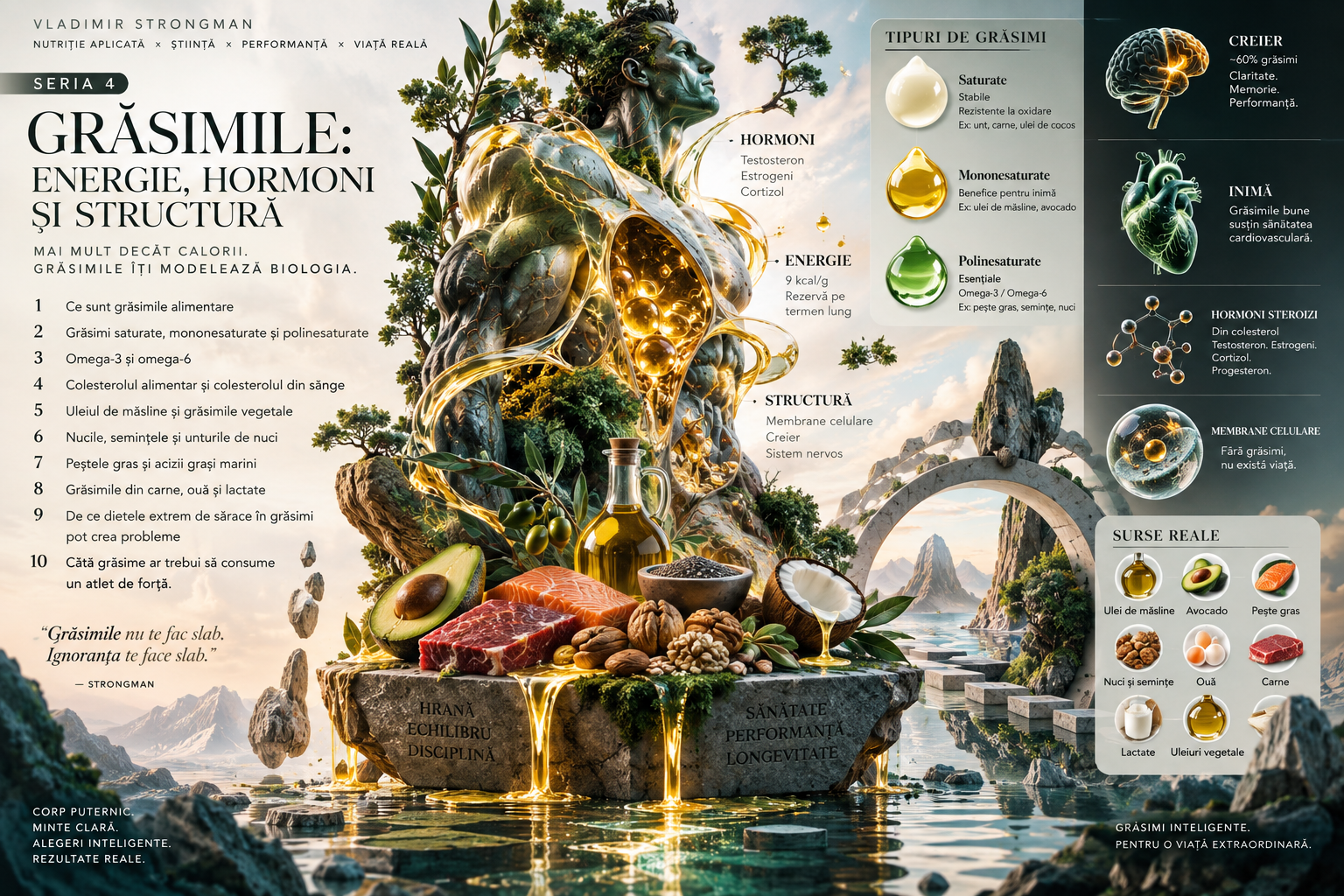
Meat, eggs and dairy are three of the most important animal sources of dietary fat, but they do not form a metabolically uniform category. Fat from a cut of beef, an egg yolk and full-fat yogurt differs in fatty-acid composition, cholesterol, phospholipids, fat-soluble vitamins and in the food matrix in which it is consumed.
For a strongman, these foods have a double identity: they are valuable sources of protein and micronutrients, yet they can also add large amounts of fat and energy very quickly. When calorie requirements are very high, the difference between lean and fatty meat, skim and whole milk, or egg whites and whole eggs can meaningfully change daily intake.
This episode separates myths from physiology. We will follow fats in meat, eggs and dairy from their chemical composition to effects on LDL, HDL, ApoB, satiety and recovery, while also discussing processing, fermentation, cooking and the practical place of these foods in a strength athlete’s diet.
1. Animal fat is not a single substance
In everyday language, “animal fat” sounds like one category, but chemically it is a mixture of triglycerides, phospholipids, cholesterol and saturated, monounsaturated and polyunsaturated fatty acids. The proportions differ greatly among species, tissues and foods. Butter, egg yolk and intramuscular meat fat therefore should not be treated as metabolically identical.
Composition can vary even within the same species. Feed, breed, age and anatomical cut influence the lipid profile. A lean cut of beef and a heavily marbled ribeye come from the same animal species but have very different energy densities and fat contents.
2. Saturated fatty acids matter, but they do not explain everything
Meat and dairy can provide meaningful amounts of saturated fatty acids, especially palmitic and stearic acids. Their effects are not identical: palmitic acid generally raises LDL-C more, whereas stearic acid is relatively neutral for LDL compared with several other saturated fatty acids. The final response still depends on the whole food and on what nutrient is replaced.
3. Stearic acid makes ruminant fat more interesting than it first appears
Beef fat contains a meaningful proportion of stearic acid, an 18-carbon saturated fatty acid. The body can convert part of it to oleic acid through desaturation. This helps explain why not all saturated fatty acids have identical effects on circulating lipoproteins.
4. Beef also contains substantial oleic acid
A substantial fraction of beef fat is monounsaturated, especially oleic acid. The same fatty acid dominates olive oil, although the food matrix and accompanying fatty acids are very different. Animal origin does not mean that every lipid in the food is saturated.
5. Pork fat has a different lipid profile from beef
Pork fat usually contains a high proportion of monounsaturated fatty acids, and its profile can be strongly influenced by the animal’s feed. Lard is therefore not simply “saturated fat.” It remains extremely energy-dense, so the amount used matters greatly for total calorie intake.
6. Poultry can contain more polyunsaturated fat
Chicken and turkey fat often contain a greater proportion of polyunsaturated fatty acids than ruminant fat. Skin carries a substantial amount of lipid, so skinless chicken breast and skin-on thigh are very different foods in terms of energy density.
7. The cut matters more than the broad label
“Red meat” can mean a very lean muscle or a heavily marbled cut. For fat intake, the specific cut often matters more than the species label. Tenderloin, sirloin, rib, neck or brisket can differ by hundreds of kilocalories at the same serving weight.
8. Marbling improves flavor but also raises calorie density
Intramuscular fat contributes to tenderness, flavor and juiciness. Nutritionally, however, marbling can turn an apparently “protein-based” serving into a food supplying a large amount of energy from fat. For an athlete monitoring body weight, that is a major practical difference.
9. Processed meat is not the same as fresh meat
Sausages, salami, bacon and other processed meats can combine fat, salt, nitrites, high energy density and substantial processing. Health associations with these foods cannot be attributed to saturated fat alone. Processing is an essential variable when interpreting epidemiological evidence.
10. What replaces meat matters
In nutrition, the useful question is not only “do you eat meat?” but “what would be eaten instead?” Replacing very fatty meat with fish, legumes or a leaner cut changes saturated fat, unsaturated fat, fiber and energy density at the same time. This is why substitution studies are more informative than simplistic comparisons.
Modern guidelines generally pair reductions in saturated fat with replacement by unsaturated fats or fiber-rich carbohydrates, not by sugar and refined starch. The replacement nutrient can profoundly change the metabolic result.
11. Egg fat is concentrated in the yolk
Egg white is mostly water and protein, whereas almost all of the egg’s fat is found in the yolk. Whole eggs and an equivalent amount of egg whites therefore differ greatly in energy content and nutrient matrix.
12. Egg yolk contains both saturated and unsaturated fats
Egg fat is mixed: it contains monounsaturated, polyunsaturated and saturated fatty acids. The exact profile can be modified by hen feed, which is why omega-3-enriched eggs differ somewhat from conventional eggs.
13. Eggs are a major source of dietary cholesterol
Egg yolk contains substantial dietary cholesterol, making eggs a central character in many nutrition controversies. Yet dietary cholesterol and blood cholesterol are not the same thing. Intestinal absorption, hepatic synthesis and LDL-receptor regulation determine the final response.
14. Responses to egg cholesterol differ among individuals
Some people show larger increases in LDL-C and HDL-C when cholesterol intake rises, whereas others respond less. Genetics, intestinal absorption and background diet contribute to this variability. The same egg intake therefore does not produce an identical lipid profile in everyone.
15. Eggs also provide phospholipids
Egg yolk is rich in phospholipids, especially phosphatidylcholine. These molecules are components of cell membranes and participate in lipid transport. Egg fat therefore arrives in a matrix that differs from isolated fats such as butter or lard.
16. Choline is one of the yolk’s major strengths
Eggs are an important food source of choline, a nutrient required for phospholipids, neurotransmission and hepatic lipid metabolism. Removing all yolks to reduce fat can simultaneously reduce intake of choline and several other micronutrients.
17. The yolk carries fat-soluble vitamins
Vitamins A, D, E and K occur in varying amounts in the yolk, together with carotenoids such as lutein and zeaxanthin. A whole egg is therefore more than protein plus fat: it is a complex nutrient matrix.
18. Eggs should not be judged apart from the rest of the meal
Eggs can appear in a meal with vegetables and whole grains or in one built around bacon, sausages, butter and pastries. Those contexts differ greatly in energy, sodium, fiber and fat. Food pairing may explain part of the inconsistency seen across observational studies.
19. For athletes, whole eggs can efficiently supply energy and protein
During high-calorie phases, whole eggs can provide protein, fat and micronutrients without excessive food volume. During fat-loss phases, combining whole eggs with extra egg whites can keep protein high while lowering total energy intake.
20. Dairy is more than saturated fat
Milk, yogurt, kefir, cheese, cream and butter come from the same raw material but have radically different food matrices. Water, protein, lactose, calcium, fermentation and physical structure can alter digestion and metabolic responses. Treating all dairy only by its saturated-fat percentage misses much of the picture.
Modern dairy evidence suggests that the cardiovascular effect of the whole food cannot be perfectly predicted from saturated-fat content alone. Dairy is a classic example of the food-matrix concept.
21. Milk fat is chemically diverse
Milk fat contains hundreds of fatty-acid species, including short-, medium- and long-chain fatty acids. Palmitic, stearic and oleic acids are among the most quantitatively important. This diversity makes dairy fat more complex than a simple pool of saturated triglycerides.
22. Butyric acid is characteristic of dairy fat
Butter and other dairy fats contain butyric acid, a short-chain fatty acid that contributes to their characteristic aroma. Dietary butyrate should not be confused with the butyrate produced in the colon from fiber fermentation, but its presence illustrates the diversity of milk fat.
23. Ruminant dairy contains naturally occurring trans fats
Milk and meat from ruminants contain small amounts of trans fatty acids formed naturally in the rumen. They should not be assumed to have the same exposure pattern as industrial trans fats, yet public-health guidance generally recommends keeping total trans-fat intake as low as practical.
24. CLA exists, but it does not turn dairy into a fat-loss supplement
Conjugated linoleic acid, or CLA, occurs naturally in ruminant foods. Although marketed as a body-composition supplement, dietary amounts are small, and supplement studies do not justify presenting cheese or butter as fat-burning agents.
25. Whole and skim milk differ mainly in energy density
Removing part of the fat lowers milk’s calorie density without removing most protein and calcium. For a strongman struggling to reach calorie targets, whole milk can be useful. For someone reducing body weight, lower-fat versions provide more energy flexibility.
26. Yogurt differs from milk through fermentation and structure
Fermentation changes lactose, acidity and parts of the food structure. Yogurt can be full-fat or low-fat, plain or heavily sweetened, so fat percentage does not tell the whole story. Choice should reflect the complete composition and the purpose of the diet.
27. Kefir combines dairy fat with complex fermentation
Kefir results from bacterial and yeast fermentation and can have a different matrix from plain milk. Its fat content depends on the milk used. Potential benefits of fermentation do not make every sweetened kefir automatically superior.
28. Cheese concentrates fat, protein and sodium
By removing water and through ripening, cheese becomes far more nutrient-dense than milk. A small serving can provide substantial protein, calcium, fat and sodium. For athletes with very high calorie intakes, cheese is efficient, but portions can rapidly increase total energy.
29. The cheese matrix can modify lipid responses
Controlled studies have found that similar amounts of dairy fat can produce different LDL-C responses when consumed as cheese rather than butter. Calcium, fat structure and interactions within the food matrix are possible mechanisms. The whole food matters.
30. Butter is close to an isolated fat
Butter contains far less protein and water than milk and is highly energy-dense. Practically, it behaves more like a cooking fat than a protein food. A tablespoon added casually to several meals can rapidly raise daily calories and saturated-fat intake.
31. Cream can turn a meal into a very high-calorie one
Cream is lipid-dense and easy to underestimate when used as a sauce or topping. For an athlete gaining mass it can be an energy tool. For someone pursuing a calorie deficit, the same property can become a trap.
32. Dairy fat and dietary cholesterol are different things
Full-fat dairy contains cholesterol, but its effect on LDL-C is also influenced by saturated fatty acids. Dietary cholesterol should not be confused with saturated-fat content. They are distinct components with distinct mechanisms that coexist in some foods.
33. Lean meat can provide little fat despite being animal-based
Lean beef, pork or poultry can provide substantial protein with relatively little fat. Choosing lean cuts and trimming visible fat can dramatically change the energy profile of a meal without removing meat from the diet.
34. Poultry skin is a simple calorie dial
Removing poultry skin cuts a substantial amount of fat without radically changing the muscle protein content. For an athlete, this is a simple way to adjust calories in the same meal according to the training phase.
35. Cooking can add more fat than the food originally contained
A lean cut of meat can remain relatively lean when grilled or can absorb substantial oil when breaded and fried. Evaluating a meal therefore requires considering cooking fat, not only the raw food composition.
36. High temperatures do more than melt fat
High heat promotes lipid oxidation and Maillard reactions. Browning adds flavor, but excessive burning and charring are not culinary goals. Moderate cooking and avoiding repeated overheating of fats is a more rational approach.
37. Fat does not magically disappear when it melts
During cooking, some fat can drain from meat, but some remains in the food or cooking juices. The difference between raw and cooked weight also reflects water loss. Calorie comparisons should therefore use a consistent basis, raw with raw or cooked with cooked.
38. Animal fat is an efficient way to raise calories
At roughly 9 kcal per gram, fat increases energy intake without enormous food volume. For a strongman consuming several thousand kilocalories per day, this can be useful. The same efficiency also makes it easy to overshoot calories, so body composition and metabolic markers still need attention.
39. Satiety depends on the food, not only grams of fat
A whole egg, a piece of meat and a spoonful of butter can contain similar amounts of fat yet produce very different satiety because they differ in protein, water, volume and structure. The food matrix influences how easily excess energy is consumed.
40. Saturated fat and LDL-C: the relationship is real but needs proper interpretation
On average, replacing some saturated fat with polyunsaturated fat lowers LDL-C and cardiovascular risk. This does not mean that every food containing saturated fat has the same effect. Amount, food source, overall dietary context and replacement nutrient all matter.
The World Health Organization recommends keeping saturated fat below 10% of total energy and replacing it mainly with unsaturated fats or fiber-rich carbohydrates. This is population guidance, not a complete description of every individual food.
41. ApoB adds information beyond LDL-C
LDL-C reflects cholesterol carried within LDL particles, whereas ApoB approximates the total number of atherogenic particles. In some people, especially with obesity, high triglycerides or insulin resistance, the two measures can be discordant.
42. High HDL-C is not permission to ignore LDL
A high HDL-C does not automatically cancel the risk associated with elevated LDL-C or ApoB. HDL participates in cholesterol transport, but its plasma concentration does not function as a mathematical shield against atherogenic particles.
43. Triglycerides tell a different story from cholesterol
High triglycerides relate to VLDL metabolism, energy excess, alcohol, insulin resistance and other factors. An athlete can have acceptable LDL-C with high triglycerides or the reverse. The lipid panel should be interpreted as a system, not as one isolated number.
44. Large body mass changes the context
Strongman athletes can carry very high body mass, often combining large muscle mass with varying amounts of adipose tissue. High calorie expenditure does not erase the effects of visceral fat, hypertension or dyslipidemia. Performance and metabolic health are not the same metric.
45. Animal foods can be excellent protein sources
Meat, eggs and dairy provide complete proteins, and many are rich in leucine. This protein quality does not depend on whether the food is lean or fatty. Fat level can be chosen separately according to energy needs.
46. Fat does not automatically make protein more anabolic
Adding butter, cream or extra fat to a protein source raises energy intake but does not magically amplify the protein’s anabolic effect. Muscle protein synthesis depends mainly on amino acids, dose, distribution, training and the broader energy context.
47. Fat slows gastric emptying
Very high-fat meals tend to slow gastric emptying. This can help satiety but may feel uncomfortable before yoke, farmers, medleys or truck pulls. Timing can matter as much as the daily total.
48. Before competition, digestibility can matter more than theoretical perfection
On competition morning, a very fatty breakfast built from eggs, cheese, bacon and butter may sit heavily in the stomach. An athlete who tolerates a leaner meal better may perform better even if both menus look equivalent on paper.
49. Post-workout meals do not need to be fat-free
There is no physiological rule requiring a post-workout meal to contain zero fat. Moderate amounts are compatible with recovery. Meeting overall protein, carbohydrate and energy needs across the day matters more.
50. Fatty meat can help mass gain but complicate fat loss
During weight-gain phases, fattier cuts reduce the food volume needed for a surplus. During fat-loss phases, the same foods rapidly consume the calorie budget. Moving toward leaner cuts is one of the simplest adjustments without rebuilding the entire menu.
51. Eggs allow fine control of calories
An athlete can combine a few whole eggs with extra whites when seeking micronutrients with moderate fat, or increase whole eggs when calorie needs are high. This is a simple example of nutritional periodization.
52. Dairy fat percentage can be used as a calorie control
Low-fat yogurt, full-fat yogurt, skim milk, whole milk and different cheeses allow energy intake to be adjusted without completely changing the protein source. This flexibility is extremely useful when planning an athlete’s diet.
53. Not all cheeses have the same energy density
Fresh cheeses, cottage cheese, mozzarella, feta-style cheeses, cheddar and parmesan differ greatly in water, fat and sodium. The nutrition label is more useful than assuming that “cheese” is one uniform category.
54. Lactose and fat are separate variables
Lactose intolerance is not intolerance to dairy fat. Some high-fat dairy foods contain little lactose, while some low-fat products retain lactose. Choice should depend on symptoms, composition and individual tolerance.
55. Sodium in processed meat and cheese deserves separate attention
Sodium is not fat, but it often accompanies energy-dense animal foods. Athletes can need substantial sodium when sweat losses are high, yet persistently very high intakes should still be interpreted in the context of blood pressure and the entire diet.
56. Calcium makes dairy different from many other fat sources
Milk, yogurt and cheese provide calcium within a protein-rich food matrix. Calcium can interact with fatty acids and bile acids in the intestine, one proposed explanation for different lipid responses to cheese and butter.
57. Vitamin B12, iron and zinc often accompany meat fat
Red meat provides heme iron, zinc and vitamin B12, nutrients important for erythropoiesis, energy metabolism and neurological function. Choosing a leaner cut can preserve much of this micronutrient value while reducing total fat.
58. Diet quality cannot be reduced to “animal versus plant”
A diet can contain lean meat, fish, yogurt, eggs, vegetables, fruit, whole grains and olive oil, or it can combine processed meat, butter, pastries and little fiber. Both include animal fats, but they are radically different dietary patterns. Binary labels are too crude for real biology.
59. Monitoring beats assumptions
For an athlete consuming large amounts of animal foods and calories, periodic testing can show what is happening in the real body: LDL-C, HDL-C, triglycerides, non-HDL-C and, when available, ApoB. Body weight, waist circumference and blood pressure complete the picture better than assuming that performance guarantees health.
60. Conclusion: food, amount and context all matter
Fats in meat, eggs and dairy cannot be divided simplistically into “good” and “bad.” They come in different matrices, with different fatty-acid profiles and accompanying nutrients. For strongman, the goal is to use these foods intelligently for protein, energy and micronutrients without losing sight of digestion, body composition and cardiovascular health.
Practically, a flexible diet can use lean or fatty meat, whole eggs or egg whites, and dairy with different fat percentages according to the training phase. Dogma is unnecessary; what matters is dose, context and objective feedback.
Sources and recommended reading
1. World Health Organization. Saturated fatty acid and trans-fatty acid intake for adults and children: WHO guideline. Geneva: WHO, 2023.
2. Carson JAS et al. Dietary Cholesterol and Cardiovascular Risk: A Science Advisory From the American Heart Association. Circulation, 2020.
3. Astrup A et al. Saturated Fats and Health: A Reassessment and Proposal for Food-Based Recommendations. Journal of the American College of Cardiology, 2020.
4. Thorning TK et al. Whole dairy matrix or single nutrients in assessment of health effects: current evidence and knowledge gaps. American Journal of Clinical Nutrition, 2017.
5. Drouin-Chartier JP et al. Systematic Review of the Association between Dairy Product Consumption and Risk of Cardiovascular-Related Clinical Outcomes. Advances in Nutrition, 2016.
6. Rong Y et al. Egg consumption and risk of coronary heart disease and stroke: dose-response meta-analysis of prospective cohort studies. BMJ, 2013.
7. Micha R et al. Red and processed meat consumption and risk of incident coronary heart disease, stroke, and diabetes mellitus: a systematic review and meta-analysis. Circulation, 2010.
8. Dietary Guidelines Advisory Committee. Scientific Report of the 2025 Dietary Guidelines Advisory Committee: Food Sources of Saturated Fat and Cardiovascular Disease. U.S. Department of Health and Human Services and U.S. Department of Agriculture, 2024.
9. Sniderman AD, Langlois M, Cobbaert C. Update on apolipoprotein B. Current Opinion in Lipidology, 2021.
10. Thomas DT, Erdman KA, Burke LM. Nutrition and Athletic Performance. Journal of the Academy of Nutrition and Dietetics, 2016.
Editorial note: this article is educational and does not replace individualized advice from a physician or dietitian. People with dyslipidemia, cardiovascular disease, diabetes, food intolerances or other metabolic conditions should individualize nutrition with a qualified healthcare professional.
More From The Journal

Training
The Science of Strongman Training - Episode X: Competition Programming
How to build a complete Strongman competition preparation block: calendar, events, volume, intensity, specificity, simulations, autoregulation, tapering and fatigue management.

Training
The Science of Strongman Training - Episode IX: Peaking
Peaking in Strongman: how to turn months of training into maximal competition performance by reducing fatigue, preserving adaptations and managing specificity.