
Nutrition
Series: Fats: Energy, Hormones and Structure - Episode 6: Nuts, Seeds and Nut Butters
September 10, 2026
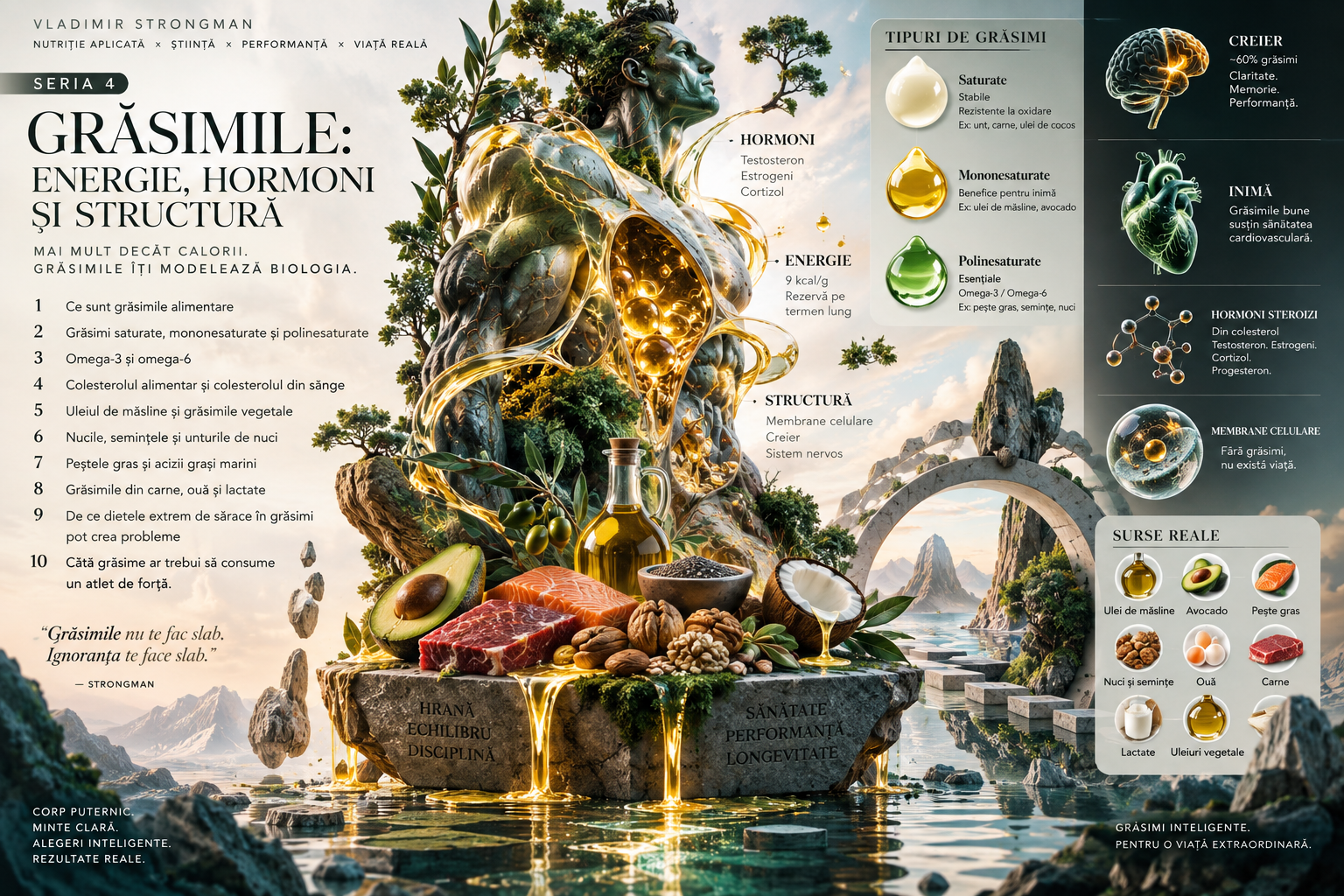
Nuts, seeds and the butters made from them occupy an interesting place in nutrition: they are extremely energy-dense foods, yet they also provide unsaturated fats, protein, fiber, vitamins, minerals and many bioactive compounds. That combination makes them quite different from simply adding a spoonful of isolated oil to a meal.
For a strongman, these foods can be extremely useful. When calorie requirements are high, a few servings of nuts or peanut butter can add substantial energy without enormous food volume. The same energy density, however, can become a problem when body mass or metabolic health needs tighter control.
This episode follows nuts, seeds and nut butters from food structure through digestion, blood lipids, satiety and sports use. We will discuss walnuts, almonds, pistachios, peanuts, pumpkin, sunflower, sesame, flax and chia seeds, together with roasting, grinding, allergies, aflatoxins and the trap of invisible calories.
1. Nuts and seeds are whole foods, not just sources of fat
Nuts and seeds contain fat, but also protein, fiber, vitamins, minerals and bioactive compounds. Their metabolic effect cannot be reduced to the number of grams of fat on the label.
2. Fatty-acid profiles differ greatly between species
Walnuts, almonds, pistachios, hazelnuts, cashews, pecans, sunflower seeds, pumpkin seeds, sesame, flax and chia contain very different proportions of fatty acids. Choosing among them also means choosing a particular mix of mono- and polyunsaturated fats.
3. Most nuts are rich in unsaturated fats
In many nuts, monounsaturated and polyunsaturated fatty acids predominate. This composition explains part of their favorable effect on blood lipids when they replace foods rich in saturated fat.
4. Walnuts are an important plant source of omega-3 ALA
Walnuts contain alpha-linolenic acid, ALA, an essential plant omega-3 fatty acid. ALA has nutritional value in its own right even though its conversion to EPA and DHA is limited.
5. Almonds are rich in monounsaturated fat and vitamin E
Almonds provide mainly oleic acid together with vitamin E, magnesium, fiber and protein. The combination of lipids with the food matrix makes them metabolically different from an isolated oil.
6. Pistachios provide unsaturated fats, protein and potassium
Pistachios combine unsaturated fatty acids with protein, fiber, potassium and carotenoids. For an athlete they can be a useful calorie-dense snack, but portion size still matters.
7. Hazelnuts are dominated by oleic acid
Hazelnuts have a fatty-acid profile rich in monounsaturated fat, especially oleic acid. In lipid composition they resemble olive oil more than plant foods dominated by omega-6.
8. Cashews contain more carbohydrate than many other nuts
Cashews remain a high-fat food, but proportionally contain more carbohydrate than many other nuts. For athletes tracking macronutrients closely, differences between species can matter.
9. Peanuts are legumes, but nutritionally they resemble nuts
Botanically, peanuts are legumes rather than tree nuts. Nutritionally they are used in a similar way and provide unsaturated fats, protein, niacin and other micronutrients.
10. Seeds can concentrate more protein and minerals than they appear to
Pumpkin, sesame, hemp, sunflower and chia seeds can provide meaningful amounts of protein and minerals in a small volume. Magnesium, zinc, phosphorus and iron are among the nutrients commonly found in them. Nutrient density does not mean the serving size is unlimited. Seeds are extremely energy-dense and can quickly add hundreds of kilocalories to an already large diet.
11. Pumpkin seeds are rich in magnesium and zinc
Pumpkin seeds are a concentrated source of magnesium and also provide zinc, iron, protein and unsaturated fats. They can complement an athlete's meals particularly well when food variety is limited.
12. Sunflower seeds provide a large amount of linoleic acid
Sunflower seeds are rich in omega-6, especially linoleic acid, and also provide vitamin E. The presence of omega-6 does not make them inherently inflammatory.
13. Sesame provides lignans and minerals
Sesame seeds contain unsaturated fats, calcium, copper and lignans such as sesamin. These components have attracted interest for their effects on lipid metabolism and oxidative stress.
14. Tahini is essentially sesame-seed butter
Tahini is the paste produced by grinding sesame seeds. It is highly calorie-dense, but its food matrix still contains protein, minerals and phenolic compounds.
15. Flaxseed is one of the richest plant sources of ALA
Flax provides ALA, fiber and lignans. Ground flax is generally more digestively accessible than intact seeds, some of which can pass through the gastrointestinal tract only partly digested.
16. Chia combines ALA with a large amount of fiber
Chia seeds absorb water and form a gel because of their soluble fiber. They provide ALA and can contribute to satiety, but they are not nutritionally equivalent to EPA and DHA from oily fish.
17. Hemp seeds have an interesting protein and fat profile
Hemp seeds provide protein, polyunsaturated fats and several micronutrients. They add useful variety, but they do not have special anabolic properties simply because they are a plant food with a relatively high protein content.
18. Protein from nuts and seeds is useful, but not highly concentrated
Nuts and seeds contribute to daily protein intake, but usually provide a lot of energy for each gram of protein. For high protein targets, they generally complement meat, dairy, eggs or other concentrated protein sources better than replacing them completely.
19. Plant-protein digestibility varies
Food structure, fiber and amino-acid composition influence the digestibility of protein from nuts and seeds. Processing, grinding and roasting can alter how easily nutrients become accessible.
20. Fiber is an important part of their metabolic effect
Nuts and seeds provide insoluble fiber and, in some cases, meaningful soluble fiber. Fiber can support satiety, bowel function, the gut microbiome and glucose control.
For a strongman eating very large amounts of food, fiber should be increased gradually. A sudden large increase can cause bloating, discomfort and reduced tolerance for high-volume meals.
21. Phytosterols compete with cholesterol in the intestine
Many nuts and seeds contain phytosterols, plant molecules structurally similar to cholesterol. They can modestly reduce intestinal cholesterol absorption and contribute to lower LDL-C.
22. Vitamin E helps protect membrane lipids from oxidation
Almonds, sunflower seeds and other plant foods can provide substantial vitamin E. It functions as a fat-soluble antioxidant and helps protect membranes and lipoproteins from oxidative damage.
23. Magnesium matters for contraction and energy metabolism
Magnesium participates in hundreds of enzymatic reactions, including processes involving ATP, neuromuscular excitability and glucose metabolism. Nuts and seeds can make a meaningful contribution to daily intake.
24. Zinc has roles in immunity, enzymes and protein synthesis
Pumpkin seeds and some nuts provide zinc, although phytates can reduce its bioavailability. A varied diet matters more than concentrating on a single food.
25. Phytates are not simply 'antinutrients'
Phytic acid can bind minerals and reduce their absorption, but the label antinutrient is overly simplistic. Phytates also have potentially useful biological properties and are natural components of seeds and grains. In a varied diet, in a person without deficiencies, phytates are not a reason to avoid nuts and seeds. Problems are more likely when the diet is highly monotonous and depends almost entirely on foods with low mineral bioavailability.
26. Roasting changes flavor and texture
Roasting reduces moisture, intensifies flavor and makes many nuts more crisp. At the same time, heat can alter temperature-sensitive compounds and accelerate oxidation when processing is excessive.
27. Raw and roasted nuts can both fit a good diet
There is no rule making raw nuts automatically superior. Moderate roasting can improve palatability, and the practical difference depends on temperature, duration and what is added afterward.
28. Salt does not turn nuts into a bad food, but it changes the context
Salted nuts contribute to sodium intake. For athletes who sweat heavily this is not automatically a problem, but in people with hypertension or very high sodium intake it should be viewed within the whole diet.
29. Glazed and caramelized nuts are a different product
Added sugar, honey, chocolate or coatings can substantially increase energy density and change the nutritional profile. When evaluating a product, the base food should be separated from what has been added to it.
30. Grinding changes how quickly we eat and absorb the food
Turning nuts into a paste disrupts much of their physical structure and makes lipids more accessible. Nut butters are therefore easy to eat quickly and can deliver a large amount of energy in a very small volume.
For a strongman who struggles to reach a high calorie intake, this can be an advantage. For someone trying to control body weight, the same characteristic can become a calorie trap.
31. Peanut butter is essentially ground peanuts
A simple peanut butter may contain only peanuts and perhaps salt. Commercial products vary, however, and some include sugar, added oils, emulsifiers or other ingredients.
32. Almond butter has a different fatty-acid profile from peanut butter
Almond butter is rich in oleic acid and vitamin E, while peanut butter has its own characteristic fatty-acid and micronutrient profile. Neither is universally superior; the choice depends on the whole diet, tolerance and preference.
33. Calories from nut butters accumulate extremely quickly
Two tablespoons of nut butter can provide roughly 180-220 kcal depending on the product and serving size. When eaten directly from the jar, visual estimates are often inaccurate.
During a gaining phase, the calorie density can be useful. During a phase aimed at reducing body fat while preserving strength, weighing the serving becomes much more important.
34. Metabolizable energy can be slightly lower than theoretical estimates
In whole nuts, some lipids remain trapped within intact cell walls and may not be completely absorbed. Effective available energy can therefore be somewhat lower than classic estimates based only on macronutrient content.
35. The food matrix matters
Whole nuts require chewing, retain cellular structure and release lipids gradually. This helps explain why 30 g of whole nuts are not metabolically identical to the same amount of extracted fat consumed as oil.
36. Satiety can offset part of the high energy density
Although nuts are calorie-dense, they contain protein and fiber and require chewing. In many people these characteristics increase satiety and can lead to compensatory reductions in later energy intake.
37. Eating nuts does not automatically cause weight gain
In observational and intervention studies, regular nut consumption is not inevitably associated with weight gain. Energy balance remains decisive, but the body does not handle 200 kcal of nuts in exactly the same way as 200 kcal of a sugar-sweetened drink.
38. Blood lipids can benefit from including nuts
Meta-analyses of controlled trials show modest reductions in total cholesterol and LDL-C when nuts are incorporated into an appropriate diet. The effect is influenced by dose, type of nut and the food being replaced.
The benefit does not come from a magical ingredient. In practice, an important part of the effect appears when nuts replace snacks or fats richer in saturated fatty acids.
39. Nuts are not cholesterol medication
A handful of nuts cannot compensate for very high LDL-C, familial hypercholesterolemia or high cardiovascular risk. Nutrition helps, but medical evaluation and treatment are sometimes necessary.
40. Nuts can support a cardioprotective dietary pattern
In Mediterranean-style diets, nuts appear alongside vegetables, fruit, legumes, fish and olive oil. The observed benefits arise from the entire dietary pattern rather than from isolating a single snack.
41. Inflammation cannot be reduced to omega-6 in seeds
Sunflower seeds and other sources rich in linoleic acid do not automatically produce systemic inflammation. Energy balance, diet quality, adiposity, smoking, sleep and other lifestyle factors all matter.
42. Oxidation of nut fats develops over time
Polyunsaturated fatty acids are sensitive to oxygen, light and heat. Rancid nuts are not merely unpleasant in taste; they indicate lipid degradation.
43. Cold storage can extend freshness
Nuts and seeds rich in polyunsaturated fats keep better in tightly sealed containers protected from light and heat. For large quantities, refrigeration or freezing can slow oxidation.
44. Nut butters expose more lipid surface to oxygen
Grinding increases the amount of fat exposed to oxygen. After opening, storage conditions and the time taken to finish the jar therefore become more important than with intact nuts.
45. Nut and peanut allergy can be severe
Peanut and tree-nut allergies can cause serious reactions, including anaphylaxis. For an allergic person, the main issue is not portion size or fatty-acid profile, but strict avoidance and the medical plan they have been given.
46. Aflatoxins are a food-safety issue, not a macronutrient issue
Peanuts and some nuts can be contaminated by molds that produce aflatoxins when storage conditions are poor. Quality control, drying and the storage chain are therefore important.
Consumers cannot always detect contamination by taste alone. Choosing products from controlled sources and following storage recommendations matter more than marketing claims about being 'natural'.
47. The classic serving is small but highly concentrated
A serving of roughly 25-30 g is only a small handful, yet it can provide around 150-200 kcal. For athletes, two or three such servings can substantially change the day's energy balance.
48. For strongman, calorie density is often an advantage
When energy intake needs to be very high, nuts and nut butters can increase calories without enormous food volume. They can be added to oats, yogurt, shakes or snacks.
49. They are not ideal immediately before a heavy event
Large amounts of fat and fiber slow gastric emptying. Before a yoke, farmer's walk or medley, a large bowl containing nuts and peanut butter can sit heavily in the stomach and reduce comfort.
50. Timing depends on digestive tolerance
For meals close to training, smaller portions are often easier to tolerate. Larger amounts of nuts and seeds usually fit better farther away from intense effort.
51. During recovery, nuts are an addition rather than the foundation
After training, priorities include sufficient protein, carbohydrate according to training volume and rehydration. Nuts can add energy and micronutrients, but should not replace an adequate protein source.
52. During mass-gain phases, nut butters can solve the food-volume problem
Very large athletes may struggle to consume enough calories from bulky foods alone. A measured serving of peanut or almond butter can add energy without doubling the volume of a meal.
53. During fat-loss phases, the same calorie density becomes a challenge
When the goal is to reduce body fat, unmeasured intake can easily undermine the energy deficit. Nuts remain high-quality foods, but quality does not cancel energy balance.
54. Nut butter in a shake can become an 'invisible calorie'
Liquids are consumed quickly and often provide less satiety than solid foods. Two large spoonfuls added to a shake can increase energy substantially without feeling like a much larger meal.
55. Choosing a product begins with the ingredient list
A simple product usually lists the nut or peanut as the main ingredient, perhaps with salt. Added sugar, oils and flavorings do not make a product automatically bad, but they should be counted when energy intake or nutritional profile matters.
56. Protein on the label does not turn peanut butter into a protein supplement
Peanut butter contains protein, but also a large amount of fat and energy. Obtaining 30-40 g of protein exclusively from it requires a very high calorie intake compared with a more concentrated protein source.
57. Variety is better than searching for one 'perfect' nut
Almonds provide abundant vitamin E, walnuts ALA, pistachios potassium, pumpkin seeds magnesium and zinc, and sesame different bioactive compounds. Rotating among sources creates a broader nutrient profile.
58. For many athletes, one or two servings can be enough
There is no universal dose. Depending on total calories and the rest of the diet, one or two daily servings can provide benefits without occupying too much of the energy budget.
59. Blood tests are more useful than assumptions
If an athlete consumes large amounts of nuts, nut butters, meat, dairy and oils, the lipid profile shows the real metabolic response. LDL-C, non-HDL-C, triglycerides and, when available, ApoB are more informative than labels such as 'clean' or 'natural'.
60. Conclusion: nuts, seeds and nut butters are nutrient-dense, useful and easy to overdo
Nuts and seeds combine unsaturated fats, protein, fiber and micronutrients in a small volume, while their butters concentrate energy even further. For strongman, they are excellent tools when portions, digestion and metabolic context are controlled; their main advantage is nutrient density, not a miraculous property.
Sources and recommended reading
Sabaté J et al. Nut consumption and blood lipid levels: a pooled analysis of 25 intervention trials. Archives of Internal Medicine, 2010.
Del Gobbo LC et al. Effects of tree nuts on blood lipids, apolipoproteins, and blood pressure: systematic review, meta-analysis, and dose-response of 61 controlled intervention trials. American Journal of Clinical Nutrition, 2015.
Aune D et al. Nut consumption and risk of cardiovascular disease, total cancer, all-cause and cause-specific mortality: a systematic review and dose-response meta-analysis of prospective studies. BMC Medicine, 2016.
Estruch R et al. Primary Prevention of Cardiovascular Disease with a Mediterranean Diet Supplemented with Extra-Virgin Olive Oil or Nuts. New England Journal of Medicine, 2018.
Ros E. Health Benefits of Nut Consumption. Nutrients, 2010.
Novotny JA, Gebauer SK, Baer DJ. Discrepancy between the Atwater factor predicted and empirically measured energy values of almonds in human diets. American Journal of Clinical Nutrition, 2012.
Ellis PR et al. Role of cell walls in the bioaccessibility of lipids in almond seeds. American Journal of Clinical Nutrition, 2004.
Alasalvar C, Bolling BW. Review of nut phytochemicals, fat-soluble bioactives, antioxidant components and health effects. British Journal of Nutrition, 2015.
Thomas DT, Erdman KA, Burke LM. Nutrition and Athletic Performance. Journal of the Academy of Nutrition and Dietetics, 2016.
Food and Agriculture Organization of the United Nations. Fats and Fatty Acids in Human Nutrition. FAO Food and Nutrition Paper 91, 2010.
Editorial note: this article is educational and does not replace individualized advice from a physician or dietitian. People with food allergies, dyslipidemia, diabetes, cardiovascular disease, kidney disease or other metabolic conditions should individualize nutrition with a qualified professional.
More From The Journal

Training
The Science of Strongman Training - Episode X: Competition Programming
How to build a complete Strongman competition preparation block: calendar, events, volume, intensity, specificity, simulations, autoregulation, tapering and fatigue management.

Training
The Science of Strongman Training - Episode IX: Peaking
Peaking in Strongman: how to turn months of training into maximal competition performance by reducing fatigue, preserving adaptations and managing specificity.