
Nutrition
Series: Fats: Energy, Hormones and Structure - Episode 5: Olive Oil and Plant Fats
September 10, 2026
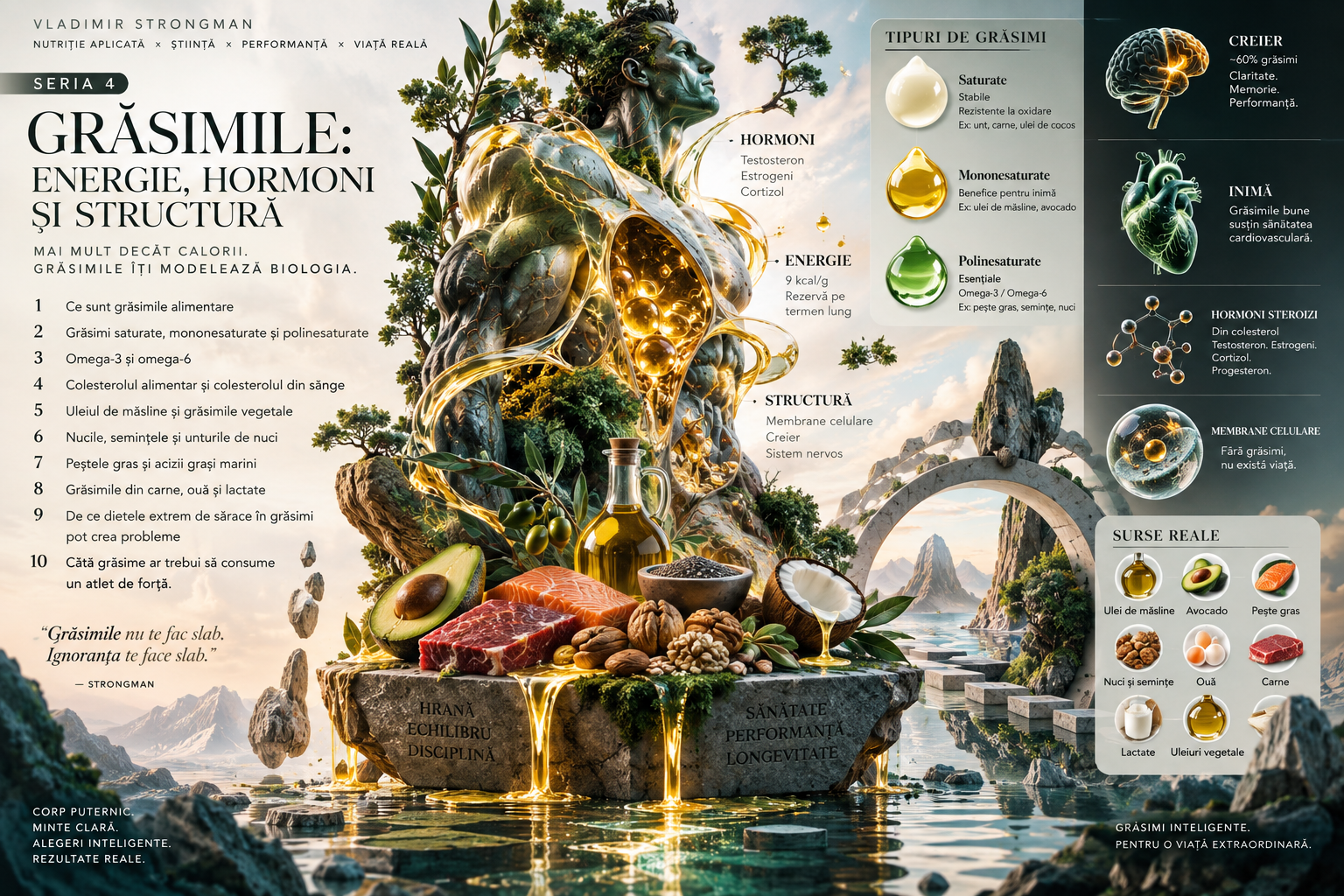
Olive oil is probably the most celebrated plant fat in modern nutrition. It has been presented as a symbol of the Mediterranean diet and, at times, as a near-universal remedy, while other plant oils have been either praised or demonized. Reality is more interesting: every oil has its own fatty-acid profile, minor compounds, stability and culinary role.
For a strongman, the subject is highly practical. A diet of 4,000, 5,000 or more kilocalories can accumulate large amounts of fat quickly, and oil choice influences energy density, digestion, blood lipids and overall diet quality. Oils can be excellent tools, but they are also one of the easiest ways to add hundreds of calories with almost no food volume.
This episode follows olive oil and the major plant fats from chemistry to the frying pan and the blood test. We will discuss oleic acid, polyphenols, canola, sunflower and soybean oils, coconut and palm oils, oxidation, smoke point, storage and how a strength athlete can use these energy sources intelligently.
1. Plant fats are not all the same
The phrase “plant fats” covers a very broad family of foods and oils. Olive oil, avocado, nuts, seeds, canola oil, sunflower oil, soybean oil and coconut oil have very different compositions. Plant origin alone does not tell us whether a fat is rich in monounsaturated, polyunsaturated or saturated fatty acids.
2. Olive oil is dominated by oleic acid
The main fatty acid in olive oil is oleic acid, a monounsaturated omega-9 fatty acid. The exact proportion varies with cultivar, climate, ripeness and processing, but a profile rich in oleic acid is one of olive oil’s defining characteristics.
3. Oleic acid is not essential, but it is metabolically relevant
The body can synthesize oleic acid, so it is not an essential fatty acid. In the diet, however, replacing part of saturated fat intake with monounsaturated fat can improve the lipid profile, particularly by lowering LDL-C in some contexts.
4. Extra virgin is a technological category, not just a marketing label
Extra virgin olive oil is obtained by mechanical procedures without chemical refining and must meet specific chemical and sensory criteria. Its quality depends on the fruit, the time to processing, temperature, storage and control of oxidation.
5. Virgin and extra virgin are not identical
Both are mechanically extracted, but the extra virgin category has stricter limits for sensory defects and selected quality parameters. The difference is not only flavor: gentler processing generally preserves minor bioactive compounds better.
6. Refining removes part of the minor compounds
Refining can reduce free fatty acids, unwanted odors and defects, but it also removes a substantial portion of polyphenols and aromatic compounds. The fatty-acid profile remains broadly similar, while the chemical matrix becomes different.
7. Polyphenols can distinguish two oils with similar fat profiles
Extra virgin olive oil contains phenolic compounds such as hydroxytyrosol, tyrosol and oleuropein derivatives. They contribute to bitterness, pungency, oxidative stability and some of the biological effects studied in olive oil.
8. Oleocanthal is one of the best-known compounds
Oleocanthal is a phenolic compound partly responsible for the throat-stinging sensation produced by some extra virgin olive oils. It has been studied for biological properties, but laboratory findings should not be turned into pharmacological promises for ordinary dietary intake.
9. Vitamin E helps protect lipids
Plant oils can provide vitamin E in the form of tocopherols. These compounds help protect lipids from oxidation and act as antioxidants in the body, but content varies greatly between oils and processing methods.
10. Fatty-acid profile matters more than plant origin
One plant oil may be rich in monounsaturated fats, another in omega-6, another in omega-3, and another in saturated fat. Serious nutrition guidance therefore does not simply separate fats into animal versus plant sources, but examines their actual composition.
11. Canola oil has a different profile from olive oil
Canola oil is rich in monounsaturated fat but also provides alpha-linolenic acid, a plant omega-3. It is one of the oils with a favorable profile when used to replace saturated fat in the diet.
12. Sunflower oil is rich in linoleic acid
Conventional sunflower oil contains a large amount of linoleic acid, an essential omega-6 fatty acid. High-oleic varieties also exist and are bred for much higher oleic acid content and different thermal stability.
13. Soybean oil provides omega-6 and some omega-3
Soybean oil contains a high proportion of linoleic acid and a smaller amount of alpha-linolenic acid. It is widely used in food manufacturing, so intake can become substantial in diets rich in processed foods.
14. Corn oil is predominantly polyunsaturated
Corn oil supplies mainly linoleic acid and plant sterols. It can fit into a balanced diet, but because it is extremely energy dense, the total amount consumed still matters.
15. Nut and seed oils can provide useful fatty acids
Oils from walnuts, flax, hemp and other seeds can have interesting fatty-acid profiles, with some being rich in ALA. Many are sensitive to oxidation, however, and are better suited to uses that do not involve high temperatures.
16. Flaxseed oil is very rich in ALA
Flaxseed oil is one of the most concentrated dietary sources of alpha-linolenic acid. ALA is essential, but its conversion to EPA and especially DHA is limited, so it does not perfectly replace marine omega-3 sources.
17. Avocado oil is rich in monounsaturated fat
Avocado oil has a profile dominated by oleic acid and may provide plant sterols and tocopherols. Final composition depends on the raw material and degree of refining.
18. Coconut oil is plant-based but very high in saturated fat
Plant origin does not automatically mean a favorable lipid profile. Coconut oil contains a high proportion of saturated fatty acids and can raise LDL-C compared with oils rich in unsaturated fats.
19. Palm oil is also relatively high in saturated fat
Palm oil contains substantial palmitic acid together with oleic acid. Cardiometabolically, it should not be placed in the same category as olive oil simply because both come from plants.
20. Unsaturated fats can replace saturated fats
One of the most consistent principles in cardiovascular nutrition is that replacing part of saturated fat intake with polyunsaturated or monounsaturated fat can lower LDL-C and cardiovascular risk. The key is replacement, not simply pouring extra oil onto the same diet.
In practice, replacing butter or part of the animal fat in a diet with olive oil can keep total energy similar while changing the fatty-acid profile. This is the logic behind substitution-based recommendations.
21. If you only add oil, you also add calories
One tablespoon of oil contains roughly 120 kcal. If olive oil is added on top of an already excessive energy intake, the favorable fatty-acid profile can be outweighed by weight gain and worsening metabolic control.
22. Olive oil does not burn body fat
No dietary oil causes fat loss independently of energy balance. Olive oil can be part of a metabolically favorable diet, but its energy still counts and must fit within total daily intake.
23. The Mediterranean diet is more than olive oil
Mediterranean dietary patterns usually include vegetables, fruit, legumes, whole grains, fish, nuts, seeds and olive oil, together with limited ultra-processed foods. Attributing all benefits to one ingredient oversimplifies a complex dietary pattern.
24. PREDIMED provided important evidence on the Mediterranean diet
The PREDIMED trial showed that a Mediterranean dietary pattern supplemented with extra virgin olive oil or nuts could reduce cardiovascular events in people at elevated risk. The finding supports a dietary pattern, not the idea that olive oil functions as an isolated drug.
Participants did not receive a single isolated food; they followed a broader dietary pattern with repeated counseling. The trial should therefore not be read as proof that a fixed amount of olive oil neutralizes every other dietary choice.
25. LDL-C can respond favorably to changing the type of fat
When saturated fats are replaced with olive oil or other unsaturated-fat sources, LDL-C can fall. The size of the effect depends on baseline intake, body weight, genetics, total energy and the rest of the diet.
26. HDL-C should not be followed in isolation
Some diets rich in monounsaturated fat can maintain or alter HDL-C, but higher HDL does not cancel high LDL or ApoB. Interpretation should remain focused on the whole lipid profile.
27. ApoB remains relevant regardless of the fat source
Even if the diet contains olive oil, elevated ApoB indicates a high number of atherogenic particles. No healthy-food label makes an unfavorable biomarker irrelevant.
28. Triglycerides respond mainly to the energy and metabolic context
Type of fat matters, but triglycerides are strongly influenced by calorie excess, alcohol, refined carbohydrates, insulin resistance and body weight. Olive oil cannot compensate for these problems on its own.
29. Endothelial function can respond to dietary pattern
Extra virgin olive oil and dietary patterns rich in unsaturated fats have been studied for effects on endothelial function, oxidative stress and inflammation. Effects are generally moderate and depend on the overall dietary context.
30. Polyphenols may help protect LDL from oxidation
Some research suggests that polyphenols in extra virgin olive oil can reduce the susceptibility of LDL to oxidation. This is an interesting mechanism, but atherosclerotic risk remains primarily tied to the number and cumulative exposure to ApoB-containing particles.
31. Oil oxidation begins before the frying pan
Light, oxygen, temperature and time can degrade oils during storage. Dark packaging, tightly closed containers and storage away from heat therefore help preserve quality.
32. Harvest date can matter more than a slogan on the label
A fresh, well-stored extra virgin olive oil may preserve aromatic and phenolic compounds better than an old oil exposed to heat. Real quality can decline even when the label remains unchanged.
33. Bitterness and pungency can signal phenolic compounds
Bitterness and a peppery throat sensation are common in extra virgin olive oils rich in phenolic compounds. They are not defects by definition and can be sensory clues to a richer chemical profile.
34. Smoke point does not tell the whole story
Smoke point is only one parameter used to describe how an oil behaves under heat. Oxidative stability also depends on degree of unsaturation, antioxidants, free fatty acids, heating duration and repeated reuse.
35. Olive oil can be used for cooking
Contrary to a popular myth, olive oil can be used for many forms of cooking. Its high oleic-acid content and antioxidant compounds make it relatively stable, particularly when it is not severely overheated or repeatedly reused.
Relative stability does not mean indestructibility. Every oil degrades progressively when severely overheated, exposed to air for long periods or reused repeatedly.
36. Extra virgin olive oil does not become instantly toxic when heated
Heating changes every cooking oil chemically, but the idea that extra virgin olive oil suddenly becomes toxic the moment it touches a pan is incorrect. Oxidative stress increases with temperature, duration and repeated heating cycles.
37. Repeated deep-frying is different from ordinary cooking
Oil used for hours and through multiple frying cycles accumulates oxidation and degradation products. This is different from using a modest amount of oil to cook one meal at home.
38. Highly polyunsaturated oils are more oxidation-sensitive
A larger number of double bonds increases the susceptibility of polyunsaturated fatty acids to oxidation. That does not make them unhealthy, but it explains why storage and heat use should match each oil’s composition.
39. High-oleic varieties are more heat stable
High-oleic sunflower and other plant oils have been developed to contain more oleic acid and fewer polyunsaturated fatty acids. This composition generally improves stability at high temperatures.
40. Rancidity is a sign that oil has degraded
Cardboard-like, paint-like or stale-nut odors and unpleasant flavors can indicate advanced oxidation. Rancid oil is not automatically an acute poison, but it is no longer a high-quality dietary source and should be replaced.
41. Dark glass helps
Light accelerates photo-oxidation, so opaque or dark-colored containers are preferable for sensitive oils. After opening, contact with oxygen also becomes important.
42. Kitchen heat can shorten oil shelf life
Keeping the bottle beside the stove is convenient but repeatedly exposes it to heat. A cool, dark location is a better choice for maintaining quality.
43. Package size should match how quickly you use it
A very large bottle may look economical, but if it remains open for many months, oxidation progresses. For quality, it is more useful to buy an amount that will be consumed within a reasonable period.
44. Nuts and seeds are not equivalent to their oils
Whole foods provide fat together with fiber, protein, minerals and phytochemicals. Isolated oil concentrates energy and lipids while removing most of the structure of the original food.
45. Fiber changes the metabolic response to food
Nuts and seeds are calorie dense, but their structure and fiber influence digestion, satiety and energy absorption. A spoonful of oil does not create exactly the same response as an equivalent amount of fat eaten inside a whole food.
46. For strongman, energy density can be an advantage
During periods of very high calorie intake, oils allow energy intake to rise without enormous food volume. This can be useful when meals become difficult to tolerate, but it also makes it very easy to overshoot energy needs.
In strength sports, the practical value becomes obvious when an athlete can no longer easily increase the volume of rice, pasta or other foods. A few measured tablespoons can add energy without turning every meal into a digestive endurance event.
47. Oil can make a high-calorie diet easier to eat
Added in controlled amounts to rice, pasta, salads or vegetables, olive oil can raise energy density and palatability. For a large athlete, this can be practical during high-calorie phases.
48. More oil does not automatically mean better performance
Maximal strength does not rise because a diet contains more tablespoons of oil. Performance depends on total energy, carbohydrate, protein, hydration, training and recovery, with fats being only one component.
49. Too much fat before training can slow digestion
A very high-fat meal eaten close to training can delay gastric emptying and create a heavy feeling. In dynamic events such as yoke, farmer’s walk or medleys, digestive comfort can become a real performance factor.
50. Fat timing should match tolerance
There is no universal perfect time for olive oil. Many athletes tolerate meals closer to training better when fat is moderate, while a larger share of daily fat can be placed in meals farther from the session.
51. Plant fats help absorb fat-soluble vitamins
Fat in a meal supports absorption of vitamins A, D, E and K and several carotenoids. A salad with some oil can therefore improve absorption of certain compounds compared with the same salad eaten entirely fat-free.
52. Oils do not provide protein or carbohydrate
In a strongman diet, oils are almost entirely sources of fat and energy. They do not replace meat, eggs, dairy, grains, potatoes, rice or other foods that provide protein, carbohydrate and micronutrients.
53. Oil choice should reflect the entire menu
If the diet already contains a lot of saturated fat from fatty meat, butter and cheese, using olive or canola oil can improve the overall fat profile. If the diet is already rich in oils and nuts, simply adding more may become unnecessary calorie excess.
54. Olive oil does not compensate for an ultra-processed diet
One food considered healthy cannot erase the effects of the whole dietary pattern. Pizza, processed meat, sweets, sauces and excessive fried foods do not become cardioprotective simply because extra virgin olive oil appears in some meals.
55. Read the label simply and practically
For extra virgin olive oil, information on category, origin, producer, lot and best-before date is useful. Claims about detoxification, fat burning or curing disease deserve skepticism.
56. Authenticity and adulteration are real market issues
Olive oil is a valuable product and can be vulnerable to fraud or misleading blends. Buying from reputable producers and retailers and choosing products with good traceability can reduce this risk.
57. Variety among fat sources is useful
Olive oil can be the main oil for many meals, while the diet can also include oily fish, nuts, seeds, avocado and other well-chosen oils. Variety provides different fatty-acid profiles and micronutrients.
58. Blood tests matter more than personal nutrition theory
If an athlete has elevated LDL-C, ApoB or triglycerides, the sensible response is to evaluate the whole context and follow objective changes. The belief that one uses “healthy fats” is not enough reason to ignore biomarkers.
To evaluate the effect of a dietary change, blood tests are more useful when compared under similar conditions after a sufficiently stable period. Otherwise changes in body weight, training or other parts of the diet can confuse the result.
59. The practical strongman strategy is balance
A strength-focused diet can use olive oil for energy, flavor and a favorable fatty-acid profile while preserving enough protein, carbohydrate, fiber and micronutrients. The amount should be adjusted to energy needs, digestion and changes in body weight.
60. Conclusion: plant fats are tools, and olive oil is one of the strongest options
Extra virgin olive oil combines a profile rich in oleic acid with polyphenols and good culinary stability. Its benefits are clearest when it replaces less favorable fat sources and sits inside a strong dietary pattern, not when it is treated as a miracle food.
Sources and recommended reading
Estruch R et al. Primary Prevention of Cardiovascular Disease with a Mediterranean Diet Supplemented with Extra-Virgin Olive Oil or Nuts. New England Journal of Medicine, 2018.
Covas MI et al. The effect of polyphenols in olive oil on heart disease risk factors: a randomized trial. Annals of Internal Medicine, 2006.
Guasch-Ferré M et al. Olive oil consumption and risk of cardiovascular disease and mortality in the PREDIMED Study. BMC Medicine, 2014.
Sacks FM et al. Dietary Fats and Cardiovascular Disease: A Presidential Advisory From the American Heart Association. Circulation, 2017.
Schwingshackl L, Hoffmann G. Monounsaturated fatty acids, olive oil and health status: a systematic review and meta-analysis. Lipids in Health and Disease, 2014.
European Food Safety Authority. Scientific Opinion on the substantiation of health claims related to polyphenols in olive oil and protection of LDL particles from oxidative damage. EFSA Journal, 2011.
Gaforio JJ et al. Virgin Olive Oil and Health: Summary of the III International Conference on Virgin Olive Oil and Health Consensus Report. Nutrients, 2019.
Food and Agriculture Organization of the United Nations. Fats and Fatty Acids in Human Nutrition. FAO Food and Nutrition Paper 91, 2010.
Calder PC. Functional Roles of Fatty Acids and Their Effects on Human Health. Journal of Parenteral and Enteral Nutrition, 2015.
Thomas DT, Erdman KA, Burke LM. Nutrition and Athletic Performance. Journal of the Academy of Nutrition and Dietetics, 2016.
Editorial note: this article is educational and does not replace individualized advice from a physician or dietitian. People with dyslipidemia, diabetes, cardiovascular disease, kidney disease or other metabolic conditions should individualize nutrition with a qualified professional.
More From The Journal

Training
The Science of Strongman Training - Episode X: Competition Programming
How to build a complete Strongman competition preparation block: calendar, events, volume, intensity, specificity, simulations, autoregulation, tapering and fatigue management.

Training
The Science of Strongman Training - Episode IX: Peaking
Peaking in Strongman: how to turn months of training into maximal competition performance by reducing fatigue, preserving adaptations and managing specificity.