
Nutrition
Series: Fats: Energy, Hormones and Structure - Episode 2: Saturated, Monounsaturated and Polyunsaturated Fats
September 10, 2026
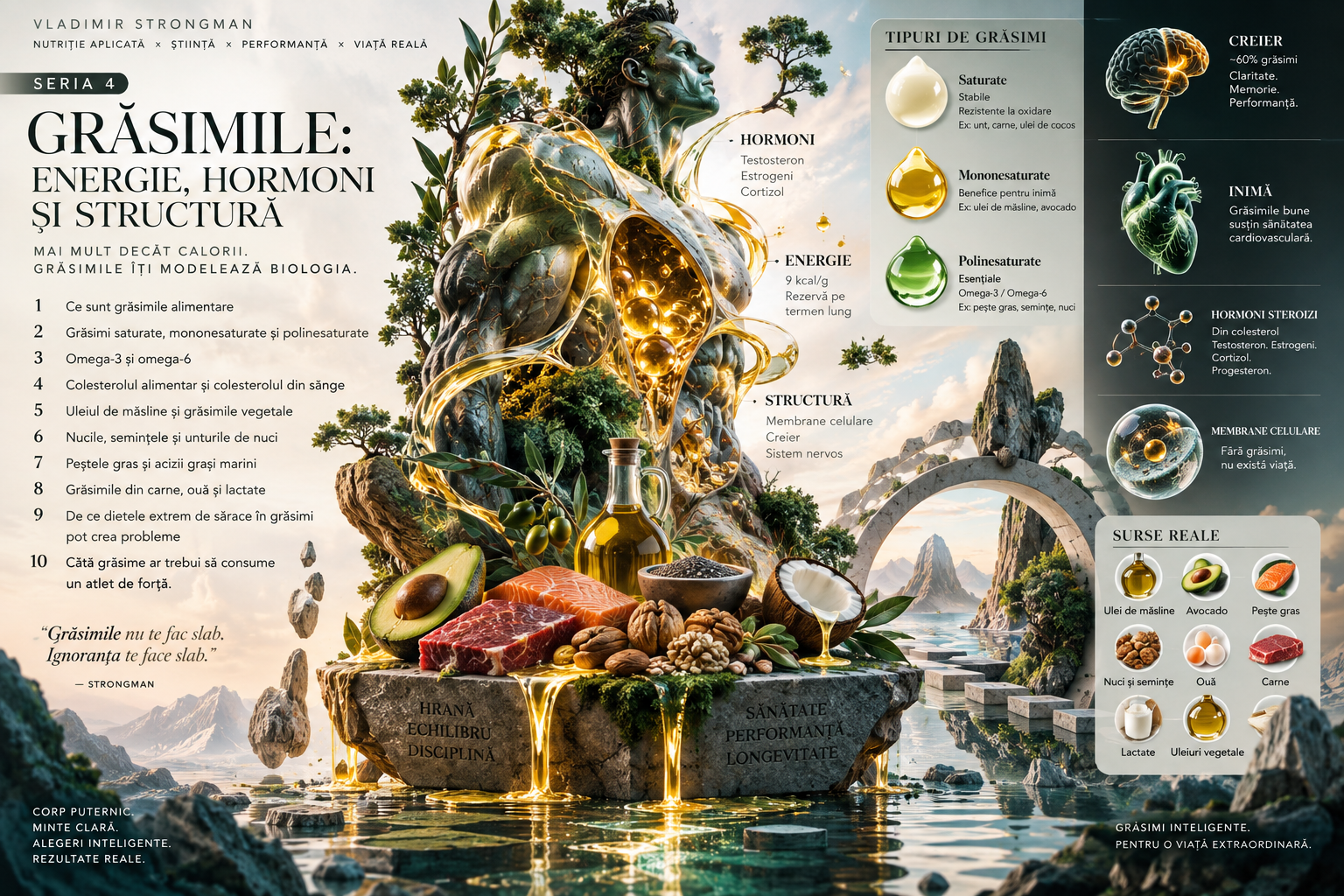
Saturated, monounsaturated and polyunsaturated fats appear in almost every nutrition discussion, yet they are often treated as moral labels: bad, good and very good. Biology is not that convenient. The differences begin with fatty-acid chemistry, while their real effects depend on dose, food source, replacement nutrient and individual metabolic context.
For a strongman, the issue is highly practical. A high-calorie diet can easily deliver 120, 150 or more grams of fat per day. At that level, the difference between an intake dominated by fatty meat, butter and ultra-processed foods and one that also includes olive oil, nuts, seeds and fish can influence lipid profile and long-term cardiovascular health.
This episode examines what saturation means, why double bonds change the physical properties of fats, how individual fatty acids differ, what we know about LDL and cardiovascular risk, and why the better question is not only how much saturated fat you eat, but what replaces it.
1. Classification begins with bonds between carbon atoms
A fatty acid is a carbon chain carrying hydrogen atoms and a carboxyl group. The main categories are separated by the number of double bonds between carbon atoms. No double bonds means saturated, one double bond means monounsaturated, and two or more means polyunsaturated.
2. Saturated means saturated with hydrogen
In a saturated fatty acid, carbon atoms carry as much hydrogen as the structure allows. The chain stays relatively straight and can pack closely with neighboring molecules. This helps explain why many fats rich in saturated fatty acids are solid at room temperature.
3. One double bond changes molecular shape
Monounsaturated fatty acids contain one double bond. In the cis configuration common in nature, this introduces a bend into the chain. Molecules cannot pack as tightly, which is one reason oils rich in monounsaturated fats, such as olive oil, are usually liquid at room temperature.
4. Multiple double bonds define polyunsaturated fats
Polyunsaturated fatty acids contain two or more double bonds. As the number of double bonds rises, the molecule becomes less tightly packed but also more prone to oxidation. The omega-3 and omega-6 families belong here and play important roles in membranes and cell signaling.
5. All three types provide the same energy per gram
From a calorie standpoint, saturated, monounsaturated and polyunsaturated fats all follow the same basic rule: about 9 kcal per gram. Their important differences emerge through metabolism, molecular structure, stability and health effects.
6. Saturated fat is not one single molecule
The term saturated fat covers several fatty acids including lauric, myristic, palmitic and stearic acid. Their biological effects are not perfectly identical. Stearic acid, for example, affects blood cholesterol differently from palmitic acid.
7. Palmitic acid is one of the most common saturated fatty acids
Palmitic acid occurs in both animal foods and some plant oils and can also be synthesized by the body. When energy intake is high, endogenous fatty-acid synthesis can increase, so its presence in blood does not reflect only dietary saturated fat.
8. Stearic acid behaves differently from some other saturated fats
Stearic acid, found in meat and cocoa butter, tends to have a more neutral effect on LDL than some other saturated fatty acids. Part of it can be converted to oleic acid. The word saturated describes structure, not identical metabolic behavior.
9. Monounsaturated fat is largely represented by oleic acid
Oleic acid is the major monounsaturated fatty acid in human diets and is abundant in olive oil, olives, avocado and many nuts. Replacing part of saturated-fat intake with monounsaturated-rich foods can improve the lipid profile, particularly within an overall high-quality diet.
10. Polyunsaturated fats include two major families
The two major families are omega-6 and omega-3. Linoleic acid belongs to omega-6 and alpha-linolenic acid to omega-3. Both are essential because humans cannot synthesize them from scratch.
The body can form longer-chain derivatives from these precursors, but conversion is limited. Direct dietary sources of EPA and DHA, especially fatty fish, therefore have distinct practical value.
11. Food sources matter more than an isolated label
Butter, fatty meat and cheese can provide substantial saturated fat but come in different food matrices. Olive oil is predominantly monounsaturated, while nuts combine unsaturated fats with fiber, minerals and bioactive compounds.
12. The food matrix changes the metabolic response
The same amount of saturated fat can come from butter, cheese, whole yogurt or processed meat, and observed effects are not perfectly identical. Food structure, fermentation, calcium, sodium, protein and processing can all modify the response.
13. LDL is central to the discussion
Higher intakes of certain saturated fatty acids can raise LDL cholesterol in many people. Cumulative exposure to atherogenic particles contributes to atherosclerosis. Excellent strength performance does not cancel this cardiovascular biology.
14. Higher HDL does not cancel higher LDL
Some saturated fatty acids may also raise HDL, but higher HDL does not automatically erase the risk associated with atherogenic particles. Modern assessment looks at the whole lipid profile, including non-HDL cholesterol and, when available, ApoB.
15. ApoB can add information about atherogenic particles
Apolipoprotein B is carried by major atherogenic particles and can help estimate their number. Two people with the same LDL cholesterol may have different particle distributions, so cardiovascular risk cannot always be reduced to one laboratory value.
16. Replacement matters more than simple reduction
When saturated fat is reduced, the outcome depends on what replaces it. Replacing it with polyunsaturated fat tends to be more favorable than replacing it with highly refined carbohydrate. Nutrition is a substitution problem within the same calorie budget.
17. Polyunsaturated fats can lower LDL when replacing saturated fats
One of the most consistent observations is a reduction in LDL when part of the energy from saturated fat is replaced with polyunsaturated fat. This shows that the type of fat in the diet can meaningfully alter the lipid environment.
18. Monounsaturated fats are also a useful alternative
Monounsaturated fats, especially from olive oil, avocado and nuts, can effectively replace part of saturated-fat intake. In Mediterranean-style diets they appear alongside vegetables, fruit, legumes and fish.
19. Omega-6 should not be demonized
Linoleic acid is essential and participates in normal physiology. The claim that omega-6 is automatically inflammatory is too simplistic. Human evidence does not support the idea that ordinary linoleic-acid intake inevitably raises systemic inflammation in healthy people.
20. Omega-3 brings another family of effects
EPA and DHA become incorporated into membranes and can influence the production of lipid mediators. They have well-known effects on blood triglycerides and are studied for cardiovascular, neurological, inflammatory and sports-related roles.
Omega-3 is not a magic supplement. Benefit depends on baseline intake, dose, source and objective. For most people, regular fatty-fish intake and an overall balanced diet are stronger foundations than extreme supplemental doses.
21. The omega-6 to omega-3 ratio is often overinterpreted
A numerical ratio can describe a diet but does not automatically capture diet quality. Two people can have the same ratio with very different absolute intakes. Securing adequate omega-3 and limiting excessive ultra-processed foods is more useful than obsessing over a fraction.
22. Fats influence cell-membrane fluidity
Membrane phospholipids contain fatty acids with different degrees of unsaturation. More double bonds can increase membrane fluidity and influence protein mobility and local membrane properties. The body regulates this composition while diet supplies part of the available fatty-acid pool.
23. The brain and retina are rich in specialized lipids
DHA is present in substantial amounts in neuronal and retinal membranes. Its structural role shows why polyunsaturated fats are not simply fuel. They literally become part of the architecture of highly specialized tissues.
24. Unsaturation increases susceptibility to oxidation
Double bonds are chemically more reactive sites. Polyunsaturated fats are therefore more vulnerable to oxidation than saturated fats, particularly with prolonged exposure to heat, light and air. This is a question of chemical stability, not a reason to avoid polyunsaturated fats.
25. Cooking temperature matters
Oils should not be judged by smoke point alone. Stability depends on degree of unsaturation, natural antioxidants, heating duration and reuse. Extra-virgin olive oil can be reasonably stable during ordinary cooking because of its monounsaturated profile and phenolic compounds.
26. Repeated oil reuse is a separate problem
Repeated and prolonged heating can generate oxidation and degradation products. The issue is more relevant to commercial deep-frying or repeated reuse of the same oil than to ordinary controlled home cooking.
27. Trans fats should not be confused with saturated fats
Trans fats are unsaturated fatty acids with a different geometry around the double bond. Industrial trans fats have clearly unfavorable cardiovascular effects and are not simply a type of saturated fat.
28. Meat usually contains a mixture of fatty acids
A piece of meat does not contain only saturated fat. It often includes a substantial amount of oleic acid and other unsaturated fatty acids. The ratio varies by species, cut, feed and degree of marbling.
29. Dairy fat has a complex lipid matrix
Dairy fat contains many fatty acids, including saturated fats of different chain lengths. Effects of dairy foods may depend on fermentation, structure and accompanying nutrients. Cheese and butter do not necessarily produce identical responses even though both come from milk.
30. Coconut oil is not equivalent to olive oil
Coconut oil is rich in saturated fatty acids, including lauric acid, and can raise both LDL and HDL. Olive oil is dominated by oleic acid and fits a different dietary profile. The fact that both are natural does not make them metabolically identical.
31. Olive oil is primarily a source of monounsaturated fat
Olive oil, particularly extra virgin, provides oleic acid and phenolic compounds. In Mediterranean-style diets it is associated with a cardiovascularly favorable dietary pattern.
32. Nuts combine unsaturated fats with fiber and minerals
Almonds, walnuts, pistachios and hazelnuts provide mostly unsaturated fats along with fiber, magnesium, potassium and phytosterols. For an athlete with high calorie needs, they are a practical way to increase energy density.
33. Seeds provide different lipid profiles
Flax and chia provide ALA, while sunflower and sesame seeds are richer in omega-6. Each can fit into a balanced diet. Omega classification should not be turned into a rigid system of prohibitions.
34. Fatty fish provides EPA and DHA directly
Salmon, sardines, mackerel and herring are important sources of EPA and DHA. This distinguishes them from plant sources of ALA, where the body must perform the conversion.
35. Avocado is rich in monounsaturated fat
Avocado provides mostly monounsaturated fat along with fiber and potassium. It is bulkier than oil and can increase satiety, which may be useful or inconvenient depending on the athlete's calorie target.
36. Butter is calorie-dense and rich in saturated fat
Butter can fit into a diet, but it is highly energy-dense and rich in saturated fat. In an athlete consuming many calories, seemingly small servings can quickly add tens of grams of fat.
37. Processed meat brings risk factors beyond saturated fat
Processed meats may contain saturated fat, but they also often provide substantial sodium and compounds created during processing. Explaining their effects only through saturated fat misses an important part of the picture.
38. Saturated fats do not need to be eliminated completely
Complete elimination is unrealistic and unnecessary because foods contain mixtures of fatty acids. A well-built diet can include eggs, meat, dairy and chocolate without automatically becoming excessive in saturated fat.
39. Unsaturated fats are not unlimited either
A large calorie surplus remains a surplus even when it comes from olive oil and nuts. Fat's energy density makes overeating easy. Lipid quality and energy balance are two different dimensions of the diet.
40. Population guidelines generally limit saturated-fat intake
International guidelines generally recommend keeping saturated fat to a limited share of total energy and minimizing trans fat. These recommendations target cardiovascular prevention and do not mean that every gram of saturated fat is toxic.
For an athlete consuming 4,000, 5,000 or more kilocalories, percentages translate into very large absolute amounts. It is therefore useful to consider both the percentage and the total number of grams.
41. Large body mass magnifies the importance of cardiovascular risk
A 130-170 kg strongman may face a different hemodynamic load from a much lighter person. If hypertension, sleep apnea or an unfavorable lipid profile are added, dietary fat quality becomes one relevant piece of a larger risk puzzle.
42. Athletic performance does not automatically protect arteries
Being able to lift enormous weights does not provide metabolic immunity. Exercise capacity and vascular health are related but not identical. An athlete can perform extremely well and still have unfavorable LDL, blood pressure or glucose values.
43. Dietary fat and testosterone have a complex relationship
Extremely low-fat diets may influence sex hormones in some people, but that does not mean more saturated fat will raise testosterone proportionally. Steroidogenesis uses cholesterol, yet the body synthesizes cholesterol and tightly regulates hormone production.
44. Dietary cholesterol does not turn directly into testosterone
The idea that more dietary cholesterol automatically means more testosterone ignores endocrine control. Conversion of cholesterol into steroid hormones depends on enzymes, pituitary signals, gonadal function and energy status.
45. Unsaturated fats can support a high-calorie diet
For strongman athletes, olive oil, nuts, nut butters and avocado can increase calories without excessively increasing food volume. These foods can support a high energy intake with a more balanced lipid profile than if all additional calories came from butter, fatty meat and processed foods.
46. Before training, total fat can matter more than fat type
A very high-fat meal can slow gastric emptying whether the fat comes from olive oil or butter. Close to a hard training session, digestive tolerance and the time before exercise become the immediate priorities.
47. After training, fat does not need to be eliminated automatically
A post-training meal can contain fat without stopping recovery. The priorities are total protein, carbohydrate, energy and fluid intake across the day. If extremely rapid recovery is needed, a very fatty meal may simply be less practical.
48. During a calorie deficit, fat quality remains important
As calories fall, every food occupies a larger share of the nutritional budget. Keeping sources of unsaturated fats and essential fatty acids remains useful even when total fat intake is reduced.
49. During mass gain, fat can make a surplus easier to reach
When the goal is to gain body mass, fat's energy density can be useful. Yet an excessive surplus promotes adipose-tissue gain regardless of fat type. The useful strategy is enough energy, not unlimited excess.
50. Absolute intake can become enormous in strongman
At 150 g of fat per day, 40% of intake means 60 g from one category. At 200 g, the same proportion becomes 80 g. Percentages that appear moderate can therefore produce large absolute amounts in athletes with high energy needs.
This arithmetic is why strongman athletes should think in both percentages and grams. A 6,000 kcal diet is not merely an ordinary diet enlarged; the absolute effects of food choices accumulate much more quickly.
51. Blood tests can guide individualization
LDL cholesterol, HDL cholesterol, triglycerides and non-HDL are common markers, while ApoB can add further information. If the profile worsens, diet is one variable worth reviewing.
52. Individual responses to saturated fat differ
Genetics, body weight, insulin sensitivity and overall diet composition can influence the lipid response. Some people see larger LDL increases as saturated-fat intake rises.
53. Calorie context changes interpretation
A chronically hypercaloric diet with rapid weight gain can worsen metabolic markers even when fatty-acid quality is reasonable. Fat type and energy excess should be analyzed at the same time.
54. Carbohydrates and fats do not need to be at war
A strongman needs carbohydrate for repeated high-intensity work and enough fat for energy, essential fatty acids and vitamin absorption. The useful question is how calories are divided so that performance and health can coexist.
55. Animal protein foods can also differ greatly in fat content
Lean meat, fish, eggs and dairy vary widely in both the amount and type of fat. Choosing only the fattiest versions can quietly reshape the entire dietary profile.
56. The healthy fat label does not exempt portions from mathematics
Olive oil, nuts and avocado are useful foods, but they are calorie-dense. Large servings added mechanically to every meal can turn a carefully planned diet into a substantial surplus.
57. Diversity of fat sources is a simple and robust strategy
Fatty fish, olive oil, nuts, seeds, eggs, dairy and meat can coexist in one diet. Diversity reduces the chance that one type of fat dominates and simultaneously provides different micronutrients.
58. Natural does not automatically mean metabolically optimal
Butter, tallow, coconut oil and olive oil all come from natural sources, yet their lipid compositions differ. The word natural says little about effects on LDL, stability or calorie density.
59. A practical model favors unsaturated fats without making saturated fat taboo
In practice, a robust approach is to obtain most added fats from sources rich in mono- and polyunsaturated fats while allowing saturated fat to occur naturally in eggs, meat, dairy and other foods.
60. Conclusion: chemical structure becomes a food choice
Saturated, monounsaturated and polyunsaturated fats are more than label terminology. The number of double bonds changes molecular shape, stability and biological roles. In practice, saturated fat is worth moderating while unsaturated sources deserve a substantial place in daily intake.
For a strongman, this choice carries literal weight: at very high calorie intakes, a few percentage points translate into tens of grams per day. A well-built lipid profile does not guarantee health, but it reduces one avoidable source of metabolic pressure.
Sources and recommended reading
1. World Health Organization. Saturated fatty acid and trans-fatty acid intake for adults and children: WHO guideline. Geneva, 2023.
2. World Health Organization. Total fat intake for the prevention of unhealthy weight gain in adults and children: WHO guideline. Geneva, 2023.
3. Sacks FM et al. Dietary Fats and Cardiovascular Disease: A Presidential Advisory From the American Heart Association. Circulation, 2017.
4. Mensink RP. Effects of Saturated Fatty Acids on Serum Lipids and Lipoproteins: A Systematic Review and Regression Analysis. World Health Organization, 2016.
5. Hooper L et al. Reduction in saturated fat intake for cardiovascular disease. Cochrane Database of Systematic Reviews, 2020.
6. Kris-Etherton PM et al. Literature on monounsaturated fatty acids, dietary patterns and cardiovascular risk.
7. Saini RK, Keum YS. Omega-3 and omega-6 polyunsaturated fatty acids: dietary sources, metabolism, and significance. Life Sciences, 2018.
8. Food and Agriculture Organization of the United Nations. Fats and Fatty Acids in Human Nutrition. FAO Food and Nutrition Paper 91, 2010.
9. Thomas DT, Erdman KA, Burke LM. Nutrition and Athletic Performance. Journal of the Academy of Nutrition and Dietetics, 2016.
10. Astrup A et al. WHO draft guidelines on dietary saturated and trans fatty acids: time for a new approach? BMJ, 2019.
Editorial note: this article is educational and does not replace individualized advice from a physician or dietitian. Interpretation of the lipid profile and cardiovascular risk should be personalized, especially in the presence of hypertension, diabetes, obesity, medication use or other risk factors.
More From The Journal

Training
The Science of Strongman Training - Episode X: Competition Programming
How to build a complete Strongman competition preparation block: calendar, events, volume, intensity, specificity, simulations, autoregulation, tapering and fatigue management.

Training
The Science of Strongman Training - Episode IX: Peaking
Peaking in Strongman: how to turn months of training into maximal competition performance by reducing fatigue, preserving adaptations and managing specificity.