
Nutrition
Series: Fats: Energy, Hormones and Structure - Episode 1: What Are Dietary Fats?
September 10, 2026
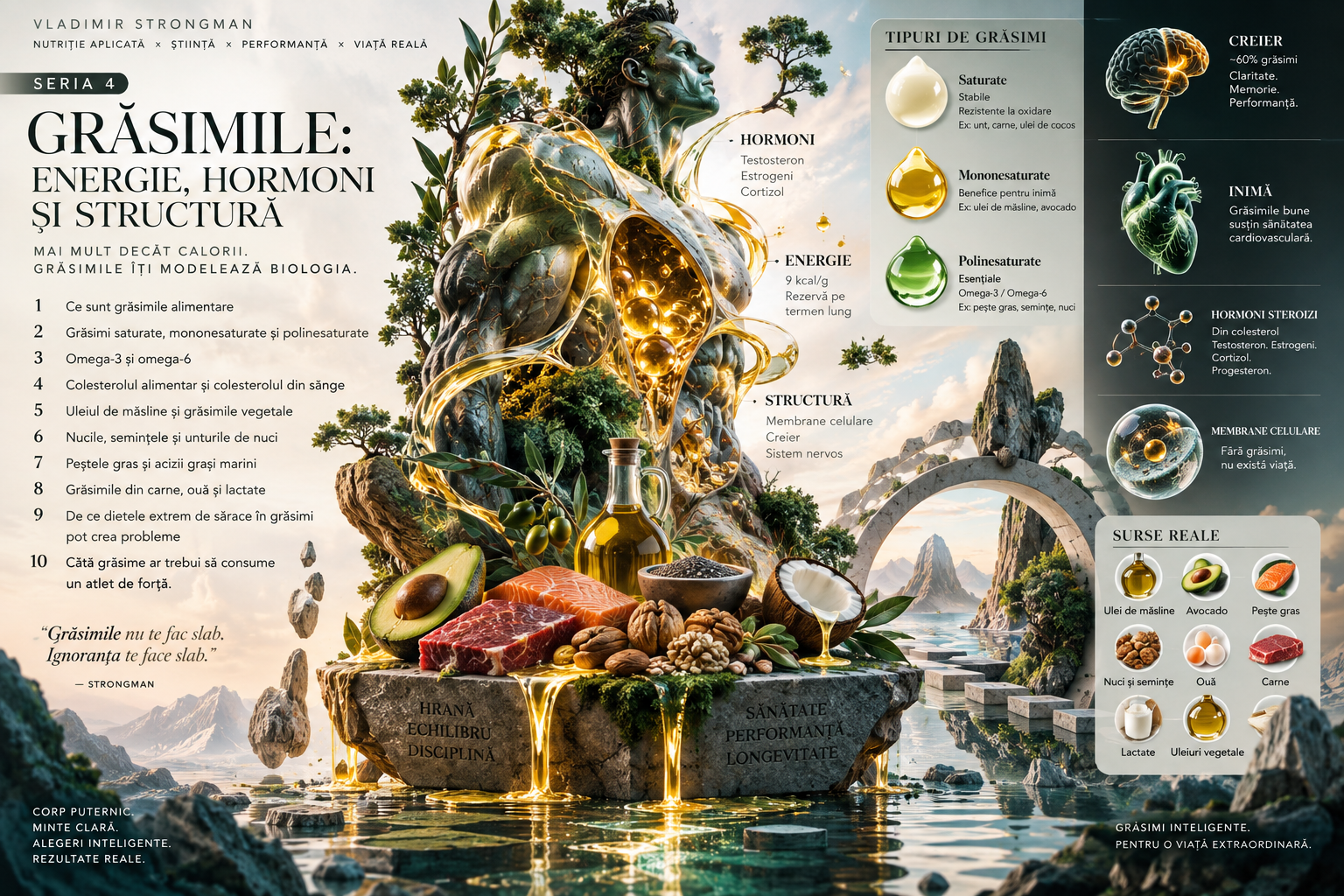
Dietary fat has probably been pushed between two extremes more than any other macronutrient. It was once portrayed as the main nutritional enemy, then later became the centerpiece of diets that gave it almost magical powers. Reality is less dramatic and much more interesting. Fats are essential molecules with energetic, structural and signaling roles, but their effects depend on type, amount, context and the rest of the diet.
For a strongman, the subject matters even more because daily energy intake can be very high and every food choice must balance performance, digestion, body composition and long-term health. Fat provides a large amount of energy in a relatively small food volume, but it is not merely fuel. It contributes to cell membranes, helps absorb fat-soluble vitamins and supplies fatty acids that the body cannot manufacture on its own.
This first episode builds the foundation. We will separate terms that are often mixed together, examine triglycerides, fatty acids and phospholipids, explain what saturated and unsaturated mean, follow fat through digestion and transport, and show why the statement that fat “makes hormones” needs much more precision. Later episodes can then discuss food sources and practical strategies without relying on slogans.
1. Fats are not a single substance
When we say “fat,” we are talking about a broad family of lipids. Foods and the human body contain triglycerides, phospholipids, cholesterol, cholesterol esters and many fatty acids with different structures. Two foods can contain the same total amount of fat and still have very different lipid profiles. The grams on a nutrition label therefore tell only part of the story.
In nutrition, fat quality matters alongside quantity. Fatty-acid type, food processing and overall energy balance can change metabolic effects. Reducing the subject to “fat is good” or “fat is bad” is like compressing an entire library into one sentence.
2. Fat, fatty acids and triglycerides are not the same thing
Most dietary fat is present as triglycerides, molecules built from a glycerol backbone and three fatty acids. The fatty acids are the components that vary the most and give a fat many of its biological properties. During digestion, triglycerides are dismantled, their components are absorbed, and those components may then be reassembled or used elsewhere in metabolism.
3. One gram of fat provides about 9 kcal
Fat is the most energy-dense of the three classic macronutrients. One gram provides about 9 kcal, while protein and carbohydrate provide about 4 kcal per gram. For a very large athlete, this density can be useful when energy needs are high and food volume becomes difficult to tolerate. At the same time, it makes accidental calorie excess easy when portions are not noticed.
4. Fatty acids are carbon chains with different properties
A fatty acid is essentially a chain of carbon and hydrogen atoms with a carboxyl group at one end. Chain length and the number of double bonds change how the molecule behaves. These chemical details determine melting point, stability, how the fatty acid is incorporated into membranes and some of its metabolic effects.
5. Chain length changes digestion and metabolism
Fatty acids can be short-, medium-, long- or very-long-chain. Medium-chain fatty acids are absorbed and transported differently from most long-chain fatty acids, while very-long-chain forms enter more specialized pathways. Ordinary diets are dominated by long-chain fatty acids, which move through the classic process involving emulsification, micelles and chylomicron transport.
6. Double bonds define the degree of unsaturation
If a carbon chain contains no double bonds, the fatty acid is saturated. With one double bond it is monounsaturated, and with two or more it is polyunsaturated. This is not just vocabulary. Double bonds change molecular shape and the way lipids pack together, influencing both the physical consistency of foods and the fluidity of cell membranes.
7. Saturated fatty acids contain no double bonds
Saturated fatty acids occur in substantial amounts in fatty meat, butter, cheese, baked foods and some tropical oils. They are a normal part of human diets, but high intakes, especially when they replace unsaturated fats and appear in a poor overall dietary pattern, are associated with a less favorable cardiovascular profile. For athletes, balance is more useful than obsessive elimination.
8. Monounsaturated fatty acids have one double bond
Oleic acid is the best-known monounsaturated fatty acid and is abundant in olive oil, avocado and many nuts. Monounsaturated fats fit well into an athletic diet because they can increase energy density without pushing the diet toward a saturated-fat-dominated profile. They are especially useful when they come from foods that also provide micronutrients.
9. Polyunsaturated fatty acids contain multiple double bonds
Polyunsaturated fats include the omega-3 and omega-6 families. They matter for membrane structure, cell signaling and the formation of lipid mediators. The body can modify certain fatty acids in these families through elongation and desaturation, but that capacity is limited. Diet therefore remains essential for supplying their principal precursors.
10. Trans fats are a separate category
A double bond can have a cis or trans configuration. Most naturally occurring unsaturated fats are cis, which creates a bend in the molecule. Industrial trans fats produced through partial hydrogenation have unfavorable cardiovascular effects and offer no performance advantage. Small amounts of trans isomers also occur naturally in ruminant foods, but the context is different.
For an athlete, the lesson is not to turn every gram of fat into a chemistry exam. It is enough to understand that identical calorie values can come from very different lipid profiles, and that source quality matters for long-term health, especially in a sport where body mass and energy intake can be exceptionally high.
11. Triglycerides are the main form of dietary fat
Most fat in food consists of triacylglycerols, commonly called triglycerides. They are efficient energy-storage molecules because they contain a great deal of energy in relatively little mass and are stored without the large amount of associated water that accompanies glycogen. This biochemical advantage helps explain why adipose tissue is the body's major long-term energy reserve.
12. Phospholipids build much of the cell membrane
Phospholipids contain a region that interacts with water and another that avoids it. This architecture allows them to form the bilayer of cell membranes. In muscle, a membrane is not merely packaging. It carries receptors, ion channels and transport proteins, and its lipid composition can influence the physical properties of this biological platform.
13. Cholesterol is a lipid, but it is not a triglyceride
Cholesterol is often placed in the same verbal box as “fat,” but chemically it is a sterol. It has structural roles in membranes and serves as a precursor for steroid hormones, bile acids and vitamin D. The body can synthesize cholesterol, so dietary cholesterol is not the only source. The relationship between diet, blood cholesterol and cardiovascular risk is more complex than a direct copy from plate to blood test.
14. Some fatty acids are essential
A nutrient is essential when the body cannot make enough of it and must obtain it from food. For fats, linoleic acid from the omega-6 family and alpha-linolenic acid from the omega-3 family are considered essential. They serve as precursors for other fatty acids and for molecules involved in normal physiological signaling.
15. Omega-3 describes a family, not one molecule
The term omega-3 includes alpha-linolenic acid, EPA, DHA and related molecules. ALA occurs in plant sources such as flaxseed and walnuts, while EPA and DHA are concentrated in fatty fish and other marine sources. Conversion of ALA to EPA and DHA is limited, which is why direct food sources can have distinct practical value.
16. Omega-6 is also a family of fatty acids
Omega-6 should not automatically be labeled “inflammatory” or bad. Linoleic acid is essential, and omega-6 derivatives participate in normal physiology. The practical issue is the quality of the whole diet and the balance of food sources, rather than demonizing a single family. A diet based largely on minimally processed foods can include omega-6 sources without difficulty.
17. Omega-9 is not nutritionally essential
Oleic acid, an omega-9 monounsaturated fatty acid, is abundant in olive oil and can also be synthesized by the body. That does not make dietary sources useless, only biologically nonessential in the strict nutritional sense. The labels omega-3, omega-6 and omega-9 describe the position of the first double bond relative to the omega end of the molecule.
18. Fat digestion begins modestly before the small intestine
Lipases act in the mouth and stomach, but most fat digestion occurs in the small intestine. Fat does not mix easily with the watery environment of the digestive tract, so the body needs special mechanisms to increase the contact area between enzymes and lipids. Bile and pancreatic enzymes become central at this stage.
19. Bile emulsifies dietary fat
Bile acids produced by the liver and stored in the gallbladder help disperse large fat droplets into smaller structures. Emulsification does not “burn” the fat or fully digest it. Instead, it creates conditions in which lipases can work efficiently. Without bile, absorption of lipids and fat-soluble vitamins would be much more difficult.
20. Pancreatic lipase breaks triglycerides down for absorption
Pancreatic lipase hydrolyzes triglycerides, releasing mainly fatty acids and monoacylglycerols. Along with bile salts, these products form micelles that carry them through the watery intestinal environment to the surface of enterocytes. Once inside these cells, many fatty acids are esterified again and rebuilt into triglycerides.
The rebuilt triglycerides are packaged with cholesterol, phospholipids and proteins into particles called chylomicrons. They enter the lymphatic system first and then the bloodstream, where they deliver lipids to tissues. The useful mental picture is that fat does not simply float freely through blood. It travels in specialized particles designed for a mostly water-based environment.
21. Lipoprotein lipase helps tissues take up fatty acids
As chylomicrons circulate through capillaries, lipoprotein lipase can release fatty acids from their triglycerides. Muscle may use them as fuel, while adipose tissue can re-esterify and store them. The dominant direction depends on metabolic context: what was eaten, energy expenditure, training status and the hormonal signals present at that moment.
22. Adipose tissue is an active energy-storage organ
Adipose tissue is not an inert storage tank. It stores triglycerides, releases fatty acids when energy demand rises and secretes molecules with endocrine functions. For a strength athlete, some energy reserve is normal, but excessive fat gain can bring metabolic and mechanical costs. Performance is not measured only by the number on the scale.
23. Muscle can also store triglycerides
Muscle fibers contain lipid droplets holding intramuscular triglycerides. These can provide fatty acids for oxidation, particularly during longer and lower-intensity activity. Such stores should not be confused with intermuscular or subcutaneous adipose tissue. The location and metabolic function differ even though all involve lipids.
24. A fatty acid can be oxidized or stored
After absorption and transport, fatty acids have several possible destinations. They can enter membranes, become precursors for signaling molecules, be re-esterified into triglycerides or be oxidized to produce ATP. The body shifts among these pathways according to energy status and tissue demand. Metabolism is a traffic network, not a conveyor belt with one exit.
25. Beta-oxidation breaks fatty acids down to produce energy
During beta-oxidation, fatty acids are progressively broken into acetyl-CoA units. The process also generates NADH and FADH2, which feed the respiratory chain for ATP synthesis. Total energy yield can be very high, but the rate of energy delivery is slower than the systems supporting explosive effort. A large energy reserve is not the same thing as rapidly available energy.
26. Mitochondria are central to fatty-acid oxidation
For most fatty acids to be oxidized efficiently, their metabolism must connect with the mitochondria. There, products of beta-oxidation feed the citric acid cycle and respiratory chain. Muscle fibers with greater mitochondrial density are better equipped for fat oxidation. Maximal-strength training, however, relies much more heavily on other energy systems.
27. Carnitine participates in long-chain fatty-acid transport
Long-chain fatty acids use the carnitine shuttle to reach the mitochondrial matrix for oxidation. This biochemical fact has sometimes been turned into the marketing claim that simply taking more carnitine “burns fat.” Biology is more complicated. The presence of one component in a pathway does not mean that adding more of that component automatically speeds up the whole pathway.
28. Fat is an abundant but relatively slow fuel
Body fat stores contain far more total energy than glycogen stores. Yet fatty-acid oxidation depends on mitochondrial processes and oxygen availability, making it better suited to sustained energy demand than explosive power production. During a maximal deadlift, energy stored in adipose tissue cannot be converted quickly enough to drive the lift.
29. Maximal strength is not powered mainly by fat oxidation
A maximal repetition lasting only a few seconds relies primarily on available ATP and the phosphocreatine system. As duration and repetitions increase, glycolysis becomes more important. Fat supports background metabolism and contributes to longer efforts, but it is not the dominant fuel of an explosive lift. A high-fat diet therefore does not replace carbohydrate's role in repeated high-intensity events.
30. Fat contribution rises during lower-intensity periods
Between sets, while walking, during light activity and throughout many hours of the day, the body can oxidize a substantial proportion of fatty acids. This metabolic flexibility helps preserve glucose for situations where it is more useful. There is no simple switch between “burning carbs” and “burning fat.” Both contribute simultaneously in proportions that continually shift.
31. Burning fat for fuel does not automatically mean losing body fat
The body may oxidize more fat during one period, but if daily energy intake still exceeds expenditure, lipids can be stored again. Loss of adipose tissue is governed by energy balance across meaningful periods of time, not by the percentage of fat oxidized during a single hour. This distinction explains why “fat burning” and fat loss are not synonyms.
32. Energy balance remains the foundation of storage and mobilization
When energy intake persistently exceeds expenditure, surplus energy is stored. When expenditure exceeds intake, reserves are mobilized. Hormones such as insulin and catecholamines regulate short-term flux, but they do not cancel long-term energy balance. For strongman athletes, this matters during both mass-gain phases and periods when body weight must be controlled without unnecessary performance loss.
33. Dietary fat is stored efficiently, but it does not cause fat gain by magic
Metabolically, dietary fat can be stored at a relatively low energetic cost. That does not mean every fatty food automatically increases adipose tissue. Calorie context determines the net direction. High-quality olive oil still provides about 9 kcal per gram. Nutritional quality does not erase energy, and energy content does not erase nutritional quality.
34. The body can also make fat from other energy sources
Through de novo lipogenesis, the body can synthesize fatty acids from carbohydrate-derived precursors, although this is not continuously the dominant pathway in a typical mixed diet. Energy surplus can produce body-fat gain regardless of which macronutrient supplied the excess. Metabolism does not obey the rigid borders of diet labels.
35. Fat can increase satiety, but the effect varies
Fat can slow digestion and contribute to satiety, particularly in meals that also contain protein, fiber and minimally processed foods. Yet highly energy-dense and hyperpalatable foods can make large calorie intakes easy before fullness becomes sufficient. For a strongman trying to eat more, this may be useful; for one controlling body weight, it can become a trap.
36. Very high-fat meals can slow gastric emptying
A large amount of fat in a meal can slow stomach emptying. On an ordinary day this may be perfectly tolerable. Before training or competition, however, fullness, reflux or nausea can become practical problems. Timing and amount matter just as much as whether the fat source carries a healthy reputation.
37. A very fatty pre-exercise meal may be a poor choice
Shortly before a hard yoke, farmers, medley or log session, an enormous high-fat meal may remain in the stomach exactly when the athlete needs to move quickly and breathe hard. There is no universal ban, but digestibility becomes a performance variable. The closer the effort, the more practical it often is for the meal to be simpler and easier to tolerate.
38. Post-training fat does not automatically block recovery
After training, major priorities include energy restoration, adequate protein, hydration and the day's total intake. A moderate amount of fat in a post-training meal does not cancel muscle protein synthesis or destroy recovery. Problems are more likely when an extremely fatty meal displaces carbohydrate or protein that is needed during a period in which rapid refueling genuinely matters.
39. Fats help absorb vitamins A, D, E and K
Vitamins A, D, E and K are fat-soluble, meaning their absorption is linked to lipid digestion. An extremely low-fat diet can compromise intake and absorption of these nutrients, especially if food variety is also poor. For athletes, dietary fat is therefore part of the infrastructure through which other micronutrients become available to the body.
40. Some fat in a meal can improve absorption of lipophilic compounds
Carotenoids and other lipophilic compounds are absorbed more effectively when a meal also contains lipids. This is a useful example of why foods do not function as isolated nutrients. A vegetable salad with a moderate amount of oil, nuts or seeds is not merely more caloric; it can also change the bioavailability of compounds in that meal.
In practice, the food matrix matters. Fatty fish provides protein, fatty acids and micronutrients together; nuts provide lipids, fiber and minerals; eggs combine lipids, protein and fat-soluble compounds. Judging a food only by the number beside “total fat” ignores the nutritional ecosystem around that number.
41. Lipids are part of every cell's architecture
Cell membranes are built largely from phospholipids and cholesterol. The fatty acids incorporated into phospholipids influence membrane fluidity and behavior. In muscle, this matters because receptors, transporters and ion channels operate within that platform. Dietary fat does not directly produce a muscular contraction, but it contributes to the structural environment in which contraction becomes possible.
42. The nervous system depends on lipids
Nervous tissue contains substantial amounts of lipids, and the myelin that insulates many nerve fibers is rich in lipid components. The brain and nervous system rely on specialized membranes in which certain fatty acids have structural roles. For a strength athlete, this is a reminder that dietary fats belong not only to discussions of calories and body fat, but also to the neurological infrastructure controlling movement.
43. Fatty acids can become signaling molecules
Some fatty acids and their derivatives are converted into eicosanoids, resolvins, protectins and other signaling molecules. These can influence inflammation, vascular tone, platelet activity and immune responses. Fatty-acid profile therefore has consequences beyond energy delivery. The relationships are complex, however, and cannot be reduced to a simple “pro-inflammatory” versus “anti-inflammatory” label.
44. Inflammation cannot be explained by one omega-6 to omega-3 ratio
The omega-6 to omega-3 ratio is popular in nutrition discussions, but it can oversimplify the issue. Absolute intake, food sources, metabolic status and the whole dietary pattern matter. Linoleic acid is essential, and omega-6 should not be eliminated. A more useful strategy is to ensure regular omega-3 sources and favor unsaturated fats overall rather than turning one mathematical ratio into a clinical verdict.
45. Cholesterol is a precursor for steroid hormones
Testosterone, cortisol, aldosterone and other steroid hormones begin biochemically with cholesterol. That fact matters, but it should not be turned into a false conclusion: the body synthesizes cholesterol and tightly regulates steroidogenesis. Eating more cholesterol or more fat does not force endocrine glands to produce proportionally more testosterone. Having a precursor does not mean that precursor is the only limiting factor.
46. Adequate energy and fat support the endocrine environment
Severe and prolonged energy deficiency, sometimes combined with very low fat intake, can impair endocrine and reproductive function. Low energy availability is a genuine issue in sport. The correct message is not that fat “boosts hormones,” but that the body needs sufficient energy, essential fatty acids and micronutrients to maintain normal physiological function.
47. More fat does not automatically mean more testosterone
Some studies have observed hormonal differences between diets containing different proportions of fat, but effects depend on calories, fatty-acid composition, body mass and intervention duration. There is no linear relationship in which every extra spoonful of oil raises testosterone. For a strongman, unnecessary calorie surplus can worsen the very metabolic markers the athlete is trying to protect.
48. Extremely low-fat diets can cause problems, but the opposite extreme is not the answer
Pushing fat intake very low can make it harder to obtain essential fatty acids, fat-soluble vitamins and sufficient total energy. Yet responding with a very high-fat diet can reduce room for carbohydrate needed during intense training. For strength athletes, the useful solution is usually enough well-chosen fat, not membership in a macronutrient camp.
49. Fat quality matters for cardiovascular health
A strongman may carry high body mass, generate very high cardiac output during effort and spend years consuming large amounts of energy. In that context, cardiovascular health is not a footnote. Dietary patterns emphasizing unsaturated fats from fish, nuts, seeds and plant oils instead of excess saturated and trans fats are generally more compatible with long-term health goals.
50. What replaces saturated fat matters
Reducing saturated fat does not have the same meaning if it is replaced by polyunsaturated fats, whole-food carbohydrate sources or refined sugary foods. Nutrition works through substitutions. When something leaves the plate, something else takes its place. Modern recommendations therefore focus not only on eating “less,” but also on choosing what replaces it.
51. Industrial trans fats have no useful role in an athlete's diet
Industrial trans fats can raise LDL cholesterol and adversely affect cardiovascular risk. They provide no advantage for strength, muscle mass or recovery. Their presence in food has fallen in many countries because of regulation, but they remain an excellent example of how chemical structure can alter biological effects even when calorie content is similar.
52. Olive oil, nuts and seeds are useful unsaturated-fat sources
Olive oil, almonds, walnuts, other nuts, seeds and avocado can provide unsaturated fats within a varied diet. For an athlete with high calorie needs, these foods increase energy density without requiring enormous portions. Yet that same density demands awareness: two tablespoons of oil can disappear visually into a meal while remaining energetically very visible.
53. Fatty fish provides EPA and DHA directly
Salmon, sardines, herring, mackerel and other fatty fish provide EPA and DHA, long-chain omega-3 fatty acids. Sports-performance research does not support the idea that omega-3 is a spectacular ergogenic aid, but there is interest in effects on membranes, recovery and muscle function. Food sources remain a prudent foundation before supplement claims are considered.
54. Whole foods provide more than isolated fatty acids
Nuts also provide fiber, magnesium and bioactive compounds. Fish provides protein and micronutrients. Extra-virgin olive oil contains phenolic compounds. When evaluating a fat source, the food matrix can matter as much as the percentage of each fatty acid. Good sports nutrition is usually built from foods that solve several nutritional problems at once.
55. Cooking stability depends on fat type and temperature
Fats containing more double bonds are generally more susceptible to oxidation than more saturated or monounsaturated fats. Heat, time, light and repeated heating can accelerate degradation. In an athlete's kitchen, that means avoiding burned oils and repeatedly reused frying fat. Cooking technique matters, not only the name printed on the bottle.
56. For strongman, calorie density is both an advantage and a risk
For a 120-150+ kg athlete, calorie needs can become high enough that eating turns into a logistical challenge. Fat can compress energy into smaller portions and make a high-calorie diet easier to sustain. The same advantage can quickly push intake beyond requirements. The difference between a performance diet and uncontrolled calorie accumulation may fit into a few spoonfuls of oil and dense snacks.
57. Around training, fat intake should be adjusted to digestion
Meals several hours before training can comfortably contain a moderate amount of fat. As the session approaches, athletes prone to reflux, nausea or heaviness may benefit from smaller amounts. After training, fat can return to ordinary meals as long as protein, carbohydrate and hydration remain adequate for the athlete's recovery goal.
58. During mass gain, fats can help without dominating the diet
When a strongman aims to gain body mass, fats are useful for increasing total energy without turning every meal into a mountain of rice. The surplus should still be controlled, and carbohydrate intake must remain high enough for training volume. An effective mass-gain diet is not a contest to pour the greatest possible amount of oil over every plate.
59. During a calorie deficit, fat should not be cut arbitrarily to zero
When weight loss is the goal, fats are often easy to reduce because of their high energy density. Cutting too far, however, can compromise food variety, satiety, essential fatty acids and fat-soluble vitamins. A useful strategy is to preserve sufficient high-quality fat while first removing invisible surpluses and very dense foods that contribute little nutritional value.
60. Conclusion: fats are fuel, structure and signal at the same time
Dietary fats are not one nutrient with one job. They provide concentrated energy, essential fatty acids, membrane components and precursors for signaling molecules, support fat-soluble vitamin absorption and interact with endocrine physiology. For strongman, their value comes from integration: enough for function and energy, but not so much that carbohydrate, protein or metabolic health are pushed aside.
This is the starting point of the series “Fats: Energy, Hormones and Structure.” Later episodes can move deeper into saturated and unsaturated fats, omega-3 and omega-6, cholesterol, food sources, cooking and, ultimately, how much fat a strength athlete actually needs. The foundation remains the same: neither fear of fat nor worship of fat, but physiology, context and dose.
Sources and recommended reading
1. Thomas DT, Erdman KA, Burke LM. Nutrition and Athletic Performance. Journal of the Academy of Nutrition and Dietetics, 2016.
2. World Health Organization. Total fat intake for the prevention of unhealthy weight gain in adults and children: WHO guideline. Geneva, 2023.
3. World Health Organization. Saturated fatty acid and trans-fatty acid intake for adults and children: WHO guideline. Geneva, 2023.
4. Lowery LM. Dietary fat and sports nutrition: a primer. Journal of Sports Science & Medicine, 2004.
5. Saini RK, Keum YS. Omega-3 and omega-6 polyunsaturated fatty acids: dietary sources, metabolism, and significance. Life Sciences, 2018.
6. Kapoor B et al. Dietary Polyunsaturated Fatty Acids (PUFAs): Uses and Potential Health Benefits. Current Nutrition Reports, 2021.
7. Philpott JD, Witard OC, Galloway SDR. Applications of omega-3 polyunsaturated fatty acid supplementation for sport performance. Research in Sports Medicine, 2019.
8. Hargreaves M, Spriet LL. Skeletal muscle energy metabolism during exercise. Nature Metabolism, 2020.
9. Institute of Medicine. Dietary Reference Intakes for Energy, Carbohydrate, Fiber, Fat, Fatty Acids, Cholesterol, Protein, and Amino Acids. National Academies Press, 2005.
10. Food and Agriculture Organization of the United Nations. Fats and Fatty Acids in Human Nutrition: Report of an Expert Consultation. FAO Food and Nutrition Paper 91, 2010.
Editorial note: this article is educational and does not replace individualized medical or dietetic advice. Fat requirements and digestive tolerance vary with total energy intake, body mass, blood-lipid profile, metabolic disease, medication and sporting goals.
More From The Journal

Training
The Science of Strongman Training - Episode X: Competition Programming
How to build a complete Strongman competition preparation block: calendar, events, volume, intensity, specificity, simulations, autoregulation, tapering and fatigue management.

Training
The Science of Strongman Training - Episode IX: Peaking
Peaking in Strongman: how to turn months of training into maximal competition performance by reducing fatigue, preserving adaptations and managing specificity.