
Physiology
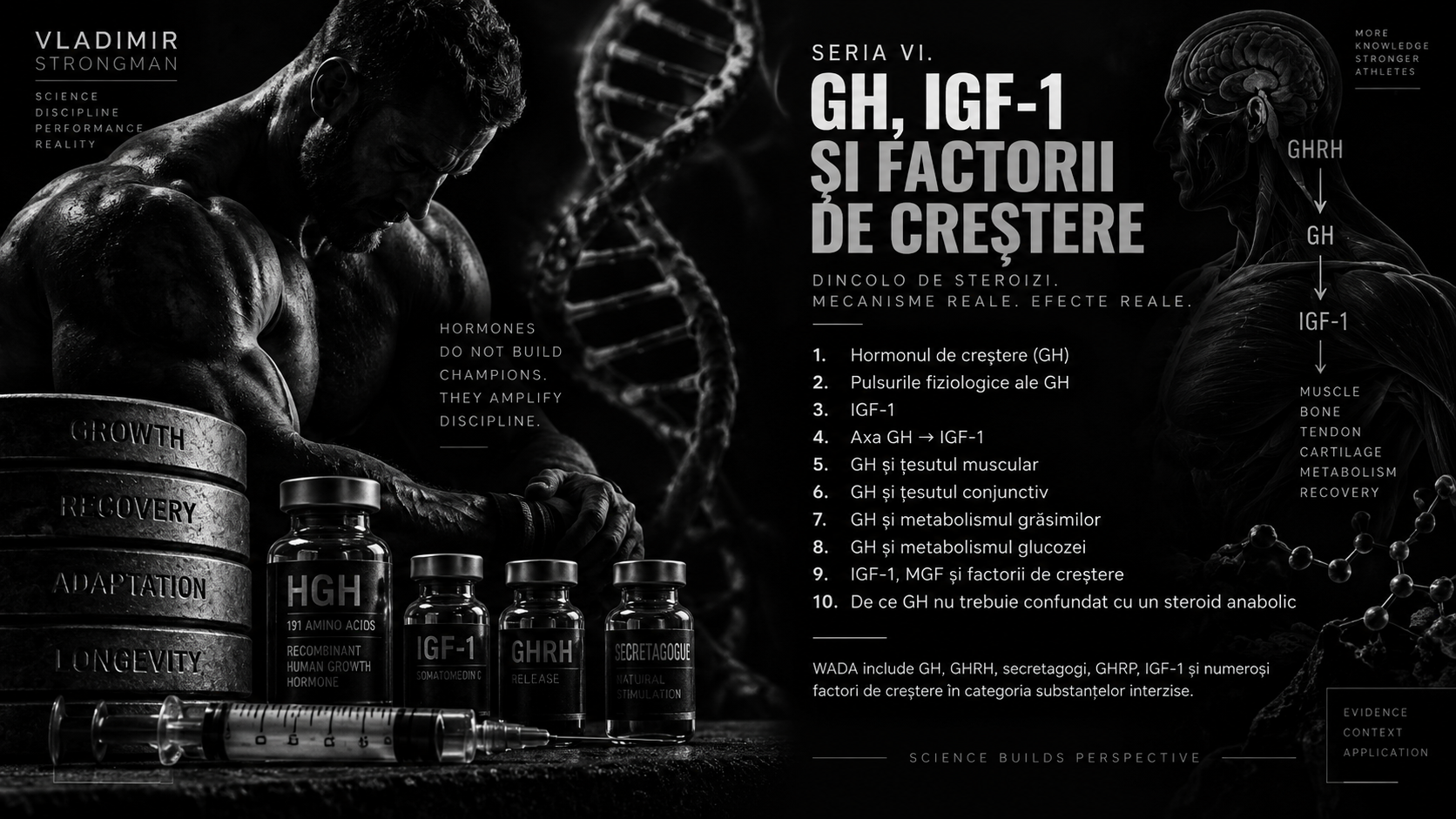
GH, IGF-1 and Growth Factors - Episode 9: IGF-1, MGF and Growth Factors
September 7, 2026
1. IGF-1 is one of the main links between GH and tissue adaptation
IGF-1 is a central growth factor within the somatotropic axis. GH stimulates IGF-1 production, particularly in the liver, but IGF-1 is also produced locally in many tissues. The GH-IGF-1 relationship is therefore not a simple linear pathway, but an endocrine, paracrine, and autocrine network.
2. Circulating IGF-1 and local IGF-1 are not the same thing
IGF-1 measured in blood reflects mainly hepatic production and transport associated with proteins such as IGFBP-3 and ALS. At the same time, tissues can produce IGF-1 locally, and this fraction may respond more directly to stimuli such as mechanical loading, injury, or remodeling. A serum value does not perfectly describe what is happening inside an individual muscle.
3. The IGF-1 receptor carries the signal into the cell
IGF-1 binds the IGF-1 receptor, a receptor tyrosine kinase. Downstream signaling can involve IRS, PI3K-AKT, and other pathways that influence protein synthesis, metabolism, cell survival, and gene expression.
4. The PI3K-AKT-mTOR pathway is an important connection to protein synthesis
Akt is an important node in anabolic signaling and can promote mTORC1 activity and processes that support protein synthesis. However, muscle hypertrophy is not explained by IGF-1 alone. Mechanical tension, amino-acid availability, cellular energy, and local responses interact with this pathway.
5. IGF-1 can influence satellite cells
Satellite cells are muscle progenitor cells involved in repair and remodeling. IGF-1 signaling can contribute to their proliferation, differentiation, and incorporation in certain contexts, but the response depends on the phase of regeneration and the tissue environment.
6. MGF is a term historically used for a local product associated with the IGF1 gene
MGF, or mechano growth factor, is a historical term used for a proposed IGF1 splice variant described in the context of muscle tissue. The central idea is that mechanical loading can alter expression of local products of the IGF1 gene. In modern literature, however, the nomenclature and exact identity of these transcripts and peptides are more complex than the popular formula “MGF = muscle IGF-1.”
7. MGF should not be treated as a completely independent hormone
In fitness culture, MGF is often presented as a distinct molecule with effects completely separate from IGF-1. Biologically, that simplification can be misleading. The actual discussion concerns isoforms, transcription, post-translational processing, localization, and the function of products derived from IGF1.
8. Why mechanical loading matters for local signaling
Muscle does not respond to a single molecule. Contraction and mechanical tension alter intracellular signaling, gene expression, and the extracellular environment. Local growth factors, including components of the IGF system, may participate in translating this mechanical stimulus into a remodeling response.
9. IGF-1 has effects beyond muscle
IGF-1 participates in the biology of bone, connective tissue, and other structures. The same signaling system should therefore be viewed as part of a wider growth and repair network rather than as a mechanism intended only for muscle hypertrophy.
10. Growth factors work in networks, not isolation
IGF-1 interacts with insulin, GH, mTOR, local growth factors, cytokines, and mechanical signals. In active tissue, the final outcome is produced by overlapping signals together with the cell’s energetic state.
11. IGFBP-3 and ALS modify IGF-1 availability
Most circulating IGF-1 is transported in complexes with binding proteins. IGFBP-3 and the acid-labile subunit, ALS, contribute to stabilizing IGF-1 in circulation and regulating the fraction available for receptor interaction. This helps explain the difference between total concentration and effective signaling in a tissue.
12. The location of a signal can be as important as its magnitude
A local signal produced in the tissue being challenged is not equivalent to the same molecule administered or measured systemically. Tissue biology depends on where, when, and for how long a signal appears, as well as on receptor availability.
13. IGF-1 participates in cell survival and remodeling
IGF-1-AKT signaling can influence cell-survival processes and resistance to some apoptotic signals. During recovery, this may be relevant to tissue maintenance and reorganization, but it should not be confused with a guarantee of complete regeneration.
14. Growth factors can support repair, but repair is not the same as hypertrophy
Recovery after exercise or microinjury involves controlled inflammation, immune cells, satellite cells, extracellular matrix, and growth signals. Hypertrophy is only one possible tissue adaptation. This distinction is essential when interpreting IGF-1 and MGF.
15. Nutrition and insulin influence the IGF-1 response
IGF-1 is sensitive to nutritional and metabolic status. Insulin supports normal hepatic production and availability within the GH-IGF-1 axis, while undernutrition can produce GH resistance and lower IGF-1 even when GH is elevated.
16. This is where signal and outcome diverge
An increase in a molecular marker or signal does not guarantee a proportional functional adaptation. Cells can alter receptors, binding proteins, feedback, and other pathways. In biology, signal intensity and tissue outcome are related, but they are not identical.
17. Why the term “MGF” can be confusing
The literature on mechano growth factor has evolved, and some experimental findings do not translate into the simple claim that there is a single “MGF” peptide which, when administered separately, reproduces muscle adaptation. For educational purposes, it is more accurate to discuss local products and splice variants associated with IGF1 and separate demonstrated mechanisms from popular extrapolations.
18. Growth factors do not replace mechanical tension
Muscle adapts to a combination of mechanical stimulus, energy, nutrients, endocrine signals, and recovery time. IGF-1 and related local products may participate in the process, but without the appropriate biological stimulus there is no molecular shortcut that guarantees the same adaptation.
19. In strength sports, the relationship with performance is indirect
Strength depends on muscle mass, architecture, neural coordination, technique, tendons, energy availability, and recovery. Growth factors may contribute to tissue remodeling, but there is no simple relationship in which an increase in IGF-1 or MGF automatically becomes a proportional increase in performance.
20. What to remember about IGF-1, MGF, and growth factors
IGF-1 is a major mediator of the GH axis and an important signal for growth, metabolism, and remodeling. MGF is a historical and experimental term linked to local products of the IGF1 gene and responses to mechanical loading, but it should not be reduced to a “magic anabolic molecule.” Growth factors work together with mechanical tension, nutrients, insulin, and other signals to produce tissue adaptation.
21. The key idea of Episode 9
IGF-1 is one of the major bridges between endocrine signaling and tissue adaptation, while the MGF concept illustrates how complex the local biology of the IGF1 gene can be. For muscle, the important point is not one isolated growth factor but the integration of mechanical, metabolic, and endocrine signals into a coordinated response.
Editorial and safety note
This article presents IGF-1, MGF, and growth factors for educational purposes. It does not provide doses, protocols, administration methods, or instructions for using hormones and peptides for doping or body-composition manipulation.
More From The Journal

Training
The Science of Strongman Training - Episode X: Competition Programming
How to build a complete Strongman competition preparation block: calendar, events, volume, intensity, specificity, simulations, autoregulation, tapering and fatigue management.

Training
The Science of Strongman Training - Episode IX: Peaking
Peaking in Strongman: how to turn months of training into maximal competition performance by reducing fatigue, preserving adaptations and managing specificity.