
Physiology
GH, IGF-1 and Growth Factors - Episode 5: GH and Muscle Tissue
September 7, 2026
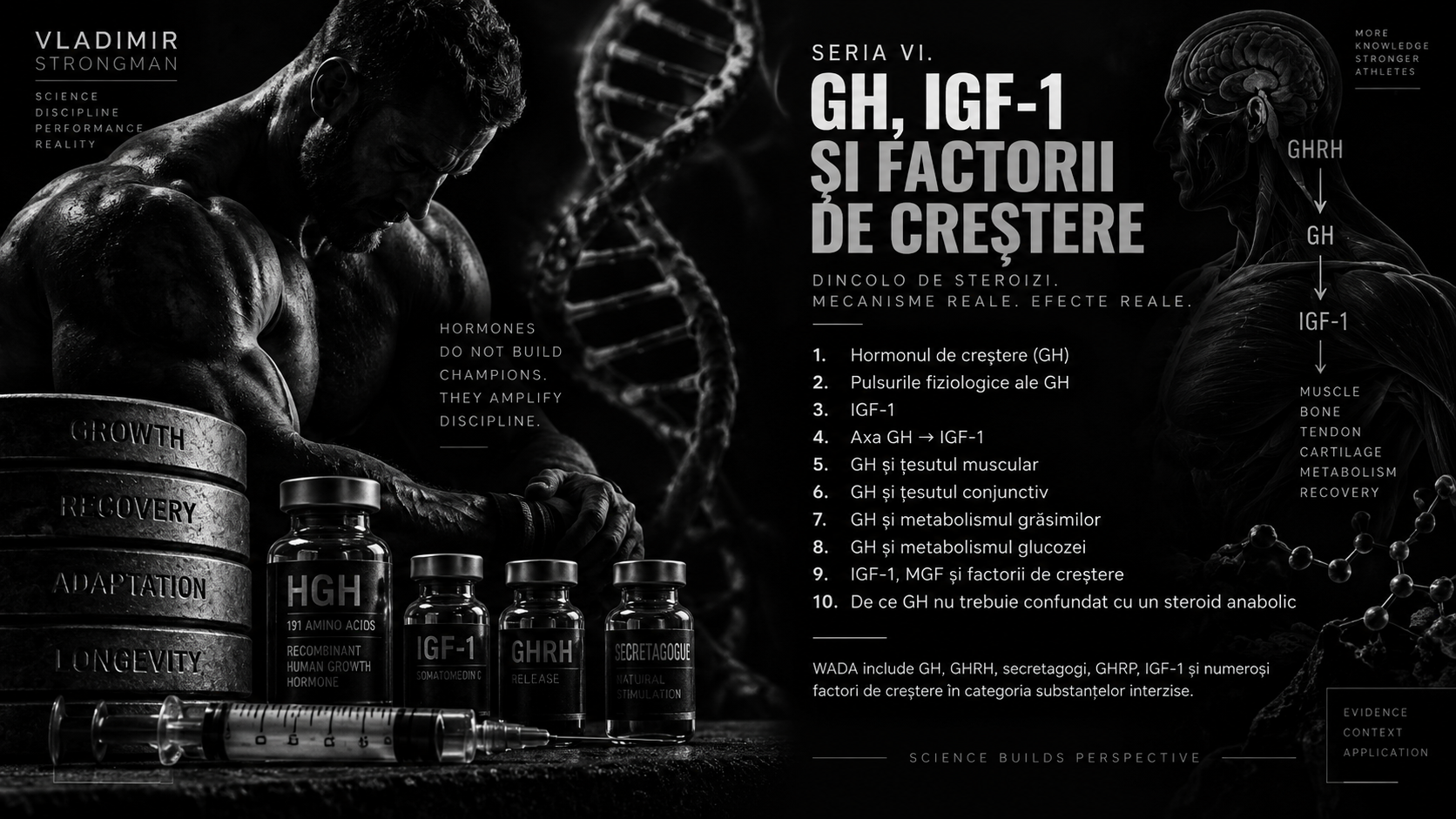
1. GH influences muscle, but it is not simply a “muscle-building hormone”
Growth hormone, GH, influences muscle tissue, but the relationship is not a simple “more GH = more muscle” equation. GH acts directly through the growth hormone receptor, GHR, and indirectly through IGF-1 and changes in metabolic substrate availability. The muscular response also depends on nutritional status, training, sleep, age, and the wider endocrine system.
2. GHR is expressed in muscle tissue
Muscle fibers and other cells in musculoskeletal tissues express growth hormone receptors. When GH binds GHR, intracellular pathways including JAK2-STAT, MAPK/ERK, and PI3K/Akt can be activated. These signals can alter gene expression and cellular processes within the tissue.
3. GH has direct and indirect actions on muscle
Some GH effects on tissues are direct through GHR. Others are mediated by IGF-1, including IGF-1 produced by the liver and locally within tissues. This distinction matters because two people can have similar GH exposure but different tissue responses.
4. GH does not “turn into” IGF-1 in muscle
GH is the hormonal signal, while IGF-1 is one of the system’s major downstream responses. GH binds its receptor and activates a signaling cascade that, particularly in the liver, stimulates transcription of the IGF1 gene. IGF-1 then enters circulation or acts locally within tissues.
5. IGF-1 is an important bridge toward protein synthesis
IGF-1 binds IGF1R, a receptor tyrosine kinase, and can activate PI3K/Akt. Akt can then favor mTORC1 signaling, a major control node for protein synthesis and cellular growth. This is an important mechanism, but it is not the only mechanism determining muscle hypertrophy.
6. Mechanical tension remains essential
Muscle does not grow simply because an endocrine signal is present. Mechanical loading and mechanosensitive pathways generate their own adaptive signals within muscle fibers. GH and IGF-1 intersect with these processes but do not replace them.
7. GH and IGF-1 can influence satellite cells
Satellite cells contribute to skeletal muscle remodeling and regeneration. IGF-1 signaling can support their activation, proliferation, and differentiation in certain contexts, contributing to repair and adaptation. The final effect still depends on the local tissue environment and mechanical stimulus.
8. Nitrogen retention is not the same thing as hypertrophy
In physiology, GH influences protein metabolism and substrate use, but acute changes in nitrogen balance or fluid retention should not be confused with permanent accumulation of contractile proteins. Real muscle growth requires tissue remodeling over time.
9. GH changes fat utilization
An important metabolic effect of GH is stimulation of lipolysis and mobilization of fatty acids. This can alter fuel selection and helps explain why GH participates in body composition even when direct effects on muscle are not dramatic.
10. GH and glucose: muscle does not operate in isolation
GH can reduce insulin sensitivity and support glucose availability. Insulin and IGF-1 have insulin-like actions in some contexts and interact with glucose metabolism. Any discussion of GH and muscle therefore needs to include energy metabolism.
11. Why GH can influence lean mass without automatically producing a huge increase in strength
Lean mass, contractile muscle mass, and maximal strength are not synonyms. Strength also depends on motor-unit recruitment, discharge rate, coordination, technique, leverage, and training specificity. A hormonal change does not translate mechanically into extra kilograms on the bar.
12. GH and connective tissue
The GH-IGF-1 axis also influences connective tissues, including processes related to synthesis and remodeling. This matters in strength sports because muscle, tendon, bone, and periarticular tissues do not necessarily adapt at the same speed or in the same proportion.
13. Why muscle can respond differently from liver
The liver is a major source of circulating IGF-1, but hepatic and muscular responses are not identical. Muscle can generate local signals, has its own microenvironment, and integrates mechanical tension, amino acids, energy, and endocrine signals simultaneously. Serum IGF-1 is therefore not a complete map of events inside the muscle fiber.
14. Nutrition can alter the muscle response to the GH-IGF-1 axis
Energy and protein availability influence axis activity. During severe energy deficit or undernutrition, GH may be relatively high while IGF-1 is low, a pattern compatible with GH resistance. The presence of GH in blood therefore does not guarantee that tissues are receiving an effective growth signal.
15. Sleep changes the hormonal environment in which muscle recovers
A large part of physiological GH secretion is associated with deep sleep. Sleep should therefore be viewed not only as rest but also as part of the neuroendocrine environment in which recovery takes place. Sleep fragmentation can alter the nocturnal GH pulse.
16. GH deficiency and muscle
Severe adult GH deficiency can be associated with changes in body composition, reduced muscle mass and strength, and reduced exercise capacity. Medical treatment of confirmed deficiency can improve body composition and some functional outcomes, but that clinical situation is different from using GH for performance enhancement in healthy people.
17. Why GH is not equivalent to an androgen
GH and androgens belong to different hormonal systems. Androgens primarily act through the nuclear androgen receptor and change specific gene-expression programs, whereas GH signals through GHR and associated pathways related to the cytokine-receptor family. The systems can interact, but they are not interchangeable.
18. GH can alter body composition without explaining hypertrophy by itself
When changes in lean mass or fat tissue are observed, it is tempting to attribute everything to a single hormone. In reality, body composition reflects energy availability, physical activity, endocrinology, sleep, and tissue adaptation. GH is an important component, not the entire puzzle.
19. What does this mean for strength sports?
In Strongman, powerlifting, and other strength sports, the body must convert mass and metabolic capacity into usable force. GH can influence components of body composition and tissue biology, but sporting performance is determined by the whole system: muscle, nervous system, technique, leverage, energy availability, and training specificity.
20. The biggest mistake: confusing a signal with an adaptation
A hormone concentration, a GH pulse, or temporary Akt/mTOR activation is a biological signal or event. Hypertrophy is the cumulative result of synthesis, degradation, remodeling, and adaptation over time. The signal starts the machinery; it does not guarantee the final product.
21. The key idea of Episode 5
GH influences muscle tissue through several routes: directly through GHR and indirectly through IGF-1, metabolism, and interactions with other endocrine and mechanical signals. Muscle responds to a combination of tension, nutrients, energy, sleep, and hormonal signaling. GH should therefore not be treated as a simple “muscle-building hormone,” but as one component of a much larger physiological system. The logical next step is to examine IGF-1 inside muscle and how local signaling differs from circulating IGF-1.
Editorial and safety note
This article presents GH physiology and its relationship with muscle tissue for educational purposes. It does not provide doses, protocols, cycles, or instructions for using GH or other hormones for doping or performance enhancement.
More From The Journal

Training
The Science of Strongman Training - Episode X: Competition Programming
How to build a complete Strongman competition preparation block: calendar, events, volume, intensity, specificity, simulations, autoregulation, tapering and fatigue management.

Training
The Science of Strongman Training - Episode IX: Peaking
Peaking in Strongman: how to turn months of training into maximal competition performance by reducing fatigue, preserving adaptations and managing specificity.