
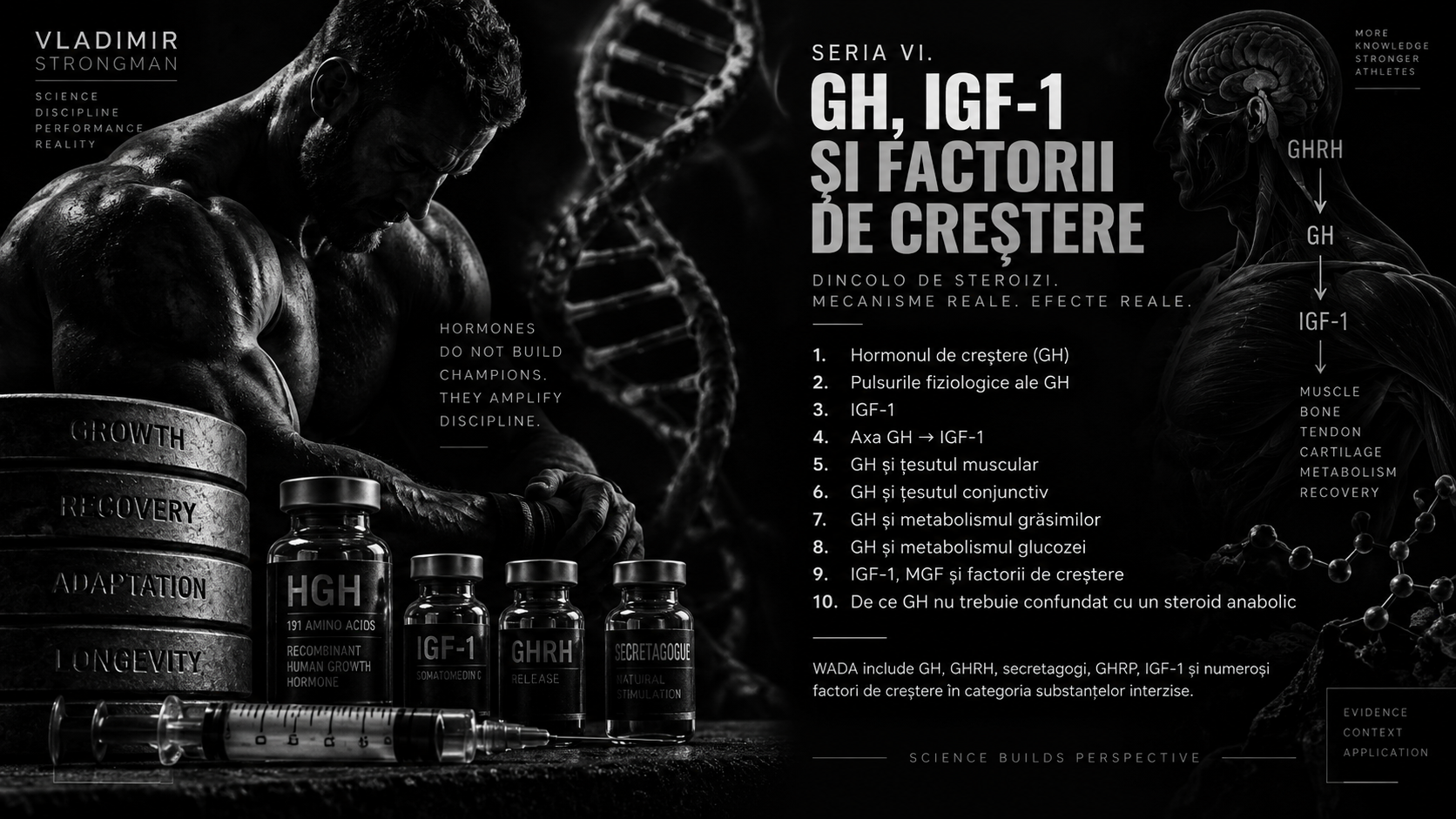
1. GH and IGF-1 are two links in the same axis
The GH - IGF-1 axis is not a simple “GH goes in, IGF-1 comes out” relationship. It is a multi-level endocrine system in which the hypothalamus regulates GH secretion, GH acts on the liver and other tissues, and IGF-1 transmits a major part of growth-related signaling. In parallel, IGF-1 and GH participate in feedback that limits the initial stimulus.
2. The first step is the GH pulse
GH is released from the pituitary in pulses. Pulse amplitude and timing matter because tissue exposure to GH is dynamic rather than constant. GHRH and somatostatin regulate secretion, while sleep, exercise, age, sex, and metabolic state modify the pulsatile profile. IGF-1 therefore has to be understood as the response of a system receiving a time-varying signal.
3. The liver is the main generator of circulating IGF-1
GH reaches the liver and binds the GHR receptor on hepatocytes. Through intracellular signaling, particularly JAK2 and STAT5, it stimulates transcription of the IGF1 gene. The liver therefore becomes the major source of circulating IGF-1, even though many other tissues also produce IGF-1 locally.
4. GHR is the intermediary between GH and IGF-1
GH does not chemically turn into IGF-1. GH binds the GHR receptor and activates a signaling cascade. In the liver, this cascade increases IGF1 transcription and the production of components involved in IGF transport. The receptor is therefore the molecular link that translates the hormonal message into a cellular response.
5. JAK2 - STAT5: one of the central pathways
GHR activation recruits and activates JAK2, which promotes phosphorylation of STAT proteins, especially STAT5. STAT5 enters the nucleus and regulates GH-dependent genes, including IGF1. This is a clear example of how an extracellular signal becomes a gene-expression program.
6. IGF-1 does not travel alone
In blood, most IGF-1 is bound to carrier proteins. IGFBP-3 is the major circulating binding protein, and IGF-1 and IGFBP-3 can associate with the acid-labile subunit, ALS, forming a large complex that prolongs IGF-1 persistence in the circulation and regulates tissue access.
7. IGFBP-3 and ALS are more than simple “transporters”
Binding proteins modify IGF-1 bioavailability and prolong its half-life. The IGFBP-3/ALS complex acts as a stable circulating reservoir. Therefore, the total amount of IGF-1 measured in blood is not identical to the amount freely available to receptors.
8. The next step: IGF-1 reaches its receptor
When IGF-1 becomes available in the tissue microenvironment, it can bind IGF1R, a receptor tyrosine kinase. IGF1R activation recruits signaling proteins that lead mainly to pathways such as PI3K - Akt and MAPK - ERK. These pathways can influence cell survival, metabolism, protein synthesis, proliferation, and differentiation.
9. GH and IGF-1 overlap, but they are not identical
A substantial portion of GH growth effects is mediated through IGF-1, but GH also has IGF-1-independent actions. These include direct metabolic effects on adipose tissue and substrate metabolism. The overall response therefore cannot be interpreted through the IGF-1 value alone.
10. In muscle, the story becomes more interesting
Muscle tissue can produce and respond to local IGF-1. These autocrine and paracrine signals act within the muscle microenvironment, where training mechanics, nutrition, and energy status intersect with cellular signaling. Therefore, serum IGF-1 cannot be used as a direct measure of every local change occurring inside a muscle fiber.
11. IGF-1 can support protein synthesis, but it is not alone
IGF1R activation can stimulate Akt and favor mTORC1 activation, a major control node for protein synthesis and cellular growth. However, muscle protein synthesis results from the convergence of multiple signals, including mechanical tension and amino-acid availability. Activation of a molecular pathway is not synonymous with visible hypertrophy.
12. GH - IGF-1 and bone
During childhood and adolescence, the GH - IGF-1 axis plays a major role in longitudinal growth. GH stimulates IGF-1 production, and IGF-1 acts on the growth plate and other skeletal components. In adults, the axis remains relevant to bone remodeling and homeostasis, but it cannot produce additional height after physiological growth-plate closure.
13. Why nutrition changes the GH - IGF-1 axis
Energy and nutrient availability influence IGF-1 production and action. During malnutrition or severe energy deficit, the body can become relatively resistant to GH: GH may be present, but the liver produces less IGF-1. This directly links endocrine physiology to nutritional status.
14. Insulin is an important partner of the GH - IGF-1 axis
Insulin and GH interact at the hepatic level, and insulin contributes to hepatic sensitivity to GH and IGF-1 production. Severe changes in insulin availability, nutrition, or insulin resistance can therefore alter the relationship between GH and IGF-1. The axis does not operate in an endocrine vacuum.
15. The liver can break the link between GH and IGF-1
When liver function is impaired, production of IGF-1 and its transport components can fall even when GH is present. In that setting, a low IGF-1 value does not automatically demonstrate primary GH deficiency. The entire axis and liver status must be considered.
16. IGF-1 then sends a signal back
Rising IGF-1 contributes to negative feedback on the GH axis at the pituitary and hypothalamic levels. This feedback is essential for homeostasis: GH stimulates IGF-1, while IGF-1 helps limit the GH stimulus.
17. Why the same amount of GH does not necessarily produce the same amount of IGF-1
The hepatic response depends on age, sex, nutrition, insulin, liver function, and metabolic state. Receptor activity and intracellular pathways can also behave differently in different contexts. The axis is adaptive, so GH → IGF-1 is not an equation with a fixed coefficient.
18. Why IGF-1 is more useful than GH for some assessments
GH is pulsatile and can vary enormously over a short interval. IGF-1 is more stable in circulation and better reflects integrated activity of the axis over a broader period. Even so, IGF-1 is not a standalone verdict. Age, sex, nutrition, liver function, and other conditions influence the result, and evaluation of GH deficiency may require dynamic testing.
19. GH - IGF-1 in strength sports
In strength sports, the GH - IGF-1 relationship is often reduced to the idea that “more IGF-1 means more muscle.” Physiology does not support such a linear relationship. Muscle mass, mechanical tension, the nervous system, sleep, energy availability, amino acids, and training specificity all contribute to the result. The GH - IGF-1 axis is one component of the system, not the whole system.
20. GH - IGF-1 is a network, not a linear ladder
The correct picture is not a straight GH → IGF-1 → muscle line. A better model is a network: hypothalamus → pituitary → GH → GHR → liver and tissues → IGF-1 → IGF1R → intracellular signaling, interacting with insulin, nutrition, metabolism, and hormonal feedback. Each node can alter the final response.
21. The key idea of Episode 4
GH and IGF-1 function as an integrated axis, but they are not interchangeable hormones. GH provides a pulsatile signal to receptors such as GHR, the liver translates much of that signal through production of IGF-1 and transport components, and IGF-1 acts through its own receptor and complex cellular pathways. At the same time, nutrition, insulin, liver function, and hormonal feedback can reshape the entire response. To understand effects on muscle tissue and performance, the next step is to go deeper into IGF1R and PI3K - Akt - mTOR signaling.
Editorial and safety note
This article explains GH - IGF-1 physiology for educational purposes. It does not provide doses, protocols, cycles, or instructions for using hormones or growth factors for doping or performance enhancement.
More From The Journal

Training
The Science of Strongman Training - Episode X: Competition Programming
How to build a complete Strongman competition preparation block: calendar, events, volume, intensity, specificity, simulations, autoregulation, tapering and fatigue management.

Training
The Science of Strongman Training - Episode IX: Peaking
Peaking in Strongman: how to turn months of training into maximal competition performance by reducing fatigue, preserving adaptations and managing specificity.