
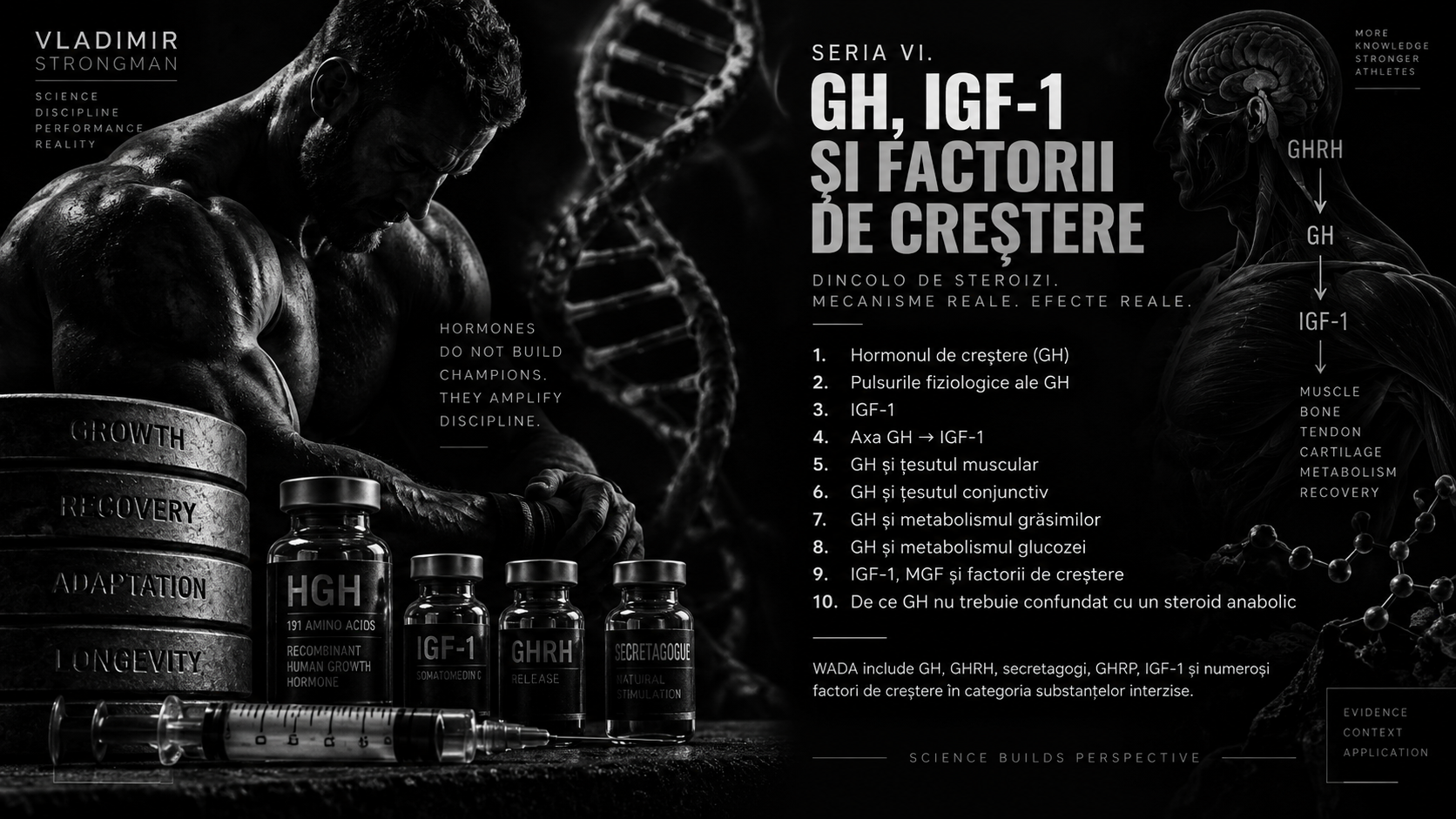
1. IGF-1 is one of the central pieces of the GH axis
IGF-1, insulin-like growth factor 1, is a peptide growth factor that mediates an important part of GH action. It is produced in multiple tissues, with the liver being the major source of circulating IGF-1. IGF-1 contributes to growth, development, metabolism, and tissue regulation, but its function cannot be reduced to “building muscle.”
2. GH and IGF-1 are not synonyms
GH is the endocrine signal that, among other effects, stimulates IGF-1 production. IGF-1 is one of the major mediators of that signal. However, GH also has direct IGF-1-independent actions, and IGF-1 can be produced locally within tissues. The axis is therefore a multi-level system, not a simple one-to-one relationship.
3. Where is IGF-1 produced?
The liver is the major source of IGF-1 found in the circulation under stimulation by GH. At the same time, many tissues can produce IGF-1 locally, where it acts through autocrine or paracrine mechanisms. This local production is important because serum IGF-1 does not perfectly describe all IGF-1 actions throughout the body.
4. IGF-1 circulates bound to proteins
Most circulating IGF-1 does not travel freely. It is associated with binding proteins, especially IGFBP-3 and the acid-labile subunit, ALS. This system prolongs the half-life of IGF-1 and regulates its availability to tissues. Total concentration and biologically accessible fraction are therefore not identical concepts.
5. IGF1R is the gateway into the cell
IGF-1 produces many of its effects through the insulin-like growth factor 1 receptor, IGF1R. It is a receptor tyrosine kinase structurally related to the insulin receptor. When IGF-1 binds IGF1R, it initiates an intracellular signaling cascade that can influence cell survival, protein synthesis, metabolism, and growth processes.
6. What happens after IGF1R is activated?
Two major pathways are PI3K-Akt and Ras-Raf-MEK-ERK. PI3K-Akt influences metabolism and protein synthesis, while interaction with mTOR contributes to control of cellular growth processes. MAPK/ERK signaling is particularly important for proliferation and differentiation. The receptor therefore converts an extracellular signal into a complex set of cellular responses.
7. Why does mTOR appear so often in discussions of IGF-1?
Akt can inhibit the TSC complex and, through this interaction, favor mTORC1 activation. mTORC1 is a major control node for protein synthesis and cell growth. In muscle, this network is one pathway through which endocrine and nutritional signals can converge on the protein-synthesis machinery. However, activation of a signaling pathway at a given moment is not equivalent to permanent muscle growth.
8. IGF-1 and muscle hypertrophy
IGF-1 can support anabolic processes in skeletal muscle through Akt signaling and protein synthesis and by influencing satellite cells and tissue regeneration. But actual hypertrophy depends on a wider set of factors: mechanical tension, recruitment, amino-acid availability, energy, recovery, and local tissue responses. IGF-1 is an important link, not a single switch for muscle growth.
9. Local IGF-1 should not be confused with blood IGF-1
Muscle and other tissues can produce local forms of IGF-1 that act within the tissue microenvironment. A normal serum value does not prove that every local signaling process is identical in every tissue, and an elevated serum value does not guarantee that a particular muscle will respond proportionally. Endocrinology becomes clearer when circulating signals are separated from local signaling.
10. IGF-1 participates in bone growth
During childhood and adolescence, IGF-1 is a major mediator of longitudinal growth through effects on the growth plate and bone tissue. Its action is closely linked to GH and nutritional state. After growth-plate closure, IGF-1 remains important for bone remodeling and homeostasis, but it cannot physiologically create additional height by reopening growth plates.
11. IGF-1 and connective tissue
IGF-1 signaling contributes to synthesis, proliferation, and repair processes in multiple tissues, including components of connective tissue. This helps explain why the GH-IGF-1 axis is not limited to skeletal muscle fibers. Muscle, bone, tendons, and other tissues respond in different contexts and on different time scales.
12. IGF-1 and metabolism
IGF-1 has some insulin-like effects, and the GH-IGF-1 axis interacts closely with glucose and lipid metabolism. IGF-1 can influence glucose utilization and insulin sensitivity, while GH tends to have opposite effects on insulin sensitivity. The balance between these signals contributes to the body's metabolic profile.
13. Why is IGF-1 more stable than GH in blood tests?
GH is secreted in rapid pulses, with large variations throughout the day. Circulating IGF-1 is much more stable because it is produced and transported within a slower hormonal system. For this reason, IGF-1 is often useful in clinical assessment of GH-axis activity, whereas a single GH value may capture only the moment when the sample was taken.
14. High IGF-1 does not automatically mean “more muscle”
An elevated circulating IGF-1 level indicates a particular level of axis activity or another influence on IGF-1, but it cannot by itself predict how much muscle will be built. Receptor activity, tissue sensitivity, intracellular signaling, energy intake, training, and tissue state all matter. Biology responds to networks, not to one number.
15. Nutrition influences IGF-1
Energy and protein intake, nutrient availability, and metabolic status influence IGF-1 production and action. Malnutrition and severe energy deficiency can suppress GH-IGF-1 activity or produce what is often described as GH resistance, where GH is present but hepatic IGF-1 production is reduced. This is one reason endocrine measurements can be misleading without nutritional context.
16. The liver is essential for circulating IGF-1
Because the liver is the major source of circulating IGF-1, hepatic function can influence serum levels. Low IGF-1 does not automatically mean that the pituitary is failing to produce GH; the issue can be downstream, at the level of hepatic responsiveness, or related to nutritional and metabolic context. Correct interpretation requires integration of multiple data points.
17. IGF-1 feeds back on the GH axis
IGF-1 contributes to negative feedback within the GH axis, reducing GH secretion at the pituitary and influencing hypothalamic control. In this way, GH stimulates IGF-1, while IGF-1 helps limit the original stimulus. It is a classic endocrine feedback loop.
18. What happens when IGF-1 is low?
Low IGF-1 can occur with GH deficiency, undernutrition, some liver diseases, and other clinical conditions. In children, impaired activity of the axis can affect growth. In adults, changes may reflect altered body composition and metabolism. Interpretation should consider age, clinical context, other laboratory results, and, when appropriate, dynamic testing of the GH axis.
19. IGF-1, performance, and the myth of the “magic hormone”
In strength sports, IGF-1 is sometimes presented as a direct command for hypertrophy and recovery. The reality is more nuanced. IGF-1 signaling matters for growth and repair, but performance depends on a network that includes the nervous system, mechanical tension, muscle architecture, energy availability, sleep, and training specificity. One endocrine marker cannot predict the result on the platform.
20. GH can increase IGF-1, but the response is not identical in everyone
The IGF-1 response to GH depends on age, sex, nutrition, liver function, receptor sensitivity, and metabolic state. This variability explains why the same endocrine stimulus does not necessarily produce the same IGF-1 concentration in two people. The axis should be understood as an adaptive system, not a pump with a fixed output.
21. The key idea of Episode 3
IGF-1 is one of the major mediators of the GH axis and an important bridge between endocrine signaling and cellular response. Part of GH action is translated into a growth signal through IGF-1, which acts via IGF1R and pathways such as PI3K-Akt-mTOR and MAPK/ERK. But IGF-1 must not be confused with GH, muscle mass, or performance. To understand what comes next, we need to follow the receptor, the signaling pathways, and the difference between circulating and locally produced IGF-1.
Editorial and safety note
This article explains IGF-1 physiology and the GH axis for educational purposes. It does not provide doses, protocols, cycles, or instructions for using hormones or growth factors for doping or performance enhancement.
More From The Journal

Training
The Science of Strongman Training - Episode X: Competition Programming
How to build a complete Strongman competition preparation block: calendar, events, volume, intensity, specificity, simulations, autoregulation, tapering and fatigue management.

Training
The Science of Strongman Training - Episode IX: Peaking
Peaking in Strongman: how to turn months of training into maximal competition performance by reducing fatigue, preserving adaptations and managing specificity.