
Physiology
GH, IGF-1 and Growth Factors - Episode 10: Why GH Should Not Be Confused with an Anabolic Steroid
September 7, 2026
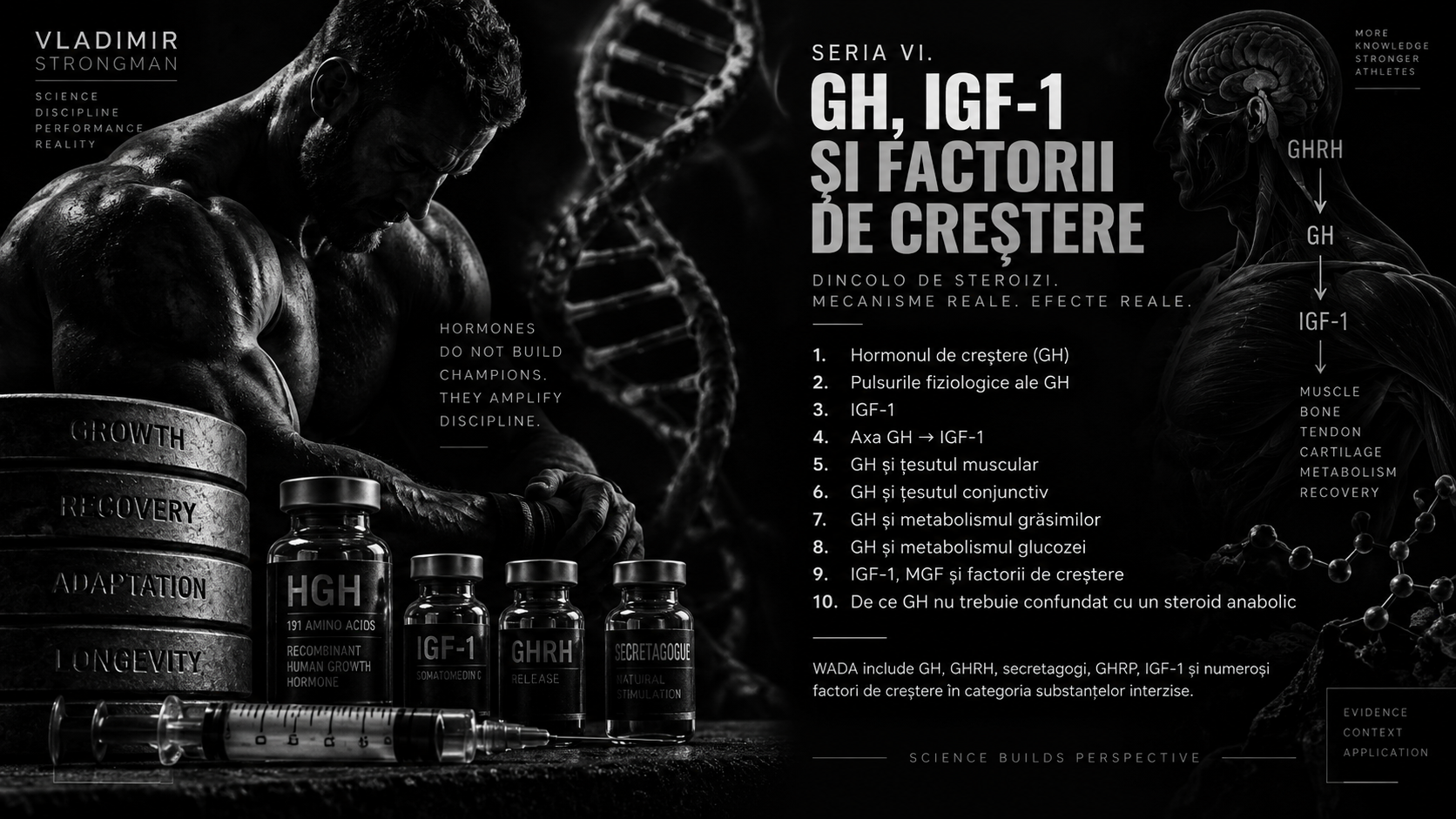
1. GH and an anabolic steroid are not the same class of molecule
Growth hormone (GH) is a protein made of amino acids and secreted by the pituitary gland. An anabolic-androgenic steroid is a lipid-soluble molecule derived from the steroid nucleus and acts primarily through the androgen receptor. The fact that both can influence body composition or muscle-related outcomes does not make them equivalent.
2. The first major difference: chemical nature
GH is a peptide hormone. Anabolic steroids are steroid hormones or steroid derivatives. This difference determines, from the beginning, how the molecule is transported, where its receptor is located, and how the biological signal is transmitted.
3. GH acts through the GH receptor, not the androgen receptor
The GH receptor is a membrane receptor associated with JAK2-STAT signaling, whereas anabolic steroids bind the androgen receptor, an intracellular member of the nuclear-receptor family. The two receptor systems initiate different biological programs.
4. GH has a central relationship with IGF-1
One of the defining functions of GH is to stimulate IGF-1 production, especially in the liver, alongside local actions in tissues. IGF-1 can activate the IGF-1 receptor and PI3K-AKT signaling, influencing growth, metabolism, and tissue remodeling.
5. Anabolic steroids use a different molecular axis
An anabolic-androgenic steroid acts primarily through the androgen receptor. The hormone-receptor complex can influence transcription of specific genes and, depending on tissue and context, alter protein synthesis, cellular differentiation, and other androgen-dependent processes.
6. GH is not an androgen
GH does not reproduce the functions of androgen hormones. It does not activate the androgen receptor and does not directly generate the gene-expression program characteristic of testosterone and androgenic derivatives. Its effects on muscle therefore should not be described as a different version of anabolic-steroid action.
7. GH influences metabolism before it influences adaptation
GH has important effects on lipolysis, fatty-acid use, and glucose metabolism. Through these actions, it can change fuel availability and the metabolic environment in which other tissues operate. An anabolic steroid has a different pharmacological profile, dominated by androgen-receptor signaling.
8. Body mass is not synonymous with muscle anabolism
A change in body mass may come from changes in water, glycogen, adipose tissue, connective tissues, or muscle. GH can influence several of these compartments, which makes it misleading to conclude that every increase in mass represents muscle anabolism.
9. GH and muscle hypertrophy should not be reduced to the same equation as androgens
Androgens can act directly on muscle tissue through the androgen receptor. GH can contribute to muscle processes directly and through IGF-1, but the response depends on the endocrine, metabolic, and mechanical context. The two systems do not produce the same biological signature.
10. The receptor matters more than the mere presence of the hormone
Two molecules can produce very different effects even if both influence the same final outcome, such as lean mass. The receptor, tissue expression, cofactors, signaling pathways, and feedback systems determine what the molecule actually does.
11. GH and steroids do not have identical tissue-effect profiles
GH influences a broad range of tissues, including liver, adipose tissue, bone, connective tissue, and muscle. Androgenic steroids have tissue effects shaped by androgen-receptor distribution and by the properties of each molecule. Their organ effects therefore cannot be treated as interchangeable.
12. GH does not produce the same type of genomic signaling as a steroid
The androgen receptor functions as a ligand-activated transcription factor and can alter gene expression in the nucleus. The GH receptor primarily initiates membrane-associated signaling cascades involving kinases and transcription factors. The architecture of the signal is fundamentally different.
13. GH can interact with insulin metabolism
GH can have anti-insulin effects, reducing insulin sensitivity in certain settings and favoring fatty-acid availability. This is a central part of GH physiology and one reason its metabolic effects should not be confused with those of an androgenic steroid.
14. GH and androgens can reach the same tissue through different mechanisms
Muscle can receive mechanical, metabolic, IGF-1, and androgenic signals at the same time. The fact that two pathways can influence the same cell does not mean they are the same pathway. In muscle biology, signaling convergence is common, but each signal remains biologically distinct.
15. Connective tissue makes the difference even clearer
GH and IGF-1 have important relationships with fibroblasts, collagen, extracellular matrix, tendons, and ligaments. This profile is different from the question of whether a compound activates the androgen receptor. Tendon adaptation cannot simply be inferred from the behavior of muscle mass.
16. GH should not be described as a “steroid without androgenic effects”
That phrase is biologically incorrect. GH is not a steroid and is not a variant of an androgen. It belongs to a different hormone class, uses a different receptor, follows different signaling mechanisms, and serves different physiological priorities.
17. IGF-1 does not turn GH into an anabolic steroid
IGF-1 is a growth factor that links part of the GH response to tissue growth and remodeling. The fact that IGF-1 can activate pathways associated with protein synthesis does not change the pharmacological identity of GH or make it an androgen-receptor agonist.
18. Why the comparison appears so often in strength sports
In strength-sport discussions, GH, IGF-1, and androgens often appear together in conversations about muscle mass, recovery, and body composition. The problem is that placing them in the same conversation can create the false impression that they share the same pharmacology.
19. A molecule can contribute to the same final outcome through a completely different route
Muscle mass, strength, recovery, and body composition are emergent outcomes. Multiple systems can contribute to them through different pathways. Saying that two molecules are “the same” because both can influence an outcome means ignoring the mechanism that produces that outcome.
20. In strength sports, the perceived effect is not always the direct effect
An athlete may notice simultaneous changes in muscle mass, fat mass, water retention, recovery, and training capacity. Attributing all of these changes to one hormone is an interpretive error, especially when multiple endocrine signals and training stimuli coexist.
21. The key idea of Episode 10
GH and anabolic steroids are not equivalent molecules and are not variations of the same mechanism. GH is a peptide hormone acting through the GH receptor and the GH-IGF-1 network, with important effects on metabolism, growth, and tissue remodeling. Anabolic steroids are steroid derivatives acting predominantly through the androgen receptor. They can converge on outcomes such as lean mass or muscle adaptation, but they do so through different biological architectures.
Editorial and safety note
This article is educational and compares hormonal mechanisms. It does not provide doses, protocols, combinations, or instructions for using GH or anabolic steroids for doping or performance enhancement.
More From The Journal

Training
The Science of Strongman Training - Episode X: Competition Programming
How to build a complete Strongman competition preparation block: calendar, events, volume, intensity, specificity, simulations, autoregulation, tapering and fatigue management.

Training
The Science of Strongman Training - Episode IX: Peaking
Peaking in Strongman: how to turn months of training into maximal competition performance by reducing fatigue, preserving adaptations and managing specificity.