
Physiology
GH, IGF-1 and Growth Factors - Episode 1: Growth Hormone GH
September 7, 2026
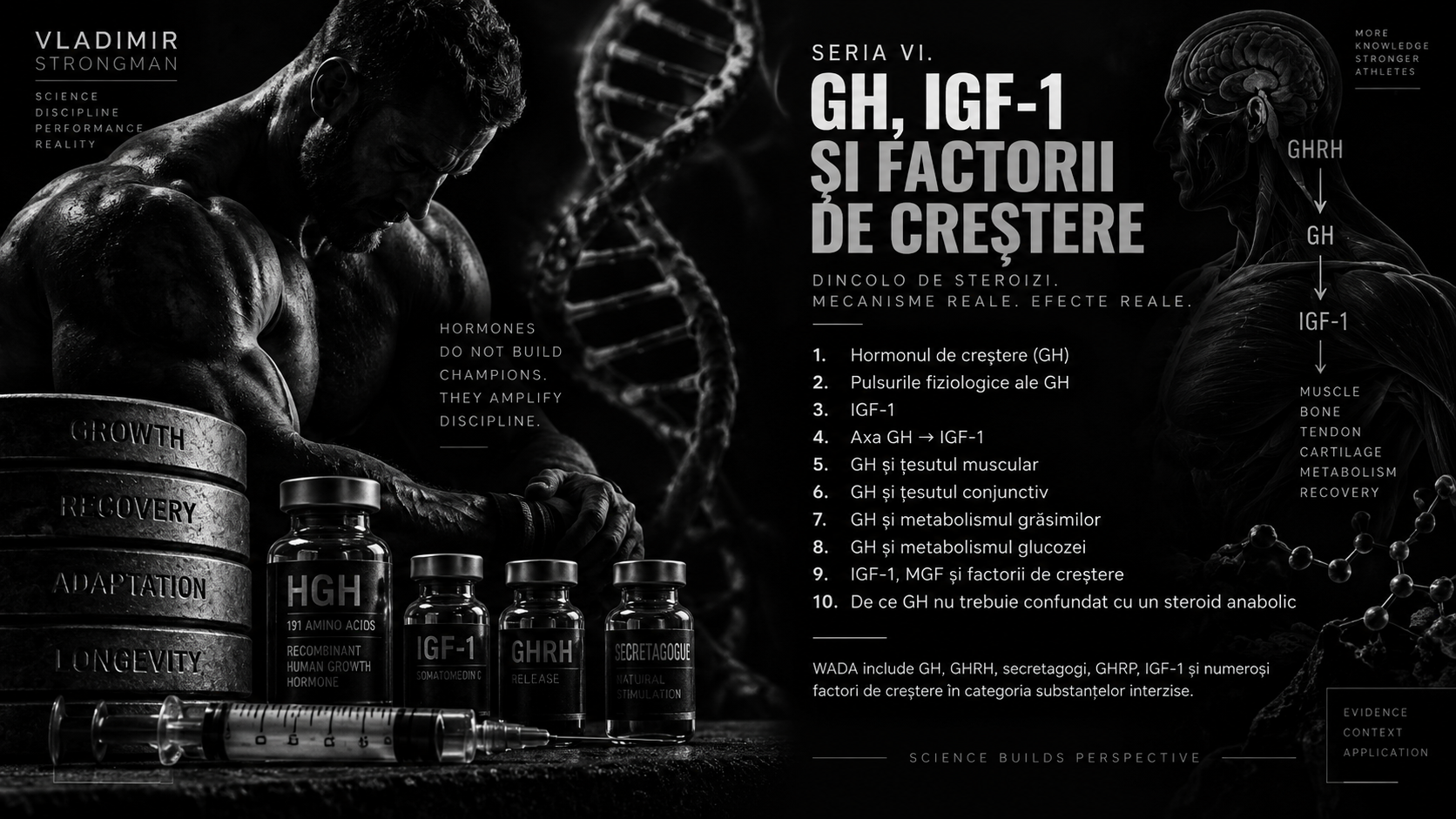
1. GH is not simply “the hormone that makes you bigger”
Growth hormone, GH, is a peptide hormone produced predominantly by somatotroph cells in the anterior pituitary. Its name points toward linear growth, but its biology is much broader: GH participates in regulation of adipose tissue, glucose and lipid metabolism, lean mass, connective tissue, and bone. During childhood it is essential for normal growth. In adults, the GH axis remains active and continues to influence body composition and metabolism.
2. Where is GH produced?
GH is synthesized and released mainly by the anterior pituitary under hypothalamic control. Two major signals exert opposite effects: growth hormone-releasing hormone, GHRH, stimulates GH release, while somatostatin inhibits it. Ghrelin can also contribute to stimulation, making the system a neuroendocrine network rather than a simple on/off switch.
3. GH is secreted in pulses, not at a constant rate
Physiological GH secretion occurs in pulses, with substantial variation across the day and night. Because of this pulsatility, a single serum GH measurement has limited value for describing total endogenous secretion and should not be treated as a direct snapshot of daily production. When clinically indicated, GH deficiency is assessed with dynamic stimulation testing rather than a random GH value.
4. Sleep, exercise, and metabolic state influence the GH axis
The GH axis is sensitive to physiological context. Sleep, exercise, nutrition, glucose, fatty acids, and energy availability can alter secretion. This variability is why GH should never be interpreted separately from the wider endocrine system. The body adjusts GH release according to the demands of growth, recovery, and metabolism.
5. GH travels to tissues and looks for its receptor
GH exerts its effects after binding to its specific receptor, the growth hormone receptor, GHR. This receptor belongs to the cytokine receptor superfamily and is expressed in many tissues, including liver, muscle, adipose tissue, bone, heart, and kidney. The broad distribution of GHR helps explain the systemic nature of GH biology.
6. What happens when GH binds to GHR?
Binding of GH to GHR initiates a cascade of intracellular events. A central element is activation of the receptor-associated tyrosine kinase JAK2, followed by phosphorylation of signaling proteins and activation of STAT transcription factors. STAT5, especially STAT5b in the liver, is important for transcription of GH-dependent genes, including those involved in IGF-1 production.
7. The JAK2-STAT5 pathway is one of the key pieces
GH does not signal through a single messenger. GHR signaling includes JAK/STAT pathways as well as MAPK/ERK and PI3K/Akt pathways. These systems can alter gene expression, cellular metabolism, growth, and differentiation. One hormone can therefore generate different biological responses depending on the tissue and physiological context.
8. This is where IGF-1 enters the picture
One of the best-known consequences of GH signaling is stimulation of insulin-like growth factor 1, IGF-1. The liver is a major source of circulating IGF-1, although GH can also influence local IGF-1 production in other tissues. GH and IGF-1 therefore form a functional axis rather than two isolated endocrine systems.
9. GH and IGF-1 are not the same thing
GH is an initiating hormonal signal in many contexts, while IGF-1 is one of the major mediators of growth-related effects. However, GH also has IGF-1-independent actions, including direct metabolic effects such as stimulation of lipolysis and regulation of energy substrates. The equation “GH = IGF-1” is therefore too simple for real phisiology.
10. GH and fat metabolism
GH promotes mobilization of fatty acids and changes substrate utilization. This metabolic component is one reason GH should not be reduced to a tissue-growth hormone. Under energy shortage, this part of GH signaling can help shift the availability and use of metabolic fuel.
11. GH and glucose: the relationship is more complicated
GH can reduce insulin sensitivity and support processes that increase glucose availability, including gluconeogenesis. For that reason, GH effects on body composition cannot be interpreted without considering glucose metabolism. Endocrine systems interact continuously, and a stronger trophic signal can also produce metabolic effects that require clinical monitoring.
12. GH, bone, and growing tissues
In children and adolescents, GH and IGF-1 contribute substantially to longitudinal bone growth and normal development. In adults, growth plates can no longer produce additional height, but the axis remains involved in tissue remodeling and musculoskeletal integrity.
13. What does GH have to do with muscle mass?
GH influences muscle tissue directly and indirectly through IGF-1, metabolism, and effects on other tissues. Severe adult GH deficiency may be associated with reduced muscle mass and strength, while replacement therapy in people with documented deficiency can improve body composition and some aspects of exercise capacity. This does not mean GH is a universal hypertrophy accelerator in healthy people.
14. GH is not an androgen
GH belongs to a different hormonal class from testosterone and other androgens. Its receptor, signaling mechanisms, and physiological effects are distinct. In performance settings, these systems may interact, but they should not be treated as different versions of the same hormone. Understanding hormone classes is essential for separating physiology from “anabolism” myths.
15. Why a GH value and an IGF-1 value do not tell the same story
GH is pulsatile, whereas circulating IGF-1 is more stable and reflects, among other factors, activity of the GH axis over a broader time window. This is why IGF-1 is commonly used in clinical assessment of GH-axis activity, although interpretation must account for age, sex, nutritional status, liver function, and other variables. A single number never captures the entire physiology.
16. What happens when GH is insufficient?
GH deficiency can be congenital or acquired. In children, it can impair growth velocity. In adults, severe deficiency may be associated with altered body composition, reduced muscle mass and strength, low energy, lipid abnormalities, and impaired skeletal integrity. Diagnosis relies on the clinical picture and, when appropriate, stimulation testing rather than a single random GH measurement.
17. What does GH treatment mean in medicine?
Recombinant GH is a medical treatment used for established indications, particularly documented GH deficiency and certain approved disorders. In adults with confirmed deficiency, guidelines recommend individualized treatment with clinical and biochemical monitoring. Benefits and risks must be assessed for each patient.
18. Why GH should not be presented as a universal performance solution
A hormone with important physiological functions does not automatically become a safe or effective performance-enhancing tool in healthy people. The Endocrine Society recommends against using GH to enhance athletic performance, and non-medical use raises questions of efficacy, safety, and ethics.
19. GH and strength performance: where the confusion begins
In strength sports, increases in lean mass, changes in body composition, recovery, and work capacity are often blended into a single concept called “anabolism.” Physiologically, those variables are distinct. GH can influence metabolism and tissues, but maximal strength also depends on muscle mass, muscle architecture, the nervous system, technique, leverage, and training specificity. No single endocrine signal can explain the entire result on the platform.
20. GH also has biological brakes
Hormonal systems are self-regulated. GHR/JAK-STAT signaling is also constrained by negative feedback mechanisms, including SOCS proteins and phosphatases, which limit the duration and magnitude of the response. These brakes are essential because an unrestricted growth signal would create profound imbalance.
21. The key idea of Episode 1
GH is better understood as an endocrine regulator of growth and metabolism than as a simple “mass hormone.” The hypothalamus controls pituitary secretion, GH activates GHR and intracellular signaling pathways, and a major part of this cascade leads to IGF-1. At the same time, GH has direct IGF-1-independent actions. To understand what actually happens to muscle tissue, body composition, and performance, we need to follow the entire axis from signal to cellular response.
Editorial and safety note
This article explains GH physiology and medical use for educational purposes. It does not provide protocols, doses, cycles, or instructions for GH use as doping or performance enhancement.
More From The Journal

Training
The Science of Strongman Training - Episode X: Competition Programming
How to build a complete Strongman competition preparation block: calendar, events, volume, intensity, specificity, simulations, autoregulation, tapering and fatigue management.

Training
The Science of Strongman Training - Episode IX: Peaking
Peaking in Strongman: how to turn months of training into maximal competition performance by reducing fatigue, preserving adaptations and managing specificity.