
Training Science
Series: GRIP STRENGTH: THE SCIENCE OF THE HAND THAT CONTROLS WEIGHT - Episode 8: Grip in the Deadlift, Axle and Hercules Hold
October 13, 2026
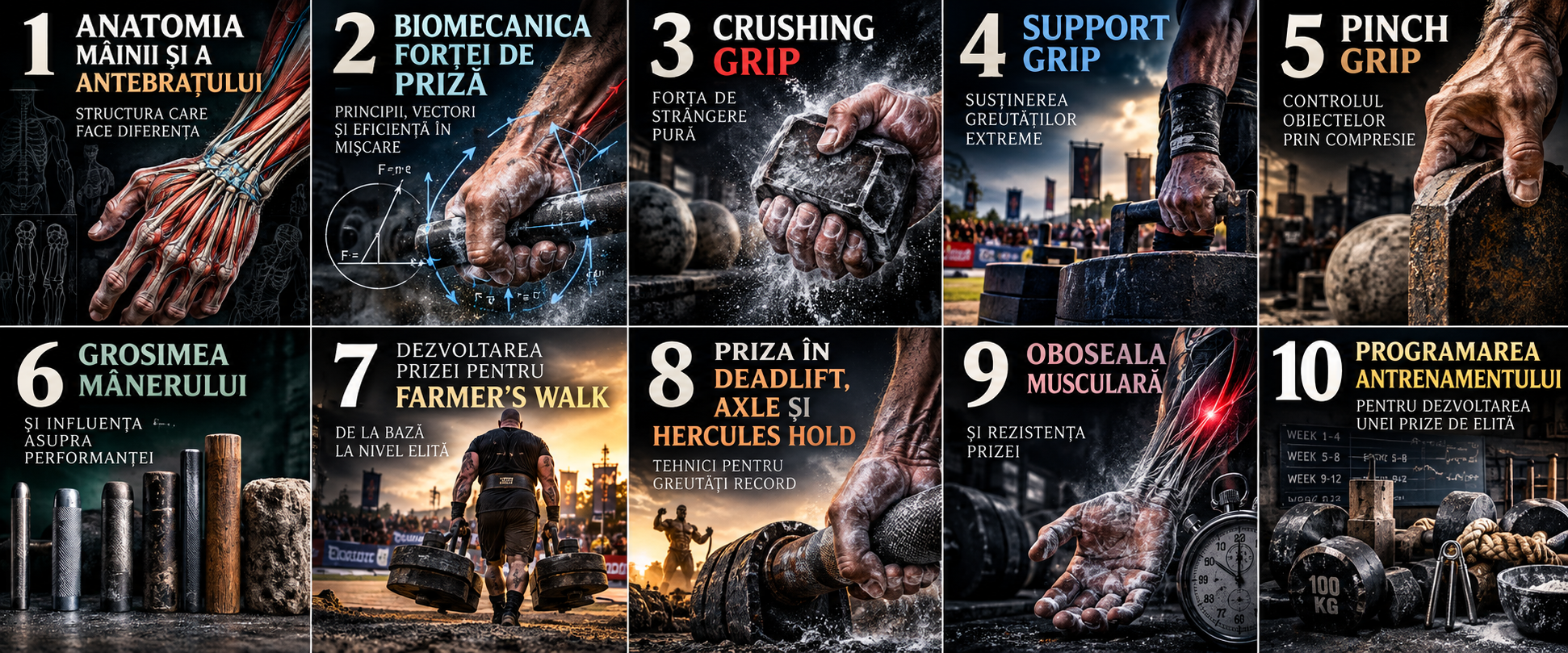
At the edge of the platform, three events can look like variations on one idea: an athlete places a hand on metal and refuses to let go. In the deadlift, the bar travels upward while the fingers retain a load that also challenges the legs, hips and trunk. In the axle deadlift, a familiar movement changes because of one seemingly small feature: the cylinder's diameter, surface and rotational behavior. In the Hercules hold, even the direction of force changes. Two structures pull the arms laterally, and the athlete must preserve contact while resisting a configuration of forces and moments dictated by the apparatus.
Gym conversation calls all three demands 'grip'. In biomechanics, that label is too broad to explain why an athlete can deadlift a huge bar with a mixed grip, lose a considerably lighter thick axle with double overhand hands, and hold a Hercules apparatus for a long time without converting that performance into a corresponding deadlift weight. This episode examines the differences. Its purpose is not a spectacular formula for converting one record into another, but a clear account of force production, slipping, equipment, fatigue and the adaptations worth training.
Three Events, Three Mechanical Problems
During a deadlift, the athlete applies force to raise the load against gravity, while the hands transfer that force through contact with the shaft. On an ordinary bar, finger geometry may permit some mechanical hooking, and the knurling influences the skin-metal interface. On a thick axle, the fingers may remain more extended depending on individual hand dimensions, and contact or rotational behavior may change. The Hercules hold involves retaining two handles against predominantly lateral, outward pulls, often with relatively little movement after the athlete takes the load.
Plate mass, shaft diameter and holding duration are different variables. A deadlift contest may reward a maximum lift or repetitions; a Hercules hold usually rewards time. In an axle event, grip rules and apparatus design may be decisive. Serious analysis begins by identifying the measured outcome, external forces and competition constraints. Without those specifications, claims about the 'best grip' cannot be meaningfully tested.
The Hand Is Not a Rigid Hook
Flexor digitorum profundus contributes to flexion at the distal finger joints, while flexor digitorum superficialis acts at more proximal finger segments. Intrinsic hand muscles help control the phalanges and coordinate finger positioning. The thumb may stabilize contact through opposition and pressure when object geometry permits. Finger and wrist extensors contribute to joint stability, even when observers focus on the visible anterior forearm. These muscles are not identical cables pulling in one direction. They operate through different moment arms, lengths and functions.
Small changes in finger joint angles can modify force-production conditions. On a very thick cylinder, the phalanges may no longer hook beneath the object in the same way as on a normal bar. A vertical Hercules handle, meanwhile, may impose a substantially different forearm orientation. This is one reason supported mass cannot be calculated from forearm circumference alone. Muscle size matters, but performance also depends on exactly how those muscles interact with an object.
Contact: Compression, Friction and Geometry
A basic relationship for idealized dry friction is Ff ≤ μN, where Ff is the tangential force resisted by contact, μ is a simplified friction coefficient, and N is the normal contact force. In real hands, however, contact occurs at multiple points, skin deforms, moisture modifies interactions, and some finger segments may partially support an object through geometry. The equation helps explain why pressing a handle against the skin can improve retention. It does not calculate full muscular demand from the announced competition load.
Research on cylinders shows that force distribution across fingers and phalanges is not uniform. Kong and Lowe examined different handle diameters and observed changes in force capability and perceived comfort [2]. Seo and Armstrong showed that total normal contact force differs from the force registered by certain squeezing devices [3]. These findings come from controlled cylinder-gripping experiments. They illuminate the mechanics but do not supply a direct conversion table between dynamometer results and competition axle performance.
What Grip Failure Actually Means
An object may begin to slip even while the flexors generate substantial tension. Available contact has become insufficient for the immediate demand. The limiting factor may involve friction, pressure distribution, finger opening, cylinder rotation or fatigue. One athlete feels a bar migrate slowly toward the fingertips; another loses it abruptly during acceleration. In the Hercules hold, one hand may fail before the other, immediately making the system asymmetrical. These failures need not share one biological explanation.
The distinction matters in training. If the bar rolls from the beginning, technique and surface conditions are early hypotheses to investigate. If retention ends after a prolonged hold, local fatigue and sustained isometric control deserve attention. If the entire deadlift fails before the fingers are challenged, hip extension, trunk stability or bar trajectory may be the principal limitation. Labeling every failed attempt 'weak grip' is simpler than investigating it but provides much less useful information.
Crushing Strength Is Not Identical to Supporting Strength
A dynamometer tests force in a specified posture with a particular device. During a deadlift or Hercules hold, object retention depends on how muscular force becomes effective contact. A hand capable of impressive squeezing may struggle during a prolonged thick-handle hold. Conversely, an athlete with years of heavy support training may excel at that specific task without topping a crushing-grip leaderboard. Transfer is possible, but the tests are not identical.
Serious comparisons preserve handle diameter, surface, arm position, grip rules, duration and load. Even 'kilograms per hand' can be an incomplete descriptor when one device applies lateral tension and another hangs vertically. A central lesson of this episode is that we do not train an abstract number called grip. We train the capacity of a hand-object system to accomplish a defined task.
Why Duration Changes the Event
A maximal lift may last only seconds, but contact demands change as the bar accelerates and decelerates. Deadlift repetitions challenge retention repeatedly with accumulating fatigue. The Hercules hold can require continuous activation for much longer, sometimes until contact can no longer be maintained. Duration is not a minor detail. Local metabolism, sensation, stabilization strategies and opportunities for slipping all change over time.
There is no justification for claiming that an athlete who retains 200 kilograms in one arrangement for thirty seconds will automatically retain 100 kilograms for exactly one minute in another. The relationship between load and duration is not universal, and equipment mechanics substantially alter the outcome. A proper analysis distinguishes maximum gripping force, the ability to maintain contact and the ability to repeat efforts.
The Conversion Table That Should Not Exist
Athletes sometimes propose equations such as 'a 180-kilogram axle corresponds to a 240-kilogram deadlift' or 'a one-minute Hercules hold corresponds to a farmer's walk with 150 kilograms per hand'. Without direct data from the same athletes using well-characterized implements and comparable protocols, these conversions are not established. Even an association between two outcomes in a group would not guarantee accurate predictions for individuals. Hand size, grip choice, surface friction, technique and endurance can create substantial deviations.
Other competitors' performances can serve as descriptive benchmarks, not interchangeable units of measurement. A mature analysis leaves each record attached to its actual event and investigates the characteristics of that specific task. This does not diminish records. It preserves what they actually mean.
Deadlift: Grip Is the Final Link in the Pull
A deadlift does not consist of two independent movements, one for the back and another for the hands. The athlete generates whole-body tension and transmits force into the bar through the upper limbs. If the hand cannot maintain sufficient contact with the shaft, force produced by the legs and hips cannot be transferred effectively into the load. Nevertheless, a failed deadlift does not automatically prove that grip was limiting. Observe whether the bar starts slipping, fingers open and the rest of the body is capable of continuing the movement.
The deadlift therefore presents an interesting biomechanical situation. The locomotor system may have greater capacity than the hands, or the reverse may be true. An athlete using straps for back training can have high pulling potential while being limited by unassisted retention in a contest. Another competitor may hold the bar securely near a personal maximum but fail to break it from the floor. These problems require different interventions and should not be hidden behind the vague statement that the bar was too heavy.
Double Overhand: Symmetry and Limitations
With double overhand, both palms face approximately toward the athlete and the forearms are pronated. This creates symmetry in hand orientation but does not guarantee symmetry of every force in the body. As loading rises, the bar can migrate toward the fingertips, especially when contact is no longer maintained effectively. The ability to wrap the fingers beneath the cylinder, its texture and individual hand dimensions influence the outcome. There is no universal kilogram limit for this grip.
Double overhand has training value for unsupported retention because it may expose the limiting capacity of the hands. Yet it is not obligatory for every aspect of deadlift development. If the session primarily targets demanding work for the hips and back while grip fails prematurely, the athlete may choose another permitted method according to the objective. Turning every warm-up into a maximal grip test can waste capacity needed for important work sets.
Mixed Grip: Changing Palm Orientation
A mixed grip uses one pronated and one supinated hand. This changes how the bar tends to rotate relative to the palms and may permit loads that the athlete cannot control using double overhand on the same day. The advantage does not mean the finger muscles have instantly become stronger. Instead, the mechanical strategy for retention has changed, potentially creating more favorable interaction between the bar and the hands.
Pratt and colleagues studied twenty-nine resistance-trained athletes using double overhand, hook and mixed grips at different deadlift intensities [1]. Under their experimental conditions, mixed grip was perceived as the easiest and was associated with lower activation of some of the sampled superficial muscles. These findings do not establish that mixed grip is optimal for every athlete, nor that a particular EMG amplitude directly equals tendon force. They do support the proposition that palm orientation influences muscular demand and perceived task difficulty.
Mixed Grip and Asymmetry: What Is Known
The arms adopt different orientations during a mixed-grip lift, potentially changing upper-limb positions and the sensation of tension. This does not automatically mean that every supinated repetition causes injury or permanent structural asymmetry. Injury claims require direct evidence, not merely photographs showing different shoulder rotations. At the same time, athletes should avoid unnecessary active elbow flexion and maintain controlled arm positioning under very heavy loads.
A commonly discussed concern is that the supinated arm places the elbow flexor system, including the biceps, in a configuration deserving attention during extreme effort. No validated equation calculates a precise added injury risk for each ten-kilogram increment. An athlete with anterior elbow pain or other symptoms should discuss grip selection with a qualified clinician. Sensible technical precaution must not be confused with epidemiological proof that an injury is inevitable.
Switching the Supinated Hand
Some athletes alternate which hand is supinated during submaximal work to avoid exclusively practicing one orientation. Others maintain their most familiar arrangement during important attempts. Neither strategy has been established as universally superior across strongman preparation. Alternation may have practical logic but should not be advertised as guaranteed prevention of a particular injury without directly relevant evidence.
Technical familiarity can become particularly important close to a contest. When mixed grip is legal and well practiced, the last week is a poor time for an unnecessary radical change. Earlier training can explore tolerance of both orientations with loads that allow good technique. The final choice depends on the task, comfort, control and relevant medical circumstances.
Hook Grip: The Thumb as a Mechanical Element
Hook grip places the thumb along the bar and traps part of it under one or more fingers, according to individual anatomy. Its mechanism is not identical to maximal squeezing. It changes contact and constrains certain tendencies to open or rotate, although pressure and discomfort at the thumb can be substantial. Familiarization is important, and tolerance should not be forced through neurological symptoms or skin injuries.
Hook grip was one of the three variations examined by Pratt and colleagues [1]. The study does not show that every competitor can learn and apply it equally effectively in one session. Thumb length, shaft thickness, texture and training history all influence its usefulness. On a very thick axle, trapping the thumb beneath the fingers may become impossible or much less effective even for someone who uses hook grip successfully on a standard Olympic bar.
The Role of Lifting Straps
Straps may allow sufficient loading of large muscle groups when unassisted grip would terminate a set prematurely. But straps change the task and cannot be used to test unsupported hand retention. A strapped deadlift should not be reported as directly equivalent to the same grip requirement without straps. This distinction does not make one exercise good and another bad; it clarifies the variable being trained.
A multi-event competitor may sensibly use straps for some rows or deadlifts to preserve forearm capacity for axle or Hercules training. If the contest allows straps for deadlifts, preparation differs from an event that prohibits them. Programming should follow regulations and total local stress rather than a moral judgment about whether refusing every assistance device makes someone stronger.
Powerlifting Bars and Ordinary Bars Are Not Neutral
Bars vary in shaft diameter, knurling, flexibility, sleeves and response under load. On some deadlift bars, shaft flex and plate placement affect the way the pull begins; on others, the full load separates from the floor differently. Grip depends on shaft thickness and texture, but also on how loading is transmitted to the hands. General characteristics of a bar category should not be confused with exact specifications of every model.
When comparing gym records, note the bar, grip orientation, straps, chalk and performance rules. If those variables differ, the lifted weight may remain impressive without isolating gripping contribution. In competition, the valid result is defined by event regulations; biomechanical interpretation also requires information about the equipment.
Deadlift Repetitions and Repeated Contact Cycles
During a repetition event, the hand experiences repeated loading cycles and sometimes changes in bar position between attempts. Even without fully releasing the shaft, small readjustments can change contact. When the bar touches the floor and is raised again, conditions differ from a continuous hold, and whole-body fatigue affects grip quality. Set duration, repetition pace and reset rules all matter.
An athlete may possess enough supporting strength for one maximal repetition yet lose the bar after several submaximal repetitions. There is no contradiction. Maximum retention and tolerance of repeated effort have different components. Training only heavy singles may fail to reproduce a timed repetition event; training only long sets may provide insufficient exposure to extremely heavy single lifts.
Identifying the Deadlift Limitation
Begin by observing when the hand opens and what the bar does at that moment. If slipping starts immediately from the floor, hand setup, contact and peak acceleration forces deserve examination. If it occurs near lockout, consider time under tension and whether the shaft has already migrated across the palm. If the grip remains secure but the bar stops moving, the primary limitation may be strength or technique elsewhere rather than the hands.
Next, test the hypothesis under controlled conditions. A hold on the same shaft at a safe height can reveal something about retention but does not perfectly reproduce the initial floor pull. Comparing grip choices may identify a more effective arrangement for one athlete without establishing universal principles. Stop tests before uncontrolled drops or concerning symptoms occur.
Axle Deadlift: When the Cylinder Becomes the Main Opponent
An axle is not merely a conventional barbell with an unusual appearance. Depending on construction, its shaft can be much thicker than a standard bar, have a smooth or differently coated surface and use sleeves behaving differently from Olympic rotating sleeves. When fingers can no longer wrap sufficiently around the cylinder, the mechanical conditions for retention change. An athlete may feel the back and legs are strong enough while the shaft gradually migrates across the palm until contact becomes insufficient.
Not every axle is built identically. Some have comparable diameters but different materials or finishes; others allow some independent sleeve movement or use rigid designs. We should not claim that every axle inevitably rolls in the same direction or that diameter alone explains its difficulty. Serious comparisons specify measured diameter, texture, length, loading configuration and event rules. The implement's name does not replace its physical characteristics.
Open-Hand Grip: Working Flexors in an Open Position
Informal strength-sport terminology often uses open-hand grip for an arrangement in which the fingers remain relatively extended because the object is too thick for full closure. This appearance does not imply relaxed muscles. The flexors may produce intense tension in a challenging position, while wrist extensors help stabilize hand orientation. As a handle starts migrating, the athlete must manage compressive forces and a changing contact geometry simultaneously. This differs from squeezing a narrow gripper until its handles touch.
Open-hand grip is not automatically a completely independent muscular quality measured by one exercise. A thick cylinder, a climbing hold and an irregular object can involve seemingly similar finger postures but different force directions and contact conditions. Training one may transfer partially to another without making performances identical. Defining the object is part of defining the tested capacity.
Diameter and Hand Length
Kong and Lowe's study of cylindrical handles showed that comfort preference and finger-force capability varied with diameter and hand dimensions [2]. The results came from controlled gripping tasks involving work-style handles, not maximal strongman deadlifts. They do not validate the direct use of one fixed percentage of hand length to select the 'perfect' competitive axle. In a contest, the athlete generally cannot choose the diameter best suited to anatomy and must prepare for the specified implement.
Longer fingers can offer favorable geometry on some larger cylinders, but they do not guarantee superior performance. Available muscle force, wrist control, skin condition and experience also matter. Predicting ability from palm photographs or forearm circumference is oversimplification. Research can describe group relationships; individual success must be established through actual testing.
Why Comfort Is Not the Ultimate Criterion
A comfortable handle may reduce perceived discomfort without maximizing sporting performance in every circumstance. Ergonomic research often investigates controlled tools designed for efficient use or reduced unnecessary loading. A competition axle is a defined sporting challenge, not a tool engineered for everyday work comfort. Findings concerning preferred workplace-handle diameters therefore require careful qualification when applied to strongman events.
The athlete's useful question is whether sufficient contact can be produced and maintained on the organizer's diameter. Adaptation may involve greater strength, familiarity with finger postures and control of the bar path. It does not require continuous pain, wounds or chaotic attempts. Progressive, recoverable exposure generally offers a more defensible training strategy than one maximal session on an unfamiliar implement.
Cylinder Rotation: What Is Actually Rolling?
When an athlete says the axle rolls, several phenomena may be involved: rotation of the shaft relative to skin, downward movement across the phalanges or some combination. If plates and shaft are rigidly connected, transmitted impulses and moments can differ from those of a system with independently rotating sleeves. Actual behavior depends on construction and loading distribution. We cannot attribute every slip to rotation without sufficient observation.
A small reference mark on the shaft can help identify relative movement, and side-view video can show when the bar begins migrating toward the fingertips. Nevertheless, ordinary footage cannot establish the exact skin-metal friction coefficient or the force produced by each finger segment. Visible observations are useful for exercise selection and gripping strategy, but they should be distinguished from inferences about internal causes.
Double Overhand on the Axle: Familiar Orientation, Different Demand
In many axle configurations, double overhand becomes the dominant limiting factor because both hands must retain a cylinder with reduced finger wrapping. Yet its importance depends on the rules. If mixed grip or straps are allowed, the task changes. If the organizer forbids assistance and requires a particular palm orientation, preparation should focus on that exact condition. An unstrapped thick-axle record is not interchangeable with a strapped lift on similar equipment.
Training double overhand with the actual axle is a direct way to develop event-specific retention. Choose loads that allow the athlete to begin and finish repetitions under control. Repeatedly dropping the bar can be costly to the skin and hazardous to feet or equipment. Progression includes the ability to reproduce comparable successful attempts, not merely adding plates.
Hook Grip on Very Thick Cylinders
Hook grip requires the thumb to fit underneath the fingers. On a conventional shaft, some athletes can create an effective arrangement; on a thick axle, geometry may prevent the same strategy. This need not reflect poor effort or inadequate training. The digits may simply have too far to travel to establish the desired contact. Forcing fingers and thumb into an impossible configuration can produce discomfort without useful adaptation.
If hook grip is legal, athletes may cautiously test whether it can be established on the actual diameter. Use controllable loading rather than repeatedly attempting to force painful contact. No universal solution fits every hand. Athletes with longer fingers may have options unavailable to smaller hands, and success on an Olympic shaft does not transfer automatically.
Mixed Grip on the Axle: Possible Benefit, Not a Universal Solution
Opposite palm orientations may modify the way a cylinder rotates, but this does not guarantee retention. Very large diameter, a smooth finish or unfavorable load distribution may remain limiting. If mixed grip is allowed, it is reasonable to evaluate it as a technical option. If it is prohibited, training specifically for the event should not rely exclusively on it.
Again, take sensible care with the supinated arm without converting caution into an unverified scientific claim. The arms should primarily transmit loading without unnecessary active elbow flexion. Persistent pain or unusual symptoms require appropriate assessment. A technique that permits more weight should not automatically be adopted if it causes abnormal discomfort.
Smooth Surfaces Are Not Neutral
Friction changes with finish, roughness, moisture and skin condition. A polished axle may feel different from a painted one even if measured diameter is identical. Knurling on a conventional bar changes contact differently. Chalk can help in some conditions, but an identical amount will not necessarily behave similarly on every material. Excess powder may create uneven coverage, and dirty surfaces can undermine test comparability.
Training should therefore reproduce the competition surface as closely as practicable. If specifications are unknown, athletes may use controlled exposure to several finishes without declaring one variation to represent all grip demands. Similar conditions make changes in performance easier to interpret. Different conditions should be documented rather than ignored.
Choosing Assistance Exercises for the Axle
Static holds on the actual shaft rehearse contact without requiring a full floor pull every time. Partial lifts may expose the athlete to different loads while also changing body position. Thick sleeves fitted to dumbbells or machines can develop useful components but do not necessarily replicate the stiffness, precise diameter or behavior of the competition axle. An accessory earns its place when it addresses an established limitation, not because it looks unusual.
If static axle retention improves yet full-lift performance remains unchanged, determine whether grip was truly limiting. The athlete may lack initial pulling force, setup coordination or control of the bar path. If every other component works until the fingers open, grip remains the relevant focus. Specificity requires analysis as well as similar-looking equipment.
Hercules Hold: Why the Gates' Mass Does Not Describe the Event
The Hercules hold is visually distinctive: an athlete stands between two large structures, each hand retaining a handle attached to a system pulling outward. Mechanically, however, 'two gates weighing several hundred kilograms' is an incomplete description. Actual force reaching a handle depends on structure geometry, pivot location, the center of mass, opening angle and any cable or counterweight mechanisms. Visible mass is not automatically the pulling force applied to each palm.
Mechanical reasoning uses torque. In a simplified system, external torque about a pivot depends on force and its perpendicular moment arm. To maintain equilibrium, the force at the handle must produce sufficient opposing torque. Its actual value follows from the relevant distances and angles. Without those measurements, gate mass cannot be converted into 'kilograms of grip'. Two installations may look similar while imposing dramatically different hand forces. This is one of the most important cautions when comparing Hercules hold records.
Body Position Under Lateral Pull
In the deadlift, the arms hang relatively vertically and the load is transferred through a bar in a gravity-dominated system. During the Hercules hold, the arms are often abducted to the sides while the handles pull outward, although exact angles depend on equipment and rules. The shoulder girdle and trunk must stabilize the position, and the task cannot be reduced to finger contraction alone.
Foot position, stance width and thoracic orientation change how the body accommodates those forces. If the athlete slides or loses balance, the attempt may end before the finger flexors reach their own limit. Conversely, excellent body stability does not guarantee long-term handle retention. The event simultaneously demands postural control and supporting endurance in an unusual directional configuration.
Force Direction and Handle Orientation
In some designs, the handle is vertical and resembles a short upright bar. Other configurations may use different shapes, angles or finishes. Orientation changes how fingers press the object, while lateral pull may create combinations of normal, tangential and rotational demands at the wrist. We cannot assume every Hercules hold imposes exactly the same wrist posture.
A long cylindrical handle may allow the hand to choose a particular contact region; a short handle may restrict positioning. Knurling affects friction differently from a smooth surface. Handle height and arm length influence elbow and shoulder angles. Time comparisons therefore need apparatus information rather than only the stopwatch's final display.
Predominantly Isometric, Not Perfectly Motionless
Much of the task can be described as isometric because the athlete tries to hold position and prevent handles from moving. In practice, finger positions, elbow angles, shoulder configuration and trunk orientation may change slightly. The apparatus may have mechanical play, and biological tissues deform under load. When one palm starts slipping, pressure distribution changes and the athlete may involuntarily redistribute effort.
A visually static hold does not prove that every muscle fiber remains at an unchanged length or every joint is completely fixed. A more accurate description is a predominantly sustained holding task with small dynamic adjustments. This matters when selecting auxiliary exercises. A completely rigid hold may train one component without reproducing the instability or geometry of the real installation.
What Happens When the Apparatus Is Released
In certain Hercules hold formats, athletes establish their grip before the system is fully loaded or released. The transition can create different demands from the stabilized hold that follows. When the mechanism begins exerting outward tension, hands must accommodate the change without losing contact and the body must control the disturbance. Start procedures and rules can substantially change difficulty.
Athletes should not improvise violent releases using heavy suspended gates or loads. Such configurations need inspected equipment, trained personnel and reliable safety systems preventing impact or entrapment. Controlled increases of tension and position familiarization are preferable before heavier exposures. A safe start is part of event quality, not merely an organizational formality.
The Shoulder and Trunk Are Working Too
The handle transmits force through the forearm toward the elbow and shoulder. Shoulder-girdle and trunk muscles help maintain position, with their contributions depending on arm angles and apparatus resistance. Forearm burning may dominate the athlete's sensations, but that does not mean the rest of the body is relaxed. Tension is distributed through a chain of segments rather than isolated in the fingers.
Advice to 'pull the shoulders back' or 'push the chest forward' should not become universal without understanding the apparatus. Certain positions may stabilize one athlete while imposing inappropriate demands on another. When shoulders are near individual tolerance limits, adjustments deserve particular care. Coaches should prioritize reliable control rather than rigidly copying a photograph from a different competition.
Maximum Time Reflects the Whole System
Time to failure during a Hercules hold reflects contact force, local endurance, body stabilization and equipment design. An athlete can possess outstanding supporting capacity but be limited by an unfamiliar shoulder position. Another may stabilize the body effectively yet lose the handle because of diameter and surface conditions. Both records remain valid for their particular events, while the limiting explanations differ.
Directly comparing seventy seconds on one installation with sixty-five seconds on another is inappropriate if forces and dimensions are unknown. International records need their competitive context and organizers' criteria. For training, the most useful comparisons involve the same apparatus or a consistently configured simulator.
Unilateral Failure and Changing Torques
One palm may fail before the other. At that instant, the athlete does not merely lose half of the supporting system; the equilibrium changes rapidly. One structure may move and pull the body asymmetrically. This is why improvised exercises involving cables, machines or suspended loads require mechanisms that safely restrict object movement.
An assistant should not try to catch a massive moving load by hand. Mechanical safeguards must be planned before the attempt. Training can emphasize symmetric contact and recognition of early slipping, but safe termination takes priority over gaining one additional second at any cost.
What a Hercules Hold Simulator Measures
A simulator may use two cables, weight stacks or other structures pulling outward. It provides a useful approximation when handle orientation, arm position and external force are reasonably matched. But two fitness-machine cables do not automatically reproduce the dynamics of competition gates. Pulleys, their friction, cable alignment and tension distribution can alter the task. A label on a weight stack is not guaranteed to equal the actual hand force.
For internal comparisons, preserve the same machine, settings, posture and timing method. Calibrated force sensors would provide much more useful scientific data than estimates drawn from plate labels. Without such measurement, describe the device as a training simulator rather than a certified replica of every competition.
Hercules Hold Versus Farmer's Walk
Farmer's walk involves locomotion, and the hands must accommodate object oscillations and accelerations. Hercules hold involves little locomotion but can create unusual lateral traction and arm positions. Both demand supporting ability, but force directions and stabilization strategies differ. Their performances cannot be converted directly into one another.
A strong farmer's-walk athlete may possess a useful foundation of grip endurance but still needs familiarity with the handles and posture of a Hercules hold. Conversely, an outstanding Hercules time does not establish the ability to lift, accelerate and carry heavy frames. Transfer needs to be investigated through testing rather than assumed.
Local Fatigue: Why a Hand Stops Holding Despite Feeling Strong
Supporting a heavy object demands intense and, in some configurations, nearly continuous muscular contractions. As time passes, peripheral and central processes involved in force production change. Metabolites, energy availability, neural drive and local blood flow contribute to fatigue without any single factor explaining every failure. During a long Hercules hold, an athlete may experience pronounced forearm discomfort while preserving control for several more seconds. During a maximal axle pull, slipping can occur much earlier and without a comparable burning sensation.
This explains why two programs both described as 'grip endurance training' may lead to different results. A plan dominated by prolonged moderate holds may develop time tolerance without guaranteeing retention of a maximal load on a very thick cylinder. A plan consisting only of extremely heavy short attempts may improve high-intensity contact yet leave the athlete underprepared for a one-minute endurance hold. The target outcome determines a useful combination.
Isometrics and Adaptation: What Reviews Show
Oranchuk and colleagues examined adaptations to isometric training across different muscle groups and configurations [5]. Their review indicates that muscle length, intensity and the intention to produce force can influence adaptation but does not provide a Hercules-hold-specific prescription. A 2025 meta-analysis by Ghayomzadeh and colleagues compared isometric and dynamic training and reported benefits for isometric strength in the populations and tests examined [6]. These findings support strategic use of holds, not an assertion that isometric exercise is superior for every sporting outcome.
Transfer depends on the task. Holding an Olympic bar does not automatically produce identical gains on a vertical handle, and contraction at one wrist angle may have different effects at another. Coaches drawing from broad research should state that the evidence concerns general training principles, not protocols validated on large groups of elite strongmen. This distinction protects both readers and scientific accuracy.
Blood Flow and the Myth of a Bloodless Forearm
During intense contractions, intramuscular pressure may temporarily modify local circulation. The extent of change depends on intensity, posture and duration, and athletes cannot accurately infer blood flow from burning sensations alone. Saying that circulation completely stops during every heavy hold is unjustifiably categorical. Fatigue is not reducible to accumulation of one metabolite either. Modern physiology describes interacting processes that change throughout effort.
The practical observation is that a very long hold may not be reproducible immediately at the same standard. Rest intervals, accumulated fatigue and recovery modify the result. Athletes should record the rest between attempts and avoid interpreting every decline as lost muscular strength. Repeating tests under inconsistent conditions can create a journal full of numbers but poor in information.
Skin and Superficial Tissues
Knurling or hard surfaces on deadlift bars and axles create pressure and shear forces against the palms. Hook grip adds particular pressure at the thumb. A Hercules hold may concentrate substantial pressure in one region for longer. In every case, calluses and irritated skin can alter contact before muscle capacity is exhausted. A skin lesion may prevent a thoroughly prepared athlete from completing the event.
Skin care therefore belongs to training preparation. Repeated exposure of open wounds to abrasive surfaces or loads that reopen them should be avoided. Deliberately tearing calluses to prove toughness is not a useful training method. Close to competition, intact palms and thumbs may matter more than another maximal gripping set. Reducing workload is sometimes the most intelligent intervention.
Thumb Pressure and Hook-Grip Limits
Hook grip may feel uncomfortable even when applied deliberately, but symptom intensity and persistence require differentiation. Transient contact sensitivity is not the same as numbness continuing after training, loss of normal sensation or persistent pain. When concerning symptoms occur, the athlete should stop the provoking activity and seek appropriate medical evaluation. Attempting to build tolerance through ignoring unusual symptoms may delay recognition of a problem.
There is no universal period after which all hands must tolerate hook grip. Anatomy, diameter, workload and exposure history differ. Athletes can adopt the method progressively when rules permit and tolerance is acceptable, or choose mixed grip or another appropriate technique. Grip choice should not become a contest of pain tolerance.
The Supinated Elbow and Distal Biceps Tendon
Mixed grip is often associated in strength-sport discussions with potential biceps injury on the supinated side. Accurate language matters: position and loading may justify caution, but the use of mixed grip alone cannot predict a rupture. There is no universally validated injury-risk calculation per additional kilogram or repetition. Individual case reports should not be represented as sufficient proof of a general causal relationship.
A prudent technical principle is avoiding unnecessary active elbow flexion while a massively loaded bar applies tension through the arm. Anterior elbow pain, sudden deformity, a popping event accompanied by strength loss or other significant symptoms deserve prompt medical assessment. Training does not substitute for diagnosis, and recovery from injury should not be planned solely through an educational sports article.
Wrist Position: Stability Without Absolute Rigidity
Wrist configuration can influence gripping force. O'Driscoll and colleagues examined relationships between wrist position, grasp size and grip strength [4]. Their findings support the importance of joint configuration but do not establish the perfect angle for every axle or Hercules hold. Sporting surfaces and force directions differ from clinical grip-testing equipment. Athletes should seek controllable positions that transmit force without extreme compensations.
Exaggerated wrist flexion or extension can change tendon demands and handle pressure distribution. Yet claiming that the wrist must remain at exactly zero degrees throughout every event is an overgeneralization. Appropriate posture depends on anatomy and equipment. When pain or instability appears, technique and volume should be reassessed rather than addressed solely with a rigid command to keep the wrist straight.
Tingling and Numbness Are Not Adaptation Markers
Ordinary fatigue may produce intense sensations, but persistent neurological symptoms should be distinguished from muscular effort. A hand that loses sensation, continues tingling after loading ends or develops new weakness deserves proper assessment. Video cannot identify the exact cause, whether it is local irritation, neural compression or another mechanism. A sound program must permit training to stop and change when necessary.
Claims that all strongmen experience numb fingers after axle work turn a possible observation into a false norm. Competitive effort does not justify ignoring persistent symptoms. Early recognition of a problem can protect future training capacity, which is far more valuable than one extra attempt on an unfavorable day.
Recovery Between Grip Events
Strongman training frequently combines deadlifts, farmer's walks, rows, log presses and other exercises challenging the forearms directly or indirectly. Adding prolonged Hercules-hold training to all this can create considerable local workload without an immediately obvious warning. Absence of next-day soreness does not prove complete recovery, while modest soreness does not automatically prohibit all activity. Monitoring should combine performance, technical quality and symptoms.
Sometimes holding sessions can be placed far from maximal deadlifts. In other schedules, athletes may deliberately consolidate grip stress into one training day, preserving less demanding days afterward. There is no mandatory arrangement; the decision depends on the full program and individual response. Every exposure should have a purpose rather than being added automatically on the belief that the forearms tolerate anything.
Whole-Body Fatigue Can Resemble Grip Fatigue
Late in a competition, an athlete may lose the axle or Hercules hold earlier than in training without having permanently lost hand strength. Insufficient sleep, stress, dehydration, earlier events and postural fatigue may affect overall performance. These factors do not explain every weak attempt, but show why a single test offers an incomplete picture. Context is necessary to identify the actual limitation.
Intelligent preparation may include limited simulations of event order without constantly recreating full contest stress. Observations of time to slipping and hand-placement quality can reveal vulnerabilities after particular events. This information is more useful than simply comparing a contest result with a fresh gym record.
Grip Assessment: Which Questions Should the Coach Ask?
Testing is worthwhile when it answers a concrete question. If an athlete loses a deadlift during its final seconds, we want to know whether contact or another body segment was limiting. If an axle slips during initial clearance, we need to consider handle geometry, available force and acceleration. If a Hercules hold ends early, determine whether the failure occurs in the hands, shoulder stabilization or overall body position. A squeezing test alone cannot answer all these questions.
The ideal test is sufficiently specific to relate to the event and sufficiently controlled to be repeatable. Combining these qualities is not always easy. A maximal Hercules simulation may be specific but demanding and difficult to standardize; a dynamometer is convenient but less specific. Coaches should select the level of fidelity needed for their decisions without confusing numerical precision with predictive validity.
Dynamometers and Testing Context
A manual dynamometer supplies information about squeezing force under defined conditions. Its result depends on device adjustment, arm posture, wrist angle, instructions and familiarization. If an athlete changes posture between evaluations, the numbers can differ without a meaningful muscular adaptation. Protocol consistency matters more than discovering a position that happens to produce an unusually high value.
Use the data modestly. Improved dynamometer results can suggest greater general squeezing ability but do not prove a longer Hercules hold. Conversely, unchanged dynamometer readings alongside better axle results may reflect technique or adaptations not captured by the device. A test need not measure every dimension of performance to be useful; it simply should not be interpreted beyond what it evaluates.
Static Holds on a Standard Bar
Static holds on an ordinary bar, ideally in a safe rack arrangement, can be repeated relatively easily. They record load and duration without requiring a full floor pull each time. They may indicate one component of supporting ability when bar type, height and palm orientation remain consistent. However, a rack hold does not exactly reproduce the initial pull of a deadlift or the mechanics of a Hercules hold.
Athletes may progress in rack holds by cautiously increasing load or duration, but gains do not automatically establish better axle performance. Diameter, loading dynamics and contact differ. This is an auxiliary test. Only a sufficiently specific attempt demonstrates whether adaptation meets the actual competitive demand.
Axle Testing: Standardization Is Part of the Result
When testing an axle, record actual diameter, total mass, surface, grip orientation, straps, chalk, starting height and completion rules. If an athlete achieves a record on a painted shaft and then fails on a polished cylinder, it is insufficient to conclude that muscular strength declined. The object changed and therefore the test partly changed.
Gym testing does not require a complex laboratory to preserve this information. A simple log and identifiable footage can provide useful context. Cross-athlete comparisons require even greater care because equipment differences can dominate small performance variations. Editorial precision does not diminish a record; it describes the record accurately.
Hercules Testing: Time Without Measured Tension Is Incomplete
A Hercules simulator can produce a very precise time in seconds. But without knowing the actual force transmitted through each handle, that time alone does not describe total hand loading. In a gate installation, geometry and angles modify the torque about each pivot. In a cable simulator, pulley friction and cable orientation modify tension. Calibrated measurements are preferable for rigorous comparisons between installations.
For internal training, the same apparatus and identical settings can still track progress. Athletes can compare holding time under a stable configuration with similar recovery and procedures. The result should not be presented as a universal Hercules record across all gate systems. Standardization permits useful comparison but does not make different machines mechanically identical.
The First Moment of Slipping Is Informative
Recording only success or failure omits important detail. When did the bar first move toward the fingertips? Was contact lost in the first seconds or after a prolonged effort? During Hercules, did one palm start opening before the other? Did the axle migrate immediately after leaving the floor? Such observations may guide auxiliary exercise choice, holding duration and starting strategy.
Visible signs do not automatically identify internal mechanisms. An opening finger may reflect insufficient friction, fatigue or altered leverage. Differentiation requires further observation. Sometimes standardizing hand position resolves the variation. In other cases, a block emphasizing force production or task-specific endurance may be necessary.
Separate Hand Tests Only When Useful
Differences between hands may occur in healthy athletes without automatically indicating a medical problem. Dominance, experience, palm shape and technical habits influence performance. If one hand repeatedly fails first in a Hercules hold, the apparatus and symmetry of external forces also need inspection. Two cables with different tensions can produce an apparently unilateral problem without proving one hand is inherently weaker.
Unilateral tests can supplement the assessment when loads remain controllable and positions are safe. New weakness, numbness, sensory changes or persistent pain require appropriate clinical evaluation. Coaching measurements should not be turned into diagnoses, nor should meaningful symptoms be ignored.
Video Helps but Cannot See Tendon Forces
Video can show when the lift begins, how long it lasts, visible shaft rotation and changes in posture. A small reference mark on an axle may help distinguish movement relative to the hand. Two Hercules camera angles can reveal arm position and the onset of failure. Footage linked to timing allows more rigorous analysis than an athlete's subjective recollection.
Ordinary footage cannot measure the force in each tendon, local circulation or exact activation of deep muscles. Inferring such quantities without instrumentation can produce an attractive but unsupported explanation. Biomechanical research employs additional methods precisely because visual observation has limits. Use film for what it reveals and keep internal mechanisms appropriately uncertain.
Comparing Results Before and After a Training Block
Adaptation may be assessed with a small combination of tests: one standardized deadlift-grip task, an axle hold or pull, and a safe Hercules-style simulation. At the end of the block, repeat them under similar conditions. Simultaneously changing equipment, warm-up and chalk rules weakens conclusions. Keeping procedures comparable makes changes easier to interpret.
All three tests need not be maximal on one day. Fatigue from the first can compromise the other results. Testing may be distributed through the schedule according to recovery and competition priorities. Thoughtfully designed measurement is more valuable than one dramatic day in which every grip variation is exhausted without a clear objective.
Why Improvement May Appear in Only One Event
If deadlift performance improves while axle remains unchanged, general pulling strength may have increased without resolving thick-handle geometry. If axle performance improves while the conventional deadlift stays stable, grip-specific adaptation may have occurred while the deadlift is limited elsewhere. If Hercules time improves without a higher axle maximum, endurance, technique or simulator familiarity may be responsible. None of these interpretations is a certain diagnosis without sufficient evidence.
This variability is normal. There is no requirement for every gripping ability to improve by the same percentage. The purpose of monitoring is discovering what changed and what deserves priority. Mature programming accepts that an athlete can possess extraordinary grip ability in one configuration and a very specific limitation in another.
Programming: Three Goals Competing for Shared Resources
Grip preparation for deadlift, axle and Hercules hold cannot be built by simply adding every known gripping exercise. The events recruit common structures, especially finger flexors and wrist stabilizers, but demand them in different conditions. If every workout includes unsupported deadlifts, maximal axle holds and long Hercules simulations, fatigue can increase faster than the quality of performance. The first decision is not set count. It is the hierarchy of objectives.
An athlete preparing for an unstrapped deadlift contest in four weeks may prioritize the actual competition shaft and allowed palm orientation. Another facing a double-overhand axle event needs repeated exposure to the relevant diameter. Someone preparing for Hercules hold may prioritize retention time in the event-specific posture. Everything else is an auxiliary method, judged by its relevance to the primary goal.
Specificity Without Artificial Isolation
Specific training does not mean performing only the competition event. General exercises can build force and reduce exposure to apparatuses that heavily stress the skin or joints. But transfer should not be assumed identical across variations. Meta-analytic research on resistance-training specificity shows that improvements tend to be greater in tasks resembling the practiced exercise than in different tests [7]. This general finding offers a principle rather than a universal strongman program.
In practice, exercises have different roles. Some increase force-production capacity, others train retention in a given geometry, and others rehearse contest posture, duration and rules. If an exercise has no clear contribution, it is not compulsory merely because a celebrated athlete performs it. A program should be complex enough to support progress and simple enough to monitor.
Building Maximum Finger-Retention Capacity
An athlete may need greater available force to maintain contact with a heavy cylinder. Short demanding holds on a relevant handle may be practically justified. Loading should challenge the athlete without making most attempts end in uncontrolled drops. Sets can finish when technique deteriorates and test conditions can no longer be maintained.
We should not pretend there is an exact percentage of deadlift one-repetition maximum that optimally develops gripping strength. A pulling maximum reflects the entire lifting system rather than the hand alone. For event-specific work, it is more informative to define the actual mass or tension retained during the exercise and track changes. Progress may appear as a few extra seconds at the same load or more secure retention at a demanding weight.
Developing Isometric Endurance
For Hercules hold, prolonged retention deserves attention apart from maximum force. Moderately loaded holds long enough to approximate the target task can serve as a practical method. Load should permit the required posture and reasonably secure contact without major compensations. Very long failure-to-drop attempts should not dominate training because they can accumulate fatigue and compromise subsequent sessions.
Reviews of isometric training support strength adaptations, but exact application to Hercules hold remains indirect [5, 6]. Therefore an ideal set duration must be selected according to the real event and athlete capacity, not copied from a study on another muscle group. When the actual apparatus is seldom available, a standardized simulator may be a compromise, provided its limitations are acknowledged.
Integrating Work with Heavy Deadlifts
Heavy deadlifts challenge the whole body and can create enough local fatigue to affect subsequent grip sessions. If increasing maximal pulling strength is the primary goal, main strength sets should retain quality. Grip work can be allocated according to purpose: some unsupported sets for familiarity, others using straps when regulations and overall training strategy justify them. Every set need not be performed under identical conditions.
An unstrapped deadlift event naturally requires unstrapped practice. However, accumulating countless attempts to grip failure may reduce useful posterior-chain work. Effective programming separates stimuli and allows progress in both areas without making exhausted forearms a permanent obstacle to the rest of preparation.
A Weekly Framework for Three Events
A healthy experienced athlete might have one primary deadlift session that includes some work without straps, a separate or integrated axle exposure, and a brief block of Hercules-oriented holding. This is an example of structure, not a universal frequency recommendation. Additional farmer's walks, yokes and other events must be counted in total workload. Three separate grip exposures may be excessive for one athlete and appropriate for another.
Exercise order matters. If axle is the competitive priority, practicing it after an hour of maximal deadlifting may produce consistently poor results through fatigue. Conversely, a maximal hold before heavy deadlift sets can degrade the principal objective when the deadlift is more important. Competition priorities often determine which task deserves the freshest state.
Example Training Block: Weeks One and Two
During the first two weeks of a hypothetical eight-week block, an athlete can focus on equipment and technical standardization. Palm orientation is explored cautiously on deadlifts, a submaximal axle baseline is established, and Hercules positioning is practiced. Loads should permit control, and most sets should stop before complete failure. Record diameter, surface, duration, posture and symptoms. The objective is a comparison baseline, not a record.
Marked differences between hands should prompt checks of equipment and technique first. Persistent symptoms call for modifying the plan and seeking assessment when appropriate. A predetermined calendar has no value if the body does not tolerate its initial workload.
Example Training Block: Weeks Three and Four
After familiarization, one relevant variable can gradually increase: retention load, holding duration or resemblance to competition geometry. There is no need to increase all variables simultaneously. Heavier and shorter axle attempts may serve one objective, while longer moderate Hercules holds may serve another. Program deadlifts according to their main goal while keeping the local workload recoverable.
An athlete recording improvement should establish that the result is repeatable. A few additional seconds in one attempt may reflect learning or ordinary variability. Changes persisting with identical equipment and stable technique provide stronger justification for progression. The program should remain adjustable.
Example Training Block: Weeks Five and Six
Preparation may become more competition-specific during this phase. Handles, orientations and rules increasingly resemble expected conditions, while some sets replicate event loading or duration. Auxiliary exercises generating fatigue without useful transfer may be reduced. For a deadlift repetition event, grip must survive the full set rather than only one heavy repetition. For an extended Hercules hold, retention deserves testing in a posture resembling the actual apparatus.
Greater specificity does not justify maximal attempts to failure every session. They may create fatigue and risk without enough additional information. One heavy controlled exposure can provide useful confirmation, with remaining work focused on repeatable technique. Adjustments should follow observed results rather than a rigid schedule.
Example Training Block: Weeks Seven and Eight
As competition approaches, a possible strategy is reducing total volume while retaining a few specific exposures, aiming to arrive without excessive local fatigue or skin injury. This approach draws from general preparation principles, not a directly validated clinical Hercules-hold protocol. Recovery requirements vary with the athlete, the intensity of recent sessions and all the other events.
Introducing a painful new hook grip or completely unfamiliar axle in the final days is unlikely to produce meaningful immediate adaptation. Technical familiarity and tissue integrity become priorities. Contest day expresses the preparation already developed rather than offering an opportunity to repair every previous limitation through one more workout.
Autoregulation and Effort Perception
Perceived-exertion scales can help if the athlete specifies what is being rated. During a deadlift, legs may feel near failure while grip remains secure. During axle work, the body may be ready for more weight while the hands are at their limit. During Hercules, forearms may fail before shoulders or the other way around. One whole-body rating does not differentiate these situations. A separate impression of grip proximity to failure can be useful.
There is no universal conversion between an individual effort rating and a precise percentage of finger force. RPE is a communication and autoregulation tool, not a tendon sensor. Used consistently, it can reveal patterns. Presented as an exact measure of internal mechanics, it is misleading.
Why Rest Intervals Matter
Intense holds cause local fatigue, and rest periods that are too short may turn subsequent sets into exhaustion tests rather than quality repetitions. When maximum retention force is the objective, sufficient recovery between trials helps reproduce performance. When repeated-effort tolerance is the target, shorter rest can have a role if used deliberately. One optimal pause cannot fit every grip event because task duration and intensity vary.
Training logs should include rest as well as performance. Two sessions with the same kilograms and hold durations may represent different challenges if the rest periods differ substantially. Such information improves decisions without turning the program into a permanent contest to accumulate fatigue.
Individualization Is Not an Excuse for No Structure
Individualization does not imply that every method is equally effective. Structure remains necessary: measurable objectives, exercises selected for likely transfer, progression, monitoring and reassessment. The difference is that loading and distribution are not copied from another athlete's program. Two people with identical deadlift maxima may have very different axle and Hercules capacities.
A plan becomes intelligent when modifications respond to information. If primary-event performance improves, the strategy may be maintained. If it stagnates, examine test quality and the true limitation before changing exercise selection or workload. Automatically adding another accessory is seldom the clearest solution.
Scenario One: Huge Conventional Deadlift, Modest Axle
An athlete lifts a conventional bar comfortably with mixed grip but cannot retain a substantially lighter axle using double overhand. It is tempting to call the athlete's grip weak. A closer analysis notes that both shaft diameter and palm orientation have changed. Finger contact may be different, while the mechanical advantage of mixed grip is no longer present. The discrepancy does not show that muscular force disappeared within minutes. It shows the two events do not measure the same hand-object relationship.
Preparation might include controlled exposure to the actual shaft, repeatable hand placement and submaximal holds. Every session need not become a dramatic comparison between deadlift and axle records. Axle gains should be evaluated under consistent axle rules. If the athlete remains limited by initial floor clearance, general pulling capacity may also need work, but diameter alone cannot establish the cause.
Scenario Two: The Axle Leaves the Floor, Then Rolls
Another athlete breaks the axle from the ground but feels it migrate during the pull. Before prescribing hundreds of gripper repetitions, the coach checks surface finish, starting hand position and actual shaft behavior. Video with a visible orientation mark may suggest whether the problem involves rotation, sliding or both. It is unnecessary to invent a sophisticated explanation involving deep muscles when the primary problem may involve the contact interface.
If slipping appears during every near-maximal attempt, additional event-specific retention work may be useful with controlled progression. If it happens only on one axle, examine the equipment. The athlete need not pull repeatedly until an uncontrolled drop to prove commitment. One carefully recorded and safely terminated attempt gives better information than a sequence of failed holds.
Scenario Three: Great Hercules Time in One Gym, Poor Time Elsewhere
A competitor lasts a long time on a cable simulator and then fails early on a gate apparatus. Psychological collapse is not the only possible explanation and should not be assumed. Handle orientation, actual tension, arm position and start procedures may differ. Identical numbers on weight stacks do not guarantee identical force at the palms. Without calibration, comparing two machines numerically may be almost meaningless.
Better preparation involves familiarization with equipment resembling the competitive apparatus when safe access exists. Otherwise, the simulator remains useful for positioning and endurance but does not precisely predict contest time. Athletes can train trunk and shoulder control while maintaining consistent logs. The competition result must be interpreted under the real event conditions.
Scenario Four: Mixed Grip Helps, but the Elbow Hurts
An athlete finds mixed grip permits heavier pulls but develops persistent discomfort around the elbow or supinated upper arm. The appropriate response is not to continue because 'every powerlifter feels this'. Nor is it justified to announce that a tendon rupture is imminent. Symptoms may require stopping or reducing the provoking activity and obtaining clinical assessment according to their nature. A short description cannot establish a diagnosis.
Longer-term grip choice can be reconsidered in light of rules, tolerance and professional medical advice when needed. General training may continue in suitable forms depending on the medical situation, but an educational article should not prescribe rehabilitation for a possible tendon injury. Performance does not require normalizing persistent pain.
Scenario Five: Excellent Grip, Hercules Limited by Shoulder Position
An athlete retains thick bars securely but struggles to maintain the required arm position during Hercules hold. The limitation may concern shoulder and trunk stabilization rather than finger strength alone. Testing should use safe equipment and loads allowing controlled posture. In this situation, more grippers without another intervention may be an overly narrow response.
Auxiliary exercises for scapular control and gradual exposure to the task posture have practical logic, though no universal rehabilitation-free Hercules protocol has been validated across all machines. If the position produces joint pain, training should change. The objective is maintaining an entire force configuration, not merely displaying a large squeezing number.
Scenario Six: Grip Survives One Deadlift, Not a Timed Set
An athlete successfully locks out one heavy deadlift and later loses a lighter bar during a repetition event. This is not paradoxical. Repetitions accumulate contact time and change loading conditions, requiring control through multiple acceleration cycles. If the rules require touch-and-go movement, the task differs from separate singles with full rest between them.
Preparation can include contest-format sets alongside heavy strength work preserving maximal capacity. Grip selection must be legal and reproducible. Very long light sets alone may not build enough high-load retention; singles alone may fail to address the duration requirement. Training organization should reflect the actual measured outcome.
The Myth of an Unbreakable Grip
Expressions such as 'steel hands' or 'an unbreakable grip' may sound exciting, but they do not describe unlimited capacity. Every hand has conditions under which contact becomes insufficient. Changing diameter, surface, force direction or duration may dramatically alter difficulty. An extraordinary result demonstrates high adaptation in a specific context, not absolute superiority across every possible gripping task.
Recognizing limits is a form of respect for performance. Holding hundreds of kilograms for several seconds is remarkable even if a different handle cannot be held for a minute. Records are impressive because tasks have rules and constraints, not because athletes have escaped mechanical laws.
The Myth That Thumb Pain Is Essential for Hook Grip
Hook grip uses a particular contact configuration and may feel uncomfortable. That does not make pain tolerance the measure of technical competence. Persistent numbness, skin injury and pain continuing between sessions do not demonstrate superior adaptation. Some competitors employ the technique successfully, while others find it difficult because of anatomy or circumstances.
Learning through gradual exposure is more defensible than aggressively forcing the thumb. A very thick axle may make an effective hook mechanically unavailable for many hands. Intelligent selection recognizes geometry and competition rules rather than turning a technique preference into a judgment of character.
The Myth That Hercules Time Converts into Deadlift Weight
Claiming that a one-minute Hercules hold 'equals' a particular deadlift ignores different force directions and apparatus mechanics. Gate mass is not necessarily transmitted directly to the palms, because torque about the pivot matters. Deadlifting involves a different loading orientation and dynamic lifting of the entire system. These outcomes cannot be converted through one simple coefficient.
Research comparisons could become interesting if real forces were measured and the same athletes tested on defined protocols. Until then, internet conversions are anecdotes rather than programming tools. Invented equations are unnecessary for appreciating authentic strength performance.
The Myth That More Forearm Exercises Guarantee Progress
Extra volume produces useful stimulus only if it is relevant and recoverable. A plan crowded with grippers, pinch lifts, axle holds, hangs and wrist curls can create a great deal of fatigue while barely moving the main event forward. If the same structures are stressed heavily repeatedly across the week, incomplete recovery may undermine the highest-priority sessions. Effort quantity does not replace correct exercise selection.
Start with the deficit: maximum force, thick-cylinder contact, prolonged retention or stabilization under lateral traction. Then select a recoverable workload and monitor its effect. If fewer exercises produce better event results, added complexity is not a virtue.
The Myth That Every Hand Study Provides a Strongman Recipe
An ergonomic-handle experiment can demonstrate the influence of diameter on contact pressure without prescribing axle records. An isometric-training meta-analysis may show strength adaptations without validating a universal Hercules program. A mixed-grip EMG study may identify activation differences without proving exact injury rates. The evidence type determines the appropriate scope of conclusions.
Scientific literature is useful precisely when those limits are respected. Research and practice need not compete. Research clarifies questions and checks exaggerated claims; practice provides observations from actual competition environments. They complement each other when neither pretends to have demonstrated a result that it never measured.
Where the Evidence Is Strong and Where It Is Missing
We can state with reasonable confidence that hand orientation influences the activity of selected muscles during deadlifts, that cylindrical diameter changes the distribution of contact forces and that isometric training can improve task-related strength. Experimental research and systematic reviews support these general observations [1–7]. We cannot directly turn them into formulas predicting an individual's axle record or the number of seconds achievable in a Hercules hold. In particular, direct peer-reviewed research on the exact Hercules installations used in major strongman contests is much less developed than research on ordinary handgrip tasks or general resistance training.
It is worth distinguishing levels of evidence because the same sentence may be plausible without being experimentally established in elite sport. A force-and-torque model describes how a lever system responds when geometry is known. It does not provide the missing apparatus dimensions. An EMG study describes electrical activity in sampled muscles under the tested conditions. It does not directly measure tendon failure probability. A meta-analysis on isometric exercise combines studies with their own intervention protocols and participant characteristics. It cannot automatically determine the ideal Hercules hold duration for a specific open-class strongman.
These distinctions should be visible to readers rather than hidden beneath a long reference list. Recommendations on set selection, alternating palm orientations, holding duration and loading progression are practical frameworks requiring adjustment to athlete and apparatus. They are not universal schedules validated in large intervention trials of elite strongman competitors. Research can narrow uncertainty, but only when its actual measurements match the question.
Future studies could measure hand forces in real Hercules systems using calibrated sensors while documenting gate geometry, handle diameter, surface and arm posture. For axle, well-designed comparisons could test different handle thicknesses across lifters with a range of hand dimensions, using the same load protocol and monitoring contact movement. Training interventions could compare event-specific holds with general supporting work, tracking changes over several weeks. Such investigations would contribute much more than assuming that an impressive athlete must have discovered a universal training method.
What Better Research Could Change
One useful study design would establish baseline performance across conventional double-overhand deadlifts, thick-axle lifts and a calibrated lateral-pull apparatus. Participants would then follow clearly described training interventions, with volume and loading carefully recorded. Researchers could examine whether gains are greatest in the trained event, whether any substantial transfer occurs and whether hand dimensions moderate the response. The study would also need to record technique and apparatus variables; otherwise differences might be attributed to muscular changes that were never measured.
Another approach could use pressure-sensing equipment to distinguish finger contact patterns on thick and standard shafts. Such measurements might help determine whether failure is preceded by gradual movement toward the fingertips or by abrupt loss of usable friction. In the Hercules hold, two separately calibrated handle-force sensors could reveal whether the apparently symmetrical apparatus actually imposes equal pulling forces. These questions are testable and more informative than guessing grip force from total gate mass.
A longer-term project could investigate training tolerance and injury symptoms without assuming that pain invariably predicts tissue damage or that absence of pain guarantees safety. Collecting prospective exposure data would improve on relying solely on retrospective recollections. Strongman has many specialized tools and relatively few controlled studies. Transparent measurement would strengthen both coaching practice and understanding of the sport.
Responsibility in Coaching and Competition
A responsible coach does not equate a failed attempt with weak character. Before demanding more effort, inspect the rules, equipment, technique, accumulated fatigue and symptoms. A responsible athlete does not ignore persistent pain or sensory loss merely because a record is at stake. Across all three events, the ability to repeat high-quality efforts and recover belongs to long-term performance. Injuries are relevant in strongman, as retrospective epidemiology demonstrates, but those surveys do not specify a precise injury probability for every grip variation [8].
A simple recording system can help: shaft or apparatus type, actual diameter, surface, grip orientation, mass or measured tension, time, repetitions, the onset of slipping and general condition. When progress is measured on the same equipment and under comparable rules, it becomes meaningful. When an apparent record emerges only after equipment or regulations change, interpretation requires more care. Sporting success deserves accurate description as much as enthusiastic celebration.
Athletes also need to distinguish skill development from an increase in maximum muscular force. Early improvements may come from better placement of the fingers, a more efficient start or familiarity with how an axle behaves. Those gains are legitimate and valuable, but they should not automatically be attributed to hypertrophy or changes in tendon stiffness. Likewise, an improved Hercules time might reflect more effective posture rather than greater squeezing force. The outcome is real while the underlying explanation remains uncertain.
Equipment standardization is another form of fairness. Two visually similar axles can differ in surface finish or diameter. Two Hercules gates can impose different forces despite appearing equally imposing. An athlete should not be considered inherently weaker for achieving a shorter time under mechanically harder conditions. Comparing records without context may create false rankings and misleading expectations.
Conclusion: The Same Hand, Three Definitions of Strength
The deadlift, axle and Hercules hold demonstrate why grip strength is not one property independent of the task. During a deadlift, the hand transmits forces needed to raise a bar, while choices among double overhand, mixed grip and hook grip change retention mechanics. During axle lifts, diameter and surface change finger position and contact conditions. During Hercules hold, lateral pulling forces, apparatus geometry and sustained duration bring the whole body into a different configuration. The events are related, but none provides an absolute standard for all the others.
An athlete seeking elite grip does not need myths about indestructible hands. The athlete needs clear goals, well-characterized equipment, recoverable progression, consistent testing and respect for the body's limits. A hand capable of producing a huge dynamometer score is impressive; a hand that retains a thick axle under competition rules is impressive for another reason; and a hand capable of preserving contact for a long Hercules hold displays yet another adaptation.
Rather than asking which event proves someone has the strongest hands in the abstract, ask what task must be solved, how it is measured and what factors limit it. This shift turns vague enthusiasm into useful preparation. It helps athletes choose exercises more intelligently, compare performances more fairly and identify when additional grip work would produce more fatigue than benefit.
The most useful measure of grip training is the ability to reproduce the performance it was designed to improve. An athlete who consistently holds the required handle, completes the prescribed deadlift and retains a calibrated Hercules apparatus demonstrates task-specific capacity. The next episode of this series will turn to muscular fatigue and gripping endurance, examining the biological reasons that hands eventually lose contact and distinguishing established mechanisms from simplified stories about burning sensations, lactate and willpower.
Scientific References and Evidence Classification
[1] Pratt, J., Hoffman, A., Grainger, A., and Ditroilo, M. (2020). Forearm electromyographic activity during the deadlift exercise is affected by grip type and sex. Journal of Electromyography and Kinesiology, 53, 102428. DOI: https://doi.org/10.1016/j.jelekin.2020.102428. Experimental study in 29 resistance-trained participants, measuring EMG and perceived difficulty rather than tendon-injury incidence.
[2] Kong, Y.-K., and Lowe, B. D. (2005). Optimal cylindrical handle diameter for grip force tasks. International Journal of Industrial Ergonomics, 35(6), 495–507. DOI: https://doi.org/10.1016/j.ergon.2004.11.003. Ergonomic cylinder-gripping study, not a direct strongman axle intervention.
[3] Seo, N. J., and Armstrong, T. J. (2008). Investigation of grip force, normal force, contact area, hand size, and handle size for cylindrical handles. Human Factors, 50(5), 734–744. DOI: https://doi.org/10.1518/001872008X354192. Analysis of contact forces and hand geometry.
[4] O'Driscoll, S. W., Horii, E., Ness, R., Cahalan, T. D., Richards, R. R., and An, K. N. (1992). The relationship between wrist position, grasp size, and grip strength. Journal of Hand Surgery (American Volume), 17(1), 169–177. DOI: https://doi.org/10.1016/0363-5023(92)90136-D. Study of grip biomechanics; application to strongman is indirect.
[5] Oranchuk, D. J., Storey, A. G., Nelson, A. R., and Cronin, J. B. (2019). Isometric training and long-term adaptations: Effects of muscle length, intensity, and intent: A systematic review. Scandinavian Journal of Medicine & Science in Sports, 29(4), 484–503. DOI: https://doi.org/10.1111/sms.13375. Review spanning various isometric tasks rather than Hercules hold specifically.
[6] Ghayomzadeh, M., and colleagues (2025). Effects of isometric vs. dynamic resistance training on isometric and isokinetic muscular strength: A systematic review with meta-analysis. Journal of Science and Medicine in Sport, 28(12), 1046–1055. DOI: https://doi.org/10.1016/j.jsams.2025.07.011. Meta-analysis on strength outcomes without a validated Hercules-hold protocol.
[7] Task Specificity of Dynamic Resistance Training and Its Transferability to Non-trained Isometric Muscle Strength: A Systematic Review with Meta-analysis (2025). Sports Medicine, 55, 1651–1676. DOI: https://doi.org/10.1007/s40279-025-02225-2. Synthesis of task-specific adaptation; not a direct comparison of the three strongman events.
[8] Winwood, P. W., Hume, P. A., Cronin, J. B., and Keogh, J. W. L. (2014). Retrospective injury epidemiology of strongman athletes. Journal of Strength and Conditioning Research, 28(1), 28–42. DOI: https://doi.org/10.1519/JSC.0b013e3182986c0c. Retrospective self-reported injury survey that does not establish causal risk for one grip technique.
Methodological note: Mechanical descriptions of Hercules hold use general force-and-torque principles applied to described configurations. Without calibrated equipment measurements, they cannot produce an exact force at the handles. Programming examples are educational rather than medical prescriptions or promises of improvement.
More From The Journal

Training
The Science of Strongman Training - Episode X: Competition Programming
How to build a complete Strongman competition preparation block: calendar, events, volume, intensity, specificity, simulations, autoregulation, tapering and fatigue management.

Training
The Science of Strongman Training - Episode IX: Peaking
Peaking in Strongman: how to turn months of training into maximal competition performance by reducing fatigue, preserving adaptations and managing specificity.