
Training Science
Series: GRIP STRENGTH: THE SCIENCE OF THE HAND THAT CONTROLS WEIGHT - Episode 7: Developing Grip Strength for the Farmer's Walk
October 13, 2026
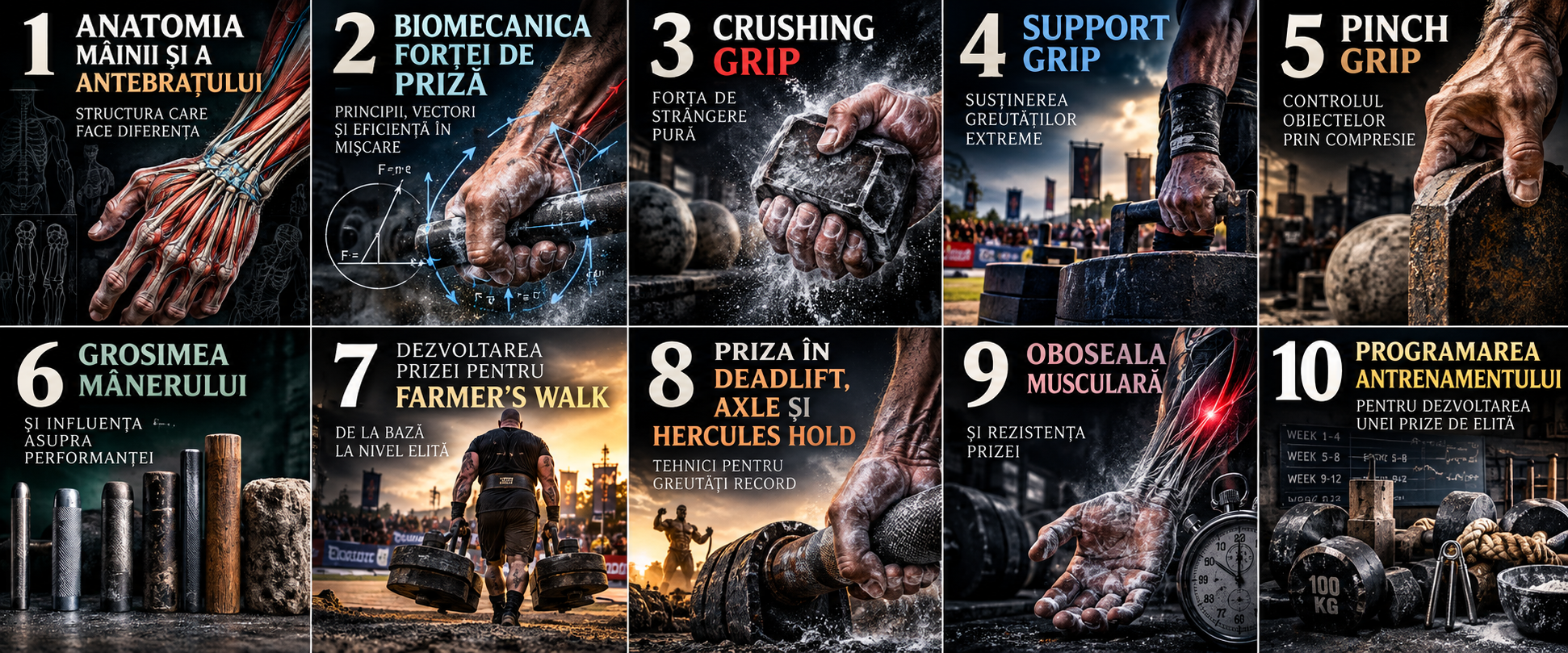
The farmer's walk is one of the rare strength events in which an athlete can be powerful enough to lift two objects from the ground and still lose because the hands cannot retain them. The opening lasts only seconds: the athlete places the palms, braces the body, lifts the implements and starts moving. What follows is no longer a simple static hold. Every step creates accelerations, oscillations and small course corrections. The handle presses differently against the fingers, sweat and friction matter, the forearm becomes fatigued, and the nervous system has to preserve balance and speed at the same time. To spectators the implements simply look heavy. To the competitor they are two moving systems requiring uninterrupted control.
This episode explains how to develop a grip capable of meeting those conditions without confusing dynamometer performance with loaded-carry ability. We begin with anatomy and continue toward loading, distance selection, pace, surfaces, testing and recovery. We distinguish findings directly supported by research from practical coaching suggestions that require individual adjustment. There is no sufficiently large trial establishing one universal grip program for every strongman athlete. A responsible explanation must therefore show both what is known and where gym experience cautiously supplements limited evidence.
A Simple-Looking Event with Several Possible Limits
A farmer's walk can be defined as lifting and carrying two loads, one in each hand, over a prescribed distance. This definition is useful but incomplete. A speed event rewards a fast finish; a maximum-distance event rewards the distance covered before stopping; a medley introduces transitions between objects and the associated time costs. Sometimes the implements are so heavy that the pick-up is the first obstacle. In other situations, the athlete can move quickly but loses the handles before the finish. A good solution for one format may be inadequate for another.
When somebody drops a twenty-meter carry, weak forearms are not the only possible explanation. The athlete may have lost trunk position, struck an implement against the leg, accelerated too aggressively, exhausted the back or allowed a handle to migrate toward the fingertips. Training becomes effective when it identifies the dominant mechanism behind failure. The word 'grip' is useful in conversation, but programming requires observations more specific than a broad label.
What Supporting Grip Means During Movement
In a static support event, the hand's principal task is preventing an object from slipping. During a farmer's walk that task continues, but hand and object accelerate together and their contact is disturbed by walking. Fingers are not fixed mechanical clamps. Their interphalangeal and metacarpophalangeal joints can make small adjustments that may be too subtle to see in ordinary video. The wrist must also remain sufficiently stable, although wrist musculature is not the only source of gripping ability.
Describing the entire task as isometric is a useful approximation, not a literal account of every tissue. Finger flexors produce force to retain the object, yet local pressure and joint configurations may fluctuate from step to step. Sometimes the implement shifts slightly without falling. At other times an equally small shift begins a slip that cannot be recovered. A good static-hold time is therefore useful information but not a guarantee of a fast carry. The moving task brings supporting endurance, gait coordination and whole-body stability into the same problem.
Muscles Involved in Maintaining Contact
Flexor digitorum profundus and flexor digitorum superficialis contribute to finger flexion and the maintenance of handle contact. Thumb flexors, thenar muscles and the interossei help adapt the grasp to the diameter and position of the hand. Finger and wrist extensors must not be dismissed as irrelevant antagonists. They participate in postural control, help stabilize the joints and may change the conditions in which the flexors generate force. Their exact contributions depend on individual anatomy and the implement involved.
Large forearm circumference does not by itself demonstrate exceptional farmer's-walk grip ability. Hypertrophy can increase the potential for force production, but sporting performance also depends on the balance between force, task-specific endurance, neural control, finger length, contact properties and effort duration. Two athletes with comparable muscle mass can produce very different results on the same handles. Accordingly, muscle growth should not be mistaken for complete event-specific adaptation.
A Basic Contact Model: Normal Force, Friction and Shape
To remain in the hand, a handle requires contact forces capable of opposing movement against the skin. Elementary friction is often represented by F ≤ μN, where N is normal contact force and μ represents a simplified coefficient of friction. This equation does not directly convert the weight of the implements into the force produced by each finger. A palm deforms, pressure is distributed among different surfaces, and finger segments wrapping around the bar may provide additional geometric support.
Movement adds a dynamic component. As the handle and implement accelerate, the forces required to control them may differ from the forces of a stationary hold. The familiar relation F = ma expresses a general physical principle, but it cannot provide a precise estimate of each finger's forces without detailed movement and geometry data. Nominal implement mass remains important but cannot describe all gripping demands. This is why two frames with the same mass can behave quite differently.
How Handle Diameter Changes the Task
A relatively narrow handle usually permits the fingers to wrap farther around it, whereas a thick cylinder may leave the hand in a more open posture. That observation does not establish a universal law stating that each additional millimeter reduces performance by a fixed percentage. The relationship depends on finger length, surface texture, thumb position, handle rotation and individual characteristics. An athlete might excel with a standard handle and struggle on an unusual diameter.
For competition preparation, the useful question is not which diameter produces the greatest grip strength in general. It is which diameter most closely resembles the actual event. Fat-grip sleeves can be useful variations, but they do not necessarily reproduce the construction, length, behavior or surface of a competition implement. Changing diameter changes the test. Records become meaningfully comparable only when these characteristics remain sufficiently consistent.
Why Identically Loaded Handles Behave Differently
Total weight is just one implement characteristic. Handle length and position, the distance between the gripping point and center of mass, frame width, plate distribution and structural stiffness affect how the load responds to movement. An implement that swings significantly requires repeated corrections from the shoulders, trunk and hands. If the handle rotates, controlling additional moments may become decisive. A rigid design has different disturbances, not necessarily an absence of difficulty.
This helps explain why a dumbbell-carry record cannot simply be entered as an equivalent competition farmer's-walk result. Dumbbells can differ in overall length, mass distribution, grip diameter and position relative to the thigh. Exercises may assist one another in training, but performance equivalence must be demonstrated rather than assumed. A useful training log records the implement, weight per hand, gripping surface and relevant conditions.
The Pick-Up: A Separate Test Inside the Event
Before the first step, the implements must leave the ground. The athlete positions the feet between the handles, checks hand alignment, and creates tension through the legs and trunk. The lift should permit both controlled clearance and a rapid transition into locomotion. An explosive start may help, but abruptness is not synonymous with speed. If the implements jerk and slide toward the fingers before walking begins, fractions of a second saved at the start may become a costly mid-course stop.
Starting posture depends on handle height, limb lengths and implement construction. No single joint angle is ideal for every body. A very low handle may require considerable knee and hip flexion; a higher handle invites a different strategy. Winwood and colleagues' comparison of the farmer's lift and the deadlift demonstrates that visual similarity does not establish identical mechanics [2]. Coaches should examine the specific movement rather than automatically importing instructions designed for an Olympic barbell.
Setting the Hands Before Lifting
During a heavy attempt, an athlete should establish a secure grasp before the implement leaves the floor. Fingers are positioned to enclose as much of the handle as anatomy and event rules reasonably permit. The thumb may assist stabilization when it can reach a favorable position, but its contribution changes with diameter. Athletes check hand symmetry and avoid gripping so close to an edge that the load will pull unevenly as the carry accelerates.
The skin should not be trapped in unnecessarily large folds between the palm and metal, which can increase discomfort or superficial injury risk. Nevertheless, the opposite claim that everybody must grasp only with the fingers is not universally correct either. A secure setup follows actual handle geometry and force transmission, not a slogan. Frontal and side video can help identify gross asymmetries but cannot measure the forces generated by individual fingers.
What Research Shows About Moving with Loads
In a preliminary 2014 study, Keogh and colleagues tested five resistance-trained participants who performed twenty-meter carries with 90.5 kilograms in each hand [1]. Average speed was greater in the middle and later portions than at the beginning. Changes occurred alongside differences in stride length, stride rate and ground-contact time. This supports treating the launch and the established moving phase as distinct parts of the same event.
The study did not establish an ideal universal cadence or a method for preventing grip failure. It used a small sample and specific loading conditions, and its central measurements concerned gait rather than individual finger forces. Its value is conceptual: finishing speed is not produced by one isolated quality. It emerges from the interaction among lifting, acceleration, step mechanics and implement control.
Recognizing Grip Failure Before a Drop
Failure can occur suddenly, when an object leaves the hand without much warning, or gradually, when a handle starts migrating toward the fingertips. An athlete might notice increasing asymmetry, progressively harder squeezing, unexpected implement rotation or involuntary finger extension. These sensations provide useful training information. They are not reasons to turn every session into a contest of holding until an uncontrolled drop. Falling implements can endanger the feet and nearby people.
If retention fails immediately after the pick-up, examine hand setup, texture and the supporting strength available in that configuration. If failure regularly appears after ten or fifteen meters, examine duration, pace, accumulated fatigue and implement oscillation. If only one hand fails, compare positions and technical habits without automatically assuming a medical disorder. Diagnosing pain or neurological symptoms requires clinical assessment rather than an improvised test with two heavy metal frames.
Footwork and Grip Do Not Work Independently
Walking with a heavy external load changes ground reaction forces as well as the relationship between the implements and the hands. An excessively long step can provoke larger oscillations, whereas very short steps may require more acceleration cycles over the same distance. Neither observation establishes one universally ideal cadence. Athletes need a rhythm that supports fast locomotion without unnecessary disturbances or loss of position. The step pattern seen in skilled competitors results from training, load and technique; it cannot simply be copied.
When grip begins to fail, some athletes shorten their steps to reduce movement of the implements. Others lengthen the stride and try to finish before contact is lost. Either response may work under particular conditions, but neither is a general rule. Repeatable outcomes provide the better criterion. If a technical change consistently produces a faster time with identical loads and similar conditions, the finding is informative. One unusually good trial may merely represent normal daily variation.
Implement Swing and Wasted Energy
A farmer's walk does not involve implements traveling in perfectly vertical lines beside the thighs. They can swing during acceleration and braking, and every change of direction requires control. If an implement strikes the leg, the athlete may alter the pathway or unintentionally change the grip. Even a modest swing can increase the disturbances transmitted through the handle. Fingers oppose not only the broad tendency to slip but also the repeated perturbations associated with movement.
Reducing oscillation does not mean rigidly bracing the entire body until all natural movement disappears. Locomotion requires appropriate rotations and adjustments. The objective is eliminating movement that consumes effort without contributing to travel. A controlled start, balanced implements and a prepared lane can help. When the same weight feels inexplicably harder on different frames, inspect their design and behavior before deciding that grip strength has declined.
The Trunk and Shoulder Girdle
The force holding a handle is not produced exclusively in the palm. The arm transmits load toward the shoulder, while the trunk helps stabilize the moving system. Scapular positioning, thoracic orientation, dorsal muscle activity and lateral pelvic control can influence how predictably the implements travel. McGill and colleagues documented high trunk demands in several strongman events, including the farmer's walk, illustrating why these tasks cannot be reduced to forearm endurance [3].
This relationship works both ways. Inadequate trunk control may allow excessive load movement, making the fingers' job harder. A grip approaching its limit may also change posture as the athlete attempts to reduce perturbations by slowing down or altering arm position. Observation should therefore include the entire athlete. Prescribing more squeezing exercises to somebody primarily limited by loaded gait stability can miss the actual problem.
Why a Perfectly Upright Posture Is an Oversimplification
Telling an athlete to walk tall can help prevent excessive trunk collapse, but the best posture is not identical for every load or body proportion. Some competitors adopt a small inclination to maintain stability; others work effectively with a nearly vertical torso. Arm positioning also depends on implement width. Competition photographs capture isolated moments, frequently during acceleration, and cannot establish universal biomechanical standards.
The practical question is whether the athlete maintains a controllable posture, breathes adequately for the duration and transmits force without repeated collisions or loss of grip. Some change in position is almost inevitable as loading increases. A change is not automatically a technical error, just as an attractive position does not prove efficiency. Coaches compare similar attempts and identify when technical deviations start influencing performance or safety.
Maximum Acceleration Versus Sustainable Speed
A race can be lost in its first three seconds or its final three meters. A very slow start wastes time; an excessively aggressive start can generate swing and local demands that precipitate grip failure. On a fixed-distance course, the athlete seeks the greatest speed that can be sustained within technical and gripping constraints. A maximum-distance event has different pacing priorities: local endurance and the cumulative energetic cost become more important than the first fraction of a second.
Sprint-running formulas should not be applied directly to extremely heavy loaded carries without appropriate validation. External mass changes gait, ground contact and acceleration potential. Existing biomechanical investigations used small samples and particular equipment configurations [1, 2]. They help generate useful questions, not prescribe one absolute pace for every federation and weight class.
Handle Surfaces Beyond the Feeling of Grip
A knurled handle, a painted one and a polished one are not interchangeable. Contact depends on microtexture, roughness, contamination, moisture and skin condition. An aggressive surface may improve retention in certain conditions while increasing discomfort and superficial abrasion risk. Smooth handles may slip more readily under some conditions, but a matte finish does not guarantee greater friction with every hand. Actual properties matter more than commercial descriptions.
Athletes should test the implements available to them, maintain reasonably comparable conditions and document important changes. If one attempt uses clean handles and another uses damp ones, a performance difference cannot simply be attributed to muscular development. Comparability is not a laboratory obsession. It is necessary for understanding progress.
Chalk: A Possible Aid, Not a Replacement for Strength
Sporting chalk usually consists primarily of magnesium carbonate applied to the hands to manage moisture and contact. A modest amount can help under some surface conditions, whereas a thick layer may change tactile sensation or create uneven deposits. Effects depend on material, humidity, perspiration and the rules. Friction research involving climbing cannot supply an exact formula for farmer's-walk performance because surface properties and force directions differ.
One straightforward approach is standardizing chalk application during tests: similarly dry palms, comparable amounts and handles prepared in the same way. This makes comparisons clearer. If chalk is prohibited during the competition, training needs some exposure to the permitted conditions. Building records exclusively with aids unavailable on the platform makes little sporting sense.
Lifting Straps and the Specificity Problem
Straps can allow training of the legs, back and trunk when grip would otherwise terminate an exercise too early. Their use is not inherently a bad habit. However, a carry completed with straps is not a valid test of unassisted grip. If the contest prohibits them, the athlete requires sufficient direct contact with implements under competition-like conditions. Otherwise considerable loaded-carry capacity may develop without fixing the link that ultimately limits performance.
At the same time, refusing straps in every training exercise can place unnecessary work on the forearms, especially in programs containing deadlifts, rows, axle work and other strongman events. The solution is separating objectives. Some sets train the entire locomotor system; others explicitly train unassisted retention. Confusing those goals makes progression less clear and can accumulate fatigue without a specific benefit.
Hands Are Not Necessarily Identical
Asymmetry is common in sport, but should be described rather than dramatized. One hand may perform differently because of experience, position, functional leverage or contact tolerance. A modest difference alone is not evidence of injury. If one implement consistently falls first, inspect implement balance, whether the athlete starts symmetrically and whether one hand shifts toward a handle edge.
Unilateral tests may provide additional information if protocols remain comparable and loads do not compromise posture. Persistent numbness, sudden weakness, changes in sensation or significant pain deserve medical assessment. Grip exercises cannot diagnose neurological conditions.
Turns and Changes of Direction
Some contests require out-and-back carries, movement around a marker or another directional change. Here, performance cannot be inferred from a straight-line time. Athletes must brake, redirect a heavy system and accelerate again. The frames may approach the legs, handles may rotate slightly against the palms, and total holding time increases. A tight turn can challenge grip differently from traveling the same distance in a straight line.
Preparation can include turns under submaximal loading with ample space and stable markers. The objective is consistent control rather than an impressive turning angle. Additional steps may be necessary. Time saved with a risky maneuver is not useful progress if that maneuver regularly causes dropped implements.
When the Implements Strike the Thighs
Repeated accidental leg contact can change gait and implement behavior. Sometimes a small collision reduces movement momentarily, but it can also redirect an implement in a harder-to-control direction. Deliberate support strategies must be evaluated against event regulations, which can vary between organizers. During training, aim for implement pathways that permit unobstructed steps.
If an athlete repeatedly strikes the thighs, possible causes include frame width, arm positioning, a narrow step pattern or a fatigue-related technical change. Another forearm exercise will not automatically correct those problems. Adjusting the setup and reviewing frontal and lateral footage may be more useful than judging the aesthetics of gait in isolation.
Athlete Body Mass and the Cost of Carrying
Body mass can influence force potential, stability and locomotion cost, but it does not determine the outcome by itself. A heavier athlete may enjoy advantages in absolute lifting ability but must also move the body through the course. A lighter competitor may compensate with speed, efficiency and endurance. Limb lengths and hand dimensions can also influence compatibility with a particular implement.
Comparisons across weight classes therefore demand care. Weight per hand matters, but it is not the only parameter; distance, duration, equipment geometry and rules complete the context. Even the ratio of implement mass to body mass cannot universally rank gripping performance. It is a descriptive measure for a defined task, not a law of athletic ability.
When the Implements Leave the Floor Unevenly
Sometimes one implement rises first while the other remains grounded for a fraction of a second. This asymmetry may reflect hand placement, pressure distribution through the feet, equipment differences or lifting strategy. The immediate answer is not automatically more unilateral grip work. Review the start, handle positions, handle heights and whether the loads are genuinely identical. An equipment setup issue can imitate a strength problem.
If asymmetry persists on standardized equipment, athletes can practice technical lifts with moderate loads and video feedback. The priority is simultaneous clearance without violently jerking the delayed arm. At heavy loads, that jerk can abruptly change demands on the upper limb and compromise retention from the first second.
Why the Actual Event Must Be Practiced
Static holds, strapless rack pulls, hangs and forearm exercises can develop useful components. Yet they do not fully reproduce locomotion with two separate implements. They lack the same acceleration, changing system geometry, lateral disturbances and pacing decisions. Specificity does not mean practicing the event daily. It means giving competition-relevant equipment and conditions enough space in the program, while supplementary exercises address identified needs.
When an athlete improves every isolated forearm exercise but remains stuck at the same distance in farmer's walks, transfer deserves investigation. Perhaps the auxiliary exercise develops a different quality, perhaps specific exposure is insufficient, or perhaps gait is the principal limitation. Gym progress is most useful when it helps explain and improve the desired sporting performance.
Maximum Strength and Specific Endurance Are Different Qualities
An athlete able to support an enormous load for three seconds is not automatically the person who can cover the greatest distance with a moderate load. Maximum strength helps establish the ceiling for retention, but effort duration also depends on local fatigue resistance, tissue tolerance, pressure control and locomotor efficiency. Thoughtful programming does not arbitrarily choose between heavy and long work. It identifies which limitation matters in the athlete's event and develops the required qualities in suitable proportions.
Consider two competitors using identical implements. The first has a much higher static maximum but begins to slip after twenty seconds. The second has a somewhat lower maximum but can maintain contact for longer. We cannot predict the winner without knowing distance, speed, technique and exact load. Competition capacity reflects the combination of resources rather than a single figure on a dynamometer.
Relative Intensity and Time Until Failure
The same absolute load can represent very different fractions of individual capacity. When a weight approaches an athlete's supporting limit, time to failure may be short; when it is substantially below that limit, retention may last longer. This relationship should not be reduced to a fixed formula that assigns an exact number of seconds to a percentage, because surfaces, effort duration, skin condition and experience alter the result. Furthermore, a static maximum does not automatically equal the maximum carried while walking.
Coaches need athlete-specific reference points. A trial at a defined weight, on a specified course and with standardized handles can establish a baseline. Subsequent changes need comparison against the same task. If the athlete carries the same load farther at a similar pace, a relevant capacity has likely improved. If the distance grows only because the athlete moves much more slowly, gripping endurance may have changed, but the outcome no longer represents identical competitive performance.
Static Holds Are Tools, Not Competition Results
Static holds using actual farmer's-walk handles provide familiarity: the hand works with the real interface in an event-like position. They allow control of the holding duration without additional demands of locomotion. Short, heavy holds may practice high-intensity retention, while longer holds can emphasize local endurance. Loads should allow the implements to be controlled and set down safely. Near the athlete's limit, suitable preparation of the area and support personnel become particularly important.
The method's limitation is straightforward. A stationary hold lacks steps, braking, turns and movement-related oscillations. Static performance should therefore be interpreted alongside actual carrying results. A dramatic improvement in holding time may help without being sufficient to produce a faster twenty-meter race. Integration is preferable to replacing one task with the other.
Rack Holds and Starting Height
Rack holds can save the energy spent lifting from the floor. A bar or frame is positioned so the athlete can clear the supports with a short controlled movement, then maintain the selected load for a specified duration. The advantage is relative isolation of supporting ability. The disadvantage is that force directions and handle geometry may differ markedly from the actual event. A standard Olympic bar does not automatically reproduce a thick, independent or swinging implement.
If rack holds are used, keep the protocol consistent: identical bar, height, grip orientation and rules about chalk and straps. An athlete is not necessarily better at the farmer's walk merely because the hold duration improved on a conveniently shaped bar. The exercise should be valued for its training contribution, not marketed as a perfect substitute.
Heavy Farmer's Walks over Short Distances
Short carries with loads approaching competition demands can develop confidence in the pick-up, event-specific strength and early retention. Limiting distance partially reduces cumulative fatigue and permits attention to starting mechanics. Nevertheless, excessive loading can change the movement entirely, forcing very slow steps or poor positioning. Heavier is not automatically more specific when the target event requires speed over twenty or thirty meters.
A sensible progression prioritizes repetition quality. If the athlete starts evenly, controls the implements and finishes without slipping, a modest increase may be reasonable. If every additional load produces repeated drops, useful training volume decreases. Consolidating the existing weight can then be more productive than another attempt at a record.
Moderate Loads over Longer Distances
Longer carries provide opportunities to train sustained contact and technical control under fatigue. They may be especially useful for maximum-distance events or athletes who fail during the final seconds of a race. However, a very long set at an extremely light load may become predominantly general conditioning. This does not make it worthless; it simply differs from the stimulus required to retain extremely heavy handles.
Choose duration and distance in relation to the real event. A fifteen-meter race with huge loads cannot be prepared exclusively through leisurely walks with light dumbbells. Conversely, an event rewarding maximum distance may require more continuous exposure than very short heavy lifts provide. Specificity is a question of proportion and priority, not rejecting every different exercise.
Carry Intervals and Accumulating Volume
One practical method divides total target distance into shorter segments separated by enough rest to partially recover grip function. Athletes can repeat controlled runs on the same course without turning every attempt into a failure test. This repeats the pick-up and acceleration, useful for technical learning. But the sum of intervals does not equal one continuous carry: rest profoundly changes the physiological demands.
Six short carries and one long carry can cover the same total distance yet produce distinct challenges. The first stresses repeated starts and the quality of each segment; the second emphasizes uninterrupted retention. Neither is categorically superior. The decision depends on event format, athlete experience and the workload imposed by the rest of training.
Using a Hand Dynamometer
A hand dynamometer measures force in a defined configuration, usually through squeezing. It can track one component of grip strength when the testing procedure is consistent. But it does not reproduce the same contact as a heavy cylinder, sustained retention or motion with independent loads. Crushing grip and farmer's-walk supporting grip overlap without being synonymous. A new dynamometer record cannot alone establish a new loaded-carry potential.
For comparison, athletes should use consistent arm position, handle adjustment, trial sequence and recovery time. Values obtained under different conditions are more difficult to interpret. If testing causes pain or aggravates symptoms, the procedure should stop and the problem should be appropriately assessed.
Why Bar Hangs Are Not Farmer's Walks
During a dead hang, the hand commonly supports a substantial fraction of body mass, but the force directions, shoulder position and contact circumstances differ. The bar may remain fixed while the body hangs below it; during farmer's walks, the body and implements travel together, with the arms in a different position. Hanging can improve general gripping endurance, but transfer to very heavy frames should not be overestimated.
For a heavier athlete, hanging may already be highly demanding and may create substantial shoulder loading. Selection should reflect individual tolerance and medical history. An exercise popular in climbing is not automatically appropriate for strongman preparation.
Fat Grips, Axles and Different Joint Angles
Large-diameter handles can help train open-hand configurations, but evidence does not establish that they should dominate every farmer's-walk program. When competition implements have conventional diameters, excessive work on unusually thick axles may transfer only partially. When the event uses large smooth handles, familiarity with that configuration becomes considerably more relevant.
Variation is valuable when addressing a demonstrated limitation. It may include thick-sleeve rows, axle holds or alternative carry handles without eliminating actual event practice. Avoid uncontrolled accumulation of finger-flexor work merely because every accessory promises enormous forearms. Recovery capacity remains limited regardless of how many devices the gym contains.
Pinch Grip and the Thumb
Pinching exercises, including plate and block lifts, challenge thumb participation and control between surfaces. They can contribute to general hand training, but the farmer's walk primarily requires retention of a cylindrical handle. A competitor may make major gains in plate pinch yet still drop heavy frames near the finish. Transfer must be observed, not assumed.
Opportunity cost also matters. Intense pinch work before heavy carrying can fatigue the thumb and forearm, reducing specific training quality. When frame performance is the priority, auxiliary exercises should support rather than compete with the essential work.
Selecting a Baseline Test
Before a training block, athletes and coaches benefit from a measurable reference point. One straightforward test is covering a fixed distance at a fixed load with identical handles, route and equipment rules. Record time, drops, the distance to the first contact failure and technical observations. If the objective is maximum distance, define a separate test rather than combining incompatible outcomes.
Testing need not require an injury-risking maximal effort to produce information. A sufficiently demanding submaximal load often provides useful data at a lower recovery cost. For comparisons, use similar warm-ups and rest periods. If the weight, surface, route and chalk rules all change together, it becomes difficult to identify why the result changed.
When Video Helps and What It Cannot Show
A side view displays trunk position, approximate stride length and forward-backward frame movement. A frontal recording may show asymmetry and collisions with the legs. Video synchronized with timing can separate the pick-up, acceleration and finishing phases. These observations can indicate whether time is lost at the start, during locomotion or through repeated balance corrections.
Without specialized measurement, ordinary video cannot establish exact tendon forces, the contribution of each finger flexor or the skin-handle friction coefficient. Coaches claiming to extract all those variables from a clip risk telling plausible but unverified stories. Use footage for what it can observe and keep physiological hypotheses within defensible limits.
Real Improvement Versus Measurement Noise
When an athlete improves a time once by two tenths of a second, progress is possible, but improved conditions or stopwatch error are also possible. Repeated gains with standardized equipment and procedures carry greater meaning. Over short distances, manual timing can introduce significant variation. Video with clearly marked start and finish points may help, though it does not replace professional electronic timing.
Progress in gripping is not just more kilograms. It can mean eliminating a drop, maintaining contact over the last few meters, achieving a cleaner start at the same load or reproducing performance with less technical deterioration. Record what actually improved rather than simply writing that the session felt better.
Programming Starts with Event Rules, Not Accessories
Before prescribing sets and repetitions, determine weight per hand, distance, surface, implement shape and timing procedure. Some contests allow one or more pick-ups after a drop; others impose specific penalties or termination rules. Speed races, maximum-distance events and medleys change priorities. A useful program follows the actual task, not an abstract image of strongman training.
Only then should the means be selected. If the athlete is fast enough but drops the implements during the final seconds, more event-specific endurance may help. If retention is secure but the pick-up costs five seconds, the initial lift may be the priority. If every turn causes difficulty, technical practice may be more useful than another forearm exercise. Identifying the problem protects training time.
A Framework for Beginning Athletes
Somebody new to the farmer's walk should first learn a controlled pick-up, walking along a clearly defined lane and setting implements down safely. Loads that cause repeated drops, uncontrolled trunk movement or collisions with the legs are unsuitable at this stage. Early training should emphasize reproducible mechanics and tissue familiarity rather than proving maximum capacity.
Sessions may contain several moderate-distance carries with full rest and attention to quality, perhaps followed by a small amount of static holding. The exact number of sets is not a universal prescription. Athletes should finish capable of repeating sound technique, without pain and frequent contact loss. Progress may mean a smoother carry with unchanged load, not merely adding plates.
Intermediate Athletes: Two Stimuli, One Goal
Once basic technique is established, it may be useful to alternate relatively heavy, short-distance work with efforts emphasizing longer retention. These stimuli do not necessarily require different training days; placement depends on the complete program. The important point is avoiding fatigue that compromises deadlifts, log presses, other loaded carries or general recovery.
One possible organization, not a clinically validated protocol, includes several heavy segments of ten to twenty meters, plus moderately loaded longer carries in another session. Adjust loads based on actual performance. As specific volume increases, reducing supplementary finger-flexor work may become necessary. The relationship between stresses matters more than meeting an arbitrary count of exercises.
Advanced Athletes and the Cost of Extreme Loads
At a high competitive level, one heavy effort can create substantial demands on the hands, trunk, knees and hips. More progress does not necessarily come from adding another grip day to an already crowded schedule. It may come from better management of heavy exposures, carefully selected assistance work or a more effective start. Repeated near-maximal efforts can accumulate fatigue without allowing connective structures enough adaptation time.
Advanced plans should reflect the athlete's actual loading history. Years of event experience may permit volumes inappropriate for a beginner, but experience does not eliminate risk. Strongman injury studies [5, 6] support caution, yet they do not identify one magical training dose that prevents every problem.
Warming Up from General Movement to Loaded Carries
A useful warm-up begins with general movement and preparation of the joints involved, then progresses toward easy lifts and short carries. The goal is to evaluate contact, gait and implement behavior before heavy attempts. Performing countless maximal squeezes before a race can unnecessarily fatigue the flexors. A warm-up should prepare rather than exhaust the capacity needed for performance.
As loads rise, athletes may shorten warm-up distances and lengthen rest. The number of attempts depends on experience and the event. Somebody feeling prepared after a few sets does not necessarily benefit from ten more; another athlete may require additional technical repetitions. Individual response matters, while the outcome should be entering the main task with control and energy.
How Heavy Should Training Carries Be?
Percentages of an athlete's deadlift maximum are not a reliable universal method for prescribing farmer's walks. The relationship between these performances depends on handle height, implement construction and technique. Neither can a static-hold record be directly converted into an optimal twenty-meter load. The most relevant reference is current performance on comparable carrying tasks.
For speed-oriented training, loading needs to permit sufficiently quick movement and stable contact. For high-load retention work, speed may be less important, but control is still mandatory. In both cases, loading should follow performance rather than ego. If a set no longer resembles the intended event, it has probably become a different stimulus.
Distance as a Training Variable
Distance deserves as much consideration as weight. For a twenty-meter race, some sessions can rehearse the full twenty meters, others the pick-up and initial acceleration, and others prolonged retention under fatigue. Forty meters is not automatically twice as useful as twenty. It can develop endurance but may also reduce speed quality or recovery availability during the rest of the week.
If turns are part of the task, specify whether the distance is linear or includes directional changes. Two segments separated by rest differ radically from two continuous segments. A program that only says '4 × 20 m' without rest, direction and load details is inadequate for meaningful analysis.
Rest Between Attempts Changes the Stimulus
Intense holding can create pronounced local fatigue, and recovery rates differ between athletes. Repeating heavy segments with insufficient rest may turn later sets into tests of exhaustion rather than high-quality technical practice. With sufficient rest, each attempt provides a better chance to rehearse the start and pace. This is why programs cannot be compared using only weight and distance.
Short rest may still be useful when the objective is repeated-effort tolerance in a medley or deliberate endurance work. It should be intentional. General resistance-training guidance [7] offers broad principles rather than event-specific farmer's-walk rest intervals. Adaptation to competition rules and individual responses remains central.
RPE and Perceived Control
Ratings of perceived exertion can guide sessions if we clarify what is being rated. An athlete may find the leg effort extremely demanding while the grip remains secure. Another may feel the load is easy to move but almost impossible to keep in the fingers. One overall RPE number can conceal this difference. A separate impression of whole-body difficulty and grip proximity to failure may be more informative.
We should also avoid overstating precision. An 'RPE 8 for grip' has no validated universal conversion into a specific percentage of support strength. It is a communication and autoregulation tool, not a disguised dynamometer. Consistently used, it may reveal trends; treated as an absolute number, it creates false certainty.
Example Preparation Block: Weeks One and Two
Consider a healthy athlete familiar with the event preparing for a twenty-meter farmer's walk. During the first two weeks, a specific session might contain three or four controlled carries over the target distance at a moderately challenging load, with sufficient rest between attempts. If a second exposure is appropriate, it might involve two or three brief, moderate holds or technical pick-up practice. This structure is not a recommendation for somebody with pain, neurological symptoms or no relevant experience.
The goal is establishing a measurable baseline. Record equipment, time, the sensation of slipping and gait quality. If results stabilize, progression becomes possible. If frequent drops or pain emerge, adjust loading and investigate causes rather than rigidly completing the calendar.
Example Preparation Block: Weeks Three and Four
Following accommodation, the athlete can emphasize load or distance according to the identified objective, without increasing every variable simultaneously. One session may feature somewhat heavier short carries; another, if the overall program allows, may reproduce the full event duration at moderate load. No research validates this sequence as optimal for every athlete. It is a practical example grounded in progression and specificity principles.
If recovery becomes problematic, a reduced-volume week can be more useful than continuing to increase stress. Relevant signs include persistent deterioration of technique, declining results across sessions and discomfort that does not settle. One poor workout need not provoke panic, but a consistent negative pattern should not be ignored.
Example Preparation Block: Weeks Five and Six
At this stage, training may more closely reproduce competition conditions: weight, distance, handle, permitted chalk and any required turn. A main session might rehearse an almost identical race without making every attempt maximal. Supplementary forearm work can be reduced if specific carrying already produces substantial fatigue. Repetition quality and recovery capacity become more important than the number of exercises.
Some near-maximal exposures may be useful for athletes facing extremely heavy events, but their frequency requires individualization. There is no strong evidence that a weekly all-out farmer's walk ending in a drop is necessary for progress. A controlled trial with a small reserve can provide stimulus and feedback without the full cost of repeated failure.
Example Preparation Block: Weeks Seven and Eight
As the contest approaches, emphasis gradually shifts from accumulating fatigue toward expressing established capacity. Training volume may decrease, while a few brief precise efforts preserve familiarity with starting and contacting the handles. Following demanding preparation, reducing total stress can facilitate recovery. This is one plausible preparation strategy, not a schedule established in huge randomized clinical trials of competitive strongmen.
During the final days, extra grip-to-failure sessions carry uncertain benefit and potentially meaningful cost. Athletes want intact skin and available forearms at the start, not a record amount of fatigue in the training log. Final adjustments must account for all other events, travel and the competition timetable.
The Example Is Not an Individual Prescription
The eight-week illustration supplies a logical sequence, not exact compulsory weights, percentages or a guaranteed result. It must be adapted to training history, number of events, available time and load tolerance. A competitor preparing for a yoke, deadlift and log press does not have the same hand and trunk recovery resources as somebody training farmer's walks alone. Planning makes sense only within the entire program.
The practical lesson is that grip is not developed through a series of punishments for the forearms. We train a defined performance, monitor what limits it and choose the smallest workload that produces observable progress. An exercise that increases fatigue without useful transfer is not compulsory simply because it appears in a popular program.
The Physiology of Forearm Fatigue
During an intense hold, muscle fibers consume energy to maintain the necessary tension. Force generation depends on neural activation, contractile mechanisms, available energy substrates and tissue transport processes. Nearly continuous contractions may change local blood flow, but this does not mean circulation stops completely during every farmer's walk. The degree of restriction depends on intensity, muscle structure, posture and duration. Forearm activation may also fluctuate slightly even when the grasp looks motionless. Saying that 'lactic acid caused failure' is not a sufficient physiological explanation.
Fatigue is complex and involves peripheral and central changes. Burning sensations do not accurately measure remaining force, and an inability to continue does not prove that all muscular energy is depleted. An athlete may still squeeze the hand forcefully in the air after a carry yet fail to stabilize a particular handle. Failure occurs at the interaction of the object, tissues, position and control. Preparation therefore requires observing the exact failure conditions, not merely subjective exhaustion.
How the Nervous System Adapts
With repeated event practice, athletes can improve coordination among lifting, wrist stabilization, finger activation and stepping. Some early progress may reflect task learning before substantial muscle growth becomes visible. Competitors learn to avoid jerking the handles, recognize when slipping starts and regulate pace. These adaptations matter, but they cannot endlessly substitute for the force required to retain a massive load.
It is tempting to explain every record through a stronger 'mind-muscle connection' or a vaguely improved nervous system. Such expressions are too general without observations or measurements. Coaches need to know whether athletes repeat efficient movement, whether identifiable errors diminish and whether grip retention improves under comparable conditions. Motor learning and strength development support each other; neither should be ignored.
Tendons and Unequal Adaptation Rates
Finger flexors transmit force through tendons, while large loads place substantial demands on them and surrounding joint structures. Muscles and neural processes can adapt at rates that do not exactly match connective tissue adaptation. No universal weekly weight increase can be declared safe for every tendon. Individual history, other training exposure and emerging symptoms matter. Greater lifting ability does not prove that every structure has gained an identical reserve of tolerance.
Reasonable progression avoids unjustified combinations of maximum loading, very long durations and excessive frequency. Persistent pain should not be interpreted as proof that a tendon is 'getting stronger'. It is a signal to modify activity and, when necessary, seek professional assessment. For athletes combining deadlifts, axle lifts and farmer's walks, total finger-flexor stress can exceed what any single session suggests.
Skin: The Biological Contact Interface
Palmar skin tolerates pressure, shear forces and changing friction throughout each carry. Calluses may develop through repeated exposure, but thick raised edges can become locations for superficial tears. A wound can compromise a contest even if forearm muscles are fully prepared. Skin management therefore belongs to training preparation rather than cosmetic care. Hygiene, care of excessively dry areas and limiting exposure to surfaces that repeatedly cause injury are relevant practices.
There is no evidence that deliberately tearing the skin speeds grip development. Once skin is injured, repeatedly loading it until the wound reopens may extend the problem and increase risks. As competition approaches, functional palms are more valuable than another auxiliary session completed through stubbornness. On unusually aggressive handles, reducing volume may be more logical than ignoring local pain.
Numbness, Tingling and Pain Are Not Progress Markers
Intense gripping may produce transient muscular fatigue and discomfort, but persistent neurological symptoms should not be normalized. Tingling, altered sensation, sudden one-sided weakness or pain lasting between sessions can reflect causes impossible to diagnose from a video. Important nerves and tendons pass through the hand, wrist and forearm. Dismissing symptoms as 'just heavy training' may delay appropriate assessment.
Athletes can temporarily reduce loading, stop provoking exercises and seek clinical evaluation when indicated. Light exercise alone is not always sufficient, and prolonged total rest should not be prescribed automatically without appropriate diagnosis. Strongman programming must respond to symptoms because future performance depends on preserving training capacity rather than winning every present attempt.
What Strongman Injury Studies Actually Tell Us
Epidemiological research documents injuries among strongman competitors, but percentages require context. Winwood and colleagues reported retrospective injury data based on athletes' recollection of training and competition exposure [5]. Such designs identify patterns but are vulnerable to recall error. They do not demonstrate that one particular farmer's-walk technique causes a specific injury. Keogh and Winwood's systematic review examines multiple weight-training sports with the methodological limitations present in this field [6].
The responsible practical conclusion is to monitor loads, technique and symptoms. General data do not justify calling one movement completely safe or inherently catastrophic. Problems may involve skin, fingers, shoulders, the back or lower limbs, and risk depends on actual circumstances. Good coaching cannot eliminate all risk, but it can reduce needless exposures and encourage timely responses to warning signs.
Recovery Is More Than the Absence of Soreness
An athlete may feel little delayed muscle soreness while still having residual gripping fatigue after numerous heavy holds and carries. Conversely, modest muscular discomfort does not automatically mean that every structure is unable to work. Planning should consider performance, movement quality, general condition and symptoms rather than only next-day soreness. Sleep and adequate nutrition support general recovery without any specific food magically restoring a weakened grip after a contest.
If the next workout includes heavy deadlifts, rows and axle work, an intense farmer's-walk session immediately beforehand may be counterproductive. Training placement should reflect whole-body demands. Sometimes reducing extra holds is enough to restore the main event's quality. Recovery is partly a programming decision, not merely a collection of interventions performed after exhaustion.
When Less May Produce More
Grip enthusiasts sometimes add grippers, pinching, hangs and thick-handle sets to every strongman session. This variety can feel productive, but cumulative fatigue may increase without corresponding improvements in the target event. Evaluate each exercise by asking which specific limitation it addresses, what measurable change is expected and what it costs in recovery. An exercise without clear answers need not be prohibited, but its volume can be reconsidered.
Effective training does not require total exhaustion every session. Contemporary resistance-training principles emphasize progression and an appropriate dose for the target outcome [7]. Direct extrapolation to elite strongmen carrying hundreds of kilograms requires caution because most general research does not test that population. Still, seeking improvement at a recoverable workload is a robust practical principle.
The Course and Training Environment
Safety begins before the first pick-up. The lane needs to be clear, sufficiently wide and free of unexpected obstacles. Turning markers must be visible, while bystanders remain outside the moving area. A dropped implement does not necessarily stop precisely where intended. Fatigue and slipping can cause sudden falls or rotation, creating hazards for feet and nearby people.
The floor surface matters for footwear, stepping and directional control. An uneven course can alter the entire task, including grip stability, without providing useful adaptation. In competition, existing conditions must be followed; in training, conditions can be selected to allow reliable progression and assessment. Not every added difficulty represents desirable training.
Fatigue Accumulated from Other Events
Farmer's walk is rarely the only event in a contest. Heavy deadlifts can tax finger flexors beforehand; log presses and yokes can fatigue the trunk and shoulder girdle; medleys can challenge breathing and balance. Event order changes the physical state in which athletes arrive at the handles. A fresh training record should not be assumed to represent capacity after three earlier events.
Some limited simulations of competition order can provide useful information without recreating full contest stress every day. Coaches may observe start time, contact quality and earlier onset of slipping. These data can be more realistic than an isolated effort. Yet very heavy simulations also carry recovery costs and should be scheduled carefully.
When Heavy Loads Affect Breathing and Decisions
During heavy carries, athletes manage trunk stiffness while still meeting the need to breathe. Excessive bracing maintained without adjustment can become difficult over longer distances. One rigid breathing pattern should not be prescribed for every event because load, duration and medical context differ. Training should permit trunk control without turning every step into disorganized breathlessness.
As fatigue increases, decisions about pace, trajectory and safely setting down implements can become less precise. That is another reason failure-to-drop efforts should not dominate training. Technical decision quality belongs to competition performance and can be practiced through controlled repetitions.
Mature Specificity Includes Recovery
Sometimes the most specific decision is not adding another carry. If athletes have sufficiently rehearsed competition loading but the palms are irritated and technique is deteriorating, another set may provide less value than recovery. Adaptation develops over time, not only during the act of lifting. Training must create conditions for the next session's progress.
This does not excuse superficial work. It demands discipline in dosing intensity, observing warning signs and selecting exercises that actually contribute to the goal. Elite grip is not built solely from spectacular moments but from the many high-quality repetitions between them.
Scenario One: Fast Moving, but Dropping the Implements Near the Finish
An athlete covers the first fifteen meters at a competitive pace, then one handle starts slipping and the last few meters are lost. Improving initial speed alone may actually worsen this problem. Coaches need to establish whether the slip reflects local fatigue, increasingly large implement oscillations or poor contact from the outset. Video may show when a problem becomes apparent, but it cannot directly establish forearm metabolite concentrations.
One possible intervention is repeated full-distance carries at loads allowing sound form, supplemented with static holds on the actual handles. If slipping occurs only at very high speeds, controlling pace and oscillation may matter more than adding kilograms. Progress means reliably completing the course without a drop while maintaining a competitive time, not merely standing still for longer.
Scenario Two: Strong Grip, Slow Pick-Up
Another athlete can travel rapidly once the implements are airborne, yet loses time setting up and lifting. The principal limitation may be handle height, lifting force, leg-trunk coordination or an overly complicated starting routine. Hundreds of extra gripper repetitions will not automatically fix these issues.
Training may include isolated pick-ups using the competition implements and brief carries with carefully repeated mechanics. Athletes focus on establishing contact before lifting and transitioning smoothly into the first step. Timing can distinguish the interval between start signal and complete clearance from the interval between the first step and the finish. That distinction identifies the real improvement and avoids confusing gripping ability with general lifting power.
Scenario Three: One Hand Always Lets Go First
When the same hand repeatedly loses contact before the other, begin with equipment and technique. Verify actual loading, plate placement, handle symmetry and body position. Differently constructed implements can create unilateral disturbances unrelated to anatomical hand strength. If the equipment is genuinely equivalent and the pattern persists, carefully controlled unilateral tests may supply additional information.
Unilateral work should not become reckless lifting to failure, particularly when trunk control is compromised. Correcting handle placement may matter more than large amounts of assistance work. Sudden weakness, persistent numbness or continuing pain call for medical evaluation. A difference between hands is an observation, not a diagnosis.
Scenario Four: Much Thicker Competition Handles
An athlete trains for months on ordinary handles, then learns that the competition uses cylinders of substantially larger diameter. It is unsafe to assume complete transfer of developed strength. Finger position, thumb contact and slipping tendency may change. If time permits, progressive exposure to the actual diameter becomes appropriate, starting with controllable loads and adjusting according to observed retention.
Trying to compensate for unfamiliar equipment through one all-out thick-handle session shortly before the contest is not sensible. Tissue tolerance and adaptation time matter. Sometimes the realistic objective is improving setup and reducing errors rather than dramatically rebuilding capacity in a few days.
Scenario Five: Two Turns During the Carry
An athlete outstanding on straight courses may repeatedly lose control when changing direction. Coaches should observe braking, implement paths and renewed acceleration. Forearm work can increase force reserve, but it does not automatically teach the timing of turns. Specific moderate-load practice permits learning this sequence while avoiding needless collision risk.
Separately timing straight portions and turns can show whether the difficulty is primarily technical or reflects broad fatigue. Excessive handle movement during turns may call for a more conservative strategy. A visually dramatic pivot does not necessarily produce the fastest complete course.
Scenario Six: A Farmer's Walk After Heavy Deadlifts
In a multi-event competition, athletes may reach the carries already fatigued from heavy deadlifts. Excellent fresh performance does not precisely predict this situation. Supporting ability and locomotion must be interpreted in the context of accumulated fatigue. Implement transitions consume time, and the palms may be in a different condition following contact with the deadlift bar.
Some carefully limited moderate-load simulations can be useful without repeating an entire maximal medley every week. Focus on transition quality, hand setup and preserving pace. If handles are consistently lost immediately after deadlifts, adjusting the distribution of grip stress during the week may be more productive than automatically adding further volume.
Myth One: A Huge Deadlift Guarantees an Excellent Farmer's-Walk Grip
Deadlifts develop general strength and can expose the hands to heavy loads, particularly without straps. But a farmer's-walk handle can have different diameter and behavior, while locomotion introduces disturbances absent from stationary lifting. Even the preferred grip strategy may differ. Somebody with an outstanding deadlift can still be limited by frame geometry or event duration.
Deadlift strength is therefore a resource, not a sufficient event test. Transfer must be observed with real implements. If transfer does not occur, simply adding more of the same deadlift work is unlikely to identify the limiting mechanism.
Myth Two: Bigger Hands Always Win
Hand size can influence contact, especially on thick handles, but it cannot determine force, endurance or technique alone. Longer fingers may provide geometric advantages in some configurations, while conditioning and experience can change outcomes considerably. There is no straightforward equation converting forearm circumference and palm length into a twenty-meter time.
Judging competitors by hand or forearm photographs is weak inference. Performance should be measured in the defined event. Anatomy matters, but developed capacity and task specificity matter alongside it.
Myth Three: Every Grip Workout Must Reach Failure
Complete grip failure can reveal a limit during a test, but it is not essential to every training stimulus. Carries stopped before implements fall can preserve technical quality and allow recoverable workload to accumulate. Constant failure attempts can have disproportionate costs, particularly when other demanding events are trained in the same week.
The opposite extreme, never facing meaningful demands, is not helpful either. Sufficiently high loading is necessary to encourage adaptation. The distinction is between challenging the limit with a plan and repeatedly chasing failure as personal proof of toughness.
Myth Four: Chalk Fixes Weak Grip
Chalk can change contact conditions, but it cannot replace muscular capacity, skill or tolerance of duration. When a load substantially exceeds available support ability, surface preparation will not transform an impossible effort into a controlled carry. Effects also vary with material and moisture.
Any benefit is real only under the conditions producing it. No universal number of kilograms can be added to grip capacity based on chalk use alone. Actual testing and compliance with contest rules matter more than marketing claims.
Myth Five: Thick Handles Are Always Superior
Large handles may provide a useful stimulus, but they also change finger joint angles and contact geometry. If a contest uses narrower cylinders, adaptation to an enormous handle will transfer only partially. Differences between implements explain why useful variation must coexist with specific practice.
A sound program does not rank exercises by how intimidating their equipment looks. It evaluates whether they address the athlete's problem. Sometimes the best training implement is precisely the handle that will appear on competition day.
Myth Six: Longer Strides Always Produce the Fastest Time
Studies of loaded gait have reported associations between performance and selected stride characteristics [1, 4]. Yet associations in small samples do not establish universal individual prescriptions. Deliberately overstriding can destabilize implements or impair transitions under different loads and conditions.
Athletes should develop steps that support effective acceleration and control. Video analysis and repeated trials are more informative than copying one number from a single study.
Myth Seven: No Forearm Pain Means No Training Effect
Delayed soreness and burning sensations are not reliable measures of progress. Athletes may develop stronger gripping ability through repeatable exposures with appropriate recovery and without marked discomfort after every session. Conversely, severe post-training pain does not guarantee a superior stimulus.
Meaningful criteria are performance, technical consistency and the ability to continue preparation. Persistent pain, numbness or unusual symptoms deserve assessment rather than demonstrations of mental toughness.
What the Six Scenarios Have in Common
All six cases share one lesson: the reason for farmer's-walk failure should be identified before adding workload. Sometimes the problem is insufficient hand strength or endurance; at other times it is the pick-up, implement path, handle diameter, turn or fatigue from previous events. Identical outcomes, such as dropping a frame at fifteen meters, can have different explanations requiring different interventions.
That is the difference between 'doing grip' and intelligently training grip. The first phrase names a broad group of exercises. The second describes a process of assessment, testing, adjustment and learning under real sporting conditions. A grip program earns its place not through how punishing it feels, but through the relevance of the capacities it develops.
Biomechanical Research Explains Only Part of the Problem
A systematic review published by Hindle and colleagues in 2019 examined the biomechanical literature on strongman exercises and identified a relatively small number of eligible studies [4]. The authors described loaded-gait characteristics, features of other events and multiple knowledge gaps. This context matters when evaluating recommendations. We can explain general mechanical processes and observe associations between gait variables and performance, but we do not possess a complete map of force distribution across every finger in every possible farmer's-walk configuration.
Studies involving five or six participants can generate valuable hypotheses. They cannot establish that all strongmen and strongwomen, across ages and performance levels, should train identically. A scientifically informed training culture neither dismisses small studies nor turns them into doctrine. It integrates their observations with careful coaching and repeatable evaluation.
Evidence also differs in type. A biomechanical cross-sectional study asks what happens during a particular movement. A longitudinal intervention asks how training changes performance over time. An injury survey asks what people recall experiencing. These are not interchangeable questions. An association between faster steps and higher performance does not establish that forcing everybody to increase stride length will improve their result. Likewise, finding injuries among competitors does not determine the risk of a single carefully managed training session.
What Future Studies Need to Measure
Future investigations could measure finger-specific contact forces, precise implement movements and the relationship between contact pressure, moisture and slipping. Comparisons among different handle diameters, textures and course lengths would be especially useful, as would testing multiple loading levels. Researchers should also study performance changes following defined training interventions rather than only differences between athletes at one moment. A very strong athlete observed in a cross-sectional study does not prove that the athlete's training method caused that strength.
Longitudinal studies could compare specific carries, static holds and selected auxiliary exercises under standardized conditions. They should monitor recovery, symptoms and movement quality as well as final records. Researchers also need to report meaningful information about equipment, including measured handle diameter, finish, center of mass and stability. Two apparently similar frames might introduce different disturbances that affect the outcome.
Larger and more diverse samples would strengthen confidence that findings apply beyond a narrow participant group. Until these data are available, fixed percentages and guaranteed improvement claims deserve skepticism. Practical coaching has value precisely because it can respond to athlete-specific evidence, but personal experience should not be misrepresented as a universal controlled trial.
Strongwomen, Lightweight Classes and Masters Athletes
The physical principles of hand-handle contact apply across categories, yet absolute loads and individual capabilities differ. Strongwomen, lightweight competitors and masters athletes should not mechanically copy the workloads of an open-class male athlete. Specificity, progression and recovery remain relevant to everybody, but application requires reference points based on actual performance and training history.
No single biological explanation adequately captures every difference among athletes. Hand dimensions, technical experience, contest regulations, equipment access and tolerance of workload interact. Analyses based only on body weight or sex miss much of that complexity. More useful questions concern what the athlete can accomplish under defined conditions and how performance changes over time.
Age alone is an especially poor substitute for assessment. Two masters competitors of identical age may have radically different strength-training histories, medical circumstances and technical proficiency. Similarly, strongwomen should not be assigned arbitrary percentages of another population's loads without event-specific testing. A responsible program begins with capacity, objectives and recovery observations rather than stereotypes.
Training Without Competition Farmer's Handles
Many gyms do not have real farmer's-walk frames. Heavy dumbbells, kettlebells or suitable handled bars may provide useful alternatives. They train aspects of retention and loaded locomotion, but not every variation is equivalent. Mass distribution and grip diameter can substantially alter difficulty. Athletes preparing for contests should seek occasional safe access to the exact competition equipment when possible.
When this is impossible, progress can still be tracked consistently with accessible implements. An athlete who improves load or distance with the same dumbbells under similar conditions demonstrates a real adaptation to that practiced task. It should not automatically be reported as an official farmer's-walk competition record. Precise terminology protects comparisons between athletes.
An alternative tool should be chosen according to the limitation it addresses. Heavy dumbbell carries may challenge retention and gait, while a trap-bar carry provides a different frame geometry. Neither guarantees matching handle orientation, contact surface or implement inertia. Combining available variants sensibly is better than claiming every improvised setup offers complete specificity.
Farmer's Walk and Everyday Carrying
Transporting objects is an everyday activity, and farmer's walks share general demands for retention, locomotion and stability with such tasks. Nevertheless, carrying hundreds of kilograms in competitive strongman is far removed from shopping bags or moving household objects. Loaded carries may have applications in general physical conditioning, but elite loading levels and technical expectations are not suitable default targets for the broader population.
For somebody pursuing health or practical function, the principles should be applied with tolerable loading, appropriate supervision when needed, and without competitive maximal-speed objectives. Findings from elite competitors cannot automatically be extrapolated to people with pain, disability or medical restrictions. This is a necessary qualification whenever an exercise is described as 'functional'.
The skill of regulating pace while carrying objects may be broadly useful, but the physical exposures remain highly context dependent. A modest loaded carry chosen for general exercise and a maximal strongman race are different tasks. Discussing both under one name should not conceal those differences.
Define Success Before Beginning Training
If the target is a race time, track weight, distance, time and the number of drops. If retention is the target, also note the point where slipping first appears or how long the athlete can hold a standardized implement. If the event involves turns, time those critical sections separately. A small consistent dataset may be more useful than ten sophisticated measurements taken on only one occasion.
Not everything that can be measured deserves measurement. Information should affect the coaching decision: what weight to select, how much specific practice to retain, when to reduce volume and which limitation takes priority. Numbers without context can be impressive without being informative.
A simple log can include the date, implement description, mass per hand, distance, timing method, surface condition, chalk use, rest interval and a note on why the attempt ended. Reviewing several weeks of such records may reveal whether progress follows improved starts, fewer drops or greater holding endurance. Without that context, even a genuine personal record may teach the coach relatively little.
How This Episode Fits the Series
Earlier episodes explored hand anatomy, general grip biomechanics, crushing strength, static support, pinch grip and handle diameter. Farmer's walk brings those concepts together in a dynamic task where the hand is the final contact point of a much larger moving system. The event makes clear why one isolated muscular quality cannot predict whole-event performance.
The next episode will extend the comparison to deadlifts, axles and Hercules holds, where force directions, arm positions and sporting rules alter the demands again. A high-quality grip program should produce improved performance under the conditions that matter, rather than merely increasing an impressive but isolated gym number.
The objective of this series is not to promise an 'unbreakable hand'. It is to show how force can be built, measured and used responsibly. Developing elite grip requires exposure to difficult tasks, but scientific care requires keeping measurements, interpretations and prescriptions distinct.
Conclusion: Strong Grip Must Remain Strong While Moving
Farmer's walk does not merely test whether a hand can squeeze a heavy object. It tests whether athletes can maintain contact with two independent implements while the body accelerates, brakes, stabilizes and changes pace. During a short race, the pick-up and preservation of speed can decide the outcome. During a longer effort, local endurance and technical control under fatigue become increasingly visible. In a medley, the athlete's physical state upon reaching the handles matters as well. Without these conditions, a weight figure is only a partial description of performance.
Grip development begins by identifying the actual limiting factor. If the athlete drops a handle, the coach should know when it slips and what happened immediately beforehand. If the start is inefficient, analyze the lift. If the athlete moves slowly despite secure retention, locomotor mechanics may be the main issue. Assistance exercises have value when they support a required adaptation, not simply because they increase the total number of sets. Maximum force, supporting endurance, interface geometry, body control and recovery need to be programmed as parts of one interacting system.
A responsible method does not promise spectacular percentages or an indestructible hand within a few weeks. It requires comparable measurements, repeatable technique, recoverable progression and respect for physical warning signs. Someone who can reproduce a good performance with the same implements and under similar conditions demonstrates capacity more convincingly than somebody who completes one extreme attempt that cannot be repeated. Elite grip is not merely a hand that squeezes harder. It is a hand that remains effective until the end of the actual task.
There is another important distinction between performance and explanation. Coaches can observe an athlete reaching the finish line faster; they cannot necessarily attribute that success to one specific tissue or physiological mechanism. It may reflect improved grip force, better force distribution, a smoother start, less implement swing or some combination of those factors. Training decisions can be useful before every mechanism is scientifically resolved, provided uncertainty is stated rather than concealed. The objective is neither to dismiss experience nor to place it above evidence. It is to combine careful observation with the best available scientific understanding.
The farmer's walk consequently provides a broader lesson for strength sport. Moving a huge weight is not the same as controlling it. External load and successful movement are the visible outcomes of a complex interaction among anatomy, mechanics, skill, fatigue and environment. As those conditions change, so does what the hand must accomplish. The athlete who understands that interaction has a better basis for deciding what to train next than the athlete who assumes every problem can be solved by squeezing a gripper more often.
One further precaution is distinguishing the effects of training from the effects of becoming familiar with the equipment. During early sessions, athletes may improve race time by selecting a better hand position, reducing unnecessary setup movements or simply learning the course. Those are legitimate sporting improvements, but they must not automatically be described as increases in maximum finger-flexor strength. More informative assessments use repeated trials, record equipment conditions and distinguish technical performance from hypothesized physiological adaptation.
Similarly, impressive numbers from other athletes' programs are not clinical standards. A carry with 140 kilograms in each hand could be routine volume for one competitor and an all-out effort for another. Without distance, duration, implement and context, that number is not a prescription. What deserves imitation from successful athletes is disciplined observation, not merely the count of plates mounted on their frames. Consistency in training records makes it possible to interpret exceptional days without mistaking them for permanent improvements.
Coaches should also distinguish the minimum performance needed for a specific contest from general ambitions about grip strength. If the handles must be retained for roughly the duration of a short race, obtaining more endurance at very light loads may eventually offer diminishing relevance. If the event is a long carry for maximum distance, training only near the athlete's highest pick-up load may leave an important endurance limitation. Neither conclusion identifies a universal best protocol. It means that useful training decisions begin with the rules and an athlete-specific baseline, then adjust one meaningful variable at a time.
Scientific References and Evidence Limitations
[1] Keogh, J. W. L., Kattan, A., Logan, S., Bensley, J., Muller, C., and Powell, L. (2014). A Preliminary Kinematic Gait Analysis of a Strongman Event: The Farmers Walk. Sports, 2(1), 24–33. DOI: https://doi.org/10.3390/sports2010024. Preliminary biomechanical study with a small sample.
[2] Winwood, P. W., Cronin, J. B., Brown, S. R., and Keogh, J. W. L. (2014). A Biomechanical Analysis of the Farmers Walk, and Comparison with the Deadlift and Unloaded Walk. International Journal of Sports Science & Coaching, 9(5), 1127–1143. DOI: https://doi.org/10.1260/1747-9541.9.5.1127. Exploratory comparison of movement mechanics.
[3] McGill, S. M., and colleagues (2009). Comparison of Different Strongman Events: Trunk Muscle Activation and Lumbar Spine Motion, Load, and Stiffness. Journal of Strength and Conditioning Research. PMID: 19528856. https://pubmed.ncbi.nlm.nih.gov/19528856/. Trunk biomechanics rather than direct measurement of grip capacity.
[4] Hindle, B. R., Lorimer, A., Winwood, P., and Keogh, J. W. L. (2019). The Biomechanics and Applications of Strongman Exercises: A Systematic Review. Sports Medicine - Open, 5, 49. DOI: https://doi.org/10.1186/s40798-019-0222-z. Systematic review of a field containing a limited number of studies.
[5] Winwood, P. W., and colleagues. Retrospective Injury Epidemiology of Strongman Athletes. PMID: 23669816. https://pubmed.ncbi.nlm.nih.gov/23669816/. Retrospective, self-reported injury data.
[6] Keogh, J. W. L., and Winwood, P. W. (2017). The Epidemiology of Injuries Across the Weight-Training Sports. Sports Medicine, 47, 479–501. DOI: https://doi.org/10.1007/s40279-016-0575-0. Injury review rather than a farmer's-walk-specific experiment.
[7] American College of Sports Medicine (2026). Resistance Training Prescription for Muscle Function, Hypertrophy, and Physical Performance in Healthy Adults: An Overview of Reviews. https://pmc.ncbi.nlm.nih.gov/articles/PMC12965823/. Broad synthesis of resistance-training evidence that requires careful adaptation to elite strongman conditions.
Interpretation note: directly relevant farmer's-walk findings come mostly from biomechanical studies with small samples. Recommendations concerning progression, rest intervals, workload distribution and auxiliary exercises are practical proposals informed by general principles and sporting experience, not validated prescriptions for every class of athlete. No cited source establishes a universal maximum grip workload, exact conversion between dynamometer readings and competition carries, or guaranteed percentage improvement from thick-handle training. Training loads should be selected according to individual capacity, rules, equipment and health context.
More From The Journal

Training
The Science of Strongman Training - Episode X: Competition Programming
How to build a complete Strongman competition preparation block: calendar, events, volume, intensity, specificity, simulations, autoregulation, tapering and fatigue management.

Training
The Science of Strongman Training - Episode IX: Peaking
Peaking in Strongman: how to turn months of training into maximal competition performance by reducing fatigue, preserving adaptations and managing specificity.