
Training Science
Series: GRIP STRENGTH: THE SCIENCE OF THE HAND THAT CONTROLS WEIGHT - Episode 6: Handle Diameter and Its Influence on Performance
October 12, 2026
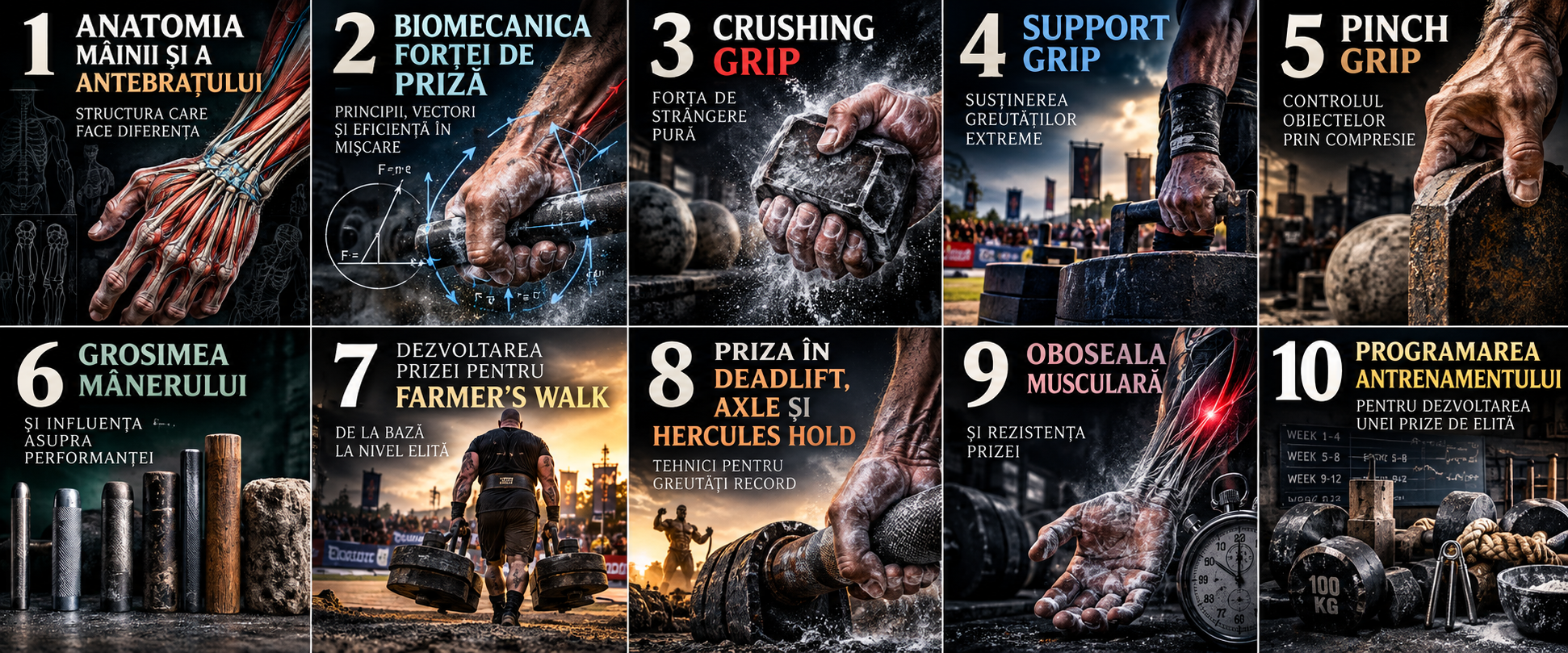
An athlete may pull a barbell weighing more than two hundred kilograms from the floor, then find that a considerably lighter load on a thick axle defeats the grip. The legs have not suddenly become weak, the back has not lost its ability to extend, and the nervous system has not forgotten the movement. What changed is where the body meets the object: the cylindrical surface that the fingers must wrap around and control. Handle diameter can transform an entire strength event even when the visible path of the bar appears almost unchanged. In strongman, the distinction is obvious in axle deadlifts, farmer's walks, frame carries, and unconventional objects without comfortable gripping surfaces.
The first temptation is to say that thick bars simply demand a “stronger grip”. That explanation is incomplete. As diameter changes, finger posture changes, skin contact is redistributed, and the ability to prevent slipping and rotation becomes a different mechanical problem. Squeezing a cylinder in an ergonomic experiment is not the same as supporting a loaded axle or carrying two implements whose inertia creates oscillations with every step. Hand forces have different directions and must be maintained for different durations. No universal conversion coefficient can transform a score in one task into an equivalent score in the other.
A foundational 2005 study by Kong and Lowe examined maximum grip-force production on cylindrical handles with diameters between 25 and 50 millimeters. Twenty-four participants rated intermediate handles of 30, 35 and 40 millimeters as most comfortable for maximal exertions under the tested conditions [1]. That observation matters for ergonomics and for understanding hand–cylinder interaction. It does not establish that the most comfortable tool diameter is optimal for elite strongman events. Competitive objectives may involve handling deliberately awkward objects, and comfort is not synonymous with the largest weight supported in every configuration.
In 2008, Seo and Armstrong examined grip force, total normal force, contact area, hand size and handle diameter using cylinders between 38 and 83 millimeters [2]. The relationship between handle diameter and hand length explained a substantial part of the variation in measured outcomes within that experimental setting. This is an important argument against superficial comparisons. The same 50-millimeter handle does not impose the same relative demand on every athlete. Someone with larger hands may preserve a different contact arrangement from someone with smaller hands, without either person's maximum strength being determined automatically by anatomy.
We will follow the problem from finger joints to the loaded implement. The discussion covers open-hand geometry, the relationship between diameter and force, friction, wrist position, rolling bars, and the difference between an axle and a grippy thick handle. It will examine deadlift and farmer's walk, accessory fat-grip sleeves, and ways to evaluate progress without mistaking equipment changes for physiological adaptation. Finally, we will consider programming, recovery, the limits of the scientific evidence, and common myths surrounding thick-handle work.
The scientific starting point must be rigorous. Research involving cylinders and hand dynamometers is far more extensive than studies measuring each digit's contact force on a competition axle. A 2019 systematic review of strongman exercise biomechanics by Hindle and colleagues [4] found relevant research alongside important gaps. Some explanations in this article are therefore reasonable biomechanical inferences rather than direct conclusions from experiments comparing every diameter, surface and athletic population. That distinction will be maintained wherever it matters.
Thick Handles Do Not Add Kilograms; They Change the Problem
On a conventional bar, fingers can wrap relatively far around the cylinder. On a much thicker bar, the phalanges must operate at more open joint angles, and the thumb may meet the other digits in a different geometric arrangement. For some hands, the opportunity to form an effective mechanical hook decreases. The body must compensate through combinations of flexion force, normal pressure, friction and rotational control. With external mass unchanged, the back's metabolic demand does not simply increase because the bar is thicker. The new limitation may arise at the hand–bar interface.
This does not mean a thicker handle is always harder for every movement. Certain squeezing tasks have ranges of diameter that facilitate force production through favorable finger postures. An exceptionally thin cylinder may be uncomfortable or redistribute pressure unfavorably, while an extremely wide one can restrict finger closure. The relationship depends on anatomy and the purpose of the test. The popular idea that “thicker always means better” is not a scientific conclusion, but a simplification of a multidimensional problem.
The Anatomy of Cylindrical Gripping: Fingers, Joints and Forearm
Understanding diameter requires viewing the hand as a set of interacting levers rather than a rigid clamp. Metacarpophalangeal, proximal interphalangeal and distal interphalangeal joints let each finger adapt to the object. Flexor digitorum superficialis contributes strongly to proximal interphalangeal flexion, while flexor digitorum profundus influences distal joint flexion. Interossei and lumbricals participate in segment control, and wrist flexors and extensors establish mechanical conditions for force production. Each muscle does not contribute identically to every event, because recruitment depends on arm position and object geometry.
On a relatively narrow cylinder, fingers can flex substantially and some phalanges may reach beneath the bar. That configuration can provide a component of mechanical support in addition to friction. On a thick axle, the phalanges may remain more open and fail to reach a conveniently locked position. Athletes sometimes experience this distinction toward the end of a hold: the cylinder moves gradually toward the fingertips, and every small displacement reduces the initially favorable contact. The process is not purely muscular, because it depends on object shape and how surfaces are oriented.
Individual finger length also affects load distribution. The index and middle fingers may contact one region, while ring and little fingers contribute differently depending on the grip angle. The thumb may press against the cylinder or against other digits when geometry permits effective opposition. On a very thick bar, the thumb may be unable to reach a position that offers useful mechanical closure. We should not assume that all hands follow one identical strategy. Video of a lift cannot accurately establish every finger's force contribution; that would require direct pressure or force measurements.
From a lever perspective, a muscle's joint moment depends on muscular force and its internal moment arm. As joint angle changes, moment arms and available force may change. Yet it would be unjustified to claim that a finger flexor loses a fixed percentage of strength for every ten-millimeter increase in handle diameter. The relationship is neither linear nor universal. Such a calculation would require individual joint positions, tendon information and force measurements. Sporting practice usually reveals the net effect instead: how much weight the hand can support in one defined configuration.
Open-Hand Grip: A Useful Term, Not One Universal Event
In strength-sport language, open-hand grip generally refers to a configuration where fingers remain relatively extended. The term also appears in climbing, but there it may denote finger positions substantially different from a thick-axle deadlift. Finger posture must therefore be distinguished from the actual exercise. Athletes may use an open-hand configuration to hold a large cylinder, secure an awkward object or hang from a climbing hold, but the force directions, thumb contribution and duration differ. Open-hand grip is not automatically one completely independent capacity.
An important distinction exists between active flexion and visible hand position. Open fingers do not imply relaxed flexors. During a demanding hold, the forearm muscles can produce very high tension to prevent object movement even when the visible range of finger flexion is small. This explains the intense forearm effort experienced on an axle. Muscles are trying to create sufficient contact force from joint angles that may be less favorable than those on a conventional bar. Lack of visible movement must never be confused with lack of muscular work.
With a large cylinder, the athlete may try to compensate through wrist flexion or altered arm position. Such adjustments change the length and leverage of certain flexors but can also allow the bar to roll. A position that feels advantageous for one brief attempt may be unsuitable for a prolonged hold. Research on wrist posture, grasp size and grip strength, including O'Driscoll and colleagues' 1992 study [3], demonstrates that wrist positioning can substantially influence force. A result obtained with a hand dynamometer, however, cannot be turned into a fixed rule for 250-kilogram axle lifts.
Why the Last Finger Segments Matter
An athlete sometimes notices that the thick bar does not fall instantly but slips progressively toward the distal phalanges. The fingers continue producing force as the contact region moves. This migration changes pressure distribution and may reduce opportunities for mechanical hooking around the cylinder. If the bar begins rolling as well, stabilizing the interface becomes even more demanding. Experienced athletes may recognize the onset of movement, but recognition does not guarantee enough force reserve to stop it.
For training, this observation supports learning a repeatable setup. Hands should establish contact before the lift, and the athlete should know how far the fingers can close around that specific diameter. Jerking the object before the grip is established can promote slipping regardless of maximum muscular force. Conversely, unnecessary adjustments before every repetition can prolong time under tension. Effective technique emerges from controlled repetitions and familiarity with the actual implement, not from searching for one hand position that works for everyone.
Anatomy Is Necessary but Not Sufficient
No anatomical model can predict a competition maximum without considering the surface, duration, loading and athlete's technical choices. Two hands may have similar finger lengths yet different conditioning, tissue tolerance and motor coordination. A muscularly strong athlete may struggle with an unfamiliar rotating axle, while a technically experienced competitor may retain it more effectively. The useful question is not whether anatomy or training matters more in isolation. It is how their interaction determines the grip mechanics at the required moment.
This approach also guards against simplistic genetic narratives. A large hand can help in certain configurations, but it does not supply unlimited forearm force or perfect tactile control. A smaller hand may face disadvantages on particular thick handles while remaining highly competitive on other objects. Claims about hand size should therefore be linked to defined dimensions, not turned into universal predictions about athletic achievement.
Normal Force and Friction: What Actually Keeps a Bar in the Hand
A heavy cylinder can be retained only when contact forces between hand and surface prevent relative movement. As fingers and thumb compress the bar, they create approximately normal forces at local surface regions, while friction helps oppose gravity and relative displacement. A basic model expresses the upper limit of friction as Ff ≤ μN, where μ represents the coefficient of friction and N is normal force. For a real hand, the equation is conceptual rather than a complete model: skin deforms, contact points have different orientations, and partly wrapping fingers may provide mechanical support as well.
Grip is commonly imagined as simply how hard someone squeezes. In reality, supporting capacity emerges from the interaction among compressive forces, friction coefficient and contact geometry. Narrow cylinders may permit favorable hooking positions. Thick cylinders alter contact, potentially requiring different pressure even for the same external load. Doubling diameter cannot be assumed to double required force, because the mechanics are not one-dimensional. Changes in the directions of individual finger forces may influence the outcome.
Seo and Armstrong [2] demonstrated that total normal force on cylinders must not be confused with a force value obtained from a split-cylinder apparatus. Their analysis found average total normal force to be approximately 2.3 times one specific grip-force measure under the tested conditions. That is not a universal equation converting deadlift mass to finger force. It demonstrates that instruments record different quantities and that the kilograms on a barbell do not directly reveal what each digit generates. During a lift, forces act across multiple surfaces and cannot be fully reconstructed from object mass alone.
At the skin interface, local pressure may rise when effective contact becomes concentrated in smaller regions. If an athlete grasps a very broad handle with only limited portions of the digits, those locations may experience high local loading. A larger contact area does not automatically guarantee greater retention either. Pressure, material, moisture, microtexture and the object's preferred direction of movement all matter. Apparently similar implements may behave differently. A smooth steel cylinder is not mechanically equivalent to a handle of the same diameter covered in rubber or an abrasive layer.
Why a Bar May Start Rolling
A thick axle may be difficult not only because fingers close less, but also because some gripping configurations allow the cylinder to rotate or shift against the skin. The word “rolling” requires precision. A bar may actually rotate relative to the hand, slide vertically, or combine both movements. What an athlete feels may not establish their exact contributions. Biomechanical analysis would benefit from orientation marks on the implement, video and information about joint positions.
On a conventional Olympic barbell, loading sleeves can rotate relative to the shaft through bearings or bushings. On many rigid axles, plates and the central cylinder move together, depending on the design. This does not mean every axle necessarily rotates more against the palm or every Olympic shaft remains motionless. The behavior depends on the specific implement and loading configuration. A rigid shaft may transmit moments from the moving plates differently, while grip properties determine how the hand responds. The bar's construction should be described before attributing the entire difficulty to its diameter.
Center of mass and pulling direction also affect contact. If an athlete holds the bar slightly ahead of the vertical line of the hand, or grips asymmetrically, additional rotational tendencies may arise. During maximum lifting, small geometric differences become important near the limit of retention. Learning a stable path can reduce disturbances without abolishing gravity or inertia. Good technique makes it more likely that existing strength is used in favorable conditions; it does not create unlimited friction.
A common discussion error is treating any rolling as proof that the athlete has lost all muscular force. Muscles may still generate high tension while contact becomes inadequate to stabilize the object. As the bar migrates toward the fingertips, mechanical demands change within the attempt itself, which may amplify sliding. A failed grip therefore cannot identify the exact percentage of muscular force missing. We know where the system failed, not every physiological mechanism involved.
Surface Texture and the Limits of Comparison
A knurled handle, a painted cylinder, a chrome-like surface and a rubber coating present different interfaces. Knurling can facilitate some contact conditions while increasing local pressure against skin. A smooth finish may slide with less resistance under some moisture conditions. There is no universal ranking of all materials from easiest to hardest for every hand. Skin conforms to surfaces, and identical textures can feel and behave differently under different loads and skin conditions.
Amca and colleagues investigated how chalk affects the coefficient of friction between fingers and climbing holds [6]. Their study is relevant because it experimentally addresses contact conditions. However, values obtained on climbing surfaces are not multipliers for axle performance and do not demonstrate that chalk always helps with every combination of metal, moisture and skin. Sometimes a thick coating may change surface texture unfavorably; sometimes drying the skin improves stability. Athletes need to test actual conditions and follow event rules.
When comparing results between gyms, describing the handle can be nearly as important as recording the load. A nominal “50-millimeter axle” may have a somewhat different measured diameter, texture, finish and stiffness than another. If one athlete uses a bar allowing substantially better contact, lifted mass cannot isolate differences in muscular grip capacity. This does not diminish the sporting effort. It turns an impressive number into interpretable information.
Moisture, Skin and the Meaning of a Controlled Test
Hands are biological contact surfaces, not standardized rubber blocks. Sweating, local temperature, calluses and recent abrasion can influence contact. An athlete may experience substantially different grip security on the same bar on different days without any change in forearm strength. That is why evaluation should consider the state of the skin, whether chalk was permitted, and whether the shaft was cleaned or otherwise altered. Changes in the interface can be legitimate parts of sport, but they should not be presented as proof of physiological adaptation.
Even an attempt performed at a fixed weight can change in difficulty when the object is colder, the room more humid or the athlete's skin condition differs. We cannot infer exact effects without direct measurement, and we should resist universal claims that one environment always increases or decreases grip. The practical response is consistent preparation and detailed enough logging to identify major changes. This approach separates a useful observation from an invented law of friction.
The Relationship Between Handle Diameter and Hand Size
In strength sports, hand size is sometimes treated as the definitive explanation for performance on an axle. Finger and palm lengths do influence the ability to wrap a cylinder, but the athlete with the biggest hands does not automatically lift the largest weight. Muscular strength, technique, specific experience and contact conditions remain important. Diameter is also only one equipment variable; texture, stiffness and object design alter demands. The useful question is not simply how large the hand is, but how individual anthropometry interacts with a defined task.
Seo and Armstrong [2] reported that the ratio of cylinder diameter to hand length explained 62% of variance in one grip-force measure, 57% in normal force and 71% in contact area within their statistical analyses. These values must be read as study-specific findings, not universal performance predictions. They do not mean that 62% of axle-deadlift success is genetically predetermined. Nor do they prove that anatomy independently dictates every other capacity involved in lifting. The study shows instead why absolute diameter can be misleading when hand size is ignored.
A straightforward normalization can consider the relationship between handle diameter and hand length without pretending that the ratio completely describes performance. For two athletes using an identical 50-millimeter cylinder, the athlete with longer hands will have a smaller relative diameter-to-length ratio. Their fingers may, in principle, wrap proportionally farther around it. But the precise difference in supported mass cannot be calculated from this ratio alone. It would require information about digital force, pressure distribution, friction and test conditions. A geometric ratio gives context, not a perfect performance handicap.
Using one axle for everyone in competition has an obvious benefit: it defines a common external challenge. Sport need not compensate for every anatomical difference. Yet a coach interpreting two athletes' progression should recognize that the same event may challenge relatively different capacities. One athlete may be limited by finger-flexor force; another by inadequate finger wrap; a third by rotational control. No single photograph of the hand on the bar can reliably distinguish all those explanations.
Palm Width Is Not Finger Length
Casual references to “large hands” often mix palm width, overall hand length, thumb-to-little-finger span and phalangeal length. These measurements are partly related but not interchangeable. Two hands with identical overall lengths can have different palm-to-finger proportions. On a thick handle, digit segment lengths and thumb opposition can matter differently from palm width. During pinch gripping, the span between thumb and fingers may become especially important. A single anthropometric score therefore cannot explain every form of grip.
Practical assessment may include hand length, finger span and a description of handle dimensions. Not every athlete needs a detailed morphometric assessment before training, however. When the objective is individual progress, periodically testing the same implement under the same rules is usually more important. Anthropometric measures become especially relevant for research, comparisons across athletes or equipment design. In a training log, the identity of the handle and the current result may be more useful than an exhaustive list of body measurements.
The Most Comfortable Diameter Is Not Necessarily the Best Sporting Diameter
Kong and Lowe's study [1] investigated optimal diameters for cylindrical force tasks, including perceived comfort and force distribution. Their results indicated favorable ratings for intermediate sizes and a relationship between preferred size and hand length. Subjective comfort, maximum squeezing force in a laboratory task and suspended load in a strapless deadlift are nevertheless different outcomes. An ergonomic tool aims to permit safe repeated use. A competition implement may deliberately test an awkward mechanical condition. Optimizing one does not automatically optimize the other.
This distinction matters when selecting accessories. If an athlete uses fat-grip sleeves to approximate an upcoming competition diameter, the choice has a clear specific purpose. If exceptionally large sleeves are used without a relevant target or rationale, they may consume recovery capacity without enough transfer. That does not mean extreme diameters are inherently useless. It means each variation should answer a defined question: are we trying to improve force in open-hand positions, tolerate a particular surface, or perform on one exact implement?
Why Comparing 28 and 50 Millimeters Requires Care
A conventional deadlift bar commonly has a relatively narrow shaft, while a competition axle can have a diameter around 50 millimeters. The geometric difference is substantial. But if an athlete moves from a sharply knurled standard bar to a smooth axle, they have changed texture as well as diameter. If the axle is rigid while the conventional bar has shaft flexibility and rotating sleeves, dynamic behavior may also differ. If conventional lifting used mixed grip while the axle event requires double-overhand grip, another major variable has changed. All of these factors should be considered before interpreting record differences.
Isolating diameter experimentally would require objects matched as closely as possible in other respects, controlled surfaces, a consistent technique, appropriate loading and comparable recovery states. In practice, comparing two gym implements is more often a functional comparison than a perfectly controlled experiment. It remains useful to coaches because it reveals what an athlete can actually manipulate. Interpretation should be restrained. A reduced record on one bar should not be attributed entirely to diameter unless the other differences have been assessed.
Normalization Does Not Replace Sporting Rules
Researchers can normalize dimensions to study general patterns, but competition results still belong to the actual implement and rulebook. A fixed 50-millimeter axle may relatively favor athletes with certain hand geometries, just as body size influences other strongman events. That does not invalidate the sport. It defines which capacities the event rewards. Scientific assessment and sporting ranking answer different questions, and neither should be used to erase the value of the other.
Axle Deadlift: A Pull That Can Test the Hand Before the Back
During a strapless axle deadlift, the athlete must maintain contact with a broad cylinder throughout the pull. The movement can resemble a conventional deadlift, but the hand demands differ. When rules require double-overhand grip, the competitor cannot exploit the opposing orientation used with mixed grip. When the implement lacks knurling, surface contact may be less secure. When plates and shaft move rigidly together, rotational behavior differs from bars with independently rotating sleeves. No single factor explains every axle's difficulty. It emerges from the combined demands of equipment and rules.
The lift starts before the plates leave the floor. The hands must settle onto the cylinder and establish useful contact pressure before or as pulling tension increases. When whole-body tension rises abruptly before grip is ready, the bar may slip before hip extension can contribute fully. Excessive setup time, on the other hand, can create local fatigue before the active movement begins. The technical objective is a repeatable sequence: finger placement, controlled tension, stable lift-off, and retained contact until the prescribed finish.
During lift-off, vertical acceleration affects the momentary forces required to move the system. An uncontrolled jerk may create a faster change in grip demand than a controlled lift. That does not mean slow lifting is universally superior. Athletes must coordinate whole-body effort with contact limitations, and appropriate speed depends on the task. Evidence is insufficient to prescribe one precise lift-off duration that maximizes results on every axle. Differences between techniques cannot be reduced to diameter alone.
As the bar ascends, it may migrate within the hand. Athletes sometimes feel secure initially but lose the object near the knees or lockout. Sustained loading, time under tension and shifting hand–bar geometry may all contribute. It would be premature to conclude that “grip is weak only at the top”. Contact may have been deteriorating from the first centimeters, becoming obvious only later. Video can help identify the timing, but it does not directly measure finger force.
Some events require full extension, a referee's down command or as many repetitions as possible within a time limit. Those variations change grip demand. A competitor who can pull a particular mass once may be unable to repeat it continuously because hand stress and time under tension accumulate. Others manage repetitions through efficient technique and reduced unnecessary handling. Maximum single-lift strength and repeated-lift capacity are related but different outcomes. The coach should prepare the exact event rather than chasing one number on the barbell.
Double-Overhand, Mixed and Hook Grip on Thick Bars
Double-overhand grip, with both palms oriented similarly, is frequently used to test axle-supporting capacity, but official rules vary. Mixed grip changes arm orientation and may influence how rotational tendencies are opposed. Hook grip uses the thumb as part of a locking mechanism beneath the fingers, but larger diameters can make it difficult or impractical for some hand geometries. No technique should be declared automatically superior for every athlete. The relevant questions concern legality, contact mechanics and safe individual execution.
If the training objective is to develop double-overhand axle grip, consistently using mixed grip during specific heavy work changes the intended stimulus. If the objective is lifting maximum mass under rules permitting several techniques, a competitor may choose a different strategy. Both choices can be rational, but they assess different skills. Confusion arises when performances are presented as equivalent. A 200-kilogram axle pull with lifting straps is not a record of unsupported grip strength, even though it may be a legitimate display of whole-body pulling capacity.
Hook grip can produce substantial local thumb pressure. Gradual familiarization and individual monitoring matter, but persistent pain should not be framed as evidence of effective adaptation. There is no universal program making every hand capable of hooking any diameter. Rules may forbid the technique or reduce its usefulness. A scientific article cannot substitute for individual adjustments when a competitor has a history of thumb symptoms.
Competition Axles Must Be Measured, Not Imagined
The word axle is applied to cylinders of different diameters and constructions. Some gyms have fixed bars close to 50 millimeters; others use sleeves increasing the diameter of an ordinary shaft. Shaft length, empty-bar mass, stiffness and plate attachment can vary. There is no reason to assume that every object called an axle reproduces the conditions of a particular strongman final. Coaches with access to specifications should document them. Otherwise, measuring diameter and describing surface texture are better than estimating dimensions from photographs.
When final competition rules are not yet available, preparation can combine a standardized gym reference with moderate exposure to different conditions. Once official specifications are released, the work can become more specific. This approach reduces the chance that an athlete masters one cylinder only to be surprised by a different finish in competition. Buying every device is unnecessary. Understanding which variables change the task and adapting without abandoning progression and recovery is more useful.
Distinguishing Grip Failure from Full-Body Failure
A failed axle attempt may end because hands lose the cylinder, but it may also end because knee and hip extension cannot move the external load. These outcomes should not receive identical training prescriptions. If the hand slips while the body has obvious pulling reserve, specific grip work may be justified. If the athlete cannot break the load from the floor despite stable hands, extra fat-grip holds are unlikely to solve the main limitation. In ambiguous cases, recording where the bar stops and how it moves provides useful evidence.
Even apparent grip failure may involve multiple contributors. General fatigue can alter posture and slow the pull, extending the time during which the hand must retain a difficult object. Conversely, a grip that slips early can prevent the body from reaching the positions where its strongest muscles contribute most. This interaction is why a complete analysis considers the entire lift. No isolated hand test fully predicts the competition outcome.
Farmer's Walk: Handle Diameter Meets Acceleration and Gait
Farmer's walk is often described as a test of whole-body strength and endurance, but for the hands it is a demand that changes with every step. Athletes do not merely hold two heavy objects in a fixed position. They lift, accelerate, transport and control them while the center of mass of the entire system moves. If the handles are relatively thick, the fingers must preserve a more open configuration while the implements' inertia creates repeated disturbances. A grip that survives a static hold may fail during movement at the same weight on the same handle. The difference is not paradoxical; dynamic control adds its own demands.
Winwood and colleagues analyzed farmer's-walk biomechanics in a study involving six experienced male strongman competitors and compared the event with deadlifting and unloaded walking [5]. The research documented differences in ground-reaction forces, stride characteristics and gait. It did not directly record each digit's force on the handles or identify an ideal diameter for farmer's walk. Its contribution is showing that heavy carrying is a dynamic event distinct from static support. Discussions of handle thickness should include that dynamic dimension without attributing untested claims to the study.
Thick handles can also change how the lift begins. The athlete needs to position the fingers before lifting the implements and then stand in a configuration that permits the arms to bear the load. An excessively violent start may create oscillation before contact pressure is properly established. An excessively slow setup wastes time in a timed event. Start control becomes a technical factor, just like selecting the first few steps. Experienced athletes can practice submaximal starts to coordinate leg extension, trunk stabilization and hand tension.
During a carry, implements can swing forward and backward or laterally, depending on frame construction, hand positions and walking technique. Handles positioned differently relative to the center of mass can change the objects' behavior. Hands must respond to repeated perturbations, and thick cylinders may limit the ability to increase finger closure when slipping begins. Under fatigue, each unnecessary swing can contribute to failure. Not every dropped implement results from the same form of fatigue. Identifying when instability begins may provide more useful coaching information than simply labeling the athlete's grip weak.
Weight, Distance and Duration Are Different Outcomes
Farmer's-walk performance can be evaluated through maximum carried weight, time over a defined distance, distance until loss of grip or repeated trips. These outcomes are related without being identical. One athlete may start well on thick handles yet lose the load after ten meters. Another may start slowly and maintain a steadier pace across a longer course. Diameter interacts with effort duration and acceleration profile. A high static-hold result therefore does not guarantee a fast carry. Training should reproduce the variable that decides the competition ranking.
When the event rewards speed over twenty meters, submaximal runs may permit practice of steps and object control. When maximum distance is the goal, maintaining contact under local fatigue matters more. When maximum weight must be carried a very short distance, lift-off quality and immediate supporting strength may dominate. These variations do not require entirely unrelated training programs but do establish different priorities. An athlete should not equate an improved static maximum with automatic gains in competition speed.
Frame Carry and Other Handles: Similar Concepts, Different Implements
A frame carry can use handles of different diameters, orientations and positions relative to the torso. A rigid frame may be steadier than two independent implements, but not inevitably: construction, mass distribution and surface determine behavior. With thick handles, finger opening is a limitation. With narrow abrasive handles, something else may be decisive. Calling every frame carry mechanically identical to farmer's walk would obscure relevant differences. Specific training should approximate the actual competition device whenever it is known.
Some events use handles positioned at unconventional heights or oriented differently from a deadlift shaft. Wrist positions may differ substantially. O'Driscoll and colleagues' findings [3] suggest wrist position can influence available grip force, but their laboratory angles cannot be translated directly into performance on every frame design. Coaches can instead observe whether a specific orientation promotes premature slipping and test controlled technical adjustments. That is a defensible application of biomechanical principles.
Hercules Hold: Lateral Forces and Handle Diameter
In Hercules Hold, competitors may retain two handles loaded predominantly by laterally directed forces, depending on the installation. This differs from a vertically loaded axle deadlift. Thick handles may restrict finger wrap, while pulling direction and arm posture introduce additional demands. Sometimes athletes must stabilize the body between structures pulling in opposite directions. Diameter is not the only influence; shoulder, wrist and trunk position contribute to the entire system's stability.
Consequently, axle-deadlift maximum is not automatically the best predictor of Hercules Hold. It may develop part of the capacity to support a broad cylinder, but cannot reproduce the installation's force directions or postural requirements. Coaches preparing this event should investigate the actual device geometry, handle width, duration and starting conditions. When the exact apparatus is unavailable, simulations may help but should be described as approximations. Merely using a 50-millimeter cylinder cannot guarantee transfer.
When Thick Handles Are Not the Priority
Not every strongman competitor requires entire training blocks devoted to thick diameters. If most events use conventional handles and the athlete loses races because of walking speed, excessive fat-grip work may divert resources from the true limitation. If whole-body carrying capacity is the bottleneck, open-hand strength may be a secondary goal. Conversely, consistently dropping a thick handle before the finish makes targeted work reasonable. The best exercise is not the most unusual one, but the intervention that addresses an observed constraint.
Translating Carry Experience into Useful Testing
A competitor can compare static holds with short carries using the same handles, weights and hand conditions. If static duration improves while carrying performance does not, the coach can look at swing control, gait and event-specific fatigue. If both improve, the observations suggest useful transfer but still do not isolate the exact physiological cause. Maintaining a small number of reference tasks makes these comparisons practical without turning every training session into laboratory research.
Fat-Grip Sleeves: Useful Accessories, Not Identical to an Axle
Fat-grip accessories are sleeves fitted over narrower handles to increase the diameter presented to the hand. They may be made of resilient materials and can quickly turn a conventional bar, dumbbell or cable attachment into a broader surface. Their main advantage is accessibility. Athletes need not own a collection of specialty bars to expose the hands to more open gripping postures. But the construction introduces differences from rigid metal cylinders. The surface can deform, compress beneath finger pressure and have a different coefficient of friction.
A sleeve with a longitudinal opening fitted onto a normal bar need not distribute pressure exactly like a continuous steel cylinder. The outer material may be more adhesive, changing the perception of grip security. Some accessories can rotate or shift slightly relative to the inner shaft, while others are more securely attached. Consequently, a 50-millimeter sleeve lift should not be reported as a 50-millimeter rigid-axle record without explanation. Both are legitimate exercises, but identical external diameters do not make the implements mechanically equivalent.
During preparation, fat grips can play a complementary role. Athletes introducing wider hand positions can use moderate loading on dumbbells, cables and pulling handles. If the final objective is an official axle-deadlift event, they should also practice with equipment close to the competitive implement. A sleeve cannot perfectly reproduce the rigidity, finish and rotational behavior of the bar. It can, however, provide mechanical variety and opportunities for capacity development when official equipment is unavailable.
What Happens When Rows Get Thick Handles
Dumbbell rows, cable exercises and pulldowns can be modified by increasing handle diameter. This change does not automatically create a superior back-hypertrophy exercise. Finger fatigue may become limiting before the targeted back muscles, reducing weight or repetitions available for the original training objective. If the day's main goal is developing the back, premature grip limitation can be a cost rather than a benefit. If the objective is additional local exposure for the hands, the variation may be useful.
This is a clear example of goal-dependent exercise choice. A session intended for back hypertrophy and a session intended for open-hand grip need not use identical accessories. One athlete might use standard handles or straps for some movements to preserve the target muscular stimulus, then train thick grip separately. Another may combine stimuli while accepting reduced back-training volume. Neither choice is universally correct. Effective evaluation asks which quality has priority and whether the accessory develops it without compromising other objectives.
Pull-Ups, Hangs and Large-Diameter Handles
Bar hangs and pull-ups on thick handles may build familiarity with sustaining cylindrical surfaces under traction. But holding bodyweight on a fixed bar differs from lifting a barbell off the ground. During a hang, the body moves relative to the contact point, and shoulder and trunk positions influence loading. In a deadlift, the bar moves while hands face other rotational and force demands. Similar diameter does not make the movements mechanically identical.
Extremely thick-handled hanging can become the limiting factor in a session before the athlete completes the pulling volume needed for back development. When pull-up performance is the goal, an overly challenging handle may interfere. When grip competition is the target, controlled hangs can have a specific place. Duration, diameter and safe release need planning. Athletes with prior elbow, thumb or shoulder symptoms should avoid repeatedly forcing near-maximal hangs merely because the exercise looks impressive.
Log Press and Internal Handles: Limited Similarities
Strongman logs may contain internal handles whose thickness affects how the implement feels during the clean and press. Yet the athlete does not hold them in the same configuration as an axle deadlift. During the clean, the log may be supported on the body; during the press, forces pass through the handles in different directions. Thickness can affect comfort and control, but final performance also depends on elbow position, leg drive, trunk stability and pressing mechanics. Improved axle grip cannot be assumed to produce a larger log record.
Log handles vary in diameter and finish. Familiarization with competition-like equipment may help, but thick-bar work should not replace practicing the complex lift. If an athlete loses control of the log during transition, the specific mechanism should be examined. If the press fails because extension force is insufficient, a program devoted exclusively to thick handles may not solve the limitation. The best accessory addresses an identified obstacle rather than a vague resemblance between implements.
Thick-Bar Curls and the Temptation to Measure Everything through the Forearm
Elbow curls on a thick bar may stress the hand in another configuration but do not isolate finger-flexor strength. The biceps and brachialis contribute to elbow flexion while grip stabilizes the object. Increasing handle diameter can require lower external loading to retain contact. That does not prove the arm muscles are being trained more effectively. According to the goal, grip limitation may be intentional or an unwanted interference.
Multiple thick-handle exercises in one week can accumulate local stress beyond what a simple exercise count suggests. Rows, curls and deadlifts on broad cylinders may repeatedly challenge the same hand structures on consecutive days. Programs tracking only kilograms for large muscle groups can underestimate these demands. For strongman, integration across the whole training week matters more than the impressive appearance of any isolated exercise.
Fat Grip Does Not Mean Automatic Forearm Hypertrophy
Enlarging a handle can increase the difficulty of retaining an object, but muscular growth depends on sufficient training stimulus, recoverable workload and long-term progression. If the sleeve makes the task so difficult that meaningful repetitions cannot be performed, it may not provide the intended volume. In other cases, it may selectively challenge local tissues and support useful adaptation. The equipment itself does not guarantee results. Claims that one accessory grows forearms faster than all conventional exercises require comparative intervention research, not testimonials alone.
A good coach evaluates what the changed grip actually limits. If the forearm is the intended target, difficulty at the hand can be desirable. If the back, biceps or pressing muscles are the intended targets, the grip may interfere with productive loading. Strategic selection allows both aims to coexist in a larger program without pretending every exercise must train every quality simultaneously.
Neural Adaptations: Why Early Progress Does Not Automatically Mean Larger Muscles
An athlete beginning thick-bar training may experience surprisingly rapid improvement over the first weeks. Increased performance can appear disproportionate to visible changes in forearm size. Plausible explanations include technical familiarization, more effective finger placement, improved coordination and motor learning tailored to the object. Duchateau, Semmler and Enoka's review of training adaptations in motor-unit behavior [9] shows that neural changes can contribute to strength development. However, this is general resistance-training literature, not a direct intervention study on elite axle competitors.
When a hand first meets an exceptionally broad cylinder, the nervous system must organize forces in an unfamiliar joint configuration. The athlete may press excessively in one region and inadequately in another, start pulling before the fingers are positioned or allow the bar to move across the palm. Controlled repetition may improve these relationships. The resulting performance gain is real even if muscle mass has not changed greatly. Early progress should not automatically be advertised as spectacular finger-flexor hypertrophy.
Technical refinement nevertheless has limits. As external load grows, the athlete must create and sustain greater contact forces. That requires physical adaptation in the structures involved. Familiarity reduces unnecessary errors, but does not suspend mechanics. An athlete skilled at positioning fingers cannot support indefinitely increasing weight without developing the relevant capacity. Good training therefore combines specific practice and progressive loading rather than placing technique and strength in false opposition.
Forearm Muscles and the Conditions for Hypertrophy
Finger flexors have substantial muscle bellies in the forearm, so demanding hand tasks can impose local muscular work. Yet an intense pump does not guarantee hypertrophy. Adaptation depends on mechanical tension, recoverable volume, proximity to capacity limits, recovery and consistent exposure. A very heavy two-second effort does not automatically provide the same stimulus as several controlled sets across greater total work. Conversely, very long holds at tiny loads do not guarantee competitive maximum-grip development. Different targets justify different loading methods.
Some thick-handle tasks strongly emphasize supporting capacity, while others combine supporting force with repeated movement. A single thick-bar deadlift provides brief intense exposure; a farmer's hold may provide longer duration; sleeve-assisted rowing provides repeated contractions. The same muscles may participate, but the conditions are not identical. Comparative research is insufficient to claim one exercise universally superior for forearm growth in strongman. Selection should follow event demands and individual tolerance.
Tendons Do Not Necessarily Follow the Speed of Records
Muscles produce tension while tendons transmit it to bones. Thick gripping repeatedly loads finger flexors and stabilizers in potentially unfamiliar joint postures. Bohm, Mersmann and Arampatzis' 2015 systematic review [7] examined tendon adaptation to mechanical loading in humans. The evidence supports tendons' capacity for change over time but does not identify an ideal axle-training protocol for elite strongmen. Neither forearm pain nor rapid record gains prove beneficial tendon thickening.
One programming hazard is increasing load, diameter, frequency and holding duration simultaneously. Each can alter tissue demand, and changing all of them obscures interpretation. The athlete may think they are simply “training grip” while repeatedly loading digits, wrist and elbow. Rational progression limits the number of major simultaneous changes, monitors technical quality and adjusts stress when signs of poor tolerance appear. Long-term adaptation matters more than testing a maximum every session.
Local Fatigue and Whole-Body Fatigue
Failure on a thick handle may involve local hand factors but cannot be completely separated from the condition of the rest of the body. After heavy deadlifts, general fatigue can slow the pull, lengthening the time hands must support the object. After numerous farmer's-walk runs, leg and trunk fatigue may change gait and increase implement swinging. On other days, whole-body pulling strength may be available while forearms remain fatigued from earlier work. A lower result does not automatically prove a long-term loss of capacity.
This interaction is why maximum grip testing should occur in a reasonably reproducible context. An athlete who tests axle maximums after radically different preceding workouts each week will measure changing fatigue as well as strength. A periodic assessment in a relatively consistent session may be useful, with other sessions devoted to training volume. No single recovery interval suits every athlete, because history, intensity and overlapping events differ. What matters is recording the context before declaring the program successful or unsuccessful.
Time to Failure Is Not Merely Willpower
During a heavy static hold on a thick handle, an athlete may begin with adequate contact and gradually lose the ability to retain it. Sustained contraction involves energetic demands, motor-unit activity and local changes in circulation according to relative intensity. However, research is insufficient to specify exactly how blood flow behaves within each digital muscle during a 300-kilogram competition attempt. Claims that circulation is completely stopped at a particular load should be avoided without measurement. Holding limits are multifactorial rather than a simple equation based on burning sensations.
An athlete can fail before strong muscular discomfort appears if the surface is very slippery. Another may feel intense congestion while retaining an object because contact is favorable. Holding duration should therefore be interpreted alongside diameter, texture, load and technique. Two thirty-second holds on different handles do not establish identical capacity. For individual progress, a stable reference implement and consistent rules are more useful than comparing spectacular videos.
Recovery Is Part of the Adaptation Process
Training provides a stimulus, while subsequent recovery permits readiness to return. This does not mean an athlete must be completely free of sensation after every session, nor that one fixed number of days is universally correct. The appropriate interval depends on absolute load, relative difficulty, training history and other work involving the hands. A competitor also performing heavy rows, deadlifts, carries and event training may accumulate more forearm stress than a grip specialist whose other training is lighter.
Coaches should consider the combined weekly workload rather than counting only dedicated grip sessions. Symptoms, performance changes and the quality of subsequent events are useful observations. If additional thick-handle work repeatedly worsens an upcoming farmer's walk, it may be poorly placed even if the exercise itself is effective. Training should improve the intended competition outcome, not simply maximize the number of exhausting activities recorded in a log.
Programming Thick-Handle Exercises
Effective preparation begins by defining the event. Double-overhand axle deadlift requires familiarity with competition-relevant diameter, surface and rules. Thick-handled farmer's walk also requires moving with the implements, because static holds do not reproduce walking oscillations. For general forearm development, accessories can vary more widely without allowing grip to unnecessarily limit every back exercise. These three objectives require different priorities.
The ACSM resistance-training progression guidance [8] supports adjusting load, volume and frequency to experience and objectives. It does not validate a universal fat-grip program for elite strongmen. Without specific comparative research, practical examples should be viewed as cautious applications of general principles rather than experimentally established recipes. An experienced athlete already performing heavy deadlifts and carries may tolerate a different local workload from a newcomer to grip training.
Initially, coaches can prioritize repeatable hand placement and load control at moderate intensity. Keeping diameter and surface stable, they can gradually increase mass or duration according to the target event. Changing diameter, load and time under tension simultaneously makes it difficult to identify why performance changed. A consistent reference handle, tested periodically, is more informative when supplemented by deliberately selected variations.
Maximum strength may be developed through relatively heavy, short attempts with enough recovery for high-quality effort. Local endurance may be trained through repeated or longer holds at moderate loads. Race preparation also needs movement. All these qualities need not be maximized within one session. Heavy deadlifts followed by repeated holds to failure and numerous fast carries can impose more recovery cost than their additional benefit justifies.
If axle grip is the priority, some back exercises may use straps so that finger fatigue does not limit every set. Straps change the task and cannot count toward unassisted grip testing, but they serve another training goal: loading the large pulling muscles. Separating back and forearm stress deliberately is not abandoning grip work. It can represent more effective allocation of recovery resources.
Diameter as a Training Variable
Moving from a forty-millimeter handle to a fifty-millimeter one is not equivalent to adding plates to the same bar. Joint posture, contact and finger wrap change. Progress at each diameter should be tracked separately. Someone may improve on exceptionally broad cylinders without a proportional gain on the standardized axle used in competition. Specificity remains the central criterion.
Persistent symptoms around the thumb base, fingers or elbow may require reduced loading and clinical assessment. Pain does not prove that tendons are adapting beneficially. Ordinary muscular fatigue after exercise should not automatically be labeled injury either. Monitoring local response and performance over subsequent days is more useful than a rigid rule about how often maximum attempts must occur.
Recording Training without Complication
A useful log can record implement identity, measured diameter, surface condition, loading, time or repetitions, and whether the lift was technically successful. Additional notes may mention chalk, preceding fatigue and any unusual discomfort. This is enough to distinguish many true performance changes from changes in equipment or conditions. Training does not become scientific merely by producing more numbers; the numbers must describe comparable tasks.
Testing Performance across Handle Diameters
A useful test answers a precise question. To determine how much an athlete can lift on a 50-millimeter axle, use that implement and a defined success rule. To assess holding endurance, fix the load and measure duration until a clear endpoint. To investigate diameter effects, test several specified handles while keeping surface conditions, rest and technique as comparable as possible. These procedures do not produce identical information. Maximum load, holding time and performance across diameters should be reported separately.
A simple protocol may include progressive warm-ups, attempts at increasing loads and sufficiently long rests to limit interference from fatigue. The success criterion must be defined in advance: floor clearance, full lockout, referee command or a specified holding duration. Testing with consistent hand positions and grip orientation improves comparability. Switching from mixed to double-overhand grip or introducing straps changes what is being tested. The results should not be combined as though they describe one capacity.
Another common error is treating a nominal diameter as an exact measurement. Manufacturing tolerances exist, and elastic sleeves may compress. If precision matters, the outer diameter should be checked and test conditions documented. Surface state is also relevant. A freshly cleaned cylinder may offer different contact from one covered in residues. Applying chalk for one attempt but not another can make part of the difference attributable to friction conditions.
When several diameters are tested in one session, their order can affect results. Beginning with maximum efforts on the thickest implement may reduce later scores through fatigue. Always starting with the narrowest leaves the last condition tested in a different state. Research could use randomized or counterbalanced testing orders. In individual training, a stable order can help consistency, but the accumulated fatigue effect should still be acknowledged. We should not pretend to have perfectly isolated diameter when the procedure itself changes readiness.
Interpreting Two Different Records
Suppose an athlete completes an unassisted 220-kilogram deadlift on a narrow bar but only 160 kilograms on a smooth axle. The sixty-kilogram difference is real as an outcome of these two tests. It does not prove that diameter alone “stole” exactly sixty kilograms. The bars may differ in texture, rotational behavior and permitted technique. The athlete may also be more familiar with the conventional bar. Isolating the effect of diameter requires reducing other differences and repeating measurements under comparable conditions.
Results should be interpreted relative to competition goals. A smaller axle maximum may not matter when the next contest contains no such event. If axle is decisive, the difference may justify focused work. The program should nonetheless track whether improvements transfer to the official event rather than only to convenient accessories. Outcomes need documentation before any implement or method is called superior.
What a Hand Dynamometer Cannot Tell Us
Hand dynamometers estimate force in defined configurations but do not automatically recreate heavy-axle geometry. Handle position, spacing and how force is applied are different. Athletes may improve conventional dynamometer values without improving thick-bar records, or vice versa. Potential correlation does not imply identity. When competition performance is the target, supplementary tests should assist diagnosis and monitoring rather than permanently replacing practice on the real implement.
Measurement Error Is Not a Personal Failure
A single unusually poor attempt may result from temporary fatigue, contact changes or execution error. A single exceptional effort may likewise overestimate what can be repeated consistently. Repeated observations across well-defined sessions provide more useful evidence than a dramatic one-day result. In an individual athlete, consistency matters not because performance must be identical every day, but because variation needs context before training decisions are made.
Wrist Position and the Cost of Poor Compensation
When fingers cannot wrap a thick cylinder effectively, athletes may try to compensate by changing wrist angle. Excessive flexion, extension or sideways deviation can appear. Such adjustments alter muscle length relationships, leverage and contact position. O'Driscoll and colleagues [3] showed that wrist posture influences force in grasp testing. Participants adopted a preferred position under laboratory conditions, and imposed deviations reduced force. The finding supports the importance of posture; it does not prescribe one universally optimal angle for every strongman event.
On an axle, a wrist position that feels advantageous before lift-off can become unstable during the pull. Excessive wrist flexion may reduce the ability to respond to subsequent bar migration. A rigid but unfavorable angle may concentrate pressure locally. The solution is not one fixed posture for everyone but identifying a repeatable configuration on the real implement. Submaximal loading can reveal when the handle begins to move without the hazards of a maximum attempt.
Skin and Local Tissues: Contact Has Biological Limits
The hand's surface is deformable and sensitive to pressure. A rough thick handle may load different regions from a narrow knurled bar. Repeated contact can produce calluses, but these do not offer unlimited protection. Sliding under heavy loading may irritate or damage skin. A torn callus can disrupt multiple productive sessions, making local care and surface inspection legitimate parts of preparation rather than cosmetic concerns.
New, rusted or damaged cylinders may contain irregularities that alter friction or injure skin. Elastic sleeves may shift on their inner bars if poorly secured. Before heavy efforts, the athlete should inspect equipment and the space into which it can be released. Deadlift setups should allow a missed load to return safely without an attempt to catch it during a fall. Farmer's walk needs sufficient clear space to prevent dropped implements striking others.
Thumb, Elbow and Forearm Pain Are Not Progress Indicators
Repeated loading can create normal local fatigue, but persistent pain, numbness, loss of function or a sudden tearing sensation require a different response. No exercise description can establish whether symptoms originate in a tendon, joint or nerve. New pain should not be automatically labeled “tendon adaptation”. Important or persistent symptoms warrant clinical assessment rather than automatic application of an internet protocol. Training should be adjusted to the athlete's actual response, not to an exercise's reputation.
An important problem is unnoticed accumulation of stress. Axle deadlifts, fat-grip rows, thick-bar pull-ups and farmer's walks can load the same digital structures in one week, even though a log classifies them under different muscle groups. If symptoms develop, abandoning every form of grip may not be necessary, but reducing and reorganizing exposures may be. Recovery must be planned around stressed tissues, not only exercise names.
Intelligent Loading over Time
The most useful program is the one that can be sustained long enough to produce adaptation. An occasional record has sporting and motivational value, but it cannot replace months of progression. Athletes competing frequently need to integrate thick-grip work with demanding events and recovery periods. An aggressive scheme that systematically impairs priority deadlifts and carries can be counterproductive even when forearms feel exhausted after every session. Fatigue is not synonymous with effectiveness.
Progress is better assessed through repeatable performances under comparable conditions: the same bar, technique, a longer successful hold or a heavier load. An athlete improving on the target implement without accumulating abnormal symptoms or compromising other events has reasons to regard the method as useful. A personal log cannot establish a universally superior protocol, but it can support more informed decisions. In sport, disciplined observation is often more valuable than constantly chasing dramatic sensations.
What Protective Practice Actually Means
Safety does not require avoiding challenging hand positions forever. It means controlling progression, understanding release options and distinguishing training stress from concerning symptoms. Grip training can be demanding while remaining methodical. An athlete who stops a set because the bar is about to fall uncontrollably has not failed at commitment. They have kept a manageable event from becoming an unnecessary injury risk.
Three Coaching Scenarios That Require Different Decisions
First, imagine an athlete with a very large conventional deadlift who loses a thick axle immediately after lift-off. One possible explanation is the difference in relative diameter and finger posture. But the coach should also examine surface knurling, a double-overhand requirement and rotational behavior. If the athlete rarely trains on this implement, unfamiliarity may matter. Submaximal axle practice and gradual loading could be reasonable, but no fixed number of training weeks guarantees a particular percentage of the conventional-bar maximum.
Second, an athlete can hold heavy thick handles for thirty seconds yet loses farmer's walk after only a few meters. Rather than declaring static grip useless, the coach should examine the start, implement oscillation and walking rhythm. Carrying includes acceleration and disturbances absent from a static hold. Short controlled runs and better object stabilization may be useful interventions. If walking speed is the actual limitation, increasing finger force alone may not resolve it.
Third, a competitor improves rapidly on elastic fat-grip sleeves yet sees little progress on a metal competition axle. This is not necessarily surprising because materials have different friction and deformation properties. One device may feel comfortable and allow effective compression while the other requires more sliding control. Specific practice on the real implement is a logical response, not an automatic rejection of all accessories. Training tools can be useful without perfectly replicating the final test.
Why Athletes Must Not Be Judged Only by Hand Size
Large palms can offer wrapping advantages at certain diameters, but anatomy does not determine results alone. Finger-flexor strength, positioning skill, friction, holding duration and experience can alter rankings. Athletes with smaller hands can improve substantially in open-hand configurations even when some geometry remains relatively disadvantageous. Anthropometric comparisons help explain patterns; they should not become final verdicts about an individual's potential.
Differences between women and men require equally careful interpretation. Absolute-strength distributions may differ among populations, but competition categories, training level, body dimensions and individual histories matter. It is inappropriate to infer a specific athlete's axle performance from sex or clinical averages. Actual standardized testing provides better information than stereotypes. For masters competitors, training history, joint condition and recovery also matter, without any universal age at which thick-grip improvement must cease.
When a Thicker Grip Becomes a Different Kind of Task
At some point, increasing diameter changes more than the difficulty of an otherwise identical grip. On a relatively narrow cylinder, fingers can wrap considerably. On an exceptionally broad object, contact may depend more on compression between partly opposing surfaces. The transition does not occur at one identical diameter for everyone, and supporting, grasping and pinching categories may overlap on some implements. Exercise classification should therefore reflect hand configuration and force direction rather than only the commercial name of the device.
A very broad object may require greater thumb participation than a normal handle without becoming identical to plate pinch. Plate pinching generally compresses relatively opposed faces, while cylindrical gripping distributes digits around a curved surface with differently oriented forces. Similar forearm sensations do not erase the mechanical distinction. This is a central lesson of the series: grip strength belongs to a family of capacities rather than one universal number.
Competition Preparation Is an Exercise in Prioritization
An athlete cannot simultaneously specialize maximally in every form of grip while also maximizing every strongman event. Training has a finite recovery budget. If the next competition emphasizes axle deadlift, specific practice deserves priority. If farmer's walk is the decisive test, dynamic control and carrying may receive more attention. If no thick-handle event is scheduled, general maintenance may be enough. Sound decisions consider the actual competition calendar rather than the cultural prestige of individual exercises.
The same logic applies to equipment purchases. Owning a variety of sleeves and unusual cylinders does not guarantee progress. A dependable reference axle, a practical loading method and well-documented sessions can provide valuable feedback. More equipment is beneficial only when its different geometry serves a defined purpose. Otherwise it can make comparison and consistency more difficult.
Seven Popular Claims about Thick Handles and What Science Can Actually Say
The first claim is that training on a thicker handle always increases grip strength more than training on a narrow bar. The evidence is insufficient for such a universal conclusion. Greater diameter changes joint posture and force distribution, but the result depends on the quality being trained. Someone may improve axle support without equivalent improvements in grippers or pinching. Specificity explains why equipment changes can develop one concrete skill without automatically being the best method for every goal.
The second claim says a fifty-millimeter bar is twice as difficult as a twenty-five-millimeter bar because its diameter is doubled. Mechanics do not work like that. Diameter changes, but muscular capacity, skin contact, leverage and thumb position do not vary linearly with one parameter. Ergonomic studies [1] and [2] demonstrate why hand geometry and handle size must be examined together. A fixed difficulty multiplier requires controlled evidence rather than being inferred from a simple ratio of diameters.
The third claim holds that competitors with large hands are automatically unbeatable on axle. Hand dimensions may provide a relative advantage on some implements, but performance also depends on force, specialized experience and contact control. Favorable finger span does not protect someone from a slippery surface or ineffective technique. Athletes with smaller hands can still make impressive gains through appropriate progression and specialization. Anthropometric tendencies should not become deterministic predictions.
The fourth claim treats elastic sleeves and rigid metal axles as perfectly equivalent whenever their outside diameters match. Material changes deformation, friction and possible relative movement. A sleeve lift may be useful training data but does not automatically replace testing on an official metal implement. Training equipment and competition devices must be distinguished, just as a hand dynamometer differs from a farmer's-walk event.
The fifth claim says chalk solves every grip problem. Research on finger–hold friction [6] confirms the importance of surfaces and contact conditions, but not one fixed advantage on every material or for every person. If fingers cannot generate sufficient force in the required posture, no product guarantees success. If moisture is the main problem, interface conditions may be more influential. Training capacity and equipment conditions interact rather than replacing one another.
The sixth claim equates a long thick-handle hang with guaranteed performance on an axle deadlift. These exercises share some capacities, but external loading, posture and object behavior differ. A hang supports the body from a fixed point, while deadlifting moves an external load with potentially different rotational demands. Improvement in one does not guarantee equivalent improvement in the other. Transfer should be assessed, not assumed.
The seventh claim insists daily failure is essential to elite grip strength. Maximal attempts provide information but can accumulate fatigue, damage skin and impair priority training. General resistance-training guidelines [8] support organized progression rather than the belief that more missed attempts always produce better results. Hands need exposure to high effort and recovery between demanding sessions. Long-term performance, not the sensation of exhaustion, is the final criterion of program quality.
What Matters when Comparing Grip Events
A strongman dominating axle deadlift is not automatically the best pinch specialist, and a gripper specialist does not automatically become the fastest farmer's-walk competitor. Each event presents the hand with a particular object geometry. Handle diameter is a major factor, but it interacts with texture, loading, duration, acceleration and body position. Professional analysis begins with this real configuration and avoids turning one sporting result into a universal measure.
Strength Is Task-Specific, Not Fragmented beyond Usefulness
Recognizing differences among grip events does not mean every event requires completely separate muscular development. Shared finger flexors, thumb musculature and wrist stabilizers contribute across tasks. Building general force capacity may support several events, while practicing a particular handle teaches how to express that capacity under its conditions. The challenge is finding a useful balance rather than choosing between “general strength” and “specific skill” as though one must exclude the other.
What We Know and What Still Requires Research
Evidence on diameter comes from different research fields. Ergonomic and dynamometric studies [1] and [2] show how cylinder geometry relates to force and contact area. Wrist-position work [3] supports the importance of posture. Strongman research [4] and the farmer's-walk study [5] provide sport context, while findings on friction [6], tendons [7] and neural adaptation [9] explain general mechanisms. Together, these results support a coherent analysis, but they do not validate one universal axle-deadlift program.
To isolate the effect of diameter, studies should test the same athletes on cylinders of different sizes while controlling texture, hand orientation and recovery. Pressure sensors could quantify contact distribution, while synchronized video identifies object migration and rotation. Participants should include different hand sizes and levels of sporting experience. Findings from a few volunteers cannot automatically be extrapolated to elite strongman athletes whose loads and training histories are exceptional.
Transfer is an especially important research question. If one group trains only on a fifty-millimeter axle and another practices several diameters, which will improve more on the official event? Answering requires controlled intervention studies with comparable volume and loading. Gym anecdotes can suggest hypotheses but cannot establish one method's superiority. Until direct evidence becomes available, maintaining a reference implement and using purposeful variations remains a practical choice rather than an experimentally proven law.
Using Sporting Experience Responsibly
An athlete with hundreds of axle attempts may have valuable technical observations. Such a person can identify the onset of slipping and find finger positions that improve control. But that does not prove the same position is ideal for every hand. Science can investigate common mechanisms, while experience tests applicability in a particular context. A sound recommendation states whether it rests on direct research, biomechanical analogy or practical observation.
This distinction protects readers from invented promises. We cannot claim that one handle diameter will improve strength by twenty percent in six weeks without appropriate comparative evidence. We can explain why diameter changes leverage and why athletes should track progress under consistent conditions. Methodological clarity makes an article more credible rather than less useful.
What New Research Could Change
Direct measurements during competition-style axle holds could reveal how contact pressures redistribute as fatigue develops. Longitudinal studies might compare fixed-diameter training against varied-width practice, using actual competition performance as the outcome. Biomechanical work could distinguish rotation from sliding and relate both to hand dimensions. Such findings would make recommendations more precise. Until then, coaches should avoid presenting untested assumptions as established facts.
Conclusion: The Same Weight, a Different System of Forces
Handle diameter is not merely an aesthetic characteristic of equipment. It influences joint posture, digital force distribution, contact surfaces and how the hand prevents sliding or rotation. A thicker cylinder can make a lift much harder without any sudden loss of leg or back capacity. The exact effect cannot be expressed through a universal multiplier. Hand size, surface texture, technique and effort duration alter the outcome, and these factors must be considered together.
During axle deadlift, the hand must control the cylinder throughout the pull, and grip configuration and bar construction can be decisive. In farmer's walk, the same contact must survive disturbances produced by moving. During Hercules Hold, the main force direction may be different. Fat-grip sleeves introduce materials and deformation not identical to rigid metal axles. These distinctions do not make any of the exercises useless. They tell us each has a particular function and that transfer should be checked through performance on the relevant competition implement.
Developing grip for thick handles requires muscular force, coordination, experience with object geometry and sufficient recovery. Coherent programming retains a small number of standardized reference tests, progresses loading gradually and avoids turning every session into repeated attempts to failure. It also accounts for overlap with back exercises, carries and heavy deadlifts. The aim is not permanently exhausted forearms. It is retaining the object when competition demands it.
Scientifically, the strongest conclusions come from studies on cylindrical grip mechanics, contact force and hand positioning. Strongman-specific research adds context but does not yet answer every question about diameters and training methods. When existing studies cannot support a fixed transfer percentage or ideal protocol, acknowledging that limit is better than inventing certainty. Precision does not make strength sport less extraordinary. It makes exceptional performance more interesting by revealing what the hand must control.
The lesson of this episode is that a thick handle demonstrates not only an athlete's strength but how effectively that strength can be expressed in a particular configuration. An axle is both a test of physical capacity and an examination of the relationship between anatomy and object. A record on a broad cylinder can be remarkable, but scientific interpretation becomes most valuable when the surface, technique and rules responsible for the result are known. This is the foundation of preparation that can be evaluated, improved and communicated responsibly.
Continuing the Series
The next installment will examine farmer's-walk grip development in greater depth, including the relationship among maximum holding force, movement, oscillation and performance duration. The aim remains the same throughout the series: to connect anatomical and biomechanical knowledge with authentic sporting demands while stating clearly where direct scientific evidence ends and practical inference begins.
Scientific References and Evidence Classification
[1] Kong, Y.-K., & Lowe, B. D. (2005). Optimal cylindrical handle diameter for grip force tasks. International Journal of Industrial Ergonomics, 35(6), 495–507. https://doi.org/10.1016/j.ergon.2004.11.003
[2] Seo, N. J., & Armstrong, T. J. (2008). Investigation of grip force, normal force, contact area, hand size, and handle size for cylindrical handles. Human Factors, 50(5), 734–744. https://doi.org/10.1518/001872008X354192
[3] O'Driscoll, S. W., Horii, E., Ness, R., Cahalan, T. D., Richards, R. R., & An, K. N. (1992). The relationship between wrist position, grasp size, and grip strength. The Journal of Hand Surgery, 17(1), 169–177. https://doi.org/10.1016/0363-5023(92)90136-D
[4] Hindle, B. R., Lorimer, A., Winwood, P., & Keogh, J. W. L. (2019). The biomechanics and applications of strongman exercises: A systematic review. Sports Medicine - Open, 5, 49. https://doi.org/10.1186/s40798-019-0222-z
[5] Winwood, P. W., Cronin, J. B., Brown, S. R., & Keogh, J. W. L. (2014). A biomechanical analysis of the farmers walk, and comparison with the deadlift and unloaded walk. International Journal of Sports Science & Coaching, 9(5), 1127–1143. https://doi.org/10.1260/1747-9541.9.5.1127
[6] Amca, A. M., Vigouroux, L., Aritan, S., & Berton, E. (2012). The effect of chalk on the finger-hold friction coefficient in rock climbing. Sports Biomechanics, 11(4), 473–479. https://doi.org/10.1080/14763141.2012.724700
[7] Bohm, S., Mersmann, F., & Arampatzis, A. (2015). Human tendon adaptation in response to mechanical loading: A systematic review and meta-analysis of exercise intervention studies on healthy adults. Sports Medicine - Open, 1, 7. https://doi.org/10.1186/s40798-015-0009-9
[8] American College of Sports Medicine (2009). Progression models in resistance training for healthy adults. Medicine & Science in Sports & Exercise, 41(3), 687–708. https://doi.org/10.1249/MSS.0b013e3181915670
[9] Duchateau, J., Semmler, J. G., & Enoka, R. M. (2006). Training adaptations in the behavior of human motor units. Journal of Applied Physiology, 101(6), 1766–1775. https://doi.org/10.1152/japplphysiol.00543.2006
Evidence classification. References [1] and [2] examine cylinders under ergonomic or experimental conditions rather than strongman records. Reference [3] investigates relationships among wrist posture, grasp size and force. Reference [4] is a systematic review of strongman biomechanics, while [5] describes biomechanical differences in farmer's walk using a small athlete sample without determining optimal handle diameter. Study [6] addresses friction in climbing; it does not prove a fixed axle-performance advantage from chalk. Reference [7] examines general tendon adaptation to mechanical loading, [8] synthesizes resistance-training progression principles and [9] describes motor-unit training adaptations. Applying these principles to axle deadlift, farmer's walk, Hercules Hold and fat-grip accessories remains cautious practical interpretation rather than direct proof of a universal program. Illustrative loads and scenarios are explanations, not results of studies conducted on particular athletes. This material is educational and does not replace individualized medical assessment or professional coaching.
More From The Journal

Training
The Science of Strongman Training - Episode X: Competition Programming
How to build a complete Strongman competition preparation block: calendar, events, volume, intensity, specificity, simulations, autoregulation, tapering and fatigue management.

Training
The Science of Strongman Training - Episode IX: Peaking
Peaking in Strongman: how to turn months of training into maximal competition performance by reducing fatigue, preserving adaptations and managing specificity.