
Training Science
Series: GRIP STRENGTH: THE SCIENCE OF THE HAND THAT CONTROLS WEIGHT - Episode 5: Pinch Grip, Controlling Objects Through Compression
October 12, 2026
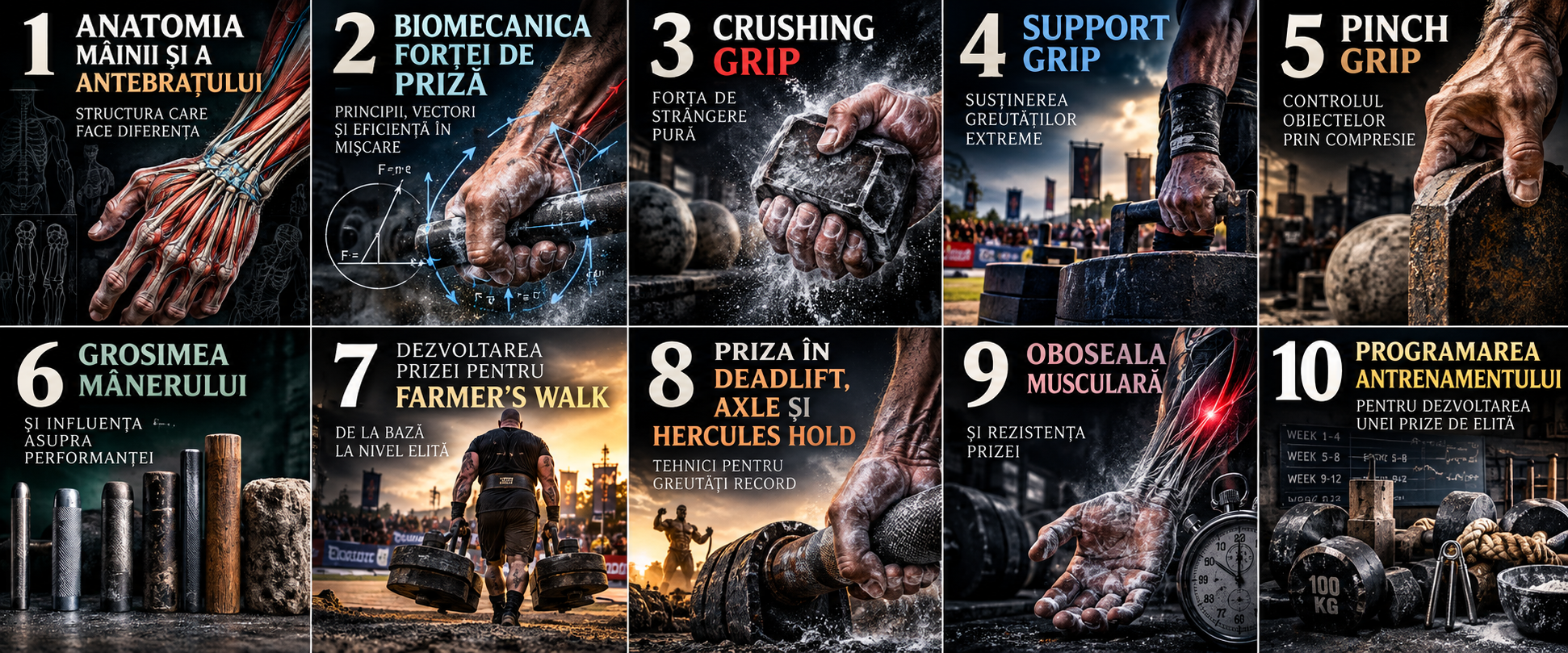
A strongman athlete may carry two exceptionally heavy implements by their conventional handles and, minutes later, discover that two smooth weight plates slip out of the fingers. This is not necessarily a contradiction or evidence that strength has vanished. The tasks use partly different mechanisms. During a carry, the fingers can wrap around and mechanically hook a handle. During plate pinching, the thumb presses the object against the fingers, and stability depends heavily on geometry, normal force and friction at the contact surfaces. This second family of tasks is known as pinch grip.
Pinch grip is not one uniform movement. Clinical testing distinguishes tip pinch, performed between the thumb and index fingertip; palmar pinch, generally using the thumb against the index and middle fingers; and key pinch, which uses the lateral surface of the index finger. Sport introduces other configurations, including plate pinches and block pinches, in which objects may be far wider and heavier than clinical gauges. Results from these tools are not directly interchangeable even though all involve compression between the thumb and other parts of the hand.
Thumb anatomy helps explain the distinction. The carpometacarpal joint permits the thumb to orient toward different surfaces, while the thenar musculature and adductor pollicis contribute to control and force production. The fingers opposing the thumb are not passive: flexors, intrinsic muscles and wrist stabilizers maintain the geometry required for compression. On a block or plates, the position of each contact surface can change which part of the system becomes limiting. Strength on a conventional hand dynamometer does not automatically mean equivalent performance on a very wide block.
Research also supports measuring these abilities as distinct tasks. A systematic review by Szekeres and colleagues, published online in 2024 and appearing in the 2025 volume of Disability and Rehabilitation, included 33 studies and 1,962 participants. Pinch-strength assessment was generally reliable, while evidence regarding responsiveness to change was less consistent. Such findings are valuable for standardizing assessment, but they derive primarily from clinical and general populations rather than extreme plate-pinching events. That is our starting point: use established knowledge of the hand without inventing certainty about elite grip sport.
The Thumb: The Joint That Turns a Hand into a System of Opposition
Thumb anatomy offers a clear demonstration of the difference between a hand capable of squeezing and one capable of manipulating. The first metacarpal meets the trapezium at a complex carpometacarpal joint whose geometry permits motion in multiple planes. The thumb can be oriented toward the index finger, middle finger or surfaces elsewhere across the palm. This mobility does not imply permanent instability: ligaments and muscles help control the joint under loading. Nichols, Oberhofer and Chim emphasized in their 2022 review how central the joint is to opposition and grasp [2]. The sporting implication is straightforward. Pinch performance requires not only strength but placing the thumb where that strength can be transmitted to the object.
Opposition should not be confused with simple flexion. The thumb uses combined movements, and its pressing direction depends on the basal joint, metacarpophalangeal alignment and distal phalanx position. In a tip-pinch test, the thumb tip may meet the index fingertip. In key pinch, it presses against the lateral aspect of the index finger. On a wide block, contact may involve a larger area of the thumb rather than only its distal pad. All qualify as pinch gripping, but the joint configurations in which the muscles generate moments are different. Comparing performance without specifying thumb position is rather like comparing weightlifting attempts performed through different ranges without acknowledging the difference.
Adductor pollicis contributes importantly to bringing the thumb toward the palmar plane and to force production in some forms of pinching. Thenar muscles such as opponens pollicis, abductor pollicis brevis and flexor pollicis brevis participate in orientation and stabilization. Flexor pollicis longus, whose muscle belly is in the forearm, influences flexion at the thumb interphalangeal joint. There is no perfect division into “strength muscles” and “precision muscles”. Recruitment depends on effort direction, object shape and stabilization requirements. In an electromyographic investigation of eight participants, Cooney and colleagues observed the involvement of adductor pollicis, the long flexor and other muscles during pinch and grasp [3]. That describes a coordinated system, not a formula that predicts an athlete's record from one muscle's activity.
During a heavy plate pinch, the thumb may apply substantial normal force to one face of the object, while the opposing fingers must generate complementary contact forces. In simplified mechanics, two surfaces squeezing an object establish the conditions for friction to oppose its weight. In a real hand, contact points are not perfectly symmetrical, and the object's center of mass may introduce rotational moments. The thumb participates in a three-dimensional task, not merely the action of pressing an imaginary button. Placing it too close to an edge may allow the object to rotate; favorable placement can transmit force more effectively.
This distribution helps explain why a strong clinical pinch score does not automatically win a block-pinch competition. In the clinical test, a gauge may be held between thumb pad and one or two fingers without an extremely heavy object being suspended. On a heavy block, joint position, rotational moment, friction and holding time become important. Building one isolated contraction does not guarantee complete transfer. Thumb strength remains fundamental, but performance emerges from its interaction with the object and the rest of the hand.
The Fingers Opposing the Thumb
Simplified explanations sometimes present pinch grip as a test of the thumb alone. That description removes half the mechanical system. To compress an object between two contact regions, both sides must contribute. The index and middle fingers can provide opposition in palmar pinch, while wide plate pinching may also involve the ring and little fingers. Long digital flexors help maintain finger posture, while interossei and lumbricals contribute to joint control. Pinch training therefore does not eliminate forearm involvement and is not merely an exercise for one muscle beside the thumb.
Finger differences affect contact distribution. Index and middle finger lengths, their position relative to the thumb and their effective surface area against a block can alter object stability. Long fingers may cover more surface without necessarily producing greater normal pressure. On a wide pinch, excessive opening may reduce the leverage of some flexors. On a narrow pinch, contact area may become small or uncomfortable. Hand size should therefore be regarded as a relevant mechanical variable rather than a sufficient explanation of performance.
During a maximum lift, digits may have different roles depending on the object. Some contribute compression, others resist rotation, and some help stabilize the hand without exerting their individual maximum. No photograph or subjective sensation can provide precise force percentages for every digit. Such conclusions require pressure sensors, geometric modeling and possibly muscle-activation measurements. Athletes can nevertheless observe how a task changes when two, three or four fingers contact an object, provided other variables remain comparable and painful positions are avoided.
From a programming perspective, the difference between tip pinch and plate pinch justifies separate assessments when both matter. A clinical gauge can monitor compressive force in a standardized configuration; a sporting object reveals the capacity to lift and retain that object. Their scores should not be reported as numerical equivalents. Each test has value when clearly defined and connected to a relevant question.
The Three Clinical Pinches: Tip, Palmar and Key
In tip pinch, the thumb and index finger meet through their distal contact regions. The movement seems intuitive because people frequently use it to handle small objects, but measuring its strength requires an appropriately sized instrument. Fingertip position, wrist angle and how the gauge is held can alter the score. It is especially important that the tester does not inadvertently support the participant's palm and that the athlete does not turn the gesture into a multi-finger squeeze outside the protocol. A value reported without such details may be only broadly informative. In research, tip pinch represents a defined task, not every movement in which thumb and index finger touch.
Palmar pinch, sometimes called the three-jaw chuck, generally involves the thumb compressing an opposing surface formed by the index and middle fingers. This changes contact area and force distribution compared with tip pinch. For some people, involving two fingers allows a higher value, but numerical comparisons depend on the individual and the apparatus. There is no reason to prescribe one fixed ratio between the scores. Palmar pinch is relevant to many manipulation tasks and may inform sport-specific compression, but it does not fully reproduce holding a suspended wide block with substantial rotational demand.
Key pinch, or lateral pinch, resembles holding a key between the thumb and the lateral aspect of the index finger. The force direction and thumb configuration differ from tip pinch. Adductor pollicis may have a prominent role, while basal-joint stability remains important. This demonstrates that pinch describes a family of tasks rather than one muscle. An athlete may score exceptionally well on key pinch without the result precisely predicting a lift involving two smooth plates. Transfer should be tested under relevant conditions.
The systematic review by Szekeres and colleagues [1] supports the general usefulness of pinch-strength assessment and highlights the need for reproducible measurement. The authors found strong associations between pinch and conventional grip measures in some studies, but correlation does not mean identity. Two measures may vary together in a population while describing different biomechanical tasks and without permitting direct conversion from one to the other. Evidence on how reliably tests detect changes over time was less conclusive. Athletes should therefore preserve a consistent protocol and interpret the value relative to its purpose.
A ranking based on a clinical pinch gauge should not be advertised as a universal grip-sport ranking. The instrument was designed to evaluate a defined function, whereas sporting events select different combinations of force, control and contact. That is not a defect in the instrument. The problem arises when asking it to answer a question for which it was not designed. If the question is who can lift more smooth plates, test smooth plates under comparable rules. If the question concerns standardized thumb-compression force, a pinch gauge may be more appropriate.
Friction: The Hidden Component of Plate Pinching
To lift a smooth object through compression, the athlete must create sufficient normal force at the contact surfaces for friction to oppose the object's tendency to slide. A classic representation is F ≤ μN, where μ is the coefficient of friction and N the normal force. In an idealized symmetrical two-surface model, each contact can provide part of the tangential reaction needed to support the weight. A hand is not a rigid metal clamp, however: skin deforms, pressures are uneven and edges can introduce mechanical support. The formula is a conceptual tool, not an exact calculator of an athlete's maximum lift.
That distinction matters when comparing plates. A smooth face and a rough painted one may produce different effective friction, while moisture or deposits can further change the interface. Gripping two plates with smooth faces outward may be different from holding textured faces. Identical mass therefore does not necessarily mean equivalent pinch performance when materials and textures vary considerably. Meaningful comparisons require surface descriptions and ideally standardized implements.
Research by Seo and colleagues on grip surface and maximum pinch force demonstrated that contact material may affect voluntary normal-force production, not only whether an object slips [4]. During testing on surfaces with differing friction, participants produced roughly ten percent greater maximum normal force with higher friction, and force variability decreased under the experimental conditions. This does not permit claiming that changing a strongman's plate texture increases the lift by precisely ten percent. It shows that the sensorimotor system responds to contact and that assessment should control the material.
There is also a psychomotor dimension. An athlete may perceive a surface as insecure and change pressure application before slipping becomes visible. On sensing downward migration of a plate, the athlete might increase compression or change wrist position. Near maximum loading, that correction may come too late. Establishing contact before lifting therefore has practical value. It does not provide a shortcut replacing strength development. Stable technique makes better use of existing capacity, while physiological gains require training.
Center of Mass and Rotational Tendency
Block pinching is not limited to preventing vertical sliding. If the block is grasped away from its center of mass, weight may create a moment around the contact region. The athlete must compensate through pressure redistribution between thumb and fingers or by adjusting object orientation. This may be especially important for blocks longer in one dimension or improvised equipment. Of two blocks with identical mass and width, one may be significantly harder if its center of mass is farther from the grip location.
In standardized testing, dimensions and loading points should be known. If plates are suspended beneath a block on a chain, chain length and load placement can influence oscillation even when total mass is unchanged. If an object is solid and heavy across its length, mass distribution affects rotational inertia and response to disturbance. Such differences do not make one event illegitimate. They mean each task should be described as the actual mechanical system that it is. Comparing records without those details cannot support precise conclusions about hand capacity.
One informative exercise is to compare submaximal holds on two blocks of identical width but different shapes. If one tilts and requires correction, geometry and center of mass may be involved rather than pure compression strength. The observation is not general experimental proof, but it can guide practice. Athletes learn to position the thumb relative to the actual object instead of copying a rule from a photograph. Adaptability has value in a sport using varied materials.
How Important Is Chalk?
Sports chalk may change moisture and contact conditions, but the outcome depends on material. A painted block can behave differently from two smooth cast-iron plates. Thick deposits may affect local feel and pressure distribution. Strongman-specific studies are insufficient to prescribe a universally optimal chalk layer. A reasonable approach uses competition-permitted products consistently and tests the outcome under event-like conditions. Comparisons between sessions should record changes in surface treatment or product use.
More importantly, the immediate influence of an aid should be distinguished from long-term physiological adaptation. If an athlete lifts a heavier plate after applying chalk, the improvement may come from more favorable contact rather than an instant increase in muscular force. The lift can still be competitively valid if the product is allowed. But when evaluating a training program, equipment changes must not be mistaken for physiological development.
Plate Pinch: Two Plates, a Task with Its Own Rules
Plate pinch is perhaps the most recognizable form of pinch grip in strength gyms. The athlete presses two plates together between thumb and fingers and attempts to lift them by their outer faces without using center holes or edges that permit mechanical hooking. The action looks simple, but details fundamentally alter difficulty. Plates may have different overall diameters, thicknesses, painted or smooth surfaces and edges with varying curvature. If an edge allows a phalanx to hook underneath, the test can shift from friction-dominated pinch toward a combination of pinching and supporting. Before records are compared, the permitted contact surfaces should be described.
When plates are arranged with smooth faces outward, the athlete has less opportunity to benefit from pronounced lips or relief that provides mechanical support. Compression and resistance to sliding become more relevant. Yet the expression “smooth faces” does not describe a single material standard. Bare cast iron, smooth paint, chrome-like finishes and rubber coatings have different properties. Even nominally identical plates can show different wear. A claim such as “pinched two twenty-kilogram plates” becomes more informative when the plate model, combined thickness and orientation are specified. Without those details, one can appreciate the effort without converting it into a universal measure of pinch capability.
The plates' outer diameter also changes load stability. A large plate distributes mass differently from a small one. If the assembly begins tilting, rotational moments can change hand contact. Total mass is only one relevant property. The athlete must keep the object sufficiently upright for pressure between thumb and fingers to remain effective. In a unilateral lift, shoulder and trunk positioning may alter the object's path and introduce swinging. Although often presented as a pure thumb-strength test, plate pinch also involves controlling a heavy object in three-dimensional space.
A standardized attempt needs clear success criteria. Is merely breaking the floor enough, or must the athlete reach full extension? Is there a minimum lift height, a prescribed hold time or a referee's command? Can fingers be repositioned after lifting? Must the plates remain together without additional support? Results change with these answers. Training may use several variations, but reporting a record should include the protocol. Otherwise a lift of a few centimeters may be improperly compared with a stable hold at lockout.
From a learning perspective, plate pinching lets athletes observe the relationship between placement and performance directly. Before attempting a very heavy assembly, a submaximal load can reveal whether the plates rotate, whether the thumb presses close to the intended region and whether the other fingers provide stable opposition. These observations are technical hypotheses, not universal rules. Long fingers may favor a different position from a wide palm, and different plates may reverse the apparent advantage. The goal is repeatable, safe contact rather than a magical posture that suits everyone.
Two Plates or Three? Why Width Matters
Adding plates between the contact faces increases the gap between thumb and fingers. This can change the relationship between available muscular force and required joint moments. If an object is too narrow, the digits may meet in a configuration that is unfavorable for that person. If it is excessively wide, thumb and fingers separate until some structures work at a mechanical disadvantage. It is therefore wrong to assume a linear relationship in which every millimeter of width makes the task harder by an exact fixed percentage. The effect depends on anatomy and object shape.
Lifting two identical plates offers a convenient training reference because it is easy to organize. Moving to three plates may increase both thickness and mass. When an athlete switches directly from two to three, both variables change, so the cause of additional difficulty cannot be isolated. Studying width separately requires an adjustable device with mass held constant. Studying absolute force separately requires keeping the pinch span as constant as possible while changing suspended load. Ordinary training cannot control everything perfectly, but it can at least record what changed.
A 2026 study by Huang and colleagues [5] illustrates the relevance of width to climbing pinch tasks. The investigators tested twenty-two advanced climbers on holds of differing widths and reported significant differences in traction forces and muscular activity. The population and task differ from plate pinching in strongman, and neither loading direction nor posture can be directly extrapolated. The study nevertheless demonstrates that pinch width belongs among the variables to be investigated rather than treated as decoration. Very different gaps may measure partly different mechanical demands.
A strong result at a relatively narrow width does not guarantee a proportional result on a much wider one. Conversely, larger hands may offer a relative geometric advantage on broad surfaces. This does not mean “big hands always win”. Muscle strength, thumb orientation, joint stability and friction can offset or amplify geometric advantages. Inter-athlete comparisons are most informative at standardized widths, while individual training may include several widths to prepare for variation between events.
Plate Edges and the Problem of Mechanical Hooking
Some gyms use plates with lips, integrated handholds or shapes that allow the fingers to hook subtly underneath an edge. Such lifting can be useful for practicing object control, but it changes the test. If the phalanges support part of the mass through an underside lip, some load is carried mechanically rather than through friction alone. The object may be easier to lift than one with flat faces and edges that cannot be hooked. Training need not prohibit every variation, but records should distinguish methods to avoid unfair comparisons.
This distinction resembles carrying a bag by its handle versus compressing it between palm and fingers. The object's mass can be identical while the mechanical demands on the hand differ. Coaches seeking to develop pinching should check whether the chosen exercise truly challenges compression. If an object can be hooked easily, lifting performance may improve without equivalent growth in pinch capacity. That progression is not worthless; it measures a different task.
Real strongman implements need not meet the idealized standard of a laboratory tool. Some competition objects have irregular shapes, edges and finishes that permit several legal strategies. Event performance depends on using what rules allow. If an edge may legally be used, it becomes part of technique. The distinction between sporting preparation and measurement of an isolated capacity should remain clear. An athlete may perform competitively by exploiting a legal contact surface, while a researcher may require strictly defined faces to measure pinch force.
Block Pinch: Why a Rectangular Object Becomes a Sophisticated Test
Block pinch uses an object with two opposing surfaces broad enough to be compressed between thumb and fingers. It may involve wood, metal or purpose-built equipment with a suspended load. Compared with plates, a block often permits more precise control of width and surface angles. Yet a block is not automatically standardized just because its faces are flat. Their dimensions, thickness, texture, material, center of mass and loading attachment all matter. Two nominally sixty-millimeter blocks may produce different results if one has grippy paint and the other polished metal, even with equal mass.
Blocks can partly remove the advantage of plate edges when their design prevents hooking fingers underneath. They can therefore challenge the capacity to maintain compression between contact surfaces more directly. Very small blocks may create different problems by limiting contact area, while very tall blocks may offer several hand-placement options. An instrument designed for measurement should deliberately reduce ambiguity. For sport preparation, variability may be beneficial; for testing, it is often measurement error. One piece of equipment need not perfectly serve both objectives.
When a load hangs beneath the block on a chain, mass creates vertical demand, and the hand compresses the surfaces to prevent sliding. A long chain can permit oscillation at lift-off. An eccentric attachment point can create rotation. Rapid lifting may temporarily change the required forces through acceleration. A block-pinch lift is therefore not identical to producing an isometric squeeze against a piece of wood fixed in space. The first requires suspension and stabilization; the second involves compression against a supported structure.
One useful approach keeps the same block across consecutive testing periods and modifies only the external load while preserving success criteria. That permits observation of whether heavier masses can be lifted under comparable conditions. Another approach keeps mass constant but changes width to explore adaptation to different postures. These methods answer different questions and should not be treated as the same test. If width increases and performance falls, that does not automatically indicate loss of strength. The configuration in which force must be generated has changed.
Optimal Width Is Not the Same for Everyone
Before discussing the “best block width”, we must define best. If the goal is maximizing a test value, the optimal gap may be the one where an individual achieves favorable balance between muscular output and leverage. If the goal is adaptability for variable competition objects, practicing multiple widths may be useful. If the objective is comparing athletes, one fixed width may be necessary even though it relatively favors some anatomies. These aims are not contradictory; they apply different standards of usefulness.
An ergonomic study published in 2025 investigated maximum pinch force on concave and convex surfaces across three-, five- and seven-centimeter spans and found that geometry and width can influence strength and perceived usability [6]. It did not necessarily involve strongman blocks under extreme loads, so it cannot justify prescribing one width for every competitor. Its relevance is demonstrating a variable often ignored when people discuss records. Changing curvature and span changes the task. A clean methodology needs to describe both.
Huang and colleagues' study of advanced climbers [5] also shows that pinch width influences how forces are transmitted during climbing holds. The effect cannot be reduced to “narrower is always easier”. Different holds produced different outcomes according to the tested geometry and task. Those values cannot be directly transferred to a suspended strongman block, but the general observation remains: anatomy and contact configuration determine what force is available and how effectively it can be transmitted. Width should be considered in relation to the task rather than in isolation.
A rational sporting approach may use one reference block and one or two additional widths when equipment is available. A large collection is unnecessary. The reference tool supports longitudinal comparison, and variations provide complementary exposure. Testing a different width every week makes progress hard to interpret. Never changing surfaces may produce exceptional performance on one narrowly defined task while leaving the athlete unfamiliar with other geometries. Effective programming balances specificity with adaptability.
Flat, Concave and Convex Surfaces
The expression block pinch also hides surface curvature. A perfectly flat block creates one type of contact; slightly concave faces may guide digit position; convex surfaces may reduce or redistribute effective contact area. Skin conforms to shape, and local pressures change. A convex object may require precise positioning to avoid rotation and sliding, whereas concavity may create supplementary mechanical support. These are plausible biomechanical explanations, but the size of the effects must be measured under specific conditions rather than guessed from sensation.
Training with blocks therefore cannot be summarized by width and kilograms alone. A useful log records the model, material and face geometry. If competition rules specify an exact block, that becomes the reference for specific preparation. General training may use several shapes to broaden experience, but progress on one does not automatically transfer to another. Adaptable hands may have advantages with unfamiliar objects without proving one training method universally superior.
Building a Comparable Block Attempt
A reproducible block-pinch assessment needs defined starting and ending conditions. It might require fully clearing the floor, reaching a stable standing position or holding for a specified time. The criterion changes what is measured: very short lifts emphasize rapid establishment of contact, while prolonged holds add local endurance. Whatever the choice, later assessments should use the same rules. The working hand, permitted position of the other hand and whether repositioning is allowed should also be specified.
Loading can progress gradually without requiring a maximum test in every session. When a maximal lift is the goal, hard attempts may be separated from technical practice and volume accumulation. When the goal is duration, moderate loading may permit repeatable holds. In both cases, exercise should stop if sharp pain develops or loss of control creates a hazard. A heavy object suspended only through pinch can fall abruptly; the working area and foot position should allow safe release.
Hub Lift: Why the Center of a Plate Is Another Event
Hub lifting uses the raised center portion of a weight plate or purpose-built equipment reproducing that shape. The athlete grasps the hub with thumb and fingers and attempts to raise the load. Although usually placed within pinch-grip events, its mechanics differ from compression between parallel faces. The hub may be cylindrical, tapered, shallow or tall enough to offer substantial contact. If fingers can hook an edge, mechanical support enters the task. With a smooth, shallow surface, compression and resistance to slipping become more important. A common exercise name does not guarantee equivalent difficulty.
During a hub lift, forces may act radially around the object, and digits do not necessarily press on just one face directly opposing the thumb. The shape can permit circular contact with multiple pressure points. This is one reason a block-pinch score cannot be directly converted into a hub score. A wide block demands compression between parallel surfaces, while a small hub may require narrower thumb–finger geometry and another pressure distribution. Overlapping muscular capacity matters, but geometry changes how it can be used.
Assessment should record hub diameter, height, profile, material and surface condition. Total load and any suspended loading attachment should also be specified. A small metal hub and a large Olympic plate grabbed by the center may have different rotational behavior. Rankings that combine different models can therefore mislead. Grip-sport records are often tied to particular implement models precisely because construction differences matter. When a competition defines equipment, comparison becomes more meaningful.
Hub lifts can develop a gripping quality insufficiently challenged by conventional bars. The objective need not be an arbitrary commercial benchmark, however. Standard plate weights and hub designs vary. Rational progression uses consistent equipment and pays attention to hand condition. Attempts should allow plates to be returned or dropped safely without striking the feet. The less secure the contact, the more important a controlled release becomes.
Blob: The Object That Refuses Convenient Geometry
In grip-sport culture, Blob refers to heavy rounded objects historically associated with certain dumbbell heads, or purpose-built replicas. Unlike parallel-sided blocks, blobs generally have curved surfaces and mass distributions that substantially alter contact. The thumb and fingers apply force to regions that are not perfectly parallel, while the object may rotate at lift-off. Blob performance is not simply block pinch under another name.
Curvature may limit how much of the phalanges can make useful contact. Certain fingers may contribute more than others, and thumb position may be difficult to standardize across different hand sizes. Rounded implements can behave unpredictably when leaving the ground, especially when the center of mass is not aligned with the contact region. A small rotation can rapidly change pressure points. Experience with the exact model may matter greatly, and its result should not be used to rank every athlete's universal thumb strength.
Blob lifts can expose athletes to complex surfaces and develop adaptability, but that does not mean beginners should immediately attempt extreme loads. When control is poor, reducing mass and practicing on a more stable object is sensible. Equipment should be checked for sharp edges or damage to skin. The event deserves recognition as its own sporting skill rather than the ultimate measure of all pinch strength. Hands familiar with flat surfaces may need time to adapt to curvature and rotation.
Two-Hand Pinch: How Bilateral Work Changes the System
A two-hand pinch lift uses both hands to compress an implement of defined width with added loading. Compared with unilateral pinching, the task requires coordination between hands, load sharing and maintaining object stability. Bilateral scores cannot be assumed to be exactly twice unilateral scores. Available force in each hand, arm posture, object shape and timing of compression all affect the result. One hand might contribute more without that asymmetry being visible in the total mass lifted.
Grip-sport communities use adjustable equipment, sometimes informally described as Euro Pinch or two-hand pinch devices, to provide repeatable width and progressive loading. Exact specifications and rules vary by organization and event, so an arbitrary dimension should not be presented as a universal standard. Meaningful comparison should identify model, width, texture and lifting criteria. Some rules require a particular lift height or restrict contact points. Official performance means completing the attempt under that event's rules rather than merely clearing the ground with a weight.
Bilateral loading permits load distribution but introduces synchronization requirements. If one hand slips or presses eccentrically, the device may tilt, forcing the other hand to compensate. Preparation therefore includes trajectory and body-position control, not only maximum compression. Some athletes may feel stronger bilaterally, while others encounter surprising coordination difficulties. Without measuring forces from each hand separately, one total result cannot identify the exact mechanism.
Two-hand pinch can be particularly relevant to competitors preparing for grip-sport events. For a strongman athlete whose competitions mainly involve conventional handles, it may develop a neglected local quality, but transfer to the actual events must still be tested. Replacing all specific carries and holds with bilateral pinching because the numbers look impressive would be poor programming. Different tasks deserve different tools based on observed limitations and explicit objectives.
Variations Are Not Rivals
Plate pinch, block pinch, hub lifting, blobs and two-hand pinch all require thumb participation, but their geometries and object-control demands differ. One variation permits progressive loading at fixed width, another familiarizes athletes with rounded surfaces, and another emphasizes bilateral coordination. No evidence establishes one device as universally superior for every form of pinching and every athlete. Programming begins by defining the aim: compression in a standardized posture, preparation for competition on a specified implement or adaptability to unfamiliar objects.
The important lesson is to judge the task rather than the prestige of equipment names. Sophisticated implements may be valuable for measurement, yet ordinary plates can provide meaningful training. Conversely, unspecified plates cannot support rigorous inter-athlete comparisons. Methods should be selected according to the question being addressed, available equipment and the hand's tolerance of loading.
From Pressure to Control: What the Nervous System Perceives
Pinch grip appears static when an object stays at the same height, but the nervous system continues to monitor contact. Thumb and finger skin contains receptors sensitive to deformation, pressure and relative movement. When a block begins slipping, tactile information can contribute to force adjustments as long as sufficient muscular reserve remains. Johansson and Westling investigated grip-force regulation in precision-handling tasks [7]. Their findings do not provide a direct numerical model for maximal plate pinching, but they demonstrate that touch and motor control operate together. Force is not distributed blindly; the system attempts to match the object.
With moderate loading, an athlete may sense that the thumb needs more pressure or that the index finger is badly positioned. A small adjustment can stabilize the implement. Under near-maximum loading, repositioning becomes more difficult because the hand is already highly stressed. Initial preparation therefore matters. Identifying contact areas, distributing pressure and gradually establishing tension can reduce the likelihood of beginning an attempt with an unstable grip. That does not imply wasting excessive setup time. Practice can make reliable preparation both faster and more consistent.
Anticipation also contributes. Repeated exposure to one block may provide a working representation of its behavior and required force. Such learning helps explain some rapid early improvements. Not all initial gains reflect growth of thenar muscles or thickening of tendons. Athletes may learn to use existing capacity more efficiently. Technique cannot replace strength forever, however: as mass exceeds the muscular capacity available in the relevant geometry, physiological development becomes necessary.
Consider a change from a painted block to a smooth one. Initially, an athlete may apply pressure poorly, then learn to establish more secure contact. Improvement after several tries does not automatically indicate new muscular force. Equally, a lower result on the first day with unfamiliar material does not prove regression. Interpretation should include sensorimotor learning, surface conditions and recovery status. Professional programming therefore preserves stable reference tests while introducing variations deliberately.
Isometric Pinching and the Limits of Perfusion
During a block pinch maintained at a fixed height, muscles sustain nearly continuous tension. Contraction requires energy and neural activation. At high relative intensities, intramuscular pressure may influence local blood flow. These mechanisms are recognized in general sustained-contraction physiology, but research is insufficient to describe the precise perfusion of every thenar muscle during an extreme competition lift. This distinction matters: we cannot claim that a given percentage of blood circulation stops at a particular sport load. We can state that time to failure is influenced by relative intensity and by the tissues' ability to sustain tension.
During a brief maximal lift, the immediate limitation may be the inability to produce enough force to clear the floor. During a prolonged hold, adequate initial compression may gradually become insufficient. This explains why a maximum lifted mass and maximum holding duration are not identical records. Exercises can develop partly different qualities, and selection should reflect the intended event. If the goal requires only lifting a block to a specified height, a one-minute hold at much lower loading may be a useful accessory but not a replica of the event.
Fatigue cannot be adequately explained as “lactic acid in the thumb”. Sustained contraction involves interacting peripheral and neural mechanisms, and local burning does not precisely measure remaining capacity. An athlete may lose an object without major discomfort when friction is insufficient. Another may experience substantial congestion while still retaining mechanical control. Exercise effectiveness should therefore be judged by the ability to lift and hold under defined conditions rather than by how intensely the muscles burn. Subjective experience is information, but it is not a substitute for performance measurement.
Recovery between attempts matters because available muscular capacity changes throughout a session. Repeating hard efforts with very short pauses can produce a decline that is temporary rather than evidence of lost long-term strength. Record testing should allow enough recovery to avoid comparing efforts under radically different fatigue states. Training for repeated work capacity may deliberately use shorter rests, but it addresses another quality. Testing maximum capacity and developing training volume are compatible, not identical, goals.
Maximum Force and Rate of Force Development
In plate pinching, an athlete must establish contact before or as the object leaves the floor. Pulling abruptly before the thumb and fingers have created adequate compression can cause sliding. The timing of force generation relative to lift-off therefore matters. This does not mean the lift must always be exceptionally slow. It means compression and acceleration must be coordinated: sufficiently fast for the task but controlled enough to retain contact. Experienced athletes may automate this preparation.
Maximum force and the rate at which it develops overlap but are distinct qualities. One individual may reach a high compression level after several seconds, while another generates a substantial fraction of capacity very quickly. Events requiring immediate object lift may reward rapid establishment of tension. Events permitting longer setup may place more emphasis on final maximum force. Ordinary video cannot reveal an exact thumb force–time curve. Specialized sensors and a clear analytical protocol would be needed.
Preparation may involve practicing contact on submaximal loads and gradually increasing intended acceleration without uncontrolled jerking. That does not justify abruptly imposing extreme forces on thumb joints. The thumb contains small structures that require progressive loading, and a lost object may land on a foot. Competitive effectiveness does not override safety. Technical refinement means maintaining control of the task rather than turning every attempt into an unpredictable event.
Why Feedback Can Fail at Maximum Load
An important distinction exists between detecting slipping and successfully correcting it. Tactile receptors may signal changes in contact, but correction still requires available muscle force and enough time. At a very high relative intensity, the athlete may already be applying close to the maximum possible compression. The nervous system can detect sliding while the hand lacks reserve to prevent it. This explains why experience can reduce some errors without making every extreme attempt successful.
During a moderate load, however, anticipation and careful force regulation may prevent needless fatigue. Applying much more compression than required could consume resources during prolonged holds. Applying too little risks losing the object. Efficient control seeks a safety margin appropriate to the task. The optimal margin cannot be inferred from one universal percentage because friction, object geometry and individual physiology differ. Repeated exposure teaches a useful calibration, especially under conditions that resemble competition.
Training Maximum Pinch Strength
Pinch-grip training should begin with the question the athlete wants to answer. If the objective is lifting the greatest possible load on a block of fixed width, preparation needs progressively demanding attempts in that configuration. If the objective is holding two plates for an extended period, duration becomes a central variable. If a competitor expects unfamiliar surfaces, practice across several geometries may be useful. These goals all belong to the pinch family, but they do not require identical programming. Specificity means reproducing the measurable target closely enough while still developing relevant general capacities.
For maximum force, relatively short, demanding efforts allow the athlete to practice high compression. But if every attempt ends with a dropped implement, technique may deteriorate and local tissues may accumulate substantial stress. A rational plan can include heavy attempts after warming up, supported by submaximal work sufficiently controlled to preserve hand configuration. The exact number of sets and duration depend on experience, thumb condition and overlapping exercises within the week. General resistance-training guidance, such as the ACSM progression position stand [8], offers loading principles but does not validate one universal elite block-pinch protocol.
A programming mistake is increasing mass, width and duration simultaneously. When the new attempt fails, the athlete cannot readily identify which variable contributed most. Changing width may also impose different stresses around the thumb basal joint despite only a small increase in external mass. It is more useful to keep one reference block, progress its load gradually and train other widths separately. This approach does not remove every physiological interaction, but it improves interpretation and reduces the chance of turning training into a series of arbitrary challenges.
Maximum-force testing should allow enough rest to maintain effort quality. When the goal is repeated work capacity, shorter rests may be introduced intentionally. Confusing the two produces misleading conclusions: an athlete lifting less on the fifth attempt has not necessarily lost long-term strength, but may simply be fatigued. Logs including rest, load and success rules support fairer comparisons. Genuine progress is easier to detect when fundamental testing conditions do not change every week.
Pinch Endurance and Time Under Tension
Not every pinch event consists of one brief maximum lift. Some drills require holding an object for a prescribed duration, while others involve carrying it. Under those conditions, compression between thumb and fingers must persist as local fatigue develops and the object threatens to slip. A block that an athlete can lift once may become impossible to maintain after several closely spaced attempts. This does not necessarily represent a reduction in baseline maximum strength. It may reflect accumulating fatigue and the fact that duration is a distinct task demand.
A twenty-second hold at moderate intensity is not equivalent to a five-second effort near maximum. Relative intensity alters energetic, mechanical and control demands. Programs may include both when justified, but should not label every hold simply as “endurance” without regard to load. Recording mass together with duration, width and surface offers a basic monitoring system. Improving from twenty to thirty seconds under identical conditions is relevant to that test without proving a specific change in muscle capillarization or tendon stiffness.
Many athletes are tempted to take every set to failure because the implement can be released easily. This may increase local fatigue and impair later attempts. Planned holds ending before loss of control can provide meaningful practice and allow greater consistency. Occasional tests to failure may help assessment, but should not be mistaken for the whole development process. Competitors also preparing deadlift, farmer's walk or Hercules hold need to consider the combined stress on forearm structures. Additional thumb work is not useful when it systematically undermines events with higher priority.
Isometrics, Repetitions and Range Control
Most block-pinch exercises are largely isometric at the contact interface: the athlete develops pressure and keeps fingers in a relatively stable configuration while lifting. Not all variations are identical, however. Compressing an object that remains externally supported creates a different task from suspending it against gravity. Repeatedly lifting from the floor introduces phases of force application, retention and reduction. Exercise selection should follow purpose, and their performances should not be merged into one ranking.
Compression movements against adjustable equipment provide another variation, but only when transmitted force can be sufficiently measured or controlled. A machine displaying a value is not automatically comparable to a suspended block. In a fixed device, the user may exert pressure without maintaining an object against gravity. During block pinching, friction and rotational control can determine success. One test can therefore improve without identical progress in the other. Overlapping muscles do not make the mechanical tasks interchangeable.
Balanced training may use technical repetitions with lighter loads, moderate-intensity holds and periodic heavier exposures. What a general article cannot legitimately establish is one universal set prescription guaranteeing records for every athlete. A beginner whose thumb has never faced heavy pinch demands and an advanced competitor have very different loading histories. Progression should respect that difference and monitor for abnormal symptoms.
Why Training Dose Is More Than Kilograms
External mass is only part of pinch-training dose. Width, contact material, object curvature, duration, repetition count, total weekly frequency and existing forearm workload all matter. A small change in one factor may substantially increase stress on a particular joint configuration. Thus a “lighter” session on a very wide, slippery block may be highly demanding for the thumb even though the weight is modest. Judging every workout by kilograms alone can lead to poor programming.
Training logs need not become burdensome spreadsheets. A few consistent fields usually provide enough context: implement identity, width, load, duration or repetition count, chalk conditions and observed mode of failure. Repeatedly measuring these variables makes changes easier to interpret. If the same block feels unexpectedly difficult, the athlete can consider fatigue and surface conditions before deciding the program has stopped working. Reliable observations are more useful than impressive numbers without context.
Periodization Without Pretending to Have an Elite Formula
A development phase can emphasize high-quality practice and progressively greater work capacity. A later phase can give more time to heavy competition-specific attempts. Before a formal test, reducing accumulated fatigue may allow the athlete to demonstrate current capacity more accurately. This resembles general resistance-training periodization, but there is not enough direct research to prescribe one ideal calendar for every elite pinch competitor.
The important principle is continuity rather than rigid ritual. Improvements may be fast during early familiarization and slower as the athlete approaches the present limit. A plateau lasting several sessions is not proof of an immutable genetic ceiling. It may reflect fatigue, a gap between available equipment levels or a mismatch between practice and the target task. Changes should be deliberate enough that their effects can be evaluated.
From Pinch Grip to Strongman: Transfer Must Be Demonstrated
Strongman athletes use their thumbs during most activities involving an object, but that does not mean every event depends equally on pinch grip. In farmer's walk, fingers can wrap around a cylinder and provide mechanical support. In deadlifting, the bar is retained against gravity, and methods such as mixed grip or hook grip change the locking mechanism. During plate pinch, the thumb contributes directly to compression, allowing friction to oppose sliding. Shared finger-flexor involvement does not eliminate differences in geometry and control. An athlete can therefore set extraordinary carrying records while posting modest plate-pinch results.
Transfer should not be considered zero either. Developing muscles that participate in multiple tasks may provide additional reserve, while thumb stability may matter when handling unusual objects. The relevant question concerns how much improvement in one test appears in another. To answer it, performance on the competitive implement must be monitored alongside the block-pinch result. If an athlete improves block pinch without changing farmer's walk time or distance, this does not prove that training was pointless. It may indicate that pinching was not the limiting factor in carrying.
During loading medleys, some objects lack convenient handles, forcing rapid decisions about grasping. Sandbags, stones, kegs and metal objects do not automatically require pure pinching, but some surfaces may demand local thumb compression. If an object can be hugged or supported against the arms, another mechanism may dominate. Block-pinch performance therefore cannot directly predict sandbag loading. It may develop a complementary ability, while whole-event performance still depends on technique, whole-body strength and actual contact with the object.
Athletes sometimes search for the one grip exercise with maximum transfer to every event. That desire is understandable, but no such universal exercise has been established. Preparing for competitions featuring axle, farmer's walk and a pinch event requires a different mixture from preparing only for strapped deadlifts. Athletes need not maximize every grip quality simultaneously. They should develop the capacities most likely to limit priority events and distribute remaining training resources across the rest of performance.
Climbing: A Useful Laboratory, Not a Replica of Strongman
Climbers frequently use narrow, broad and rounded holds, generating research on finger mechanics. Huang and colleagues' study in the 2026 volume of Journal of Sports Sciences [5] found that pinch width affected traction forces and muscular activity in the upper body. Such literature is useful because it directly measures aspects of contact that are often missing from strongman research. Yet climbers support part of their own body mass in positions involving complex traction, whereas a strongman block pinch may suspend an external load beneath an object. The percentages from a climbing study cannot be transferred as though the tasks were identical.
Climbing also offers lessons about the relationship among digits, skin and material. Surface properties can determine whether contact remains stable even when muscles are strong enough. But climbing holds and metal plates can use substantially different materials. Wall texture, moisture and pressing against a vertical surface may differ from lifting a suspended weight. Sound scientific reasoning identifies a shared mechanism while preserving contextual distinctions. In that way, research from another sport becomes a source of ideas rather than unquestionable authority over strongman programming.
Climbing also includes crimp and open-hand grips that should not be confused with pinching. A crimp can place fingers into strongly flexed configurations stressing particular structures, with a different role for the thumb. An open-hand grip uses another arrangement of phalanges. Their coexistence in one sport does not make adaptations completely interchangeable. For research and coaching, classifying tasks by geometry and force direction is more useful than categorizing everything according to the sport's general name.
Three Scenarios That Change Coaching Decisions
First, imagine an athlete who can lift two smooth fifteen-kilogram plates but cannot lift a block with the same total mass. A premature conclusion would be that the results contradict one another. In fact, the plates and block may have different widths, materials and mass distributions. The athlete should compare surfaces and contact positions before changing the program. If the block is much wider, the weaker result may reflect different leverage rather than lost strength. If the block rotates, object stability may be involved. The observation generates hypotheses rather than diagnoses.
Second, an athlete improves key-pinch strength but remains at the same plate-pinch load. This need not mean training failed. Key pinch uses a lateral thumb configuration, while plate pinch can involve broad surfaces and a larger gap between digits. Improvement may be specific. If plate pinching is the intended sport event, the coach should examine how often it is actually practiced and which phase limits performance. If the objective is improved clinically measured lateral pinch strength, the result may represent complete success.
Third, a strongman finishes farmer's walk without difficulty but loses an irregular object during a medley. Before prescribing hundreds of gripper closes or a maximal block-pinch cycle, the coach should examine whether the object could have been grasped differently, whether the surface was slippery and whether positioning was the real limit. The athlete may need specific practice on that object, more local strength or a different lifting strategy. A good intervention addresses a documented limitation rather than an exercise trend.
Competition Context: Decision Time Is Part of the Task
During timed competition, athletes cannot spend several minutes inspecting every object. They must choose a hand position rapidly, establish pressure and complete the lift. This speed may improve through experience with a family of objects, without turning every training day into chaotic attempts on uncontrolled weights. Technical drills with moderate loads can improve recognition of useful positions. At very high loading, control and safety remain priorities.
Accumulated fatigue is another variable. Fingers and thumbs may already have been stressed by carries, deadlifts or sandbag handling. A fully rested block-pinch record does not perfectly predict an event scheduled fifth in a competition. Some limited practice after other exercises may be justified when the intended competition demands it, without simulating an entire meet every session. Context specificity must be balanced with recovery according to the actual calendar.
Why the Strongest Thumb Does Not Necessarily Win
A sport event produces one final outcome from several interacting capacities. A competitor may have exceptional isolated thumb compression but poor ability to stabilize a rotating object. Another may have only moderate laboratory pinch scores but better technique and favorable hand dimensions on a particular implement. A third might be physically capable of a large attempt yet arrive fatigued after preceding events. The winner is determined by the entire task under actual rules, not by one isolated anatomical measure.
This does not make laboratory assessment irrelevant. Standardized testing helps track qualities that are difficult to isolate during competition. The mistake is treating a test as a complete description of sporting ability. Measurement should inform decisions, and those decisions should be checked against the actual event result.
The Carpometacarpal Joint: Mobility That Requires Stability
The base of the thumb combines remarkable mobility with the need to transmit substantial forces. The carpometacarpal joint, located between the first metacarpal and trapezium, is often described as a saddle-shaped articulation. Its geometry permits opposition while relying on ligamentous and muscular stabilization under pressure. During heavy plate pinching, the result depends not only on the muscles that press the thumb toward the object. It also depends on preserving a stable relationship among bones and joints as the object tries to slide or rotate. The 2022 review of this articulation [2] explains why stability belongs at the center of hand function rather than being treated as a minor detail.
Forcing an excessively mobile position is not proof of superior strength. When an athlete tries to grasp a block too wide for their present configuration and moves into painful joint alignment, tolerance may become limiting before the muscles are exhausted. This does not mean every discomfort indicates disease or that challenging widths should be avoided entirely. It means progression should account for actual thumb position, individual loading history and response to effort. A load tolerated well in one configuration is not necessarily equally tolerable in another.
Metacarpophalangeal position also influences transmission of force. If the thumb bends or extends excessively in an uncontrolled way, contact shifts and leverage changes. Athletes should not attempt to rigidly lock every joint; the hand requires some adaptability to fit objects. Yet a controlled, repeatable configuration supports performance and makes improvement easier to interpret. If technique deteriorates between attempts, merely adding weight may create a larger problem than the one training was supposed to solve.
Thumb Tendons and the Pace of Adaptation
Muscles generate tension, and tendons transmit it to bony segments. Flexor pollicis longus and other musculotendinous structures involved in thumb motion and stabilization may experience high demands during pinching. Tendinous tissue can adapt to mechanical loading, but the process does not necessarily unfold at the same pace as rapid motor-learning improvements. Bohm, Mersmann and Arampatzis' 2015 systematic review [9] provides general evidence on human tendon adaptation to exercise. It is not a trial comparing plate-pinch programs in elite grip competitors. That limitation matters when prescribing aggressive loading.
Early gains can occur because an athlete learns thumb placement, reduces oscillation and establishes compression before lift-off. Those gains cannot demonstrate that tendons have instantly become dramatically thicker or stiffer. Abruptly increasing mass, frequency and number of maximum attempts can create stress exceeding local tissue tolerance. Coherent preparation therefore progresses gradually enough to observe how the hand responds. Today's record is valuable, but a training plan should preserve the ability to continue next month.
Symptoms near the thumb base or thenar region can have different causes. Not every pain should be automatically labeled tendinitis, and sensations of local tension do not prove beneficial adaptation. Persistent focal pain, inflammation, locking or loss of function warrant clinical assessment rather than completing a program at any cost. Athletes with previous injuries require individualized planning with an appropriate clinician. General training science provides progression principles but cannot substitute for examining a symptomatic joint.
Thumb Skin and Superficial Tissue Injury
During pinch exercises, pressure may concentrate on the thumb pad and relatively small areas of the opposing digits. Highly abrasive or repeatedly slipping surfaces can irritate skin and produce superficial injury. Calluses may develop in response to repeated contact, but they do not provide unlimited protection from tears. Local skin management is therefore not merely cosmetic. It helps maintain an interface capable of transmitting force throughout the sporting season. Damaging the hand for a marginal record may cost several productive training sessions.
Competition surfaces can be rougher or smoother than gym equipment. Gradual familiarization may improve tolerance, but cannot make skin immune to every condition. Chalk can alter contact without eliminating abrasion risk or replacing technique. When an object suddenly slips, attempting to save it through uncontrolled contraction may worsen local trauma. A clear drop zone allows safe release without endangering feet or nearby people. Equipment positioning and release planning belong within training quality.
Pain Is Not a Training Method
Predictable muscular effort discomfort differs from sharp joint pain, numbness or sudden loss of strength. These symptoms have different possible meanings and warrant assessment when severe, persistent or accompanied by functional changes. Strength-sport culture sometimes treats every painful signal as proof that tissue is “getting tougher”. That claim is unsupported. Adaptation cannot be inferred from pain, while ignoring new symptoms can interrupt preparation for much longer than timely evaluation might have required.
Good programming includes the possibility of reducing load when the tissue response makes it necessary. This does not mean abandoning an objective or avoiding every challenging effort. It means sporting progress is measured over months and years, not simply by one day's heaviest lift. The hand contains numerous small structures whose coordination makes pinching possible. Preserving their function is a prerequisite for performance, not an obstacle.
Why Fatigue and Injury Must Be Distinguished
A demanding pinch session can temporarily reduce force and make familiar objects harder to hold. That is not automatically injury. Acute fatigue may recover with suitable rest and unloading. By contrast, new focal pain, swelling, altered sensation or inability to move a digit normally deserves a different interpretation. Treating both situations identically can lead either to unnecessary alarm or to reckless continued loading. Evaluation should consider onset, location, associated symptoms and changes in function.
No self-assessment based on this article can establish the exact diagnosis of a thumb or finger problem. An athlete might suspect that a joint, tendon or nerve is involved, but confirming the mechanism may require clinical testing. Strongman training demands high forces, making appropriate professional assessment especially important when symptoms persist. It is possible to respect the discipline's demanding nature without treating the body as disposable.
Safety Includes the Entire Environment
Pinch objects often appear small compared with strongman implements, but a twenty- or thirty-kilogram block dropped from hand height can still cause injury. Athletes should avoid positioning feet directly beneath a suspended object and keep bystanders outside the potential drop area. Suspended loading pins, chains and attachments should be checked before heavy attempts. If a plate assembly begins separating, attempting to catch it with bare fingers can create additional hazards. A reliable setup allows abandonment without emergency improvisation.
Competition rules may specify where and how an implement is dropped. Training can reproduce legal procedures while prioritizing physical safety. A successful performance should not depend on risking the feet, damaging flooring or forcing a fatigued hand to catch a falling object. Attention to these details makes heavy pinching more repeatable and protects everyone sharing the training space.
Measuring Pinch Grip Without Mistaking a Changed Test for Progress
Good assessment begins by selecting a precise question. To evaluate thumb-compression force clinically, use an appropriate pinch dynamometer and standardized protocol. To assess a plate-pinch record, identify the plates, their orientation and the required lift height. To assess block pinching, document equipment, width, surface and loading. These tests are not rivals; they describe partly different properties. A score without the conditions in which it was obtained may be impressive but is insufficient for rigorous comparison or interpretation of a program.
In clinical evaluation, trunk, shoulder, elbow and wrist positions should follow the chosen protocol. Equipment should remain in a repeatable configuration, with defined numbers of attempts and rest intervals. The reported result could be the maximum, an average or another statistic, but the choice must be specified. The systematic review by Szekeres and colleagues [1] found good evidence regarding the reliability of pinch strength measures, though not every measurement property was equally well established. Small changes therefore deserve careful interpretation. A few extra units do not prove biological improvement when the test was administered differently.
Sports standardization can begin with a simple log. Block-pinch records should include width, total mass, surface type, hand used and success criteria. A load lifted to knee height is not the same performance as one barely clearing the floor. If the first attempt used chalk and the second a damp surface, contact conditions can affect the outcome. When the equipment changes, a new measurement series may be needed or at least a documented adjustment. Methodological discipline is not unnecessary rigidity; it protects the meaning of numbers.
Bilateral assessment is more complex. A two-hand lift may conceal substantial differences between left and right. Athletes interested in asymmetry also need unilateral measures. However, bilateral performance should not be assumed to equal the exact sum of unilateral maxima. Arm posture and coordination change the task. A stable difference between hands is not necessarily a medical or sporting problem. A new difference accompanied by pain or loss of function may have another significance and warrants assessment.
Testing frequency matters too. Excessively frequent maximum attempts can introduce fatigue that alters precisely the quality we want to measure. Testing too rarely may deprive coaches of useful information. A reasonable approach uses a small set of stable reference measures and checks progress periodically, rather than turning each session into a maximum examination. The interval depends on level, competition calendar and device demands. No universally proven interval exists for elite plate-pinch athletes.
What Does a Five-Kilogram Improvement Mean?
Suppose an athlete lifts twenty-five kilograms on a block and, several weeks later, lifts thirty kilograms. The numerical result is higher. To conclude that the athlete's pinch capacity improved under comparable conditions, however, width, texture, suspended load and success criteria must be examined. A grippier block can produce part of the advantage. Greater familiarity may improve coordination. Better rest can reduce fatigue. Total sporting performance may have improved, but the exact physiological mechanism cannot be derived from two numbers alone.
These distinctions matter even more when comparing historical records or videos online. One person may use smooth-faced plates, another a painted block, and a third a hub with a substantial edge. Without identifying the implement, direct comparison is unjustified. A photograph cannot calculate the thumb's normal force, and video cannot reveal individual tendon tensions. Technology may help identify joint angles and gross object movement, but should not be represented as a force sensor when it does not measure forces.
A good test need not be the heaviest possible. A moderately demanding reference object used consistently may provide better evidence of progress than a different near-maximal device every week. If the goal is a specific contest, the final test must eventually reproduce competition rules. Assessment and training complement each other when each has a defined role: one describes present capacity, while the other attempts to change future capacity. Confusing the two can generate apparent records without developing durable performance.
Hand Size, Sex and Experience
Pinch grip is influenced by anthropometry but cannot be predicted solely from finger length. Large hands may enjoy geometric advantages on some broad blocks, but muscle force, joint stability and experience still matter. The effect may differ on a narrow device. There is no scientific reason to reduce an individual's potential to palm dimensions without examining the exact task. Ergonomic studies of span and curvature demonstrate why equipment description is essential before comparisons.
Differences between women and men should be interpreted through statistical distributions and training experience rather than stereotypes. General populations may show differences in average absolute force, but these do not determine any individual's performance without testing. A trained competitor cannot be characterized adequately using clinical averages from sedentary people. In competition, categories and rules provide the relevant comparative framework. In training, personal progress and loading tolerance may be more useful than automatically copying the numbers of an athlete with different anatomy.
Age and training history may affect both performance and recovery. Beginners can improve rapidly through learning, while experienced specialists may need longer periods for small gains. These tendencies do not establish rigid individual ceilings. Good programming begins with the actual situation, monitors responses and adjusts loading accordingly. Pinch grip is not a contest to match an anatomical norm, but a trainable sporting ability evaluated under clearly defined goals and conditions.
Reliability Does Not Mean Perfect Prediction
A reliable test produces reasonably consistent measurements under similar conditions. That is valuable, but reliability alone does not prove that it predicts a different sporting event or detects every meaningful adaptation. A clinical tip-pinch result may correlate with other hand-strength measures yet remain a poor direct substitute for a maximum block lift. Reliability, validity and responsiveness answer different methodological questions. Confusing them creates unsupported claims about what a single score reveals.
The systematic review by Szekeres and colleagues [1] is particularly instructive here. Its findings support clinical pinch-strength assessment as a generally reliable tool, while showing that some measurement properties are less extensively studied. Extrapolation to extreme strongman equipment adds further uncertainty. The practical response is not to abandon measurement, but to use the right test for the right question, document its conditions and distinguish observed performance from the underlying explanation.
The Value of Repeated Observation
Athletes often remember record days vividly while overlooking ordinary sessions. A training log corrects that imbalance. It shows whether capacity is rising consistently, whether one device improves while another stagnates, and whether heavy attempts become harder after particular training days. Even simple records of load, width, surface, rest and result can reveal patterns worth investigating. Such records cannot turn an individual training history into a randomized study, but they can improve decisions.
A program should also record symptoms rather than only successful lifts. New focal thumb pain, numbness or unexpected loss of function can change what loading is appropriate. Improvement in a record is not a complete account of adaptation when tissue tolerance is deteriorating. Responsible performance tracking considers what the athlete can do and whether they can continue doing it.
Six Myths About Pinch Grip That Can Derail Training
The first myth claims pinch strength is identical to overall squeezing strength. An athlete may achieve an extraordinary conventional dynamometer score yet struggle on a wide block. Measures may be correlated, but external loading, joint configuration and contact differ. If pinch is the target, assessment must involve relevant thumb compression. No single number describes every capacity of the hand.
A second myth says the thumb must be trained in isolation, with no contribution from the other fingers. Real pinching uses opposing forces across multiple contact surfaces. Index, middle and sometimes ring and little fingers help stabilize the object. The nervous system coordinates their activation while the wrist provides a mechanical base. Thumb-focused exercises may be useful, but no single muscle determines the entire result. Many objects require coordinated whole-hand control.
A third myth insists that greater width is automatically more difficult for everyone. The effect depends on finger length, joint configurations, surface curvature and loading. Research confirms that pinch span affects performance, but does not establish one universal multiplier. An athlete may perform relatively better at one width than another. Instead of declaring one span universally the hardest, document it and test under controlled conditions.
A fourth myth equates the weight of a hub lift with an equal weight on plate pinch. Lifting the same mass on two devices does not mean the biomechanical demands were identical. Hubs can permit circular contact, plates have flat faces and particular edges, and blobs introduce curvature and distinctive mass distribution. Comparing these objects by kilograms alone eliminates precisely the variables that make grip sport diverse.
A fifth myth treats daily failure training as the unavoidable fastest path to records. Recovery differs among individuals, and thumbs participate in many other activities. Repeated heavy misses without structure may accumulate fatigue and local symptoms. Coherent methods include progression, technical exposures and response monitoring. No strong evidence guarantees that more maximum failures produce greater adaptation than carefully organized work.
The sixth myth treats discomfort as proof of useful adaptation. Predictable fatigue after effort differs from persistent basal-thumb pain, numbness or loss of function. Such symptoms do not prove that tendons are “toughening”. New or severe signs deserve appropriate evaluation. Athletes protecting their hands so they can continue training are not abandoning performance. They are preserving the opportunity to build it over time.
Conclusion: Thumb Strength Is a Relationship Between Surfaces
Pinch grip is more than squeezing something between two fingers. It is the ability to turn muscular activation into useful contact pressure within a particular geometry, against friction, gravity and rotation. The thumb is central but does not work alone. Thenar muscles, adductor pollicis, long flexors, opposing fingers and wrist stabilizers form an interacting system. The object determines part of the demand: width, texture, curvature, mass and center-of-mass location can change difficulty substantially.
Plate pinch provides an accessible demonstration of compression between surfaces, but its result depends on plate model and orientation. Block pinch permits better control of width and loading, although devices vary in material and geometry. Hub lifting and blobs impose other contact shapes, while two-hand pinch adds coordination between the hands. None alone defines every aspect of pinching ability. Each becomes valuable when selected to answer a clear question and assessed through a consistent protocol.
For strongman athletes, pinching can complement hand development and help with certain awkward objects, but transfer to deadlifts, farmer's walks and medleys must be verified. A large block record does not guarantee faster event performance. A modest pinch result does not invalidate extraordinary supporting strength. Sports select different combinations of abilities, and programming should target what actually limits the outcome. The best strategy is not acquiring every possible implement but building preparation aligned with the intended competitions.
Available science provides meaningful knowledge about anatomy, measurement and contact mechanics, yet does not validate one universal formula for elite strongman pinch records. Rigorous writing should preserve that limitation, avoid invented conversion factors and distinguish individual observations from controlled experimental findings. Hand strength is not an abstract universal substance. It is a response to the requirements of a real object. When hand and object meet in a stable configuration, a few centimeters of contact can support an exceptional sporting performance.
Editorial Perspective: Why Specificity and Adaptability Both Matter
Specialization creates exceptional results because athletes repeatedly practice the exact problem that matters to them. A competitor preparing for a standardized block-lift record should spend time on that device and its rules. However, strongman events sometimes use equipment that differs from expectations. Some planned variation in width, material and shape can help athletes adjust their technique to unfamiliar implements. These goals are compatible when the program distinguishes primary performance work from complementary exposure.
Neither complete specialization nor endless variation provides a universal recipe. If every session uses a different device, the athlete may struggle to monitor progress. If every session uses only one perfectly familiar block, that expertise may transfer incompletely to another surface. Coaches can preserve a standardized reference test while introducing a smaller number of deliberate variations. The optimal mixture depends on the competition calendar and on which skills appear limited in practice.
The same balance applies to muscular development and motor learning. Force production can improve through resistance training, while object control improves through familiarization and feedback. Early improvements may reflect both. Stronger muscles do not eliminate geometric constraints, and superior technique does not create unlimited strength. An athlete benefits from recognizing what each intervention can realistically change rather than searching for a miracle exercise.
Research Questions Worth Pursuing
Future studies could combine handle-mounted pressure sensors with recordings of digit positions to investigate heavy pinch events more directly. Measuring normal forces across thumb and opposing fingers would clarify how contact changes when block width varies. Tests could examine the onset of slip and the relationship between force reserve and performance duration. Comparisons should include different hand sizes, sexes and levels of grip-sport experience. Such research could distinguish some of the mechanisms that ordinary video cannot reveal.
Longitudinal interventions are also needed. Researchers might compare consistent-width training with systematically varied widths, or examine the transfer from clinical pinch dynamometry to competitive plate lifting. To attribute improvement to a method, they would need to control other hand training, recovery and repeated test familiarity. Until such studies exist, coaching advice must remain provisional. Practical experience can generate useful hypotheses, but it does not justify universal numerical promises.
The strength of this scientific approach lies in making uncertainty productive. Instead of claiming that one object is the final test of the human hand, we can ask which mechanical qualities it actually measures. Instead of assuming the hardest-feeling training always works best, we can evaluate results under repeatable conditions. Instead of treating persistent pain as a badge of commitment, we can protect the very structures that make improvement possible. Such choices make grip training both more rigorous and more sustainable.
The next episode can examine another dimension of hand performance while preserving the editorial approach of this series: accessible anatomy and physics, sporting examples described accurately, and scientific evidence presented with its limitations. Understanding a strong hand requires no invented mythology when bones, muscles, skin, sensory control and mechanical interactions already offer a compelling story.
Bibliography and Evidence Classification
[1] Szekeres, M., Aspinall, D., Kulick, J., Sajid, A., Dabbagh, A., & MacDermid, J. (2025; publicat online în 2024). Reliability, validity, and responsiveness of pinch strength assessment: a systematic review. Disability and Rehabilitation, 47(7), 1631–1643. DOI: https://doi.org/10.1080/09638288.2024.2382907
[2] Nichols, D. S., Oberhofer, H. M., & Chim, H. (2022). Anatomy and Biomechanics of the Thumb Carpometacarpal Joint. Hand Clinics, 38(2), 129–139. DOI: https://doi.org/10.1016/j.hcl.2021.11.001
[3] Cooney, W. P. III, An, K.-N., Daube, J. R., & Askew, L. J. (1985). Electromyographic analysis of the thumb: a study of isometric forces in pinch and grasp. The Journal of Hand Surgery, 10(2), 202–210. DOI: https://doi.org/10.1016/S0363-5023(85)80106-4
[4] Seo, N. J., Shim, J. K., Engel, A. K., & Enders, L. R. (2011). Grip Surface Affects Maximum Pinch Force. Human Factors, 53(6). DOI: https://doi.org/10.1177/0018720811420256
[5] Huang, Y., Li, S., Peng, Y., Yu, J., Chen, R., Ding, X., & Hao, W. (2026; online în 2025). Mechanics and muscular activity characteristics of the pinch grip across varying hold widths and climber skill levels. Journal of Sports Sciences, 44(4), 431–442. DOI: https://doi.org/10.1080/02640414.2025.2585743
[6] Choi, J. W., Lin, Y., & Loh, P. Y. (2025). Influence of surface curvature and pinch span on the maximal force exertion of pinch grip: a prospective cohort study. International Journal of Industrial Ergonomics, 109, 103800. DOI: https://doi.org/10.1016/j.ergon.2025.103800
[7] Johansson, R. S., & Westling, G. (1984). Roles of glabrous skin receptors and sensorimotor memory in automatic control of precision grip when lifting rougher or more slippery objects. Experimental Brain Research, 56, 550–564. PubMed: https://pubmed.ncbi.nlm.nih.gov/6499981/
[8] American College of Sports Medicine (2009). Progression Models in Resistance Training for Healthy Adults. Medicine & Science in Sports & Exercise, 41(3), 687–708. DOI: https://doi.org/10.1249/MSS.0b013e3181915670
[9] Bohm, S., Mersmann, F., & Arampatzis, A. (2015). Human tendon adaptation in response to mechanical loading: a systematic review and meta-analysis of exercise intervention studies on healthy adults. Sports Medicine - Open, 1, 7. DOI: https://doi.org/10.1186/s40798-015-0009-9
[10] Roberts, H. C., et al. (2011). A review of the measurement of grip strength in clinical and epidemiological studies: towards a standardised approach. Age and Ageing, 40(4), 423–429. DOI: https://doi.org/10.1093/ageing/afr051
[11] Amca, A. M., Vigouroux, L., Aritan, S., & Berton, E. (2012). The effect of chalk on the finger-hold friction coefficient in rock climbing. Sports Biomechanics, 11(4), 473–479. DOI: https://doi.org/10.1080/14763141.2012.724700
[12] Hindle, B. R., Lorimer, A., Winwood, P., & Keogh, J. W. L. (2019). The Biomechanics and Applications of Strongman Exercises: a Systematic Review. Sports Medicine - Open, 5, 49. DOI: https://doi.org/10.1186/s40798-019-0222-z
[13] Kong, Y.-K., & Lowe, B. D. (2005). Optimal cylindrical handle diameter for grip force tasks. International Journal of Industrial Ergonomics, 35(6), 495–507. DOI: https://doi.org/10.1016/j.ergon.2004.11.003
Methodological note. Sources [1], [2], [3], [4], [6] and [10] concern mainly clinical assessment, anatomy, hand biomechanics or ergonomics and do not establish an optimal plate- or block-pinch program for strongman competitors. Source [5] examines advanced climbers; its numerical findings cannot be transferred directly to suspended external loads. Source [7] investigates tactile control during precision manipulation, [8] provides general resistance-training recommendations, and [9] reviews human tendon adaptation. Sources [11]–[13] add context about friction, strongman and handle geometry rather than direct tests of specific pinch-training methods. Exercises, competition examples and hypothetical scenarios are presented as cautious applications of biomechanical principles, not findings from studies that have never been conducted. This material is educational, does not replace clinical assessment and does not endorse any commercial device or sporting organization.
More From The Journal

Training
The Science of Strongman Training - Episode X: Competition Programming
How to build a complete Strongman competition preparation block: calendar, events, volume, intensity, specificity, simulations, autoregulation, tapering and fatigue management.

Training
The Science of Strongman Training - Episode IX: Peaking
Peaking in Strongman: how to turn months of training into maximal competition performance by reducing fatigue, preserving adaptations and managing specificity.