
Training Science
Series: GRIP STRENGTH: THE SCIENCE OF THE HAND THAT CONTROLS WEIGHT - Episode 3: Crushing Grip, the Science of Squeezing Strength
October 12, 2026
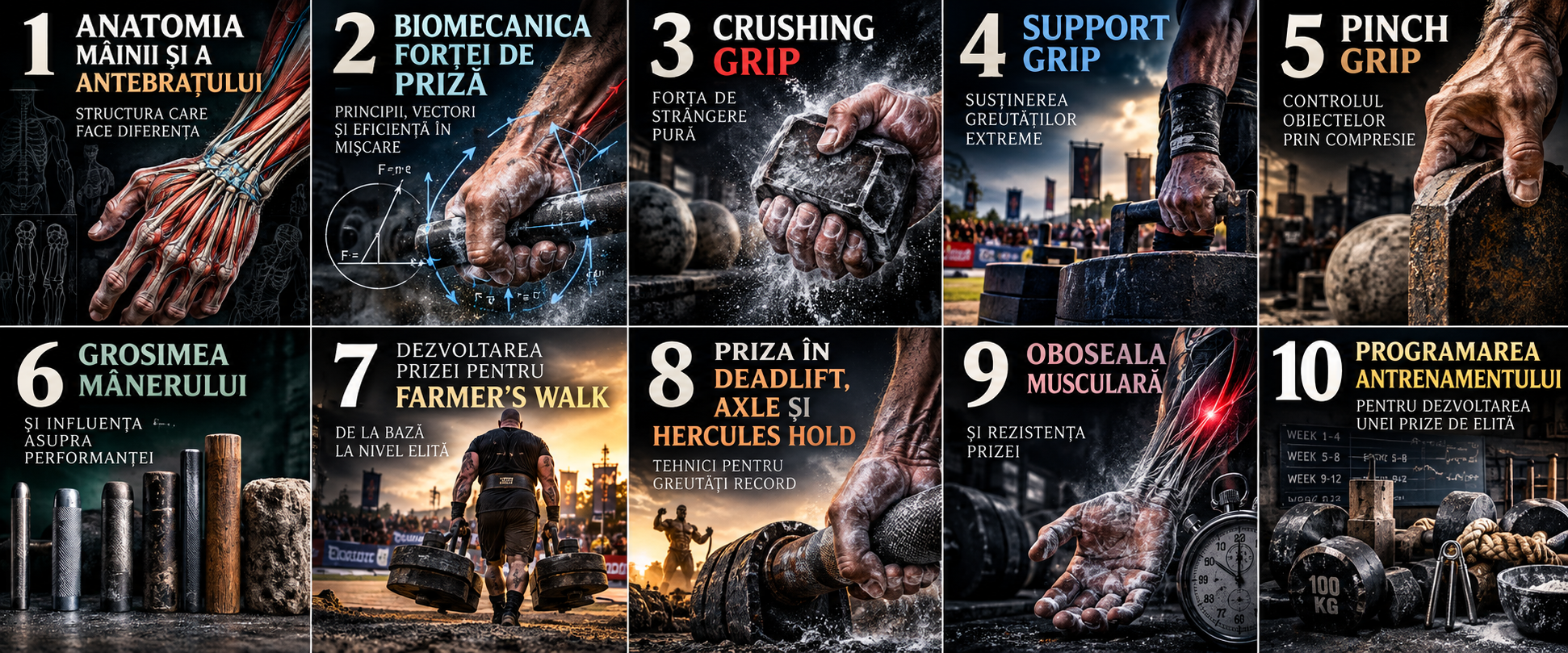
There is a form of strength that does not require moving a heavy barbell or carrying an implement for twenty meters. The athlete holds a device with two handles and a powerful spring and tries to bring the handles together until they touch. The movement lasts only seconds, yet the hardest levels may require years of preparation. In communities devoted to hand strength, closing a gripper is sometimes considered the purest expression of grip. The usual term is crushing grip, or squeezing strength. Behind this apparently simple gesture, however, lies a mechanical problem distinct from supporting a weight that pulls downward.
Closing a gripper requires finger muscles to generate enough joint moment to overcome the device's resistance as the handles approach one another. A dynamometer may measure force using a mechanism specifically designed for assessment. In a spring gripper, resistance depends on spring properties, handle geometry and the point where force is applied. The instruments are not interchangeable and do not, by definition, measure exactly the same quality. Likewise, an athlete closing an extremely difficult gripper is not guaranteed equivalent performance in axle deadlift, farmer's walk or pinch grip. The strength is real; transfer to another task has to be demonstrated.
Episode one examined the hand's and forearm's anatomy. Episode two introduced levers, friction, handle diameter and contact forces. We now focus on a specific quality in which the dominant intention is bringing surfaces together by flexing the fingers: producing the highest possible squeezing force. We will explain muscular mechanisms, spring-gripper mechanics, dynamometer limitations, the difference between the beginning and end of closure, training methods and progress evaluation. Commercial resistance labels will not be confused with actual hand force, and we will maintain a clear distinction between scientific studies and community practice.
Dedicated research on elite athletes closing extremely difficult grippers is considerably more limited than clinical literature on dynamometry. We have studies about handle separation, maximal finger force, force distribution and measurement methods, but not enough comparative evidence to declare one universal program superior for everyone. Many popular grip-sport techniques originate in experience rather than randomized studies on world-class competitors. This does not make them useless; it means they must be described accurately. Experience generates hypotheses, training generates feedback and science demands control of variables.
What Crushing Grip Is, and What It Is Not
In grip sport, crushing grip generally means the ability to generate high force by closing the fingers toward the palm or an opposing surface. The classic example is the spring gripper, although a hand dynamometer also involves squeezing. The central objective is not maintaining a suspended object but producing compressive force between defined surfaces. In everyday life, squeezing occurs frequently, from operating a tool to grasping an object. In sport, the demand is increased and standardized to permit comparison. Such standardization is not trivial because the hand and device interact.
Crushing grip differs from supporting grip. When holding a heavy implement, the fingers must resist opening under an external load generally directed by gravity. In a spring gripper, the opposing resistance changes with handle angle and device construction. An athlete may tolerate impressive suspended loads using hook-like finger configurations yet struggle with the final portion of gripper closure. Another may be excellent at maximum squeezing but have modest endurance in a prolonged hold. These outcomes are not contradictory. The movements share components but differ in external loading and contact conditions.
Crushing grip also differs from pinch grip, where compression occurs mainly between the thumb and one or more fingers. A gripper typically challenges the digital flexors in a power-grip arrangement, while pinch grip emphasizes thumb opposition and adduction. Hand dynamometry uses a specific configuration of palm and digits, but should not be assumed to reproduce every spring-gripper task. The existence of one word, “squeezing”, for these actions does not remove anatomical and mechanical differences.
Finally, crushing grip differs from the speed of hand closure. A person may bring two surfaces together rapidly against modest resistance while being unable to overcome very high resistance. Another may produce an impressive peak but need time to establish the starting position. We should distinguish maximal capacity, rate of force development, endurance across repeated efforts and technical skill. Training that improves one does not guarantee identical improvements in all others. Testing should correspond to the quality being targeted.
Where Closing Force Comes From
The main muscles flexing the long fingers are located in the forearm. Flexor digitorum superficialis contributes strongly to proximal interphalangeal flexion, while flexor digitorum profundus bends the distal interphalangeal joints. Intrinsic hand muscles adjust digit positioning and pressure distribution. During gripper closure, these structures do not function completely independently. Wrist posture affects long-flexor length and mechanical advantage, while wrist extensors help stabilize the system. As the handles approach, joint angles change, and identical muscle tension may have different mechanical effects at different points of the movement.
The wrist is not a minor detail. Closing the fingers with the wrist in deep flexion places long flexors in a different configuration from one in which moderate wrist extension is maintained. Dynamometry studies show that wrist position can change measured output, but do not establish one universally optimal angle for every gripper [3]. The way a device sits against the palm also influences stabilization requirements. An effective approach uses a repeatable controlled position compatible with the exercise and its rules.
Finger closure does not produce perfectly uniform force. Digits differ in length and have mechanical and neural interdependencies. Talsania and Kozin measured different average contributions from the index, middle, ring and little fingers during dynamometer gripping [4]. The “enslaving” phenomenon studied by Zatsiorsky, Li and Latash describes involuntary force generation in neighboring fingers during tasks attempting isolated activation [5]. Such findings explain why gripper performance cannot be reconstructed by simply adding four independent finger maxima. The hand is an interconnected system.
The middle finger may contribute substantially in some tests, but that does not make the ring and little fingers expendable. On many grippers, handle geometry gives the last two digits particular roles near the final closing phase. This is a practical observation about the device rather than a universal rule about each finger's exact force contribution. With a different handle length or hand placement, distribution may change. Gripper performance is produced by the whole hand acting on a particular lever.
A Spring Is Not a Dynamometer
A classic torsion-spring gripper contains two handles joined by a spring. As the handles approach, the spring deforms and resists the applied moment. This means difficulty cannot be accurately expressed using only a number of kilograms printed on packaging. Depending on where force is applied, the distance from the spring axis and system deformation, the same nominal figure may correspond to different mechanical demands. Comparing grippers requires a clearly defined calibration method.
The lever principle is crucial. Applying force farther from the axis can create a greater moment for the same force, in the simplified relationship M = F × r. Where the fingers press on a handle therefore changes mechanical advantage. Two people using the same gripper but positioning it differently may have substantially different experiences. Saying that a device “has 100 kilograms of resistance” is insufficient without specifying where and how that rating was defined. Local force near the end of a handle is not numerically identical to the force produced by each digit or to a clinical dynamometer score.
Grip-sport communities have developed practical methods for classifying grippers. Cannon PowerWorks, for example, publishes calibration data from many thousands of devices, revealing variation among grippers marketed under the same nominal level [6]. These data form a useful technical record from a specialist community; they are not clinical studies of hand strength and cannot directly convert a gripper rating into strongman-event performance. They do demonstrate something important: two springs carrying the same label may yield different measurements when calibrated.
Individual devices may vary in spring material, handle placement and assembly. A used gripper and a new one may behave differently, and improper treatment may alter geometry or resistance. For personal progress, keeping the same instrument improves comparability as long as it remains in good condition. For competitions and certification attempts, rules about device identification and handling are crucial. An impressive closure should be described together with its testing standard so others can interpret it.
Starting handle separation determines where the effort begins. A very open gripper can demand a different mechanical advantage early in the movement and may require sufficiently large hands for efficient positioning. Starting from a partially closed position bypasses part of the range of motion. Successfully completing the last few millimeters does not automatically prove that the entire movement can be performed from a wide opening. Both capacities can be trained but need to be tested separately when they represent distinct goals.
Why the Final Part of Closure Can Be So Difficult
Many practitioners find that they can bring a gripper's handles within a few millimeters but cannot finish the final distance. The explanation involves spring resistance, hand geometry and joint-moment capacity in that position. As the gripper closes, finger angles change, contact points move and the spring may demand a different moment. On some devices, the final position can be especially challenging because resistance and mechanical advantage interact. There is no simple law stating that every gripper becomes exactly twice as difficult over the final millimeters.
A common approach is to train the final phase through controlled efforts on a device suitable for the athlete's level. Others use assisted closures, short holds near complete contact or partial-range work. Such methods have biomechanical logic through angle-specific practice, but evidence does not support a universal effectiveness ranking for elite gripper closures. A method is useful when it produces measurable progress without excessive cost to tendons and joints. Sharp pain and loss of function should not be mistaken for the ordinary strain of a demanding attempt.
Starting Position: The Set That Changes the Entire Attempt
Among gripper specialists, “set” does not only mean a series of repetitions. It can describe how the device is positioned in the hand and how close the handles are brought before the actual attempt. If an athlete uses the free hand to stabilize and partly close the gripper, the starting geometry differs from grasping it fully open and closing it entirely with the active hand. Both may require remarkable strength, but they are not equivalent performances. The difference resembles the distinction between a full-range lift and one that begins after a difficult portion of the movement has already been bypassed. This is not a moral hierarchy; it is a matter of defining the task.
Setting a gripper involves seating one handle securely in the palm and arranging the fingers on the other. With unfavorable placement, the device may migrate as the spring resists closure, turning part of the effort into a struggle to restore contact. With a stable position, the same muscular output may be transferred more effectively into closure. Technique alone cannot produce every possible result, but positioning can change performance. Testing must therefore distinguish the ability to set a device from the ability to close it after setting. For beginners, learning consistent placement is often an important step before interpreting the loading challenge.
Expressions such as “deep set”, “parallel set”, “credit card set” and “no set” are common within the grip community, but their definitions are not completely uniform between organizations. A deep set begins from a relatively narrow opening; a parallel set roughly references handle position; a credit card set requires demonstrating a minimum gap with a physical reference; and no set generally means closure without assisted prepositioning. Exact dimensions and verification procedures depend on the rules. Reporting that someone “closed gripper X” without identifying the set may omit information that explains much of the attempt's difficulty.
IronMind's official Captains of Crush certification rules provide a concrete example. Athletes may use the free hand for positioning, but they must demonstrate that an official card fits between the handle ends before the attempt; they then complete the closure under specified conditions. The rules also address permitted chalk and prohibit altering the device [7]. This matters because certified performance means more than mechanically making two handles touch. It means doing so after a legal start and within a verifiable procedure. Those rules apply to that certification rather than every grip-sport competition.
Video evidence has similar implications. Footage showing only the last part of a close does not establish where movement started. A camera angle obscuring the gripper may leave final handle contact uncertain. Online communities sometimes debate attempts because critical details are missing. Good documentation shows the device, start position, free hand, movement and final contact without cuts that remove relevant information. Transparency does not diminish achievement; it allows others to understand what was demonstrated.
Full Range, Partials and Angle Specificity
A gripper is not mechanically simple just because it has two handles. As they move, the fingers change position and some joints approach deep flexion. Available force in each phase depends on muscle length, tendon moment arms, contact position and spring opposition. A complete repetition tests the ability to solve a sequence of mechanical problems rather than generate tension at only one joint angle. Someone who can hold a gripper nearly closed is therefore not guaranteed the ability to overcome its initial opening, which may present a different configuration.
Partial repetitions can be used deliberately to expose the hand to a difficult position, but they should not be reported as full closures. If the device is assisted nearly shut and then held for several seconds, the athlete mainly practices control within a restricted joint-angle region. Training only the initial portion of closure works in another configuration. Both methods may contribute to preparation, but transfer to the full movement must be tested. Evidence does not justify promising a fixed percentage of transfer from a partial hold to a regulation-start close.
Assisted eccentrics are another familiar practice. An athlete may use the free hand to bring the handles together and then try to control their opening with the working hand. Mechanically, resisting opening under load differs from closing against the same resistance. Muscle fibers can be challenged while lengthening, and excessively heavy loading may rapidly exceed local tissue tolerance. Precisely because this method allows interaction with devices that cannot be closed voluntarily, it requires caution, limited exposure and progressive loading. Being able to slow a device's opening is not evidence that the full concentric movement is possible.
Combining full range, control at limiting positions and goal-specific practice may make sense. However, the order and proportions depend on experience, recovery and competition requirements. If certification requires a wide starting gap, exclusively training closes after deep sets may underprepare the first part of the movement. If the challenge is a final closure on a familiar device, examining the last few millimeters may be useful. Programming starts with defining the desired performance rather than selecting whichever exercise produces the greatest sensation of effort.
Calibration Is Not Physiological Strength
A gripper can be calibrated by applying an external load at a defined point until the handles touch. Cannon PowerWorks uses this general approach and publishes reference ratings for many devices [6]. Such a reading does not directly measure flexor digitorum profundus tendon tension, the sum of all digit forces or a dynamometer result. It describes the device's mechanical resistance in a particular arrangement. Converting calibration into a physiological estimate would require an additional model incorporating hand position and force distribution.
Commercial labels are difficult to compare when manufacturers use different methods. A number such as 100 printed on a gripper cannot simply be equated to 100 kilograms on a dynamometer. Calibration methods also have measurement uncertainty: strap application, exact position and the criterion for closure influence the result. A useful device database acknowledges these limits rather than claiming illusory decimal precision. An athlete should seek a sufficiently consistent measurement system, not the most impressive-looking number.
In practice, a calibrated set can help select difficulty levels: one gripper suitable for controlled repetitions, another close to maximum, and another representing a longer-term goal. Acquiring a vast collection is unnecessary. A few carefully selected levels can permit progression if training volume and hold duration can also be changed. For elite-strength programming, the tools become useful only when integrated into total weekly workload and when performance is recorded under comparable conditions.
Dynamometry: Precise Measurement or Illusion of Precision?
A dynamometer can provide valuable information, but only if we understand what it measures. Hydraulic, mechanical and electronic devices detect force according to their construction. In clinical settings, dynamometry is used to evaluate function, monitor recovery and sometimes estimate broader aspects of health. In grip sport, the interest shifts to high scores and specific performance improvements. Both uses require standardization, but they do not necessarily share reference populations or interpretation. An exceptional dynamometer score cannot be converted automatically into a competitive ranking for torsion-spring grippers.
Roberts and colleagues reviewed the literature on handgrip measurement and noted major differences among equipment types, subject positions, numbers of attempts and methods for selecting the reported result [1]. An article reporting that an athlete scored “90 kilograms of grip” without naming the device and method leaves essential questions unanswered. Was it one effort, an average or the best of three? Was the instrument calibrated? Was handle spacing adjusted to the hand? Was the athlete tested after demanding training or completely rested? Numbers become useful only when attached to transparent methods.
Body position may change the result. A test performed with the arm alongside the trunk and the elbow bent is not identical to one with the arm extended. Wrist position matters, as research on gripping geometry demonstrates [3]. Every laboratory need not use one protocol for every possible purpose, but longitudinal comparisons should preserve consistent conditions. If the athlete changes posture to obtain a higher score, that may be an interesting demonstration of biomechanical advantage rather than evidence of muscular adaptation.
An electronic dynamometer may record not only peak force but also how it rises and falls over time, provided the device and software support that measurement. A force–time curve can help distinguish a short peak from the capacity to maintain tension for several seconds. Results are sensitive to sampling rate, filtering and the start point chosen for analysis. An elegant graph cannot compensate for inconsistent testing. For an athlete, the most useful tool may be the one that can be used correctly and repeatedly rather than the one with the most sophisticated screen.
Nor is dynamometry an isolated measurement of flexor digitorum profundus. Digits, palm and wrist all contribute to the configuration used in testing; the measured force represents their combined output through the instrument. A finger injury or altered nerve function may reduce the score, but the result alone cannot localize the cause. Likewise, a small change can reflect day-to-day variation, familiarization or instrument differences. Proper evaluation must consider both athletic significance and measurement error.
Forces Between Digits and Handles
During a gripper close, the handles press against different areas of the palm and fingers. Contact pressures are not uniform and may change as the handles converge. That helps explain why rough texture may feel secure yet painful. Surface roughness affects slipping, while effective contact area changes local pressure. If the device migrates across the palm, part of the muscular effort is spent restoring position rather than reducing handle separation. Technique aims to limit that loss, although anatomical constraints cannot be eliminated.
Hand size may create mechanical advantages or disadvantages on a particular gripper. Longer fingers may improve wrapping around a wide device, but length alone does not predict results. Muscle capacity, joint position, wrist stability and experience also matter. In clinical testing, handle separation affects readings, showing why the relationship between hand dimensions and external task should be controlled [3]. In grip sport, where a device may be standardized, athletes share external geometry but not identical relative difficulty.
High pressure concentrated in one area of the palm is not synonymous with efficiency. A gripper may be seated securely yet contact so little tissue that local discomfort becomes the limiting factor. More favorable pressure distribution may permit greater force without disproportionate pain. This functional explanation does not justify extreme positioning or ignoring symptoms. Skin can adapt to repeated contact, but escalating difficulty faster than tissue tolerance allows may create problems that interrupt training.
Near the end of closure, very small adjustments in finger placement may influence the final millimeters. Athletes may therefore pay particular attention to the index, middle, ring and little fingers. There is, however, no single experimentally established ordering for every human hand. Devices differ, and an effective technique for someone with a wide palm may not be the same as for someone with long, narrow fingers. A sensible principle is to maintain stable, repeatable contact, avoid uncontrolled joint movements and judge technique through valid closures rather than visual impression.
Right and Left: Asymmetry Without Premature Labels
Hands do not always develop identically, even among athletes training both sides. Everyday dominance, injury history, technique and anatomical variation may all contribute to different results. Dominance alone, however, is not a sufficient explanation. Some normative dynamometry research reports smaller effects of hand dominance than commonly assumed once other variables are considered. It is incorrect to insist that the dominant hand must always be ten percent stronger or that any departure from that pattern is pathological.
A gripper may reveal differences absent from farmer's walk because the tasks demand different configurations. If an athlete closes a device with the right hand and misses by a few millimeters with the left, possible causes include strength, setting technique and contact tolerance. The rational first step is to compare positioning and conditions rather than diagnose an exact muscular deficit. Unilateral training can help track each hand's progress without allowing the stronger one to obscure the weaker one's performance.
Asymmetry should be understood within the sport. Frequent mixed-grip deadlifting imposes different orientations on the upper limbs. A prior finger injury can lead to unconscious changes in grip. Not every asymmetry requires intervention, but a new difference accompanied by pain, numbness or loss of function warrants assessment. A coach should monitor trends over time and distinguish a stable characteristic from a clinically meaningful change.
Finally, comparing hands only makes sense with consistent procedures. The same device, handle setting, rest intervals and rules are preferable to alternating different grippers. Repeatedly forcing the weaker hand to match the stronger hand's record immediately may accumulate excessive fatigue. Progression should match each hand's capacity, and the sporting objective can be overall improvement without demanding perfect symmetry.
Neural Command: From Intending to Squeeze to Transmitting Force
When an athlete tries to close a difficult gripper, the nervous system does not issue one simplistic order to the forearm. The central nervous system recruits motor units, regulates impulse frequency and coordinates finger-flexor activation with muscles stabilizing the wrist. A motor unit consists of a motor neuron and the muscle fibers it controls. As demand rises, additional units may be recruited, and active units may alter their discharge rates. This organization contributes to available voluntary force. It does not justify claiming that an unsuccessful close occurred because the athlete “used only seventy percent of neural potential” unless there are measurements supporting the figure.
Repeated practice also develops motor familiarity. Early attempts may involve inefficient pressure, changing wrist angles during the movement or wasting effort stabilizing a poorly positioned device. After several sessions, execution may become more consistent even without visible forearm growth. This does not establish that all initial gains are exclusively neural, but it helps explain why early performance can improve faster than structural hypertrophy. In a technical strength task, available force interacts with the athlete's ability to transmit it through the device at the right moment.
Co-contraction of stabilizing muscles plays an important role. Long finger flexors cross the wrist, where their tension can create an unwanted flexion moment. Wrist extensors can provide an opposing moment, maintaining a position that allows favorable muscle lengths and leverage. Too little stabilization can result in lost position, while unnecessary rigid bracing throughout the upper limb may consume resources without improving closure. The goal is not total relaxation but activation organized around the task. This organization develops through specific practice and feedback.
Tactile information allows athletes to sense where a handle slips and how pressure changes across the palm. On a heavy gripper, the opportunity to correct positioning after the effort begins may be limited because resistance is already high. Setup therefore matters: the fingers must identify the surfaces and establish a sufficiently stable arrangement before maximal force is produced. This differs from simply increasing arousal. A focused competitor who understands the required movement may waste fewer motions and reduce failures due to poor positioning.
Strength-sport explanations sometimes invoke “one hundred percent motor unit recruitment” or the release of hidden force through a mental trick. Without appropriate physiological protocols, such statements are speculative. Shouting, psychological stimulation or stimulant use do not guarantee specific, safe improvements on grippers. Arousal can affect perceived exertion and readiness, but can also alter motor precision, sleep or recovery. Especially for athletes already undertaking demanding training, increased stimulation is a poor substitute for coherent technique and progression.
Muscular Adaptations: More Than Visibly Large Forearms
Resistance training may improve neural command and coordination as well as producing structural muscular adaptations. Hypertrophy broadly involves increases in muscle-fiber size, but its contribution to exercise performance depends on architecture, working length and force transmission. A large forearm circumference may include muscles that are not the principal digital flexors for gripper closure. Bone structure and adipose tissue also influence measurements. Photographs and measuring tape are therefore poor stand-alone predictors of a specific gripper close.
Flexor digitorum profundus and superficialis have different anatomical roles, but they cooperate during maximal closing. No ordinary two-handle exercise guarantees perfect isolation of either muscle. Changing joint positions can modify mechanical emphasis without turning an exercise into a pure test of one structure. A program claiming to target exclusively “the muscle responsible for the last two millimeters” should be viewed critically. The end of the movement is produced by an integrated muscle–joint configuration, not a secret structure switched on only at the end.
Muscular adaptation requires sufficient repeated effort combined with appropriate recovery. General resistance-training literature supports progressive loading and adjustment of variables according to training status [8]. Yet elite-gripper studies are insufficient to prove that exactly three, four or five sessions per week are universally optimal. Forearms already participate in deadlifts, rows, pulling movements, carries and everyday tasks. Crushing-grip programming must fit into this total workload. Otherwise a seemingly small number of extra closures may overwhelm an already fatigued system.
An indicator of successful adaptation is the ability to reproduce a performance under comparable conditions. Closing a difficult gripper once on an exceptional day is a valid achievement, but it does not necessarily demonstrate stable repeated capacity. If, weeks later, the athlete can execute more controlled repetitions with the same quality, progress becomes more convincing. Repetition endurance and maximum strength should still be distinguished. A certification requiring one difficult closure ultimately demands that exact performance, not only many repetitions on a substantially easier device.
Tendons: Adaptation, Transmission and Vulnerability
Finger-flexor tendons transmit force from the forearm muscle bellies to the phalanges. They consist of connective tissue organized to resist tension, but they are not perfectly rigid structures. Their properties depend on tissue composition, fiber arrangement, loading history and current condition. A difficult gripper can generate substantial forces, especially when repeated close to failure. Yet device difficulty alone cannot tell us the precise tension in a particular tendon. That estimate would require additional measurements and biomechanical modeling.
Tendons may adapt to exercise, but their time course and adaptations differ from rapid improvements in motor coordination. An athlete who improves by two gripper levels in a short time cannot be assumed to have doubled tendon stiffness. Nor does every sensation of local tension prove beneficial adaptation. Excessive loading or insufficient recovery may produce symptoms that impair function, and persistent pain warrants contextual clinical evaluation. Sustainable progress over months and years matters more than one closure obtained at the expense of many later training sessions.
Finger anatomy also contains guiding structures, including tendon sheaths and digital pulley systems that help keep tendons close to the bones. These structures matter functionally when the fingers are subjected to high loads. Sudden palmar finger pain, particularly with a pop or inability to flex normally, is not something to “train through”. This article cannot diagnose a condition, but the hand contains numerous small structures vulnerable to loading, and a local problem can compromise whole-hand performance.
Force Is a Product of Coordination, Not an Isolated Organ
It is worth returning to a foundational distinction. The body does not contain a dedicated “gripper muscle” that can be trained independently of everything else. Closing force results from long flexors, intrinsic muscles, wrist stabilizers, joint geometry, the contact surface and neural coordination. A training plan targeting only one visible forearm region may develop muscle without adequately reproducing the task. Conversely, practicing only the specific gripper may improve technical familiarity without providing enough variation for other capacities needed in strength sport.
An effective approach recognizes both specificity and generality. Specific practice teaches the athlete to handle the spring's changing resistance, locate the handles in the palm and coordinate the last part of closure. General strength work may improve the wider muscular system and its tolerance for load. Neither proves that all abilities will transfer completely. What matters is the result under the athlete's target conditions and whether progress remains compatible with recovery and broader sporting preparation.
It is also important to distinguish the sensation of effort from the effectiveness of a session. A very difficult gripper may feel impressive while producing little high-quality training volume. An easier one may permit technically consistent repetitions that gradually build capacity. On the other hand, endlessly repeating low-effort closures is unlikely to prepare the system for a maximum attempt without appropriately challenging it. The art of programming is to choose loads and tasks that generate adaptation without turning every session into a maximal contest.
Finally, neural and muscular development are not competing explanations. The nervous system controls existing muscle tissue, and repeated loading can alter both motor control and muscular structure. Improvements at a gripper may arise from several sources simultaneously. The distinction is scientifically useful because it prevents simplistic claims. Athletic performance is the final product of integrated adaptation, while the precise contribution of each mechanism often remains uncertain without specialized tests.
Building a Program for Maximum Crushing Strength
The first programming principle is to define the objective. If an athlete wants to close a particular gripper from a regulated starting position, training must periodically include that exact setting and closure. If the goal is a higher dynamometer score, practice should use the same apparatus and protocol. If preparation aims to improve farmer's walk, crushing strength may be only one component. Without this clarity, an athlete can accumulate difficult repetitions without knowing which result should justify them. An exercise is not useful merely because it is hard. Its value depends on demonstrable contribution to the intended outcome.
One practical organization distinguishes sessions emphasizing high force from those using moderate training volume. During a strength-focused session, an athlete might use a gripper allowing only a few clean closes, with enough rest that successive attempts are not overwhelmed by previous fatigue. During an accumulation session, lower resistance may permit controlled repetitions and technical practice. This is an application of general resistance-training principles [8], not a gripper-specific protocol proven superior in elite comparative studies. Exact set numbers must account for the rest of the program and the athlete's individual response.
Repetition quality matters. A full closure performed without prohibited assistance or a change in position invalidating the test provides clear information. An attempt stopping a few millimeters short is genuine effort, but it is not a complete close. Recording failures as successes overestimates progress. Partials and near-maximum misses can be used deliberately in training, but they should be recorded separately. Accurate reporting supports motivation while preventing premature escalation of difficulty before performance is stable.
Consider an intermediate athlete who consistently closes a moderate gripper three times but cannot close the next level. One option is to consolidate clean repetitions on the current level, occasionally test one attempt at the higher level and include suitable recovery periods. Another may involve controlled holds or a calibrated intermediate device. We cannot claim one strategy is optimal in every case, but repeatedly missing the hard close many times is not automatically a better dose. Quality of effort and joint tolerance should be monitored together.
For advanced athletes, the gap between available gripper levels can become large relative to monthly physiological progress. Small differences between calibrated devices or accessory exercises that change loading may therefore prove useful. There is also a risk: too much time spent on variations may turn the program into a collection of secondary skills while the main event is practiced too rarely. Mature preparation retains regular contact with the target task and introduces variations only when they help address an observed limitation. Specificity is not monotony, and variety is not inherently progress.
Repetitions: What Changes When We Close a Gripper Many Times?
Repeated closes on an accessible gripper can train the ability to produce force repeatedly, maintain technique and tolerate local loading. They may help accumulate volume and consolidate skill, but they are not equivalent to maximum performance on a much harder device. Repetitions achieved before fatigue depend on resistance, starting gap, movement speed and pauses between contractions. When those variables change, raw repetition counts are difficult to interpret. Two sets of ten may be very different when one involves full closures and the other partial movements.
Repetition tempo matters. A rapid close followed by uncontrolled opening challenges the system differently from a controlled close and moderate return. Some exercises may usefully practice rapid force development, but sudden acceleration must not be confused with a requirement to force joints into extreme positions. The goal remains producing sufficient joint moment under event-relevant conditions. Tempo should be selected according to load and control rather than how aggressive a set feels.
Training to failure may reveal a temporary performance limit, but it carries a cost in local fatigue. If every session includes numerous sets continued until the handles no longer meet, later exercises may suffer. There is no adequate scientific reason to make every set an absolute maximum test. Athletes can adapt through sets that leave some repetitions in reserve, particularly when the broader aim is accumulating high-quality practice. Proximity to failure can be used strategically rather than compulsively.
Progress can be recorded across several dimensions: clean closes, gripper difficulty, setting style, necessary rest and execution quality. Improving from three technically stable repetitions to six demonstrates progress. Closing a higher level only after a much deeper set requires interpretation in relation to the goal. Not all improvements are equivalent, and they need not be. A good training log preserves the information required to explain a result rather than merely circling a large number.
Rest Intervals: Why Several Minutes May Matter More Than Another Attempt
Maximal strength depends on high-quality efforts, and those are influenced by recovery between attempts. A hard gripper used repeatedly with very short pauses may become progressively harder not because the device changed but because muscular and neural capacity has not recovered sufficiently. General resistance-training recommendations support relatively long rests for heavy strength work [8]. Evidence does not demonstrate that exactly three minutes is uniquely optimal for every gripper attempt and every individual.
Rest can be shorter for lighter or technical work when the goal is repeated practice and work capacity. Near-maximal attempts may benefit from longer intervals that preserve performance quality. The choice should match the objective. When comparing records made with very different rests, some variation may come from immediate recovery status. Recording rest intervals improves the fairness of comparison. This simple precaution may eliminate many misleading conclusions about supposedly good or bad strength days.
Within-session fatigue can also change technique. As flexors become less capable of producing force, athletes may change wrist position or start using movements from the whole arm. Such adjustments can transform the task without the person recognizing it immediately. Comparing footage of the first and last repetitions may show where consistency is lost. Appropriate rest is not a sign of weakness; it is a tool for preserving the intended training stimulus.
Recovery between days matters as well. An athlete performing heavy deadlifts Tuesday, high-volume rows Wednesday and maximum grippers Thursday accumulates repeated loading on the fingers despite having only one formally labeled grip session. The individual session may look reasonable on paper while the surrounding workload changes its actual dose. Good programming considers the entire loading history of forearm and hand tissues, not simply the day on which a gripper appears.
Programming Principles Versus Fixed Prescriptions
A principle is not the same as an exact prescription. Progressive overload, appropriate recovery and task-specific practice are well-established concepts in strength training. However, applying them to a particular gripper athlete requires knowledge of experience, hand health, other events and available training time. One athlete may tolerate more frequent small exposures; another may improve better with fewer sessions because their deadlift and carries already impose considerable demand. Neither observation proves that a single schedule is optimal for everyone.
The sensible aim is to preserve performance quality while allowing adaptation to accumulate. If strength decreases for several consecutive sessions, if local discomfort increases or if technique deteriorates early in workouts, the training dose deserves review. On the other hand, never challenging maximum force may leave an athlete unprepared for a truly difficult closure. Programming therefore balances enough demanding work to drive progress with enough lower-stress practice and recovery to make that progress sustainable.
An especially useful distinction separates a test from a workout. Testing asks what a person can do under defined conditions. Training applies repeated stress intended to change future capacity. Frequent maximal attempts may be informative but can also disrupt preparation if treated as the entire plan. A sound program includes performance checks while leaving space for work whose value becomes visible over weeks rather than within one spectacular attempt.
Isometrics and Controlling Opening
An isometric contraction maintains a position without major visible changes in joint angle, even though muscles and tendons can adjust internally. With grippers, this may mean holding the handles together or exerting force in a position where the device no longer moves. These tasks differ from a complete closure. If an athlete uses both hands to close the device and then keeps it closed with one, the demonstrated ability is resistance to opening in that position, not necessarily the ability to overcome resistance throughout the full range.
Isometric work has a biomechanical rationale when an athlete struggles at a particular angle. It can provide controlled exposure to tension and permit tracking of holding time. Results must be documented alongside device identity, handle separation and setting method. Ten seconds at a five-millimeter gap is not equivalent to ten seconds at twenty millimeters. Different calibrated grippers also create different demands. Angle specificity can help training, but does not guarantee full transfer to closure from a wide opening.
Assisted eccentrics are different. The gripper is brought into a closed position, and the athlete attempts to resist its opening. Muscles produce tension while the system lengthens under spring resistance. This method can expose the hand to substantial loads, which explains its appeal in grip sport. It can also create poorly tolerated stresses when the device greatly exceeds concentric capacity. Loading should progress carefully, and movement should remain controlled.
General evidence on eccentric contractions does not prove that supramaximal gripper eccentrics are universally the best method. Comparative studies among elite gripper athletes are limited. Local fatigue may also impair later deadlifts, rows or carries. If an exercise produces persistent pain or functional decline, its practical value needs reevaluation. Complete closures, assisted holds and eccentrics should be recorded separately because they are different tasks.
Warming Up for a Difficult Attempt
Closing an extremely hard gripper should not be the first serious hand contraction of the day. Progressive preparation can begin with gentle finger and wrist movement, followed by several closes on accessible devices and gradually increased difficulty. The purpose is to assess comfort, prepare coordination and establish secure positioning without accumulating major fatigue before the main sets. Warm-up should prepare the challenge rather than become a separate contest.
The required number of repetitions is not universal. A beginner may need more technical attempts to position the device consistently; an advanced athlete may use a brief familiar routine. Repeated maximal attempts before the target effort can reduce its quality through fatigue. A useful principle is to increase intensity gradually while reducing volume as the maximum is approached. This resembles warm-up logic in other strength movements without imposing a mandatory numerical scheme.
Skin and contact pressure also matter. A knurled handle may cause discomfort when it slides, while previously irritated skin may become limiting. Athletes should practice under conditions similar to those permitted during the test, including chalk rules. IronMind certifications specify permitted products [7]. Familiarity with rules prevents a genuine physical performance from going unrecognized because of a procedural error.
The Difference Between Training and Demonstration
A gripper workout and a formal gripper attempt serve different purposes. Training provides exposure intended to change future capacity. A test demonstrates what the athlete can do under specified conditions. An assisted eccentric, partial repetition or deep-set closure may be valuable in preparation while failing to satisfy the rules of a particular certification. There is nothing contradictory about that. It becomes a problem only when training performance is reported as if it met a stricter standard.
Keeping separate records for full closes, partials, isometric holds and assisted eccentrics makes progress easier to understand. A new record in one category may or may not predict a new record in another. Rather than treating every exercise as an official attempt, athletes can select complementary methods and periodically verify transfer to the specific task that matters.
Local Fatigue and the False Idea That Every Session Must Destroy the Hand
Crushing grip uses a relatively small muscle system compared with the lower body, but that does not mean it can be trained maximally without consequences. Finger flexors, tendons and structures near the elbow also participate in many gym movements. An athlete performing heavy deadlifts, rows, pull-ups and farmer's walks accumulates substantial loading even without using grippers daily. Fatigue may appear as fewer successful closes, difficulty setting the device, temporary stiffness or unusually high perceived effort. None is a diagnosis alone, but together they may indicate that training dosage needs attention.
Complete exhaustion is not necessary for productive training. Repeatedly failing at a gripper far beyond present capacity provides exposure but may yield few technically valid repetitions and considerable fatigue. By contrast, work at a level permitting clean execution produces clearer evidence of progress. Heavy attempts can remain in the program, but they should form part of a structure rather than being the whole structure. The distinction between productive stress and stress that merely consumes resources matters especially to athletes preparing for multiple events.
A practical approach to autoregulation is to compare expected and actual performance under similar conditions. If a gripper comfortably closed in recent weeks suddenly becomes impossible, sleep, preceding workload and local symptoms should be reviewed before adding more volume. One poor workout does not establish regression or justify a dramatic response. Repeated declines across several sessions may justify reconsidering the training plan. Autoregulation does not mean abandoning progression; it means adjusting the day's demand to available capacity.
Why Forearm Congestion Is Not a Sufficient Indicator
A pump or burning sensation may develop during repeated sets, but its intensity does not directly measure training effectiveness. A very easy gripper used for a long time may cause substantial congestion without transferring strongly to an elite close. A difficult single effort with ample rest may not create the same sensation despite being relevant for maximum strength. Training logs should not treat pump intensity as a personal record. Successful performance under defined conditions and the ability to reproduce it are more informative.
Muscle fatigue involves multiple mechanisms, including changes in energetic availability, fiber-level force production and neural drive. It is not explained by one substance supposedly filling the forearm. During sustained, high-intensity contractions, intramuscular pressure may temporarily influence local perfusion and affect tolerance of effort. The sensation alone, however, cannot reveal an exact percentage of reduced blood flow. A scientific explanation distinguishes plausible mechanisms from direct measurements, especially when discussing extreme performance without physiological instrumentation.
Recovery Is Not Simply a Day Without Grippers
Recovery involves sleep, sufficient nutrition, workload organization and avoiding the aggravation of local symptoms. A day without grippers may still contain numerous heavy unstrapped rowing sets; that is not necessarily a day of rest for the hand. Programming must consider stress imposed on gripping structures regardless of the exercise label. This is particularly important in strongman, where most events involve some form of hand–object contact. Planning should consider the whole week rather than one isolated session.
Complete recovery does not require never feeling any post-training sensation. Predictable fatigue can occur without injury. Persistent localized pain, numbness, swelling or new difficulty moving a finger should nevertheless be treated differently from ordinary muscular tiredness. Repeatedly forcing maximal closes through such symptoms may delay recognition of a significant problem. Timely clinical assessment helps protect long-term sporting performance; it is not an admission of failure.
The Cost of Testing Too Often
An all-out gripper attempt is a test of current capacity, not automatically the most efficient use of every workout. When it is repeated frequently, its results may fluctuate because of accumulated fatigue rather than adaptation. An athlete could misinterpret the fluctuation, add more work and create an unproductive cycle. Keeping defined testing occasions and separating them from training sessions may help clarify trends. What matters is not avoiding heavy effort, but placing heavy effort strategically within an overall progression.
Maximum attempts are also psychologically attractive because they offer immediate feedback and the possibility of a record. Lower-load practice may feel less spectacular but can provide high-quality repetition and controlled exposure. Both have value. The stronger athlete over time may be the one who consistently executes enough useful work and arrives at important attempts adequately prepared, rather than the one who tries to prove maximum capacity every day.
From Grippers to Strongman: How Much Squeezing Strength Transfers
A strongman competitor can have good reasons to train crushing grip even without entering gripper-closing competitions. Digital flexors contribute to many events, and increasing their capacity may enlarge the reserve available for holding bars and handles. Transfer, however, is not the same as anatomical similarity. Exercises using overlapping muscles may differ in joint position, timing, force direction and duration. A few seconds closing a spring does not automatically reproduce a forty-meter farmer's walk or a prolonged Hercules hold.
During farmer's walk, the primary challenge is maintaining contact while the body and implements move. Handles may oscillate and transmit rotational moments, while the fingers work in a relatively stable position for a longer period. During gripper closure, the fingers actively move against spring resistance. Increasing one's gripper maximum might provide a larger reserve of force, but it does not guarantee that holding time increases proportionally. Transfer should be checked using the actual carrying implement under repeatable conditions.
In deadlifting, particularly with double overhand grip, the fingers must resist sliding and rolling of the bar. Better finger-flexor strength may help in some configurations, but technique, surface texture and diameter may independently limit the result. Hook grip uses the thumb as part of a particular locking arrangement. Straps transfer part of the direct finger demand to fabric. Under those conditions, closing a harder gripper does not guarantee a heavier deadlift. First establish whether unassisted gripping is truly the limiting factor.
Axle deadlift illustrates the importance of diameter. Fingers remain relatively open, with mechanical leverage different from the final phase of a nearly closed gripper. Consequently, an athlete may have excellent crushing strength without enjoying equivalent advantage on a thick cylinder. Specific axle preparation should include actual contact with competition-relevant diameters whenever equipment and conditions permit. A gripper may remain a useful accessory, but cannot replace the entire axle-grip program.
Pinch grip introduces an even clearer distinction. The thumb becomes one of the main surfaces compressing the object, and control relies on other hand configurations. Exceptional gripper performance can coexist with mediocre plate-pinching ability. There is no paradox: the athlete has strongly developed one task, not every possible task. This distinction justifies separate discussions of crushing, supporting and pinching. A complex discipline deserves analysis that does not reduce every capacity to one test.
When Crushing Grip Should Become a Priority
Priority depends on what limits performance. If an athlete completes farmer's walk quickly without approaching handle failure, increasing maximum gripper strength may yield little immediate competitive benefit. If fingers start opening early under loads that the legs and trunk could still manage, the contribution of digital flexors deserves investigation. Even then, one must check whether friction or rotation caused the problem. More crushing work is not necessarily the entire solution. Programming decisions should begin with an observed limitation rather than an exercise's reputation.
There are also situations in which crushing grip is an independent sporting goal rather than an accessory to strongman. An athlete may pursue gripper certification or participate in grip-sport competition. In that case, specific closing ability becomes central, and training time devoted to other tasks may be adjusted. Every sporting discipline need not be justified by transfer to deadlifting. A difficult technical achievement has value under its own rules. The program should be explicit about objectives and success criteria.
For a strongman in competition season, introducing aggressive new gripper training may create recovery conflicts. Weekly event sessions may already involve thick handles, loaded carries and deadlifts, subjecting flexors to repeated tension. The potential benefit of extra sets should be weighed against reduced quality in event preparation. The off-season may allow more time to develop local abilities, but that does not make daily maximum testing desirable. Priorities should follow the competitive calendar rather than equipment fashion.
Recognizing the Limiting Factor
Before prescribing crushing exercises, observe how grip fails. Gradual finger opening under a stable handle suggests one problem; abrupt slipping across a wet surface suggests another. Rotation may create an additional demand not captured by a gripper. Pain can create a functional limit unrelated to maximum muscular capacity. These distinctions are hypotheses, not diagnoses, but they help prevent a coach from prescribing the same exercise regardless of why an implement was dropped.
The practical question is not whether crushing grip is important. It clearly matters within its own class of tasks. The question is whether it is the most appropriate target for the athlete's current objective. Sometimes increasing finger-force capacity is valuable. Sometimes controlling an implement more effectively offers the larger opportunity. Good strongman coaching combines general development with careful identification of the exact performance bottleneck.
A Training Cycle: Development, Consolidation and Verification
A coherent program can be divided into phases with different goals without requiring a complicated scheme. During development, the athlete builds work capacity through clean closes on manageable devices while controlling volume. During consolidation, work gradually approaches the target difficulty through specific attempts and practice around limiting angles. During verification, accumulated fatigue is reduced enough to reveal maximum capacity under standardized testing conditions. This is not an experimentally proven gripper-specific recipe but a cautious application of established resistance-training progression principles [8].
A common conceptual mistake is equating maximal effort with maximal adaptation. Very heavy attempts may be necessary for familiarization and assessment, but they cannot systematically replace the work volume needed to build capacity. Conversely, endless light repetitions may improve local endurance without adequately preparing the athlete for a spring near maximum resistance. A program should combine complementary demands rather than rely exclusively on whichever feels most spectacular. The proportions depend on experience, recovery availability and competitive objectives.
Progress often slows at higher levels. A beginner may improve quickly through familiarization and technique, while an advanced specialist can spend months pursuing the next level. Slower progress does not establish a permanent genetic ceiling. It may reflect proximity to current capacity, large gaps between available devices and increasingly complex preparation. Program changes can be justified, but replacing the plan every week out of impatience prevents meaningful evaluation of each method.
A testing phase should reproduce the rules of the intended attempt. If certification requires a card-width starting gap, preparation must make that technique familiar. If an event specifies arm position, training should not depend entirely on another configuration. When video evidence is required, camera angle and visibility of final handle contact should be checked before testing day. A performance can fail procedurally even when the hand possesses enough strength; preventing that outcome is part of professional preparation.
Selecting the Next Difficulty
Moving to a harder gripper is tempting, but should be supported by stable results. If the current device can only be closed through increasingly deep sets, the athlete may not yet possess sufficient capacity across the range required by the final standard. If valid closures can be repeated across several workouts, the next level becomes a more defensible target. Calibration can help identify an intermediate device, while recognizing that its rating describes spring resistance rather than exact physiological hand force [6]. Equipment selection becomes more systematic and less dependent on marketing labels.
Progress can also occur without immediately changing grippers. The athlete may improve the number of clean closes, setting consistency, movement completion time or ability to reproduce a result after comparable rest intervals. Each improvement should be interpreted relative to the goal. More repetitions do not guarantee the next gripper level, but they may indicate better work capacity. Moving to a new device should follow evidence and recovery readiness rather than the desire for an impressive label.
There is value in keeping one reference gripper over a long period. By returning to the same device monthly under similar conditions, an athlete can observe general performance trends. Constantly changing device, setting gap and test protocol instead produces numbers that are hard to compare. Ambitious training need not be chaotic. Measurement consistency allows real change to become visible and helps separate adaptation from variation in circumstances.
A Program Is an Experiment in Individual Response
No published trial establishes one universal weekly distribution of gripper sets for all strongman competitors. The effective dose will differ with training history and simultaneous exposure to other pulling events. This makes careful observation especially important. If the athlete's target close improves while the hands remain healthy and strongman practice is unaffected, the program may be serving its purpose. If gripper records rise while essential event sessions deteriorate, the balance may be inappropriate for the wider goal.
A training block can therefore be treated as a structured individual experiment. Define the desired outcome, maintain a small number of comparable measurements, introduce changes deliberately and assess their consequences over enough sessions to reduce the influence of day-to-day variability. Such observation is not a substitute for controlled scientific research, but it is considerably better than assigning every success or failure to whichever exercise happened most recently.
Common Problems in Fingers and Wrists
Crushing-grip training can repeatedly load finger joints, flexor tendons and palmar contact tissues. A small device does not necessarily create small internal stresses. A difficult gripper may produce large resisting moments over a short range, while athletes can repeat attempts frequently because the exercise does not cause the systemic fatigue of a heavy deadlift. This convenience can encourage local overload. The first protective measure is to treat grip work as a genuine component of training, with dosage, progression and recovery, rather than an extra activity that never counts toward workload.
Localized pain near a finger base, persistent stiffness or the sense that a tendon no longer moves normally should not automatically be described as beneficial adaptation. The hand contains small joints, ligaments, tendon sheaths and fibrous guiding structures that keep tendons near the phalanges. Symptoms may reflect irritation, overload or injury, and the cause cannot be diagnosed from location alone in a message. Significant pain, swelling, restricted movement or locking of a finger warrants evaluation by a qualified clinician. Generic training advice cannot replace examination.
At the wrist, high finger-flexor force requires stabilization. Repeatedly changing wrist position under extreme effort can alter local mechanical stress. Some postures feel comfortable to one athlete and unpleasant to another. Dynamometry research shows that wrist angle affects force output [3], but it does not authorize forcing a painful posture simply to maximize a reading. Effective technique must remain compatible with control and individual tolerance.
Tingling and numbness are distinct from ordinary forearm congestion. They can reflect involvement of neural structures and should not automatically be normalized in a heavy-loading sport. Median and ulnar nerves serve different hand territories, and compression may produce characteristic symptoms, but diagnosis requires individual assessment. If symptoms persist, worsen or accompany new weakness, continuing maximal gripper efforts without clarification carries unnecessary risk.
Technical Hygiene Before Adding Resistance
Careful observation may reveal whether a gripper moves excessively within the palm during closure. If one handle migrates toward the palm's edge, the athlete may lose leverage and concentrate pressure over a small area. Before deciding a harder device is needed, compare settings and footage from successful attempts. This does not require obsession over millimeters. The aim is a repeatable, secure and efficient position rather than a ritual in which setup takes longer than actual training.
Grippers should be checked periodically for obvious deterioration. A loose handle, crack or deformation may change resistance or introduce mechanical risk. Athletes should not improvise spring alterations and then compare results with the manufacturer's nominal level. Modifications may invalidate certification attempts. In ordinary training, equipment integrity matters more than making resistance feel exotic. The goal is controlled loading of the hand, not testing a device that may fail unpredictably.
Skin condition matters too. Knurling may leave marks and irritate contact areas. Repeated attempts on damaged skin can turn a small problem into a prolonged training interruption. Callus care, hygiene and appropriate surfaces are practical measures rather than signs of softness incompatible with strength sport. Hands used for sport need to remain capable of performing it. Needlessly sacrificing skin for a handful of extra attempts rarely represents good long-term strategy.
When Testing Should Stop
Sudden severe pain, a popping sensation followed by lost function, finger deformity, rapidly increasing swelling or persistent numbness are signals to stop an attempt and obtain appropriate assessment. This article cannot assign a diagnosis to each symptom. It can, however, explain that repeating heavy closes to “see whether it passes” is not a medical test. Timely clinical attention is more important in such situations than achieving the target close. A justified pause can protect months of future preparation.
Long-Term Performance Requires Healthy Contact
Gripper strength is sometimes discussed as if the athlete's only responsibility is to overcome the spring. In reality, sustainable practice also requires functioning joints, intact skin and adequate neural control. A technically valid closure is valuable, but its training cost matters when the athlete hopes to compete for years. Progress should be judged not only by the hardest device closed once, but by whether the hand continues to tolerate preparation and the wider demands of sport.
The Myth of One Number That Defines Hand Strength
Discussions about exceptionally strong athletes often seek to rank every capability using one number. Under that assumption, the person closing the hardest gripper should automatically have the best grip in every event. Biomechanics challenges this simplification. A gripper requires finger flexion against a spring. A dynamometer measures output within a device of particular dimensions. A farmer's implement must be held during movement, while pinch grip uses different thumb mechanics. Performances may be correlated, but the size of those relationships must be measured rather than assumed. No single result defines the complete capacity of a powerful hand.
Another myth equates a high gripper resistance rating directly with an athlete's physiological force in kilograms. In reality, the rating describes device resistance under a particular procedure, while tensions within the human hand depend on leverage and contact points. Closing a gripper labeled with a certain number does not mean that every digit produces that force or that a dynamometer must produce an identical reading. Independent calibration may improve comparisons between devices, but cannot replace physiological measurement. The distinction between an object's rating and human performance is fundamental to grip sport.
Forearm size is also sometimes treated as a guarantee of superior crushing strength. Muscular hypertrophy can contribute to strength, but visible dimensions include multiple structures and the gripper requires coordination and favorable geometry. Someone with enormous forearms developed largely through elbow-flexion exercises may perform modestly on a very hard spring. Another athlete may be smaller but highly practiced. That does not prove muscle size is irrelevant; it proves size is not the only variable. A photograph cannot reliably predict a gripper score.
The claim that permanent pain proves progress is more dangerous. Closing a difficult gripper can cause intense exertion and temporary discomfort, but persistent joint pain does not demonstrate beneficial adaptation. Increasing finger sensitivity, loss of normal movement and tingling may mean something different from ordinary muscle fatigue. Recognizing these distinctions allows an athlete to continue training over time. Sustainable performance is unlikely when every symptom is ignored until function becomes compromised.
Another myth promises inevitable progress from using the same device every day. Suitable frequency depends on intensity, number of attempts, the wider program and recovery capacity. Frequent very easy closes impose a different dose from daily maximum attempts. They should not be treated as the same method simply because both involve grippers. Programs must be evaluated according to actual load and results. When fatigue increases and performance stagnates, adding another session is not necessarily the solution.
Gripper Strength and Functional Strength Are Not Opponents
Some people dismiss gripper closing as a skill with no value beyond specialist competitions. This is as exaggerated as claiming that it predicts every strength event. The exercise loads real muscles, and finger-flexion capacity contributes to other activities. The legitimate question concerns the degree of transfer and the conditions under which it occurs. Strongman athletes dropping weights at the end of carries also need specific supporting work. Gripper specialists place the closing task at the center of preparation. This is a difference in specialization, not the moral worth of one form of strength.
A balanced program need not declare one exercise to be “real strength”. It may include, where appropriate, crushing closes, supporting holds and pinching tasks alongside global strength exercises. Using all methods at once is not mandatory during every phase. Each consumes time and recovery resources. Effectiveness comes from selecting abilities required by actual goals rather than completing a glamorous catalog of equipment.
Myth, Observation and Evidence
One final distinction concerns how claims are formed. An athlete may notice that a particular gripper accessory preceded a personal best. That observation is useful but does not isolate causality: training history, recovery, practice and ordinary performance variation may also contribute. If several athletes report similar experiences, the idea becomes more interesting, but it is still not equivalent to a controlled comparative trial. Serious sports writing should respect lived experience without promoting every anecdote into a universal law.
Conversely, the absence of a perfect trial does not mean coaches must stop making decisions. Biomechanics, general training principles and carefully documented individual results can support reasonable choices. The key is to label each level of evidence accurately. A plausible method may be tried and evaluated without promising guaranteed gains. That distinction helps athletes remain both open-minded and critical.
Three Training Situations That Show Why Performance Diagnosis Matters
The first example involves an athlete who repeatedly closes a moderate gripper but always stops a few millimeters short on the next level. Video shows a controlled beginning and stable wrist position. It is reasonable to investigate the ability to generate joint moment during the final phase, but not to declare that the last two fingers are “weak” without measurements. The limitation may involve joint geometry, spring resistance or pressure distribution. Controlled accessory work near the limiting position could be tested while full closes continue at the current level. Transfer is then checked with another attempt using the same setting, not through the impression that the forearm was worked harder.
The second example is a competitor with an excellent farmer's walk who tries a difficult gripper and finds the first half unexpectedly hard. This is no paradox. In carrying, the digits support a cylinder in a relatively stable configuration. A gripper requires active finger flexion against a spring that changes the relationship between resistance and leverage. The athlete may have great supporting reserves but little experience setting the device. If gripper performance is the objective, technical familiarization is a sensible starting point. If farmer's walk remains the main goal, a modest gripper score need not undermine confidence in established competitive abilities.
The third example is an athlete whose dynamometer score improves while gripper results stagnate. One premature explanation would be that the dynamometer is “lying”. More plausibly, the athlete has become familiar with one squeezing test and improved capacity in that configuration while the spring device remains limited by its start or finishing phase. The two instruments have different dimensions and resistance characteristics. If certification is the goal, progress must be judged under certification rules. Dynamometry can remain complementary without being treated as an exact predictor.
These are illustrative scenarios, not reports about real individuals and not experimental evidence. They demonstrate how a specific question can lead to a better intervention than the universal diagnosis of “needing more grip strength”. Observation should be followed by verification. If technique or training changes fail to produce progress, the original hypothesis deserves reconsideration. In performance preparation, the ability to abandon an insufficient explanation is as valuable as confidence in methods that prove useful.
Hand Size, Age and Individual Differences
Hand dimensions affect how a device is wrapped and how far the fingers sit from its rotational axis. There is no simple formula converting palm length into a gripper record. Muscle capacity, mobility, contact-tissue properties and experience also matter. Very large hands may make one handle opening advantageous without guaranteeing the same advantage on every gripper. Certification standards may use the same device dimensions for all participants while leaving anatomical differences between them intact.
Age and training history influence both force development and recovery. A competitor with many years of practice may possess task-specific adaptations that a beginner lacks, while a new athlete may improve rapidly through early familiarization. Comparisons should not be reduced to generational stereotypes. Individuals have different loading histories and different opportunities to organize training. Personal progress under consistent conditions often offers better guidance than blindly copying the numbers of someone with very different anatomy and experience.
Sex differences also require careful interpretation. Statistical differences in absolute strength exist in general populations, but distributions overlap, and trained competitors cannot be adequately characterized using averages from sedentary groups. Grip-sport organizations may define categories or standards according to their own criteria. Performance should therefore be compared within clear procedures and, where relevant, defined categories. Using clinical averages to dismiss elite female performance or inflate recreational male results is a failure of context.
What Serious Gripper Research Could Look Like
Better research into elite crushing grip would measure handle forces, finger positions and calibrated device resistance simultaneously. It should include athletes with differing experience, women and men, and a range of hand dimensions. A protocol could investigate the start, middle and finish separately rather than assuming that one phase predicts the entire movement. Longitudinal trials could compare training methods while controlling exposure to other gripping tasks and accumulated fatigue. Until such data exist, categorical claims about the absolute superiority of one method remain premature.
Transfer to strongman is another worthwhile research question. Rather than assume a relationship, researchers could measure changes in gripper performance alongside standardized supporting holds or axle efforts on a fixed diameter. They could examine whether improvements move together and which athlete characteristics influence the association. Without such evidence, recommendations remain estimates informed by anatomy and practice. That is not a weakness of the sport; it is a research opportunity in a discipline that has evolved faster than the tools used to study it.
Practical Experience Has Value When Its Limits Are Clear
Experienced grip athletes can provide useful observations about hand placement, device variation and preparation strategies. Their insights deserve attention because they come from repeated exposure to tasks rarely studied in laboratories. But even excellent athletes may misidentify why an exercise worked for them. Changes in programming often coincide with changes in total workload, recovery and skill. The best practical culture combines respect for experience with careful documentation and a willingness to test alternative explanations.
For readers, this approach offers a way to evaluate ambitious promises. Ask which performance was measured, which device was used, how it was calibrated, what starting rules applied and whether the result has been reproduced. If those details are missing, the claim may still be interesting, but the evidence is incomplete. Scientific curiosity does not diminish sporting achievement. It makes achievement clearer and more comparable.
Conclusion: The Power to Close, the Ability to Control
Crushing grip is a genuine expression of strength, but not the complete definition of gripping capacity. Bringing two handles together against spring resistance depends on cooperation among finger flexors, intrinsic hand muscles, wrist stabilizers and the nervous system. Leverage, hand dimensions, joint configuration and contact with the device all influence the outcome alongside muscular capacity. A difficult close is a measurable sporting achievement under the conditions in which it was executed. Fair comparison requires knowing the device, calibration, setting, range and validation standard.
Developing this quality requires progression and specific practice, but also recovery management. Heavy attempts, controlled repetitions, isometric work and eccentric exercises may fulfill different purposes. Comparative evidence is insufficient to guarantee that one of these methods is universally superior among elite gripper specialists. Rational choices follow the target performance, loading history and tissue tolerance, then verify progress under comparable conditions. A credible plan does not promise a record in every session. It creates conditions for results that can be reproduced and improved.
Crushing strength can complement strongman training, but transfer to carries, deadlifts and axle events needs verification within those events. Hands exceptionally capable of closing springs may encounter other challenges when controlling thick cylinders or moving implements. That does not diminish their achievement; it demonstrates the diversity of human hand function. There is no reason to pit squeezing and supporting strength against each other. They are related capacities whose relative importance depends on the sport.
One final point concerns how we describe the body. A hand does not become stronger by ignoring every kind of pain, and tendons do not become invulnerable after a few weeks of maximum attempts. Adaptation takes time, and high-level performance requires remaining healthy enough to continue practicing. A technically correct close without alarming symptoms represents more than a number. It demonstrates coordinated movement through which the body transforms muscular force into a precise result.
In the next episode we move from closing the fingers forcefully to maintaining a load against gravity. Supporting grip introduces different endurance demands, force distributions and fatigue problems. For strongman competitors, this is often the difference between lifting a weight and carrying it successfully to the finish. We will examine how gripping changes when duration becomes as important as force magnitude, and why gripper results cannot replace the assessment of real supporting capacity.
Editorial note: Training examples are applications of general biomechanics and strength-training principles, not individualized clinical protocols. Most cited studies concern hand mechanics, ergonomics and strength assessment, while evidence on elite spring-gripper performance remains limited. This material does not replace medical examination for persistent pain, numbness, finger swelling or loss of function.
Bibliography and Source Verification
[1] Roberts, H. C.; Denison, H. J.; Martin, H. J.; Patel, H. P.; Syddall, H.; Cooper, C.; Sayer, A. A. (2011). A review of the measurement of grip strength in clinical and epidemiological studies: towards a standardised approach. Age and Ageing, 40(4), 423–429. https://doi.org/10.1093/ageing/afr051
[2] Kong, Y.-K.; Lowe, B. D. (2005). Optimal cylindrical handle diameter for grip force tasks. International Journal of Industrial Ergonomics, 35(6), 495–507. https://doi.org/10.1016/j.ergon.2004.11.003
[3] O'Driscoll, S. W.; Horii, E.; Ness, R.; Cahalan, T. D.; Richards, R. R.; An, K. N. (1992). The relationship between wrist position, grasp size, and grip strength. Journal of Hand Surgery, 17(1), 169–177. https://pubmed.ncbi.nlm.nih.gov/1538102/
[4] Talsania, J. S.; Kozin, S. H. (1998). Normal digital contribution to grip strength assessed by a computerized digital dynamometer. Journal of Hand Surgery, 23(2), 162–166. https://doi.org/10.1016/S0266-7681(98)80165-4
[5] Zatsiorsky, V. M.; Li, Z.-M.; Latash, M. L. (2000). Enslaving effects in multi-finger force production. Experimental Brain Research, 131, 187–195. https://doi.org/10.1007/s002219900261
[6] Cannon PowerWorks (actualizare/updated January 2026). Grip Strength Ratings Data: date de calibrare/rating calibration data pentru grippere. Sursă tehnică comercială, nu studiu clinic/commercial technical reference, not a clinical study. https://cannonpowerworks.com/pages/grip-strength-ratings-data
[7] IronMind (regulament oficial/current official rules). Captains of Crush Grippers: Rules for Closing and Certification. Sursă oficială de procedură/official certification rules. https://ironmind.com/product-info/certification/captains-of-crush/rules-for-closing-certification/index.html
[8] American College of Sports Medicine (2009). Progression Models in Resistance Training for Healthy Adults. Medicine & Science in Sports & Exercise, 41(3), 687–708. https://doi.org/10.1249/MSS.0b013e3181915670
[9] Bobos, P.; Nazari, G.; Lu, Z.; MacDermid, J. C. (2020). Measurement Properties of the Hand Grip Strength Assessment: A Systematic Review With Meta-analysis. Archives of Physical Medicine and Rehabilitation, 101(3), 553–565. https://pubmed.ncbi.nlm.nih.gov/31730754/
Evidence classification: [1]–[5] and [8]–[9] are scientific studies or reviews concerning hand mechanics, strength measurement and training; [6] reports technical measurements of commercial devices and does not establish physiological adaptations; [7] is an official procedural rulebook rather than a scientific experiment. Extrapolation from clinical research to elite gripper competition remains limited, and the article's training examples are educational. Mentioning a device or organization is not an endorsement.
More From The Journal

Training
The Science of Strongman Training - Episode X: Competition Programming
How to build a complete Strongman competition preparation block: calendar, events, volume, intensity, specificity, simulations, autoregulation, tapering and fatigue management.

Training
The Science of Strongman Training - Episode IX: Peaking
Peaking in Strongman: how to turn months of training into maximal competition performance by reducing fatigue, preserving adaptations and managing specificity.