
Anatomy
Series: GRIP STRENGTH: THE SCIENCE OF THE HAND THAT CONTROLS WEIGHT - Episode 1: Anatomy of the Hand and Forearm
October 12, 2026
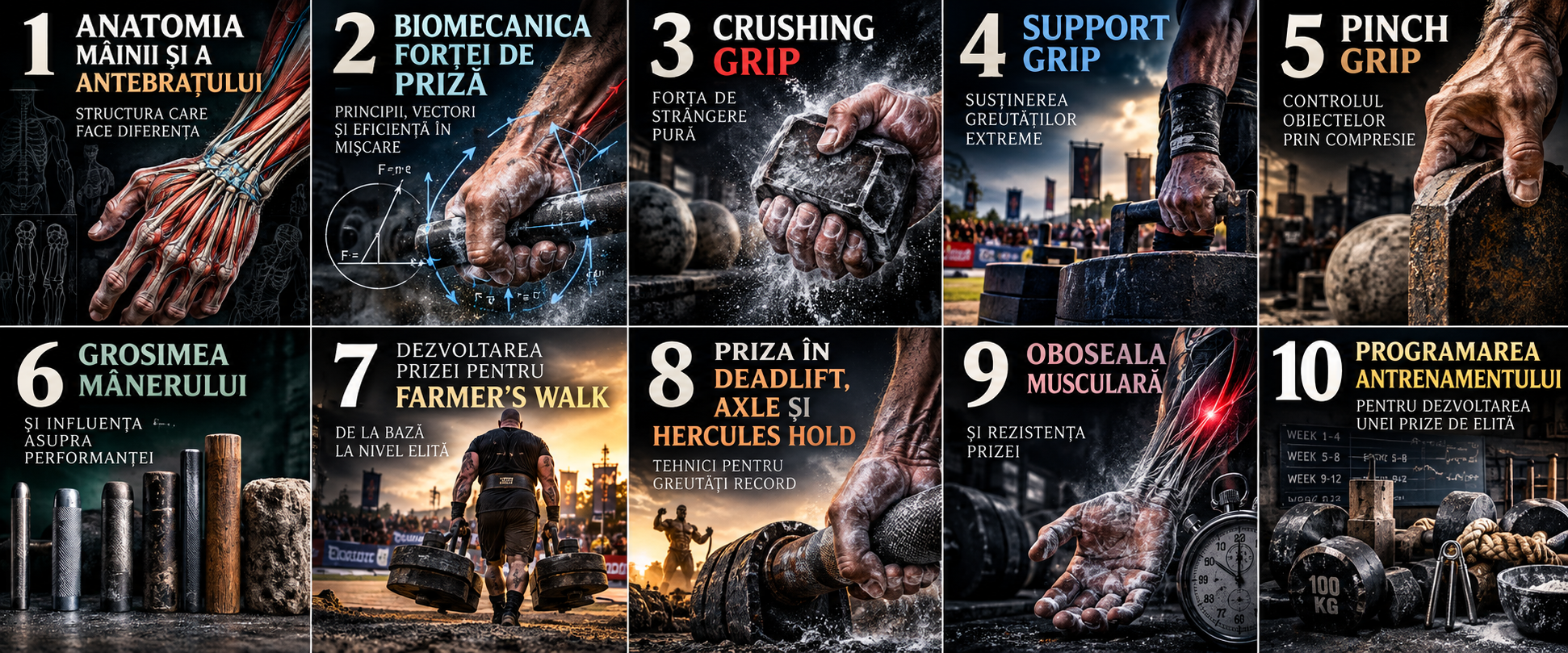
A strongman athlete's hand is the final link in a chain capable of moving hundreds of kilograms. In a deadlift, the legs and hips may produce enormous force and the trunk may remain stable, yet the bar can still slip from the fingers. During a farmer's walk, the implement travels with the body, and each step slightly alters the direction of the load. In a Hercules hold, the arms may remain steady while the fingers must preserve contact under almost continuous tension. What spectators call simply “grip” is the output of an elaborate architecture: bones, joints, muscles in the forearm and palm, long tendons, nerves, guiding structures, skin and a nervous system that coordinates the entire arrangement almost instantaneously.
It is tempting to judge hand strength by forearm circumference. A thick forearm seems to promise an unbreakable hold, yet visible size cannot tell us by itself how much force reaches a handle, in what posture, for how long and at what energy cost. Two athletes of the same body weight can perform very differently on a dynamometer, a thick bar or a loaded frame. One may have strong long finger flexors; another stabilizes the wrist more effectively. One benefits from favorable hand geometry; another has adaptations closely matched to the event. Anatomy cannot explain performance on its own, but it establishes the opportunities and constraints that training attempts to exploit.
This series begins with an apparently modest question: what actually squeezes an object when we say that someone has a strong grip? The first episode treats the hand and forearm as a functional system rather than an inventory of Latin names. We will follow force from forearm muscle fibers to the fingertips, see why the thumb fundamentally changes how an object is held, and explain why muscles often dismissed as antagonists to gripping are essential to wrist stability. We will also consider skin, sensation, local fatigue and joint posture. Later episodes will examine biomechanics, crushing, supporting, pinching, handle diameter, and strongman-specific events separately.
An important limitation must be stated from the outset. Most anatomical, biomechanical and clinical studies of hand strength concern the general population, medical practice, rehabilitation, ergonomics or other sports. These findings provide credible mechanisms and testing principles, but they do not transfer automatically to an athlete carrying 160 kilograms in each hand or holding an unusually thick axle. When connecting anatomy to strongman we will distinguish demonstrated findings from plausible explanations and practical hypotheses. That distinction does not weaken the article. It prevents useful observations from becoming imaginary universal laws.
What Do We Actually Mean by Grip Strength?
In everyday language, grip describes the way the hand holds an object. In biomechanics the term conceals several distinct tasks. You can crush a dynamometer between fingers and palm, support a weight without visible movement, pinch a plate between thumb and fingers, secure a bar that tends to roll or control an implement repeatedly disturbed during walking. All involve muscle activity, but they do not require the same distribution of forces. A single testing number cannot therefore capture a person's entire grip capacity. It describes performance in a particular test, posture and moment [8, 9].
We can conceptually distinguish maximum voluntary force, endurance at a submaximal intensity, rate of force development and precision of force regulation. An athlete may produce an impressive peak for one second without retaining the same percentage of capacity for a minute. Another has a smaller peak yet holds sufficient tension until the event ends. That second outcome is not an isolated property of “endurance fibers” in the forearm: circulation, relative effort, holding technique, friction, discomfort and sustained neural drive are also involved. Numbers without context quickly become misleading labels.
Another distinction separates the force a muscle can generate from the force transmitted at the hand–object interface. If the skin slides on metal, the object is lost even when the finger flexors have not reached physiological exhaustion. If a handle is too thick for a mechanically effective finger wrap, the athlete must use a different strategy from that used with a standard barbell. If the wrist collapses into flexion, the muscle length and joint-moment relationships change. Performance emerges from interactions, not an abstract reservoir of “power in the palm”.
Grip strength must not be equated with whole-body strength, although the two are associated in some populations. Dynamometry is often used in clinical practice as a functional indicator because it can be administered quickly and its measurement properties have been studied [8]. In strongman the more useful question is: which quality limits today's event? If a competitor drops a frame because the handle slips, the intervention may differ from one intended for an athlete whose fingers gradually open despite adequate friction. Before prescribing exercises, one must identify the actual constraint.
The expression “strong hands” is sometimes applied to every successful pulling performance. But a mixed-grip deadlift does not load both hands symmetrically, a hook grip changes the involvement of the thumb, and straps transfer part of the supporting demand to the fabric and more proximal structures. None of these choices constitutes moral proof of strength or weakness. They are mechanical solutions with different benefits and costs. Understanding anatomy allows us to evaluate those differences without slogans about the supposed legitimacy of an exercise.
We will use four anatomical landmarks throughout. Extrinsic muscles lie mainly in the forearm and send their tendons into the hand. Intrinsic muscles lie within the hand and adjust finger and thumb position. The osteoarticular system supplies the levers; the nervous system commands and corrects force. Skin and contact tissues complete the arrangement because an object is held through forces acting at a surface, not through tendons alone. These parts do not work as isolated stages in a rigid sequence. Each changes what the others can achieve.
The Skeleton: A Framework for Transmitting Force
The wrist and hand contain twenty-seven bones: eight carpals, five metacarpals and fourteen phalanges. This is more than an anatomical trivia question. It helps explain how the hand can turn relatively simple muscle actions into highly diverse contacts. The carpus is a compact assembly that distributes loads and permits hand orientation relative to the forearm. The metacarpals form the palm's framework and arches. The phalanges bring contact surfaces toward the object and adjust local pressure. A thin bar, thick handle and plate edge place these levers in markedly different positions.
The four long fingers each contain proximal, middle and distal phalanges. The thumb has only two, but also a remarkably mobile basal articulation. Metacarpophalangeal joints allow flexion and extension as well as the lateral movements needed to spread and close the fingers. Interphalangeal joints are more hinge-like. During gripping, simply bending every joint is insufficient. The angles between segments determine where the handle rests, which surfaces touch it and how effectively the tendons can act. Joint position provides an explanation for several grip differences before muscle strength is even considered.
The transverse and longitudinal arches of the palm allow the hand to conform to objects with different curvatures. A rigid hand whose segments always moved together would be a poor tool for controlling a cylinder. In reality, the fingers adjust local pressure and the palm modifies its contact shape. In strongman this matters when handles are imperfect, contain welded joints, differ in thickness or are subjected to acceleration. Conforming to a surface creates opportunities for transmitting force, but does not guarantee greater support: the object's material, the skin and load direction remain important.
The thumb deserves attention even before individual muscles. Its opposable position makes it possible to close a contact circuit with the other digits. When grasping a handle it can reinforce the hold or, in some techniques, form a locking point against rotation. In a pinch grip it becomes central: without functional opposition, finger force is not efficiently transformed into compression between surfaces. The difference between hooking an object with the fingers and securing it between thumb and palm is fundamental throughout this series. The thumb cannot be dismissed as merely the shortest digit.
Beyond the skeleton, joint capsules, ligaments and fibrocartilaginous structures guide movement and contribute passive stability. When an athlete says a particular position “feels right in my hand”, they may be describing a favorable balance between mobility, contact and stability without realizing it. But discomfort is not always a matter of getting used to a posture. Focal pain following an abrupt twist, joint swelling or inability to move a finger normally may indicate an injury that should not be hidden beneath another set of heavy holds.
Extrinsic Muscles: Engines Located in the Forearm
A common mistake is to search for the main grip muscles entirely within the palm. Much of the force that bends the fingers actually comes from muscles in the forearm, sometimes surprisingly far from the contact point. Their muscle bellies are substantial compared with the smaller structures in the palm, and their tendons cross the wrist and reach the fingers. This arrangement permits considerable muscle capacity without making the hand excessively bulky. The hand retains mobility and sensation, while the forearm supplies much of the required force. Anatomists call these muscles extrinsic precisely because their main muscle mass lies outside the segment they move [1, 2].
The forearm is not a uniform cylinder of muscle. It is a functional arrangement of bones, interosseous membrane, fascia and several muscle layers. In a useful simplification, flexors and pronators predominate on the anterior side and extensors and supinators on the posterior side, although innervation and muscle paths provide important exceptions. Superficial layers are more readily palpated, yet some crucial finger motors lie deeper. In practical terms, an exercise that seems to target only the underside of the forearm may simultaneously load finger flexors, wrist stabilizers and structures near the elbow. Anatomy helps prevent the mistaken assumption that the place where we feel fatigue is necessarily the only structure responsible.
The flexor digitorum superficialis is an important muscle of the anterior compartment. It sends tendons toward digits two through five and acts especially on the proximal interphalangeal joints, between the proximal and middle phalanges. It also contributes to metacarpophalangeal flexion. When we grasp a handle it acts alongside the deeper flexors and intrinsic hand musculature. The important detail is that its mechanical influence is joint-specific. There is no single generic cable that “closes the hand”; several tendons insert at different places, and each alters the distribution of force [2].
The course of the superficial flexor tendons illustrates the efficiency of anatomical design. Within each finger, the tendon splits to allow the deep flexor tendon to pass through toward the distal phalanx. Instead of a single insertion restricting movement to one joint, force can be transmitted at several levels. This arrangement makes it possible to bend the middle portion of a finger while retaining some separate control of its distal part. Independence is not perfect because tendons, muscle architecture and neural commands are interconnected. Yet it is sufficient to help explain the difference between grasping a bar and manipulating a thin plate.
The flexor digitorum profundus lies in the deep anterior forearm and inserts on the distal phalanges of digits two through five. That anatomical detail directly affects gripping: the final finger segments can press, wrap around a handle and resist being pulled open. If distal flexion is compromised, the geometry of contact can change markedly. During a heavy hold, gradual opening of the fingers can reflect a reduced ability to maintain the necessary flexion moments against the load. It does not mean that one isolated muscle has necessarily “failed”. The system is more complex [1, 2].
A muscle serving four fingers does not imply four perfectly independent motors. Muscle organization, connections between tendon units and individual variation may limit isolated movements. Anyone attempting to flex only the distal segment of the ring finger while stabilizing the others discovers this quickly. In strongman, these interdependencies can matter when one finger is forced into an awkward position at the edge of an implement while the others continue bearing weight. It would nevertheless be unjustified to assign every digit a fixed share of the load. Distribution depends on object shape, individual dimensions, joint angles and technique.
The flexor pollicis longus is the principal extrinsic muscle responsible for interphalangeal flexion of the thumb. Its tendon reaches the thumb's distal phalanx and works with muscles around the thumb base. In a hook grip, thumb flexion and positioning influence the way the other fingers compress it against the bar. In ordinary grasping, the thumb can help secure contact with the rest of the hand. The ability to tolerate pressure on the thumb also depends on sensation, local comfort, adaptation and surface material. Once again, no magical single muscle accounts for every performance difference.
When examining a loaded finger-flexion exercise, it is worth asking whether the resistance predominantly opposes proximal flexion, distal flexion or a combination. Segment angles determine which tendons enjoy useful moment arms and which other structures must stabilize. A coach who prescribes the closing of a very stiff gripper may improve that specific task, but cannot assume that all finger-flexor configurations develop equally. Transfer must be examined in conditions resembling the intended event. Anatomy explains why exercises share features; specificity explains why they cannot be exchanged indiscriminately.
Finger flexion must not be confused with wrist flexion. Flexor carpi radialis and flexor carpi ulnaris primarily move and stabilize the wrist rather than close the finger joints. They become particularly relevant when a bar tends to alter wrist orientation. A rolling bar may demand different wrist control from a fixed handle. Wrist curls can load the wrist flexors considerably, but do not automatically replace direct finger-flexor work. The label “forearm training” conceals functions that need to be distinguished.
The palmaris longus is an excellent reminder that simple anatomical predictions often fail. This muscle is congenitally absent in a variable proportion of the population, yet its absence does not automatically prevent powerful gripping. It may help tension the palmar aponeurosis and flex the wrist, but it is not the decisive motor behind a maximum supporting hold. Healthy anatomical variation shows why counting visible tendons or bumps on the forearm cannot serve as a performance assessment. The body possesses redundancy and compensatory options within the limits of its structures.
The Extensors: Muscles That Help the Fingers Grip
Training culture sometimes treats the extensors as supporting actors, trained only to “balance” the flexors. This view is too narrow. As the fingers close forcefully, their long flexor tendons also tend to produce a wrist-flexion moment because they cross the wrist. If the wrist were allowed to collapse without control, the finger muscles' working geometry would change. Wrist extensors can produce an opposing moment and preserve a useful position for transmitting force. Strong gripping may therefore require co-contraction: the simultaneous recruitment of muscles that ordinarily produce opposite movements in order to stabilize a joint.
Extensor carpi radialis longus, extensor carpi radialis brevis and extensor carpi ulnaris are key landmarks. The first two contribute to wrist extension and, with other actions, radial deviation. The third contributes to extension and ulnar deviation. They do not directly close the finger phalanges around a handle, but they can establish the conditions under which the digital flexors function effectively. In many tasks the wrist is held in moderate extension rather than deep flexion. This is not a universal technical command: object shape, body position and event requirements may demand other arrangements.
Studies of wrist position show that dynamometer readings depend partly on wrist angle. A study comparing grip strength and endurance at different positions found that moderate wrist extension could favor performance; the finding must nevertheless be interpreted in relation to its protocol, participants and instrument [7]. It would be incorrect to convert one observed angle into an immutable “ideal position” for every deadlift, axle or carrying frame. The practical lesson is simpler: if progress is measured with the wrist in one posture and retested in another, some of the apparent change may reflect geometry rather than training adaptation.
Extensor digitorum contributes to finger extension and to the control of digit positioning. Extensor indicis and extensor digiti minimi provide additional specialized options for the index and little fingers. These muscles help open the hand, prepare contact and recover between attempts. In a dynamic event, the time required to open, reposition and close the fingers again can matter. An athlete capable of tremendous force only in a static configuration may lose efficiency if hand repositioning is slow. Maximum strength and movement control are related abilities, not synonyms.
Finger flexors and wrist extensors continually exchange joint moments. Externally, an athlete holding a loaded frame may seem motionless. Internally, the load attempts to rotate individual segments, and muscles compensate. Small changes in finger angle influence tendon geometry, tension and contact distribution. Describing grip as “isometric” is a useful approximation of visible movement, not proof that every muscle fiber and tendon retains exactly the same length. During an apparently static hold, some tissues may shorten, others lengthen and still others store elastic energy.
A moment arm is the perpendicular distance between a force's line of action and a joint axis. If that distance changes, the same muscle tension can produce a different joint moment. This helps explain why extremely open grips, where fingers cannot wrap effectively around the object, can feel disproportionately difficult. The muscle has not suddenly become weak; the relationship between its output and the external demand has changed. We will examine these relationships in detail in episode two, devoted to grip biomechanics.
Training the extensors through wrist extensions, resisted finger opening or controlled lateral motions can serve a functional purpose, particularly in programs dominated by intense gripping and supporting loads. Yet evidence does not establish that one fixed ratio of flexion to extension sets prevents all hand injuries. A reasonable approach is to identify neglected functions, progress gradually and monitor symptoms rather than mechanically copy a formula. An athlete with wrist or elbow pain needs an appropriately specific assessment, not simply more rubber-band repetitions.
Forearm pronation and supination complete the ability to orient the hand. Pronator teres and pronator quadratus facilitate pronation, while the supinator and biceps brachii contribute to supination under different conditions. The radius moves relative to the ulna, turning the palm without requiring the entire trunk to rotate. For an athlete gripping handles that are poorly aligned or placed laterally, this ability may affect comfort and efficiency. It also explains why changing grip orientation on a rowing machine can alter the sensation in the forearm without automatically transforming the movement into a specialized grip exercise.
Brachioradialis is frequently associated visually with forearm development. It contributes to elbow flexion, particularly in intermediate forearm rotation positions, but it is not the main muscle closing the fingers. This distinction may sound pedantic until somebody assumes hammer curls can fully replace heavy supports and finger flexion work. Hammer curls may help develop the upper limb and its ability to stabilize various loads, but their primary mechanical action differs. A good program recognizes the difference between building the forearm region and training the act of grasping.
More From The Journal

Training
The Science of Strongman Training - Episode X: Competition Programming
How to build a complete Strongman competition preparation block: calendar, events, volume, intensity, specificity, simulations, autoregulation, tapering and fatigue management.

Training
The Science of Strongman Training - Episode IX: Peaking
Peaking in Strongman: how to turn months of training into maximal competition performance by reducing fatigue, preserving adaptations and managing specificity.