
Physiology
Strongman Physiology - Episode 5: Stress Hormones: Cortisol, Adrenaline and Noradrenaline
September 4, 2026

The first four episodes moved from the cardiovascular system and the heart under load to breathing, intra-abdominal pressure and then the autonomic nervous system. The next step is understanding what turns neural activation into a broader chemical response: stress hormones.
Cortisol, adrenaline and noradrenaline are among the best-known mediators of the stress response. In Strongman they appear in very different moments: before a maximal deadlift, during a medley, after a brutal event and throughout the hours of recovery. None of them is simply good or bad. Timing, dose, context and the body's ability to return toward balance all matter.
1. What does the hormonal stress response actually mean?
Physiological stress appears when the body detects a demand that rapidly changes its need for energy, circulation, ventilation or control. The sympathetic nervous system can react within seconds, while the hypothalamic-pituitary-adrenal, or HPA, axis contributes through a slower and more prolonged hormonal response.
In a Strongman athlete, these systems overlap. A maximal lift requires instant mobilization, while an entire training session can leave a stress signal that lasts long after the final repetition.
2. Adrenaline: fuel for the critical moment
Adrenaline, or epinephrine, is released mainly from the adrenal medulla in response to sympathetic activation. Its effects include increased heart rate and contractility, facilitation of glucose mobilization and preparation for rapid energy demand.
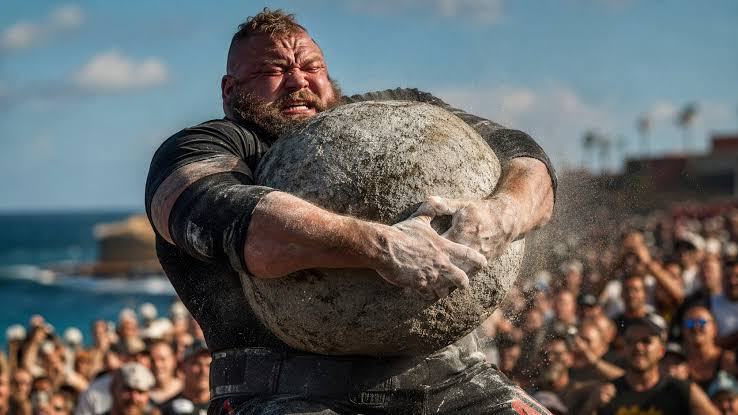
For a Strongman, adrenaline can be noticeable before the start: higher heart rate, a surge of energy, sweating, increased alertness and the feeling that the implement is lighter than it was in training. This state can help, but it does not automatically produce better performance. Excessive activation can impair technical control.
3. Noradrenaline: neural signal and circulating hormone
Noradrenaline, or norepinephrine, acts both as a neurotransmitter of the sympathetic nervous system and as a circulating hormone. It contributes to vascular tone, redistribution of blood flow and the alertness required for effort.
The difference between adrenaline and noradrenaline should not be reduced to the idea that one is for the muscles and the other is for the brain. They act together through overlapping pathways that depend on tissue, receptor type and context.
4. Cortisol: a hormone of longer-lasting stress
Cortisol is the main glucocorticoid produced by the adrenal cortex. It is part of the HPA response and has important roles in metabolism, substrate availability and the response to stress.
During a very demanding training session, cortisol can rise as part of the normal response to stress. Unlike adrenaline, which can respond very quickly, cortisol dynamics extend over a longer interval and are strongly influenced by time of day, sleep, nutrition and psychological stress.
5. Cortisol is not the athlete's enemy
A temporary rise in cortisol does not automatically mean that training was too hard or that the body has entered a pathological state. An acute hormonal response is part of normal adaptation to training stress.
The more interesting problem is the repeated context: when volume, intensity, psychological stress and insufficient recovery accumulate, fatigue can increase and hormonal markers may reflect the total load. Even then, no single test diagnoses overtraining.
6. The HPA axis: hypothalamus, pituitary and adrenal glands
The HPA axis works through a sequence of signals. The hypothalamus releases CRH, the pituitary responds with ACTH, and the adrenal cortex produces cortisol. Cortisol then provides negative feedback to the hypothalamus and pituitary.
This is a control system, not a simple alarm button. It needs to switch on when demand requires it and switch off when the demand has passed.
7. What happens before a maximal deadlift?
Anticipation of maximal effort can activate the sympathetic system before the actual muscle contraction begins. Concentration, visualization, crowd noise, an opponent and the stakes of competition can all change physiological state before the start.
At this point, adrenaline and noradrenaline are likely more important for immediate mobilization than cortisol. In other words, the athlete can enter action mode before the bar leaves the floor.
8. Stress hormones and energy availability
Adrenaline and noradrenaline help mobilize energy rapidly, while cortisol contributes to maintaining substrate availability during more prolonged stress. During exercise, blood glucose regulation and fuel use must be coordinated with muscular demand.
For a Strongman, this matters especially in long events, medleys and competition days with multiple events. One maximal repetition and five hard events on the same day do not create the same hormonal demand.
9. Why can adrenaline make effort feel different?
Sympathetic activation can increase alertness and change perceived effort. In competition, an athlete may feel a level of aggression and energy that is absent in ordinary training.
Still, more adrenaline does not mean more strength in every situation. Excessive activation can increase unnecessary muscular tension, accelerate breathing and make technical control harder.
10. Why do your hands sweat before an event?
Sweating is part of the autonomic response to stress and exercise. Sympathetic activation and rising body temperature contribute together. Before an important event, sweating can begin even before physical work starts.
11. Cortisol and the circadian rhythm
Cortisol is not static throughout the day. Under normal conditions it follows a circadian rhythm, with higher levels in the morning and a decline across the day. A single measurement therefore says little without knowing when it was taken.
For an athlete, this means two tests taken at very different times should not be interpreted as directly comparable.
12. Sleep, cortisol and recovery
Insufficient sleep can alter HPA regulation and endocrine responses to stress. For a Strongman, an identical session may feel and respond differently after a poor night than after a period of good sleep.
Sleep should therefore be treated as part of performance physiology, not simply as time in which you are not training.
13. Cortisol and nutrition
Energy availability and food intake influence the stress response. Severe energy restriction combined with heavy training can add another layer of physiological stress.
In Strongman, where energy demand can be high, recovery is not just about reducing training. The body also needs the resources required to rebuild tissue, restore glycogen and maintain normal endocrine function.
14. Stress hormones and immunity
Cortisol has complex effects on immune function, and acute stress is not equivalent to chronic stress. One hard session does not automatically create clinically meaningful immune suppression, but prolonged stress and inadequate recovery can alter physiological responses.
For the athlete, the practical lesson is not to turn one hard day into a universal explanation for every symptom or infection.
15. Adrenaline and noradrenaline during a medley
In a medley, the sympathetic system remains active while muscular and metabolic demands change from event to event. Heart rate, ventilation, vascular tone and energy mobilization must be adjusted rapidly.
This helps explain why very short rest periods are difficult: the body does not return to baseline instantly, yet the next event begins before the previous response has fully disappeared.
16. After the event: when does real recovery begin?
Immediately after exercise stops, sympathetic activation begins to decline and parasympathetic mechanisms contribute to recovery. At the same time, cortisol and other endocrine signals do not disappear instantly. The body transitions gradually from mobilization toward repair and restoration of resources.
This connects directly with Episode 4: autonomic regulation and the hormonal stress response are closely related, but they are not the same system.
17. Acute cortisol versus chronic stress
An acute cortisol rise after exercise can be fully compatible with normal adaptation. The more important situation is repeated physical and psychological stress combined with insufficient recovery over time.
That context can be accompanied by changes in sleep, mood, performance and response to training. These are complex phenomena and cannot be summarized by one cortisol measurement.
18. Can cortisol tell you if you are overtrained?
No. Cortisol has substantial variability and is affected by many factors. In sport, no isolated hormonal marker can by itself diagnose overtraining syndrome.
Useful assessment combines performance, symptoms, sleep, psychological state, training load and, when justified, medical or laboratory data interpreted by qualified professionals.
19. Hormones and perceived fatigue
Perceived fatigue is not only a matter of lactate and not only a matter of muscle. The brain integrates endocrine, metabolic, cardiovascular and psychological signals to construct the sense that an effort is easy, hard or impossible.
That is why the same load can feel different on two different days even when maximal muscular capacity has not changed dramatically.
20. What happens when competition amplifies the response?
Competition adds a psychological layer to mechanical stress. Anticipation, spectators, rivalry and the consequences of a missed attempt can increase sympathetic activation and the catecholamine response.
This is one reason an athlete can perform well above or below what training predicted. Variability is not explained by muscle alone.
21. Why calm is a performance skill
Calm does not mean an absence of sympathetic activation. It means control of it. An athlete can be highly activated before the start while still keeping breathing, technique and decisions under control.
This is why a consistent pre-event routine can be valuable: not because it magically changes hormones, but because it may reduce unnecessary variability in arousal state.
22. Recovery and hormonal normalization
Hormonal recovery is influenced by exercise intensity and duration, sleep, energy intake, psychological stress and training status. Not every endocrine component returns at the same speed.
Recovery is therefore not one simple downward curve. Heart rate can fall within minutes, ventilation can normalize relatively quickly, while endocrine and metabolic processes may continue long after the athlete feels functional again.
23. How can we reduce unnecessary stress without reducing useful intensity?
The goal is not to eliminate the stress response. Without sympathetic mobilization and acute endocrine signaling, maximal effort would be harder to sustain. The goal is to avoid stress that adds little performance or adaptation.
That means sound programming, controlled volume, appropriate rest periods, enough sleep, adequate energy intake and management of non-training stress.
24. What signs suggest accumulated stress?
There is no single symptom. A more meaningful pattern includes persistent performance decline, poorer sleep, unusual fatigue, mood changes, higher resting heart rate, difficulty recovering and reduced tolerance to training.
When that pattern persists, the answer is not to search for a supplement that 'lowers cortisol'. The first step is to address the source: excessive load, lack of sleep, inadequate intake, psychological stress or a medical issue.
25. Conclusion: stress is not the enemy, it is the signal
Adrenaline and noradrenaline help turn on the performance system. Cortisol supports mobilization and management of stress that can last longer. Together with the autonomic nervous system and the HPA axis, they allow the body to move from rest to action and then back toward recovery.
In Strongman, the problem is not having stress hormones. The problem appears when stress becomes too high, too frequent or poorly recovered. A good athlete does not try to eliminate the stress response. The athlete learns to use it during the event and then allow the body to shut it down afterward.
References and recommended reading
1. McEwen BS. Physiology and neurobiology of stress and adaptation: central role of the brain. Physiol Rev. 2007;87(3):873-904.
2. Kraemer WJ, Ratamess NA. Hormonal responses and adaptations to resistance exercise and training. Sports Med. 2005;35(4):339-361.
3. Hill EE, Zack E, Battaglini C, Viru M, Viru A, Hackney AC. Exercise and circulating cortisol levels: the intensity threshold effect. J Endocrinol Invest. 2008;31(7):587-591.
4. Duclos M, Tabarin A. Exercise and the hypothalamo-pituitary-adrenal axis. Front Horm Res. 2016;47:12-26.
5. Meeusen R, Duclos M, Foster C, et al. Prevention, diagnosis, and treatment of the overtraining syndrome: joint consensus statement. Med Sci Sports Exerc. 2013;45(1):186-205.
6. Review literature on catecholamines, acute exercise stress and sympathetic activation in resistance exercise.
Editorial note: hormonal responses are context dependent. Isolated hormone values should not be interpreted as a medical diagnosis.
More From The Journal

Training
The Science of Strongman Training - Episode X: Competition Programming
How to build a complete Strongman competition preparation block: calendar, events, volume, intensity, specificity, simulations, autoregulation, tapering and fatigue management.
Training
The Science of Strongman Training - Episode IX: Peaking
Peaking in Strongman: how to turn months of training into maximal competition performance by reducing fatigue, preserving adaptations and managing specificity.