
Analysis
Series: THE ECONOMICS OF STRONGMAN: THE MONEY BEHIND STRENGTH - Episode 3: Sponsorship and Commercial Partnerships
October 27, 2026
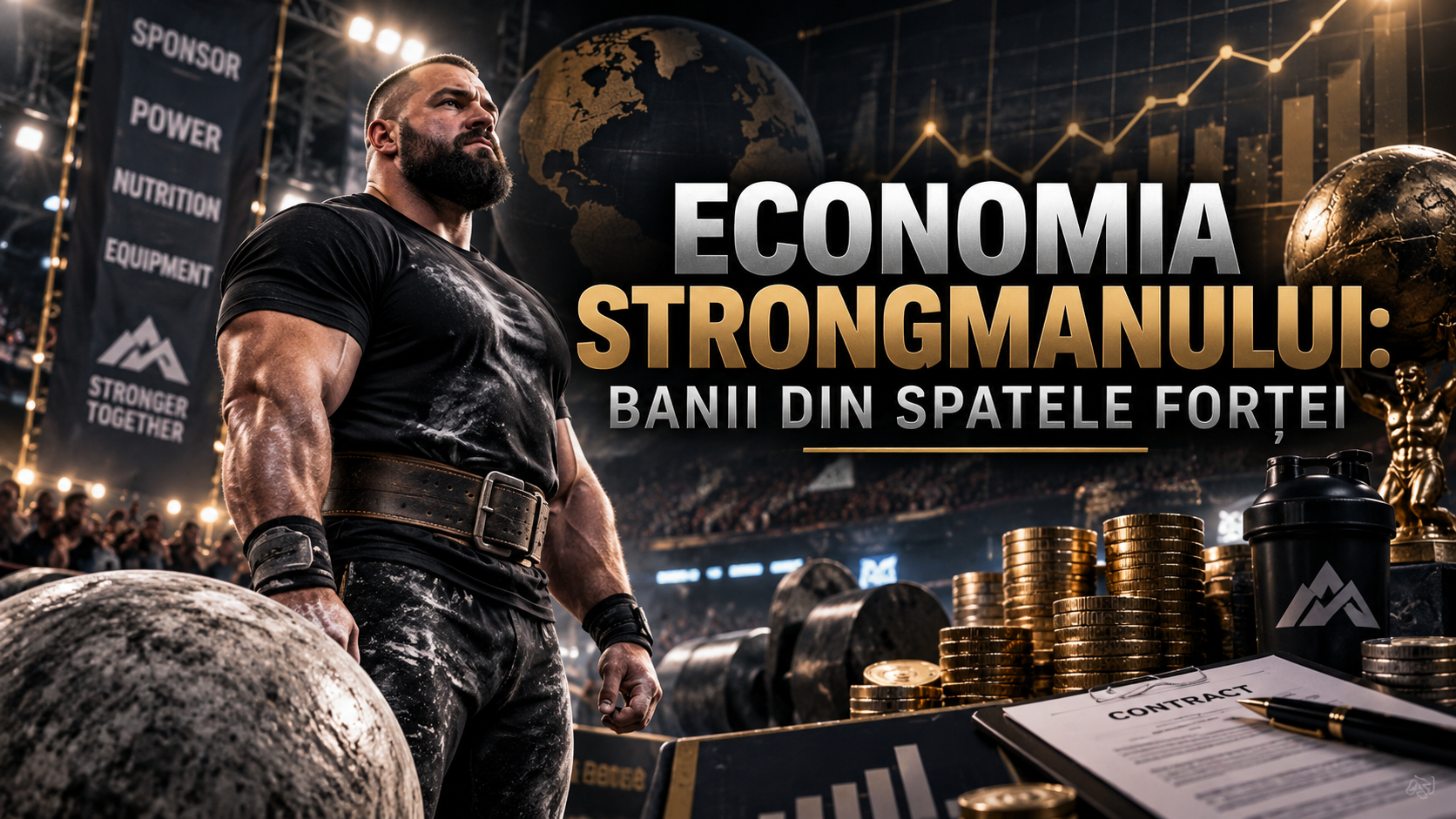
A heavy yoke, an athlete battling fatigue and a cheering arena can make unforgettable content. A sponsor nevertheless needs to know who saw that content, whether the association was credible and whether any agreed commercial outcomes were delivered. For athletes, financial partners may determine whether expensive international travel or specialist equipment is available. Episode Three of “THE ECONOMICS OF STRONGMAN: THE MONEY BEHIND STRENGTH” examines these exchanges through sponsorship research, commercial measurement and the distinction between legal sponsorship, advertising contracts and image licensing. All calculated monetary examples are illustrative rather than industry rates.
1. What a sponsor buys
A business may support an eligible nonprofit activity, purchase advertising inventory, commission promotional services or license athlete imagery. The social-media output may look similar, but the contractual and tax categories are distinct. Romanian Law No. 32/1994 defines sponsorship subject to particular requirements, including a written agreement specifying its scope, value, duration, and rights and obligations. It would be wrong to assume every payment to a competitor for a promotional post automatically falls under that framework [4].
The commercial objectives can include awareness, community engagement, product trial or attributable sales. The athlete can promise controllable deliverables, such as scheduled posts, appearances, licensed photographs and reports, but cannot guarantee victory or purchase behaviour. T. Bettina Cornwell's 2019 work encourages marketers to understand sponsorship beyond simple advertisement exposure, emphasizing meaningful and authentic engagement [1]. Successful collaboration begins by agreeing which kind of value is actually being purchased.
2. Sport-event and brand fit
Liu and Liu's 2025 meta-analysis considered 57 effect sizes from 31 studies involving 15,744 people and found positive associations between sponsor-event fit and cognitive, emotional and behavioural consumer responses [2]. This does not establish a precise expected return for a strongman contract. The contexts and populations differ. Functional fit can involve strength equipment, transport or training services, while symbolic and local fit can link other brands credibly to a competition.
A 2023 Psychology & Marketing investigation of community identification, authenticity and sponsor-club congruence in soccer settings also found that authenticity and group attachment influence sponsorship responses [3]. A specialist equipment brand can still fail commercially if its communication seems artificial, while a less obvious partner can build credible ties through sustained support. Strongman promoters should treat these findings as hypotheses to be tested with their own audiences, not ready-made conversion multipliers.
3. Cash, in-kind support and affiliate arrangements
A cash agreement can fund costs across many categories; in-kind assistance substitutes for a particular expense but does not automatically provide liquidity. Imagine three hypothetical offers: €2,000 cash; necessary travel services worth €1,600 plus €300 cash; or products labelled €2,500 of which the athlete would realistically buy only €700. Their declared package values do not tell the athlete how much unavoidable expenditure has been avoided. Managerial utility and tax valuation may also differ.
Affiliate payments are typically contingent on attributed sales, returns and contract terms, whereas fixed remuneration pays for defined work. Hybrid deals can compensate production hours and add measured performance incentives. Athletes should examine fees, delays, reversals and the cost of creating materials instead of treating headline commission percentages as profit. A complimentary product remains unsuitable if it is unsafe, irrelevant or cannot be used in the intended competition.
4. Building a priced sponsorship proposal
A useful proposal states audience characteristics and how they were measured, credible athletic achievements, deliverables, channels, deadlines, reporting methods, intellectual-property rights and costs. Merely displaying a follower count is weak evidence of buyer relevance. Pricing can consider production costs and labour, comparisons with similar niche access, and the potential value to the buyer. No one approach guarantees the correct market price.
Suppose a hypothetical €1,200 contract covers two videos and one appearance, with €300 production costs and €150 travel expenses. Only €750 remains before tax and athlete labour. If the brand then requests two years of paid advertising rights, it is buying more than the original organic-use arrangement. Generic sponsorship tiers are meaningful only when naming rights, exclusivity, display placements, video integrations and other obligations are precisely defined and never sold twice.
5. Sponsorship activation beyond logo visibility
Activation turns purchased exposure rights into meaningful audience interactions. A training-equipment demonstration, an educational video or a well-managed brand stand may communicate more than a passive banner. However, activation space and filming must not obstruct judging, warm-up routes or medical access. Spectators visit a strongman contest primarily for sport, and sponsor communication should add intelligible value rather than overwhelm the event. Specific objectives are essential: relevant product trials, qualified enquiries or measurable interest, not the vague claim that every visitor became a customer.
Activation has a cost. A hypothetical €5,000 package requiring €1,200 in video production, €600 stand construction, €400 materials and €300 extra staff leaves a €2,500 direct contribution before additional costs and taxes. The promoter should not confuse package face value with available event financing. A fulfilment register listing rights, production owners, deadlines, territory and evidence protects against double-selling exclusive assets and excessive last-minute requests.
6. Measuring sponsorship responsibly
Reach, impressions, completed video views, unique viewers, watch time, ticket scans and conversions are not interchangeable units. A professional report names each indicator's platform, period and definition. Delivery metrics measure whether posts or physical placements were provided; response metrics measure attention or engagement; commercial outcomes can include attributed purchases or qualified sales enquiries. Publishing ten agreed posts does not alone demonstrate that a campaign increased sales.
Return on investment calculations need an incremental profit estimate, not merely gross revenue. Imagine a hypothetical €2,000 campaign leading to 100 attributed orders with €18 contribution per order after variable product costs. The measured contribution is €1,800 and the direct observed result is –€200 before possible long-term brand effects. This does not prove that the campaign has no future value, but claims of profitability require stronger evidence. Promotional links and coupons can undercount delayed purchases and overstate attribution when discounts or other advertisements are involved. Small strongman audiences can make statistical estimates unstable, so uncertainty should be discussed openly.
7. Commercial contracts and image licensing
Good contracts specify parties, scope, deliverables, fees, currencies, payment dates, expense ceilings, content approval, licence terms, data protection, injury contingencies and termination. Vague promises to 'cover travel' are inadequate if they do not state who books transport, which costs qualify and when reimbursement occurs. Exclusive agreements must define product category, market, channel and time frame. A broad ban on dealing with 'other sport brands' can unexpectedly exclude legitimate revenue streams.
Organic image use and paid advertising rights differ. A photograph allowed on a sponsor's webpage for three months does not automatically authorise global paid advertisements for years. Photographers may own relevant copyright, while athletes may hold separate rights concerning their portrayal. Injury or medically necessary withdrawal should be handled through proportionate replacement deliverables or agreed cancellation rules, not a commercial incentive to compete while unfit.
8. Disclosure, ethics and consumer protection
The European Commission's Influencer Legal Hub explains that commercial partnerships and affiliate marketing, including arrangements paid through products or services, can require disclosure of commercial intent under EU consumer law [5]. US Federal Trade Commission guidance gives clear examples of conspicuous disclosure of material relationships, although the US rules must not be presented as Romanian law [6]. Transparent labelling helps viewers understand the credibility and independence of a recommendation.
Strongman sponsorship creates particular risks when product marketing makes claims about supplements, injury treatment or guaranteed strength improvement. Payment does not establish clinical evidence. An athlete's personal experience cannot substantiate an unsupported universal health claim. Organisers and athletes also need to check conflicts between competing exclusive partners before accepting a deal, particularly when apparel, arena branding and broadcast rights overlap.
9. Renewal, measurement and long-term trust
An annual partnership can improve predictable cash flow and enable learning across campaigns. Its value is not a licence to control an athlete's image indefinitely. Review windows, renewal criteria, documented deliverables and realistic contingencies are useful. End-of-event reports should show what was actually installed and published, the measurement method used and the commercial indicators that can reasonably be linked to the sponsorship.
When an event is postponed or an athlete withdraws, prompt factual communication and realistic amendments protect relationships. Inflated audience figures and fabricated advertising equivalence may win a negotiation temporarily but damage market trust. Sustainable Romanian strongman partnerships can grow from relatively small, transparent and repeatable agreements, particularly when niche audiences and genuine community benefits are well documented.
10. Hypothetical athlete partnership
Consider a €4,800 annual equipment-brand contract paid as twelve €400 instalments, in exchange for four filmed demonstrations, eight educational posts and certain limited organic-use rights. If the athlete spends €600 on production and €400 on travel, the direct contribution is €3,800 before taxes and the value of labour. At 70 hours of work, a simplified direct contribution per hour is approximately €54.29, but that number is not a fair standalone price for reputation or image licences. More deliverables and additional territory-specific advertising rights should be negotiated rather than treated as free amendments.
Imagine the brand targeted 120 qualified enquiries but recorded 85 attributed enquiries and 40 product trials. The two measures should not be added casually because some people may appear in both groups. A simultaneous rise in brand searches is also not proof that the athlete's campaign alone caused it. Renewal negotiations should review the quality of leads, fulfilment, costs and realistic future changes rather than rely only on medal counts or claims of visibility.
11. Hypothetical event with tiered sponsors
A €24,000 event might sell a €8,000 headline package, two €2,500 packages and four €500 local packages, generating €15,000 nominal cash contracts. If commercial fulfilment costs €3,000, their direct contribution becomes €12,000 before other allocations. An additional donated truck might save a real logistics cost but should not be treated as deposited cash. Payment timing matters: a headline sponsor paying half after the post-event report leaves less working capital than an equally valued package prepaid in full.
Sponsor inventories must clearly allocate naming rights, exclusivity, arena placements and video usage, preventing duplicate sales. A promoter should not guarantee hundreds of thousands of views without reliable evidence or a financed media-delivery mechanism. Controllable deliverables and honestly reported audience results create a more durable offer than speculation.
12. Local, international and specialist markets
Local sponsors may value community engagement, employee attendance or the practical provision of hotel rooms and transport. International partners may prioritize multilingual content, defined distribution territories, athlete appearances abroad and standardised reporting. Neither category automatically pays more. Legal and administrative complexity can rise with currency, cross-border invoicing, licence territory and multiple brand relationships.
Strongman audiences may be commercially small but highly relevant to specialist equipment suppliers. A maker of expensive yoke components might value a limited number of qualified buyers more than large-scale general views. Audience data should be sourced, aggregated and collected lawfully; exact percentages must never be invented to make a media kit look impressive.
13. Reputation and editorial independence
Morality and reputation clauses should protect against documented serious conduct while avoiding arbitrary control over lawful, honest speech. For athletes who publish educational or scientific analysis, sponsors must not silently purchase the findings. Paid editorial relationships should be disclosed and product claims supported by suitable evidence. Independent information can itself become a long-term reputation asset.
Conflicts between personal and event-wide sponsors should be checked before signing, including what logos may appear on camera and how long exclusivity lasts. Commercial obligations cannot justifiably override medical fitness, fair judging or evidence-based health advice. Long-term audience trust has commercial value precisely because it cannot be manufactured by purchasing every statement.
14. Practical contracting in Romania
A practical proposal links the sponsor's business objective to audience data, named deliverables, verified athletic history, price and reporting. A travel-support request can itemise route, accommodation, essential costs and documentary outputs. A one-event pilot may provide better learning and lower uncertainty than a broad long-term exclusivity demand before the parties know whether the partnership works.
Romanian law distinguishes sponsorship from ordinary promotional services [4]. Tax treatment, invoicing, rights and consumer transparency depend on the real transaction and should be checked rather than assumed from the contract's title. A private commercial opportunity register helps athletes track payments, exclusivity, delivery costs and competing commitments without publishing confidential terms.
15. Conditions for sustainable partnerships
A viable sponsorship has a clear purpose, an achievable deliverable list, timely payments, responsibly allocated risks and credible measurement. Smaller deals do not need elaborate analytics departments, but both parties should know what was delivered. Larger deals can justify stronger audience analysis, licensing and contingency clauses. The consistent principle is that accurate records lower future negotiation costs and support repeat contracts.
Sometimes refusing an apparently generous offer is economically rational when exclusivity blocks better opportunities, unsupported claims threaten reputation, payment delays create liquidity crises or appearances conflict with recovery. Sponsorship should finance sport without purchasing sporting results or scientific conclusions. Its legitimacy rests on credible association, real services and a measured understanding of commercial outcomes.
16. From reach to incremental commercial effects
Growth during a sponsorship campaign is not necessarily caused by that sponsorship. Sales may increase because of pricing, product launches, other advertising or seasonal demand. An attribution link is helpful but does not establish causal proof. A cautious design compares reasonably similar periods or audiences and acknowledges external influences. If a company sells 200 training belts rather than 150 during a previous reference period, the extra 50 cannot simply be credited to one athlete if discounts and distribution expanded simultaneously.
Consumer recognition, emotional response and buying behaviour should also be measured separately. The Liu and Liu 2025 meta-analysis examines different response categories in sport marketing [2], but the evidence does not establish an exact conversion rate for strongman. Expensive specialist equipment may have a long consideration cycle; repeated high-quality educational engagement can matter even when immediate purchase is absent. Small sample sizes make detailed uncertainty disclosure especially valuable.
17. Governance and commercial dependence
An athlete deriving nearly all reliable income from one sponsor is vulnerable to cancellation, late payment and new exclusivity demands. Promoters face the same concentration risk when a headline partner funds prizes, venue and filming. There is no universal safe dependency percentage, but a credible plan should test the consequences of losing the largest contract. Diversification needs to remain compatible with brand integrity and sporting objectives.
Commercial registers identifying commitments, due dates, territorial rights, deliverables and evidence of completion can prevent duplicate promises. More sophisticated events may need separate legal review and delivery approval. Sponsors may support production and appearances, but not interfere with fair judging, medical decisions or accurate scientific commentary.
18. Transparent sponsorship reporting
Reliable reporting does not require public disclosure of every athlete's private finances. Event operators can explain general sponsor categories, disclose sponsored content, define audience measures and confirm relevant deliverables. Athletes can distinguish cash received from donated products and identify advertising clearly. Publishers can preserve editorial independence by disclosing support while maintaining evidence-based conclusions.
Useful operational measures include timeliness of payment, completeness of promised materials, resolved exclusivity conflicts and measurement quality. Small, consistently executed contracts may contribute more to long-term trust than inflated visibility promises. A sustainable market is one in which athletes, organisers, sponsors and spectators can understand the exchange of value without being misled.
Before signing, athletes and organisers can test the proposal against five questions: is the connection between brand and audience credible, are deliverables feasible within a real training or event calendar, are payments and costs precise, are exclusivity and image rights appropriately limited, and can outcomes be reported without inflation? Unclear answers should prompt negotiation, not be hidden by the general label 'partnership'.
Researchers should distinguish effectiveness from efficiency. A campaign might achieve its stated awareness goal while consuming excessive resources; another might generate cheap impressions without changing meaningful buyer behaviour. Good evaluation examines both outcomes and the resources used. Fewer well-delivered agreements can create more sustainable value than a wall of logos whose audience or business results cannot be explained.
Conclusion
Sponsorship can sustain training, travel, contests and sports media, but only when the interests and obligations of each party are explicit. Research indicates that event-brand fit, authenticity and community identification influence consumer reactions in multiple sporting contexts [1–3]. These findings do not quantify the Romanian strongman sponsorship market. Commercial professionalism therefore requires grounded proposals, lawful disclosure, measured performance and realistic use of athlete image rights.
Bibliography
[1] Cornwell, T. B. (2019), Sponsorship-Linked Marketing As Authentic Engagement, Journal of Advertising, DOI 10.1080/00913367.2019.1588809: https://www.tandfonline.com/doi/full/10.1080/00913367.2019.1588809
[2] Liu, Q. & Liu, B. (2025), Sports Event-Brand Fit: A Meta-Analytic Review, Frontiers in Sports and Active Living, DOI 10.3389/fspor.2025.1598708: https://pmc.ncbi.nlm.nih.gov/articles/PMC12230083/
[3] Moharana et al. (2023), Brand Community Identification, Authenticity and Sponsor-Club Congruence, Psychology & Marketing, DOI 10.1002/mar.21802: https://onlinelibrary.wiley.com/doi/full/10.1002/mar.21802
[4] Romanian Law No. 32/1994 on Sponsorship: https://legislatie.just.ro/Public/DetaliiDocument/204126
[5] European Commission, Influencer Legal Hub: https://commission.europa.eu/topics/consumers/consumer-rights-and-complaints/influencer-legal-hub_en
[6] Federal Trade Commission, Disclosures 101 for Social Media Influencers, US guidance: https://www.ftc.gov/business-guidance/resources/disclosures-101-social-media-influencers
[7] Eshghi et al. (2021), Sports Sponsorship Announcements and Shareholders: A Meta-Analysis, DOI 10.1016/j.ijresmar.2021.04.003: https://www.sciencedirect.com/science/article/pii/S0167811621000410
[8] OECD (2023), Competition and Professional Sports: https://www.oecd.org/content/dam/oecd/en/publications/reports/2023/10/competition-and-professional-sports_1359a069/f59e2263-en.pdf
More From The Journal
Analysis
Series: THE ECONOMICS OF STRONGMAN: THE MONEY BEHIND STRENGTH - Episode 8: Building an Athlete's Commercial Brand
Building a strongman athlete brand through verified performance, credible storytelling, audience, research, content, commercial offers and ethics.
Analysis
Series: THE ECONOMICS OF STRONGMAN: THE MONEY BEHIND STRENGTH - Episode 7: Media Rights and Broadcast Monetisation
How strongman media rights and broadcasting business models work: television, livestreams, video platforms, athlete images, licences and costs.