
Nutrition
Series: Digestion of a 140-Kilogram Athlete - Episode 7: Constipation and the High-Protein Diet
September 11, 2026
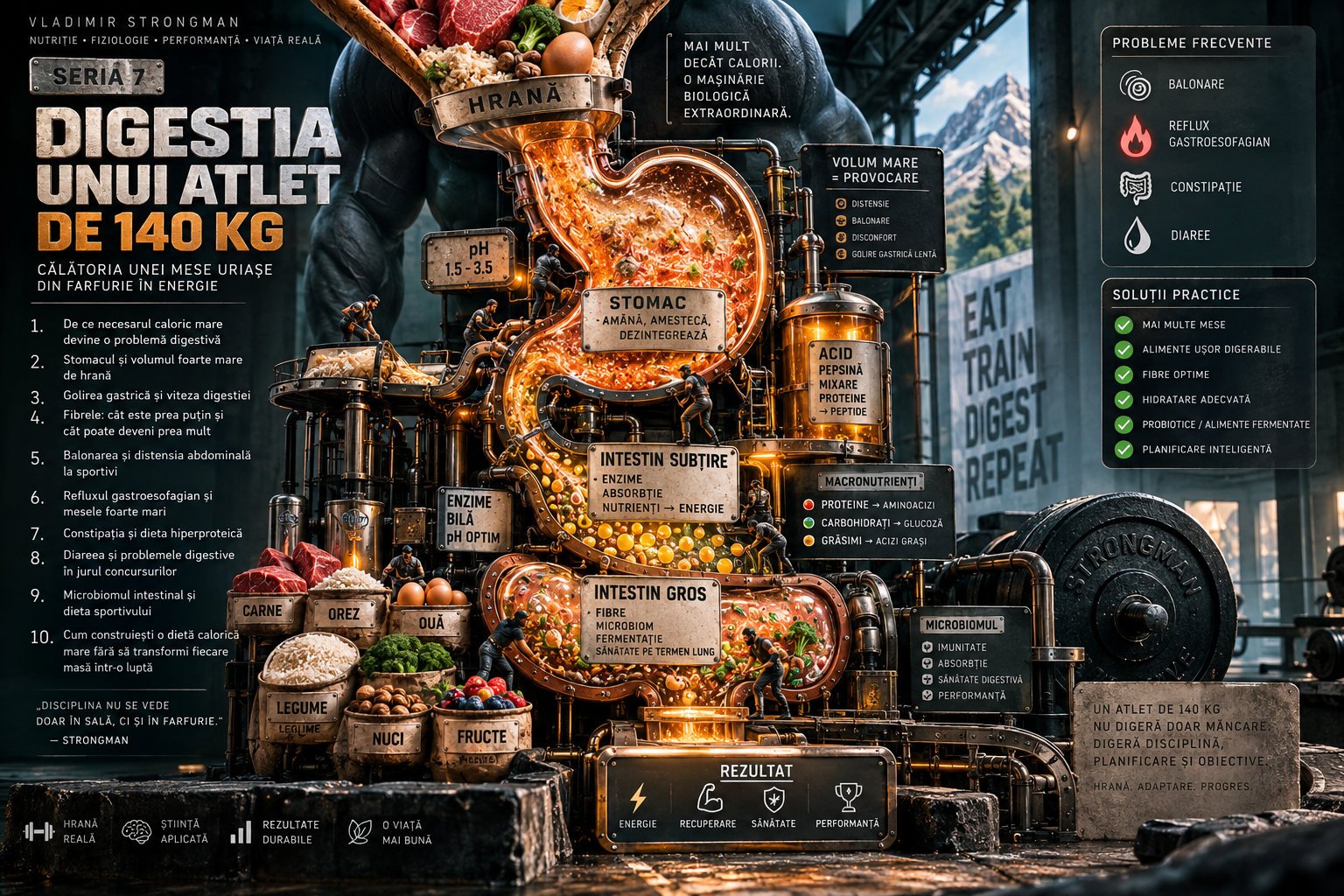
For a 140-kilogram athlete, constipation can seem paradoxical: food intake is high, sometimes extremely high, yet intestinal transit may still become slow. Total food quantity says little about how much fiber, water and residue actually reach the colon.
High-protein diets are often blamed directly, but the relationship is more nuanced. Protein does not block the intestine simply by being present; problems often appear when meat, eggs, dairy and shakes displace vegetables, fruit, whole grains, legumes and fluids.
Episode 7 examines constipation in strength athletes: what it really means, how fiber and hydration affect stool consistency, what role supplements and refined foods can play, and when symptoms deserve medical evaluation.
1. Constipation is not only about going to the toilet infrequently
Constipation can involve infrequent stools, hard stools, excessive straining, a feeling of incomplete evacuation or spending a long time trying to pass stool. Frequency is only one part of the picture.
An athlete may have a bowel movement every day and still be constipated if evacuation is consistently difficult. Conversely, someone may go less often without pain or straining, and that may simply reflect their normal pattern.
2. Protein is not automatically the cause
Meat, eggs, fish and protein powders contain little or no fiber, but that does not mean protein itself paralyzes the colon. A diet can be very high in protein and still contain adequate fiber and fluid.
The practical problem appears when the athlete increases protein and, without noticing, reduces plant foods. The diet becomes more energy- and protein-dense while producing less indigestible material to contribute to stool bulk.
3. Fiber displacement is the simplest mechanism
If every meal is built around huge portions of meat, white rice and protein shakes, vegetables, fruit and fiber-rich grains can easily become minor accessories.
A high-protein diet may therefore become associated with constipation not because protein is inherently the problem, but because the overall pattern becomes poor in components that retain water, increase fecal mass and support transit.
4. Highly refined foods leave little residue
White rice, white bread, some pastries, sugars and many processed snacks are easy to eat in large quantities but provide relatively little fiber.
For an athlete chasing high calories, these foods can be practical. The problem appears when nearly the entire diet becomes highly refined and the colon receives too little material capable of supporting a bulky, soft stool.
5. Water is essential for stool consistency
The colon reabsorbs water from intestinal contents. The slower the transit, the more time there is for water absorption, and stool can become drier and harder to pass.
Dehydration can worsen this, especially in athletes who sweat heavily. However, drinking enormous amounts of water does not automatically solve constipation if the diet remains very low in fiber or another cause is present.
6. Heavy sweating can change fluid balance
Strongman training may occur in heat, with heavy equipment and intense efforts that produce substantial sweating. If losses are not replaced, less water remains available for normal physiological processes, including digestion.
Hydration should be viewed across the entire day, not only as a glass of water with a meal. Fluids, sodium, sweat losses and food intake together create the balance that also affects the gut.
7. Insoluble fiber increases stool bulk
Insoluble fiber from whole grains, some vegetables and other plant foods contributes to fecal mass and can support intestinal transit in many people.
If increased suddenly in a sensitive gut, however, bloating and discomfort may appear. Correcting a very low fiber intake is generally better done gradually than through an abrupt overnight change.
8. Soluble fiber can retain water
Some soluble fibers absorb water and form gels, which can contribute to stool consistency. Oats, fruit, legumes and certain seeds provide these types of fiber.
The effect also depends on fluid intake and individual tolerance. More fiber is not always better, especially when large quantities are added suddenly.
9. The microbiota participates in what happens in the colon
Gut bacteria ferment part of dietary fiber and produce metabolites that can influence the colonic environment. Diets very low in plant foods provide fewer fermentable substrates.
The microbiota does not explain constipation by itself and there is no single ideal profile, but a varied plant-food intake can support a more diverse intestinal ecosystem than a diet built almost entirely from animal products and refined starches.
10. Slow transit dries the stool
If intestinal contents move slowly through the colon, water continues to be absorbed. The result can be smaller, harder stool that is more difficult to pass.
Slow transit can have many causes and should not be reduced to a single food. Diet, physical activity, routine, medications and medical conditions can all influence intestinal rhythm.
11. High calorie intake does not guarantee high stool volume
An athlete may eat five or six thousand calories, yet if much of that energy comes from highly digestible low-fiber foods, the amount of residue reaching the colon may still be relatively small.
This is why the assumption 'I eat enormous amounts, so my bowel movements should be perfect' is not always correct. Calories and intestinal residue are two different variables.
12. Dairy can complicate the picture in some people
Cheese, milk and yogurt can provide protein and energy but very little fiber. If they occupy a very large share of the diet, they may indirectly reduce the intake of plant foods.
Lactose tolerance also varies. Some people develop diarrhea and gas, while others have no obvious problem. It is inaccurate to assume that all dairy products constipate everyone.
13. Red meat is often blamed, but context matters
Red meat provides no fiber, but there is no simple mechanism by which a steak automatically causes constipation. Risk is more likely to rise when large amounts of meat systematically displace fiber-rich foods.
For a strongman, the goal is not to demonize meat but to examine the entire plate. A meal containing meat, rice and vegetables is digestively different from one built almost entirely from meat and refined starch.
14. Protein shakes can reduce the volume of whole foods
Protein powders are useful and convenient, but most contain very little fiber. Two or three shakes per day can raise protein intake while adding almost nothing to stool bulk.
If shakes complement a varied diet, this can be perfectly reasonable. If they frequently replace meals containing fruit, grains or other whole foods, the digestive context changes.
15. Very low-carbohydrate diets can also reduce fiber
When carbohydrates are drastically reduced, fruit, oats, whole-grain bread, legumes and other important fiber sources may disappear at the same time. Protein and fat then occupy the remaining space.
Not every low-carbohydrate diet causes constipation, but care is needed so that carbohydrate restriction does not unintentionally become a massive reduction in fiber and plant-food variety.
16. Fat can alter digestive pace but does not explain constipation by itself
Very high-fat meals can slow gastric emptying and prolong fullness, but constipation is primarily a problem of colonic transit and stool consistency.
In practice, a high-fat, low-fiber diet can be difficult for some athletes. It is useful to separate effects on the stomach from effects on the colon, even though the athlete may experience both as one general feeling of poor digestion.
17. Iron and some supplements can alter bowel habits
Iron supplements can cause constipation in some people, and athletes may use supplements without immediately connecting gastrointestinal symptoms to them.
Iron should not be taken casually simply because an athlete feels tired. Indication, dose and formulation should be based on laboratory findings and medical guidance, especially if gastrointestinal effects appear.
18. Some medications are classic causes of constipation
Certain opioid pain medications, some anticholinergic drugs, some antacids and other treatments can slow transit or change stool consistency.
If constipation begins after a medication or supplement is introduced, that detail is worth discussing with a clinician. Prescribed treatment should not be stopped without medical advice.
19. Daily movement matters even for a very strong athlete
A person can lift enormous weights and still be relatively sedentary during the rest of the day. Heavy strength training is not the same as frequent low-intensity movement throughout daily life.
Walking and everyday activity can support intestinal motility in some people and have additional metabolic benefits. The solution to constipation does not need to be another brutal training session.
20. Stress and routine can alter the urge to defecate
Work schedules, travel, competitions and lack of privacy can make an athlete repeatedly ignore the urge to use the toilet. Over time, that routine can become problematic.
The digestive system also responds to psychological stress and changes in routine. Constipation during travel or before competition is therefore not always explained only by what was eaten.
21. Competition day is not the time for fiber experiments
A constipated athlete may be tempted to suddenly consume huge amounts of bran, seeds or fiber supplements before competition. The result can be bloating, gas and discomfort at exactly the wrong time.
Bowel strategy is built during normal days and weeks. On competition day, the goal is digestive predictability, not repairing an unbalanced routine in a few hours.
22. Fiber should be increased progressively
If intake is very low, gradually adding vegetables, fruit, oats, whole grains or legumes gives the digestive tract and microbiota time to adapt.
An aggressive increase can create so much gas and bulk that the athlete abandons the idea and concludes that fiber does not agree with them. Sometimes the problem is dose and speed of change rather than fiber itself.
23. Some foods can help through a combination of fiber and water
Fruit, kiwi, prunes, oats and other foods can contribute fiber and water and may fit into a balanced plan when tolerated.
No single food solves every case of constipation. Effectiveness depends on the underlying cause, total fiber and fluid intake, and the characteristics of the individual athlete.
24. Some warning signs require medical evaluation
New and persistent constipation, blood in the stool, unexplained weight loss, anemia, severe abdominal pain, vomiting or inability to pass gas deserve medical evaluation.
An athlete should not assume that every bowel problem is caused by protein. Sometimes diet is only one part of a condition that needs investigation.
25. Conclusion: the problem is the structure of the diet, not isolated protein
A high-protein diet can coexist with normal bowel function when it includes adequate fiber, fluid, plant-food variety and a stable digestive routine. Protein becomes problematic mainly when it displaces the foods that support colonic function.
For the 140-kilogram athlete, the answer is not to blindly reduce protein but to examine the whole system: fiber amount and type, hydration, refined foods, supplements, daily movement and individual symptoms.
Selected bibliography
Bharucha AE, Lacy BE. Mechanisms, Evaluation, and Management of Chronic Constipation. Gastroenterology. Mearin F et al. Bowel Disorders. Gastroenterology. Reynolds A et al. Carbohydrate quality and human health. The Lancet. Slavin JL. Fiber and Prebiotics: Mechanisms and Health Benefits. Nutrients. National Academies of Sciences. Dietary Reference Intakes for Water and Fiber. Thomas DT, Erdman KA, Burke LM. Nutrition and Athletic Performance.
More From The Journal

Training
The Science of Strongman Training - Episode X: Competition Programming
How to build a complete Strongman competition preparation block: calendar, events, volume, intensity, specificity, simulations, autoregulation, tapering and fatigue management.

Training
The Science of Strongman Training - Episode IX: Peaking
Peaking in Strongman: how to turn months of training into maximal competition performance by reducing fatigue, preserving adaptations and managing specificity.