
Nutrition
Series: Digestion of a 140-Kilogram Athlete - Episode 6: Gastroesophageal Reflux and Very Large Meals
September 11, 2026
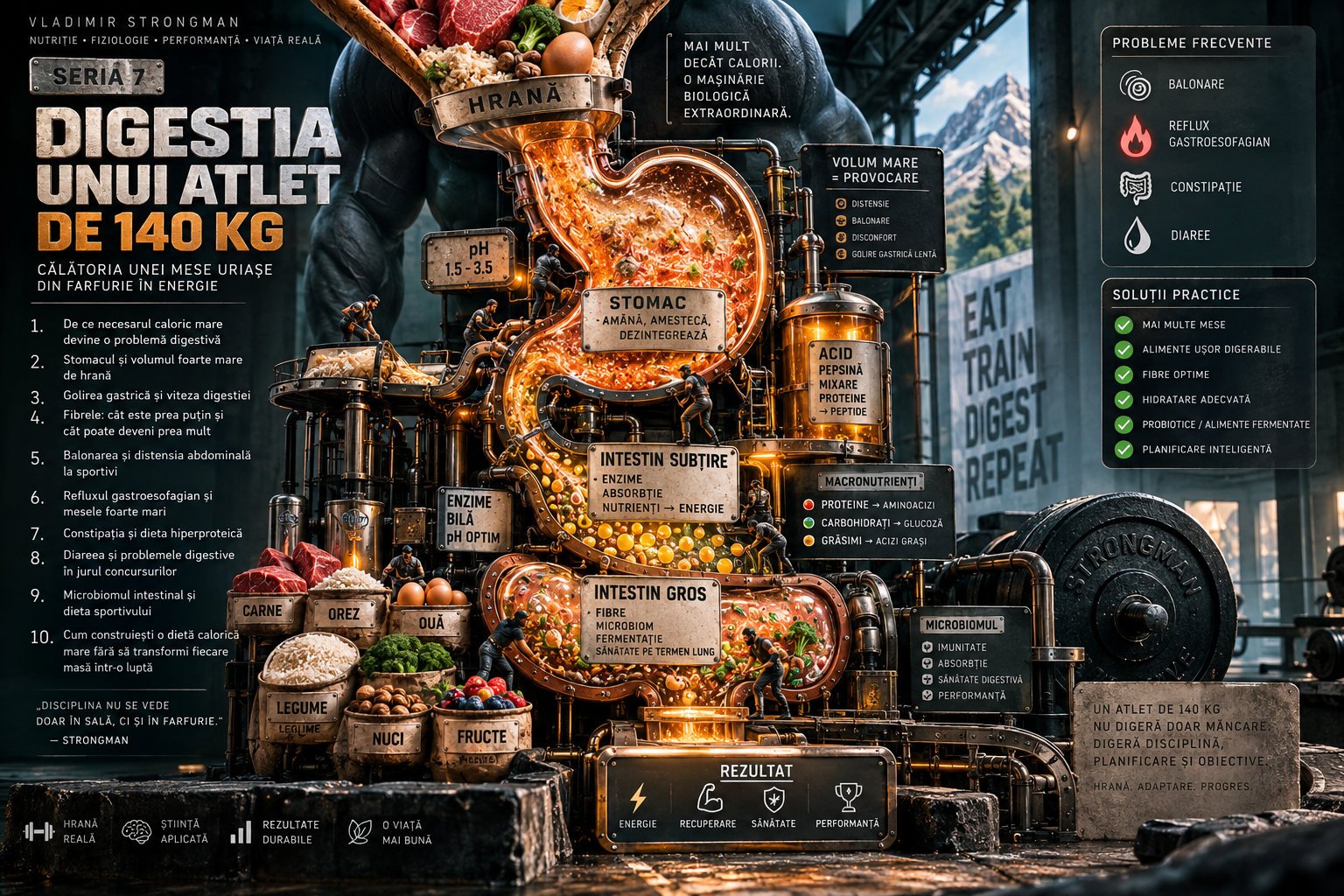
In a 140-kilogram athlete, gastroesophageal reflux can appear in a very specific context: enormous meals, high calorie intake, large fluid volumes, training with high abdominal pressure and, sometimes, a final meal eaten late at night.
Reflux is not only heartburn. Gastric contents can move upward into the esophagus and cause regurgitation, sour taste, coughing, hoarseness or nighttime discomfort, and very large meals can increase the likelihood of these episodes.
Episode 6 explains the mechanisms of reflux and why the nutrition strategy of a very heavy athlete must account not only for calories, but also gastric pressure, gastric emptying, body position and the timing of training.
1. Reflux occurs when the barrier between stomach and esophagus is insufficient
Normally, the lower esophageal sphincter and diaphragm form a barrier that limits upward movement of gastric contents. This is not a rigid valve, but a dynamic physiological system.
When gastric pressure rises or the sphincter relaxes temporarily, acid and stomach contents can reach the esophagus. Occasional episodes can occur in healthy people, but frequent symptoms may indicate gastroesophageal reflux disease.
2. Very large meals increase intragastric pressure
The more the stomach is distended, the more internal pressure can rise. A very large meal combined with abundant fluids can increase that load further.
For a strongman trying to concentrate 1,500 or even 2,000 calories into one meal, the problem is no longer only nutrient digestion but also the physics of volume inside the stomach.
3. Reflux is not the same as slow digestion
A stomach that empties slowly can maintain pressure and fullness for longer, but reflux has its own mechanisms. Not everyone with slow digestion has reflux, and not every case of reflux means gastroparesis.
It is important not to reduce every digestive symptom to the same explanation. Retrosternal burning, regurgitation and the sensation of acid rising have a different meaning from simple post-meal fullness.
4. The lower esophageal sphincter is central
The lower esophageal sphincter normally maintains pressure above that of the stomach. This gradient helps keep gastric contents where they belong.
Transient sphincter relaxations are normal and allow belching, but they can also become the main mechanism through which reflux occurs after large meals.
5. Fat can worsen the problem through several mechanisms
Fat is useful for calorie density, but very fatty meals can slow gastric emptying and extend the time the stomach remains full.
For an athlete prone to reflux, the combination of high volume and high fat may be more problematic than either factor alone.
6. Fluids can add volume to an already full stomach
Hydration is essential, but a liter or more of fluid consumed beside a huge meal temporarily increases gastric distension.
Spreading fluids across the day can reduce the need to combine very large volumes of food and water at the same time.
7. Carbonated drinks can amplify pressure
Carbon dioxide adds gas to an already distended stomach. For some people this simply causes belching, while for others it can worsen reflux and the sensation of pressure.
If symptoms consistently appear after carbonated beverages, reducing them is a simple intervention that is easy to test.
8. Lying down after eating removes the advantage of gravity
When upright, gravity helps keep gastric contents below the level of the esophagus. Lying down immediately after a large meal can make reflux more likely in susceptible people.
For an athlete who eats late in the evening, the interval between the final meal and sleep can become one of the most important practical variables.
9. Nighttime meals create a particular problem
Very high calorie intake often pushes the final meal late into the evening. If that meal is both large and high in fat, nighttime reflux may become more likely.
Nocturnal reflux can disrupt sleep through awakenings, coughing, burning or acid taste, and poor sleep can in turn impair athletic recovery.
10. Bracing increases intra-abdominal pressure
Deadlifts, squats, log press, yoke and farmers walks require powerful bracing. Increased intra-abdominal pressure is useful for stability, but it can become unpleasant when the stomach is very full.
In an athlete with reflux, a huge meal before heavy bracing can lead to regurgitation, nausea or the sensation of food rising into the throat.
11. A belt does not automatically cause reflux, but it may amplify discomfort
A tight lifting belt increases external pressure on the abdomen and is used specifically to facilitate bracing. Its effect depends greatly on how full the stomach is and on individual sensitivity.
If reflux occurs mainly during belted training after large meals, the issue may be the combination of timing, volume and pressure rather than the belt itself.
12. Central adiposity and high body mass are not the same thing
High body weight in an athlete does not by itself reveal how much abdominal fat is present. However, central adiposity can increase intra-abdominal pressure and is associated with a higher risk of reflux.
For this reason, two 140-kilogram athletes can have very different digestive profiles depending on body composition and fat distribution.
13. Acidic foods are not the only cause
Tomatoes, citrus fruit, coffee or spicy foods can worsen symptoms in some people, but the central problem in reflux is not simply the acidity of the food.
A food may be tolerated perfectly in a small portion and poorly in a huge meal. Context, quantity and timing are often more important than universal lists of forbidden foods.
14. Coffee can be an individual trigger
Coffee and caffeine can worsen symptoms in some people, but tolerance varies. Many athletes use coffee or pre-workout before training, exactly when the stomach may already be sensitive.
Rather than applying a universal ban, it is more useful to observe the relationship between dose, timing, the previous meal and the appearance of reflux.
15. Alcohol can weaken antireflux control
Alcohol can promote reflux through effects on motility, the lower esophageal sphincter and eating behavior. Very large meals combined with alcohol can become a particularly problematic combination.
For a performance-focused athlete, reducing alcohol has advantages that extend far beyond reflux alone.
16. Smaller portions can be more efficient than one gigantic meal
Dividing calorie intake across more meals reduces the peak of gastric distension. For someone who develops reflux after very large meals, this is one of the most logical interventions.
The athlete does not need to eat every hour. Sometimes it is enough to turn three enormous meals into four or five more manageable ones.
17. Energy density must be used with balance
Energy-dense foods can reduce volume, which may help. However, if density comes almost entirely from very large amounts of fat, gastric emptying may slow.
An effective strategy seeks a compromise between lower volume and digestive tolerance, not simply the maximum possible calories in the smallest possible space.
18. The final meal before sleep deserves separate planning
For athletes with nighttime symptoms, moving part of total calorie intake earlier in the day can reduce pressure on the final meal.
A less bulky dinner and a reasonable interval before lying down may be more effective than arbitrarily eliminating individual foods.
19. Elevating the head of the bed may help nighttime reflux
In people with nocturnal reflux, elevating the head of the bed can reduce esophageal acid exposure. This is different from simply stacking pillows, which may bend the torso.
This is a simple non-pharmacological strategy, but frequent or severe symptoms still deserve medical assessment.
20. Medication can control symptoms but does not replace evaluation
Antacids, H2-receptor blockers and proton pump inhibitors are used clinically for reflux depending on the situation. Choice and duration should be discussed with a clinician, especially when symptoms are persistent.
Masking daily heartburn without investigating the cause can delay diagnosis of a condition that requires treatment or monitoring.
21. Frequent reflux can damage the esophagus
Repeated acid exposure can cause esophagitis and, in some cases, complications such as strictures or mucosal changes. This is why chronic symptoms should not be trivialized.
An athlete can be extremely strong and still have a real gastrointestinal disorder. Performance does not protect the esophagus from inflammation.
22. Cough and hoarseness can occur without obvious heartburn
Some people experience regurgitation, coughing, hoarseness or a lump-in-the-throat sensation without classic heartburn. These symptoms are not specific to reflux alone, but persistent cases deserve evaluation.
In athletes who use their voice heavily, breathe hard during exertion or sleep poorly, these symptoms can easily be attributed to other causes and overlooked.
23. Alarm symptoms change the discussion completely
Progressive difficulty swallowing, painful swallowing, persistent vomiting, bleeding, anemia, unexplained weight loss or severe chest pain require medical evaluation.
Chest pain should not automatically be assumed to be reflux, especially in a large athlete with potential cardiovascular risk factors. Sometimes the important problem is not digestive.
24. A simple symptom diary can reveal the pattern
Recording meal time, meal size, fat, fluids, coffee, body position after eating and symptom onset can quickly reveal which combinations are problematic.
For an athlete, this approach is more useful than eliminating ten foods at once and unnecessarily losing dietary variety and calories.
25. Conclusion: reflux is often a problem of pressure, timing and tolerance
In the 140-kilogram athlete, very large meals can create ideal conditions for reflux: gastric distension, slower emptying, abdominal pressure and short intervals before training or sleep.
The solution is not to abandon the food intake required for performance, but to redistribute calories, adjust meal volume and fat, leave enough time before training and sleep, and treat persistent symptoms as a real medical issue.
Selected bibliography
Katz PO, Dunbar KB, Schnoll-Sussman FH et al. ACG Clinical Guideline for the Diagnosis and Management of Gastroesophageal Reflux Disease. American Journal of Gastroenterology. Gyawali CP et al. Modern diagnosis of GERD: Lyon Consensus. Gut. Guyton and Hall. Textbook of Medical Physiology. Boron WF, Boulpaep EL. Medical Physiology. Camilleri M. Integrated upper gastrointestinal response to food intake. Gastroenterology.
More From The Journal

Training
The Science of Strongman Training - Episode X: Competition Programming
How to build a complete Strongman competition preparation block: calendar, events, volume, intensity, specificity, simulations, autoregulation, tapering and fatigue management.

Training
The Science of Strongman Training - Episode IX: Peaking
Peaking in Strongman: how to turn months of training into maximal competition performance by reducing fatigue, preserving adaptations and managing specificity.