
Nutrition
Series: Digestion of a 140-Kilogram Athlete - Episode 5: Bloating and Abdominal Distension in Strength Athletes
September 11, 2026
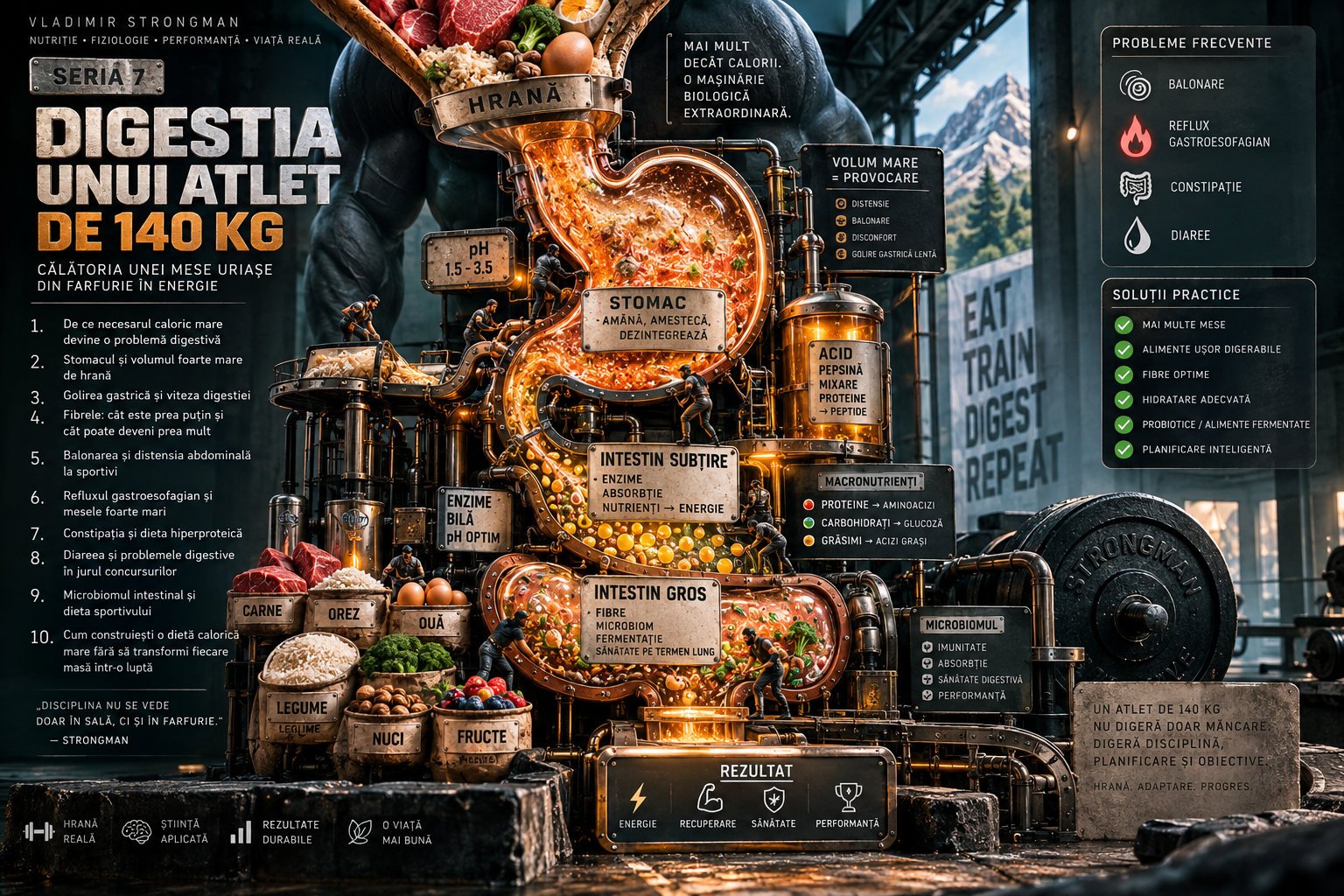
For a very heavy strength athlete, bloating can become almost as familiar as the lifting belt. Large meals, fiber, dairy, carbonated drinks, supplements and stress can turn the abdomen into a barometer of the entire eating day.
Bloating and abdominal distension are not the same thing. Bloating mainly describes the sensation of pressure or swelling, while distension means an observable increase in abdominal circumference. They can occur together, but they do not have to.
Episode 5 explains why these symptoms are common in athletes with high calorie intakes and how they can be influenced by fermentation, gas, constipation, FODMAPs, swallowed air, meal size and timing around training.
1. Bloating is a sensation, distension is a visible change
An athlete may feel extremely tight and bloated without a major increase in waist circumference. Another may show obvious distension after a meal but report little discomfort.
This difference shows that digestive symptoms do not depend only on the quantity of gas. Visceral sensitivity, abdominal wall tone and the way intestinal contents are distributed also matter.
2. Large food volume can distend the abdomen without disease
A 140-kilogram athlete may consume in one meal an amount of food that a smaller person would spread across two or three meals. The sheer volume of solids and liquids can temporarily change abdominal shape.
This post-meal distension can be physiological. It becomes more important when accompanied by pain, reflux, nausea, severe constipation or repeated interference with training and sleep.
3. Intestinal gas comes from several sources
Digestive gas can come from swallowed air and from microbial fermentation of carbohydrates in the intestine. Smaller amounts also arise through normal chemical reactions in the gastrointestinal tract.
The issue is not only how much gas is produced, but how quickly it is moved, absorbed or expelled. Two people with similar gas production can experience very different symptoms.
4. Aerophagia can matter more than it seems
Eating very quickly, drinking in a rush, chewing gum and talking during meals can increase the amount of air swallowed.
In an athlete eating many times per day, a small habit repeated over and over can become relevant. Frequent belching and a sense of trapped air may suggest that eating speed deserves attention.
5. Fermentation is normal, but it can produce symptoms
Some carbohydrates that are not fully absorbed reach the colon, where bacteria ferment them. This process produces gas and short-chain fatty acids.
Fermentation is not bad in itself. Symptoms arise when fermentable substrate, gut sensitivity and transit speed combine unfavorably.
6. FODMAPs can increase water and gas in the intestine
FODMAP is a term for certain fermentable carbohydrates that may be incompletely absorbed and can draw water into the intestinal lumen. In the colon, they may then be rapidly fermented.
Onion, garlic, some fruits, legumes, wheat, polyols and certain dairy foods can be problematic for sensitive people. This does not mean they should all be removed preventively from a healthy athlete's diet.
7. A low-FODMAP diet is not a universal solution
Temporary FODMAP reduction can be useful in some digestive disorders, especially in certain people with irritable bowel syndrome, but it is normally designed as a structured elimination and reintroduction strategy.
Randomly eliminating many foods can unnecessarily reduce dietary variety and fiber intake. Persistent symptoms are better handled with medical or dietetic guidance than with endless restriction.
8. Fiber can be both ally and opponent
Fiber supports bowel function and the microbiota, but a rapid increase or very high intake can intensify gas and fullness.
In an athlete eating several thousand calories, choosing only highly fibrous whole foods can push fiber intake far beyond the level that is comfortably tolerated.
9. Constipation can amplify bloating
When intestinal transit slows, contents remain in the colon longer and the sensation of fullness and distension can increase. Gas may be perceived more strongly when the bowel is already loaded.
Inadequate hydration, schedule changes, travel, stress and abrupt changes in fiber can contribute. The answer is not always simply adding even more fiber.
10. Dairy can cause symptoms in lactose intolerance
If lactose is not sufficiently digested in the small intestine, it reaches the colon and is fermented. Gas, cramps, bloating and diarrhea may follow.
Tolerance varies greatly between people and products. Yogurt, some cheeses and lactose-free options may behave very differently from large amounts of milk.
11. Sweeteners and polyols can become a hidden trap
Sugar-free products may contain sorbitol, mannitol, xylitol or other polyols. In larger amounts, these can draw water into the intestine and be fermented, promoting bloating and diarrhea.
An athlete may consume polyols from protein bars, gum, drinks and diet desserts without realizing that the sources accumulate across the day.
12. Carbonated drinks add gas directly
Carbon dioxide from carbonated drinks can increase belching and gastric pressure. In a stomach already occupied by a large meal, the effect may be uncomfortable.
If an athlete repeatedly notices bloating after carbonated beverages, reducing them is a simple low-risk experiment before removing entire food categories.
13. Very fatty meals can prolong the sense of abdominal fullness
Fat increases calorie density but can slow gastric emptying. A meal that is simultaneously high in fat, fiber and volume may remain difficult to tolerate for hours.
This does not mean fat should be drastically reduced. Its distribution can instead be adjusted when fullness and distension become daily problems.
14. Sodium and water retention can change abdominal appearance
A meal very high in sodium and carbohydrate can temporarily increase water retention and the mass of digestive contents. The athlete may feel heavier and more swollen even when gas is not the main issue.
It is useful to separate general water retention from intestinal bloating because the solutions differ, and aggressive sodium restriction may be inappropriate for an athlete who sweats heavily.
15. Visceral sensitivity explains why the same amount of gas feels different
Some people perceive intestinal stretching much more intensely than others. In irritable bowel syndrome, this visceral sensitivity can be especially important.
The absence of an extraordinary amount of gas therefore does not invalidate symptoms. Bloating reflects the interaction between intestinal contents and the way the nervous system perceives them.
16. Stress can change motility and digestive perception
Psychological stress and adrenaline can alter gastrointestinal motility and increase attention to abdominal sensations. Before competition, a normally tolerated food may suddenly become difficult.
This is one reason competition nutrition should be tested in training and simplified when psychological pressure is high.
17. Bracing can make distension much more obvious
Strongman requires very high intra-abdominal pressure. An abdomen already distended by food, fluid or gas may become far more uncomfortable when the athlete braces for deadlift, yoke or log press.
The problem can be mechanical rather than evidence that the food itself is harmful. Sometimes moving a meal earlier solves more than eliminating the food.
18. Pre-training meals should be predictable
Close to training, foods that are very high in fiber, fat or fermentable carbohydrate may be harder to tolerate. Amount and timing matter as much as the food itself.
A simple, familiar and repeatable meal is often more useful than a theoretically perfect meal that is gastrointestinally unpredictable.
19. A food and symptom diary can reveal patterns
When bloating seems random, recording foods, meal times, symptoms, bowel movements and training can reveal patterns that memory misses.
Changing one variable at a time is more informative than removing dairy, gluten, fruit, vegetables and supplements simultaneously. Otherwise it becomes impossible to know what actually mattered.
20. Supplements can contribute to the problem
Protein powders, mass gainers, pre-workouts, very concentrated drinks, some forms of magnesium and sweeteners can produce symptoms in certain people.
When the diet appears unchanged but bloating suddenly develops, auxiliary products deserve attention too. Sometimes the problem comes from the shaker rather than the plate.
21. Severe daily bloating should not be normalized
Some fullness after very large meals is predictable, but frequent pain, extreme distension, repeated diarrhea or severe constipation should not be accepted as the unavoidable price of being large.
Persistent symptoms may require assessment for intolerances, celiac disease, functional gastrointestinal disorders, reflux or other medical causes.
22. Red flags require medical assessment
Unexplained weight loss, blood in the stool, anemia, fever, persistent vomiting, night pain or major persistent changes in bowel habits should not be managed only through dietary experiments.
In those situations, medical evaluation matters more than optimizing the last few hundred calories in the plan.
23. The first strategy is simplification, not extreme restriction
Temporarily reducing carbonated drinks, polyols, enormous meals and foods already known to cause trouble can provide useful information without turning the diet into a list of prohibitions.
Smaller meals, hydration spread across the day and a more consistent fiber intake can reduce large swings in symptoms.
24. Gut tolerance can be trained only to a point
Gradually increasing fiber and food volume allows some adaptation. The microbiota and digestive behavior can change over time.
But adaptation does not mean every symptom should be forced through. If discomfort worsens as intake rises, the diet should be adjusted rather than simply endured.
25. Conclusion: a swollen abdomen is a symptom, not a diagnosis
Bloating and distension can arise from food volume, swallowed air, fermentation, fiber, constipation, lactose, FODMAPs, polyols, stress or combinations of these factors. There is no single universal explanation.
For the 140-kilogram athlete, a useful strategy is to track patterns, simplify meals around training, avoid unnecessary restriction and medically investigate persistent or severe symptoms.
Selected bibliography
Lacy BE et al. Bloating and abdominal distension: clinical approach and management. Gastroenterology. Simrén M et al. Intestinal microbiota in functional bowel disorders. Gastroenterology. Staudacher HM, Whelan K. The low FODMAP diet: recent advances in understanding its mechanisms and efficacy. Gut. Guyton and Hall. Textbook of Medical Physiology. Thomas DT, Erdman KA, Burke LM. Nutrition and Athletic Performance.
More From The Journal

Training
The Science of Strongman Training - Episode X: Competition Programming
How to build a complete Strongman competition preparation block: calendar, events, volume, intensity, specificity, simulations, autoregulation, tapering and fatigue management.

Training
The Science of Strongman Training - Episode IX: Peaking
Peaking in Strongman: how to turn months of training into maximal competition performance by reducing fatigue, preserving adaptations and managing specificity.