
Nutrition
Series: Digestion of a 140-Kilogram Athlete - Episode 3: Gastric Emptying and the Speed of Digestion
September 11, 2026
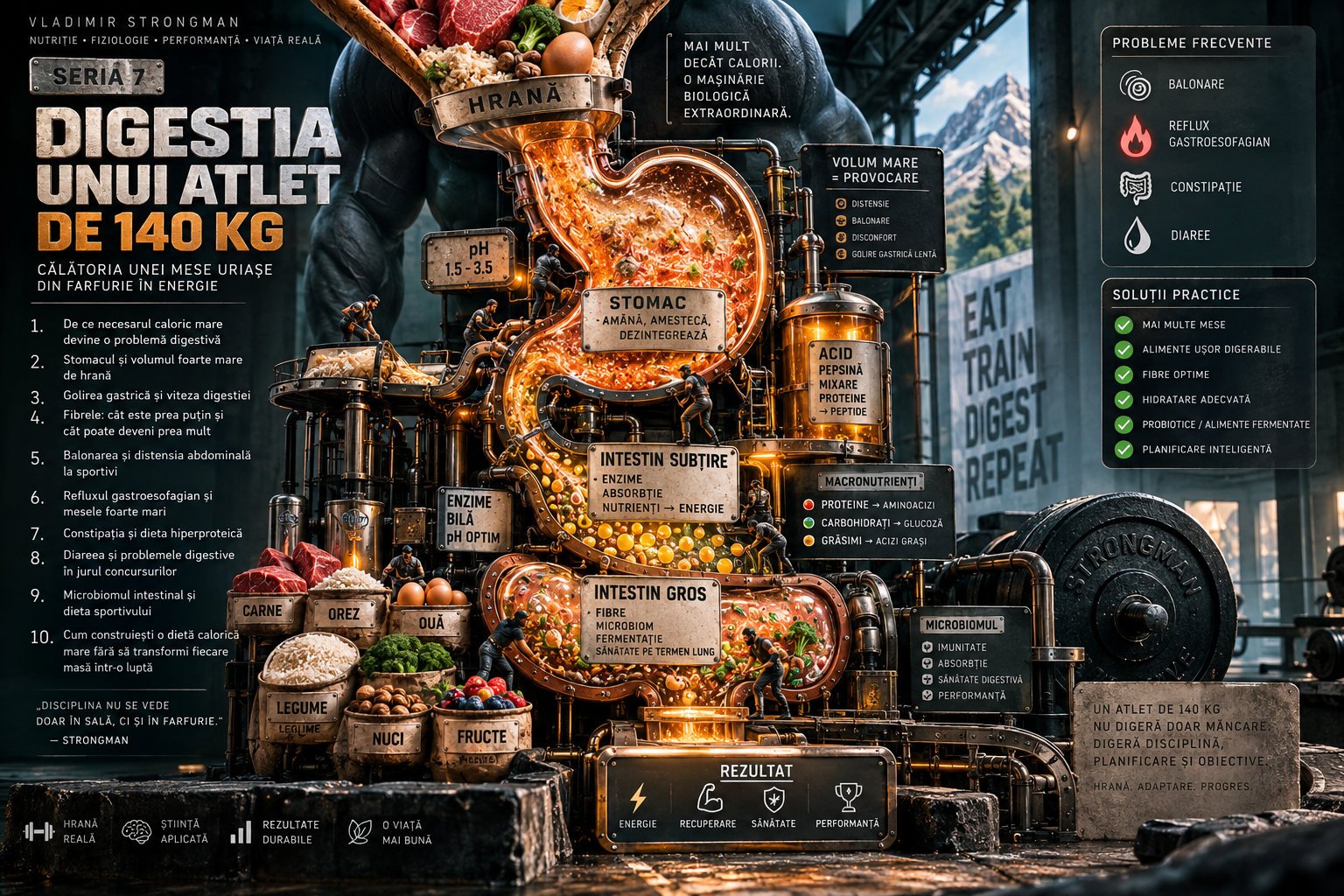
Gastric emptying is one of the processes that determines whether a large meal becomes useful fuel or a weight that seems to remain in the stomach for hours. For a 140-kilogram athlete, that difference can reshape the entire eating day.
The speed of digestion is not controlled by a single timer. Liquids, solids, fat, fiber, energy density, stress, hydration and exercise intensity all change the rate at which gastric contents reach the intestine.
Episode 3 follows this exact mechanism: why some meals seem to disappear quickly while others linger, how gastric emptying differs from digestion itself, and what this means for training and competition.
1. Gastric emptying is not the same as digestion
Gastric emptying describes the movement of stomach contents into the duodenum. Digestion is the broader process of breakdown and absorption that continues long after the stomach has emptied.
For an athlete concerned with comfort before training, this distinction matters: the stomach may be nearly empty while the intestine is still processing a substantial meal.
2. The stomach controls delivery to the intestine
The stomach works as both a reservoir and a dosing system. It mixes food with gastric secretions and gradually releases contents through the pylorus.
This control protects the small intestine from receiving too much nutrient load at once and allows absorption to proceed at a manageable rate.
3. Liquids usually leave the stomach faster than solids
Clear liquids can generally pass through the stomach relatively quickly, especially when they do not contain large amounts of energy or solid particles.
That is why water and some simple drinks are often tolerated more easily close to exercise than a bulky solid meal.
4. Solids must first be broken down
Large solid particles do not simply pass through the pylorus. The stomach subjects them to contractions and grinding until their size allows more efficient passage into the duodenum.
A meal made of large, dry or difficult-to-chew pieces may remain in the stomach longer than one that is soft and well prepared.
5. Particle size changes emptying speed
Finely chopped, mashed or thoroughly chewed foods generally require less mechanical processing in the stomach.
This is one reason well-cooked rice, mashed foods, porridges or smoothies can be easier to tolerate in a high-intake diet.
6. Fat is one of the strongest slowing factors
A large amount of fat entering the duodenum sends signals that slow gastric emptying. The body gains time for digestion and absorption of lipids.
For the athlete, this means a very high-fat meal may feel present for a long time and can delay the next meal or training session.
7. Fiber can slow the flow as well
Fiber, especially viscous fiber, can increase the thickness of gastric contents and alter the rate at which they leave the stomach.
In a very high-calorie diet, concentrating too much fiber into a single meal may amplify fullness and bloating.
8. Energy density matters
The stomach and intestine respond not only to volume but also to how much energy a meal carries. A high energy load tends to produce more controlled delivery into the duodenum.
This helps explain why two meals of similar volume can feel very different if one contains much more fat and total energy.
9. Osmolality influences tolerance
Solutions that are very concentrated in sugars or other solutes can modify emptying and draw water into the intestine.
For some people, extremely concentrated drinks can cause a heavy-stomach sensation, cramping or diarrhea, especially during exercise.
10. Food temperature matters less than many people think
Temperature can temporarily change comfort and motility, but meal composition usually has a much larger effect on gastric emptying.
In practice, individual tolerance matters more than the idea that cold or hot food dramatically speeds digestion.
11. Initial volume can speed the beginning of emptying
A larger meal can increase intragastric pressure and initially create a faster flow of liquid contents toward the duodenum.
However, if the meal is rich in fat, fiber and large solid particles, those slowing factors can outweigh the effect of initial pressure.
12. Intestinal hormones slow the stomach when necessary
When nutrients reach the duodenum, hormones such as CCK, GLP-1 and other mediators help regulate gastric emptying.
These signals are part of a feedback system that matches stomach output to the intestine's capacity to process the meal.
13. Blood glucose and perceived energy do not mirror the stomach exactly
Faster gastric emptying does not mean energy instantly reaches the muscles. Absorption and metabolic use each have their own rates.
For athletes, gastric comfort and energy availability are related, but they are not the same phenomenon.
14. Stress can change gastric motility
Acute stress, anxiety and adrenaline can alter gastrointestinal motility. Some athletes feel as if the stomach shuts down before competition, while others develop nausea or faster bowel activity.
That is why a meal tolerated perfectly on an ordinary day can become difficult on competition morning.
15. Intense exercise redistributes blood flow
During intense exercise, more blood is directed toward working muscles, the heart and the skin, while the gastrointestinal tract receives relatively less.
This environment can worsen nausea and discomfort if training begins while the stomach is still heavily loaded.
16. Light exercise and hard exercise do not have the same effect
A gentle walk after a meal may be well tolerated, while sprints, prowler work, yoke or medleys sharply increase abdominal demand.
Exercise intensity and type should be considered when deciding how much time is needed between eating and training.
17. Dehydration can worsen digestive tolerance
Dehydration affects circulation and can increase physiological stress on the gastrointestinal tract. In hot conditions, these effects can become more obvious.
For a strongman, regular hydration supports not only performance but also food tolerance across the day.
18. Very concentrated drinks are a double-edged sword
Liquid calories are useful for high intake, but a drink overloaded with sugar, fat or powders can become surprisingly difficult to tolerate.
Sometimes splitting one enormous shake into two smaller servings is more efficient than turning a single glass into a complete liquid meal.
19. Gastric emptying changes from meal to meal
There is no single fixed speed for the stomach. Meal composition, time of day, stress, sleep, hydration and what was eaten previously can all alter the experience.
Standard digestion times should therefore be treated as rough guidance rather than exact biological stopwatches.
20. Poor sleep can affect food tolerance
Sleep deprivation changes hormonal responses, appetite and the perception of discomfort. Some people experience nausea, reflux or fullness more easily after poor sleep.
A perfect eating plan on paper may work badly if recovery and sleep are constantly neglected.
21. Medications and medical conditions can alter motility
Some medications and diseases can speed or slow gastric emptying. Gastroparesis, severe reflux and endocrine disorders are examples in which dietary adjustment alone may not be enough.
Persistent symptoms, or symptoms disproportionate to meal size, deserve medical assessment.
22. Simplicity helps with the pre-training meal
Close to exercise, meals built around easy-to-digest carbohydrate, moderate fat and controlled fiber are usually more predictable.
The goal is not the healthiest possible plate in a single meal, but a combination that provides energy without leaving the stomach heavy.
23. Competition day requires food that has already been tested
Competition is not the time for new foods, unusual quantities or extremely concentrated shakes. Stress can radically change tolerance.
Foods and timing between meals and events should be tested during training or competition simulations.
24. Digestion speed should not be forced with tricks
There is no simple and safe method that forces the stomach to empty a heavy meal very quickly. Meal composition, volume and individual physiology create real limits.
The effective strategy is to build meals around those limits rather than trying to erase them.
25. Conclusion: gastric emptying regulates the entire eating day
For the 140-kilogram athlete, the speed at which the stomach releases food can determine whether the next meal is possible, whether training feels comfortable and whether daily calorie intake can be sustained.
Understanding the roles of liquids, solids, fat, fiber, stress and exercise makes it possible to build a large diet that moves through the system more smoothly instead of simply sitting in the stomach.
Selected bibliography
Guyton and Hall. Textbook of Medical Physiology. Boron WF, Boulpaep EL. Medical Physiology. Camilleri M. Integrated upper gastrointestinal response to food intake. Gastroenterology. Janssen P et al. The role of gastric motility in the control of food intake. Aliment Pharmacol Ther. Hellström PM et al. Evolving concepts in the physiology of gastric emptying. Thomas DT, Erdman KA, Burke LM. Nutrition and Athletic Performance.
More From The Journal

Training
The Science of Strongman Training - Episode X: Competition Programming
How to build a complete Strongman competition preparation block: calendar, events, volume, intensity, specificity, simulations, autoregulation, tapering and fatigue management.

Training
The Science of Strongman Training - Episode IX: Peaking
Peaking in Strongman: how to turn months of training into maximal competition performance by reducing fatigue, preserving adaptations and managing specificity.