
Nutrition
Series: Digestion of a 140-Kilogram Athlete - Episode 2: The Stomach and Very Large Food Volume
September 11, 2026
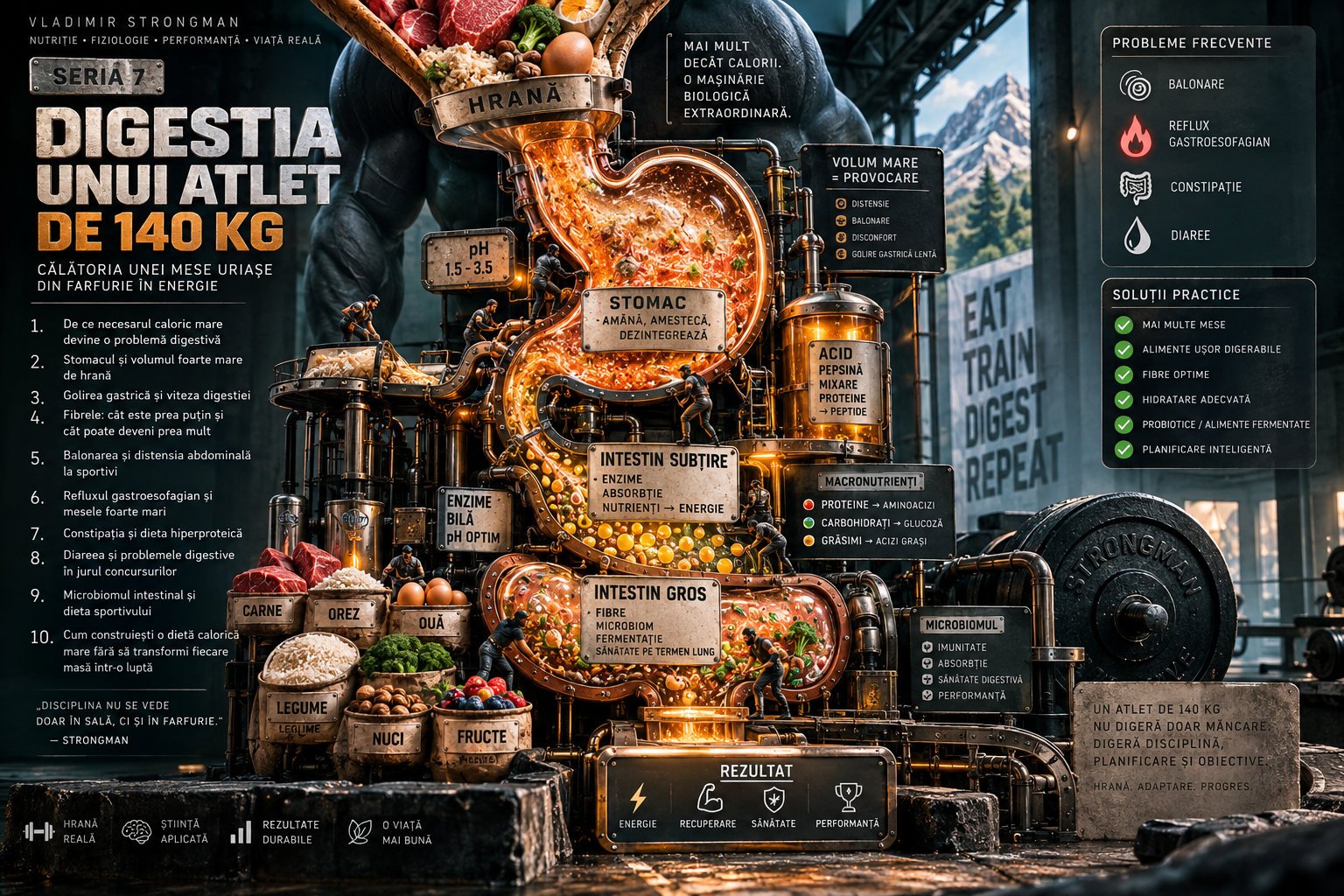
For a 140-kilogram athlete, a meal can begin to resemble a test of digestive endurance rather than a simple lunch. High calorie requirements can force the stomach to receive food volumes that most people rarely consume.
The stomach can expand and adapt, but it is not an inert bag. It senses pressure, communicates with the brain, controls how quickly food reaches the intestine and responds differently to liquids, fats, fiber and compact solids.
Episode 2 follows this exact problem: what happens when performance requires a great deal of food and the stomach must turn that quantity into a tolerable digestive flow day after day.
1. The stomach is a muscular organ, not a passive container
The stomach wall contains muscle layers capable of relaxing, stretching and mixing food. After a meal, the stomach can increase its volume without pressure immediately rising in the same proportion.
This allows large meals to be consumed, but the system has limits. When volume, density and eating speed exceed individual tolerance, pressure, fullness, nausea or reflux may appear.
2. Receptive relaxation allows the stomach to accept a meal
As eating begins, neural signals prepare the upper stomach to relax. This process, called receptive relaxation, helps the organ receive food without a sudden rise in pressure.
Athletes who frequently eat large portions may notice that their subjective sense of fullness changes over time. Adaptation, however, does not mean that every possible food volume becomes comfortable or harmless.
3. Gastric distension directly contributes to satiety
Mechanical receptors in the stomach wall detect stretch. As the stomach fills, these signals contribute to satiety and reduce the drive to continue eating.
For an athlete who must eat beyond spontaneous appetite, this creates an important conflict. The plan may demand more calories exactly when the digestive system is signaling that available space is nearly exhausted.
4. Food volume and calories are not the same thing
One kilogram of food can contain radically different amounts of energy depending on composition. Vegetables, soups and water-rich fruit occupy a great deal of space for relatively few calories, while fats and dry foods concentrate far more energy into less volume.
This is why a strongman pursuing very high calorie intake cannot build every meal entirely from bulky foods. Energy density becomes a tool for reducing the mechanical burden on the stomach.
5. Very large meals increase intragastric pressure
As the stomach fills, internal pressure can rise. If the meal is extremely large, if large amounts of fluid are added or if the athlete bends over or lies down immediately afterward, discomfort may become obvious.
This pressure is not merely a vague sensation. It can promote belching, regurgitation and reflux in susceptible people, especially when the lower esophageal sphincter is challenged by the combination of volume and pressure.
6. Gastric emptying determines how quickly space is released
The stomach does not hold food until digestion is complete. It mixes the meal and gradually releases it into the duodenum, and the speed of this process influences how quickly fullness begins to fall.
When emptying is slow, the next meal may arrive while the stomach is still handling the previous one. At very high calorie intakes, this overlap can turn the entire day into a sequence of unfinished digestive workloads.
7. Liquids and solids leave the stomach differently
Liquids without large particles can leave the stomach relatively quickly compared with solid meals. Solids first need to be broken down and mixed until they can pass efficiently into the intestine.
This helps explain why calorie-containing drinks, milk, smoothies or other liquid forms can be useful when solid food becomes hard to tolerate. They are not automatically superior, but they offer another practical route for delivering energy.
8. Fat slows gastric emptying
Fat is extremely efficient for increasing calorie density, but large amounts can slow gastric emptying and prolong fullness.
For an athlete who needs to eat again two or three hours later, a very high-fat meal may become paradoxically counterproductive. A good strategy seeks enough calorie density without turning every meal into a digestive brake.
9. Fiber can increase volume and prolong fullness
Fiber absorbs water, increases food bulk and can slow digestion. These effects are valuable for health and satiety but can become problematic if every meal in a very high-calorie diet is extremely high in fiber.
A large athlete needs fiber, but also needs gastric space. Distributing fiber across the day and avoiding enormous amounts in pre-training meals may improve tolerance.
10. Protein also has a powerful satiety effect
Protein is essential for strength athletes and tends to be highly satiating. Very large portions of meat or other protein foods can occupy substantial space and maintain a feeling of fullness.
Eating far more protein than needed is not necessarily an efficient way to raise calories. In some cases, shifting part of the energy toward well-tolerated carbohydrate and fat can make the diet easier to sustain.
11. Eating speed changes the digestive experience
Eating very quickly may allow a large amount of food to be consumed before satiety signals fully develop. For someone trying to reach a high calorie target, this can appear advantageous.
The problem is that high speed can increase swallowed air, reduce chewing and leave the athlete with an enormous meal in the stomach before realizing how full they are. Fast does not automatically mean efficient.
12. Chewing is the first stage of volume management
Chewing breaks food into smaller pieces and mixes it with saliva before it reaches the stomach. Smaller particles are easier to process mechanically later.
In a diet containing many large meals, constantly swallowing poorly chewed food does not necessarily save time if the result is discomfort, belching and the feeling that food remains in the stomach for too long.
13. Temperature and texture can influence tolerance
Soft, cooked and moist foods are often easier to consume in large quantities than very dry, fibrous or hard-to-chew foods. Texture can change how exhausting a meal becomes.
This is one reason well-cooked rice, mashed foods, soft cereals, sauces and moist preparations are common in diets of athletes who need to eat a great deal.
14. Water can help or take up too much space
Fluids assist swallowing and hydration, but a liter of fluid consumed beside a huge meal temporarily occupies additional gastric volume.
Some athletes tolerate large amounts of fluid with meals, while others become overloaded quickly. Spreading hydration across the day may prevent the stomach from having to manage an enormous meal and a very large volume of water at the same time.
15. Carbonated drinks can amplify distension
Carbon dioxide from carbonated drinks adds gas to an already full stomach. For some people this leads to quick belching; for others it produces pressure and bloating.
During periods of extremely high food intake, removing unnecessary volume from carbonation can make meals more comfortable without changing the essential nutrients in the diet.
16. Reflux becomes more likely when the stomach is constantly very full
Large meals, very fatty foods, lying down after eating and abdominal pressure can promote reflux in susceptible individuals. An athlete who eats a great deal almost continuously may encounter this problem more often.
Repeated reflux should not be normalized as the unavoidable price of gaining mass. If symptoms are frequent, severe or occur at night, medical assessment is more useful than simply tolerating heartburn.
17. Body position after a meal matters
Lying completely flat immediately after a large meal may promote reflux in some people. Remaining upright and taking a gentle walk may feel more comfortable.
Intense activity is not required after eating. The goal is simply to avoid combining a highly distended stomach with positions and efforts that further increase abdominal pressure.
18. Training with a full stomach is a mechanical problem
Yoke, farmers, deadlift, log and medleys require strong bracing and increase intra-abdominal pressure. A full stomach can turn that pressure into nausea, reflux and the sensation of needing to vomit.
This is why it matters not only what the athlete eats but also how much time the stomach has to process the meal before exertion. Meal timing is part of event preparation.
19. More meals can reduce peak volume
Dividing a high intake across more meals can reduce the amount the stomach must manage at one time. For some athletes, this is the simplest solution to excessive fullness.
Too many meals, however, can create the feeling that the athlete is eating constantly. The optimal frequency is the one that reaches the calorie target without turning every hour into preparation, eating and digestion.
20. Liquid calories can create space in the plan
Part of total energy can come from milk, drinkable yogurt, smoothies or formulated beverages according to tolerance. These may be easier to consume than yet another plate of solid food.
There is no need to turn the entire diet into liquid, however, and doing so may reduce satiety or dietary variety in other contexts. Liquid calories are tools, not a mandatory foundation.
21. Adaptation to volume exists, but it is not infinite
Repeated consumption of large meals can change subjective tolerance and eating behavior. The athlete learns which foods work, how quickly they can eat and which combinations cause trouble.
This adaptation should not be confused with digestive invulnerability. If symptoms progressively worsen, it is not reasonable to assume that the stomach simply needs to be forced harder.
22. Energy density can be increased intelligently
Moderate additions of oil, peanut butter, denser dairy, sauces, crushed nuts or other calorie-rich ingredients can increase energy without an equal increase in food volume.
The key is dosage. If every meal becomes extremely high in fat to concentrate calories, the advantage of smaller volume can be lost through slower gastric emptying and prolonged fullness.
23. Competition day requires a different strategy from an ordinary day
During competition, the goal is not to force the calorie intake of a normal gaining day at all costs. Digestive comfort and energy availability between events matter more than one gigantic meal at the start of the day.
Smaller portions, easily digested carbohydrates and foods already tested in training reduce the risk that the stomach becomes the main opponent before yoke or deadlift.
24. Warning signs should not automatically be blamed on large meals
Persistent pain, repeated vomiting, difficulty swallowing, blood in vomit or stool, unexplained weight loss and severe reflux warrant medical evaluation.
A large athlete can develop digestive disease for the same reasons as anyone else. Eating a great deal does not automatically explain every gastrointestinal symptom.
25. Conclusion: the stomach should be managed through strategy, not force
The stomach is adaptable but still follows physiological rules: it expands, detects pressure, controls emptying and responds to meal composition. High calorie needs place these mechanisms under repeated demand.
For the 140-kilogram athlete, the answer is not simply learning to endure ever larger plates. It is more efficient to manage food volume, energy density, texture, fluids, meal frequency and timing around training.
Selected bibliography
Guyton and Hall. Textbook of Medical Physiology. Boron WF, Boulpaep EL. Medical Physiology. Camilleri M. Integrated upper gastrointestinal response to food intake. Gastroenterology. Janssen P et al. The role of gastric motility in the control of food intake. Aliment Pharmacol Ther. Thomas DT, Erdman KA, Burke LM. Nutrition and Athletic Performance. Academy of Nutrition and Dietetics, Dietitians of Canada and ACSM.
More From The Journal

Training
The Science of Strongman Training - Episode X: Competition Programming
How to build a complete Strongman competition preparation block: calendar, events, volume, intensity, specificity, simulations, autoregulation, tapering and fatigue management.

Training
The Science of Strongman Training - Episode IX: Peaking
Peaking in Strongman: how to turn months of training into maximal competition performance by reducing fatigue, preserving adaptations and managing specificity.