
Nutrition
Series: Digestion of a 140-Kilogram Athlete - Episode 1: Why High Caloric Needs Become a Digestive Problem
September 11, 2026
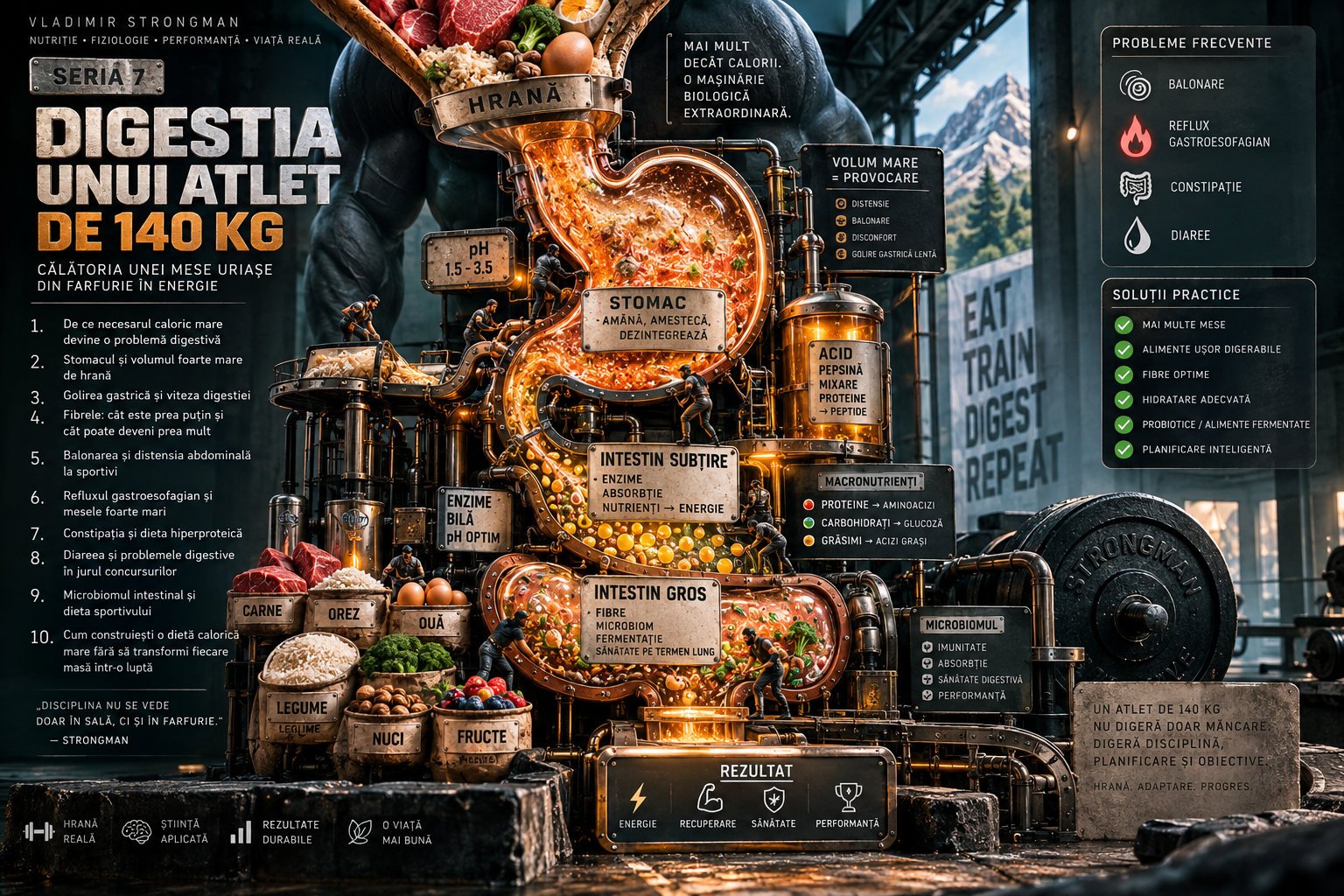
For an athlete weighing around 140 kilograms, nutrition is no longer only about choosing good foods. It is also about being able to eat, digest and tolerate very large amounts of food, sometimes every day for months.
Energy requirements can rise substantially when body mass is high, training volume is large and the goal is to maintain or improve performance. The digestive system can then become a practical limiting factor just as real as strength, recovery or sleep.
The first episode of this new series explains why a high calorie requirement can become a gastrointestinal problem: food volume, gastric emptying, fat, fiber, reflux, appetite, bowel transit, fluids and the way large meals collide with strongman training.
1. Energy needs can exceed digestive comfort
An athlete around 140 kilograms may require far more energy than a sedentary person, especially when training is long, frequent and includes strongman events. The problem is that metabolic demand can increase faster than the practical ability to eat without discomfort.
On paper, a calorie target looks like a number. In real life, every calorie must be chewed, swallowed, temporarily stored in the stomach, digested, absorbed and tolerated day after day.
2. The stomach has substantial capacity, but not infinite capacity
The stomach can adapt to large meals, but distension produces fullness and can become uncomfortable. A very heavy athlete may finish a meal not because hunger is present, but because the plan still requires more calories.
When every meal is large, fullness can persist until the next meal. This creates the paradox of an athlete who needs a great deal of energy but rarely reaches a state of genuine hunger.
3. Gastric emptying becomes a limiting link
Food does not move instantly from the stomach into the small intestine. Gastric emptying is influenced by meal volume, energy density, fat, fiber, osmolality and several other factors.
If a large meal empties slowly, the next meal may arrive while the stomach is still partly occupied. At high calorie intakes, this pattern can repeat and turn eating into a continuous sequence of overlapping meals.
4. Fat helps with calories but can slow the stomach
Fat is energy efficient because it provides many calories in a small volume. Oils, nuts, nut butters, cheese and other fatty foods are therefore often used to raise energy intake without enormous plates of food.
However, very high-fat meals can slow gastric emptying and intensify heaviness. Energy density solves a volume problem but can create a digestive-speed problem.
5. Fiber is healthy, but dose matters
Adequate fiber supports bowel function, the microbiota and metabolic health. For an athlete eating a great deal of food, however, a very high fiber intake can also mean more bulk, fermentation and satiety.
If every meal contains large amounts of oats, legumes, vegetables, fruit and whole grains, the daily total can become difficult to tolerate. Diet quality does not require maximizing fiber at every meal.
6. Protein also carries a digestive cost
Strength athletes often give protein a central role, and adequate intake is justified. Yet very large amounts of meat, dairy, eggs or shakes can add to fullness and digestive load.
Beyond a certain point, adding protein above requirements can occupy calorie space that may be easier to cover with carbohydrate or fat. More is not automatically more useful.
7. Carbohydrate is fuel, but it also has volume
Rice, potatoes, pasta, bread, cereals and fruit can support training through carbohydrate and glycogen. When daily requirements are very high, even these foods can reach impressive portion sizes.
Choosing between denser and bulkier carbohydrate sources can strongly affect tolerance. Sometimes white rice or bread is easier to use than mountains of potatoes and high-fiber vegetables.
8. Chewing can become surprisingly tiring
For someone eating six or seven large meals, nutrition can become an activity in itself. Fibrous meat, raw vegetables and very bulky meals require time and a lot of chewing.
Softer foods, sauces, minced preparations, yogurt and some liquid calories can reduce this burden. That is not laziness, but a practical adherence issue.
9. Lack of hunger does not mean energy needs disappeared
Very hard training, stress and frequent meals can temporarily reduce appetite. An athlete may still have high energy requirements on a day when hunger signals are weak.
This is where intuitive eating and performance-oriented eating can diverge. At very high intakes, hunger alone is not always a sufficient guide.
10. Reflux can appear when pressure increases
Large meals, very fatty foods, lying down after eating and abdominal pressure can promote gastroesophageal reflux in some people. Strongman adds tight belts, aggressive bracing and movements that raise intra-abdominal pressure.
If an athlete eats an enormous meal and quickly moves into squats, yoke or deadlifts, the stomach may object. Meal timing can become as important as food choice.
11. Bloating is not merely a cosmetic issue
Intestinal fermentation normally produces gas, but certain combinations of fiber, polyols, lactose or simply large quantities of food can amplify it. In a 140-kilogram athlete, the difference between a well-tolerated meal and one that causes major distension can directly affect training.
Severe bloating can interfere with bracing, belt comfort and the ability to breathe effectively between sets. Digestion and performance literally meet in the abdomen.
12. Bowel transit can become too slow or too fast
A large food intake places the digestive tract under a constant flow of material. Some people develop constipation when fiber, fluids or movement are insufficient, while others experience frequent stools when total food and carbohydrate intake rises sharply.
The goal is not one universal bowel pattern, but predictable and comfortable function. Persistent changes deserve attention, especially when they occur with pain, blood or unexplained weight loss.
13. Hydration influences digestion
Water is necessary for digestion, bowel transit and handling fiber. Very large athletes can lose substantial fluid through sweat, and dehydration can worsen constipation and gastrointestinal fatigue.
At the same time, drinking huge volumes with an already enormous meal can temporarily increase distension. Distributing fluids across the day may be more comfortable.
14. Sodium and electrolytes must be viewed in context
A strongman who sweats heavily may need more sodium than a sedentary person. Sodium supports plasma volume and rehydration, although very salty meals can increase thirst and fluid retention.
The digestive issue is not sodium by itself, but the overall context: fluid intake, temperature, sweat losses, blood pressure and tolerance. Strategies need to be individualized.
15. Liquid calories can be a useful pressure-release valve
Milk, drinkable yogurt, smoothies, juice or shakes can provide energy without the same chewing demand and sometimes with less satiety than solid food. For an athlete with very high intake requirements, this can be valuable.
However, highly concentrated liquids can cause nausea, diarrhea or discomfort in some people. They should be used as a tool, not as an excuse to turn the whole diet into a sequence of shakes.
16. Energy density needs intelligent distribution
A diet made entirely of very bulky foods may be impossible to sustain, but one made only of highly energy-dense foods can become heavy, fatty and low in fiber. Both extremes can be uncomfortable.
A better strategy combines energy-dense meals with lighter meals so total intake can be reached without every meal testing the limits of the stomach.
17. Meal frequency is a tool, not a doctrine
Some athletes tolerate four large meals, while others feel better with six moderate meals. The best number depends on schedule, appetite, gastric emptying and personal preference.
Very frequent meals can create the feeling that digestion never finishes. Meals that are too infrequent can become so large that they are difficult to consume. The balance is found through controlled experimentation.
18. Hard training temporarily changes digestion
During intense exercise, blood flow is redistributed toward working muscle and skin, while gastrointestinal activity becomes less of a priority. Adrenaline and sympathetic activation can reduce appetite and alter motility.
That is why a meal that is perfectly tolerated on a rest day can become problematic before a hard session. Nutrition should be tested under conditions similar to actual training.
19. Intra-abdominal pressure is part of the equation
Strongman involves aggressive bracing, tight belts and events that compress the trunk. A very full stomach can make these situations more uncomfortable and may promote reflux or nausea.
For this reason, large meals should usually be placed far enough away from events that demand substantial abdominal pressure. There is no perfect window for everyone, but individual experience matters enormously.
20. Poor sleep can disrupt appetite and tolerance
Sleep deprivation can alter hunger and fullness signals, increase preference for highly palatable food and change the perception of discomfort. For an athlete already pushing a large intake, the day after poor sleep can become nutritionally chaotic.
Very large late-night meals can also worsen reflux and disturb sleep, creating a vicious cycle between digestion and recovery.
21. Food monotony can become a real problem
Eating the same four foods in enormous quantities can simplify logistics but erode appetite. Sensory-specific satiety means repeated flavors and textures can reduce the desire to keep eating.
Controlled variety can help an athlete reach intake goals without learning to hate staple foods. Seasonings, sauces and changing cooking methods can matter more than they appear to.
22. Problem foods are individual
Some athletes tolerate dairy perfectly and others do not. Some eat legumes without difficulty, while others develop severe bloating. FODMAPs, lactose, fat, caffeine or sweeteners can become personal triggers.
There is no universal banned-food list for a large athlete. A simple food and symptom log can identify patterns better than randomly eliminating entire food groups.
23. Warning signs should not be normalized
Eating a lot does not make persistent pain, vomiting, blood in the stool, severe reflux, chronic diarrhea or unexplained weight loss normal. These symptoms require medical evaluation.
Performance does not justify ignoring digestive problems. What looks like a difficult diet can sometimes conceal a condition that needs diagnosis and treatment.
24. Increasing intake should be gradual
When calorie intake suddenly rises by thousands of calories, the digestive system may need time to adapt. Food volume, meal frequency and fiber can be increased progressively rather than all at once.
A controlled progression allows the athlete to observe what actually causes discomfort. If every variable changes on the same day, identifying the cause becomes almost impossible.
25. Conclusion: the limit is not only metabolic, but gastrointestinal
A 140-kilogram athlete may need a very large amount of energy, but the body does not receive that energy through a calculation alone. It must pass through a digestive system with finite volume, timing, motility and tolerance.
A good strategy does not merely hit a calorie number. It reaches that number in a way that is repeatable, comfortable and compatible with training, sleep and long-term health.
Selected bibliography
Thomas DT, Erdman KA, Burke LM. Nutrition and Athletic Performance. Academy of Nutrition and Dietetics, Dietitians of Canada and ACSM. Costa RJS et al. Systematic review: exercise-induced gastrointestinal syndrome. Alimentary Pharmacology & Therapeutics. de Oliveira EP, Burini RC. The impact of physical exercise on the gastrointestinal tract. Current Opinion in Clinical Nutrition and Metabolic Care. Camilleri M. Gastrointestinal motility and gastric emptying. National Institute of Diabetes and Digestive and Kidney Diseases: digestive health resources.
More From The Journal

Training
The Science of Strongman Training - Episode X: Competition Programming
How to build a complete Strongman competition preparation block: calendar, events, volume, intensity, specificity, simulations, autoregulation, tapering and fatigue management.

Training
The Science of Strongman Training - Episode IX: Peaking
Peaking in Strongman: how to turn months of training into maximal competition performance by reducing fatigue, preserving adaptations and managing specificity.