
Pharmacology
How Do Anabolic Substances Work? - Episode 4: Anabolism and Androgenism, Two Sides of the Same Pharmacology
September 7, 2026
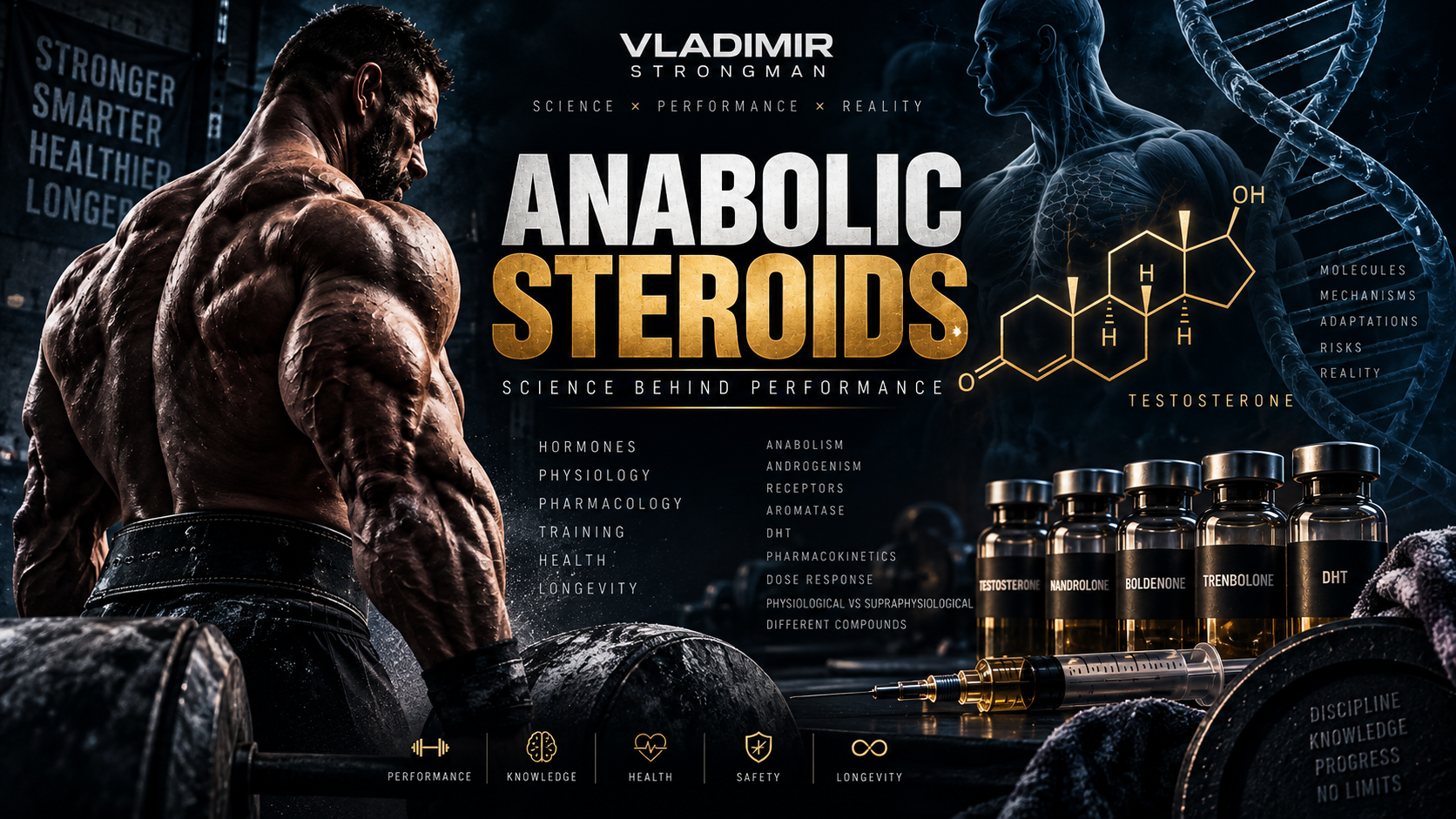
1. Why are there two words: anabolic and androgenic?
The term anabolic-androgenic steroids sounds technical, but the idea is simple. It describes two broad families of effects produced by androgens: anabolic effects, especially those related to building and maintaining tissues, and androgenic effects related to the development and function of male sexual characteristics and other androgen-sensitive processes.
In the human body, however, these two sides cannot be separated perfectly. The same androgen signaling can support muscle mass while also affecting skin, hair, prostate, red blood cell production, the nervous system, or the endocrine axis. That overlap is what makes AAS pharmacology both fascinating and difficult to reduce to slogans.
2. What does anabolism mean?
Anabolism refers to the collection of processes through which the body builds complex molecules and structures from simpler components. In strength sport, the word is usually used when discussing protein synthesis, lean tissue growth, and the repair or remodeling of tissues.
A tissue does not grow for one single reason. The response depends on mechanical signals, energy and amino-acid availability, sleep, hormones, inflammation, metabolic state, and the cell's ability to respond to those signals.
3. What does androgenism mean?
Androgenism refers to the biological effects characteristic of androgens. These include development and maintenance of reproductive structures, influence on libido, hair follicles and sebaceous glands, and regulation of other tissues that express the androgen receptor.
In other words, androgenic does not simply mean secondary or unwanted. It describes real physiological actions that are necessary for normal function, but which can become problematic when androgen signaling is excessive or inappropriate for the context.
4. Two sides of the same molecule
Testosterone is the clearest example. It can support anabolic processes such as increases in muscle mass while also influencing androgen-dependent tissues such as the prostate, skin, and hair follicles. There is no separate anabolic testosterone and androgenic testosterone.
That is why the full term anabolic-androgenic steroid is more accurate than the popular image of a steroid that simply goes to the muscle. The molecule circulates and acts throughout the body.
5. Why did researchers try to separate the effects?
Historically, researchers tried to develop compounds that preserved as much anabolic activity as possible while producing less androgenic activity. The goal was logical: more tissue building and fewer unwanted effects in androgen-sensitive tissues.
The difficulty is that these processes share common mechanisms. The androgen receptor, local metabolism, and tissue-specific gene programs connect the two sides more tightly than the terminology suggests.
6. The classic androgen-receptor model
Many AAS exert their effects through the androgen receptor. The molecule enters the cell, interacts with the receptor, and changes the expression of selected genes. After that point, the tissue determines the biological outcome using its own molecular infrastructure.
So the same molecule does not receive one label for muscle and another for the prostate. It is the same signal, interpreted by different cells.
7. Muscle sees androgen signaling, but not androgen signaling alone
In skeletal muscle, androgen signaling can support protein synthesis and adaptation to resistance training. Experimental evidence shows that androgens and exercise can act through partly overlapping mechanisms, helping explain increases in muscle mass and strength under some conditions.
Still, the androgen receptor does not work alone. The mechanical training stimulus, nutritional intake, and recovery influence how much hormonal signaling can be converted into real muscular adaptation.
8. Androgenism is not a necessary evil
Physiologically, androgenic effects are normal and necessary. Testosterone and other androgens contribute to sexual development, reproductive function, maintenance of specific tissues, and many other normal processes.
The problem arises when pharmacology pushes androgen signaling above physiological levels or into a context where the body cannot integrate it without meaningful costs. So androgenic does not mean toxic, but more androgenic should not automatically be translated into better.
9. Skin shows one of the most visible sides of androgenism
Sebaceous glands are androgen-sensitive. Increased androgen signaling can increase sebum production and contribute to acne in susceptible people.
For an athlete, this is an intuitive example. The molecule may be pursued for muscular effects, but the skin receives its own signal because it has androgen-dependent mechanisms too.
10. Hair: the same signal, different response
Hair follicles do not respond uniformly to androgens. In some body regions, androgens promote terminal hair growth, while on the scalp the same family of signals can accelerate follicular miniaturization in people who are genetically predisposed to androgenetic alopecia.
This example shows how much the tissue matters. There is no single body-wide androgen response; there are local responses.
11. DHT and the difference between tissues
Testosterone can be locally converted into dihydrotestosterone, or DHT, by 5-alpha-reductase. DHT activates the androgen receptor with high potency and is important in tissues including the prostate, skin, and hair follicles.
This is one reason the anabolic-androgenic balance cannot be explained by a single number. What matters is not only what is in the bloodstream, but also what each tissue does with the hormone.
12. Aromatase adds a third layer of complexity
Testosterone can also be converted into estradiol through aromatase. This means an androgenic molecule can produce biological effects through estrogenic metabolites as well.
That matters for bone physiology, sexual function, and other endocrine processes. Anabolism and androgenism therefore cannot be studied in isolation from the rest of endocrinology.
13. Erythropoiesis: an effect that does not look like muscle
Androgens can stimulate erythropoiesis and increase hemoglobin and hematocrit. This is a useful example of a systemic effect that does not fit neatly into a simple anabolic-versus-androgenic box.
For a strength athlete, changes in the hematologic profile can matter. A higher hemoglobin value should not automatically be considered a net gain, because hematologic changes need to be interpreted in the broader cardiovascular context.
14. The brain is part of the equation
Androgens and androgen receptors are also present in the nervous system. Signaling can influence neuronal function, mood, and behavior, meaning pharmacological effects can appear in systems that do not produce muscular force.
In sport, psychology is part of performance. That is why a molecule cannot be evaluated only by what happens to muscle mass.
15. Reproduction: the androgen paradox
Exogenous androgens can increase androgen signaling in many tissues while simultaneously suppressing the hypothalamic-pituitary-gonadal axis. When LH and FSH fall, testicular stimulation falls as well.
The result can look paradoxical: more androgen in the bloodstream, but less physiological stimulation of the testes. This can impair sperm production and gonadal function. A higher hormone concentration is not the same thing as a healthier endocrine axis.
16. Why the anabolic-to-androgenic ratio can be misleading
A simple numerical ratio often appears in AAS discussions, as though every compound could be reduced to one number showing how anabolic it is and how androgenic it is.
That picture is too simple for human biology. Results depend on species and experimental model, tissue, metabolism, exposure, and how effects are measured. A number derived from one test does not automatically become a universal clinical profile.
17. Where does the idea of tissue selectivity come from?
Pharmacological research has tried to create molecules that generate different responses in different tissues. This is often discussed as tissue selectivity or anabolic-androgenic dissociation.
Mechanistically, this selectivity can be influenced by receptor conformation, cofactor recruitment, local enzymes, tissue distribution, and pharmacokinetics. Modern literature emphasizes that receptor affinity alone does not explain the entire profile.
18. The receptor can interpret the same molecule differently
When a ligand binds the androgen receptor, the receptor changes conformation. That change can influence which cofactors are recruited and which genetic programs are activated.
In plain language, the molecule does not simply press a switch. It changes the configuration of a regulatory system, and the tissue responds with its own biological instructions.
19. Why a more anabolic molecule is not automatically safer
Even if a compound appears to favor anabolic activity in a specific model, that does not mean systemic risks disappear. Endocrine suppression, lipid changes, blood pressure, liver effects, cardiovascular effects, or fertility effects can exist independently of the muscular outcome being pursued.
So more anabolic and safer are two different statements. One describes a type of effect. The other describes a risk profile.
20. Why medical literature avoids absolute rankings
Online rankings often treat compounds like characters with fixed statistics: one for mass, one for strength, another for hardness. Science is not that tidy.
Effects depend on the person, context, exposure, duration, combinations, metabolic state, and tissue. Serious literature therefore discusses mechanisms, probabilities, and trade-offs rather than universal promises.
21. Strongman is a perfect example of an integrated system
In Strongman, increasing muscle mass is not an isolated goal. The athlete must convert mass and force into performance across different objects, distances, positions, and events.
That is why even a real anabolic effect does not automatically guarantee a competitive advantage. Mobility, technique, conditioning, recovery, body mass, and the ability to tolerate total workload can decide the contest.
22. A simple example: one signal, three outcomes
Imagine the same androgen signal reaching three tissues. In muscle it may support programs involved in protein synthesis. In skin it may increase sebaceous-gland activity. In reproductive tissue it may alter local endocrine signaling.
We do not have three different hormones. We have the same family of signals, three different cellular infrastructures, and therefore three distinct biological outcomes.
23. What happens when exposure increases?
Increasing androgen exposure does not simply mean that anabolism goes up while everything else stays constant. Along with anabolic signaling, other biological pathways are amplified, and unwanted effects can become more likely or more intense.
This is why pharmacology must be viewed through benefit-risk reasoning. In evidence-based medicine, a molecule is evaluated not only by what it does, but also by the biological price paid for that effect.
24. Why androgenic does not mean only masculinization
Masculinization is an important part of androgenic effects, but the term is broader. Androgens influence many physiological processes beyond visible sexual characteristics.
This is an important distinction for the reader: androgenism is not synonymous with a deeper voice or more body hair. It is a family of biological responses generated by androgen signaling.
25. The link between anabolism and recovery
Building tissue requires not only construction, but also time, resources, and resolution of the stress created by training. A serious discussion of anabolism must therefore include sleep, nutrition, and total training load.
Androgens can modify some recovery and body-composition processes, but they do not make the body immune to fatigue, injury, or lack of resources.
26. Why can two people respond differently?
Genetics, receptor abundance, enzyme activity, body composition, sleep, diet, age, existing disease, and other medications can alter the response to androgens.
That is why one athlete's personal experience cannot automatically become a rule for everyone. In pharmacology, inter-individual variability is part of the problem, not a calculation error.
27. Anabolism without full androgenism: is it possible?
This has been one of the major goals of drug development: to obtain effects on muscle and other tissues without the same intensity of classic androgenic effects. Researchers have developed molecules and strategies that attempt this kind of dissociation.
Perfect dissociation remains difficult. Modern studies show that ligand structure, receptor conformation, cofactors, metabolism, and tissues can create distinct profiles, but zero androgenism combined with maximal anabolism is not a realistic description of human biology.
28. AAS and the body as a system, not a single target
One of the most important principles in this series is that a pharmacological molecule does not know what the athlete wants. It does not know that the goal is a bigger deadlift or an easier moving event.
The molecule interacts with the biology that is available. If receptors and enzymes are present in multiple tissues, the signal can reach all of those tissues.
29. What does this mean for laboratory monitoring?
If AAS effects are systemic, monitoring should also be systemic. The complete blood count, lipid profile, liver function, blood pressure, kidney function, and endocrine markers can all provide information about the biological cost of androgen exposure.
None of these tests tells you how anabolic a compound is by itself. Together, however, they can show how the body is responding to androgen exposure.
30. What the anabolic-androgenic distinction teaches us about pharmacology
The central lesson is that a desired effect cannot be completely detached from the rest of a drug's pharmacology. The more we understand receptors, local metabolism, and tissues, the clearer it becomes why profiles differ.
Modern pharmacology tries to move the discussion away from labels such as mass, strength, or dry look and toward mechanisms: which receptor is activated, in which tissue, for how long, through which metabolite, and with what systemic consequences.
31. Conclusion: two sides, one biological system
Anabolism and androgenism are not two separate switches. They are two dimensions of androgen biology that overlap through the receptor, metabolism, and tissue-specific responses.
In muscle, the anabolic side may be the main focus. In the prostate, skin, or hair follicle, the androgenic component becomes more visible. In blood, the nervous system, and the reproductive axis, other effects emerge. The same pharmacology unfolds on several fronts at once.
For understanding AAS, this is a turning point: the question is no longer only what does the substance do? We ask what signal does it send, where does it go, and what does each tissue do with that signal? That is the language of real pharmacology.
Selected references
This episode draws on reviews and research covering anabolic-androgenic steroid pharmacology, androgen receptor biology, ergogenic effects, testosterone metabolism, and mechanisms that may contribute to relative dissociation between anabolic and androgenic effects. Recent literature emphasizes receptor conformation, cofactors, tissue metabolism, and pharmacokinetics, and also cautions that preclinical findings cannot automatically be translated into universal clinical rules.
More From The Journal

Training
The Science of Strongman Training - Episode X: Competition Programming
How to build a complete Strongman competition preparation block: calendar, events, volume, intensity, specificity, simulations, autoregulation, tapering and fatigue management.

Training
The Science of Strongman Training - Episode IX: Peaking
Peaking in Strongman: how to turn months of training into maximal competition performance by reducing fatigue, preserving adaptations and managing specificity.