
Sports Performance
How Do Anabolic Substances Work? - Episode 1: What Are Anabolic-Androgenic Steroids?
September 6, 2026
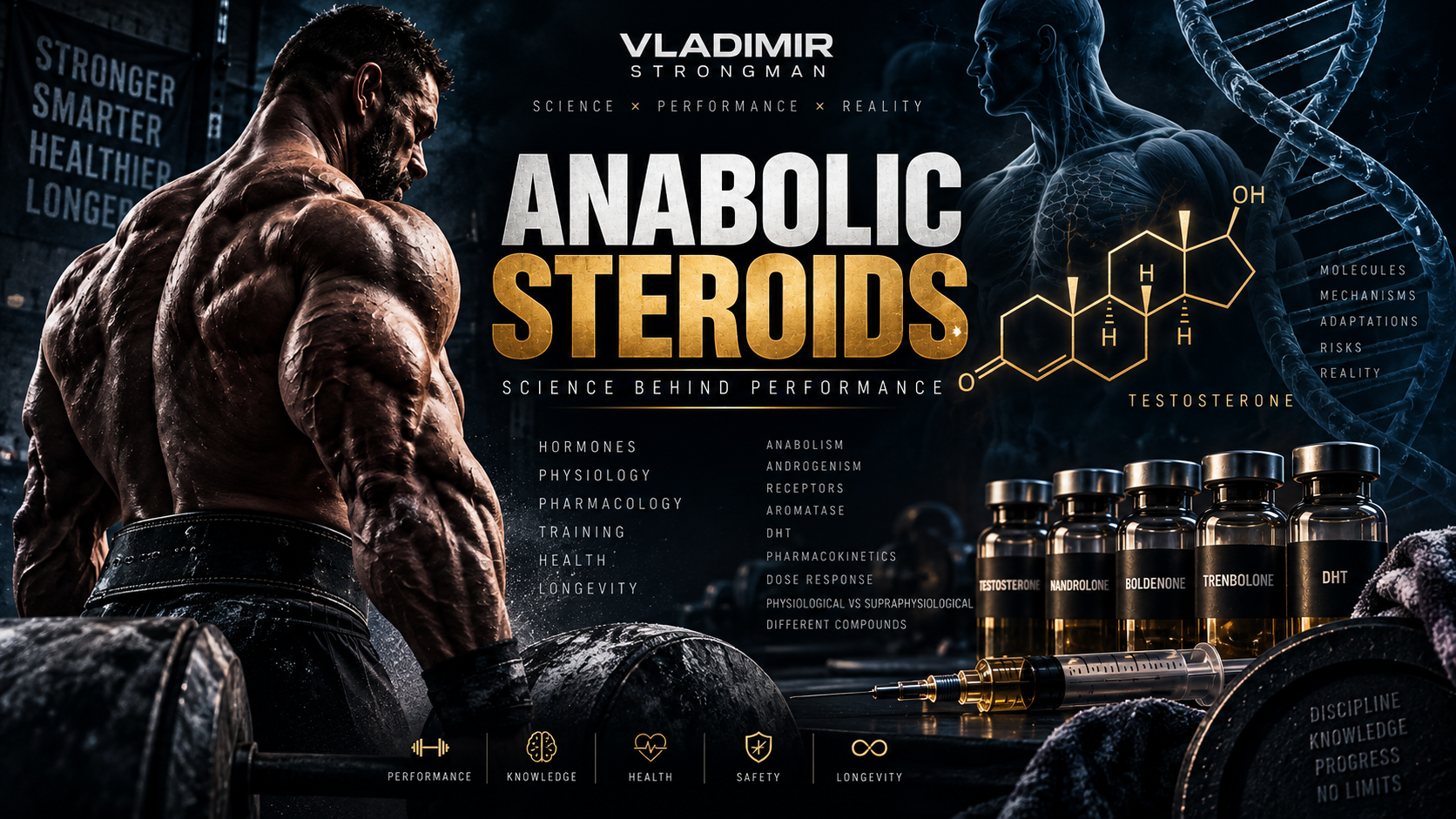
1. What are anabolic-androgenic steroids?
Anabolic-androgenic steroids, abbreviated AAS, are a family of naturally occurring androgen hormones and synthetic compounds structurally related to testosterone. They can activate the androgen receptor and produce, in different proportions, anabolic effects on tissues and androgenic effects associated with male sexual characteristics.
The word anabolic mainly describes the ability to promote tissue-building processes, particularly protein synthesis and skeletal muscle development. Androgenic refers to effects involved in the development and maintenance of male sexual characteristics. In real biology, these two components cannot be separated perfectly.
2. Testosterone is the reference molecule
Testosterone is the principal physiological male androgen and the reference molecule for this family. The body produces it mainly in the testes in men and in smaller amounts in the ovaries and adrenal glands, while testosterone can be converted into other active molecules within tissues.
In pharmacology, many compounds were developed from the testosterone structure to alter duration of action, absorption, metabolism, or the balance between anabolic and androgenic effects. No chemical modification turns an androgen into a compound that is completely free of systemic effects.
3. Why the term anabolic-androgenic?
The concept describes two sides of the same pharmacology. On one side are anabolic effects such as increased skeletal muscle mass and protein synthesis. On the other are androgenic effects involving tissues such as skin, hair follicles, prostate, and reproductive organs.
Historically, drug development attempted to produce steroids with very strong anabolic activity and minimal androgenic activity. Complete separation was not achieved. Differences between molecules are better understood as differences in profile and intensity rather than an absolute split.
4. The androgen receptor: the central target
Most classical AAS effects begin with the androgen receptor, a protein expressed in many tissues. The steroid enters the cell, binds the receptor, and the resulting complex can influence the expression of specific genes.
This signaling can modify cellular processes involved in protein synthesis, differentiation, metabolism, and tissue function. That is why the effects of an AAS are not confined to skeletal muscle.
5. What does anabolic mean?
In sport, the anabolic effect is primarily associated with a greater capacity to maintain and build skeletal muscle. Androgens can increase protein synthesis and alter the balance between protein-building and protein-breakdown processes.
This does not mean that a steroid builds muscle by itself. Muscle adaptation remains dependent on training, energy intake, amino acids, recovery, and the mechanical signals generated by exercise.
6. What does androgenic mean?
Androgenic effects include the development and maintenance of male sexual characteristics and effects on androgen-sensitive tissues. They can include changes involving skin, hair follicles, prostate, and reproductive function.
In women, androgen exposure can produce virilization, including voice changes, increased body hair, and other masculinizing effects. Some of these changes may be difficult or impossible to fully reverse.
7. Why are steroids not all the same?
AAS molecules differ in chemical structure, receptor affinity, metabolism, bioavailability, and duration of exposure. These differences can alter both the effects observed and the risk profile.
Well-known examples include testosterone and its esters, nandrolone, metenolone, oxandrolone, stanozolol, methandienone, and oxymetholone. Trenbolone is also a synthetic androgen in this broad family, but its use in humans is not a standard medical therapy.
The fact that two molecules are popularly called steroids does not mean they share the same pharmacological profile. A family name cannot replace analysis of the individual compound.
8. Testosterone, DHT, and estradiol: three biological directions
Testosterone can be converted to dihydrotestosterone, DHT, through 5-alpha-reductase enzymes. DHT is a more potent androgen in certain tissues and contributes to effects involving the prostate, skin, and hair follicles.
Testosterone can also be aromatized to estradiol. This matters because estrogen in men contributes to bone health, sexual function, and other physiological processes. Androgen pharmacology cannot be understood properly if estrogen is ignored.
9. A steroid is not simply the same as natural testosterone
A common misconception is that an exogenous AAS is simply a stronger version of the testosterone the body normally produces. Some molecules are structurally close to testosterone, while others have important modifications that alter their pharmacokinetics and metabolism.
Exogenous androgen exposure can also signal to the hypothalamus and pituitary that sufficient androgen is present, reducing testicular stimulation and endogenous testosterone production.
10. The hypothalamic-pituitary-gonadal axis is subject to feedback
Supraphysiological AAS exposure can suppress GnRH, LH, and FSH. The consequence is reduced testicular testosterone production and impaired spermatogenesis.
This suppression is one of the fundamental differences between normal androgen physiology and performance pharmacology. External androgen exposure can increase anabolic and androgenic effects in tissues while reducing the body's own hormone production.
11. Why can mass and strength increase?
At supraphysiological exposure, androgens can increase skeletal muscle mass and strength. Mechanisms include effects on protein synthesis, muscle cells, recovery, and adaptation to training.
The effect is not simply a matter of a hormone surge. Androgens change the biological environment in which muscle responds to loading. This is why AAS research must be separated from myths about one hormone or one metabolic pathway.
12. Androgens do not replace training
AAS can increase the potential for hypertrophy and recovery, but they cannot replace mechanical stimulus, technique, programming, and sport specificity. In Strongman, strength must be expressed through events with very different objects, positions, and demands.
An organism with more muscle does not automatically become a better athlete. Coordination, technique, leverage, conditioning, and competition experience remain important.
13. Pharmacology is not only about the desired effect
Every drug has intended pharmacological effects and unintended effects. For AAS, increased muscle mass is the goal for many non-medical users, but the same androgenic signaling can affect cardiovascular, reproductive, hepatic, psychiatric, and metabolic systems.
Risk is not identical for every compound or every person. The substance, exposure, combinations, health status, and product quality all matter.
14. The cardiovascular system is a major concern
AAS use has been associated with changes in lipid profiles, increased blood pressure, cardiac remodeling, and cardiomyopathy. Some oral compounds can have important hepatic effects, while metabolic changes can contribute to cardiovascular risk.
These issues are particularly relevant to Strongman because high body mass, blood pressure, sleep apnea, training stress, and other sport-specific factors may coexist.
15. The liver and differences between administration routes
Some orally administered AAS, particularly 17-alpha-alkylated derivatives, were structurally modified to resist hepatic first-pass metabolism. This can increase oral bioavailability but is associated with a distinctive hepatic risk profile.
That does not mean an injectable AAS is safe for the liver. Toxicological profiles differ, while cardiovascular, endocrine, reproductive, and metabolic effects remain relevant.
16. Fertility can be affected
Suppression of LH and FSH can reduce intratesticular testosterone production and spermatogenesis. Depending on exposure and individual response, oligospermia, azoospermia, testicular atrophy, and post-use hypogonadism can occur.
Recovery after cessation is not guaranteed on a fixed schedule and cannot be reduced to one universal protocol. Some people recover, while others require endocrine assessment and medical treatment.
17. «Anabolic» does not mean «free of androgenic effects»
One persistent myth is that some molecules are completely anabolic and completely free of androgenic effects. Biologically, that is too simple.
What exists are differences among compounds in androgenic activity, metabolite formation, tissue distribution, and other pharmacological properties. These differences can change risk, but they do not erase it.
18. Medical AAS and performance use are different contexts
Androgens have legitimate medical uses, including certain forms of hypogonadism and other specific clinical situations. In that setting, the goal is to treat a defined medical problem using an exposure selected for a therapeutic purpose.
Performance use generally involves a different exposure and a different objective. It is therefore incorrect to automatically transfer evidence from medically supervised testosterone therapy to supraphysiological use of multiple AAS.
19. «Natural» versus «pharmacological»
The key difference is not that natural testosterone is good and exogenous testosterone is bad. The molecule may be the same, but concentration, duration of exposure, and physiological context are different.
At physiological concentrations, testosterone is part of a feedback-controlled endocrine system. At supraphysiological exposure, the system is pushed into a state that the body does not normally maintain.
20. Why dose matters enormously
Androgenic and adverse effects are influenced by exposure. Higher exposure can produce stronger receptor activation, but the response is not a simple straight line and there is no universally safe supraphysiological dose.
Combining compounds can also make it impossible to attribute an effect to one molecule. Individual anecdotes such as «nothing happened to me» therefore have limited scientific value.
21. Why stacking complicates everything
Combining several AAS means combining several pharmacological profiles and several sources of adverse effects. It can become difficult to identify which compound is responsible for a reaction and difficult to estimate total risk.
This series is not intended to build use protocols. Its purpose is to explain pharmacology and how these compounds interact with the human body.
22. The myth that «more anabolic means healthier»
A compound can have a different anabolic-to-androgenic profile from another and still produce important adverse effects. Labels such as «mild», «dry», «safe», or «clean» used in sports communities are not medical categories.
Safety cannot be inferred from the physical appearance produced by a steroid or from its reputation within a community.
23. What happens after stopping?
After AAS cessation, exogenous concentrations decline, but endogenous hormonal signaling may remain suppressed for a period. Fatigue, reduced libido, erectile dysfunction, mood changes, and loss of some gained mass or strength can occur.
The duration and severity of recovery vary. Endocrine assessment may be necessary, and self-treating consequences with additional drugs can add further risks.
24. What must be understood before individual compounds?
Before discussing testosterone, nandrolone, methandienone, oxymetholone, stanozolol, oxandrolone, trenbolone, or other compounds, it is essential to understand the androgen receptor, pharmacokinetics, endocrine feedback, metabolic conversion, and organ toxicity.
Otherwise each molecule gets reduced to a forum nickname: «good for mass», «good for strength», or «no water». Real pharmacology is much more interesting and much more complicated.
25. Conclusion: AAS are active drugs and hormones, not simple «muscle pills»
Anabolic-androgenic steroids are a family of compounds that primarily act through androgenic signaling and can profoundly alter metabolism, skeletal muscle, reproductive function, and the health of multiple organ systems. They can increase mass and strength, but those effects come with endocrine changes and risks that do not disappear simply because an athlete feels well.
This series will examine performance pharmacology without romanticizing or demonizing it: what each class does, what the evidence shows, where myths begin, and where the biological cost appears. The first rule is simple: understand the molecule before judging its effect.
Selected references
1. Albano GD et al. Anabolic-androgenic steroids: How do they work and what are the risks? Frontiers in Endocrinology. 2023;13:1059473. DOI: 10.3389/fendo.2022.1059473.
2. Pope HG Jr et al. Adverse Health Consequences of Performance-Enhancing Drugs. Endocrine Society Scientific Statement. Endocrine Reviews. 2014;35(3):341-375.
3. Grant B et al. Androgen abuse: Risks and adverse effects in men. Annals of the New York Academy of Sciences. 2024. DOI: 10.1111/nyas.15187.
4. Wiacek M, Zubrzycki IZ. Anabolic-Androgenic Steroids Revisited: Structural Biology, Receptor Signaling, and Mechanisms of Anabolic-Androgenic Dissociation. International Journal of Molecular Sciences. 2026;27(6):2581. DOI: 10.3390/ijms27062581.
5. Adverse Effects of Anabolic-Androgenic Steroids: A Literature Review. International Journal of Environmental Research and Public Health. 2021.
6. Contemporary endocrinology, pharmacology, sports-medicine, and anti-doping literature on androgen receptor signaling, HPG-axis suppression, cardiovascular toxicity, hepatic effects, and reproductive consequences of AAS exposure.
26. What does the term anabolic substance really mean?
In sports language, anabolic is sometimes used for almost any substance believed to support muscle growth. Pharmacologically, the concept is more precise. An anabolic agent changes processes involved in building or maintaining tissue, but its effect depends on the molecule, receptor, exposure, duration, and the person's physiological context.
With anabolic-androgenic steroids, anabolic and androgenic effects arise from the same signaling family. The idea that a compound can produce only muscle and no meaningful systemic consequences should therefore be treated cautiously. Biology does not offer a menu where the desired effect can be selected without the rest.
27. The androgen receptor is not found only in muscle
Androgen receptors are present in multiple tissues, and the response depends on the cell type and on local enzymes. The same hormonal signal can therefore produce different consequences in skeletal muscle, skin, prostate, brain, bone, and other organs.
For an athlete, this distinction is essential. A compound may be selected because of its muscular effects, but the biological signal remains systemic. The rest of the organism does not become pharmacologically invisible.
More From The Journal

Training
The Science of Strongman Training - Episode X: Competition Programming
How to build a complete Strongman competition preparation block: calendar, events, volume, intensity, specificity, simulations, autoregulation, tapering and fatigue management.

Training
The Science of Strongman Training - Episode IX: Peaking
Peaking in Strongman: how to turn months of training into maximal competition performance by reducing fatigue, preserving adaptations and managing specificity.