
Physiology
The Brain and Nervous System - Episode 4: Intermuscular Coordination
September 6, 2026
Introduction: muscular strength is not enough
In the first three episodes of this series, we followed the brain and force production, the organization of motor units, and the role of discharge frequency in muscle tension. The next level is coordination between muscles. A Strongman does not win an event simply because the hip extensors are strong, the triceps are strong, or the grip is exceptional. Performance emerges when the nervous system can make these components work together, in the right sequence and at the right intensity.
Intermuscular coordination is the process through which multiple muscle groups distribute and synchronize their contribution to a task. It differs from intramuscular coordination, which describes how motor units are organized within a single muscle. In a heavy lift, both levels operate at the same time.
1. What does intermuscular coordination mean?
Intermuscular coordination describes the temporal and functional relationship among the muscles that participate in the same movement. Some produce the main movement, others stabilize joints, others control acceleration or braking, and some adjust segment position. In a simple exercise, this orchestration can be difficult to see. In Strongman, where implements are large, awkward, and capable of changing the center of mass, it becomes obvious.
A muscle does not work in isolation. Even when an event appears to be dominated by one body region, the nervous system must manage several joints and several sources of force. The final result depends on how these contributions combine, not simply on the maximum value of each part considered separately.
2. Agonists, antagonists, and stabilizers
In a movement, agonists provide the main contribution to the desired joint action, while antagonists can control motion and stabilize the joint. Stabilizers keep segments in a position from which force can be transferred efficiently. These roles are not fixed. The same muscle can contribute differently depending on joint angle, load, velocity, and movement phase.
In a deadlift, for example, hip extension, knee extension, and trunk control must be coordinated well enough to keep the bar close to the body and move it along an efficient path. If one segment fails, the others may compensate, increasing mechanical and energetic cost.
3. Timing matters as much as strength
Two athletes can have similar levels of muscular strength and still perform differently because they activate the same muscle groups in a different sequence. Good coordination does not mean that all muscles must be activated maximally at the same time. It means that each component contributes when it is needed.
In an explosive movement, the time windows are short. A delay in hip extension, loss of trunk rigidity, or premature activation of one segment can change force distribution and reduce implement velocity.
4. Trunk stiffness as a coordination problem
Bracing is not simply a matter of having strong abs. It is a pattern of coactivation and trunk control that creates a stable base for transferring force between the lower and upper limbs. In a heavy lift, trunk muscles must manage pressure, spinal position, and limb movement at the same time.
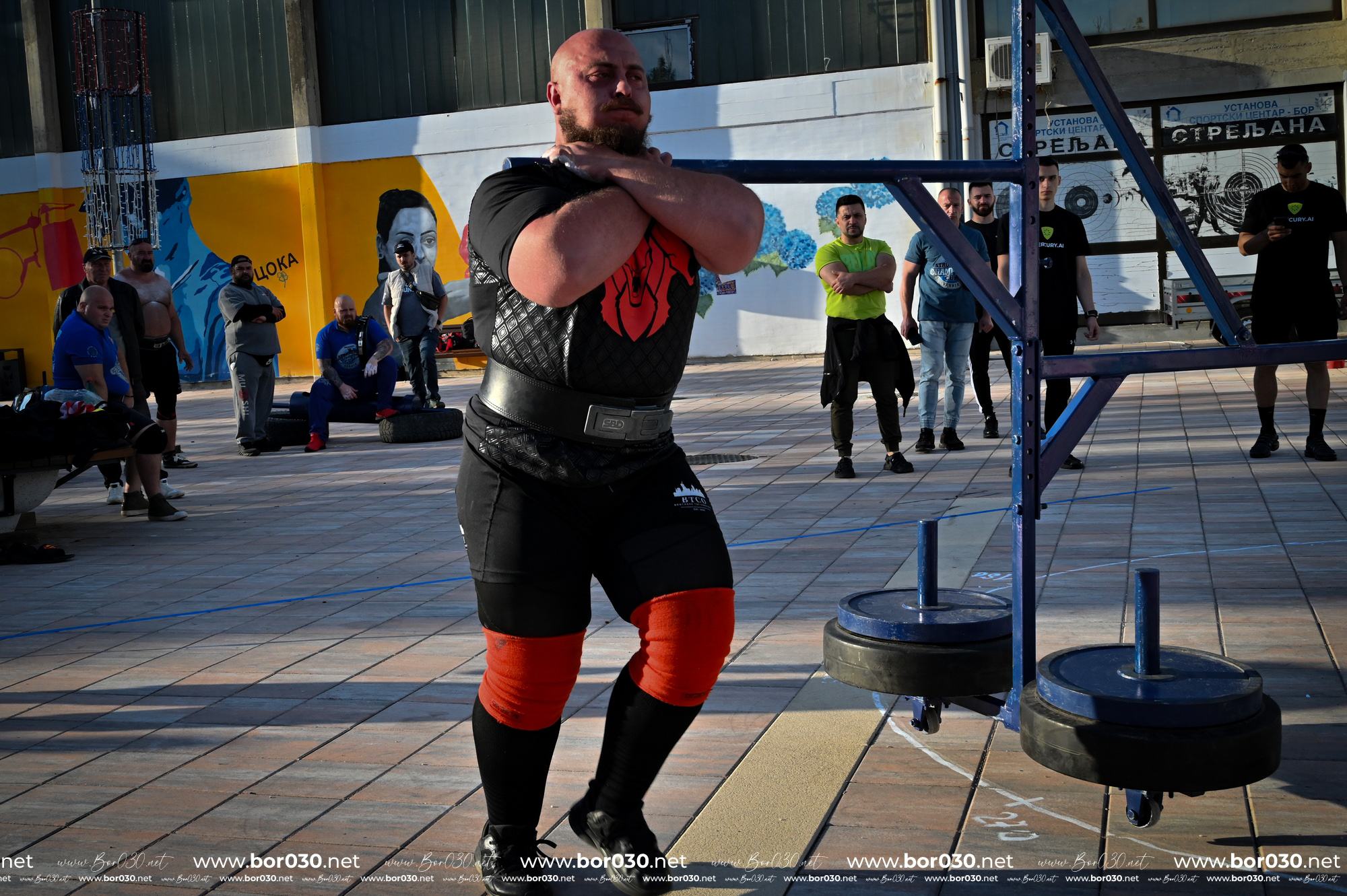
In Strongman, this is crucial for the yoke, frame carry, stone loading, and log. The implement can deviate or create a torsional moment. The nervous system must produce rapid corrective responses so that force generated by the limbs is not lost through unnecessary trunk movement.
5. Coordination in the deadlift
The deadlift is an excellent example of intermuscular coordination. At initiation, the athlete must create grip tension, fix the trunk, and produce force through the lower limbs. As the bar rises, the relative contribution of the hip extensors, knee extensors, and trunk musculature changes.
A timing problem can look like a lack of strength. If the hips rise too quickly, the bar moves away from the body, or trunk tension is lost, the muscles may still have substantial force capacity, but the mechanical conditions become unfavorable.
6. Coordination in the log press
The log press adds complexity through implement geometry and the transition between the clean, rack position, and overhead press. Legs, hips, trunk, shoulders, and arms must form an efficient sequence. Powerful shoulders do not fully compensate for a weak transition or unstable trunk position.
During repetitions, coordination also becomes a rhythm problem. The athlete must decide when to breathe, when to reset position, and how quickly to begin the next rep without losing control.
7. Coordination during carries
A carry presents a continuous control problem. Every step changes the base of support, accelerates and brakes the body's mass, and influences the implement. Lower-limb muscles must produce force in sequence while the trunk and shoulder girdle keep the object stable.
The yoke carry makes this especially clear. If the steps are too long, implement oscillation increases. If they are too short, speed may fall. Intermuscular coordination has to find a compromise between stability, rhythm, and force production.
8. Coactivation: why more activation is not always better
Antagonist coactivation can increase stability, but excessive or poorly timed antagonist activity can also increase internal resistance to movement. The nervous system must regulate this trade-off. During early motor learning, coactivation can be greater, while experience may make control more economical.
During a maximal lift, some stabilization is necessary. The goal is not to contract every muscle maximally, but to create the combination of tension and mechanical freedom that the movement requires.
9. Motor learning and technical automation
Coordination changes with practice. Repeating a stable pattern gives the nervous system an opportunity to reduce unnecessary variation and automate sequences that do not need to be consciously redesigned on every repetition. This does not make movement rigid. It creates a sufficiently stable base from which rapid adjustments can be made when conditions change.
In Strongman, automation is especially useful because implements and surfaces can vary. The athlete needs a stable baseline pattern while remaining able to adjust to the actual contest implement.
10. The specificity of coordination
Intermuscular coordination is highly task specific. Better coordination in a squat does not guarantee identical coordination in a sandbag load. A deadlift can develop general strength and control components, but the implement, grip position, and rhythm of a Strongman event change the motor problem.
Complete transfer therefore requires sufficient exposure to the target movement. General exercises build resources; specific practice teaches the nervous system how to combine them.
11. Coordination and speed
At high velocities, the time available for correction decreases. Fast movement requires prediction, automation, and precise temporal control. If each component is activated separately and too late, energy is not transferred efficiently.
This matters during stone loading, frame acceleration, and the transition out of a log clean. Training must build not only force, but also the ability to connect force production into a rapid sequence.
12. Coordination under fatigue
Fatigue does not only reduce the amount of force available. It can alter timing, stability, and movement precision. In a medley, an athlete may still have enough force to finish the event, but lose time because the coordination of each step or transition is no longer as efficient.
For that reason, Strongman training should sometimes include controlled exposure to event sequences in which coordination is challenged after accumulated fatigue. The goal is not to reinforce poor technique, but to learn to maintain useful organization under relevant conditions.
13. Breathing and coordination
Breathing is part of effort organization. In many heavy movements, bracing and breathing must be synchronized so that internal pressure, trunk stability, and force production are compatible. There is no single breathing technique for every event, but there is a general need to coordinate breathing with the critical phase of the movement.
In repetition events, breathing rhythm can become part of pacing. Poorly synchronized breathing may disturb bracing or force the athlete to slow down more than necessary.
14. Coordination and movement economy
A well-coordinated athlete is not necessarily the one who activates the most muscle, but the one who uses the appropriate resources with minimal losses. An efficient implement path, a stable base, and a repeatable sequence reduce unnecessary motion and allow more of the generated force to reach the implement.
In competition, this economy can mean seconds gained. In a medley, a small improvement in every step or transition can accumulate into a substantial advantage.
15. How can intermuscular coordination be trained?
The first principle is specificity. To improve the coordination of an event, the event itself or a sufficiently similar variation needs regular practice. The second principle is quality. Repetitions should provide useful feedback rather than simply add volume.
The third principle is progression. Speed, load, distance, and complexity can be increased gradually so that the nervous system learns to preserve movement organization as the demand rises.
The fourth principle is controlled variability. Once the baseline pattern is stable, moderate changes in load, position, or rhythm can help the athlete learn to adapt without losing the main structure of the movement.
16. Practical exercise examples
Paused deadlift: helps the athlete feel and control the transition from initial tension into load displacement. It is not only a strength exercise; it is a kinetic-chain organization problem.
Repeated log cleans: develop the sequence between lower-limb extension, pull, and receiving position. Emphasis should be on timing and consistency rather than turning every repetition into a maximal attempt.
Submaximal yoke carries: allow practice of step pattern, rhythm, and stability without immediately introducing the full stress of a maximal attempt.
Technical stone loading: loads manageable enough to repeat the path, arm position, and force transfer until the implement is placed successfully.
17. How is coordination measured indirectly?
Intermuscular coordination is not captured perfectly by a single metric. Research can use electromyography, kinematic analysis, force, implement velocity, and other methods. In practice, coaches often rely on technical consistency, implement path, rhythm, velocity, and the number of corrections required.
A set in which an athlete reproduces the same movement with little variation may indicate more stable coordination than a set in which every repetition looks different, even when the external load is identical.
18. What does the literature say about adaptation?
Resistance-training research shows that the nervous system adapts to practiced demands. Changes have been reported in cortical and spinal control, motor-unit behavior, and coordination. However, studies use different protocols and methods, and coordination is not a single variable measured identically in every experiment.
The strongest general conclusion is that specific practice improves specific control, and neural adaptation should be interpreted together with muscular development and technical changes.
19. Intermuscular coordination and Strongman performance
Strongman magnifies the importance of coordination because events combine strength, speed, locomotion, stability, and management of unconventional objects. The athlete must transform muscular capacity into efficient movement under time constraints.
An athlete may be exceptionally strong in standard exercises and still lose an event if that strength cannot be integrated with the implement and the temporal demands of the task. Coordination is the bridge between potential and expression.
20. Conclusion
Intermuscular coordination is one of the components that transforms raw strength into performance. The nervous system must combine the contractions of multiple muscles, control stability, regulate timing, and continuously adjust movement through sensory feedback.
In Strongman, coordination is essential for the deadlift, log, carries, stone loading, and mixed events. A champion needs more than muscles capable of producing force. The athlete needs a nervous system capable of making those muscles work together when it matters, at the right speed, in the right position, and under fatigue.
Training therefore has to build both force capacity and its organization. Specific practice, repeated technique, intelligent progression, and exposure to the actual event context are tools through which the neuromuscular system learns to transform many sources of force into one efficient action.
Scientific bibliography
1. Heckman CJ, Enoka RM. Motor unit. Comprehensive Physiology. 2012;2(4):2629-2682. DOI: 10.1002/cphy.c100087.
2. Enoka RM, Duchateau J. Rate coding and the control of muscle force. Cold Spring Harbor Perspectives in Medicine. 2017;7(10):a029702. DOI: 10.1101/cshperspect.a029702.
3. Duchateau J, Semmler JG, Enoka RM. Training adaptations in the behavior of human motor units. Journal of Applied Physiology. 2006;101(6):1766-1775. DOI: 10.1152/japplphysiol.00543.2006.
4. Gabriel DA, Kamen G, Frost G. Neural adaptations to resistive exercise: mechanisms and recommendations for training practices. Sports Medicine. 2006;36(2):133-149. DOI: 10.2165/00007256-200636020-00004.
5. Škarabot J, Brownstein CG, Casolo A, Del Vecchio A, Ansdell P. The knowns and unknowns of neural adaptations to resistance training. European Journal of Applied Physiology. 2021;121:675-685. DOI: 10.1007/s00421-020-04567-3.
6. Siddique U, Rahman S, Frazer AK, Pearce AJ, Howatson G, Kidgell DJ. Determining the Sites of Neural Adaptations to Resistance Training: A Systematic Review and Meta-analysis. Sports Medicine. 2020;50(6):1107-1128. DOI: 10.1007/s40279-020-01258-z.
7. Elgueta-Cancino E, Evans E, Martinez-Valdes E, Falla D. The Effect of Resistance Training on Motor Unit Firing Properties: A Systematic Review and Meta-Analysis. Frontiers in Physiology. 2022;13:817631. DOI: 10.3389/fphys.2022.817631.
Editorial note: intermuscular coordination is a complex physiological and biomechanical concept. Evidence for neural adaptations is supportive, but results differ by muscle, task, athlete level, and measurement method. The article avoids turning mechanistic hypotheses into certainties.
More From The Journal

Training
The Science of Strongman Training - Episode X: Competition Programming
How to build a complete Strongman competition preparation block: calendar, events, volume, intensity, specificity, simulations, autoregulation, tapering and fatigue management.
Training
The Science of Strongman Training - Episode IX: Peaking
Peaking in Strongman: how to turn months of training into maximal competition performance by reducing fatigue, preserving adaptations and managing specificity.