
Training Science
THE BRAIN LEARNS TO LIFT: THE SCIENCE OF MOTOR SKILL ACQUISITION IN STRONGMAN | Episode 6: Action Observation and Motor Imagery: The Role of Demonstrations in Learning Technique
October 29, 2026
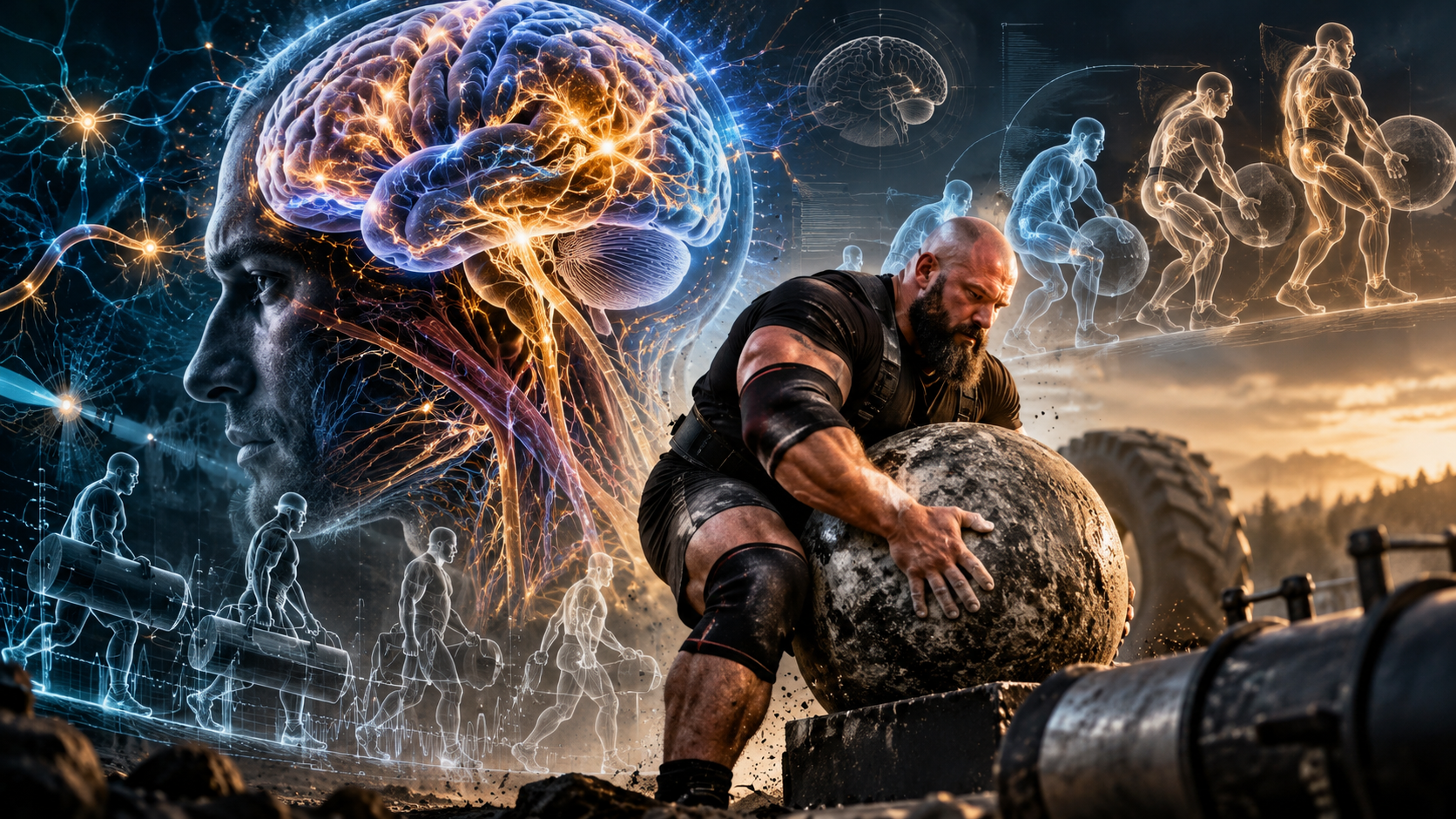
Action Observation and Motor Imagery: The Role of Demonstrations in Learning Technique
A coach loads an Atlas stone while another athlete watches every phase. Vision reveals hand position, the transfer of the object into the lap, and the direction of final extension. This information is genuine but not equivalent to experiencing a stone pressing against the chest, friction at the palms, or one's own anatomical constraints. Action observation is the process of extracting information from another actor's movement; motor imagery involves mentally simulating an action without completing its physical execution. The two can be combined, but both differ from physical practice, listening to instructions, or passively watching without a technical goal. An impressive video can stimulate enthusiasm without necessarily improving technique. By contrast, intentionally examining the moment of hand repositioning may prepare a specific attempt. The central question is when images and demonstrations change subsequent performance, not the unsupported assumption that watching automatically constitutes learning. Throughout this episode we distinguish evidence from controlled experiments from cautious extrapolation to implements weighing hundreds of kilograms, where physical demands and the consequences of error change what is appropriate [1–4].
Observation for learning differs from observation for entertainment. The observer attempts to understand the movement's goal, select useful landmarks, and compare the consequences of alternative strategies. Watching a log clean may reveal the distance between cylinder and torso, the timing of the transition into the rack, and stabilization before pressing. Watching a farmer's walk may reveal the separation of handles from the floor, acceleration, pacing, and the turn. The camera angle matters: a side view highlights aspects of trunk motion but can conceal lateral movement, whereas a frontal view may reveal differences between hands but does not directly measure forces transmitted into the implement. Selecting footage is already a methodological decision. Front and side demonstrations are not identical informational resources. Athletes may correctly identify the sequence while misjudging distances when the demonstrated performer has different body proportions. Visual differences do not necessarily constitute technical errors. The relevant criterion is whether information gained through viewing supports an effective solution for the observer's own body and the equipment actually being used [2,5].
In observational-learning research, the model is the individual or representation whose action is viewed. A model may be an expert, novice, similarly skilled peer, or the athlete's own recorded performance. Each can provide distinct information. An expert may demonstrate fluent sequencing and efficient control; a novice may make visible errors that help an observer anticipate consequences; self-observation may reveal differences between subjective sensation and recorded movement. It does not follow that experts are invariably the best models. A 2022 systematic review of observational learning in physical education, drawing on eighteen studies, supported the value of observational practice relative to its absence, but found no convincing universal advantage of expert over self or nonexpert models. Findings concerning added verbal cues were inconsistent. Because the study populations and tasks were unlike elite strongman events, a mandatory demonstration format for stone loading cannot be derived from this review. A more defensible conclusion is that model selection should depend on the learning objective, the athlete's experience, and the particular information that needs to become visible [2].
A video showing one spectacular repetition may conceal the processes that make technique repeatable. Seeing a successful heavy log does not reveal how many previous attempts failed, which changes were introduced, or whether the movement can be reproduced under comparable conditions. A normal-speed demonstration followed by analysis of a relevant transition may be more useful than a montage of records. Explaining where an error begins does not mean celebrating failure. A 2024 systematic review of observational practice for reaching adaptation suggested that viewing errors and their consequences can contribute to subsequent sensorimotor adaptation, although observational gains were generally smaller than those from physical practice. Such experiments often involve controlled visuomotor rotations or force fields, tasks fundamentally different from moving an Atlas stone. With heavy equipment, an instructor should never deliberately create a hazardous failure merely to illustrate an error. Existing footage, manageable demonstrations, and explanation of lost contact can provide information without exposing athletes to unnecessary risk. The benefit comes from understanding, not spectacle [3].
Mental imagery need not be exclusively visual. Athletes sometimes represent an action externally, as if watching a video of themselves; at other times they imagine what they would see through their own eyes. Kinesthetic imagery concerns anticipated sensations of movement, implement pressure, shifting load, and effort timing. Visual and kinesthetic qualities can coexist, but vividness differs between individuals. Someone who cannot easily generate rich visual images may still use spatial descriptions, intentions, and kinesthetic information; a lack of vivid pictures should not automatically be diagnosed as poor sporting potential. Researchers assess imagery ability through questionnaires and specific tasks, with recognized validity limitations. In coaching, a useful question is which event feature an athlete can anticipate: the instant of pickup, contact with the lap, or a final stable position. There is no reason to demand that the person reports exactly the same force sensations as during a real attempt, something that cannot be verified through self-report alone. Motor imagery is a partial simulation and should be treated as such rather than a mechanical replacement for lifting [4,6].
From observation to simulation: neural systems, viewpoints, and PETTLEP
Action observation and action execution engage partially overlapping neural networks, including premotor, parietal, and somatosensory regions, but overlapping activation does not establish identical processes. Interest in so-called mirror neurons has driven extensive research, yet claiming that merely watching a stone lift activates precisely the same neurons as physically lifting it would overstate the evidence. Directly identifying cellular properties in humans is difficult; neuroimaging signals reflect large populations rather than individual neuronal photographs. A 2024 synthesis of action understanding described multiple contributions from visual, motor, and intention-inference systems. There is no single 'imitation center' that mechanically transfers technique from coach to athlete. Watching a log can assist with representing the goal and anticipating movement consequences, but the observer must still acquire the force, contact control, and calibration needed for their own body. Neural activation should therefore not be converted into specific viewing prescriptions without appropriate experiments. In the gym, the meaningful outcomes are physical performance, consistency, retention, and transfer, not an imagined count of 'mirror neurons activated' by an instructional video [3,5].
Motor imagery may engage planning and simulation processes that share functional features with preparing an actual movement, yet it remains different from execution. It does not automatically produce equivalent mechanical tension, contact signals, or muscle adaptation. A 2018 meta-analysis of strength development in healthy adults found that imagery could improve maximal voluntary strength relative to no intervention, although physical practice generally produced greater benefits. The participants and tasks differed substantially from strongman events, so these findings cannot predict how many kilograms imagery adds to a 150-kilogram log. This distinction matters: mental simulation may complement technique training or support preparation when physical practice is temporarily unavailable, but it should never be presented as a physiological substitute for progressive loading. Brain activation observed during imagery does not prove that tendons or muscles experienced the mechanical stimulus of an actual lift. Recommendations should identify the intended outcome precisely, such as anticipating the sequence, preparing for a situation, or organizing a pre-attempt routine, rather than promising muscle hypertrophy through imagination [7].
A widely used sport-imagery framework is PETTLEP, standing for Physical, Environment, Task, Timing, Learning, Emotion, and Perspective. The idea is to make mental simulation resemble relevant characteristics of the intended action: realistic posture, a familiar location, the concrete task, plausible timing, the athlete's learning stage, appropriate emotions, and a useful viewpoint. An athlete might mentally rehearse approaching a stone, anticipating contact, and progressing through its phases in conditions resembling competition. Psychological resemblance does not, however, justify handling a dangerously heavy implement while imagining or deliberately recreating hazardous situations. PETTLEP is a design framework, not an algorithm proven superior for every athlete. A 2022 systematic review considered its use in sporting performance and documented variation among protocols. The most relevant components should reflect expertise and goals. A beginner may benefit primarily from understanding the phases; an advanced athlete may find rehearsal of the event order valuable. Any mental intervention should ultimately be assessed through subsequent physical performance, not merely through reports that the image seemed vivid [6,8].
Internal and external imagery perspectives can supply different information. From an external viewpoint, athletes can imagine the implement trajectory and the body's position in space. From an internal viewpoint, they may anticipate handle contact, shoulder support, and the instant of acceleration. Evidence does not establish a universally ideal perspective for strongman. A novice unfamiliar with the transition into a rack position may benefit from a clear external representation followed by physical trials that reveal the actual sensations. An expert may find internal rehearsal useful for a familiar action, while still requiring external footage to identify an implement-path error. Kinesthetic imagery should not be confused with deliberately imagining pain or extreme effort. Unpleasant sensations are not required for realism; the objective remains effective control. Perspective choices can be examined through the clarity of task description, subsequent execution quality, and adaptation when the implement changes. Subjective preference helps determine acceptability, but is insufficient by itself to demonstrate effectiveness [6,8].
Combining observation and imagery, called AO+MI in research, can be synchronous when athletes imagine their own action while watching a model, or asynchronous when they observe and simulate sequentially. A systematic review published online in 2025 included seventeen studies and found encouraging outcomes across several tasks. Yet intervention protocols differed considerably, and retention and transfer assessments were often missing. Only one study included participants already experienced in the relevant task, limiting direct generalization to advanced competitors. No universally optimal number of minutes or perfect combination has been established. A cautious strongman application might involve observing several relevant demonstrations, mentally rehearsing the action sequence, and then checking it under a manageable physical load. This is a plausible application of the underlying principles, not a validated competition protocol. Benefits must be demonstrated in movement rather than inferred solely from increased confidence following video viewing [4].
What demonstrations reveal in strongman events
Learning from a demonstration requires selecting relevant features rather than memorizing every bodily detail. In a log clean, the observer can watch when the cylinder begins rotating relative to the torso and how it reaches stable support before the press. A whole demonstration may give a beginner an overview of the sequence, while a replay focused on one transition can clarify the specific problem. An experienced athlete may use multiple camera angles to compare an efficient attempt with one showing a loss of velocity. Yet no coach should declare that one observed trajectory is optimal for every log design and body morphology. A camera does not directly measure joint torques or gripping forces. Applied observation starts with a question: where does contact fail, when does rotation begin, and where does an unnecessary pause occur? After viewing, the athlete practices a manageable variant and checks whether the selected landmark helps reduce the error. If it does not, the footage may be accurate but the chosen information may not address the real limitation. Demonstration becomes a diagnostic and teaching tool rather than an aesthetic verdict on technique [2,3].
With Atlas stones, it is tempting to show only the final instant when the object clears a platform. For learning, the entire sequence may be more informative: approach, hand contact, separation from the floor, placement on the lap, grip change, and final extension. Biomechanical research involving twenty experienced athletes described five phases and changes in kinematics across repetitions using progressively heavier stones. Video can help observers recognize those transitions, but the study established neither universal technique nor the exact benefit of watching demonstrations. Copying another athlete's hand positions centimeter by centimeter may be inappropriate when body proportions differ. Demonstration should highlight functional relations, such as maintaining contact and organizing phase transitions, rather than enforcing identical joint angles. One educational application is comparing footage of the same stone lifted through slightly different strategies and discussing their consequences for control. The athlete can then test the interpretation through manageable physical attempts. Observing the stone does not replace feeling its surface or adapting grip to friction [9].
For giant dumbbell, showing the movement from shoulder support to overhead position may help reveal the sequence of unilateral coordination. A side view can display implement displacement, while a frontal view may clarify leg and trunk organization. When the performer uses a competition-legal technique, observation can also help explain what constitutes a valid repetition. Giant dumbbells differ in mass distribution, however, and video alone cannot quantify their moments of inertia. Realistic mental rehearsal may anticipate the contact sequence, transition toward the shoulder, brief stabilization, and continuation to lockout. Physical practice must still occur with loads allowing control and safe lowering. Accurately imagining a movement does not prove adequate mobility, stability, or force capacity. Repeatedly watching highly loaded attempts does not automatically provide the information a beginner needs. A clear, relevant model matching the task may be more useful than a spectacular collection of unexplained personal records [2,4].
Farmer's and yoke walks invite observation of a moving system rather than the starting posture alone. In farmer's, the observer can examine pickup, acceleration, and the turning path; in yoke, stride rhythm and the frame's response to oscillation are important. A biomechanical yoke study analyzed successive sections of a twenty-meter course and highlighted differences between initial acceleration and later locomotion. Therefore, a short video showing an athlete already at speed can omit the phase that limits the learner. Demonstrations should include the start and finish, and analysis should focus on the actual problem: pickup time, number of stops, or turn control. Different frames, athlete proportions, and load distributions may change what is feasible. Watching several models can reveal options, but does not guarantee that the fastest model is imitable. The subsequent test should use a small controllable intervention rather than turning the footage into a compulsory universal standard [10].
Tire flipping and sandbag carries contain contact events that a static photograph cannot adequately show. During a tire flip, the relevant feature may be when the athlete transitions from initial force production to hand repositioning for continued rotation. During a sandbag carry, the issue may be whether the object is stabilized before walking and how the athlete responds to deformation. Imagining such events may help prepare the sequence, but actual contact provides information that mental representation cannot fully reproduce. A useful demonstration might be accompanied by the question 'what changes when the object's support shifts?' rather than a comprehensive list of joint commands. If the athlete cannot identify the feature, the coach can slow down the footage or isolate the transition. Slow motion can also distort perceived timing, so normal-speed viewing should be included before physical execution. The balance between visual clarity and temporal fidelity matters in strongman, although direct research has not established one universally optimal presentation method [3,4].
Scientific evidence: promising findings and meaningful limits
Recent meta-analyses offer a more complex picture than the slogan 'visualization works.' A 2025 synthesis covering eighty-six studies and approximately 3,593 athletes reported average benefits from imagery for selected performance outcomes, but interventions and populations were heterogeneous. The authors also explored dosage patterns, yet an apparent statistical optimum across diverse studies is not a proven recipe for a strongman competitor. A 2023 synthesis of psychological interventions in sport found apparently favorable imagery effects, but these were no longer statistically significant after nonrandomized studies and subjective performance measures were excluded. This does not establish that imagery is useless. It reduces confidence in any universally large effect estimate. Tennis performance, the accuracy of a fine motor task, and lifting an extremely heavy object differ fundamentally. An athlete may report greater confidence after imagery without demonstrating improved yoke speed or stone-loading capacity. The assessment must match the declared objective, and psychological utility must not be confused with verified biomechanical progress [6,11].
A systematic review of studies on healthy athletes, published in 2026, identified nine randomized trials involving 339 participants and examined imagery, observation, or their combination. Most included studies reported improvements in selected outcomes, but the authors concluded that an optimal protocol remains undetermined. For strongman, this is a key limitation: encouraging evidence for a psychological intervention cannot be converted into maximal loading prescriptions or precise promises about strength gains. Observation, imagery, and physical practice can have different effects and should not be counted as interchangeable repetitions. Ten minutes of mental rehearsal cannot simply be converted into ten sets of technical work; no common unit of training exposure supports that calculation. Evaluation should track distinct physical outcomes such as secure contact, transition speed, or movement consistency. Competitive level and prior task experience must be described because an intervention helpful for a novice may offer little new information to an expert familiar with the sequence [4,12].
Another error is simplistic interpretation of shared neural activation. Even if imagery and execution involve partially overlapping brain regions, their effects are neither identical nor interchangeable. An athlete imagining an Atlas stone does not experience actual variation in friction, grip uncertainty, or compression against the chest. These sensations can decisively affect coordination and cannot be simulated with perfect fidelity. Watching an action without its error consequences may also be less informative than comparing alternative outcomes. Reaching studies show observational benefits in selected paradigms without demonstrating universal transfer across contexts. Accordingly, mental practice in strongman should be described as an educational supplement rather than a replacement for developing force capacity and calibrating sensory control to real equipment. When physical practice is medically contraindicated, a return to loading requires clinical and recovery criteria rather than confidence in the clarity of imagined movement. Neuroscientific resemblance does not abolish the mechanical requirements of training [3,7].
Models can reveal functional variation rather than only an idealized example. Two successful demonstrations using the same stone may show that athletes with different proportions use different configurations while achieving the objective. Such comparison can discourage rigid copying of a posture unsuited to the observer's anatomy. Yet a montage of alternative solutions does not prove that all are equally effective or safe. Some differences reflect strategy, others load or surface properties, and some may be errors compensated for by substantial strength. The coach can identify which constraints made each approach workable and when another might be preferable. The learner then tests the hypothesis using a manageable load and their own body. Observing other athletes may expand the conceptual repertoire of possible solutions, but cannot replace selecting a strategy that reliably works. Learning from examples means understanding functional relationships, not collecting movements to imitate indiscriminately [2,5].
A frequently neglected issue is the relationship between demonstration and feedback. A recording shown before execution provides a model, whereas video of the athlete's subsequent attempt provides outcome information. Their usefulness may depend on how they are sequenced. Watching a model, performing, then comparing one relevant phase can expose a discrepancy more clearly than reviewing dozens of frames without purpose. Coaches should nevertheless avoid creating dependence on video correction after every repetition. Autonomy requires internal criteria for detecting relevant errors: an athlete should recognize slipping contact or growing yoke oscillation without always needing a screen. Later assessment without identical cues helps distinguish assisted performance from durable learning. Evidence is inadequate to prescribe one universal frequency of viewing or feedback in strongman. The decision should reflect technical complexity, the consequences of error, and the learner's existing capacity for independent detection [2–4].
Designing interventions and evaluating learning
An educational protocol for a new event should start by defining the goal rather than choosing an arbitrary video. Suppose the athlete is learning to move an Atlas stone from the lap onto a platform. The coach selects a demonstration with a similar object and target, then asks the athlete to identify two events: when the stone is stable in the lap and when final extension begins. Brief mental rehearsal of the sequence follows, without maximal muscle effort. The athlete then performs manageable attempts and discusses only meaningful differences between intention and outcome. After a delay, the same task is attempted without viewing or identical prompts. This is not a clinically or competitively validated protocol; it illustrates how observation, imagery, and physical action can be organized into a testable sequence. If improvement occurs only when the coach intervenes at exactly the right instant, assisted performance has been demonstrated, not necessarily retention. The approach becomes more persuasive if the athlete reproduces the movement without video and adjusts it to a manageable variation [2–4].
For an advanced competitor, mental methods may target a highly specific competition detail. Before a log event, an athlete may view footage of a previously consistent performance to recall the contact sequence and familiar timing. Brief imagery may rehearse the pre-attempt routine and movement order without becoming a lengthy compulsory ritual. If imagery increases anxiety, interferes with warm-up, or promotes fixation on a minor technical error, its practical value diminishes. A coach might compare periods with and without the intervention while recording consistency at comparable loads. Result differences cannot automatically be attributed to imagery when recovery, equipment, or competition conditions have also changed. For experts, a plausible benefit is not discovering the entire movement anew but preparing to retrieve and select an already established strategy. That remains a testable aim, not evidence that watching a video immediately restructures the neuromuscular system [1,4].
Effective teaching also requires knowing when not to rely on observation or imagery. New shoulder pain or severe instability during an event cannot be adequately addressed through additional mental rehearsal while heavy lifting continues. The attempt should stop and the problem be assessed appropriately. If the athlete lacks the force capacity needed to reach the required height, imagery will not eliminate that physical limitation. If camera placement conceals the grip, repeatedly watching the footage does not make the interpretation reliable. If the demonstrator has very different anthropometry, exact copying of hand placement may be unsuitable. These cases show why scientific interventions have conditions of application and stopping criteria rather than unlimited promises. Observation is useful when visual information matches the problem, and imagery is useful when the athlete can construct a relevant simulation; both require physical verification. Injury prevention cannot be inferred merely from improved performance on mental tasks [7,9].
Distinguishing observation of success from observation of error also matters. Seeing only the final position of a stone may establish the desired outcome without revealing how the movement developed. Watching a controlled example in which the stone slips because of an insecure contact may help the observer anticipate which cue is important during their own attempt. This is consistent with laboratory studies of observational adaptation but does not guarantee learning from every error. Footage must be clear enough to separate technical mistakes, strength limits, and changed surface conditions. Otherwise the athlete may learn an inappropriate correction. Coaches should never create dangerous failures merely to generate instructional material. Lower-load demonstrations, existing recordings, or explanatory simulations without heavy equipment can convey the relevant relationship. The potential benefit lies in recognizing action–outcome consequences rather than exposing observers to hazardous spectacle [3].
To decide whether observation practice worked, outcome measures should be paired with process indicators. The outcome might be a successful load, time into the rack, or carry speed. Process measures may include repositioning and control of phase transitions. Immediate testing shows whether the intervention helped that session; delayed testing examines persistence. A transfer task can modestly alter implement diameter or target height without adding disproportionate force demands. Causal conclusions about instructional efficacy would require appropriate comparison groups, controls, evaluators, and reproducible procedures. In a club, an athlete can still maintain a disciplined record of what was observed and which movement change was attempted. Improvements over time do not specify the responsible brain circuit, but they may support better educational decisions. Restraint in biological explanation is a feature of professional research rather than a lack of ambition [2,4].
Conclusions and limits of observational practice
How verbal cues accompany a demonstration may change what the athlete notices. 'Watch the wrist' directs attention toward a detail but could hide the relation between object and torso. 'Notice when the stone begins moving away' identifies an outcome variable involving several joints. Neither formulation is universally superior; usefulness depends on the actual error and learner expertise. A systematic review of observational learning in physical education reported inconsistent findings for added verbal cues, warranting caution. One practical solution is to compare two short demonstrations with distinct, clear objectives and assess the subsequent movement. Adding ten commands to a short video, by contrast, may increase confusion without benefit. A cue should enable identification of an observable event and a check of whether the same event occurs during the athlete's own execution. Detailed explanation may be valuable between attempts, but attention and safety constraints must guide what is said during effort [2].
Model selection should reflect differences in body proportions, equipment, and competition rules. A log with handles in another location may rotate differently, while a large-diameter stone changes the approach compared with a compact one. Footage of an exceptionally strong competitor may show a strategy made possible by force reserves unavailable to the observer. Thus the best model for a particular problem is not automatically a champion; it is the person or sequence that makes the relevant functional relationship clear. A similarly skilled model may be understandable to a novice, whereas an expert model may reveal advanced coordination to a specialist. Similar body shape alone does not guarantee transfer. Task goal, relative load, contact conditions, and learning stage all matter. Scientific instruction evaluates whether demonstration supports the intended outcome rather than ranking performers by visual style [2,9].
Motor imagery should not be confused with rumination about failure. Obsessively rehearsing a dropped stone or missed log can intensify worry without clarifying an effective response. Task-oriented imagery identifies the intended action, the start of the sequence, and the signal that would justify adjustment. When preparing for unfamiliar equipment, an athlete may mentally rehearse approach, strategic choice, and a calm response to changed conditions without inventing impossible precision about the object's sensations. Imagery cannot deliver new physical measurements of an implement the athlete has never touched. It can help prepare a conditional decision: if a handle is thicker, evaluate grip before acceleration. This is a plausible cognitive use, not proof that simulation automatically generates adaptation to every object. Responsible application emphasizes task clarity and flexibility rather than a promise of absolute control [1,4].
In reviewing evidence, rehabilitation outcomes must be distinguished from elite sport outcomes. Studies showing benefits of combined observation and imagery after stroke answer important clinical questions, but populations, tasks, and limiting mechanisms differ from those of healthy strongman athletes. Clinical effects cannot be converted directly into maximal loading prescriptions. Likewise, studies in healthy novices learning darts or cup-stacking sequences cannot establish improvements when carrying a 400-kilogram yoke. Such research supports the possibility of modifying selected skills through nonphysical practice, while the rest requires testing. An article that mixes these populations without explanation creates false confidence. Strongman needs direct studies of execution, retention, and transfer using relevant equipment, comparable procedures, and appropriate safety. Until those data exist, applied recommendations must remain conditional [4,12].
Mental practice may also have value between physically demanding sessions when repeating a heavy event is inappropriate. Athletes can review carefully selected demonstrations and clarify their technical intentions without substantial additional mechanical loading. This does not mean all free time should be filled with imagery or that longer sessions necessarily produce greater effects. Cognitive practice can become tiring or monotonous and should be individualized. When used, its frequency, duration, content, and subsequent physical outcomes should be documented; otherwise the intervention cannot be interpreted. Briefly rehearsing a meaningful segment may be more informative than repeating a poorly understood sequence many times. For experienced athletes, imagery may support strategic preparation; for novices, demonstrations and manageable physical execution remain essential for acquiring tactile information unavailable to imagination [4,6].
The central conclusion is that demonstration and imagery may help athletes understand tasks, select landmarks, and prepare responses, but neither replaces the interaction between body and actual equipment. Observation provides information about visible action consequences, while imagery permits partial simulation of sequences and intentions. Effectiveness depends on what is attended to, model quality, athlete experience, and the assessment used. Scientific findings are promising but inconsistent; superiority over physical practice and a universal strongman protocol have not been established. A competent coach uses these tools for clearly defined questions and later evaluates retention and transfer without mistaking a vivid image for a completed lift. The next episode examines that transfer directly: what remains useful when equipment changes, and how do we recognize adaptability with an unfamiliar implement? [1–4].
References
[1] Krakauer JW, Hadjiosif AM, Xu J, Wong AL, Haith AM. Motor Learning. Comprehensive Physiology. 2019;9:613–663. DOI: 10.1002/cphy.c170043. https://www.comprehensivephysiology.com/WileyCDA/CompPhysArticle/refId-c170043/
[2] Zhang et al. Use of Observational Learning to Promote Motor Skill Learning in Physical Education: A Systematic Review. International Journal of Environmental Research and Public Health. 2022;19:10109. DOI: 10.3390/ijerph191610109. https://pmc.ncbi.nlm.nih.gov/articles/PMC9407861/
[3] A systematic review of observational practice for adaptation of reaching movements. npj Science of Learning. 2024. https://pmc.ncbi.nlm.nih.gov/articles/PMC11449917/
[4] Binks JA et al. The effects of combined action observation and motor imagery (AO+MI) practice on motor learning: a systematic review. Published online 2025. DOI: 10.1080/1750984X.2025.2575511. https://doi.org/10.1080/1750984X.2025.2575511
[5] Lingnau A, Downing P. Action Understanding. Cambridge University Press. 2024. DOI: 10.1017/9781009386630. https://www.cambridge.org/core/elements/abs/action-understanding/EAB286F5F0C56593C6C2458AD7E7DCE4
[6] Liu Y et al. The Effects of Imagery Practice on Athletes’ Performance: A Multilevel Meta-Analysis with Systematic Review. Behavioral Sciences. 2025;15:685. DOI: 10.3390/bs15050685. https://pmc.ncbi.nlm.nih.gov/articles/PMC12109254/
[7] Effects and Dose-Response Relationships of Motor Imagery Practice on Strength Development in Healthy Adult Populations: A Systematic Review and Meta-analysis. 2018. https://pubmed.ncbi.nlm.nih.gov/29541965/
[8] Motor Imagery and Sport Performance: A Systematic Review on the PETTLEP Model. Applied Sciences. 2022;12:9753. https://www.mdpi.com/2076-3417/12/19/9753
[9] Hindle B et al. The biomechanical characteristics of the strongman atlas stone lift. PeerJ. 2021;9:e12066. DOI: 10.7717/peerj.12066. https://pmc.ncbi.nlm.nih.gov/articles/PMC8418215/
[10] Hindle B et al. The Biomechanical Characteristics of the Strongman Yoke Walk. Frontiers in Sports and Active Living. 2021;3:670297. DOI: 10.3389/fspor.2021.670297. https://pmc.ncbi.nlm.nih.gov/articles/PMC8107362/
[11] Effects of Psychological Interventions to Enhance Athletic Performance: A Systematic Review and Meta-Analysis. Sports Medicine. 2023. https://pubmed.ncbi.nlm.nih.gov/37812334/
[12] Yazgan EA et al. Effectiveness of Motor Imagery and Action Observation in Parameters of Sport Performance: A Systematic Review. Perceptual and Motor Skills. 2026;133:224–249. DOI: 10.1177/00315125251359760. https://pubmed.ncbi.nlm.nih.gov/40659534/
More From The Journal

Sports Medicine
THE STRONGMAN IMMUNE SYSTEM: INFLAMMATION, DEFENSE AND ADAPTATION | Episode 1: The Immune System and Strength Exertion: Host Defense and Muscular Activity
An evidence-based examination of strength exertion, immune-cell trafficking, inflammation, and adaptation, distinguishing established findings from hypotheses relevant to Strongman.
Training Science
THE BRAIN LEARNS TO LIFT: THE SCIENCE OF MOTOR SKILL ACQUISITION IN STRONGMAN | Episode 4: Explicit versus Implicit Learning of Sporting Technique
How technique is learned through rules, analogy, and experience: declarative knowledge, attention, competition pressure, and evidence limits in Strongman.