
Pharmacology
Series: The Real Cost: The Body After Pharmacology - Episode 2: Blood Pressure, Hypertension and Cardiac Hypertrophy
September 8, 2026
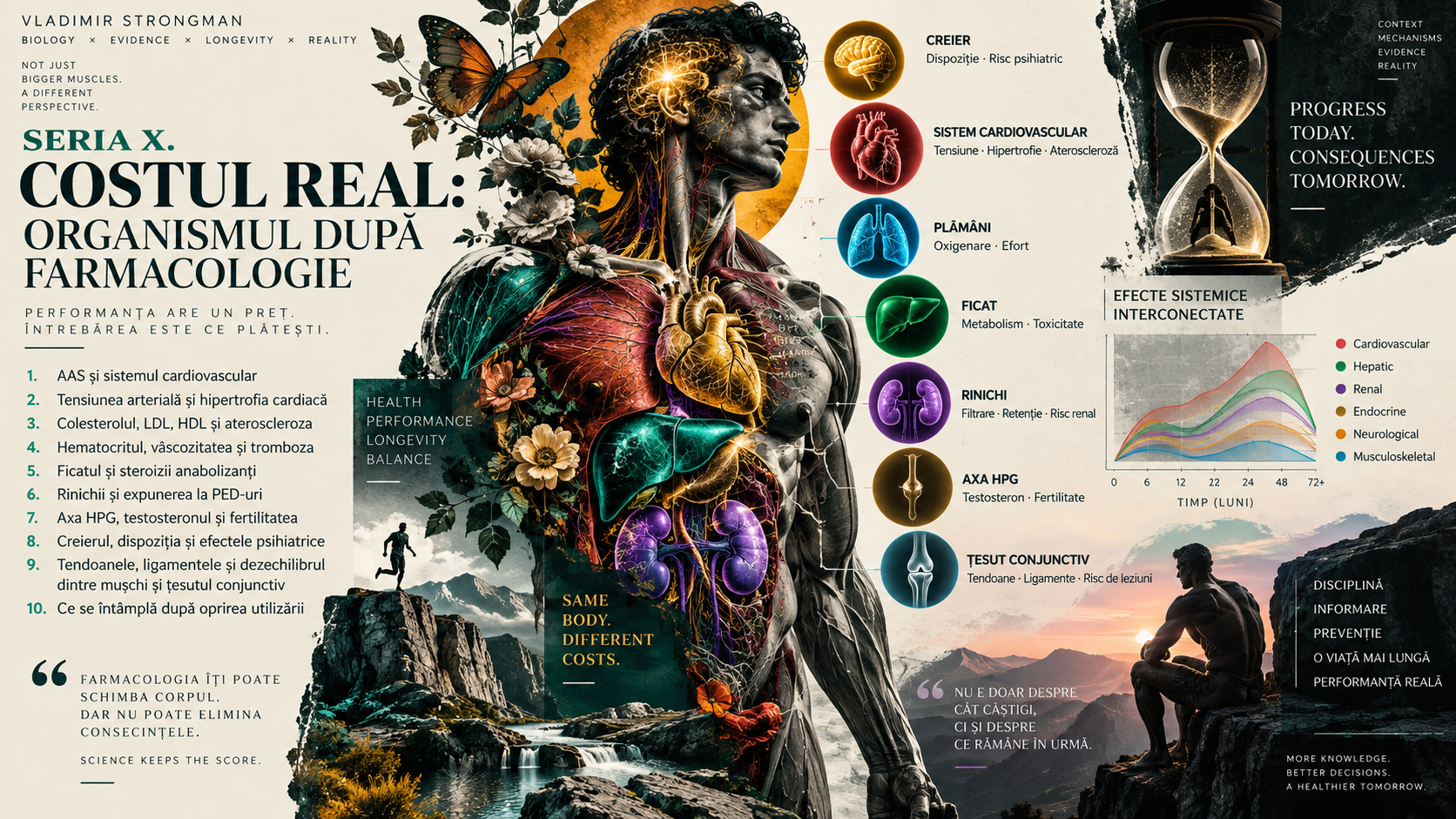
Blood pressure is one of the easiest cardiovascular variables to measure and, paradoxically, one of the easiest to misinterpret in strength athletes. A high reading after training does not automatically mean chronic hypertension, while a normal random reading does not exclude a problem that appears repeatedly during the rest of the day.
In the context of AAS, the subject becomes even more important. Several mechanisms may increase circulating volume, sympathetic activation, sodium retention, arterial stiffness and left ventricular mass. Each effect may look modest on its own, yet together they can turn blood pressure into a chronic load on the heart.
This episode follows the full chain: how blood pressure is generated, what happens during heavy lifting, when persistent hypertension becomes a concern and how the heart responds to years of increased pressure. The goal is to understand the physiology rather than turn one isolated number into a diagnosis.
1. Blood pressure is the force exerted against the vascular wall
Blood is pushed from the heart into a vascular system that resists flow. The resulting pressure depends on how much blood the heart pumps and how constricted or relaxed the smaller arteries are. Blood pressure is therefore neither purely a heart problem nor purely a vessel problem.
2. Systolic and diastolic pressure describe different phases
Systolic pressure reflects the peak pressure during left ventricular ejection. Diastolic pressure reflects the pressure that remains between beats. The two values provide different information about cardiac output, circulating volume and arterial elasticity.
3. Mean arterial pressure describes the continuous load on organs
Organs do not experience only the systolic peak. They are perfused throughout the cardiac cycle, and mean arterial pressure is a better approximation of effective perfusion pressure. When this remains chronically elevated, vessels and organs are continuously exposed to extra mechanical stress.
4. Pulse pressure can reflect arterial stiffness
The difference between systolic and diastolic pressure is called pulse pressure. A wider pulse pressure may occur when large arteries become stiffer and absorb the energy of cardiac ejection less effectively. Interpretation still depends on age, circulating volume and measurement context.
5. Cardiac output and vascular resistance build blood pressure together
Cardiac output is the product of heart rate and stroke volume. Vascular resistance depends largely on the caliber of the arterioles. An increase in either variable can raise blood pressure, and their effects may reinforce one another.
6. Heavy lifting produces very large acute pressure spikes
During maximal effort, intense muscle contraction compresses blood vessels, sympathetic drive rises and arterial pressure may increase dramatically for a few seconds. This is different from resting hypertension. A healthy system tolerates brief peaks far better than a moderately elevated pressure that persists for hours and years.
7. The Valsalva maneuver temporarily changes hemodynamics
Breath holding and increased intrathoracic pressure stabilize the trunk but alter venous return and arterial pressure throughout the lift. The response is phased rather than linear. This is why a blood pressure reading taken immediately after a heavy set should not be confused with resting pressure.
8. An acute exercise rise is not the same as chronic hypertension
Hypertension is a persistent pattern confirmed by correctly performed repeated measurements. Maximal effort produces a transient rise followed by recovery. The problem changes when the baseline is already elevated because every training session begins from a less favorable hemodynamic starting point.
9. Diagnosis is not based on one reading
Blood pressure varies with sleep, stress, caffeine, pain, exercise and time of day. Modern guidelines emphasize confirmation of a pattern, often with repeated home measurements or ambulatory monitoring. One reading is a clue, not the whole story.
10. White-coat and masked hypertension can mislead
Some people show high values in the clinic and normal values at home. Others show the reverse: clinic readings look acceptable while daily values are elevated. The second pattern may be particularly relevant when stimulants, stress and training strongly influence the daily profile.
11. Ambulatory monitoring shows blood pressure in real life
Twenty-four-hour monitoring captures values during activity, sleep and periods of stress. It also shows the average daily pressure and the normal overnight decline. A blunted nocturnal fall may indicate a less favorable cardiovascular pattern.
12. The wrong cuff can turn measurement into error
On a very large upper arm, a cuff that is too small may overestimate blood pressure. This is a practical issue in bodybuilders, strongmen and powerlifters. Arm circumference matters because even a good device can produce a poor number if the cuff does not fit.
13. Massive arms make technique even more important
A conical arm shape and large muscle mass can make cuff placement difficult. The forearm should be supported and the upper arm positioned approximately at heart level. Positioning differences can alter the result enough to complicate interpretation.
14. Correct measurement requires rest, support and repetition
A useful reading is taken after several minutes of rest, without conversation or recent exertion. The back, legs and arm should be supported. Two or more readings performed under similar conditions are more informative than a rushed single measurement.
15. AAS may raise blood pressure through several pathways
Medical literature associates AAS exposure with higher blood pressure in at least a proportion of users. There is no single mechanism: fluid retention, neurohormonal activation, endothelial changes and arterial stiffness may all contribute. Individual responses vary considerably.
16. Sodium and water retention can expand circulating volume
When the body retains more sodium, water follows. Plasma volume may increase, raising the load on the cardiovascular system. In a very heavy athlete with high caloric and sodium intake, this may become visible as edema, rapid weight gain or higher blood pressure.
17. The renin-angiotensin-aldosterone system controls pressure and volume
This hormonal system regulates vasoconstriction, sodium retention and circulating volume. When excessively activated, it can raise blood pressure through several pathways at once. It is a major physiological bridge between the kidneys, hormones and the cardiovascular system.
18. The sympathetic nervous system can keep vessels in a state of alert
Stress, sleep deprivation, stimulants and some pharmacological contexts can raise sympathetic tone. Heart rate and contractility increase and vessels may constrict. If this state becomes habitual, resting pressure may remain higher than desirable.
19. The endothelium is more than a lining
Endothelial cells regulate vascular dilation, coagulation and inflammation. When endothelial function deteriorates, arteries respond less effectively to the need for dilation. The same amount of blood is then being moved through a less adaptable network.
20. Nitric oxide helps vessels relax
Endothelial nitric oxide is an important signal for vasodilation. When its availability falls, vascular resistance can increase. This is one reason endothelial health matters both for blood pressure and for muscle perfusion during exercise.
21. Arterial stiffness changes the way the pressure wave travels
Elastic arteries buffer the energy of each heartbeat. When they become stiffer, the pressure wave travels faster and returns toward the heart earlier. The result may be higher systolic pressure and greater load on the left ventricle.
22. A high hematocrit can add resistance to the system
More red blood cells can increase oxygen carrying capacity, but they can also increase blood viscosity. More viscous blood places a greater demand on the circulation, especially when combined with dehydration or elevated blood pressure. The potential oxygen transport advantage is not free.
23. Viscosity, pressure and flow are interconnected
The more resistance the circulating fluid creates, the more pressure the heart may need to generate to maintain the same flow. The real physiology is complex, but the principle is straightforward: a very high hematocrit can push the system into a less efficient zone.
24. Sleep apnea can feed hypertension
Repeated breathing interruptions during sleep create intermittent hypoxia and sympathetic activation. In very large athletes, obstructive sleep apnea is an important factor that can push blood pressure upward. If untreated, the effect repeats night after night.
25. High body mass can increase the hemodynamic cost
More tissue means a larger vascular network to perfuse. Excess adipose tissue may also contribute through inflammation, insulin resistance, sleep apnea and neurohormonal activation. In Strongman, body mass that helps performance can simultaneously increase cardiovascular demand.
26. Stimulants can temporarily push blood pressure higher
Caffeine, some pre-workout products and other stimulants may increase heart rate and vasoconstriction. In a person with normal blood pressure, the effect may be modest and transient. In someone already hypertensive, the same impulse can carry more significance.
27. Common medications can also influence blood pressure
Nonsteroidal anti-inflammatory drugs, for example, can promote sodium retention and affect kidney function in some people. In a sport where pain and inflammation are frequent, repeated use can become an overlooked part of the blood pressure puzzle.
28. The kidney is a central regulator of blood pressure
The kidneys determine how much sodium and water the body retains and influence hormonal systems that regulate pressure. Hypertension can damage the kidneys, while impaired kidney function can in turn raise blood pressure. A self-reinforcing cycle can develop.
29. Aldosterone links salt retention to cardiovascular remodeling
Aldosterone promotes sodium retention, but its effects extend beyond volume control. Excessive activation of this pathway is also involved in vascular and cardiac remodeling. Hypertension is therefore more than a simple problem of too much fluid.
30. The left ventricle works against greater pressure
To eject blood into the aorta, the left ventricle must exceed the pressure in the arterial system. When that pressure remains elevated, the heart gradually develops structural adaptations. It is the biological equivalent of an engine working against greater resistance every day.
31. Concentric hypertrophy develops in response to pressure overload
With pressure overload, ventricular walls can become thicker. Initially this adaptation helps normalize wall stress. If the stimulus persists, the same adaptation can reduce compliance and impair cardiac relaxation.
32. The athlete's heart is not identical to the hypertensive heart
Training can produce physiological cardiac remodeling, especially when overall training volume and conditioning are high. Hypertension produces remodeling under chronic pressure. The patterns can overlap, but ventricular geometry, diastolic function and the wider clinical context help distinguish them.
33. AAS can complicate the interpretation of ventricular hypertrophy
Studies of AAS users report, on average, greater left ventricular mass and functional changes compared with controls. In a strength athlete, training, body size, blood pressure and AAS exposure may all overlap. A thick wall should not automatically be dismissed as a normal sports adaptation.
34. Diastolic function may deteriorate before the pump looks weak
A thickened, stiffer ventricle may relax less efficiently. Ejection fraction can remain normal while filling becomes less efficient. This is one of the traps behind the assumption that a normal ejection fraction means the heart is completely normal.
35. Systolic function may be affected later
If remodeling, fibrosis and chronic load continue to progress, overall contractility can decline. Early changes may be subtle and detected by more sensitive measures than simple ejection fraction. In advanced stages, the picture can evolve toward heart failure.
36. The left atrium can become a marker of elevated filling pressure
When the ventricle relaxes poorly, pressure may be transmitted backward into the left atrium. Over time, the atrium may enlarge. Atrial enlargement is not merely an echocardiographic image; it can reflect a long-standing hemodynamic burden.
37. Remodeling can create a substrate for arrhythmias
Hypertrophy, atrial enlargement and fibrosis can change how electrical impulses travel through the heart. Not every palpitation represents a dangerous rhythm, but structural changes make symptoms such as sustained irregular rhythm, dizziness or syncope more meaningful.
38. Coronary perfusion must keep pace with cardiac mass
A thicker myocardium requires more oxygen. If ventricular mass increases without a proportional increase in coronary or microvascular reserve, perfusion reserve may become smaller. Under intense exercise, that difference can matter.
39. Myocardial oxygen demand rises with pressure and heart rate
A heart that beats faster and ejects against higher pressure consumes more oxygen. If atherosclerosis or microvascular dysfunction is present, the balance between supply and demand becomes more fragile. An athlete may notice the problem only after physiological reserve has already declined.
40. Fibrosis can turn adaptation into a stiffer structure
Fibrosis is excessive deposition of connective tissue within the myocardium. It can reduce elasticity and affect both relaxation and electrical conduction. It is not the same as hypertrophy, but both can coexist in a heart exposed to chronic stress.
41. Arteries remodel under chronic pressure too
Hypertension does not change only the heart. Arterial walls may thicken, lumen geometry can change and elasticity may fall. This remodeling can further increase vascular resistance, reinforcing the cycle between pressure and stiffness.
42. The kidney is a target organ as well as a regulator
High pressure can damage the small renal vessels and glomerular filtration over time. As kidney function deteriorates, sodium and volume regulation becomes more difficult. Hypertension can therefore help sustain its own progression.
43. The brain also pays the price of hypertension
Hypertension is a major risk factor for both ischemic and hemorrhagic stroke. Over time it also damages the small vessels of the brain. Being young, muscular or highly trained does not cancel vascular biology.
44. The retina can show evidence of prolonged pressure
Retinal vessels are among the few small vessels that can be directly examined. Chronic hypertension may produce characteristic changes in the fundus of the eye. These findings demonstrate that hypertension is a systemic vascular problem, not merely a number on a monitor.
45. Large blood pressure variability can matter
The average is not the only relevant feature. Very large swings between rest, stimulation, training and sleep may add vascular stress. In athletes combining maximal effort, psychological stress, stimulants and poor sleep, the daily profile can be much more irregular than a single office reading suggests.
46. Strongman creates extreme hemodynamic peaks
Heavy yoke, maximal deadlift, log press and loaded carries combine intense muscle contraction, Valsalva and sympathetic activation. These peaks are part of the sport. The context becomes less favorable when resting pressure is already high and arterial stiffness or cardiac remodeling are present.
47. Training can be adaptive or amplify an existing problem
Well-structured resistance training is not synonymous with hypertension and can support cardiovascular health. However, very high training load, poor recovery and frequent maximal efforts on a hypertensive background can increase total hemodynamic stress.
48. Headache is not a reliable blood pressure detector
Many people believe they can feel when their blood pressure is high. In reality, hypertension is often completely asymptomatic. Headache can occur in some situations, but the absence of headache does not mean blood pressure is normal.
49. Feeling well does not exclude target-organ damage
Left ventricular hypertrophy, albuminuria or arterial stiffening can progress without obvious symptoms. Athletic performance may remain high for some time. This is one reason hypertension is dangerous: it can work quietly in the background.
50. Severe hypertension and hypertensive emergency are not the same thing
Very high readings become especially concerning when accompanied by signs of acute organ injury such as chest pain, neurological deficit, severe shortness of breath or visual disturbance. In that situation, the issue is no longer routine sports monitoring but urgent medical assessment.
51. Home monitoring can reveal the true pattern
A log of readings taken under standardized conditions can show whether blood pressure is persistently elevated or simply fluctuating. The trend over time matters more than chasing one number. The device should be validated and the cuff should fit the athlete's arm circumference.
52. Laboratory tests can reveal factors that sustain the problem
Kidney function, electrolytes, glucose, lipid profile and complete blood count provide useful context. In AAS users, hematocrit and lipids are particularly relevant to overall vascular risk. No single blood test replaces a complete cardiovascular evaluation.
53. The ECG sees electricity, not the whole structure
Electrocardiography can suggest hypertrophy, conduction abnormalities or arrhythmia, but its sensitivity for ventricular mass is limited. A normal ECG does not exclude cardiac remodeling. It is one piece of the evaluation rather than a final verdict.
54. Echocardiography shows cardiac geometry and function
Echocardiography can measure wall thickness, ventricular mass, chamber dimensions and systolic and diastolic function. In a very large athlete, interpretation must account for body size and training type. Context is what separates adaptation from pathology.
55. Myocardial strain can reveal subtle dysfunction
Myocardial deformation analysis can detect dysfunction before ejection fraction falls. In research on AAS users, strain parameters have helped describe more subtle functional changes. They are not necessary in every case, but can add information when suspicion remains.
56. Cardiac MRI characterizes tissue more precisely
Cardiac MRI provides precise measurements of volumes and mass and can characterize fibrosis using dedicated techniques. It is useful in selected cases when echocardiography does not fully answer the clinical question. It is not a routine test for every athlete with one high blood pressure reading.
57. Reversibility depends on how far remodeling has progressed
Reducing chronic pressure can allow partial regression of left ventricular hypertrophy. More advanced fibrosis and vascular injury may be less reversible. The earlier chronic stress is recognized, the more biological room there may be for recovery.
58. Stopping AAS does not guarantee immediate normalization
Some hemodynamic effects may improve after cessation, but recovery rates vary. Body mass, sleep, kidney function, lipids and previous blood pressure exposure continue to matter. Removing one exposure does not instantly erase all accumulated consequences.
59. Warning symptoms should not be dismissed as hard training
Chest pain, unusual breathlessness, syncope, neurological symptoms, prolonged palpitations or a sudden loss of exercise tolerance deserve medical assessment. In a sport where pain and fatigue are routine, there is a temptation to normalize every symptom. That normalization can delay diagnosis.
60. Conclusion: repeated pressure leaves marks even when strength remains high
Blood pressure is simultaneously a signal, a mechanical load and a driver of remodeling. In strength athletes, pressure peaks during lifting are part of the sport, but resting hypertension changes the entire context. When AAS, high body mass, sleep apnea, elevated hematocrit and arterial stiffness overlap, the left ventricle may eventually pay the bill.
The central idea is simple: a powerful heart is not automatically a healthy heart. The ability to generate enormous pressure during a lift and the ability to tolerate years of hypertension are two very different things.
Left ventricular hypertrophy can represent physiological adaptation, chronic pressure overload or a mixture of both. In a strength athlete who uses or has used AAS, interpretation must consider blood pressure, body size, training type and cardiac function rather than wall thickness alone.
Correct measurement is the first defense against confusion. A cuff that is too small, a reading taken immediately after exercise or a single value recorded on a stressful day can produce misleading conclusions. The repeated pattern matters.
Cardiovascular cost often accumulates quietly: a few extra blood pressure points, some additional arterial stiffness, a higher hematocrit, poor sleep and years of very high body mass. Each factor may look tolerable alone, but the cardiovascular system adds them together.
For the series The Real Cost, the message of episode 2 is this: pharmacology may increase performance without blood pressure or cardiac remodeling producing immediate symptoms. The absence of symptoms is not proof of the absence of cost.
Sources and recommended reading
1. European Society of Cardiology. 2024 ESC Guidelines for the management of elevated blood pressure and hypertension.
2. European Society of Hypertension. 2023 ESH Guidelines for the management of arterial hypertension.
3. Whelton PK et al. Guideline for the prevention, detection, evaluation and management of high blood pressure in adults. American College of Cardiology/American Heart Association.
4. Baggish AL et al. Long-term anabolic-androgenic steroid use and cardiovascular toxicity. Circulation, 2017.
5. Rasmussen JJ et al. Cardiovascular effects and mortality associated with anabolic-androgenic steroid exposure, cohort and imaging literature.
6. American Society of Echocardiography and European Association of Cardiovascular Imaging recommendations for cardiac chamber quantification and left ventricular geometry.
7. Current sports cardiology literature on athlete's heart, resistance training and differentiation from pathological left ventricular hypertrophy.
8. Reviews on obstructive sleep apnea, sympathetic activation and resistant hypertension.
9. Reviews on arterial stiffness, endothelial dysfunction and hypertension-mediated organ damage.
10. Contemporary reviews on blood pressure measurement, ambulatory monitoring and cuff selection in people with large arm circumference.
Editorial note: this article is educational and explains physiological mechanisms and cardiovascular risks. It does not establish diagnoses and does not replace correct blood pressure measurement, medical evaluation or investigations selected by a clinician for an individual patient.
More From The Journal

Training
The Science of Strongman Training - Episode X: Competition Programming
How to build a complete Strongman competition preparation block: calendar, events, volume, intensity, specificity, simulations, autoregulation, tapering and fatigue management.

Training
The Science of Strongman Training - Episode IX: Peaking
Peaking in Strongman: how to turn months of training into maximal competition performance by reducing fatigue, preserving adaptations and managing specificity.