
Pharmacology
Series: The Real Cost: The Body After Pharmacology - Episode 10: What Happens After Stopping Use
September 8, 2026
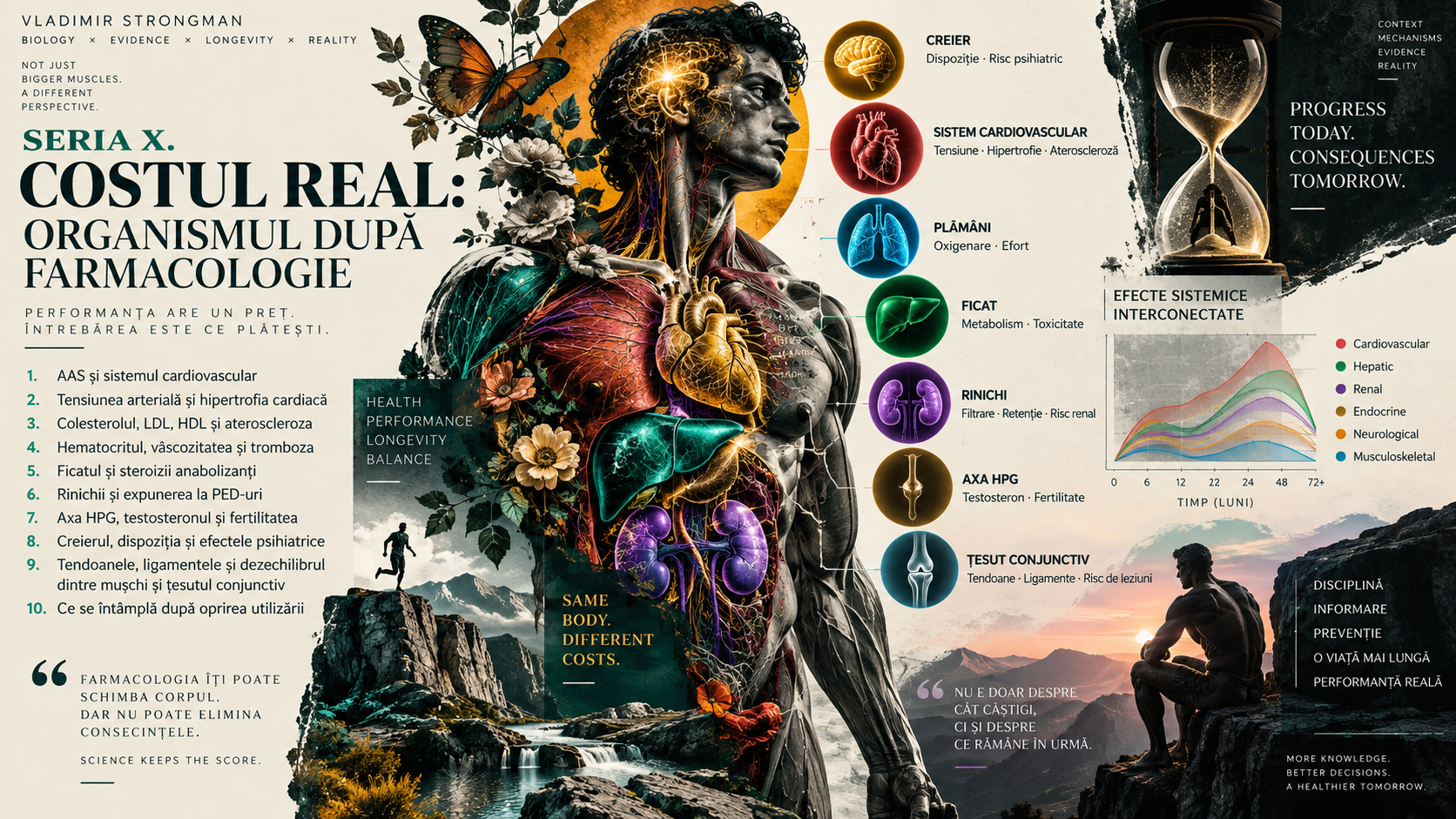
Stopping anabolic-androgenic steroids or other performance-enhancing substances does not mean the body instantly returns to its previous state. Some effects diminish within days or weeks, others require months, and certain changes may persist far longer.
The reason is simple: every system has its own pace. Drug concentrations may fall relatively quickly, but the hormonal axis, spermatogenesis, lipid profile, muscle mass, heart and psychological state do not recalibrate at the same time.
This final episode of the series treats the post-use period as a biological transition. It does not provide treatment schemes or a PCT protocol; it explains what may happen, which factors influence recovery and when medical assessment becomes important.
1. Stopping is not an on-off switch
The final administration does not automatically mark the end of biological exposure. Depending on the molecule, ester, tissue depot and duration of use, the compound or its metabolites may remain active after the last dose, and endocrine or metabolic effects can extend beyond the moment of cessation.
2. Pharmacokinetics comes before endocrine recovery
A slowly eliminated compound can continue exerting negative feedback on the hypothalamus and pituitary even after the person considers use to have ended. The date of the last administration and the moment when the hormonal axis truly begins to escape exogenous influence are therefore not always the same.
3. The HPG axis may remain suppressed
Exogenous testosterone and other androgens reduce hypothalamic-pituitary signalling through negative feedback. After cessation, GnRH, LH and FSH do not necessarily recover immediately, and the testes may remain insufficiently stimulated for a period. This phase explains an important part of post-use symptoms.
4. LH and FSH are signals, not just numbers
LH mainly stimulates testicular testosterone production, while FSH contributes to Sertoli-cell function and spermatogenesis. Low values after cessation may suggest that the central axis is still inhibited, but interpretation depends on timing, previous exposure and the clinical context.
5. Endogenous testosterone may remain low
During the transition, total and free testosterone may fall below previous levels. Some men have few symptoms, while others report fatigue, reduced libido, poorer performance, low mood or concentration difficulties. Severity cannot be predicted from the previous dose alone.
6. Symptoms do not perfectly mirror laboratory values
Two people with similar hormone levels can have very different symptoms. Sleep, stress, relationships, injuries, calorie intake, alcohol, stimulants and psychological expectations all shape the picture. Recovery is better judged through symptoms, clinical assessment and trends in laboratory results together.
7. Recovery varies enormously between individuals
Duration of exposure, drug combinations, age, baseline gonadal function, body composition, comorbidities and previous use can all change the pace of recovery. There is no formula that converts a certain number of weeks of use into an exact number of weeks required for recovery.
8. Total exposure matters more than one compound
Biological risk cannot be understood only by asking which substance was used. Cumulative duration, total doses, combinations, breaks, stimulants, thyroid hormones, diuretics and other medications all matter. The body responds to the total burden, not to the name printed on one vial.
9. Age and baseline function matter
A younger man with normal gonadal function before use does not necessarily have the same recovery outlook as an older person or someone with pre-existing hypogonadism. Sometimes cessation does not create a new problem but reveals a vulnerability that was already present.
10. Repeated exposure can prolong the transition
Repeated periods of suppression and restart can make the picture harder to predict. Evidence does not justify saying that every cycle inevitably causes permanent damage, but cumulative exposure and short recovery periods between episodes may reduce the physiological margin of safety.
11. Recovery is not linear
Hormone values and symptoms may fluctuate. One better week does not mean the process is finished, and one worse week does not automatically mean permanent failure. The direction of change across several weeks or months is usually more informative than a single day.
12. Fertility has its own timeline
Recovery of testosterone and recovery of fertility are related but not identical. A man may have an acceptable testosterone level while semen parameters remain impaired, or the reverse. A desire for fertility therefore changes the goals and interpretation of post-use assessment.
13. Spermatogenesis is slow
Producing sperm takes roughly two and a half months, with additional time for maturation and transport. Even when hormonal signalling begins to normalize, semen parameters may require several months to show meaningful recovery. Biology cannot be accelerated simply because one blood test has improved.
14. Semen analysis provides direct information
When fertility matters, a semen analysis is more informative than assumptions based on testosterone alone. Sperm concentration, motility and morphology can show where reproductive recovery stands, and repeat testing may be needed to identify the trend.
15. Testicular volume can change
During suppression, reduced gonadotropin stimulation can decrease testicular volume in some users. After cessation, recovery may be gradual and variable. Size alone does not measure fertility, but it can reflect changes in testicular function.
16. Libido can fall
Libido is influenced by testosterone, estradiol, prolactin, sleep, stress, mood and relationships. After cessation, endocrine fluctuations may combine with lower energy and anxiety about performance. Reduced libido should therefore not automatically be attributed to one laboratory value.
17. Erectile function is multifactorial
Erections depend on vascular, neurological, hormonal and psychological factors. Temporary hypogonadism can contribute to erectile dysfunction, but hypertension, anxiety, poor sleep, diabetes or vascular disease may be equally important. Persistent symptoms deserve assessment rather than assumptions.
18. Mood may fall after cessation
One of the hardest contrasts is moving from a period of unusually high strength, energy and recovery to a state perceived as below normal. Falling androgen levels, reduced performance and changes in routine can contribute to irritability, sadness, anxiety or social withdrawal.
19. Post-use depression deserves serious attention
The literature describes depressive symptoms in some users after cessation, particularly when marked hypogonadism develops. Not every drop in motivation is depression, but persistent sadness, anhedonia, isolation or deterioration in daily functioning warrants professional assessment.
20. Anhedonia can disrupt athletic identity
When progress, competition and the feeling of power have become major sources of reward, their temporary loss can leave a genuine psychological void. The athlete may continue training without the usual satisfaction, which can increase the temptation to resume use simply to feel normal again.
21. Sleep can remain disturbed
Stopping substances does not automatically correct insomnia, sleep apnoea or habits formed during intense preparation periods. Poor sleep maintains fatigue, irritability and lower testosterone and can make recovery appear slower than it actually is.
22. Performance does not return to baseline overnight
After cessation, reductions in intracellular water, glycogen, bodyweight, recovery capacity and androgenic stimulation can reduce performance. This does not mean everything built during use disappears, but peak performance achieved under pharmacological exposure is not a neutral physiological reference point.
23. Bodyweight can fall quickly without an equivalent loss of muscle
Part of the initial weight loss may come from water, glycogen and gastrointestinal content rather than contractile tissue alone. The scale can therefore be misleading in the first weeks, particularly after compounds associated with substantial fluid retention.
24. Strength can fall before muscle size visibly changes
Strength also depends on the nervous system, technique, glycogen, bodyweight and recovery. An athlete may lose performance while muscular appearance remains almost unchanged. This is one reason the mirror and the bar can tell different stories.
25. Some muscle mass can be retained
How much is retained depends on training, protein intake, energy balance, sleep, hormone levels and how much of the gained mass depended on pharmacological conditions that are difficult to sustain naturally. A realistic goal after cessation is stabilization rather than immediately forcing the same training volume and intensity.
26. Training may need recalibration
Recovery capacity may decrease before expectations adjust. Keeping the same volume, frequency and number of maximal attempts can turn a physiological transition into a sequence of injuries. Adjusting load is a risk-management decision, not a sign of weakness.
27. Tendons do not recalibrate instantly with muscle
If muscle strength changes faster than tendon properties, the relationship between tissue capacity and loading can shift. The post-use period may also involve changes in bodyweight, technique and recovery, making controlled progression of loading particularly important.
28. Injury risk can remain elevated during transition
An athlete may try to preserve records achieved in a different physiological state. If recovery, sleep and connective tissues no longer support the same loading, frequent maximal attempts may become riskier even before obvious muscle loss appears.
29. Blood pressure may improve
If androgens, salt and water retention, stimulants or increased body mass contributed to hypertension, cessation may lower blood pressure over time. However, pre-existing hypertension, sleep apnoea, obesity and vascular stiffness can keep values elevated after pharmacological exposure ends.
30. The sympathetic system does not stop with the last administration
Stimulants, stress, sleep deprivation and anxiety can keep heart rate and blood pressure high. Sometimes everything is blamed on androgens even though the competitive and behavioural environment continues to activate the cardiovascular system after cessation.
31. Hematocrit can fall gradually
If androgen exposure increased erythropoiesis, hematocrit will not normalize instantly. Red blood cells survive for months, so the decline may be progressive. Dehydration can complicate interpretation, and markedly elevated values warrant medical assessment.
32. Blood viscosity changes with hematocrit
As red-cell mass and plasma volume normalize, blood rheology may improve. Thrombotic risk, however, does not depend on hematocrit alone; blood pressure, endothelial health, inflammation, smoking, immobility and other factors also matter.
33. The lipid profile may begin to normalize
AAS, particularly some oral agents, can lower HDL and increase LDL or ApoB. These changes may improve, sometimes substantially, after cessation. Diet, genetics, visceral fat and cumulative exposure still influence how far and how quickly the profile recovers.
34. Better HDL does not erase past exposure
Laboratory recovery is valuable, but cardiovascular risk is cumulative. Years of elevated LDL or ApoB, hypertension or smoking are not instantly reset when one value improves. Arteries do not have a factory-reset button.
35. The liver may recover, depending on the injury
Mild enzyme elevations or drug-induced cholestasis may regress after the offending agent is stopped. Serious structural injury requires assessment and follow-up. In strength athletes, transaminases should also be interpreted in the context of exercise-related muscle damage.
36. Kidney function cannot be judged by creatinine alone
After cessation, lower blood pressure, body mass and drug exposure may reduce part of the renal stress. Creatinine remains difficult to interpret in very muscular athletes, however. Urinalysis, albuminuria and complementary markers can provide additional context.
37. Loss of muscle mass can change creatinine
If muscle mass decreases, serum creatinine may fall without an equivalent improvement in kidney filtration. Conversely, a high value in a very muscular athlete does not automatically indicate renal disease. Trends and complementary markers are more useful than a single number.
38. The heart remodels slowly
If exposure contributed to ventricular hypertrophy, diastolic dysfunction or other changes, cessation does not guarantee rapid normalization. Some studies suggest improvement after stopping use, but reversibility may be incomplete and depends on exposure duration, blood pressure and other factors.
39. Not all cardiovascular changes are fully reversible
This is one of the most important points in the series. Blood pressure, lipids and vascular function may improve, but fibrosis, structural remodelling or advanced atherosclerosis do not necessarily disappear simply because pharmacological exposure has stopped.
40. The endothelium may need time
Endothelial function is influenced by blood pressure, lipids, inflammation, smoking and physical activity. Removing a harmful factor is useful, but vascular recovery depends on the entire biological environment. Moderate exercise, sleep and control of other risk factors matter over the long term.
41. Arrhythmias should not be ignored after cessation
Persistent palpitations, syncope, chest pain or reduced exercise tolerance should not automatically be blamed on hormones readjusting. Previous exposure can coexist with hypertrophy, fibrosis, electrolyte disturbances or other cardiac problems that require investigation.
42. Insulin sensitivity can change
Changes in hormones, bodyweight, appetite or visceral fat may improve glucose metabolism, but the effect is not uniform. Sleep, diet, activity level and body composition can matter more than the simple fact that one substance has been discontinued.
43. Blood glucose must be interpreted in context
A normal fasting glucose does not exclude insulin resistance, and one abnormal value does not diagnose diabetes by itself. HbA1c, glucose, insulin and metabolic history can be considered together when symptoms or risk factors are present.
44. Estradiol can fluctuate during transition
After aromatizable androgens are stopped, the balance between testosterone and estradiol can shift as exogenous levels fall while endogenous production remains temporarily reduced. Symptoms cannot be reliably inferred from one value and do not automatically justify empirical medication.
45. Gynecomastia does not always disappear when hormones normalize
Established glandular tissue can persist even after the hormonal stimulus that contributed to it diminishes. Recent tenderness or swelling and long-standing gynecomastia are not the same clinical situation. A persistent breast mass warrants clinical assessment.
46. Acne and sebum production may decrease
As androgenic stimulation falls, acne and oily skin may improve. Inflammation, scarring and individual predisposition can remain, however. Some cosmetic effects reverse more quickly than others.
47. Hair loss may not be reversible
If androgen exposure accelerated androgenetic alopecia in a genetically susceptible person, miniaturized follicles do not necessarily return to their previous state after cessation. This is a simple example of an effect where removing the trigger does not guarantee complete tissue restoration.
48. Sexual function and fertility are not the same thing
Good libido and normal erections do not prove that semen parameters are normal, while improving semen analysis does not guarantee perfect mood or sexual function. These domains should be evaluated separately, especially when conception is the goal.
49. PCT is not a universal protocol
User communities often present standardized recovery schemes. In reality, cases differ in compounds used, duration, fertility goals, comorbidities and laboratory findings. Medicines such as SERMs, hCG or aromatase inhibitors have their own indications and risks and should not be converted into universal recipes.
50. Self-treatment can complicate the picture
Adding medication after medication to correct each symptom or laboratory value can create another layer of adverse effects and make spontaneous recovery harder to interpret. Severe symptoms or infertility are better assessed by qualified endocrinology or urology professionals than managed through cascading self-experiments.
51. One blood test is a photograph, not a movie
Testosterone, LH, FSH, estradiol, blood counts and lipids can vary. A single result can be influenced by time of day, sleep, acute illness, training and hydration. Trends over time often provide more information than one isolated measurement.
52. Monitoring should match the risk profile
Depending on exposure history and symptoms, a clinician may consider blood count, lipids, liver and kidney function, blood pressure, reproductive hormones, semen analysis or cardiac testing. There is no identical post-use test package required for every person.
53. The timing of testing matters
If a slowly eliminated compound is still active, hormone results may reflect residual exposure rather than the true state of recovery. Interpretation should account for pharmacokinetics and the time since the final administration, not merely the calendar date.
54. There is no universal recovery duration
Some changes improve within weeks, reproductive function may require months, and structural cardiovascular effects may persist for years or remain incompletely reversible. Any promise that everyone will be back to baseline within a fixed number of weeks oversimplifies biology.
55. Warning signs take priority over the recovery calendar
Chest pain, syncope, severe shortness of breath, neurological symptoms, very high blood pressure, jaundice, marked deterioration in kidney function or other acute changes require prompt medical evaluation. They should not simply be waited out while hormones are assumed to recover.
56. Psychological emergencies are equally real
Severe depression, suicidal thoughts, psychosis, mania, extreme insomnia or loss of behavioural control require urgent medical help. The fact that symptoms appear after AAS cessation does not make them less serious or turn them into a mandatory phase to endure alone.
57. Pharmacological history should be disclosed honestly to clinicians
A clinician may misinterpret hypogonadism, hematocrit, liver enzymes or cardiac symptoms if previous exposure is unknown. An accurate description of substances used is not a moral confession; it is medically relevant information.
58. Recovery is more than normal testosterone
A normal hormone result cannot by itself show whether blood pressure, lipids, sleep, fertility, cardiac function and psychological health have recovered. The body is a network of systems that were exposed together and may recover at different speeds.
59. The realistic goal is long-term risk reduction
After cessation, the most useful decisions are those that reduce the total burden: controlling blood pressure, stopping smoking, treating sleep apnoea, sleeping adequately, eating appropriately, returning gradually to training and evaluating persistent problems. These steps are not dramatic, but they influence prognosis.
60. Conclusion: another stage begins after pharmacology
Stopping use ends intentional exposure, but not necessarily its effects. Some systems recover quickly, others slowly, and some changes may remain. Understanding that difference is essential if cessation is to become genuine risk reduction rather than merely a change in the calendar.
The first key point is that recovery does not begin or end on the same day for every system. Pharmacokinetics, the HPG axis, spermatogenesis, blood, lipids, the heart and psychological state all have different timelines.
The second point is that normal testosterone does not equal complete recovery. Fertility, cardiovascular function, sleep and mood may lag behind or require separate assessment.
The third point is that some effects are likely reversible, others only partly reversible, and certain structural injuries may never return fully to baseline. Stopping exposure reduces future risk but does not erase biological history.
The fourth point is that universal recovery protocols oversimplify an individual problem. Symptoms, fertility goals, comorbidities and the pattern of exposure all change how the post-use period should be interpreted.
Finally, the most important consequence of cessation should be lower long-term risk. Monitoring, sleep, blood-pressure control, fertility or cardiac assessment when appropriate, and a realistic return to training matter more than quick promises.
Sources and recommended reading
1. Pope HG Jr, Wood RI, Rogol A, Nyberg F, Bowers L, Bhasin S. Adverse health consequences of performance-enhancing drugs: an Endocrine Society scientific statement. Endocrine Reviews.
2. Anawalt BD. Diagnosis and Management of Anabolic Androgenic Steroid Use. Journal of Clinical Endocrinology & Metabolism.
3. Smit DL and colleagues. Prospective HAARLEM Study publications on disruption and recovery of testicular function during and after AAS use.
4. Kanayama G, Hudson JI, Pope HG Jr. Long-term psychiatric and medical consequences of anabolic-androgenic steroid abuse. Drug and Alcohol Dependence.
5. Baggish AL and colleagues. Cardiovascular Toxicity of Illicit Anabolic-Androgenic Steroid Use. Circulation.
6. Endocrine literature on AAS-induced hypogonadism, HPG-axis recovery and differences between testosterone recovery and spermatogenic recovery.
7. Reproductive-medicine literature on spermatogenesis, semen analysis and male infertility after exogenous androgen exposure.
8. Clinical and observational studies of lipid profiles, hematocrit and blood pressure during and after AAS exposure.
9. Sports-cardiology literature on ventricular remodelling, cardiac function and reversibility of changes associated with chronic AAS exposure.
10. Psychiatric and addiction-medicine literature on depression, anhedonia, AAS dependence and psychological vulnerability after cessation.
Editorial note: this article is educational and does not provide an individual cessation protocol, PCT regimen or treatment plan. Recovery after AAS and other PEDs is variable. Severe symptoms, persistent infertility or cardiovascular, hepatic, renal or psychological warning signs require assessment by qualified professionals.
More From The Journal

Training
The Science of Strongman Training - Episode X: Competition Programming
How to build a complete Strongman competition preparation block: calendar, events, volume, intensity, specificity, simulations, autoregulation, tapering and fatigue management.

Training
The Science of Strongman Training - Episode IX: Peaking
Peaking in Strongman: how to turn months of training into maximal competition performance by reducing fatigue, preserving adaptations and managing specificity.