
Pharmacology
Series: The Real Cost: The Body After Pharmacology - Episode 1: AAS and the Cardiovascular System
September 8, 2026
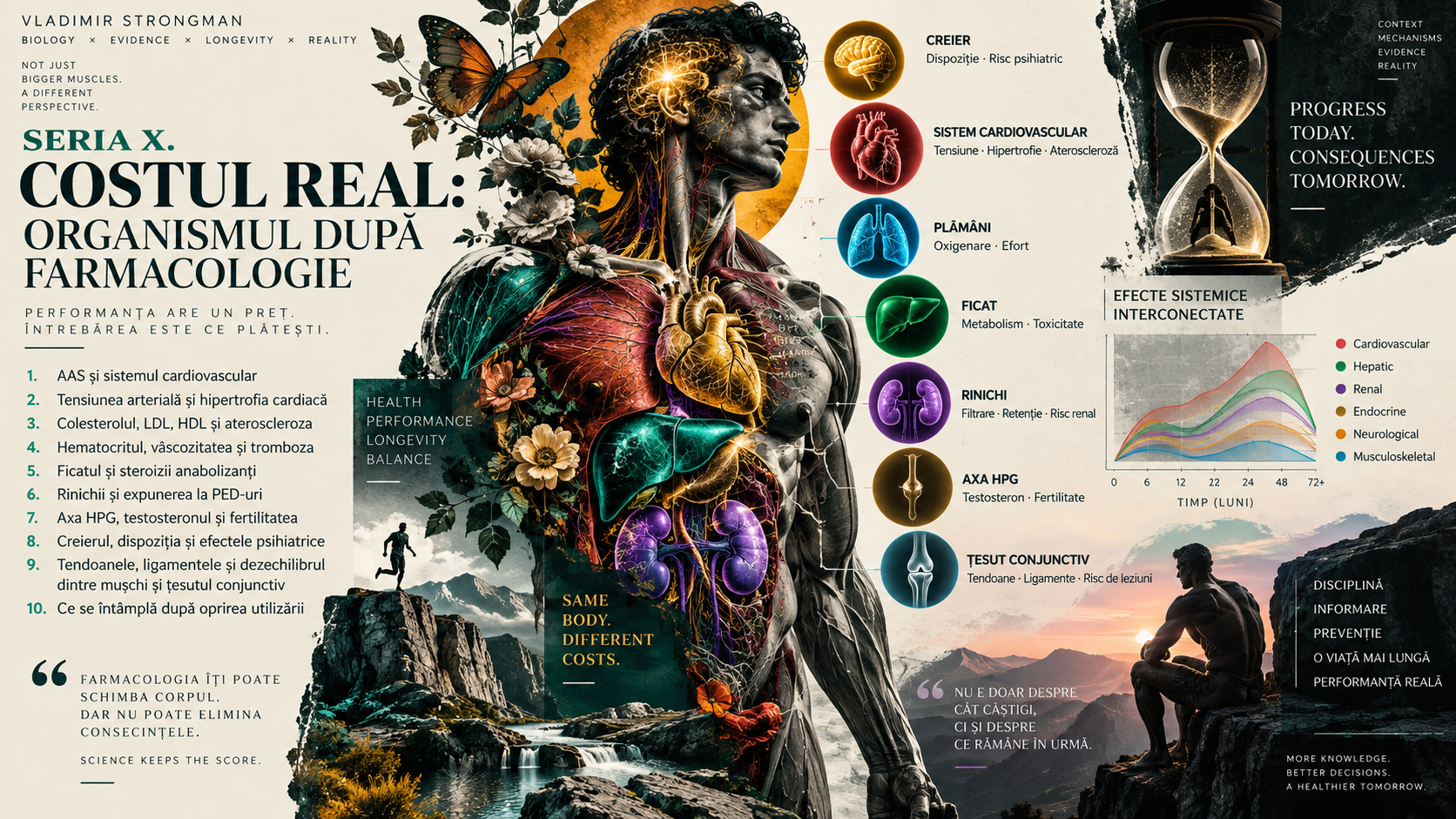
When anabolic-androgenic steroids are discussed, the conversation often stops at muscle, strength and appearance. The cardiovascular system stays in the background even though it carries a large part of the physiological cost of supraphysiological exposure. The heart has to pump through a larger body and a vascular system influenced by blood pressure, lipids, haematocrit, fluid retention and hormonal changes.
AAS do not create one single cardiovascular problem. They can simultaneously alter blood pressure, lipid profile, endothelial function, ventricular mass, cardiac electrical properties and coagulation. Some changes may be partly or fully reversible after cessation, while others can persist, particularly after long exposure or when other risk factors are present.
This episode is not a guide to use and does not try to turn risk into an optimization formula. Its purpose is to explain, in language a strength athlete can understand, what can happen to the heart and blood vessels when pharmacology becomes chronic exposure and why visible performance can hide cardiovascular processes that may remain silent for years.
1. AAS and the heart: the problem does not begin with a heart attack
Cardiovascular risk does not appear only when a dramatic event occurs. Long before that, there may be higher blood pressure, lower HDL, higher LDL and ApoB, thickening of ventricular walls, impaired relaxation or endothelial dysfunction. These are intermediate steps which, accumulated over years, can turn an apparently healthy athlete into someone with materially higher cardiovascular risk.
2. Physiological testosterone is not the same as supraphysiological exposure
Testosterone has normal physiological roles. The issue discussed here is exposure to levels and combinations far beyond endogenous production. In that setting, the same androgen pathways that support muscle adaptation can also influence cardiomyocytes, the kidneys, the renin-angiotensin-aldosterone system, the endothelium and lipid metabolism in an unfavourable direction.
3. The heart is a muscle, but not one you want to hypertrophy indiscriminately
An increase in left ventricular mass is not automatically a sign of performance. The athlete's heart can adapt physiologically to training, but AAS may push remodelling toward thicker walls, greater ventricular mass and sometimes poorer systolic or diastolic function. Structure and function matter together: a larger heart is not necessarily a more efficient heart.
4. Physiological and pathological hypertrophy are not synonyms
Training can produce adaptive, proportional and reversible cardiac remodelling. By contrast, hypertrophy associated with hypertension, fibrosis or excessive androgen exposure can change myocardial stiffness and ventricular filling. These processes can overlap in strength athletes, which is why simply saying that athletes have larger hearts does not explain the entire picture.
5. What meta-analyses show about cardiac structure
A 2026 meta-analysis including 35 studies and about 2,000 men associated AAS use with greater left ventricular mass, thicker ventricular walls and poorer measures of systolic function compared with resistance-trained non-users. The average differences are not always dramatic, but they become more important when exposure continues over many years.
6. Ejection fraction does not tell the whole story
A still-normal ejection fraction does not exclude dysfunction. Global longitudinal strain can detect subtler changes in contractility before ejection fraction clearly falls. In a strong athlete without symptoms, abnormal strain may be one of the early clues that cardiac remodelling is no longer only an innocent training adaptation.
7. Diastolic function: the problem of cardiac relaxation
The heart must not only eject blood; it must relax enough to fill between beats. Thicker walls and fibrosis can reduce ventricular compliance. During exercise, when heart rate rises and filling time shortens, a stiff heart has less room to adapt even if the athlete remains exceptionally strong.
8. Blood pressure is one of the most consistent signals
The prospective HAARLEM study showed measurable increases in blood pressure during androgen use. Even a few millimetres of mercury matter when the effect is repeated for months and years, especially in a sport where heavy lifting already produces enormous transient pressure peaks. Resting hypertension adds load between training sessions, not only during the lift.
9. Why blood pressure may rise
Several mechanisms can contribute: sodium and water retention, activation of the renin-angiotensin-aldosterone system, greater sympathetic tone, arterial stiffness, endothelial dysfunction and increased body mass. People do not respond identically, and the effect may vary with compound, duration, cumulative exposure and metabolic context.
10. Large body mass amplifies haemodynamic load
A very heavy athlete already requires a high cardiac output before any drug exposure is considered. Add hypertension, fluid retention, sleep apnoea and elevated haematocrit, and the heart faces a compound problem. Pharmacology does not act in a vacuum; it sits on top of all the demands already imposed by body size and training.
11. Low HDL is not just an ugly number on a blood test
AAS, particularly some orally administered agents, can markedly reduce HDL cholesterol. HDL is not a magical shield, but a severe drop accompanied by an increase in atherogenic particles changes the vascular environment. Risk comes from the overall profile in which vessels face pressure, inflammation and atherogenic lipoproteins at the same time.
12. LDL and ApoB: atherogenic particle burden matters
LDL cholesterol may rise, while ApoB reflects the number of atherogenic particles capable of entering the arterial wall. In HAARLEM, LDL and ApoB increased during androgen use. Repeated over cycles, this exposure may accelerate atherosclerosis long before the age at which an athlete expects coronary disease to become relevant.
13. The endothelium is the invisible organ of the vessels
The endothelium lines blood vessels and regulates dilation, inflammation and platelet interactions. Studies in AAS users have reported reduced flow-mediated dilation, suggesting poorer endothelial function. When the endothelium works poorly, the vessel loses part of its ability to respond smoothly to changes in flow and pressure.
14. Arterial stiffness changes the heart's workload
Elastic arteries buffer each ventricular ejection. When they become stiffer, pressure waves return toward the heart earlier and afterload rises. For a ventricle already exposed to hypertension and hypertrophy, this adds another burden: the heart has to push harder against a less compliant vascular system.
15. Atherosclerosis can progress silently
Coronary disease does not begin with chest pain. Plaque can accumulate for years without symptoms. Observational and imaging studies have found signals of premature atherosclerosis in AAS users, and contemporary research links exposure with greater cardiovascular risk. A personal record tells you nothing about the condition of the coronary arteries.
16. Coronary calcium and the biological age of arteries
Small studies of bodybuilders with long-term AAS exposure have reported coronary calcium scores unexpectedly high for age. This does not mean every user develops calcification, but it illustrates how arterial ageing may outpace chronological age when atherogenic factors accumulate for years.
17. Higher haematocrit changes the physical properties of blood
Androgens can stimulate erythropoiesis and increase haematocrit. More red cells may increase oxygen-carrying capacity, but more viscous blood is harder to move. When elevated haematocrit combines with dehydration, hypertension and other pro-thrombotic factors, the apparent oxygen-delivery advantage can carry a meaningful vascular cost.
18. Viscosity is not the same as thrombosis
A high haematocrit does not automatically mean a clot will form. Thrombosis emerges from the interaction between blood flow, the vascular wall and coagulation. Still, greater viscosity can make circulation less efficient and, combined with endothelial dysfunction or dehydration, may shift the system in a less favourable direction.
19. Platelets and coagulation also enter the equation
Some studies have found less favourable atherothrombotic markers and greater platelet activity in AAS users. The literature is not uniform for every marker, but the overall picture suggests that exposure can promote a pro-thrombotic environment in some settings. Risk becomes more relevant when smoking, immobility, hypertension, dehydration or vascular disease coexist.
20. Vascular inflammation is invisible in the mirror
AAS can influence oxidative stress and inflammatory signalling. These processes may affect endothelial function, myocardial remodelling and atherosclerosis. They do not necessarily produce immediate symptoms, which makes them easy to ignore in a sport culture focused on body weight, muscle size and performance.
21. Myocardial fibrosis is a scar you cannot see
Fibrosis means accumulation of connective tissue within the myocardium. It may develop in the setting of haemodynamic stress, hypertrophy and profibrotic signalling. A fibrotic myocardium becomes stiffer and can conduct electrical impulses less uniformly. This is why fibrosis connects two apparently separate problems: mechanical dysfunction and arrhythmic risk.
22. Arrhythmias are not just about a high pulse
Palpitations can have benign causes, but cardiac remodelling, fibrosis, hypertension, electrolyte disturbances and stimulants can create a substrate for more significant arrhythmias. Atrial fibrillation, tachyarrhythmias and conduction disturbances have been reported in association with AAS use, especially with chronic exposure and polypharmacy.
23. Resting heart rate cannot rule out disease
A seemingly good resting pulse can coexist with hypertrophy, hypertension or subclinical dysfunction. Heart rate is only one indicator. A complex cardiovascular system cannot be reduced to a single number on a watch, just as a strongman's ability cannot be described by one deadlift number alone.
24. Stimulants can amplify cardiovascular load
When AAS are combined with stimulants, effects on blood pressure, heart rate and vasoconstriction can add together. The problem is not only each substance in isolation but the physiological environment created by the combination. The heart may receive simultaneous signals for growth, greater pressure, increased metabolic demand and sympathetic activation.
25. Sleep and sleep apnoea can multiply risk
Very heavy strength athletes have a meaningful burden of sleep-disordered breathing. Obstructive sleep apnoea promotes intermittent hypoxia, sympathetic activation and hypertension. If AAS exposure and cardiac remodelling are added to that background, these factors may reinforce one another rather than simply add up.
26. The kidneys are part of the cardiovascular story
The kidneys regulate circulating volume, sodium and part of blood-pressure control. When renal function is impaired or fluid retention develops, the heart works against additional load. In practice, cardiovascular risk cannot be completely separated from kidney health, particularly in very large athletes exposed to multiple pharmacological agents.
27. Water retention is not only a cosmetic inconvenience
An increase in extracellular volume can raise blood pressure and worsen oedema or breathlessness in susceptible people. In a sport where extra kilograms may appear useful, retained fluid is not contractile tissue and can represent additional work for the heart and vascular system.
28. Heavy strength work already creates extreme pressure peaks
Near-maximal lifting produces dramatic but brief rises in intrathoracic and arterial pressure. A healthy cardiovascular system normally tolerates repeated episodes. The concern is when the athlete starts from a baseline already altered by hypertension, arterial stiffness or ventricular hypertrophy. Every heavy set is then layered onto a smaller cardiovascular reserve.
29. The Valsalva manoeuvre is not the enemy; context matters
Valsalva is a natural bracing strategy during heavy lifting. It also causes rapid changes in pressure and venous return. In an athlete with well-controlled blood pressure and a healthy heart, these changes are usually tolerated. In cardiovascular disease, the same manoeuvre can be more demanding, which is why clinical context matters.
30. Strongman adds duration and volume on top of maximal strength
Strongman is not only a one-repetition maximum. Farmers walk, yoke, truck pull, medleys and repetition events demand cardiac output, ventilation and pressure tolerance at the same time. If cardiovascular function is impaired, the cost may appear as slower recovery, disproportionate breathlessness or a sharp drop in performance between events.
31. A thicker heart does not automatically produce better cardiac output
Hypertrophy can increase ventricular muscle mass, but if relaxation is impaired or the cavity becomes relatively small, filling and stroke volume may suffer. Cardiovascular performance depends on how effectively the heart can receive and eject blood, not on wall thickness considered in isolation.
32. The right ventricle should not be ignored
Research has focused heavily on the left ventricle, but the heart functions as a two-pump system. The right ventricle must move blood through the pulmonary circulation, and its dysfunction can limit exercise capacity. Data on AAS and right-ventricular function are less extensive, but enough signals exist to avoid treating it as a spectator.
33. Cardiomyopathy is the severe end of the spectrum
In some individuals, chronic AAS exposure has been associated with dilated or hypertrophic cardiomyopathy and heart failure. These cases represent the severe clinical end rather than the inevitable outcome for every user. They nevertheless show that cardiac remodelling is not merely an echocardiographic curiosity and can progress to serious disease.
34. Heart failure does not mean the heart has stopped
Heart failure means the heart can no longer meet the body's needs efficiently without abnormal pressures or compensations. Symptoms can include breathlessness, poorer exercise tolerance, oedema and fatigue. In an athlete, early signs may be mistaken for poor conditioning, overreaching or simply a bad training phase.
35. Recovery after cessation is possible, but not guaranteed
The HAARLEM study showed that several short-term cardiac changes returned toward baseline after discontinuation. Long-term follow-up studies also suggest improvement in former users. Yet fibrosis, advanced atherosclerosis or very prolonged exposure may leave incomplete recovery. Reversible does not mean guaranteed to reverse.
36. Duration of exposure matters as much as intensity
Cardiovascular risk is not determined only by what happens during one period of use. Cumulative exposure, repeated cycles and years spent at supraphysiological androgen levels may be critically important. A small adverse change repeated for a long time can ultimately cost more than a short disturbance followed by complete recovery.
37. Polypharmacy makes risk attribution harder
Many users do not take one substance but combinations of AAS, stimulants, hormones, diuretics or other agents. In that setting it becomes difficult to assign each effect to one component. From the body's perspective, however, the problem is simpler: every load reaches the same cardiovascular system and effects may reinforce one another.
38. Oral agents can hit the lipid profile particularly hard
Some 17-alpha-alkylated AAS can produce marked changes in HDL and LDL. This does not make injectable agents cardiovascularly neutral; it simply means the mechanisms and magnitude of adverse effects can differ. Overall risk depends on the combined picture of pressure, lipids, haematocrit, cardiac function and duration of exposure.
39. Aromatization does not explain fluid retention and blood pressure by itself
It is tempting to reduce every episode of fluid retention to oestrogen, but circulating-volume control is more complex. Kidney function, sodium intake, the renin-angiotensin-aldosterone system, body mass and compound-specific effects all contribute. Oversimplification can easily lead to the wrong conclusion about why blood pressure has risen.
40. Very low oestrogen is not cardiovascularly neutral
Estradiol has roles in vascular function, bone metabolism and lipid regulation. Excessive suppression is not consequence-free. In an already disturbed hormonal system, trying to correct one marker by driving another to an extreme may shift the problem rather than eliminate it.
41. Infrequent blood-pressure checks can miss the real pattern
Blood pressure varies with stress, caffeine, pain, sleep and time of day. One good reading does not exclude hypertension, and one high reading does not establish it. The repeated trend is more informative. In athletes exposed to several risk factors, proper measurement and context matter more than a single snapshot.
42. Blood tests cannot see everything echocardiography can
Normal lipids and haematocrit are reassuring but do not exclude cardiac remodelling. Echocardiography provides information about wall thickness, chamber dimensions and systolic and diastolic function. In selected cases, cardiac magnetic resonance can characterize structure and myocardial fibrosis in even greater detail.
43. The ECG sees electricity, not the whole structure
An electrocardiogram can reveal rhythm, conduction and some indirect signs of hypertrophy or ischaemia, but it cannot exclude all forms of structural heart disease. A normal ECG does not cancel an abnormal echocardiogram, or vice versa. The tests answer different questions and must be interpreted in clinical context.
44. Echocardiography can help separate adaptation from suspected disease
In a strength athlete, echocardiography should be interpreted by someone familiar with the athlete's heart. Wall thickness, ventricular mass, cavity size and function need to be considered together. One isolated value may look alarming or may be wrongly dismissed. The complete pattern and its evolution over time are more useful for distinguishing physiological adaptation from adverse remodelling.
45. Cardiac MRI can show what echocardiography may miss
Cardiac MRI can measure volumes and function with high precision and can identify some forms of fibrosis through tissue characterization. It is not a routine test for everyone, but it becomes valuable when echocardiography raises questions, symptoms are present or cardiomyopathy or myocardial injury is suspected.
46. Troponin and biomarkers require context
Troponin can rise in myocardial infarction, myocarditis, heart failure and sometimes after extreme exercise. A biomarker must therefore be interpreted in clinical and temporal context. In athletes, timing relative to training matters. An abnormal result warrants medical assessment rather than assumptions based on gym experience.
47. Symptoms that should not be normalized
Chest pain, fainting, new or disproportionate breathlessness, persistent palpitations and unexplained loss of exercise tolerance should not automatically be blamed on fatigue or body size. They may have benign causes, but they can also signal cardiovascular problems that deserve prompt evaluation.
48. Sudden death is rare, but the mechanisms are plausible
Sudden cardiac death in athletes is rare, and assigning a single cause is difficult. Adverse hypertrophy, fibrosis, coronary disease, arrhythmias and polypharmacy can nevertheless create a substrate in which a severe event becomes more likely. Absolute risk may be low, but the consequence is maximal.
49. Youth does not cancel cardiovascular risk
Atherosclerosis and cardiac remodelling are cumulative processes. An athlete in the twenties or thirties may have a low immediate event risk, while exposure is already building risk for later decades. Preventive cardiology looks beyond the next competition and asks what the same trajectory means at 40, 50 or 60 years of age.
50. Genetics changes the threshold, not the mechanisms
Some people tolerate years of exposure without obvious abnormalities while others develop problems sooner. Genetics, family history, blood pressure, lipids, smoking, sleep and pre-existing disease all change vulnerability. The fact that a friend appears well after similar exposure offers no biological protection to anyone else.
51. No symptoms is not the same as no disease
Hypertension, dyslipidaemia and atherosclerosis are often silent. Cardiac remodelling can remain asymptomatic for a long time. The statement 'I feel perfect' therefore has limited value. The body can compensate remarkably well until reserve falls enough for symptoms to become obvious.
52. Good performance can coexist with cardiovascular risk
Muscular strength, technique and experience can remain excellent while blood pressure, lipids or cardiac structure deteriorate. Performance is not a medical test. An athlete may be lifting more than ever while accumulating risk factors that are impossible to feel during training.
53. Normalized blood tests do not prove every tissue has recovered
After cessation, blood pressure, haematocrit and lipids may improve relatively quickly in many people. Arterial walls and myocardium remodel on their own timelines. A reassuring blood panel after a few months does not prove that every structural effect accumulated over years has disappeared.
54. Recovery is more likely when problems are found early
Clinical data and follow-up studies suggest that some structural and functional changes can improve after AAS exposure ends, particularly when extensive irreversible injury has not developed. This is one reason early detection matters: the same abnormality found early may have a very different trajectory from one discovered after years of remodelling.
55. Medical monitoring does not make supraphysiological exposure safe
Blood-pressure checks, laboratory tests, ECG and echocardiography can identify problems earlier, but they do not turn supraphysiological exposure into a risk-free state. Monitoring is a tool for detection and prevention, not a guarantee that adverse cardiovascular effects will not occur.
56. Risk reduction begins with ordinary modifiable factors
Controlled blood pressure, smoking cessation, treatment of dyslipidaemia when indicated, adequate sleep, management of sleep apnoea, aerobic activity and medical evaluation remain important parts of cardiovascular health. None cancels the effects of AAS, but ignoring them simply stacks additional risk on top.
57. Cardio training does not clean away the cardiovascular effects of AAS
Aerobic conditioning improves cardiorespiratory fitness, blood-pressure control and metabolic health, but it is not an antidote to severe dyslipidaemia, fibrosis or cardiomyopathy. It is possible to be aerobically fit and still carry significant cardiovascular risk. Fitness and absence of disease are not the same thing.
58. 'Only testosterone' does not automatically mean low risk
Risk depends on the level and context of exposure, not only the molecule's name. Medically prescribed testosterone that restores physiological levels is a different situation from supraphysiological use for performance. Confusing those contexts can lead to underestimating the risk of high exposure.
59. The real cost is cumulative
Each isolated change may appear small: slightly higher pressure, slightly lower HDL, slightly higher haematocrit. The problem emerges when all of them overlap and persist for years. Cardiovascular risk is often the sum of several moderate abnormalities rather than one spectacular effect.
60. Conclusion: muscle can grow faster than the system that keeps it alive can adapt
AAS can increase muscle mass and strength at a remarkable pace, while the heart and vessels pay through pressure, remodelling, lipid changes and vascular stress. Not every user develops the same problem and not every effect is permanent. But modern evidence clearly supports supraphysiological exposure as a modifiable cardiovascular risk factor whose cost grows with duration and with the number of overlapping stressors.
Taken as a whole, the cardiovascular system does not respond to AAS through one mechanism. Blood pressure, lipids, circulating volume, haematocrit, endothelium and myocardium influence one another, and the effects can become more important when layered onto very high body mass, sleep apnoea, stimulants or genetic susceptibility.
The most dangerous illusion is that good performance confirms good health. An athlete can be at the peak of a career and still have hypertension, elevated ApoB, endothelial dysfunction or cardiac remodelling. Strength measures the ability to produce force; it does not measure coronary arteries or the quality of ventricular relaxation.
Prospective data matter because they also show that some effects can reverse. In HAARLEM, blood pressure, lipids, haematocrit and several cardiac parameters moved back toward baseline after cessation. Long-term studies and clinical cases also show, however, that recovery is not identical for everyone, particularly when fibrosis or coronary disease has developed.
For the strength athlete, the useful message is not panic but the distinction between athletic adaptation and pathology. The athlete's heart can differ from that of a sedentary person, but this does not confer immunity from hypertension, atherosclerosis, cardiomyopathy or arrhythmias. Medical interpretation has to include the sport and the real exposure history.
The Real Cost series begins here for a simple reason: the cardiovascular system is the infrastructure of performance. Muscle, strength and body mass can be built above it, but if the pump and vascular network deteriorate, everything above them depends on an increasingly fragile foundation.
Sources and recommended reading
1. Windfeld-Mathiasen J et al. Cardiovascular Disease in Anabolic Androgenic Steroid Users. Circulation. 2025;151:828-834. DOI: 10.1161/CIRCULATIONAHA.124.071117.
2. Cavalcante DN et al. Anabolic-androgenic steroids on cardiac structure and function in resistance-trained athletes: a systematic review and meta-analysis. International Journal of Cardiology. 2026;442:133896. DOI: 10.1016/j.ijcard.2025.133896.
3. Nascimento HS et al. Anabolic-androgenic steroids at supraphysiological doses: Cardiovascular impacts and pathophysiological mechanisms. Journal of Steroid Biochemistry and Molecular Biology. 2026;258:106938. DOI: 10.1016/j.jsbmb.2026.106938.
4. Smit DL et al. Prospective study on blood pressure, lipid metabolism and erythrocytosis during and after androgen abuse. Andrologia. 2022;54:e14372. DOI: 10.1111/and.14372.
5. Smit DL et al. Anabolic Androgenic Steroids Induce Reversible Left Ventricular Hypertrophy and Cardiac Dysfunction: Echocardiography Results of the HAARLEM Study. Frontiers in Reproductive Health. 2021/2022.
6. Baggish AL et al. Long-Term Anabolic-Androgenic Steroid Use Is Associated With Left Ventricular Dysfunction. Circulation. 2017;135:1991-2002.
7. Meagher S, Irwig MS, Rao P. Anabolic-androgenic steroids among recreational athletes and cardiovascular risk. Current Opinion in Cardiology. 2025;40:221-229. DOI: 10.1097/HCO.0000000000001235.
8. Rasmussen JJ et al. Cardiac structure and function in anabolic-androgenic steroid users: a 16-year follow-up study. Heart. 2025.
9. Urhausen A, Albers T, Kindermann W. Are the cardiac effects of anabolic steroid abuse in strength athletes reversible? Heart. 2004;90:496-501. DOI: 10.1136/hrt.2003.015719.
10. Contemporary sports-cardiology literature on hypertension, cardiomyopathy, endothelial function and evaluation of strength athletes, including recent clinical reviews of AAS-associated cardiomyopathy.
Editorial note: this material is educational and does not provide dosing, use protocols or instructions for self-medication to reduce risk. Cardiovascular symptoms, persistently elevated blood pressure or abnormal investigations require individualized medical evaluation.
More From The Journal

Training
The Science of Strongman Training - Episode X: Competition Programming
How to build a complete Strongman competition preparation block: calendar, events, volume, intensity, specificity, simulations, autoregulation, tapering and fatigue management.

Training
The Science of Strongman Training - Episode IX: Peaking
Peaking in Strongman: how to turn months of training into maximal competition performance by reducing fatigue, preserving adaptations and managing specificity.