
Sports Performance
Series: THE BODY UNDER EXTREME CONDITIONS: ENVIRONMENT AND PERFORMANCE IN STRONGMAN - Episode 10: Preparing for Strongman Contests in Difficult Climatic Conditions
October 15, 2026
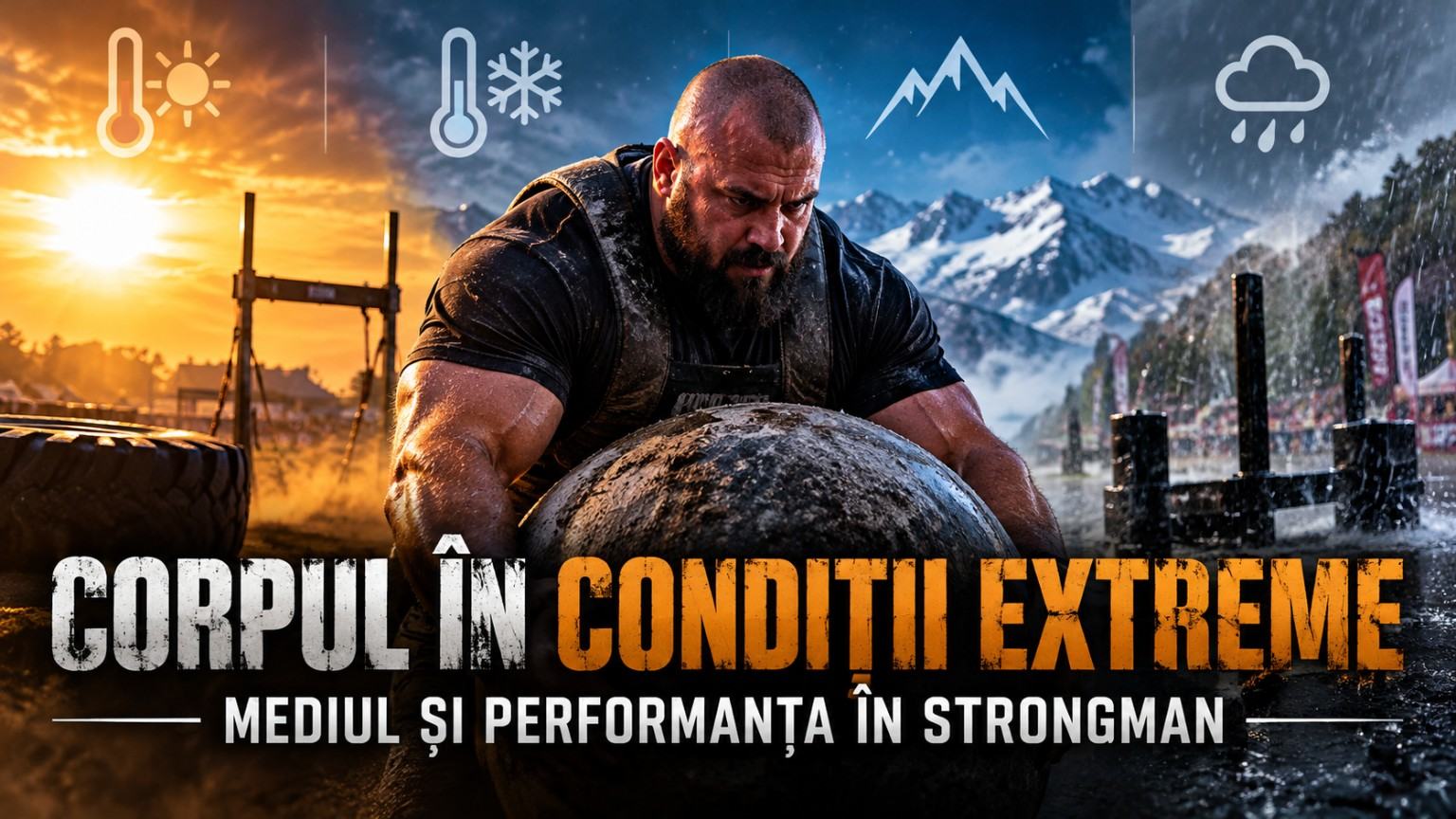
A strongman athlete can spend months developing maximal strength yet lose points to a variable that never appears on a loaded bar: the environment. A Yoke run on sun-heated asphalt, a Truck Pull after rain, a Log Lift on a cold morning or a Loading Medley held at altitude is not identical to the equivalent task in a well-ventilated gym. Air temperature, solar radiation, humidity, wind, elevation, ground traction and hours spent waiting interact with body size, clothing and event demands. Preparation for these conditions begins weeks before the platform, when the athlete identifies what can be anticipated and what requires a flexible response.
This episode concludes THE BODY UNDER EXTREME CONDITIONS: ENVIRONMENT AND PERFORMANCE IN STRONGMAN. The previous nine episodes considered heat, cold, humidity, dehydration, electrolytes, altitude, travel, surfaces and multi-day contests in turn. We now bring those dimensions together into one practical framework without abandoning scientific precision. The central question is not which spectacular trick makes an athlete immune to weather. It is how to preserve the ability to produce force, execute movements correctly and recognise unsafe situations before they become emergencies. In strongman, environmental conditions can change both the cost of effort and the level of risk.
The evidence comes from two categories that should not be confused. Strongman-specific studies describe biomechanics in selected events and retrospective injury patterns, but experimental investigations testing comprehensive acclimatisation programmes in strongman competitors remain scarce. Much of the practical guidance is therefore informed by expert consensus on exercise in heat, environmental cold injuries, fluid replacement, athlete sleep and altitude exposure. These sources offer potentially transferable principles; they do not prove that a programme developed for cyclists or distance runners produces the same performance gains in a maximal Farmer's Walk. We will distinguish direct evidence, cautious inference and individual practice.
The physiology goes beyond the simple contrast between hot and cold. The body produces heat through metabolism and exchanges it through evaporation, convection, radiation and conduction while circulation supplies both active muscles and the skin. High humidity restricts evaporation, sunshine adds radiant heat, and wind may support cooling but become dangerous in cold conditions. At altitude, lower barometric pressure reduces the partial pressure of inspired oxygen. During a heavy lift, breathing, blood pressure, coordination and exercise tolerance can change rapidly. Serious planning considers the interaction between these mechanisms and the demands of each actual event.
Effective preparation does not mean forcing the body to tolerate every discomfort. Heat acclimatisation is built progressively without hazardous exposure; in cold conditions, preserving temperature and hand function matters more than demonstrating willingness to suffer; at altitude, planning depends on duration, health status and event requirements. Logistics are equally important. Accessible drinking water, dry socks, familiar backup foods and a reliable place to rest may offer more practical value than expensive recovery gadgets. This article develops a plan for the preceding weeks, the day before competition, the event itself and the period afterwards.
Responsibilities must be distinguished among competitors, coaches and organisers. Athletes can choose clothing, plan travel and adapt warm-ups, but they cannot single-handedly repair slippery courses, inadequate water access or events scheduled during dangerous weather. Safety should not be transferred entirely onto the person under the load. Hypothetical scenarios involving extreme heat, cold, rainfall and changing conditions will illustrate decision-making without presenting invented observations as experimental results. The goal is a realistic, accessible framework, not a manual for performing climatic heroics.
The series ends with a straightforward principle: a well-prepared athlete is not someone who ignores the environment, but someone who understands it well enough to limit its effect on performance. Adaptation cannot guarantee records or eliminate medical risk. It can turn an uncertain competition into a sequence of better-informed decisions in which strength is expressed when conditions permit and health remains part of a sustainable sporting career.
1. Planning starts with environmental analysis, not a phone forecast
Strongman contests can mix indoor and outdoor events under markedly different thermal conditions. The first planning task is to establish the likely environment: precise location, season, start times, surface material, shade and expected gaps between events. A city's annual average temperature says little about the venue's actual microclimate. A metal platform in direct sun, a poorly ventilated warehouse and wet asphalt near water can create distinct challenges in one town. Athletes need information about the real competition space rather than relying only on the destination's geography.
Organisers are the main source for details weather applications cannot provide. Which events are outside? Is there a sheltered athlete area? Can event order change if rain arrives? Where will warm-ups occur, and may competitors inspect the course? These questions sound administrative, yet the answers determine clothing, drinks and footwear requirements. Missing information should prompt reasonable backup options rather than an assumption that every possible condition will be acceptable.
Useful planning separates predictable conditions from changing ones. August suggests a possibility of hot weather, but exact temperature and rain during a particular event remain uncertain. A venue's altitude is stable, while wind and cloud cover may change within minutes. An indoor hall without air conditioning has relatively stable logistical features, yet crowd density and ventilation adjustments can alter its conditions. That distinction determines what is prepared weeks ahead and what must be checked on competition morning.
Risk must also be interpreted in relation to the athlete. Heat experience, body size, cardiovascular status, medications, a previous episode of heat illness and respiratory concerns may all affect tolerance. Neither large body mass nor exceptional strength provides an adequate risk measure by itself. Such factors may justify individual medical consultation before travel. This article does not provide medical clearance and cannot substitute for examination of the person who will compete.
The nature of the event matters. A one-repetition maximum with long rest periods creates different demands from a Loading Medley combining movement, lifting and sustained activity. In Truck Pull, footwear traction and accumulated thermal strain can interact. During a wet Farmer's Walk, both grip and foot-ground traction may become limiting factors. Any forecast must therefore be translated into consequences for each event and for the waiting periods between them.
The output of this analysis should not be an endless hazard list. It should produce operational decisions: which equipment is needed, how acclimatisation is scheduled, where food can be stored, who tracks weather updates and who determines whether an attempt may continue safely. Athletes should also know what happens if events are delayed, a competitor becomes injured or the course changes. Mature climatic preparation reduces manageable surprises and identifies conditions beyond the athlete's control.
2. What makes an environment difficult: temperature, humidity and radiation
Air temperature represents only one part of the heat exchange between body and environment. At the same thermometer reading, humidity, wind, solar radiation and surface temperature can produce very different experiences. In humid conditions, sweat evaporation may be restricted even when skin is soaking wet. Under strong sunshine, the body receives additional radiant energy; in shade, thermal strain may be lower. A schedule describing conditions only as thirty degrees Celsius provides an incomplete picture.
Wet-bulb globe temperature, or WBGT, incorporates several contributors to thermal stress and is used in numerous occupational and sporting contexts. It has limitations and should be measured or appropriately estimated for the setting rather than replaced by an arbitrary figure. A conventional heat index based mainly on temperature and humidity does not fully represent solar radiation or individual exposure. When organisers apply decision thresholds, they should use guidance appropriate to the event and qualified medical assessment, not values invented for this article.
Wind illustrates why circumstances matter. In warm weather, airflow may support heat loss where physical conditions permit. In cold weather, it can increase skin cooling and the risk of injuries affecting exposed extremities. An athlete waiting without moving is exposed differently from someone carrying a Yoke because metabolic heat production differs. Clothing suitable for warm-up may therefore become unsuitable during a long pause or during the event itself.
Surfaces add a mechanical dimension. Dry asphalt, smooth concrete, grass, synthetic flooring and gravel transmit forces differently. Rain changes more than thermal comfort: traction can increase or decrease depending on materials and contamination, requiring adjustments to braking and acceleration. A wet, sloped surface may create hazards that no drinking strategy can resolve. Course inspection belongs in environmental planning precisely because weather can alter the mechanical properties of the ground.
Indoor events are not automatically free from thermal stress. Industrial halls, crowded gymnasiums and poorly ventilated tents can retain heat and moisture. A winter Log Lift event held beside open doors may expose waiting competitors to cold draughts and progressive cooling between attempts. The simple label indoor does not indicate whether thermoregulation is supported. Ventilation, water access and maintaining comfortable conditions remain important.
Environmental conditions should be assessed repeatedly. A reading taken early in the morning may be irrelevant at midday when a sustained strength-endurance event begins. Weather changes should trigger review of the course, equipment, warm-up duration and available cooling or shelter. In severe conditions, postponing, modifying or cancelling an event may be the correct decision. Environmental science does not provide a pretext to continue under every circumstance; it informs decisions about when continuing is justified.
3. Heat acclimatisation: progressive adaptation, not an endurance stunt
Repeated controlled exercise in heat can produce useful physiological adaptations. Consensus guidance by Racinais and colleagues and the review by Périard, Racinais and Sawka describe changes involving more effective sweating, circulatory adjustments and reduced cardiovascular strain at comparable workloads. These adaptations are not immediate. Some emerge in the first several days, while many programmes extend for approximately one to two weeks. Exact timing depends on the individual, exposure conditions and dose. An approach developed for runners should not be transferred mechanically to a very large strength athlete.
For strongman, the objective is not to perform maximal lifting in an overheated room. Acclimatisation may use controlled submaximal exercise with thermal stress while strength work is arranged separately where appropriate. The exposure should provide an adaptive stimulus without compromising safety or recovery before the contest. Duration and intensity require individualisation, ideally with qualified supervision, particularly for athletes with relevant medical conditions or previous difficulty tolerating heat.
Why not simply attempt maximal lifts outdoors in very hot weather? Combining extreme mechanical load and thermal stress adds risk without demonstrated extra strongman-specific benefit. A demanding Yoke training session is challenging enough without deliberate exposure to dangerous heat. Transfer should be evaluated through comfort, tolerance and the ability to perform expected tasks in appropriate conditions rather than the pursuit of personal records in an unsafe environment.
Progression matters because early exposures may be the most difficult. Athletes can observe symptoms, access to fluids, heart rate and unusual changes in wellbeing without treating one indicator as a diagnosis. Severe dizziness, confusion, collapse or impaired coordination require termination and appropriate medical assessment. They are not signs that acclimatisation is working. Thermal exposure should not be undertaken without suitable support where meaningful risks exist.
Adaptations diminish after exposure ends, so preparation must be scheduled relative to competition. Finishing a heat programme many weeks early and assuming all benefits remain unchanged is unwise. Even successful acclimatisation cannot eliminate heat illness risk if an organiser exposes athletes to dangerous conditions. It can improve tolerance within limits, not confer physiological immunity.
Without individual assessment, the prudent model remains progressive acclimatisation based on controlled effort matched to the anticipated environment. Very large athletes and those with cardiovascular concerns should discuss intensive exposure plans with appropriate clinicians. A good strategy integrates training and recovery rather than simply adding hours of heat stress to an existing programme. The objective is to arrive more prepared, not already depleted by weather preparation.
4. Integrating acclimatisation into strongman training
Climatic preparation has to fit into an existing strength programme with substantial recovery demands. Simply adding an hour of hot-environment exercise after a maximal Deadlift session does not ensure that the effects will be beneficial. Thermal stress changes perceived effort and fluid regulation, while heavy lifting requires neuromuscular and mechanical readiness. The programme must clearly define the purpose of heat exposure and preserve the safety of essential training sessions.
One possibility is to separate controlled thermal exposure from the heaviest workouts, using familiar submaximal activity while monitoring individual responses. This is not a universal prescription for a particular temperature or duration. Intervals reported in endurance-sport research provide reference points for trained professionals, not instructions to follow without supervision. Athletes can note changes in thermal comfort, appetite, thirst, sleep and subsequent training quality. Persistent deterioration in overall performance should trigger programme review.
Specificity still matters. If the competition involves carrying on asphalt, the athlete needs mechanical familiarity with shoes and the surface, not only improved thermoregulation. If events continue throughout a long day, shade, intervals and food access matter. An indoor contest in a hot hall may create different challenges because airflow is restricted. Acclimatisation does not replace technique or time management.
In the final days before departure, training priorities shift from developing capacity towards expressing it. A taper must be coordinated with heat exposures to avoid residual fatigue. Arriving fully accustomed to sunshine but physically depleted after excessive simulations defeats the purpose of preparation. No single programme suits every competitive level, and previous recovery responses and the event calendar remain essential considerations.
Fluid intake during preparation should maintain appropriate hydration without unlimited-drinking rules. Pre- and post-session body-mass measurements, interpreted carefully, may help estimate individual losses, but eating, drinking and equipment differences affect them. An athlete should not treat one number as an order to consume huge amounts immediately. The final strategy needs to be tested for digestive tolerance and adapted to relevant medical guidance.
The outcome of preparation should be an athlete who can focus on events instead of fighting constantly against the environment. Some discomfort may remain, yet perceived effort and tolerance of waiting can become more manageable. Earlier acclimatisation does not justify overlooking medical symptoms. The purpose is not to prove how much heat someone can endure, but to reduce weather-related disruption to the tasks for which they trained.
5. Preparing for cold: body temperature is not protected by pride
Cold conditions change the relationship between warm-up, waiting and maximal exertion. During a difficult event, working muscles produce substantial heat; between attempts, metabolic activity falls and the athlete may cool rapidly. Wind, rain and wet clothing increase heat loss. A competitor comfortable during Truck Pull may develop poor hand dexterity after thirty minutes of standing still. Preparation must distinguish active and passive periods rather than assuming the same clothing works in both.
The NATA position statement on environmental cold injuries emphasises prevention, recognition and appropriate management of hypothermia and local tissue injury. Hands are particularly important in strongman: cold fingers may lose sensation and dexterity, and contact with cold metal can become uncomfortable. Gloves or other coverings between attempts, where available, and drying the hands before an event may improve comfort. Rules may prohibit gloves during a lift, but they do not justify unnecessary exposure while waiting.
Cold-weather warm-up should be progressive and event-specific. General movement helps prepare the cardiovascular system, while gradual exposure to lighter loads rehearses the required technique. Attempting the heaviest lift immediately to generate warmth makes little sense. An excessively long warm-up can also produce unnecessary sweating. When movement stops and wind cools wet clothing, discomfort may increase. The aim is sufficient readiness at a reasonable energy cost.
Layered clothing allows rapid adjustment. A moisture-managing layer, insulation and protection from wind or rain serve different purposes, with exact requirements depending on conditions. Footwear should be selected for stability and traction as well as warmth. A thick comfortable sole can alter control under a very heavy Yoke. Choices should be rehearsed during familiar movements in training rather than introduced during the final.
Food and fluids still matter when thirst is less obvious than in hot weather. Cold does not eliminate sweating beneath clothing or the energy demands of heavy exertion. At the same time, forcing fluids at every break is unnecessary. Comfortable drink temperatures and accessible meals may help athletes follow a practical plan. Persistent shivering, confusion, loss of coordination or unusual speech changes require stopping and appropriate medical assessment.
Risk increases when cold combines with rain, wind and fatigue during prolonged competition. Organisers should provide shelter and inspect surfaces, particularly when ice may be present. A Farmer's course on frozen ground cannot be made safe simply through warmer socks. In extreme conditions the event may need modification or cancellation. Training in a cool room can provide some familiarisation but cannot replace a plan for real weather.
6. Humidity and sweating: wet skin does not guarantee cooling
During exercise, sweating cools the body primarily when sweat evaporates. High humidity and limited airflow can restrict evaporation, allowing athletes to sweat heavily without losing heat efficiently. This helps explain why a moderately hot but humid competition can feel much harder than expected. Discomfort cannot be predicted from air temperature alone. Assessment needs to account for the actual conditions at the venue.
Very large strongman athletes have particular body-surface-to-volume characteristics, but body size cannot predict an individual's precise sweat rate. Total mass without information on body composition, aerobic fitness, acclimatisation and clothing is an incomplete predictor. Two people of identical weight may tolerate conditions very differently. Athletes should therefore draw on observations from training and on symptoms rather than commercial estimates derived from simplified tables.
In warm humid air, ventilation and shade become parts of thermal management. Fans may encourage evaporation under appropriate conditions, but should not be presented as universal solutions regardless of heat and humidity. Excessively impermeable clothing or additional equipment may restrict heat dissipation. Removing unnecessary layers and changing very wet clothes between events may improve comfort, provided competition rules allow it.
Body-mass changes during exposure may help estimate fluid losses, but do not determine a drinking dose by themselves. Urine, food and fluids influence the reading, and a fall in mass is not automatically identical to a loss of body water. Plans should consider thirst, access to drinks and ordinary meals while avoiding both significant dehydration and overconsumption. Individual medical advice is important for competitors with relevant conditions.
Humidity can also affect implements. Chalk may perform less predictably on wet handles, and condensation changes the feeling of metal contact. Slippery objects in a Loading Medley add difficulty even when nominal weights are unchanged. Adding more chalk will not solve every grip issue. Drying equipment, correcting venue conditions and applying rules consistently may matter more. Problems should be assessed before several athletes encounter the same known hazard.
Signs of heat illness must be recognised regardless of visible sweating. Athletes may continue sweating in dangerous conditions; absence of sweat is not a prerequisite for exertional heatstroke. Confusion, collapse, neurological abnormalities and marked changes in normal behaviour require activation of the medical plan. The popular assumption that every problem in humidity is treated simply by drinking water can delay appropriate care.
7. Altitude: when strength meets oxygen availability
As altitude increases, barometric pressure falls and the partial pressure of inspired oxygen decreases. The physiological challenge differs from heat exposure. Very brief maximal efforts may respond differently from repeated or sustained tasks because reliance on oxidative metabolism is not identical. A strongman athlete does not automatically become weaker on every isolated lift simply because a venue is in the mountains. Nevertheless, long warm-ups, intervals and events lasting longer may create additional demands.
Consensus guidance on altitude in athletes emphasises exposure duration, elevation and individual experience. There is no universal arrival schedule that is optimal for everyone, whether a contest takes place at moderate or high altitude. Some endurance-sport recommendations cannot be transferred directly to maximal lifting. Specialist guidance may be needed, especially at destinations sufficiently high to create a meaningful risk of altitude illness.
Acute mountain sickness may include headache, nausea, dizziness and general discomfort after ascent. Severe symptoms, including neurological deterioration or marked breathlessness at rest, require urgent medical care and may make descent necessary. Athletes should not interpret such warnings as a lack of mental toughness. Preventive self-medication or empirical treatment without proper risk assessment is inappropriate. Altitude preparation concerns health as well as performance.
Travel budgets and employment may limit time at the destination. One competitor may drive overnight and arrive on competition morning, while another can spend several days adjusting. No simple formula can predict which will win. We can recognise, however, that transport fatigue, short sleep and altitude may interact. Where possible, less rushed arrival reduces some logistical demands even when complete physiological adaptation is unrealistic.
Fluids, nutrition and sleep remain important at altitude without justifying extreme intakes. Cold dry air can affect thirst and respiratory comfort. Activity may feel harder, and early familiarisation sessions should reflect symptoms and tolerance. Athletes should avoid unnecessary maximal testing soon after arrival if it adds risk without improving the actual competition plan.
Strongman's mixed events create the central question. One maximal Log repetition does not have the same energetic profile as a long Truck Pull or multi-object Medley. Any analysis of performance at altitude must consider event duration and intervals between efforts. Because prospective strongman-specific evidence is limited, precise claims about percentage performance losses deserve caution. The practical objective is to reduce risk and adapt, not promise that a certain number of days in the mountains will automatically earn points.
8. Travel and time zones: adaptation begins with sleep
Strongman athletes may compete hundreds or thousands of kilometres from home, sometimes with limited budgets and bulky equipment. Travel can involve missed sleep, hours seated and unpredictable meals. These are more than comfort problems: insufficient sleep can affect alertness, emotion and some aspects of athletic performance. Consensus guidance on athlete sleep supports an individual approach and protecting the opportunity to rest rather than assuming identical requirements for everyone.
A different time zone can shift the relationship between circadian rhythm and competition time. Someone lifting heavy early in a country several hours ahead may feel differently from the same athlete lifting at that clock time at home. Light exposure, meals and sleep timing influence adjustment, but precise recommendations depend on travel direction and the number of zones crossed. A one-hour shift should not be exaggerated, while intercontinental travel should not be dismissed as a simple clock change.
Before departure, transport, arrival, weigh-in, briefing and the first event should be coordinated. An extra night at the destination, if affordable, may reduce rushing and provide sleep opportunity. If arrival is late, priorities can be simplified to familiar food, organised equipment and rest rather than a demanding strength test. Adjustments using light or changed schedules must be approached responsibly and should not undermine recovery.
Travel and climate interact. After eight hours in a hot car, an athlete may arrive uncomfortable, stiff and relatively dehydrated before the first attempt. Complicated recovery procedures are not required to address every problem. Movement breaks, comfortable temperature, meals and fluid access are logical basics. On arrival, inspecting the course and footwear interaction may be more useful than maximal warm-up. New symptoms following travel deserve appropriate medical assessment rather than automatic attribution to tiredness.
Stimulants used for driving or to counter sleepiness may delay sleep onset. High caffeine intakes later in the day can undermine the very rest needed for competition. There is no assured benefit in turning the journey into an experiment with energy drinks and new supplements. Planning should include a rested driver or transport alternatives, particularly after the final. Road safety remains relevant even when the sporting objective has been achieved.
Ultimately, sound logistics make challenging weather easier to manage. Arriving with time to rest, locating food shops and drinking water, checking accommodation and finding a place to dry clothing all reduce distraction at the venue. Athletes cannot control weather or local regulations, but they can reduce the number of problems competing for their attention. Preparation for difficult conditions sometimes begins by booking appropriate accommodation rather than adopting another training technique.
9. Planned hydration: losses, thirst and the limits of estimates
Competition hydration begins with a seemingly simple question: what is the athlete's condition at the first event? A long journey, a hot night or disrupted eating may alter fluid balance before the start. The objective is appropriate hydration rather than the largest possible water intake. The ACSM position stand on fluid replacement offers principles for preventing excessive dehydration while avoiding unwarranted body-mass gains from overdrinking. Individual sweat losses and medical considerations must shape the plan.
There is no single litre target appropriate for every athlete at a given body weight. Two people of identical mass can sweat differently, while two contests with the same air temperature may have very different humidity, wind and waiting times. Athletes can observe thirst, body-mass changes and digestive comfort during training, but these are approximate references. Weighing before and after exercise must account for consumed drinks, urine, food and clothing.
A frequent error is assuming that more water always means greater safety. Exercise-associated hyponatraemia can occur when fluid intake exceeds the body's ability to eliminate water, diluting the concentration of sodium in the blood. Symptoms may include headache, nausea, vomiting and confusion; severe cases can involve seizures. Forcing additional water in that context may worsen the problem. Appropriate diagnosis and treatment require medical professionals.
Conversely, ignoring thirst and inadequate drinking access can favour dehydration, especially when sweat losses are high. A useful strategy includes available fluids, comfortable serving sizes and adjustments based on conditions. During long breaks athletes may drink progressively rather than waiting until the end of the day. Large volumes immediately before a Deadlift or Yoke are not obligatory and may create uncomfortable stomach fullness.
During multi-day contests, restoring fluid balance should be considered after every stage rather than through one enormous drink before bed. Ordinary meals contribute water and electrolytes, while distributed intake may be more comfortable than aggressive rehydration. Marked dizziness, inability to urinate, confusion or deterioration in general condition require medical assessment. Such symptoms are not always explained by a simple lack of water.
Organisers should make drinks accessible, indicate supply points and avoid schedules that prevent athletes from drinking. During hot events, shade and cooling are preventive measures, so hydration is not used as the sole defence. An athlete may have an excellent drinking plan and still face unnecessary exposure if required to wait for hours in direct sun without shelter. Safety depends on infrastructure as well as individual behaviour.
10. Electrolytes: physiologically necessary, not magical
Sodium, potassium and other electrolytes contribute to essential processes including nerve signalling and muscle function. Sweating removes water and salts in variable proportions. Sodium losses differ between individuals according to sweat composition, sweating rate and acclimatisation. A precise sodium dose cannot responsibly be prescribed solely because a competitor has a particular body weight or visible salt marks on a shirt.
Foods and drinks containing sodium may contribute to restoring balance during prolonged sweating. However, consuming concentrated salt tablets without a clear rationale can create discomfort and will not automatically prevent hyponatraemia if the athlete drinks excessive water. Water-sodium regulation is dynamic and influenced by hormones. Treating sodium as a universal antidote for any cramp or weakness oversimplifies physiology.
Exercise-associated muscle cramps have multiple possible contributors. Neuromuscular fatigue, unfamiliar tasks, individual susceptibility and, in certain circumstances, fluid or electrolyte losses may be involved. Not every cramp indicates sodium deficiency, and the appearance of a spasm does not establish a diagnosis. Severe or recurrent cramps and associated symptoms warrant appropriate assessment. Stopping an activity causing significant pain may be more important than trying a new product during competition.
For athletes sweating heavily in heat, ordinary meals may already supply a meaningful amount of sodium. Electrolyte beverages can be convenient when food is difficult to access, but selection should reflect actual circumstances. There is no basis for claiming that a saltier drink automatically improves every maximal lift. Taste, stomach tolerance and product availability influence whether a plan is practical.
People with high blood pressure, kidney disorders or other relevant conditions should discuss additional sodium intake with qualified clinicians. Generic advice for a healthy competitor is not automatically suitable for someone with cardiovascular risk. Medication affecting fluid balance may also change the decision. A sports website cannot replace individual medical guidance, and responsible climatic preparation recognises that limitation.
For organisers, the practical message is to supply water and access to appropriate foods and drinks without presenting one electrolyte formula as miraculous. Education about the differences between dehydration, hyponatraemia and heat illness is worth more than marketing slogans. When an athlete becomes confused, vomits or shows other severe signs, medical intervention comes before choosing between sports-drink brands.
11. Nutrition in difficult weather: energy has to reach the athlete
Heat, cold and travel do not simplify strongman nutrition. Energy needs may be substantial while thermal stress and adrenaline suppress appetite or create gastrointestinal discomfort. A competitor who calculates perfect macronutrients on paper but cannot eat at the venue gains little from the theoretical plan. Preparation should begin with familiar accessible foods that have been tolerated in conditions similar to those expected. A simple solution that can actually be used has greater value than an elaborate one left inside the bag.
In hot conditions, smaller portions distributed through the day may be easier for some athletes to tolerate. Carbohydrates matter for repeated warm-ups, medleys and prolonged tasks, while adequate protein supports recovery. However, every maximal lift lasting a few seconds does not empty glycogen stores. Requirements depend on the duration and density of total activity rather than only on the weight of implements. General sports-nutrition guidance needs individualisation.
In cold conditions warm foods or drinks may be more appealing, but the fundamental energy principles remain. If events take place outdoors all day, athletes need a way to store food at safe temperatures. Perishable items left in direct sun or a hot vehicle can create food-safety risks. Likewise, arriving after the first day to discover that no evening food is available can compromise recovery. Hotel selection and locating nearby shops become part of practical nutritional planning.
Meal timing should reflect the event schedule. A large meal immediately before maximal Deadlift may cause discomfort; waiting six hours without food after a busy morning can undermine energy availability. Training provides an opportunity to discover which portions and intervals allow comfortable movement. There is little benefit in experimenting with highly seasoned meals, unfamiliar stimulants or foods with uncertain digestive effects on the decisive day.
Across two or three competition days, recovery requires sufficient energy and protein, with carbohydrate intake appropriate to actual activity volume. Evening meals must also be compatible with sleep. A dinner so large that it provokes reflux may be counterproductive. When appetite is reduced, options with less volume and reasonable energy density can help without rigid numerical rules. Persistent feeding difficulties deserve consultation with a sports dietitian.
Supplements are secondary to reliable access to food. A protein shake may be convenient but is not automatically superior to a nutritionally equivalent meal. Recovery products promising instant results cannot replace lost sleep or an absence of sufficient calories. Official contests may also involve anti-doping rules, and contaminated supplements can create serious problems. Familiar routines and reliable sources are preferable to commercial improvisation.
12. Cooling strategies: context-specific aids, not performance guarantees
In hot weather, reducing thermal strain before and between events can be useful, but outcomes depend on effort duration, heat intensity and available time. Endurance-sport research has explored precooling and between-effort cooling through garments and cold contact. These findings cannot automatically be transferred to maximal Log Lift or a short Yoke run. Some benefits may concern thermal comfort rather than a measurable increase in maximal force.
Simple measures can matter most: shade, airflow, removal of unnecessary clothing, resting in cooler spaces and access to drinks. An athlete who spends three hours in direct sunlight between events is not protected merely by applying a cold towel for five minutes. Managing total exposure matters more than one isolated intervention. Organisations that schedule events during safer periods and provide rest areas reduce pressure on individual cooling methods.
Overly aggressive cooling immediately before explosive effort may be counterproductive if the temperature of working muscles falls too far, although the effect depends on the technique. Athletes should distinguish general cooling for comfort from preparing muscles for specific work. Someone can remain comfortable in the shade while still completing the warm-up necessary for Log or Farmer's. A routine that leaves hands numb is not sensible before a grip-dependent event.
Cool showers, cooling packs or cooler drinks may improve comfort but should be selected according to medical circumstances and tolerance. Sudden exposure to intense cold can provoke important cardiovascular responses. Aggressive ice immersion should not be attempted as an unsupervised experiment after a demanding event. Greater comfort is also not proof of automatic readiness for another maximal attempt.
Preventive cooling must be distinguished from emergency treatment. Suspected exertional heatstroke requires rapid recognition and effective cooling directed by trained personnel. NATA guidance includes the clinical principle of cooling before transport within an appropriate emergency plan. It should not become a self-treatment recommendation or be applied uncritically to every dizzy person. Emergency services must be activated promptly.
A realistic competition cooling protocol is rehearsed during relevant training and modified according to conditions. If an athlete can remain comfortable in the shade, drink appropriately and complete specific warm-up, additional gadgets are not necessary because they are fashionable. If weather becomes dangerous, even advanced cooling garments do not replace event modification or cancellation. Cooling is an additional protective layer, not permission to compete without limits.
13. Warming up in difficult weather
Strongman warm-up precedes extremely demanding whole-body attempts. Its purpose is not to set a record before an event, but to prepare technique, activate relevant muscles and identify symptoms. In heat, body temperature may already be high, yet this does not establish neuromuscular readiness. In cold weather, mobility preparation may require greater attention, although excessive volume can create fatigue. The plan should adapt to conditions without losing its central purpose.
For Log Lift, progression through familiar loads allows observation of overhead stability and lower-body coordination. In strong sunshine, pauses may be spent in shade to avoid needless thermal strain. In cold conditions, suitable clothing between attempts can help maintain warmth. Preparation should preserve force for scored attempts. Repeatedly lifting heavy merely to maintain psychological arousal may leave the competitor tired before the first official attempt.
Yoke warm-up involves walking, trunk control and course inspection. Every preparatory pass need not cover the full competition distance. A very heavy test run performed simply to confirm that the apparatus can move may increase fatigue before the start. Wet ground requires safe footwear checks. An athlete who feels slipping or instability should raise the problem with officials rather than hope that greater force will compensate.
Deadlift preparation includes progressive loading, trunk bracing and grip evaluation on the actual bar. Cold metal can alter hand comfort, while sweat and moisture can change contact. Unlimited chalk should not be assumed to resolve every difficulty. If focal pain or loss of control develops, repeating warm-up attempts compulsively is not appropriate.
Schedule delays need to be incorporated into warm-up decisions. When an event starts an hour later than announced, an athlete cannot maintain readiness by lifting continuously. Resting in a comfortable location and completing a few specific movements close to the revised start may be preferable. Heat calls for limiting exposure, while cold requires preserving warmth. Prompt communication by organisers helps prevent wasted energy.
Warm-up can provide information, but it is not a medical examination. Dizziness, new pain, instability or unusual weakness require reassessment. Lifting until adrenaline hides a symptom is unsafe. Athletes with known health concerns should discuss responses in advance with qualified professionals. Efficient preparation involves the minimum work sufficient for reliable execution.
14. Yoke and Farmer's Walk: footwear, ground and grip
In moving events, the footwear-ground interface influences how muscular force becomes movement. During Yoke, the athlete accelerates, stabilises and slows an extremely heavy apparatus. Farmer's Walk adds substantial grip and shoulder-girdle demands. On slippery ground, force cannot be transferred in the same way and steps become more difficult to control. Uneven or deformable surfaces introduce further balance requirements. Nominal load does not describe the entire task.
Very hot asphalt may change comfort through the shoe, while rainfall can alter friction depending on surface materials. There is no one shoe that performs ideally in every situation. Strong traction may help on a straight course, but turns and pivots introduce different demands. Shoes should be tested during training with safe loads rather than for the first time under a maximal Yoke on unfamiliar ground.
During Farmer's Walk, moisture may affect both the handles and walking surface. Athletes must preserve balance without dropping the implements unexpectedly. Chalk can help in particular circumstances but does not automatically solve condensation or damaged handles. If organisers cannot maintain reasonably comparable conditions for competitors, results may reflect factors beyond preparation. Correcting the course is better than pressuring athletes to tolerate hazards.
Rain may require changes of pace and gait. Excessively long steps or abrupt acceleration become harder to control when traction is insufficient. No one step length is ideal for every load and surface. Adjustments depend on implement dimensions, athlete height and stability. Saving fractions of a second has little value if a slip prevents completion.
Cold also brings attention to finger sensation. Metal handles may feel uncomfortable, and cold fingers can have difficulty controlling contact. Keeping hands dry and protecting them between attempts are simple measures, even when rules restrict equipment during the effort. Organisers must inspect contact surfaces and enforce rules consistently when weather changes during competition.
Competition strategy may need adjustment when conditions increase difficulty. A stable completed run may earn more points than a failed record attempt. That does not mean moving slowly is always optimal; standings and regulations matter. The essential requirement is a controllable pace and the possibility of stopping an event when the surface presents unjustified risk.
15. Truck Pull and Sled: weather changes actual resistance
Truck Pull demonstrates the relationship between athlete, equipment and surface. Force is applied through the feet while a harness or rope transfers the effort towards a vehicle. Resistance depends on mass, rolling friction, slope and course condition. Rain may change traction, while mechanical changes to the vehicle may alter difficulty. Comparing contests only through advertised tonnage is biomechanically incomplete. A heavier vehicle is not necessarily more difficult to move under every combination of conditions.
Useful preparation involves familiarisation with the harness, body position and direction of force without maximal tests on unsafe ground. In heat, a prolonged pull can increase cardiovascular and thermal strain. In cold, rope contact and foot stability require attention. Athletes should plan warm-up and rest between attempts. Those seeking to reproduce event conditions must still protect training safety rather than imitate every risk.
During Sled Push or Sled Pull, an identical load may require different forces on asphalt, artificial turf or concrete. Dust, water and substrate roughness influence friction. Time over a fixed distance should not be interpreted independently of surface. Useful training records can include ground type, distance, apparatus and weather. These observations do not turn training into a laboratory but reduce mistakes when assessing progress.
Footwear is a crucial link. Soles that grip dry asphalt may slip on wet concrete, while changes of direction can magnify difficulty. Shoes should be tested safely; deliberately provoking slips under heavy load is not recommended. If the course is hazardous, officials and organisers must evaluate it. Responsibility cannot be shifted onto the athlete through demands to pull harder.
Fairness also matters. Tyre pressure, harness setup and surface condition should be kept as consistent as possible. Significant weather changes may require transparent event adjustments. The aim is not to eliminate sporting difficulty but to prevent arbitrary variation and avoidable hazards. When results depend more on a faulty surface than athletic ability, the competitive purpose is undermined.
16. Loading Medley and Atlas Stones in wet conditions
Loading events combine strength, coordination and handling objects with different shapes. In a medley, athletes may move sandbags, barrels or stones, and fast transitions increase difficulty. Wet objects can have textures and grip characteristics unlike their training equivalents. A slippery bag is not biomechanically identical to a dry bag of equal mass. Planning must include implement contact and the safe drop zone rather than only the weight displayed.
Atlas Stones create particular contact demands between arms, skin and stone surface. Adhesives and protective equipment are regulated differently among contests and should be used only according to the rules. Rain and condensation may change difficulty, requiring equipment assessment by organisers. Unsafe improvised methods of heating or drying implements are inappropriate. Consistency across competitors is part of fairness.
Cold metal can be difficult to handle when fingers have cooled. In heat, sweat can alter contact with sandbags and affect skin comfort. Hands may be protected between attempts, and implements can be wiped using permitted methods. Real safety problems cannot be solved by demanding greater determination from competitors. Intended athletic difficulty must remain distinct from hazards arising from inadequate maintenance.
Technical familiarisation involves lifting, carrying and placing an object. Under slippery conditions, rushing a transfer can produce loss of control. A clean movement may be faster overall than an aggressive attempt followed by dropping the implement. No universal ideal trajectory exists because athletes and objects differ. Maintaining control and having a clear stopping procedure are more important than rigid prescriptions.
Loading platforms must be stable and sufficiently separated from spectators. Rain can alter contact surfaces, and absorbent materials may change behaviour when wet. Organisers should inspect implements and announce modifications before another heat begins. During multi-day contests, these mechanical demands add to accumulated fatigue. Climatic preparation anticipates the whole environment rather than only selecting a jacket.
17. The day before: inventory, reconnaissance and rest
The last twenty-four hours should not be dominated by attempts to build more strength. Relevant physical preparation has already occurred over preceding weeks; now it should be protected. Athletes can check forecasts, the official timetable, the course and implement list, then organise suitable equipment. The day before a contest is not the time for maximal simulation in extreme heat or cold. When weather may change, the inventory should include reasonable alternatives.
Venue inspection, where permitted, can answer practical questions. Where is warm-up? Are water and shade available? What surface will be used for Yoke? Where can food be stored safely? How long is the trip from the hotel? A brief visit may prevent expensive errors on competition morning. It does not justify heavy attempts to test implements, particularly while courses are still being prepared.
A simple inventory has surprising value: tested footwear, spare socks, changeable clothing, drinking containers, familiar food and hygiene items. Permitted competition equipment should be checked separately, including straps and accessories. One missing item can cause more stress than a small difference between recovery methods. Keeping the bag organised reduces reliance on last-minute improvisation in an unfamiliar town.
Meals should be normal, sufficient and familiar. An unusual feast or improvised restriction offers little advantage. Appropriate hydration can be maintained without forcing extreme volumes. If heat is expected, athletes should know where water will be available. If cold is anticipated, suitable clothing for waiting periods matters. Such decisions are easier before midnight than during a hurried trip to the arena.
Sleep is central. An overheated hotel, late travel or endless discussion of rivals can reduce the opportunity to rest. Routines should allow enough time for individual needs rather than enforcing a universal bedtime. Some pre-competition excitement does not automatically ruin performance, but late stimulants and nighttime strength tests add preventable problems.
Before sleep, confirm meeting time, transport, footwear, opening events and an organiser contact. The next day should require as few unnecessary decisions as possible. If weather changes unexpectedly, athletes can use prepared alternatives rather than improvise in panic. A good day-before plan is unglamorous: it leaves the body and attention available for competition.
18. Competition day: an adaptable protocol from morning to the last event
On competition morning, athletes check general wellbeing, sleep, symptoms and actual weather. Familiar breakfast and appropriate fluids are preferable to dietary experiments. Under strong sunshine, shaded spaces should be located early; in rain, footwear and course need attention; in cold, clothing layers for waiting periods become important. The protocol should be flexible while reducing needless decisions.
Before the opening event, specific warm-up provides information about technique and comfort. New pain, dizziness or loss of control should not be dismissed as purely mental obstacles. When the athlete is functioning normally, the plan can proceed with adjustments to the ground and temperature. There is no universal advantage in making warm-ups as long or heavy as possible.
Between events, priorities include checking symptoms, reducing unnecessary exposure, eating and drinking appropriately. In heat, waiting in direct sun can be more demanding than it appears. In cold, remaining motionless may reduce comfort and dexterity. Rest periods should not become additional exercise sessions. Long contests demand preservation of attention and execution quality.
After a delay, food and drinking times can be adjusted and part of the warm-up repeated close to the new start. Maximal arousal should not be maintained for hours. A coach or support person can follow organiser announcements while the athlete focuses on the next event. When competing alone, a short written schedule and clear information can reduce cognitive burden.
After each event, consider its result and cost. Points matter, but so do new pain, unusual fatigue, technical changes and thermal strain. If the next event challenges the same tissues, tactics may need adjustment. An extra attempt offering no realistic gain in the standings may have an unjustified cost, although decisions depend on rules and current scores.
After the final event, athletes need safe transport, food and an opportunity to rest. If another competition day follows, recovery begins immediately through simple actions. Otherwise, there is no need to test maximal loads again that evening. Unusual symptoms may develop later and deserve attention. A good protocol ends when the athlete returns safely home, not at the podium photograph.
19. Two- and three-day competitions: weather adds to cumulative fatigue
A two-day contest is not equivalent to two independent competitions. Efforts on day one may alter energy availability, muscular tolerance and sleep quality before day two. When high heat is added, athletes can face challenges more complicated than the separate events suggest. Humidity, temperature changes and waiting times influence how effort is experienced. Planning must cover the entire period, not only each scored attempt. It should anticipate how one day's decisions affect the next.
After the day's final event, start with symptom assessment and moving into a comfortable environment. Meals, appropriate fluids, dry clothing and preparing equipment for morning follow. No procedure instantly restores every tissue. Cold immersion may alter discomfort in certain contexts but cannot guarantee recovered strength, and massage cannot replace a missed night of sleep. Priorities should remain actions with clear practical or physiological value rather than a collection of elaborate rituals.
In cold weather, joint discomfort and cooling after activity can make the return to the hotel harder. In heat, fluid losses and reduced appetite may influence recovery. None of these responses is universal: athletes differ and event schedules matter. A repeated Deadlift event may challenge tissues used again during the next day's Yoke. An absence of pain at the end of day one does not ensure that stiffness will be absent the next morning.
Sleep needs active protection. A late event may delay meals and transport, shortening the available rest window. A hot hotel or noisy room adds pressure, while late stimulants can make falling asleep more difficult. Athlete sleep consensus statements emphasise individual needs and the limitations of commercial devices that offer one recovery score. Attention should focus on actual opportunity to sleep and the athlete's function rather than a reassuring number displayed by a watch.
On the following morning, athletes assess walking, mobility, focal pain and overall wellbeing before using heavy loads. Familiar stiffness differs from sharp pain accompanied by new weakness. Worrying symptoms demand medical attention before scoring strategy. When function appears normal, warm-up can be adjusted to avoid unnecessary consumption of available energy. A shorter, more focused progression may be preferable to repeating yesterday's entire routine.
By day three, responses depend even more on the individual's history. It would be inaccurate to claim that every athlete necessarily loses a fixed proportion of strength. Some remain highly competitive while others develop considerable fatigue. A realistic plan accounts for previous events, weather and food availability. Final performance reflects the capacity to protect resources between stages as well as the maximum strength that was demonstrated when rested.
20. Competition monitoring: symptoms matter more than attractive graphs
Monitoring is useful only when the information can change a decision. Athletes may record sleep duration, perceived fatigue, location of pain, appetite and general feelings during warm-up. These are subjective observations, but comparison with individual baselines can reveal meaningful changes. There is no formula converting one fatigue rating into an exact competition-load reduction. Observations are signals for consideration rather than diagnoses. Excessive monitoring without a clear purpose can itself create distraction.
Heart rate and heart-rate variability from wearable devices may describe trends, but heat, sleep, stress, caffeine and recording procedures influence the values. An unusual morning number does not automatically mean overtraining. A normal-looking pulse also cannot exclude muscle injury or thermal illness. Commercial algorithms cannot certify readiness for maximal effort; numerical outputs require interpretation alongside symptoms and context. The athlete's function remains more relevant than a decorative dashboard.
Changes in body mass following exercise may contribute to hydration planning without providing a stand-alone prescription. Thirst, urine, food, drinking and general wellbeing add information, and each indicator has limitations. Under heavy sweating, access to drinks and digestive tolerance deserve attention. If confusion, vomiting or pronounced illness develops, calculations on a phone should stop and medical assessment should begin.
A familiar submaximal movement may reveal whether speed and control appear normal. Introducing an extra maximal event solely to test recovery is usually counterproductive. Coaches can observe initial warm-up repetitions, trunk stability and technical consistency. Focal pain, new weakness or clear loss of coordination carries different implications from ordinary general tiredness. Athletes should be encouraged to report concerns without fear that doing so undermines their reputation.
Coaches can distinguish expected observations, issues requiring adjustment and warning signs requiring medical care. This classification improves communication but does not replace clinical examination. Chest pain, collapse, confusion or neurological symptoms require stopping activity and activating suitable emergency procedures. Remote diagnosis based on a watch, photograph or vague description is inappropriate.
After competition, records may show whether heat, travel, poor food access or overlapping mechanical demands created particular problems. A simple diary can improve the next edition's preparation. Dozens of indicators are not needed to recognise a hotel that was too far away or an unrealistic eating schedule. Useful monitoring reduces decision error while preserving attention for the performance itself.
21. Weather equipment: from simple essentials to sophisticated devices
Equipment for challenging conditions should be selected according to the problem it solves. A waterproof jacket may preserve dry clothing during breaks but become too hot during strenuous effort. A shoe may provide traction on one surface and behave differently on another. Drinking bottles, spare socks and dry towels are not spectacular, yet they can prevent predictable problems. An inventory should be organised according to weather, competition rules and event demands instead of product popularity.
In heat, suitable lightweight clothing may support comfort, and shade remains important. Cooling vests and related devices may have applications, but their value for one brief maximal event is not automatically demonstrated by endurance-sport studies. Time needed for use and possible interactions with warm-up should be considered. No accessory removes the hazards of a competition scheduled under dangerous environmental conditions.
In cold weather, clothing layers, protecting extremities and changing wet equipment promptly may matter more than elaborate products. Gloves between attempts can protect hand comfort, even when rules restrict their use with an implement. Equipment choices should be tested before competition, including effects on movement and stability. Very thick clothing that interferes with securing an apparatus is not necessarily advantageous.
During rain, preserving food and personal equipment matters alongside performance. Waterproof bags or simple protective coverings can keep essentials dry, while changing damp socks may improve comfort. Slippery competition courses are not resolved solely through the athlete's footwear. Organisers must inspect and correct surfaces or suspend the event when problems persist.
Recovery devices should not displace food, clothing or essential equipment in the bag. Competitors carrying pneumatic compression systems, percussion tools and several gadgets but lacking sufficient time for sleep or a safe meal have reversed their priorities. Some interventions may improve subjective comfort, but none guarantees fully restored strength. Budgets and baggage space are better directed towards measures with clear practical utility.
A final pre-departure check can prevent mundane difficulties: charged batteries, documents, organiser contacts, an updated forecast and permitted equipment. When an athlete relies on a single transport option or one pair of shoes, a realistic backup matters. Climatic professionalism often becomes visible in these details rather than in the amount of technology brought to the arena.
22. Recovery following climatic exposure: restoration without miracle claims
After a hot-weather contest, athletes may experience thermal and mechanical fatigue in different proportions. The first decision is to stop unnecessary exposure and assess for warning signs. In their absence, cooling, appropriate drinking, food and rest provide a practical foundation. No product or procedure is demonstrated to restore every muscular function to baseline within an hour. Recovery continues after immediate discomfort has subsided.
Following cold and rain, priorities may shift towards dry clothing, gradual warming and a comfortable environment. Extreme heating methods should not be applied to skin with impaired sensation. Suspected cold injury requires medically guided management. Severe body cooling, confusion or loss of consciousness calls for urgent intervention. Not every episode of shivering after an event is serious, but concerning signs must not be dismissed.
Sleep remains important after any difficult contest. Pain, psychological tension and room temperature can interfere with rest, while stimulants consumed during competition may aggravate the problem. A post-event plan includes safe return to accommodation, food, reasonable hydration and fewer unnecessary activities. During multi-day events, these decisions can influence the next stage directly. After the final, they support the transition back to normal training.
Taking painkillers or anti-inflammatory drugs merely to conceal pain without understanding its cause is unwise. Some medications can have important adverse effects, particularly when dehydration or existing medical conditions are involved. Unusually severe pain, substantial swelling, dark urine or marked weakness warrant prompt medical evaluation. Rhabdomyolysis is one potentially serious problem that should not be confused with ordinary muscle soreness.
Returning to the gym requires individual judgement. Some athletes tolerate light activity while others need more recovery days. There is no universal deadline for resuming maximal Deadlift after a contest. Before heavy loading, movement, symptoms and technical function should be assessed. Competition provides information for future programming but does not justify ignoring injury to maintain a routine.
Postcompetition analysis should distinguish mechanical problems from environmental ones. A failed carry caused by insufficient traction calls for different changes from an event impaired by poor fuelling or short sleep. Sometimes the solution lies with the organiser, sometimes with the athlete or coach. The process is valuable when conclusions are concrete and testable. Suffering greatly is not, by itself, an explanation for success or failure.
23. Warning signs: when continuing becomes unsafe
Climatic preparation must include decisions athletes hope never to make. Confusion, collapse, neurological symptoms, chest pain and unusual breathing difficulty are not normal components of strength competition. They demand cessation of exertion and appropriate medical assessment. Simply asking whether the athlete wants to continue is insufficient because judgement itself may be affected by the underlying problem. Coaches, referees and organisers must know how to activate emergency procedures before the first implement is moved.
Heat illness can occur during intense exertion even when sweating continues. An absence of perspiration is not required for exertional heatstroke, while altered mental state is a major warning sign. NATA guidance emphasises rapid recognition, effective cooling and coordinated treatment. Suspected heatstroke needs care directed by trained personnel under an established emergency plan and prompt activation of emergency services. Nobody should wait for an athlete to complete another event before assessment.
In cold weather, reduced dexterity may be an early problem, while worsening coordination, confusion and systemic symptoms require urgent attention. Local cold injury should not be treated through aggressive improvised procedures, particularly when skin sensation is impaired. A painfully cold hand does not automatically become safe for maximal lifting after vigorous rubbing. Extreme conditions require sound medical procedures rather than demonstrations of pain tolerance.
Very dark urine accompanied by severe muscle pain, swelling and pronounced weakness may indicate rhabdomyolysis, requiring prompt medical evaluation. Confusion and nausea after excessive water consumption can also raise concern about exercise-associated hyponatraemia. Symptoms overlap with other emergencies; athletes and coaches should not diagnose from observation alone. Reflexively forcing additional water may be inappropriate or harmful in certain circumstances.
Mechanical injuries have warning signs of their own. A pop with sudden pain, bruising, loss of strength or deformity needs assessment. During multi-day contests, new back or tendon pain should not automatically be dismissed as soreness. Obvious technical deterioration may increase the hazard of subsequent heavy attempts. Withdrawal can be the decision that protects an athlete's ability to train and compete again.
Emergency plans must be understood before the start: where medical staff are located, who contacts emergency services, how an event can be stopped and who controls spectator access. Extremely difficult contests can be organised responsibly, but only when safety does not depend solely on the competitor's determination. Medals do not justify dismissing clinical warnings, and a decision to stop should never be framed publicly as a character flaw.
24. Individual differences: why one protocol cannot fit everyone
Strongman athletes do not form a homogeneous population. Weight category, age, experience, sex, health and training history influence responses to the environment. A very large competitor may face particular challenges with heat dissipation or travel while possessing exceptional absolute strength reserves. A lighter athlete may respond differently to humidity or cumulative event volume. None of these characteristics permits accurate prediction of individual tolerance from biography alone.
Competitive experience helps anticipate implements, rules and logistical stress. However, an experienced competitor may also carry previous injuries or medical conditions that change tolerance. Familiarity with discomfort is not immunity to heat illness. Athletes who have competed almost exclusively in temperate environments may be surprised by extreme humidity or the elevation of a new destination. Preparation must reflect the location rather than only athletic ranking or years in the sport.
Strongwoman competitors deserve equally detailed planning rather than automatic transfer of advice from exclusively male research populations. Direct sport-specific evidence remains limited in many areas. It is not justified to claim that all women sweat, acclimatise or recover identically. Individual assessment, performance history and event conditions provide a stronger basis than stereotypes. The same analytical attention should extend to lighter divisions instead of concentrating exclusively on open-weight competitors.
Age and medical history may alter the plan. A masters athlete can perform at a high level while relevant cardiovascular, respiratory or kidney conditions require additional care. Medication may affect fluid regulation, temperature tolerance or cardiovascular responses. This article does not recommend stopping or changing prescribed medication for a competition. Such decisions belong to clinicians and patients and should be addressed before exposure to extreme conditions.
Competitors returning from injury need an assessment of their capacity to repeat demanding efforts rather than proof of one isolated lift. A shoulder tolerating Log in a cool gym may respond differently after travel, heat and hours of accumulated fatigue. This does not establish that weather directly causes injury; it changes the context in which tissues are loaded. Planning needs to consider present tissue tolerance, movement quality and relevant medical advice.
Individualisation does not require an elaborate collection of rules. It may involve tested food, familiar footwear, realistic sleep opportunities and recognition of symptoms requiring cessation. A simple repeatable protocol may be easier to implement than a spectacular one. The aim is not to discover what an average athlete supposedly does, but what allows this particular person to compete effectively and safely under the conditions encountered.
25. Organiser responsibility: prevention begins before the first whistle
Outdoor competition cannot transfer all responsibility for safety onto the athletes. Organisers control scheduling, courses, implements, water access and emergency arrangements. During heat, event timing and shaded space influence total exposure. In cold conditions, shelter and the ability to keep equipment dry become important. During rain, course inspection is essential for moving events. These are basic features of a credible championship rather than optional extras.
Planning includes monitoring environmental conditions, ideally using appropriate measurements and repeated assessments. Air temperature alone does not represent total thermal strain. Decision thresholds, where relevant, should come from applicable guidance and professional evaluation. Arbitrary figures should not be invented to justify proceeding or cancelling. Significant weather changes call for reassessment of routes and schedules, particularly when load-carrying events have become more hazardous.
Fairness requires reasonably comparable conditions for competitors. Rain beginning halfway through a group can turn what was nominally one event into a mechanically different task. Organisers need transparent rules for such situations instead of improvisation under pressure from the scoreboard. Equipment checks, handle cleaning and maintaining usable ground reduce unjustified variation. The spectacle gains no credibility when athletes are forced to accept hazards absent for others.
Resting areas, access to food and rapid communication are also safety issues. Start times changed at the last minute can disrupt sleep, meals and warm-up. A reliable contact person and consistent announcements reduce stress. Competitors without large support teams should not be disadvantaged because they cannot monitor every update. Professional planning helps even when budgets are modest and resources limited.
Medical personnel and emergency procedures must be ready before competition. Who recognises heat illness? Who begins medically directed cooling? How will emergency transport be requested? Where is equipment located? How is an area containing implements weighing hundreds of kilograms secured? Answers cannot be improvised during collapse. Interrupting an event for safety should not be regarded as an organisational embarrassment.
Afterwards, structured feedback can identify recurring problems involving surfaces, schedules, drinking access and facilities. Incident information handled with appropriate privacy protections can support improvement. There is no moral standard requiring strongman to be poorly organised to remain authentic. Legitimate difficulty comes from the sporting demands; avoidable logistical hazards reflect shortcomings in preparation.
26. Hypothetical case study: a strongman final in extreme heat
Imagine a final with ten competitors, five events and high temperatures expected during the afternoon. Log Lift and Deadlift take place in the morning, followed by Yoke, Farmer's Walk and a Loading Medley. This is not a report of real measurements or laboratory results. The scenario illustrates interactions between weather, scheduling and decisions. At the outset, organisers provide shade and water and explain that events may be modified if the risk assessment requires it.
Athlete A has completed progressive heat acclimatisation and prepared familiar food. Athlete B has arrived after a long journey without sufficient sleep. A is not automatically guaranteed more points, since performance depends on many factors. Nevertheless, A has anticipated more constraints, while B must manage travel fatigue and heat exposure together. Climatic preparation does not replace sporting ability, but it may change the condition in which that ability is expressed.
After the opening two events, temperatures rise. Competitors use shade, drink and eat according to their needs, and wait for information about the course. If someone develops confusion or neurological deterioration, the situation becomes medical and exertion must stop. We do not assume that a cold towel alone makes the athlete ready to compete again. Clinical guidance and qualified assessment take priority over scores.
Organisers notice that the course and radiant conditions create problems for moving events. Medical staff are consulted, and changing times or routes is considered with clear communication to all athletes. This scenario does not invent a universal WBGT threshold. Its point is that risk management requires competent assessment rather than a convenient number chosen to justify the story.
During delays, athletes protect available resources. Repeated high-intensity warm-ups would add stress, whereas comfortable rest and a few well-timed specific movements may preserve readiness more effectively. Food and drinking are adjusted to the actual timetable. Competitors may choose not to make another attempt that offers no scoring benefit and adds fatigue before the final event.
Any competitor might ultimately win, depending on performances and decisions. There is no fabricated winner designed to prove that acclimatisation always prevails. The lesson is that preparation, communication, organisation, symptom recognition and tactical adaptation increase the chance that genuine strength can be expressed in difficult circumstances. None can make an unsafe situation acceptable without reassessment.
27. Hypothetical case study: competing in cold, rain and wind
Consider a fictional outdoor contest featuring Log Lift in the morning, Yoke around midday and Truck Pull late in the afternoon. Temperatures are low, and rain with strong wind is forecast. This scenario does not describe a real event or claim experimental findings. Athlete A brings dry spare clothing and tested footwear, while Athlete B has only a minimal equipment bag. The logistical difference cannot tell us who will win, but it changes the options available for managing comfort and preparation when weather deteriorates.
Before the opening event, both competitors warm up progressively. Between attempts, A can keep hands and clothing dry, while B remains in damp equipment and gradually becomes uncomfortable. This does not establish that B must lose strength or perform badly. It illustrates a preventable constraint: cold discomfort may increase, dexterity may be reduced and preparation for later events can become more complicated. Resources that seem trivial during packing can become useful once athletes spend several hours waiting in harsh conditions.
Before Yoke, officials inspect the course after rain. If the surface is slippery, the conditions must be reassessed rather than treated as an exciting additional challenge. Athletes should not be required to test traction through extremely heavy attempts with a meaningful fall risk. Potential responses include correcting the route, adjusting the schedule or modifying the event, with clear and consistent rules communicated to everyone. Result fairness depends partly on reasonable comparability across competitors, not simply identical apparatus weights.
By late afternoon, cold exposure and accumulated fatigue may interact. Competitors need shelter between attempts, accessible food and a way to complete a brief specific warm-up before Truck Pull. If someone develops impaired coordination, confusion or possible injury symptoms, they should stop and receive medical evaluation. Maximal exertion is not a treatment for dangerous cooling or pain. A medically concerning situation should never be reframed as a test of commitment to the sport.
The lesson is not that better equipment automatically earns first place. Preparation gives the athlete more opportunities to express existing capabilities without predictable obstacles. Adequate event organisation and timely communication remain equally important. Under difficult weather, performance emerges from the interaction between strength, technical execution and sound decisions. Enduring discomfort has no inherent competitive value when it does not contribute safely to a legitimate result.
28. What we know, infer and still need to study in strongman
Consensus statements about exercise in heat and environmental cold injury provide strong foundations for recognising hazards and planning exposure. Hydration, athlete sleep and nutrition research also offers useful general principles. Strongman biomechanics studies, however, demonstrate that particular events possess demands that cannot be represented by one laboratory test. A result obtained in cycling or distance running should therefore be applied cautiously to maximal lifting. The appropriate question is which physiological principles plausibly transfer and which outcomes require direct testing.
Controlled strongman studies comparing comprehensive acclimatisation programmes across different weight classes remain scarce. Observations are needed about ambient conditions, event type, break duration and changes in actual competitive performance. Such research should include strongwoman competitors and masters athletes rather than treating one small sample of men as representative of every participant. More data about heavier athletes would also clarify whether patterns observed in endurance disciplines apply to populations with very different body dimensions and exercise structures.
A sound prospective project could record sleep, food intake, fluid access, ground conditions, symptoms and official attempts together. It should not turn competitions into experiments that introduce unnecessary hazards. Associations may be informative without automatically demonstrating causation. Analyses must distinguish climatic exposure from event scheduling, travel fatigue, familiarisation and competitive experience. If performance declines, several of these factors may contribute simultaneously. Researchers should avoid assigning every observation to temperature alone because it is convenient to measure.
Organisation deserves investigation too. How often are start times changed? How long do competitors wait outdoors? Are courses reinspected after rain, and what medical support exists? These variables may affect athlete health even though they never appear in record tables. Collecting reliable information could help federations and organisers establish more consistent practices. Data collection should respect participants' consent and privacy and should not be used to stigmatise athletes who report symptoms or withdraw.
Until stronger sport-specific evidence becomes available, responsible practice uses established physiological principles, acknowledges uncertainty and adapts to individuals. There is no magic acclimatisation number, universal sweating threshold or perfect footwear for all surfaces. Scientific reasoning is valuable precisely because it separates knowledge from assumption. It encourages practical preparation while resisting exaggerated claims from recovery marketing, event folklore or confident predictions unsupported by the available studies.
29. Conclusion: extraordinary strength requires intelligent decisions
Concluding this series does not mean that weather has become a fully solved problem. Temperature, humidity, wind, altitude and ground conditions change the context in which strength is expressed. Athletes can anticipate some effects through preparation, gradual acclimatisation, nutrition, sleep and suitable equipment. They cannot control every variable. Responsible competition therefore requires the ability to revise a plan when real conditions no longer match expectations. Flexibility should be regarded as a skill, not a sign that preparation was inadequate.
The most valuable recommendations are sometimes the least spectacular. Inspect the course, organise travel, select tested footwear, keep food available and protect rest. In heat, reduce unnecessary exposure; in cold, preserve dry clothing and hand function; at altitude, recognise important symptoms; during multi-day contests, manage cumulative demands. None of these steps guarantees victory or a particular personal record. They may, however, reduce avoidable mistakes and allow existing strength to become available at the moment it matters.
A strong athlete does not need to prove the ability to ignore every bodily signal. New focal pain, confusion, collapse or abnormal breathing changes priorities. Safety is not the opposite of sustainable performance; it is one condition that allows a competitor to return to the platform. Coaches, organisers and referees share responsibility for creating an environment where medical concerns can be raised without unnecessary pressure. A difficult sport can remain spectacular without celebrating preventable harm.
Future research should treat strongman as a discipline with distinctive biomechanical and environmental demands rather than merely an extension of endurance sport. At the same time, discarding reliable general evidence because it did not originate exclusively from strongman would also be a mistake. Good applied science combines established mechanisms, careful event observations and an explicit recognition of uncertainty. It refuses to offer exact percentages of improvement where measurements are absent and avoids universal protocols that fail to recognise individual differences.
Ultimately, force is not expressed in a vacuum. It moves through hands, feet, implements, surfaces and a living body constantly exchanging heat, water and energy with its environment. A prepared athlete does not try to defeat physiology through pride; the athlete uses an understanding of physiology to make better decisions. That is the common theme of all ten episodes: respect for strongman's difficulty and for the science that can make it safer, clearer and better prepared for real-world competition.
Selected references
[1] Racinais, S., Alonso, J. M., Coutts, A. J., et al. (2015). Consensus recommendations on training and competing in the heat. Scandinavian Journal of Medicine & Science in Sports, 25(S1), 6–19. https://doi.org/10.1111/sms.12467
[2] Périard, J. D., Racinais, S., & Sawka, M. N. (2015). Adaptations and mechanisms of human heat acclimation: Applications for competitive athletes and sports. Scandinavian Journal of Medicine & Science in Sports, 25(S1), 20–38. https://doi.org/10.1111/sms.12408
[3] Casa, D. J., DeMartini, J. K., Bergeron, M. F., et al. (2015). National Athletic Trainers’ Association position statement: Exertional heat illnesses. Journal of Athletic Training, 50(9), 986–1000. https://doi.org/10.4085/1062-6050-50.9.07
[4] Cappaert, T. A., Stone, J. A., Castellani, J. W., Krause, B. A., Smith, D., & Stephens, B. A. (2008). National Athletic Trainers’ Association position statement: Environmental cold injuries. Journal of Athletic Training, 43(6), 640–658. https://doi.org/10.4085/1062-6050-43.6.640
[5] Sawka, M. N., Burke, L. M., Eichner, E. R., Maughan, R. J., Montain, S. J., & Stachenfeld, N. S. (2007). American College of Sports Medicine position stand: Exercise and fluid replacement. Medicine & Science in Sports & Exercise, 39(2), 377–390. https://doi.org/10.1249/mss.0b013e31802ca597
[6] Hew-Butler, T., Rosner, M. H., Fowkes-Godek, S., et al. (2015). Statement of the Third International Exercise-Associated Hyponatremia Consensus Development Conference. Clinical Journal of Sport Medicine, 25(4), 303–320. https://doi.org/10.1097/JSM.0000000000000221
[7] Walsh, N. P., Halson, S. L., Sargent, C., et al. (2021). Sleep and the athlete: Narrative review and 2021 expert consensus recommendations. British Journal of Sports Medicine, 55(7), 356–368. https://doi.org/10.1136/bjsports-2020-102025
[8] Thomas, D. T., Erdman, K. A., & Burke, L. M. (2016). Position of the Academy of Nutrition and Dietetics, Dietitians of Canada, and the American College of Sports Medicine: Nutrition and athletic performance. Journal of the Academy of Nutrition and Dietetics, 116(3), 501–528. https://doi.org/10.1016/j.jand.2015.12.006
[9] International Olympic Committee (IOC). (2012). International Olympic Committee consensus statement on thermoregulatory and altitude challenges for high-level athletes. British Journal of Sports Medicine, 46(11), 770–779. https://bjsm.bmj.com/content/46/11/770
[10] Hindle, B. R., Lorimer, A., Winwood, P., Brimm, D., & Keogh, J. W. L. (2021). The biomechanical characteristics of the strongman Yoke Walk. Frontiers in Sports and Active Living, 3, 670297. https://doi.org/10.3389/fspor.2021.670297
[11] Winwood, P. W., Cronin, J. B., Brown, S. R., & Keogh, J. W. L. (2014). A biomechanical analysis of the Farmers Walk, and comparison with the Deadlift and unloaded walk. International Journal of Sports Science & Coaching, 9(5), 1127–1143. https://doi.org/10.1260/1747-9541.9.5.1127
[12] Winwood, P. W., Hume, P. A., Cronin, J. B., & Keogh, J. W. L. (2014). Retrospective injury epidemiology of strongman athletes. Journal of Strength and Conditioning Research, 28(1), 28–42. https://doi.org/10.1519/JSC.0b013e3182986c0c
[13] Soligard, T., Schwellnus, M., Alonso, J. M., et al. (2016). How much is too much? (Part 1) International Olympic Committee consensus statement on load in sport and risk of injury. British Journal of Sports Medicine, 50(17), 1030–1041. https://doi.org/10.1136/bjsports-2016-096581
More From The Journal

Training
The Science of Strongman Training - Episode X: Competition Programming
How to build a complete Strongman competition preparation block: calendar, events, volume, intensity, specificity, simulations, autoregulation, tapering and fatigue management.

Training
The Science of Strongman Training - Episode IX: Peaking
Peaking in Strongman: how to turn months of training into maximal competition performance by reducing fatigue, preserving adaptations and managing specificity.