
Training
Building a Champion - Episode 5: Conditioning in Strongman - The Capacity to Repeat Force
September 4, 2026
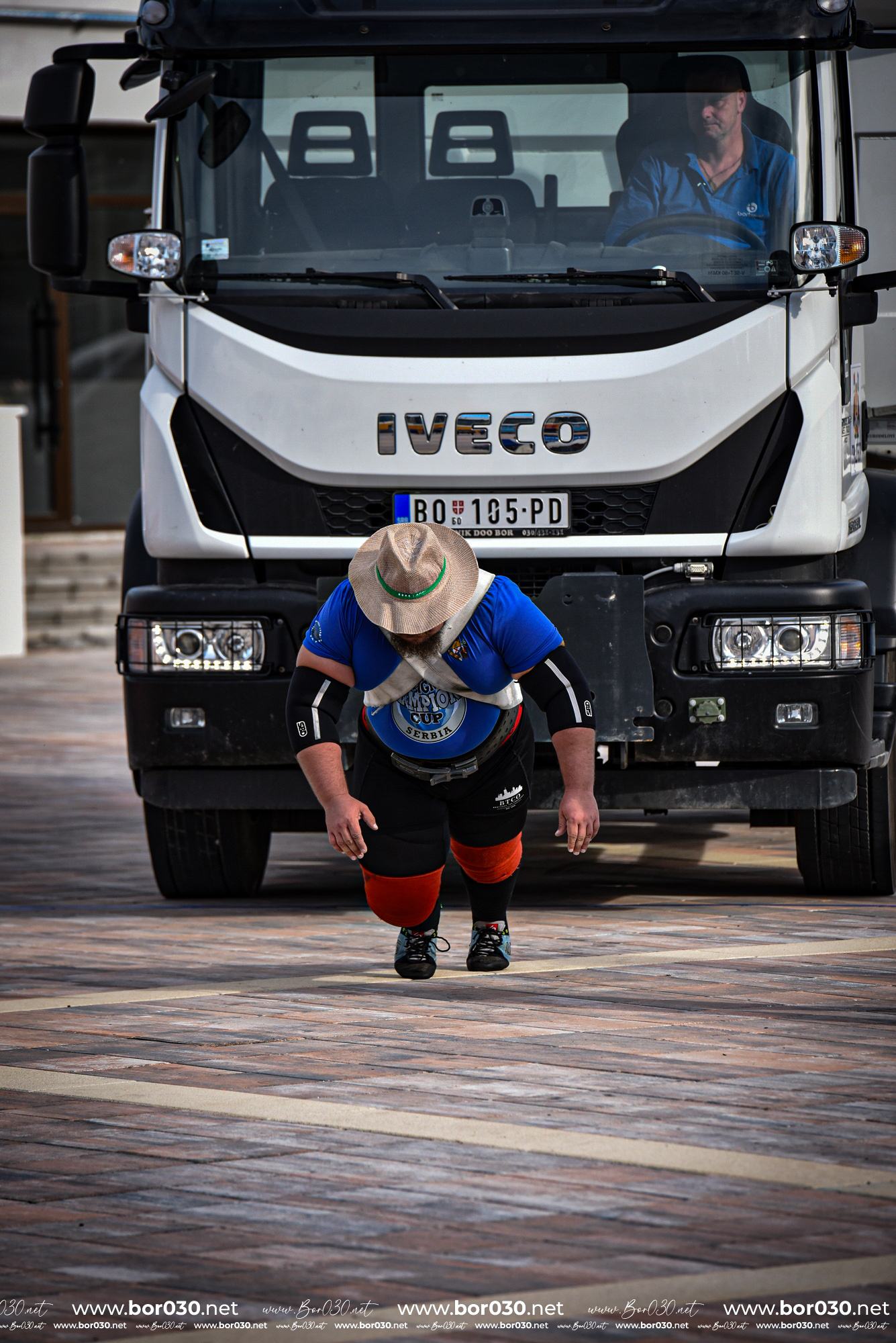
After the first four episodes, the next problem becomes simple only at first glance: what happens to strength once the athlete has to repeat it? In Strongman, the winner is not always the athlete who can produce the greatest force in one isolated moment. Very often it is the athlete who can produce enough force, fast enough, often enough and with enough control for performance to survive the entire event and, more importantly, the entire competition day.
Conditioning is this capacity for continuity. It is not synonymous with cardio, it is not an accessory placed after strength training, and it is not a contest for who can become the most exhausted. In a Strongman program, conditioning means building an organism that can sustain force production, recover between efforts and preserve technique when fatigue begins to change the way movement is organized.
1. Conditioning Is More Than Cardio
When we say an athlete has good conditioning, we need to know what that actually means. In Strongman, one event can be extremely heavy and short, another can require longer repeated effort, and another can combine several tasks before complete recovery is possible. Conditioning is therefore better understood as sport-specific work capacity: the ability to maintain useful output and control under the real conditions of the event.
From One Good Rep to Repeatable Performance
A maximal Deadlift can tell us a great deal about strength potential. It tells us much less about what happens after a hard Farmer's Walk, after a sequence of loading efforts or inside a demanding medley. Once effort becomes repeatable, a new question appears: how much of the initial capacity is still available? Conditioning increases the ability to preserve a useful fraction of that capacity.
This connects directly to the previous episodes. Muscle mass created the infrastructure. Strength and neural adaptation increased the amount of force the athlete can produce. Technique reduced mechanical waste. Conditioning is the layer that allows the whole system to keep functioning after the first resources have been spent.
Competitive Conditioning Versus Generic Fitness
An athlete can have excellent cardiovascular fitness and still not be conditioned for a Strongman medley. He may have good aerobic capacity but lose grip on Farmer's Walk or fail to maintain trunk stiffness under the Yoke. Conversely, an athlete with only moderate general fitness can be excellent in a specific event when the implement, pace and technique are highly adapted. The goal is therefore not maximum generic fitness. It is conditioning that is relevant to the contest.
2. What Happens Physiologically During Strongman Training
Strongman simultaneously demands force production and rapid energy supply. There is no single energy system carrying the entire event. The phosphagen system, anaerobic glycolysis and oxidative metabolism contribute together, and their relative contribution changes with duration, intensity, distance, repetition count and rest interval.
Energy Systems Work Together
During a very heavy, short lift, the phosphagen contribution is important. As the effort continues or the movement is repeated, glycolytic demand rises. As total duration and recovery between efforts become more important, oxidative metabolism contributes increasingly to recovery and continued work. These processes overlap continuously rather than switching on and off as separate boxes.
Research on Strongman training has shown that sessions combining tasks such as sled drag, Farmer's Walk, clean and press and tire flip can produce substantial increases in heart rate and blood lactate. In a crossover study of ten healthy men, the Strongman session produced a meaningful physiological stimulus, supporting the view that this style of training is not simply a local strength problem but also a metabolic one. The finding should be interpreted within the studied protocol and not automatically generalized to every athlete or contest.
Why the Same Weight Can Cost More on Another Day
A load does not have a single physiological cost. The same implement may feel manageable when the athlete is fresh and extremely expensive after another event. Event order, temperature, rest between attempts, surface, implement design and technique all modify demand. Good conditioning reduces the gap between fresh capacity and usable capacity after fatigue has accumulated.
3. Fatigue Is Not the Problem. Loss of Function Is the Problem
Fatigue is unavoidable in Strongman. The realistic goal is not to become an athlete who never gets tired, but to become the athlete who remains functional when fatigue appears. If breathing becomes difficult but technique remains stable, the situation may still be manageable. If posture, bracing, grip or rhythm collapse, fatigue has started to change the mechanics of performance.
Breathing Can Be Hard Without Technique Collapsing
A hard event changes breathing. Ventilation rises, perceived effort increases and the athlete has to find a rhythm in which he can continue. The problem begins when poor respiratory control pulls the rest of the system apart: posture changes, bracing weakens, stride shortens and grip relaxes too early. Breathing therefore has to be treated as part of performance rather than as an isolated phenomenon.
Local Fatigue Can Beat a Good Cardiovascular Base
An athlete can have a well-conditioned heart and lungs and still lose performance because the forearms, traps, spinal erectors, quadriceps or another local tissue becomes the limiter. In Farmer's Walk, controlled breathing is not enough if the grip can no longer transmit force. In Yoke, energy availability is not enough if the athlete cannot control load oscillation.
That is why Strongman conditioning needs to be considered at two levels: global capacity and local tolerance. Aerobic work can support the first. Carries, sleds, loading and specific repeated efforts can attack the second. The best tool is the one that solves the real limiter.
4. Carries and Medleys: Where Conditioning Becomes the Sport
Carries are among the most complete forms of Strongman conditioning because they force the athlete to produce strength while moving. Farmer's Walk combines grip, scapular stability, trunk stiffness, lower-limb function, stride rhythm and breathing. Yoke adds a load that can oscillate and immediately punishes loss of control.
Farmer's Walk and the Art of Maintaining Rhythm
At Farmer's Walk, a bad first step can cost more than a few seconds. The pick-up needs to be aggressive enough to start the load but controlled enough to avoid wasting energy. As distance grows, the athlete needs a stride rhythm that preserves tension and direction. Conditioning appears not only in how fast the athlete starts, but in how little speed is lost afterward.
The Medley and the Problem of Transitions
The medley turns conditioning into strategy. After finishing one implement, the athlete must change position, grip, line and force-production strategy. Every second lost in transition contributes to total time, while every transition can increase fatigue without directly adding distance or repetitions scored.
A good medley does not need to be the most brutal session of the week. It needs to reproduce the competitive problem. If the contest combines a carry with loading, that sequence deserves to be trained. If transition speed is the limiter, the transition itself becomes a trainable performance skill.
5. Work Capacity: The Ability to Accumulate Quality Work
Work capacity is the concept that connects conditioning with the entire program. An athlete with a well-developed capacity for work can perform more relevant training without every session creating a debt that has to be paid with multiple recovery days. This does not mean tolerating unlimited volume. It means increasing the amount of work the athlete can absorb and turn into adaptation.
More Work Does Not Automatically Mean More Progress
If you keep adding conditioning on top of heavy events, you can reach a point where the extra stimulus creates more fatigue than useful adaptation. Strongman makes this trap easy to miss because a brutally hard session looks impressive in a training log even when it lowers the quality of the following days.
Volume Must Match the Objective
During a hypertrophy phase, conditioning can support general work capacity without dominating the week. In a strength block, it needs to protect heavy exposures. In pre-contest, it becomes increasingly specific and event-oriented. The same exercise can be valuable in one phase and costly in another because the purpose and total stress have changed.
6. Aerobic Training Has a Place in Strongman, but It Must Be Used Intelligently
A Strongman athlete does not have to become a runner to develop conditioning. But that does not make the aerobic system irrelevant. A well-dosed aerobic base can support recovery between efforts and allow the athlete to accumulate activity without the cost of another maximal session. The problem appears when modality and dose begin to conflict with the primary strength objective.
Why Easy Aerobic Work Can Be Useful
Cycling, rowing and other low-impact options can provide aerobic work while keeping mechanical stress controllable. In practice, this can be valuable when the goal is to raise general capacity while keeping the legs available for Deadlift, Yoke, squats or heavy events.
Interference Is Not Inevitable, but Dose Matters
Meta-analyses of concurrent training show that the relationship between endurance and strength depends on modality, frequency, duration and organization. The effect is not a simple rule that cardio destroys strength. Some combinations are highly compatible, while large volumes and certain forms of work can create a greater cost, particularly when lower-limb demand overlaps with heavy strength training.
For Strongman, the practical conclusion is simple: conditioning must serve the sport. Choose a tool for a problem, establish a dose, monitor the response and adjust according to performance in priority events. Exhaustion itself is not the ultimate marker of quality.
7. Intervals, Sleds and Hard Conditioning
There are moments when conditioning needs to be hard. Competition may require repeated efforts, short rest intervals and a high sustainable pace. In those cases, intervals and sled work can be effective because duration, distance, rest and intensity can be controlled.
When Higher Intensity Earns Its Place
Higher intensity has value when it reproduces or prepares a real requirement: repeating a carry after previous work, accelerating an implement, working inside a time window or recovering quickly before the next attempt. In those contexts, hard conditioning becomes specific and can transfer directly.
Why the Sled Is So Versatile
Sled pushes and sled drags make work dosage straightforward and can reduce the need for complex technique. That makes it possible to add a metabolic component without forcing the athlete to repeat a difficult technical movement every time. The sled still has to be selected and positioned according to the objective. A sled used for general capacity does not have the same purpose as a sled used to imitate a contest demand.
8. How Conditioning Is Programmed Across a Strongman Season
Conditioning should not be programmed separately from the rest of the season. It belongs inside the overall architecture of the plan. The same quality can be developed through different methods depending on the phase, and what makes sense in the off-season can become unnecessary or too costly in the weeks close to competition.
Off-Season: Building the Base
The off-season provides the most freedom. General capacity can be developed, controlled aerobic work can be introduced and submaximal event practice can raise tolerance to work. The objective is not to prove how exhausting a session can be. It is to build the base that later supports heavier event work and greater competition specificity.
Strength Block: Conditioning Must Protect Strength
As strength intensity rises, conditioning has to become more precisely dosed. A large amount of hard interval work can create exactly the fatigue you do not need before a heavy Deadlift or Log session. Conditioning remains present, but it becomes subordinate to the primary objective and is placed so that high-quality strength exposures remain possible.
Pre-Contest: Specificity and Competition Rhythm
In pre-contest, conditioning should increasingly resemble the problem that will appear on the platform. That means specific events, specific transitions, realistic rest periods and sustainable competition pacing. We are no longer trying to build an entirely new general capacity. We are confirming that the capacity already built is available when it is needed.
9. How to Measure Good Conditioning
Conditioning should not be judged by how terrible a session felt. A session can be brutally difficult and create little relevant progress. Measurement should return to performance: time, distance, repetitions, execution speed, technical degradation, RPE and recovery between efforts.
The Same Performance at a Lower Cost
A strong signal of progress is performing the same event in the same time at a lower RPE, or completing more work inside the same window without a disproportionate rise in perceived effort. In a carry, track how much speed falls from the first segment to the last. In a medley, measure total time and transition time. In repeated sessions, observe how quickly technique returns between efforts.
Technique Is a Readiness Marker
For a Strongman athlete, technique is one of the most useful windows into the real state of the system. When the setup breaks down, the line becomes chaotic, grip opens and trunk position can no longer be maintained, conditioning or recovery may be the limiter rather than strength. Sometimes the best decision is to reduce the load and preserve quality because the objective is long-term capacity.
10. Conditioning, Body Mass and Movement Economy
Episode 2 treated muscle mass as infrastructure. Episode 5 also has to examine the cost of that infrastructure. Every added kilogram that contributes to force production also has to be accelerated, transported and stabilized. In static events with enormous external loads, additional mass may be highly valuable. In fast carries, medleys and longer events, the same mass can increase locomotor cost.
A Bigger Engine Needs a Capable Chassis
A champion does not maximize one variable in isolation. A bulk that raises absolute strength but severely reduces movement speed and recovery may have a lower competitive return than the numbers suggest. An elite athlete builds a system capable of using a large engine under the actual conditions of competition.
Conditioning and movement economy meet at this point. The more efficient the technique, the less energy is wasted for the same task. The better the aerobic and local capacities, the longer that technique remains available. Episode 5 is therefore not a detour from the series. It is the mechanism that holds the previously built pieces together.
11. What Championship-Level Conditioning Looks Like
High-level conditioning is not necessarily visible because the athlete can suffer more. It is visible because performance survives when the situation becomes uncomfortable. The athlete finishes a heavy carry, regulates breathing, changes implements, fixes position and produces force again without losing seconds to chaos.
Availability Is a Competitive Quality
In a multi-event competition, it is not enough to know how strong you were at the beginning. What matters is how much of that level remains available near the end. An athlete who conserves resources intelligently, recovers faster and preserves technique can extract more from a similar level of maximal strength. Conditioning is therefore a form of physical availability.
Pacing Can Beat Permanent Sprinting
A medley is not a collection of independent sprints. It is one continuous problem. If you launch every segment at the absolute limit, fatigue may cost more than the initial speed gain. The experienced athlete learns to distribute energy. That does not mean being slow. It means being fast within a pace that can be sustained.
12. Conclusion: Build the Athlete Who Can Continue
In the Building a Champion series, conditioning is the point at which every previous quality has to survive reality. Genetics supplies the material. Structural development and muscle mass build the infrastructure. Strength and neural adaptation increase production. Technique reduces losses. Conditioning allows that production to be repeated under fatigue, between events and across a full competition day.
A champion is not simply the person who can lift enormous weight. He is the athlete who can lift enormous weight and then go to the next event, breathe, reorganize and produce again. Conditioning is the difference between a capacity that looks impressive in a test and a capacity that produces points in competition.
The next episode will move into frequency and stimulus distribution: how often each quality should be trained, how stress and recovery are distributed through the week, and how to build frequency without turning the program into a collection of overlapping fatigue.
References and Sources
More From The Journal

Training
The Science of Strongman Training - Episode X: Competition Programming
How to build a complete Strongman competition preparation block: calendar, events, volume, intensity, specificity, simulations, autoregulation, tapering and fatigue management.
Training
The Science of Strongman Training - Episode IX: Peaking
Peaking in Strongman: how to turn months of training into maximal competition performance by reducing fatigue, preserving adaptations and managing specificity.