
Nutrition
Series: Carbohydrates, Fuel for Strength - Episode 2: Glucose and How Muscle Uses It
September 10, 2026
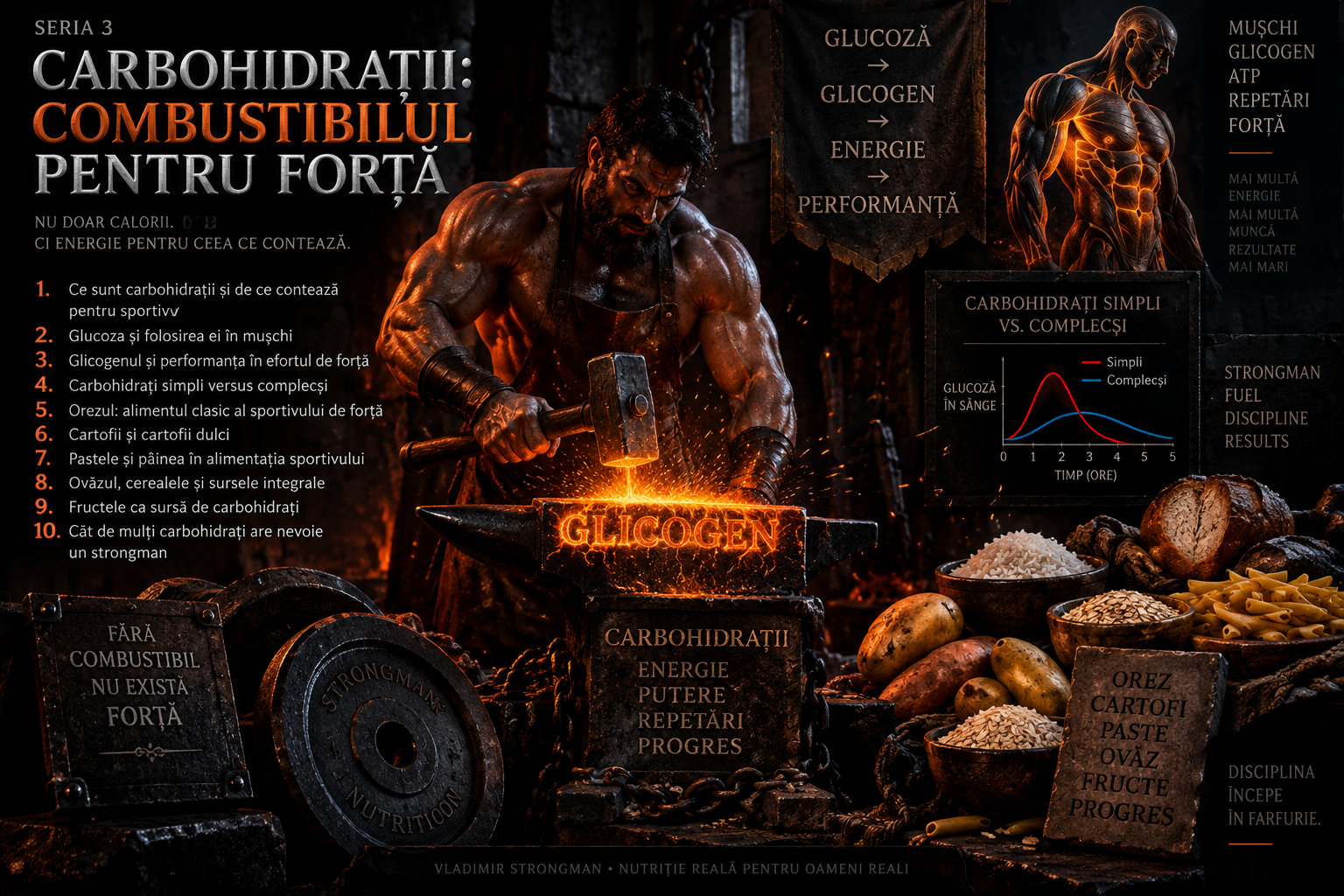
Glucose is the carbohydrate currency that muscle can rapidly turn into energy. After dietary carbohydrates are digested, a substantial share reaches the blood as glucose, and muscle fibers can either oxidize it immediately or store it as glycogen.
For a strength athlete, this pathway matters because real training involves far more than one maximal repetition. Sets, warm-ups, assistance work, yoke, farmers walk, medleys and repeated events all increase ATP demand and make glucose and glycogen part of the energy infrastructure.
This episode follows glucose step by step: where it comes from, how it enters muscle, the roles of insulin and GLUT4, how it becomes glucose-6-phosphate, when it is stored as glycogen, when it enters glycolysis and why lactate is not simply metabolic waste.
1. Glucose is a central monosaccharide in metabolism
Glucose is a simple six-carbon sugar. The body obtains it from starch and several dietary sugars, can produce it in the liver and can store it as glycogen. Its central role comes from the fact that many tissues can use it for energy.
2. Much of dietary starch ultimately becomes glucose
Rice, potatoes, bread, pasta and cereals provide starch, which consists of chains of glucose units. Digestive enzymes progressively break these chains down until glucose can be absorbed in the small intestine.
3. Absorbed glucose first enters the portal circulation
After crossing intestinal cells, glucose travels through the portal vein to the liver. There it can be used, stored or allowed to pass into systemic circulation depending on energy state and hormonal signals.
4. The liver buffers large swings in blood glucose
The liver can take up glucose after a meal and convert it to glycogen. Between meals or during exercise it can release glucose into the blood, helping maintain a concentration compatible with normal brain and tissue function.
5. Skeletal muscle is a major consumer of glucose
Because skeletal muscle makes up a large tissue mass, it is an important site of glucose disposal. After meals and especially after activity, muscle can take up substantial amounts for oxidation or glycogen restoration.
6. Glucose does not freely cross the muscle-fiber membrane
As a polar molecule, glucose requires transport proteins to cross cell membranes. In muscle, GLUT4 is one of the key transporters controlling how much glucose can enter the cell.
7. Insulin moves GLUT4 toward the muscle membrane
After a carbohydrate-containing meal, rising blood glucose stimulates insulin release. Insulin signaling promotes movement of GLUT4-containing vesicles to the muscle-cell membrane, increasing glucose uptake capacity.
8. Muscle contraction can activate GLUT4 without insulin
Exercise activates signaling pathways that increase GLUT4 translocation independently of insulin. Active muscle can therefore increase glucose uptake even when insulin levels are not high.
9. AMPK is one of the energy sensors involved in exercise
When energy demand rises, cellular energy ratios change and enzymes such as AMPK help coordinate the response. Their effects include facilitating substrate use and supporting glucose uptake in active muscle.
10. Calcium released during contraction also sends metabolic signals
Calcium is not only mechanical machinery for contraction. Rising intracellular calcium also activates signaling pathways that link muscle activity with metabolism and help adjust fuel uptake and use.
11. Once inside the cell, glucose is rapidly phosphorylated
Hexokinase converts glucose to glucose-6-phosphate. This traps it within the cell and prepares it for major metabolic destinations such as glycolysis, glycogen synthesis or other biosynthetic pathways.
12. Glucose-6-phosphate is a metabolic crossroads
Once formed, glucose-6-phosphate can enter glycolysis for energy production or be directed toward glycogen synthesis. The choice depends on energy demand, storage status and enzyme regulation.
13. Muscle glycogen is the local glucose store
When glucose is not needed immediately, muscle fibers can incorporate it into glycogen. Glycogen's highly branched structure allows many glucose units to be mobilized rapidly when exercise intensity rises.
14. Muscle keeps its glycogen largely for itself
Muscle does not have the same ability as the liver to release free glucose into the circulation. Muscle glycogen is used mainly locally to generate ATP in the fibers that store it.
15. Glycogen is not distributed uniformly within muscle
Glycogen stores are compartmentalized in different regions of the muscle fiber. Some are located near myofibrils, others near the sarcoplasmic reticulum or membrane, and location may influence function during exercise.
16. Glycolysis can begin with blood glucose or glycogen
Glycolysis converts glucose to pyruvate through a series of enzyme-controlled reactions. When substrate comes from glycogen, entry into the pathway saves an energetic step compared with glucose arriving directly from blood.
17. Glycolysis makes ATP quickly but in limited quantity
Compared with complete mitochondrial oxidation, glycolysis produces relatively little ATP per glucose molecule. Its advantage is speed, allowing rapid energy delivery during high-intensity work.
18. Phosphofructokinase is an important control point in glycolysis
Phosphofructokinase responds to the energy state of the cell and to multiple metabolites. Its activity helps regulate the rate at which glucose flows through glycolysis as ATP demand changes.
19. Pyruvate links glycolysis with mitochondrial metabolism
Pyruvate is produced at the end of glycolysis. When oxidative capacity and oxygen availability allow, it can be converted to acetyl-CoA and oxidized in mitochondria for much greater ATP production.
20. During intense exercise, some pyruvate becomes lactate
When glycolytic flux is very high, converting pyruvate to lactate helps regenerate NAD+, which is needed to keep glycolysis running. Lactate is therefore part of the solution that sustains rapid ATP production, not a metabolic mistake.
21. Lactate can be reused as fuel
Lactate can leave the fiber in which it was produced and be oxidized by other muscle fibers, the heart or converted back to glucose in the liver. It moves between tissues as part of an energy-transfer system.
22. Exercise acidosis is not simply caused by lactic acid
The old explanation that lactate directly acidifies muscle is too simple. Falling pH during intense exercise reflects the broader chemistry of rapid ATP turnover, while lactate participates in managing metabolic flux rather than merely causing fatigue.
23. Blood glucose and muscle glycogen work together
During exercise, muscle can use both glucose taken from the blood and glucose released from its own glycogen. Their relative contribution changes with intensity, duration, storage status and substrate availability.
24. As intensity rises, carbohydrate becomes increasingly valuable
At high intensities, the required rate of ATP production favors greater carbohydrate use. Fat remains important to total metabolism but cannot supply ATP at the same rate during very intense work.
25. One maximal repetition is too brief to depend mainly on glucose
A maximal deadlift lasting only a few seconds relies primarily on stored ATP and phosphocreatine. The warm-up, previous attempts and recovery between efforts, however, involve a much broader energy picture.
26. Sets of 5-10 repetitions greatly increase glycolytic contribution
As a set continues, phosphocreatine falls and glycolysis contributes more to ATP resynthesis. Hypertrophy-oriented work and higher-volume sets are therefore more glycogen dependent than a single repetition.
27. Strongman combines maximal strength with glycolytic metabolism
Many strongman events last 20-90 seconds and require repeated near-maximal contractions. In this range, glycolysis can become a major energy supplier, making glycogen stores relevant to performance.
28. Yoke and farmers walk consume muscle fuel rapidly
Moving very heavy loads recruits many muscle groups simultaneously. Even when the event itself is short, its energetic cost is large, and repeated runs within training substantially increase glycogen use.
29. Loading medleys are classic carbohydrate-demanding events
Lifting and carrying several objects in succession combines strength, speed, locomotion and very short recovery periods. The phosphagen system and glycolysis work together, and glycogen-derived glucose becomes important for maintaining pace.
30. Truck pull challenges more than the cardiovascular system
Truck pull combines high force, repeated contractions and enough duration for a substantial glycolytic contribution. Burning sensations and declining pace cannot be explained only by a lack of air.
31. Phosphocreatine recovery depends indirectly on oxidative metabolism
Between short efforts, phosphocreatine must be resynthesized using ATP generated largely through oxidative metabolism. Glucose can contribute to oxidative ATP production and therefore indirectly support repeated explosive efforts.
32. Low glycogen can reduce high-volume capacity
When glycogen stores are low, repeated sets, high training volume and glycolytic work may become harder to sustain. The effect differs among individuals and sessions but becomes more relevant as duration and volume increase.
33. Very low glycogen may also affect muscle contraction
Research suggests that specific glycogen compartments are related to processes such as calcium release from the sarcoplasmic reticulum. Severe depletion may therefore affect not only energy availability but contractile function as well.
34. After training, muscle becomes more receptive to glucose
Exercise increases muscle insulin sensitivity and maintains enhanced glucose uptake capacity for a period after training. This favors glycogen restoration when carbohydrate is available.
35. Glycogen synthase rebuilds the store after exercise
Glycogen synthase is a central enzyme in glycogen restoration. After exercise, its activity is favored and available glucose can be incorporated efficiently into muscle glycogen.
36. The first hours after exercise can favor rapid glycogen restoration
When the next session or event is close, consuming carbohydrate soon after exercise can accelerate glycogen resynthesis. With 24-48 hours until the next workout, total daily intake matters more than exact minute-by-minute timing.
37. Insulin accelerates glucose storage after meals
Insulin stimulates glucose uptake and favors glycogen synthesis. After exercise, increased insulin sensitivity combines with contraction-related mechanisms to create a favorable environment for refilling stores.
38. Protein does not replace carbohydrate for glycogen restoration
Protein is essential for tissue repair and remodeling, but glycogen is built primarily from glucose. When carbohydrate intake is adequate, protein mainly serves muscle recovery rather than substituting for carbohydrate.
39. Fructose can help restore liver glycogen in particular
Fructose is processed largely by the liver and can contribute efficiently to liver-glycogen restoration. Glucose-fructose combinations may be useful when both muscle and liver stores need to be replenished quickly.
40. Glucose and fructose use different intestinal transporters
Glucose is absorbed mainly through SGLT1, while fructose uses GLUT5. During prolonged exercise, combining carbohydrate types can increase total absorption and oxidation without relying on a single transporter.
41. During exercise, glucose from drinks can become rapid fuel
Easily digested carbohydrate consumed during a long session can enter the circulation relatively quickly and be oxidized by muscle. Its usefulness rises as duration, volume or the number of events exceeds what initial stores can comfortably support.
42. Drink concentration influences gastric emptying and absorption
An extremely concentrated sugary drink can slow gastric emptying and increase gastrointestinal discomfort. In sport, carbohydrate concentration, fluid volume and sodium should be considered together rather than separately.
43. High blood glucose does not automatically mean more force production
Instantaneous strength depends on neural recruitment, contractile mass, technique and rapid energy systems. Adequate glucose mainly helps sustain volume and repeated efforts; raising blood glucose further does not directly make an athlete stronger.
44. Hypoglycemia can sharply reduce exercise capacity
When blood glucose falls excessively, weakness, tremor, sweating, confusion and poor coordination can occur. For athletes handling very heavy loads, maintaining normal neurological function is also a safety issue.
45. High glucose intake cannot compensate for poor sleep or dehydration
Sports fatigue is multifactorial. Full glycogen stores cannot erase the effects of sleep loss, dehydration, heat, pain or accumulated central fatigue.
46. Insulin sensitivity matters for glucose handling
Insulin-sensitive muscle responds efficiently to the hormonal signal and can take up glucose more readily after meals. Regular physical activity is one of the factors that supports this metabolic capacity.
47. Insulin resistance does not make glucose useless to muscle
With insulin resistance, the response to the same hormonal signal is reduced and glucose control becomes more difficult. Muscle still uses glucose, and contraction can stimulate uptake through mechanisms that are partly independent of insulin.
48. Resistance exercise can improve glucose handling
Resistance training increases active muscle mass and stimulates glucose-uptake mechanisms. Over time, it can contribute to better insulin sensitivity and more efficient metabolic control.
49. Large muscle mass has a metabolic role, not only a mechanical one
Muscle tissue is an important glycogen reservoir and a major site of glucose uptake. Building muscle therefore changes not only force capacity but also the body's ability to handle carbohydrate.
50. Glycogen draws water into muscle fibers
Glycogen storage is associated with intracellular water. After higher-carbohydrate days, muscles can appear fuller and body weight can rise quickly without that increase representing body fat.
51. Cutting carbohydrate rapidly reduces glycogen and associated water
On a very-low-carbohydrate diet, early weight loss often comes partly from glycogen depletion and water loss. This can be mistaken for unusually rapid fat loss.
52. A large strongman can store substantial absolute amounts of glycogen
A very large athlete with substantial muscle mass has a larger absolute muscle reservoir than a smaller person. Yet the energetic cost of moving the body and external loads is also greater, so needs should be matched to work rather than body size alone.
53. Heavy event days demand more glucose than rest days
A session containing yoke, farmers, medleys and volume deadlifts can use far more glycogen than a rest day. Carbohydrate intake can therefore be periodized according to metabolic demand.
54. Pre-training carbohydrate helps protect fuel availability
Carbohydrate eaten in the hours before training can increase blood-glucose availability and reduce exclusive reliance on stored glycogen. Amount and form should be adjusted to timing and digestive tolerance.
55. Post-training priority depends on how soon the next effort occurs
If another event follows within a few hours, rapid glucose and glycogen restoration becomes a priority. If the next session is one or two days away, regular meals provide much more time for replenishment.
56. Food glucose and supplemental glucose enter the same biochemistry
Dextrose from a drink and glucose produced from digesting rice ultimately enter the same metabolic pathways after absorption. Practical differences involve digestion speed, food volume, fiber, micronutrients and context.
57. Whole-food sources and rapid carbohydrates serve different roles
Rice, potatoes, oats and fruit provide nutrients and can form the base of the diet. Glucose, maltodextrin and other rapid forms are better viewed as tools around exercise when convenience and speed are priorities.
58. More glucose does not automatically mean more glycogen
Glycogen stores have finite capacity. Once energy needs and storage restoration are covered, extra carbohydrate enters overall energy metabolism and may contribute to a calorie surplus.
59. Performance depends on glucose availability, not glucose demonization
Glucose is neither poison nor magical fuel. It is a central substrate that the body regulates and uses according to need. For athletes, the useful question is whether availability matches training demand.
60. Conclusion: glucose connects nutrition to muscular work
From intestine to blood, from GLUT4 to glucose-6-phosphate and from glycogen to glycolysis, glucose moves through a tightly controlled network before becoming ATP. For strongman athletes, its value is most obvious when efforts are intense, repeated and closely spaced.
The first key point is that muscle does not receive glucose passively: uptake is controlled by transporters such as GLUT4, activated by both insulin and muscle contraction.
The second point is that glucose can be burned immediately or stored as glycogen, and muscle glycogen is a local reservoir used mainly by the fibers that store it.
The third point is that glycolysis supplies ATP rapidly and becomes increasingly important as effort lasts longer or is repeated, which matches the profile of many strongman events.
The fourth point is that lactate is not simple waste. It helps sustain glycolytic flux and can be transported and reused by other tissues.
Finally, carbohydrate strategy should match demand: enough glucose for training and recovery, without assuming that higher blood glucose or unlimited intake automatically creates more strength.
Sources and recommended reading
1. Hargreaves M, Spriet LL. Research and reviews on glucose, glycogen and carbohydrate metabolism during exercise.
2. Richter EA, Hargreaves M. Literature on skeletal-muscle glucose uptake, GLUT4 and contraction-mediated mechanisms.
3. Sylow L and colleagues. Work on GLUT4 signaling, insulin, exercise and skeletal-muscle glucose homeostasis.
4. Bergström J and colleagues. Classic studies on muscle glycogen, diet and exercise capacity.
5. Jeukendrup AE. Literature on intestinal carbohydrate absorption and glucose-fructose oxidation during exercise.
6. Brooks GA. Research on lactate metabolism, the lactate shuttle and inter-tissue lactate use.
7. Thomas DT, Erdman KA, Burke LM. Nutrition and Athletic Performance. Guidance on carbohydrate intake and athlete fueling.
8. Kerksick CM et al. ISSN Position Stand: Nutrient Timing. Carbohydrate timing in relation to training and recovery.
9. Hall JE. Guyton and Hall Textbook of Medical Physiology. Blood-glucose regulation, insulin, liver, muscle and energy metabolism.
10. Nelson DL, Cox MM. Lehninger Principles of Biochemistry. Glycolysis, glycogen, pyruvate, lactate, glucose oxidation and bioenergetics.
Editorial note: this article is educational. People with diabetes, hypoglycemia, diagnosed insulin resistance or other disorders of glucose metabolism should individualize nutrition and treatment with qualified healthcare professionals.
More From The Journal

Training
The Science of Strongman Training - Episode X: Competition Programming
How to build a complete Strongman competition preparation block: calendar, events, volume, intensity, specificity, simulations, autoregulation, tapering and fatigue management.

Training
The Science of Strongman Training - Episode IX: Peaking
Peaking in Strongman: how to turn months of training into maximal competition performance by reducing fatigue, preserving adaptations and managing specificity.