
Psychology
The Mental Architecture of Strength - Episode III: Pain and Tolerance of Discomfort in Strongman
September 1, 2026
Abstract
In strength sports, phrases such as “push through the pain” and “do not stop when it starts to hurt” are common. They capture part of competitive experience, but they are scientifically incomplete. Pain, discomfort and perceived effort are not interchangeable, and the ability to continue a demanding task cannot be reduced to willingness to suffer.
This episode examines tolerance of discomfort in strongman through the lenses of pain science, sport psychology, perceived effort, self-regulation and resilience. The sporting literature describes resilience as a dynamic process of adaptation to adversity, and a systematic review of 92 studies proposed a sporting resilience model based on biopsychosocial protective factors. Recent evidence also supports an association between resilience and athletic performance, although the largely observational evidence requires caution about causal interpretation.
1. Introduction - When the Body Says “Stop”
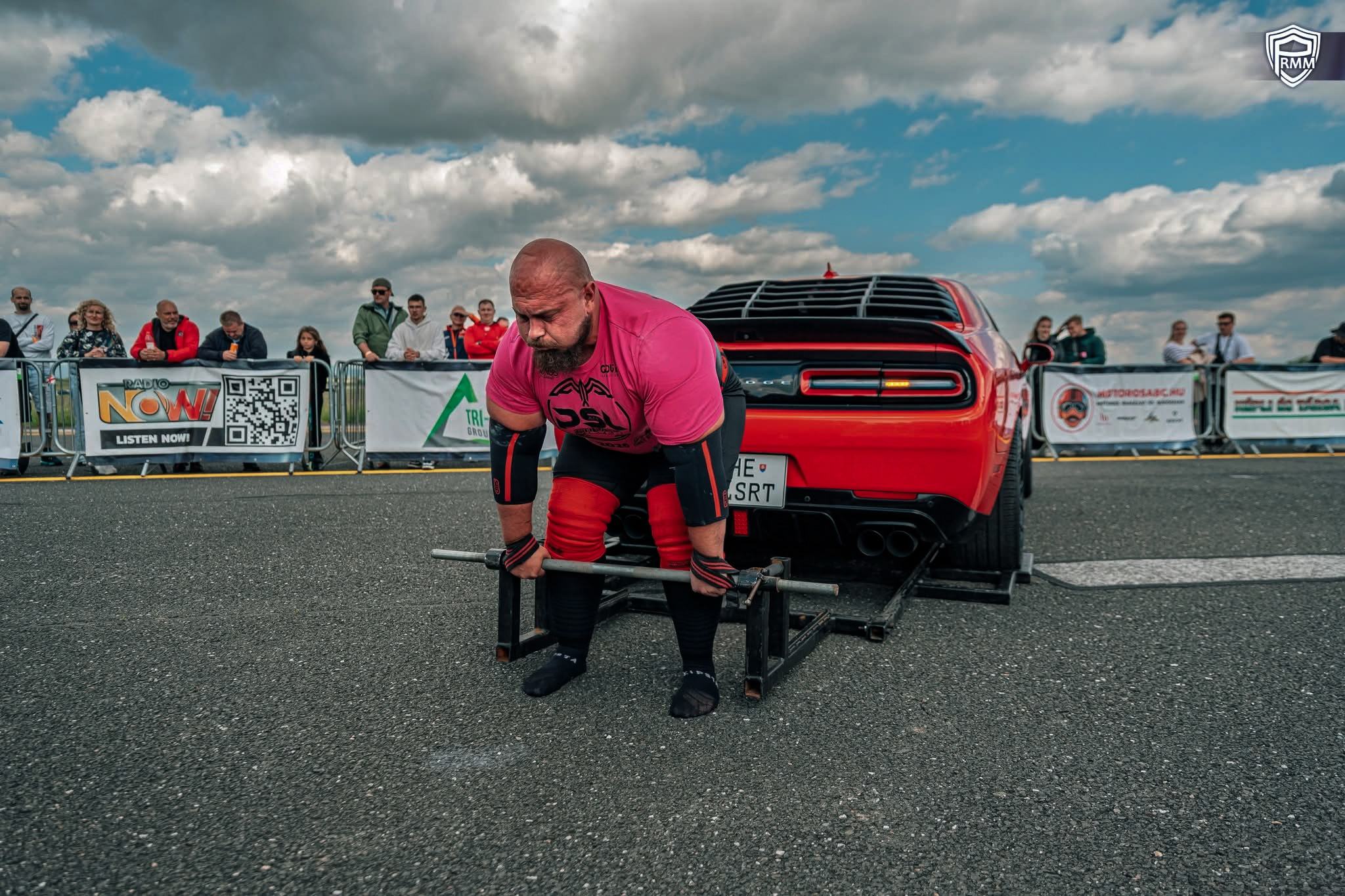
Before a strongman event, the body can appear calm. Then the effort begins. Breathing accelerates, muscles tense, pressure builds through the hands, heart rate rises and perceived effort becomes increasingly intense. At some point the athlete asks the question every competitor knows: how much longer can I go?
The answer is not determined by one factor. Physical capacity, available energy, technique, temperature, experience, anticipation, motivation and social context meet in the same moment. Tolerance of discomfort should therefore be understood as an interaction between organism and mind, not as a simple measure of character.
2. Pain Is Not the Same as Discomfort
Pain is a complex sensory and emotional experience. Discomfort can include muscular burning, pressure, fatigue, breathlessness, tension or a strong desire to stop without all of those sensations representing clinical pain. High-intensity exercise can be extremely unpleasant without automatically indicating injury.
This distinction is fundamental in strongman. An athlete needs to tolerate difficult sensations produced by effort, but should not turn every pain signal into a moral test. New, sharp, localized, progressive pain or pain associated with loss of function can have a different meaning and should not automatically be treated as a lack of toughness.
3. The Brain Is Not a Simple Pain Receiver
Pain is experienced through integration of sensory information with context, attention, memory, emotion and appraisal. This helps explain why the same physical sensation can be perceived differently in different situations. A sensation that seems manageable during training can become more threatening when associated with a previous injury or a high-stakes competition.
This does not mean pain is imaginary. The experience is real, while being influenced by cognitive and emotional processes. For a strongman athlete, understanding this mechanism supports a more mature approach: observe the sensation, interpret it and place it in context rather than automatically glorifying or ignoring it.
4. Perceived Effort: The Feeling That Work Has Become Impossible
Perceived effort is the conscious sense of how difficult it is to continue a task. In sport, it can become one of the major determinants of voluntary stopping. Two sets with the same external load can feel different depending on fatigue, motivation, temperature, sleep, experience and context.
In strongman, perceived effort is particularly relevant because many events combine strength with holding, moving, breathing under pressure and repeated exertion. Sometimes it is not the absolute weight that says “enough,” but the rising sensation that the next second has become disproportionately expensive.
5. Tolerance of Discomfort as a Psychological Skill
Tolerance of discomfort should not be viewed as a fixed quantity that an athlete either possesses or lacks. It can vary by context and can be influenced by experience, strategy, interpretation and goals. Experienced athletes may recognize demanding but familiar sensations sooner and avoid catastrophic interpretations.
Its relationship with resilience is important. A systematic review of sporting resilience described it as a dynamic process through which athletes evaluate and regulate thoughts, emotions and behavior in order to adapt to adversity. Resilience therefore does not mean feeling no discomfort. It means responding effectively to it.
6. Mental Toughness Does Not Mean Ignoring the Body
Mental toughness is widely used in sport, but definitions and measurement tools differ. A meta-analysis of the relationship between mental toughness and performance found an overall moderate-to-high association, while emphasizing that the construct is broad and multidimensional.
More importantly, a systematic review and meta-analysis of interventions designed to develop mental toughness found promising effects but also noted substantial methodological limitations and risk of bias in many studies. There is therefore no sufficient scientific basis for turning pain denial into a universal standard of character.
7. Pain, Fear and Anticipation
Athletes respond not only to what they feel now, but also to what they believe will happen next. If a sensation is associated with a previous injury, its appearance may trigger vigilance. If it is associated with repeated hard efforts and normal recovery, the same sensation may be interpreted as familiar.
Anticipation can alter attention. The athlete may repeatedly check the body, technique or breathing. Sometimes this monitoring is useful. In other situations it can consume cognitive resources that would be better directed toward execution.
8. Why Experience Changes the Relationship with Discomfort
Experience does not make the body immune to effort. It changes the mental map of effort. Experienced athletes have encountered intense sensations and learned that some are temporary, some can be managed through technique and some require stopping. This differentiation is a form of body literacy.
In strongman, experience can include unstable implements, awkward grips, unusual positions and events with rapidly changing demands. Adaptation is not only muscular. It is perceptual: the athlete learns what deserves attention and what can remain in the background.
9. Breathing and Discomfort
Breathing becomes a special component of tolerance during hard efforts. In strongman, abdominal bracing, high intra-abdominal pressure and intense exertion can create a strong sensation of respiratory difficulty. The athlete must distinguish expected exertional discomfort from symptoms that require medical attention.
Breathing strategies should be adapted to the event and technique. There is no universal formula for every situation. Psychologically, the goal is to avoid unnecessary panic when expected exertion creates discomfort, while never dismissing unusual symptoms.
10. Attention: Toward the Sensation or the Task?
Attention can be directed toward the body or toward the task. During parts of training, body monitoring is useful. During complex execution, however, excessive attention to every sensation can fragment performance.
A practical model is to alternate attention. Before the event: check the body. During execution: focus on relevant technical cues. After execution: reassess sensations. This allows control without constant hyper-monitoring.
11. Discomfort as Information, Not a Verdict
A difficult sensation can provide information about the cost of a task. But it does not by itself determine whether the athlete should continue. Interpretation should include type, location, trajectory, context and function. This is the difference between listening to the body and being controlled by every sensation.
Strength athletes sometimes interpret every limit as a psychological limit. Sometimes it is. Other times it is physiological, technical or recovery-related. A mature athlete does not decide in advance which explanation is correct. The athlete evaluates it.
12. Training Tolerance of Discomfort
Tolerance can be developed indirectly through progressive exposure to demanding work. Every training session does not need to become a suffering contest. Good programming distinguishes intensity, volume, technical work and recovery.
A useful strategy is to deliberately include sets or events where discomfort rises gradually and then practice maintaining technique. The goal is not to prove how much suffering the athlete can endure, but to learn how to preserve correct behavior when perceived effort becomes high.
13. Pain and Technique
In strongman, technique can dramatically alter the cost of an event. A more efficient position can reduce wasted energy. A better grip can redistribute pressure. A practiced breathing strategy can separate controlled effort from chaotic effort.
Sometimes the best psychological intervention for discomfort is technical rather than motivational. If an athlete needs to “be tougher” to compensate for inefficient execution, the problem may be programming or technique rather than character.
14. Fatigue and the Decision to Continue
As fatigue rises, the perceived cost of continuing can increase sharply. During a long event, the final meters or repetitions may feel disproportionately difficult. The athlete must manage not only available force but also the impulse to stop.
This is where routines help. Breaking the event into segments, technical cues and short commands can reduce psychological complexity. Instead of thinking about the entire remaining distance, attention can move to “one more step,” “keep the torso,” or “next repetition.”
15. When Discomfort Becomes Risk
One of the most dangerous myths in strength sports is that every pain signal can be overcome through willpower. It cannot. Pain may signal a problem requiring assessment, and ignoring it can worsen the situation.
Psychological resilience must include the capacity to stop when stopping is the correct decision. That is not weakness. It is executive control. An athlete who can say “I am not continuing this attempt because this signal is abnormal” is demonstrating judgment, not a lack of courage.
16. Injury and the Relationship with Pain
After an injury, the relationship with bodily sensations can change. Some sensations may be interpreted as threats, and fear of reinjury can affect return to sport. A recent systematic review of resilience in athletes found associations between higher resilience and better recovery and performance outcomes, while findings concerning injury incidence remained inconclusive.
Return should therefore be progressive and coordinated with medical and rehabilitation assessment. Psychology can support the process, but cannot replace diagnosis, treatment or functional return-to-sport criteria.
17. Resilience Does Not Mean Invulnerability
A systematic review of 92 studies emphasized that sporting resilience is dynamic and context-dependent. citeturn0search0 This changes the popular image of the “indestructible” athlete. Resilience is not the absence of impact from adversity. It is the capacity to adapt.
A resilient strongman may be tired, frustrated, afraid or disappointed and still make a good decision. He may need rest. He may change the goal. He may abandon an event and return for the next one. Mature performance psychology does not demand invulnerability. It demands functionality.
18. Discomfort and Strongman Identity
Sport identity can make discomfort harder to interpret. If an athlete defines himself through “I never quit,” stopping can feel like a contradiction of identity. At that point identity may begin to drive the decision rather than the actual performance objective.
A more robust identity says: “I am an athlete who makes difficult decisions for long-term performance.” Sometimes the difficult decision is to continue. Sometimes it is to stop. Both can require self-control.
19. Discomfort in Competition
Competition changes context. Audience, rankings, opponents and consequences can amplify sensations. An athlete may experience the same fatigue as in training but appraise it differently because the stakes are higher.
Simulation helps. Training can include time limits, judging, single attempts and clear objectives. Not to turn every session into a competition, but to give the psychological system experience with pressure before it appears in competition.
20. Self-Talk During Discomfort
When effort becomes difficult, internal language tends to simplify. Short commands can be more useful than long speeches: “Breathe.” “Hold.” “Step.” “One more.” These reduce the number of decisions required at the peak of effort.
The phrases should be tested in training. Competition is not the place to invent a new mental system. The routine should be familiar, flexible and simple enough to work when cognitive resources are reduced.
21. Voluntary Control and the Real Limit
A major mistake is to assume that every stopping point is voluntary. Performance occurs at the intersection of physical capacity and voluntary control. When physical resources are insufficient, willpower cannot create energy from nothing.
Perception can, however, influence when an athlete decides that continuation is no longer possible. This is where psychological preparation has value: not to erase physiological limits, but to prevent fear, anticipation or faulty appraisal from producing premature stopping.
22. A Practical Model: S.T.O.P. for Discomfort Assessment
A simple practical model is S.T.O.P.: Stop - Type - Observe - Proceed. Stop means taking a fraction of a second to assess rather than automatically quitting. Type means identifying the kind of sensation. Observe means checking its trajectory and effect on function. Proceed means continuing only when the signal is compatible with expected exertion and technique remains safe.
This is not a medical instrument and should not be used to diagnose pain. It is a cognitive structure designed to avoid two extremes: panic in response to every sensation and denial of every bodily signal.
23. Building Healthy Tolerance
Healthy tolerance is built through progressive exposure, adequate recovery, efficient technique, familiarity with sensations and realistic appraisal. It is not built by constantly competing to see who can suffer the most.
Programming is essential. If every session pursues exhaustion, the athlete can confuse tolerance of discomfort with accumulated fatigue. Over time, this can reduce training quality and recovery. Resilience includes preserving resources for the next demand.
24. The Coach's Role
Coaches can create more precise language. Instead of “stop complaining that it hurts,” they can ask: “What do you feel? Where? When does it appear? Does technique change?” This does not make training softer. It makes it more intelligent.
Coaches can also distinguish expected exertional discomfort from unusual warning signals. Such a culture reduces social pressure to hide problems and may support longer careers.
25. The Athlete's Role
Athletes can learn to describe sensations without dramatizing or minimizing them. Training logs can track perceived effort and performance, revealing patterns that emerge under fatigue or pressure.
Athletes can also create personal signal categories: which sensations are familiar, which have previously preceded problems, and which criteria require stopping or assessment. A decision prepared in advance is often better than a decision made in the middle of adrenaline.
26. The Limits of “No Pain, No Gain”
The phrase “no pain, no gain” has enormous cultural influence, but it is too simple for high-performance sport. Progress requires stress and adaptation, but stress is not synonymous with pain, and pain is not synonymous with progress.
A good program can produce adaptation without turning every session into a demonstration of suffering. In strongman, where the demands are already high, controlling the dose of stress is one of the skills separating preparation from impulsive heroics.
27. Longevity as a Form of Mental Toughness
If mental toughness means “endure anything,” it can conflict with longevity. If it means flexible persistence, it becomes compatible with risk management. A high-level athlete does not need to win every battle with the body in a single day. He needs to remain capable of competing months and years later.
Recent systematic evidence supports a role for resilience in recovery and performance while finding inconclusive results concerning injury incidence. This distinction matters: psychology can support recovery, but it does not provide biological immunity.
28. Conclusions
Tolerance of discomfort is a genuine component of strongman performance, but it should not be reduced to a simplistic test of masculinity or character. The athlete needs to tolerate intense effort, preserve technique as discomfort rises and continue making decisions under pressure.
At the same time, psychological maturity includes discernment. Pain is not always an enemy. Sometimes it is information. Discomfort is not always danger. Sometimes it is a normal part of exertion. And stopping is not always weakness. Sometimes it is the most intelligent decision of the day.
The strongman mindset should not be “I feel nothing.” It should be “I feel, I assess, and I choose.” That sequence transforms tolerance of discomfort from an ego contest into a performance skill. In the long term, a strong athlete is not the one who permanently ignores the body's signals, but the one who knows when to move through them and when to listen.
References
Gupta, S., & McCarthy, P. J. (2022). The sporting resilience model: A systematic review of resilience in sport performers. Frontiers in Psychology, 13, 1003053. DOI: 10.3389/fpsyg.2022.1003053.
Theodorakis, Y., et al. (2011). Self-talk and sports performance: A meta-analysis. Perspectives on Psychological Science.
Effects of mental toughness on athletic performance: a systematic review and meta-analysis. International Journal of Sport and Exercise Psychology.
Developing and training mental toughness in sport: a systematic review and meta-analysis of observational studies and pre-test and post-test experiments. BMJ Open Sport & Exercise Medicine.
The Impact of Resilience on Injury Incidence, Recovery, and Performance in Athletes: A Systematic Review. 2025.
The association between resilience and athletic performance: findings from a systematic review and meta-analysis of observational studies. 2026.
Englert, C. (2025). Self-control - A critical discussion of a key concept in sport and exercise psychology. Psychology of Sport and Exercise, 80, 102878.
Frontiers in Psychology (2025). Bounce back from adversity: a narrative review and perspective on the formation and consequences of athlete resilience.
More From The Journal

Training
The Science of Strongman Training - Episode X: Competition Programming
How to build a complete Strongman competition preparation block: calendar, events, volume, intensity, specificity, simulations, autoregulation, tapering and fatigue management.
Training
The Science of Strongman Training - Episode IX: Peaking
Peaking in Strongman: how to turn months of training into maximal competition performance by reducing fatigue, preserving adaptations and managing specificity.