
Coaching
Series: THE STRONGMAN COACH: FROM IDENTIFYING POTENTIAL TO PERFORMANCE - Episode 7: Correcting Technical Errors Through Video Analysis
October 26, 2026
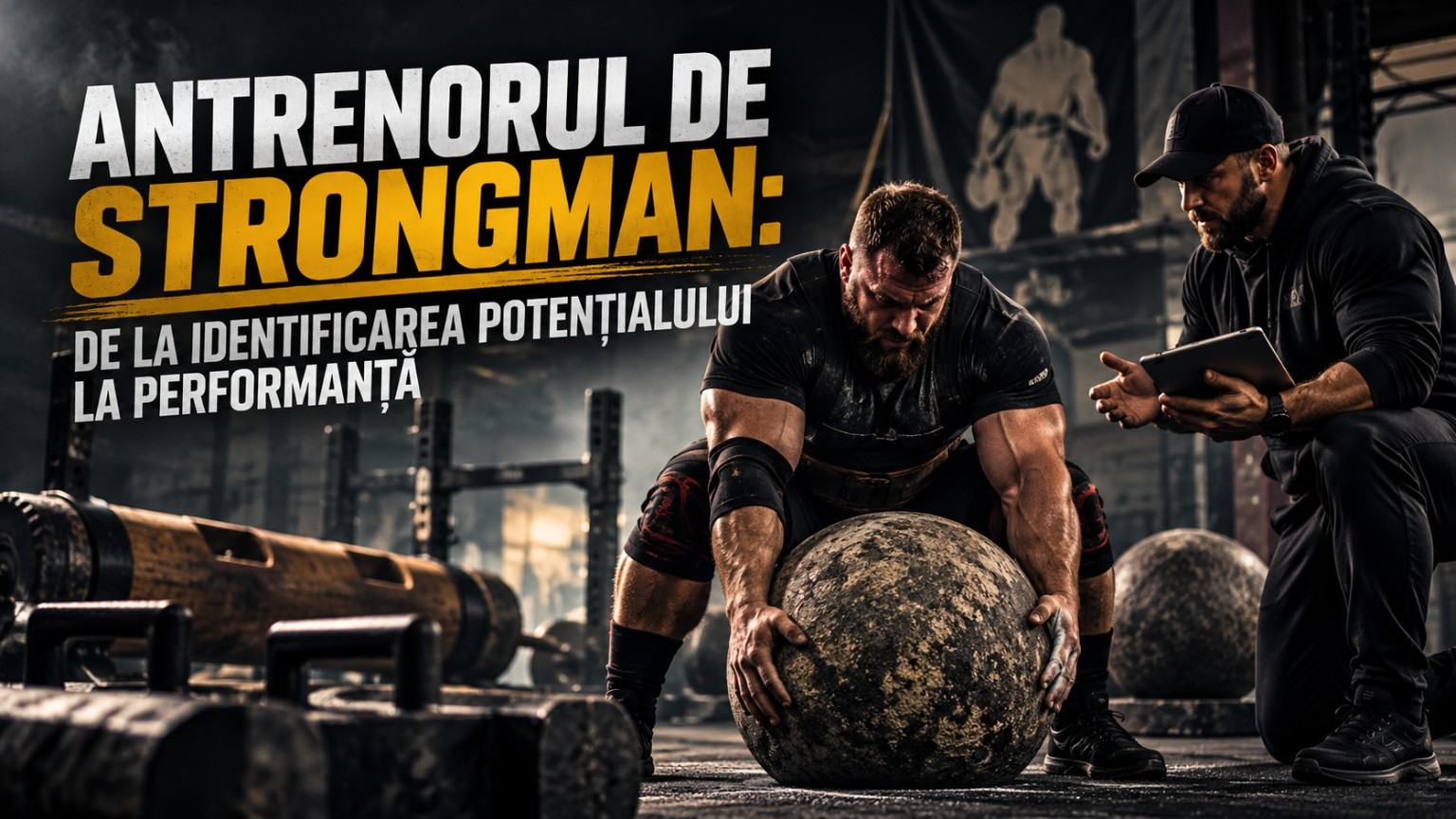
A strongman athlete lifts an atlas stone into the lap and attempts to load it onto a platform. In real time, the coach sees a disorganised effort and says, “Keep your back straight.” A few seconds later, footage of the same attempt from the side and front suggests something else: the stone slips forward before extension, the athlete repositions the elbows too late, and contact with the object is lost before the visible change in trunk position. If a coach treats only the final image, the symptom may change while the cause remains. The video has not provided a diagnosis. It has created a better opportunity to ask a question.
Episode Seven of “THE STRONGMAN COACH: FROM IDENTIFYING POTENTIAL TO PERFORMANCE” examines video analysis as a means of identifying, prioritising and correcting technical errors. After initial assessment, individual programming, technical development, communication and recovery, we turn to a tool that can connect all these processes: structured observation of movement. We consider recording methods, camera placement, biomechanical landmarks, event phases, feedback, motor learning, verification of change, remote coaching and ethical limitations.
Our purpose is not to convert a mobile phone into an improvised clinical laboratory or to insist that every deviation from an imagined ideal position must be “fixed.” Research on video feedback in sport offers genuine possibilities but also limitations concerning transfer to performance, while strongman-specific literature remains relatively sparse [1,2,6]. We will distinguish what can be observed, what may be estimated cautiously, and what cannot be inferred from two frames. A good coach is not looking for perfect photographic angles. The aim is a more efficient, repeatable movement solution suited to the athlete, implement and judging rules.
1. A camera is not yet an analysis
In strength sport, recording has become almost automatic. A phone leans against a weight plate, the event is filmed, and minutes later the clip reaches the coach or social media. However, more footage does not automatically mean more useful information. A rear view can obscure horizontal distance between a stone and the hip, while a side view may conceal differences between the hands. Before deciding that an athlete is making an error, we need to understand what was actually visible.
Analysis begins with a coaching question. Why does yoke speed decline after the first five metres? Why does the log drift away from the trunk during the clean? Why is a lighter sandbag loaded slowly despite adequate general strength? Each question calls for a particular viewpoint, movement phase and sometimes repeated trials. An impressive video archive without a purpose is still only an archive.
A useful process specifies the intended outcome, test conditions and relevant context before recording: load, distance, implement, rest, recent fatigue and rules. Video does not replace the training log or discussion. It adds one incomplete source of evidence. A well-recorded clip can overturn a coach's assumption. A poorly recorded one can make a weak assumption seem certain.
2. Outcome, error and ordinary variability
Not every movement that differs from a coach's preferred demonstration is an error. Bodies differ in size, proportions and experience. A productive starting position for a tall athlete with long arms may be unsuitable for someone with different dimensions. Implements vary too: a wide log, rigid axle and atlas stone demand different grips and pathways. Good assessment first asks whether the movement achieves the task, can be repeated and avoids warning signs requiring intervention.
A meaningful technical error affects an identifiable criterion: a missed load, loss of control, breach of judging rules, additional time or failure to reproduce performance. That does not make every unusual visual feature causal. A swinging yoke might coincide with uneven steps, but a single clip does not establish whether the problem began at pickup, through step timing or because of uneven loading.
Movement variability can be useful. The athlete must adjust to small differences in implements, surfaces and fatigue. Attempts to remove every difference between repetitions may create a rigid technique dependent on ideal conditions. The challenge is distinguishing tolerable variation from meaningful loss of control and connecting observations to outcomes. Guadagnoli and Lee's challenge-point framework highlights the relationship between task difficulty, athlete ability and information available for learning; it offers a lens, not a strongman-specific prescription [4].
3. Separating observation from interpretation
It is tempting to label every unusual hip position “poor mobility” or every lateral shift “weak core stability.” Those are interpretations, not observations. “The right shoulder drops before the first step during yoke pickup” is a visible claim that can be checked. “The hip stabilisers are too weak” is a hypothesis requiring more evidence. Confusing these two stages is a common route to ineffective coaching changes.
A helpful working formula contains three statements. First, describe what is visible and when. Second, list plausible explanations, including alternatives. Third, identify a safe test or modification that might distinguish them. If the log rolls forward in the rack transition, the reason may involve the clean sequence, the implement's dimensions, elbow timing or fatigue. Without checking, “you lack mobility” may become an inaccurate label repeated for years.
This distinction also helps the coach–athlete relationship. Neutral description reduces defensiveness because it does not attack the person. An athlete may report that a lift felt different from what the screen appears to show. Rather than a challenge to authority, that difference is useful evidence to explore. Video analysis should be a dialogue supported by imperfect observations, not a verdict delivered by whoever owns the phone.
4. Biomechanics is a map, not the entire territory
Biomechanics studies movement and associated forces. Video can reveal some spatial and temporal features: implement pathway, movement sequence, angles projected onto the image, stride rhythm and time spent during transitions. Standard footage cannot directly measure internal tendon forces, exact spinal loading or precise muscular activation. Laboratory studies typically rely on additional equipment, models and assumptions, and their estimates cannot simply be transferred to a mobile-phone app [5,8].
Strongman makes this distinction particularly important. Large objects hide joints, a yoke oscillates, sandbags deform and an atlas stone involves extensive body-to-object contact. Drawing a line on the screen does not magically reconstruct three-dimensional mechanics. Some apparent errors are effects of camera perspective while other meaningful events remain entirely invisible.
Biomechanics is best used as a disciplined framework for questions. In what order do events occur? Where is the object relative to the athlete? When does speed change? When is stability lost? We do not claim laboratory precision from a single recording. A modest but consistent description may help an athlete more than ten angles calculated with false certainty.
5. What research really says about video feedback
An integrative review by Pearson and colleagues, first published online in 2023, identified sixteen relevant studies on video feedback within sports performance analysis [1]. The authors found a relatively limited and varied literature, and noted that remembering an explanation does not guarantee better movement in competition. How feedback is delivered, how athletes participate and how review sessions are organised may matter. The screen cannot learn on the athlete's behalf.
A systematic review of video-based visual feedback in physical education found potential support for motor learning while emphasising contextual variation and limitations to generalisability [2]. This evidence does not mean that every strongman athlete improves when shown a clip after every set. Much of the evidence comes from tasks and populations unlike maximal lifting with awkward implements.
The research supports intelligently designed video feedback rather than an automatic solution. Coaches should examine whether the intervention changes observable performance and, more importantly, whether the change remains after several days and transfers to another load or implement. Without those checks, analysis may remain an elegant explanation in front of a screen rather than genuine skill development.
6. Camera angle follows the question
To examine the route of a log from the floor into the rack, a side view can clarify implement path, proximity to the trunk and extension sequence. To see whether a yoke tilts during pickup, a front or rear view may be more helpful. Farmers walk may require different perspectives for different questions: a side view describes acceleration and trunk position, whereas a frontal view can reveal swinging and differences between handles. No angle captures everything.
Where possible, use a repeatable protocol: the same area, approximately consistent camera height, a stable device and enough space to show the whole implement. Recordings that cut off a hand, foot or loading platform limit interpretation. A very close camera can distort proportions, while an oblique angle can make a joint angle appear larger or smaller than it actually is.
Recordings become more valuable when they can be compared. If today's log attempt is filmed from close to the floor and next week's from above and ten metres away, apparent trajectory changes may come from the camera rather than the athlete. Visual consistency is error control, not merely an aesthetic preference.
7. Camera stability and complete movement framing
A useful recording should let the viewer follow the movement from beginning to end. A phone held by a friend walking alongside the athlete may create compelling footage, but it complicates interpretation of trajectories. When the camera moves, the relative contribution of implement motion and camera motion becomes uncertain. A basic tripod placed outside the event lane often solves more problems than a complicated tracking application.
Framing should include the ground, feet, implement and completion area. A yoke recording placed near the finish line may capture the final metres but hide the initial pickup. A stone-loading clip showing only the upper body misses the starting contact and foot position. Angle and distance should reflect the phase under investigation, even if this requires two separate recordings rather than one attractive shot.
Safety remains more important than image quality. The athlete, camera operator and phone must remain clear of any load that may fall or swing. If the ideal camera position conflicts with a safe pathway, the coach should choose a less precise view or abandon that recording. Analysis never justifies standing between an athlete and an unstable yoke.
8. Resolution, frame rate and the illusion of precision
High-resolution footage can clarify hand position or implement contact, but it cannot compensate for the wrong viewpoint. Frame rate, measured in frames per second, matters when examining brief transitions such as the push-press drive or phase changes during a tire flip. If the relevant event is very short, low sampling frequency may miss the decisive instant. Yet extra frames do not automatically create accurate biomechanical measurements.
Poor lighting may increase exposure time and produce motion blur. Automatic stabilisation or playback functions can also change how footage appears. For comparisons, preserve reasonably consistent settings and retain the original recording. Slow-motion replay is valuable for seeing the order of events, but a slowed clip does not demonstrate that the athlete's actual movement speed was poor.
When calculating timings from frames, the effective frame rate and possible dropped frames matter. A small difference of several frames between movement phases is not automatically a meaningful performance improvement. In ordinary coaching, robust descriptions such as “the stone loses contact before extension” may be far more useful than a three-decimal measurement without supporting accuracy.
9. Two-dimensional versus three-dimensional analysis
An ordinary camera reduces a three-dimensional movement to a two-dimensional projection. When a joint or object moves toward the lens, distances and angles may look different despite limited changes in real movement. This matters especially for trunk rotation and asymmetrical tasks. A 2022 systematic review of two-dimensional video analysis in running found considerable variation in reliability and validity depending on the parameter and assessment procedure [5].
These running estimates must not be imported directly into yoke or stones, but the methodological lesson remains relevant: repeatedly observing a feature does not make its image measurement an exact representation of three-dimensional reality. If the athlete rotates toward the camera during a log clean, the projected knee angle may become misleading. Labelling that image “61.4 degrees” can create the appearance of scientific rigour without its substance.
In practice, use footage to describe movement sequences and qualified comparisons, not to diagnose from estimated angles. Two synchronised cameras may improve observation in separate planes, but they do not automatically create a validated 3D motion-capture system. A productive question is, “What could perspective be making us believe incorrectly?”
10. Choose visual landmarks before evaluating
When a coach decides after every attempt what to look for, almost any movement difference can become a retrospectively discovered “error.” A better protocol identifies a small set of landmarks before filming. In deadlift, these might include initial implement position, general trajectory and moments when the bar moves away from the body. In log, they might include body contact, rack transition and drive timing. In farmers, pickup, acceleration and handle stability offer more useful starting points.
A worthwhile landmark is observable with reasonable consistency and has a plausible relationship with the task. “The back looks nice” is vague. “The implement visibly moves away from the body during the first two-thirds of the pull” can be examined. Even the latter does not prove a cause, but it directs testing. Fewer selected landmarks also reduce the amount of information the athlete must process after each repetition.
Distinguish outcome indicators, such as total time or a successful judged lift, from process indicators, such as movement sequence. A performer may improve total time even while one technical detail looks different. That is a reason to study the function of the change instead of requiring every frame to match an ideal template.
11. Standardising load, equipment and surroundings
Comparing two recordings requires knowing what changed between them. A yoke at an identical load can behave differently when crossbar height or frame dimensions vary. A thicker log may alter the clean even at the same total mass. A loose sandbag and a densely packed one demand different gripping strategies. Without recording these details, a visible change may be incorrectly attributed to the athlete.
Standardisation does not mean banning variation. Deliberately changing conditions can help learning, but we must distinguish transfer practice from a repeated assessment. When checking progress, keep implement, surface, route, load and camera angle as comparable as possible. In transfer practice, alter one relevant factor deliberately and observe whether the skill remains functional.
Fatigue and event order are test conditions too. A farmers run performed after a demanding medley should not be casually compared with one done at the start of a session. The video reveals what happened at one moment; the training record and athlete's report explain the conditions. Together, they support a reasoned coaching decision.
12. A repetition as a timeline: phases and transitions
Instead of viewing a lift as one indivisible event, divide it into observable phases. For log, these may include grip setup, pickup, movement onto the torso, rack transition, drive, overhead pathway and final stabilisation. For stones, they may include encompassing the object, lifting to lap, repositioning the arms, extension and loading. This division is a teaching convention rather than one mandatory universal model.
Transitions often provide more information than static positions. An athlete may look strong with the stone in the lap yet lose contact while repositioning the arms. A frozen frame after the error might show a flexed trunk; the full sequence suggests that the slipping stone preceded the visible compensation. Temporal sequence does not automatically prove causation, but it eliminates some faulty explanations.
Coaches can select one or two key moments for each event, compare them across similar attempts and ask what change could improve the result. Instead of correcting hips, head, elbows and breathing simultaneously, choose the transition most relevant to performance and control. This reduces instructional noise and gives the athlete a precise task for the next attempt.
13. Log clean: the error that begins before the press
Coaches often judge log lifting almost entirely by the pressing phase because that is where the visible miss occurs. Side footage may reveal that the problem began earlier: the implement was poorly secured, rolled too far away from the body or never reached a stable rack position from which the athlete could drive. When a competitor becomes exhausted by an inefficient clean, prescribing only more overhead pressing may treat the final symptom while ignoring the energy-consuming sequence.
The recording should include everything from hand placement to final stabilisation. Observe body contact, hand repositioning, elbow timing, the ability to breathe and support the log before driving. Do not require every athlete to display identical elbow angles. Implement diameter, forearm length and functional mobility can change the effective solution. The criterion is controlled performance rather than similarity to one demonstration photograph.
A possible teaching intervention uses a lighter load to practise the difficult transition, then reintegrates it into a complete repetition. Record a repeat under comparable conditions before claiming improvement. If the transition improves but the complete lift does not, the original hypothesis was incomplete and later phases require investigation. Without verification, an inspired cue remains a suggestion rather than evidence of learning.
14. Log press: drive, trajectory and lockout
Video can help identify when lower-body drive is transferred to the log. One athlete may dip too deeply, lose trunk stability or begin the arm press before lower-limb extension contributes adequately. Another may generate enough upward impulse but allow the implement to travel away from the balance line, making the final centimetres a struggle to regain stability.
A side view offers clues about the relationship between implement and base of support; a frontal view may reveal clear asymmetries. However, one recording cannot measure exact force transmission from the legs or prove weakness in a particular muscle. Failure at lockout may involve a combination of path, fatigue, coordination, strength and rack position.
Prioritise the error with the strongest potential impact and a reasonable correction cost. If balance is lost, examine trajectory and final position. If drive transfer appears problematic, rehearse the sequence with manageable loads. Follow-up footage should show the intended change while maintaining control and the judging requirements. An aesthetically pleasing line that fails the competition command is not a successful technical correction.
15. Axle and continental clean: technique shaped by the object
An axle should not be analysed as though it were an ordinary Olympic bar. Its diameter, rotation characteristics and event rules change gripping and loading strategies. During a continental clean, some athletes use controlled intermediate contact with the body or belt before moving the axle into the rack, where rules and equipment permit. Evaluating footage without knowing the judging standard can produce advice that is incompatible with the actual event.
A side view can show contact points and the sequence of repositioning, while a frontal view may reveal different hand positions. Coaches need to distinguish morphology-specific solutions from genuine loss of control. A method should not be declared incorrect merely because it differs from that of a taller or lighter competitor. The implement is part of the movement system, not simply a mass attached to a universal action.
Interventions may focus on reducing unproductive pauses, stabilising the axle and improving the sequence. Changes should be tested progressively before transfer to high loads. Video is most useful when comparing similar attempts and addressing a precise goal: less energy used during the clean, a steadier pressing position or a shorter transition between phases.
16. Yoke: pickup and the first five metres
Biomechanical research on yoke walking found differences between the initial portion and later intervals of the carry; the first five metres feature acceleration characteristics distinct from faster portions of the event [7]. This matters for video. If an athlete loses two seconds during pickup, footage focused on the final metres may hide the greatest performance opportunity.
Recording should begin before the athlete enters beneath the crossbar. Observe foot placement, balance and posture during pickup, the first step and immediate frame oscillation. Some competitors attempt steps that are too large before controlling the load. Others stand up successfully but wait while the frame begins to swing. The interval between lifting and moving may be a useful marker if comparable attempts use the same frame and setup.
There is no single ideal stride for everyone. Hindle and colleagues described patterns in a relatively small group rather than providing universally validated individual formulas [7]. Coaches can test cautious changes to initial positioning and cadence, compare both time and stability, and check whether the new solution survives competition-relevant loading.
17. Yoke: frame oscillation and loss of speed
A heavy yoke has movement dynamics of its own. Side-to-side or forward-backward swinging can reflect an interaction between acceleration, load position, stride pattern and repeated corrective movements. Front or rear footage may reveal when swinging begins; side footage may show whether the athlete slows down to regain control. Neither view directly calculates exact forces acting on the spine or pelvis.
For practical assessment, divide the route into comparable sections and ask where time is lost. Sometimes the main limitation is the start; sometimes short steps persist throughout; elsewhere the athlete drops the frame during turns. Total time over twenty metres cannot explain the complete pattern. Video becomes valuable when it clarifies how rhythm changes and what might be practised without unnecessarily increasing weight.
The correction is not automatically “move faster.” If the competitor accelerates before controlling the load, the oscillation may increase and cause a drop. A better progression tests pickup, rhythm and distance under manageable loading and then evaluates the effects. Speed with an awkward object is built through sustainable solutions, not through ever louder instructions.
18. Farmers walk: pickup, rhythm and turns
Farmers walk combines implement pickup, loaded travel and often turning. Biomechanical literature describes differences between loaded carrying and ordinary walking, including changes in stride and ground-contact parameters [9]. For coaching, separating time lost at pickup from travel speed is useful. If an athlete struggles to lift the handles but travels quickly afterwards, additional sprint work alone misses the primary limitation.
When analysing turns, footage should include the entire turning space. Time may be lost to extra steps, swinging handles or the need to readjust the grip. A frontal camera can show asymmetries but cannot by itself establish what caused them. Surface irregularities also matter: a bumpy contest lane should not be compared uncritically with smooth indoor flooring.
A correction should pursue a clear criterion: faster pickup, more secure first steps, stable cadence or an efficient turn. Test at controllable loading and monitor both time and dropped implements. A faster run obtained through chaotic movements and markedly greater risk is not automatically a useful long-term technical adaptation.
19. Atlas stones: encompassing, lapping and losing contact
Atlas stones are particularly suitable for sequential analysis. The spectacular failure at platform height may have started during initial contact: the hands failed to secure the object, the stone moved too far away or a stable lap position was never established. Side footage helps describe object movement, while a frontal view can show arm positioning and visible stone rotation.
Analyse four transitions: floor to initial lift, lift to lap, repositioning of arms and extension to platform. Each has different demands. An athlete may possess adequate hip-extension strength but lose seconds because the grip is repositioned too late. Another may repeatedly miss because the object moves away during the final phase. Neither situation is automatically corrected by prescribing a higher conventional deadlift.
Cameras cannot reveal every pressure and contact point between the arms and stone, especially when the object hides the torso. Ask the athlete how the grip felt, where slipping occurred and when control was lost. A carefully selected intervention changes one meaningful link and then checks the whole sequence. The objective is not to force everyone into an identical template but to develop efficient, safe loading.
20. Sandbag loading: when the centre of mass moves
Unlike a rigid bar or a relatively fixed-shape stone, a sandbag can deform as it is handled. Its contents move, material folds and gripping seams or edges changes the dynamics. Drawing one imaginary centre-of-mass line on a video frame can miss this complexity. Footage needs to be interpreted alongside knowledge of the actual bag.
Analysis follows gripping and contact, lapping, then loading or carrying. If the bag slides off the thighs before extension, the answer is not necessarily “strengthen your back.” Object repositioning, a different embrace, altered rhythm or practice with a more compact bag may be relevant. Compare attempts using the same bag, explaining why two implements of equal mass are not automatically equivalent.
A failed-attempt clip matters only if it can guide a more successful next attempt. A coach might record a series of submaximal repetitions with clear goals: stable contact until extension, a transition without needless delay and a controlled finish. Then check whether the strategy holds nearer to competition loads without accelerating progression into poor control.
21. Tire flip: first pull, grip change and second drive
A large tyre is frequently filmed only during the dramatic moment of overturning. Yet time can be lost in the initial lift, the change in hand position or the transition into the final push. A systematic review of strongman biomechanics identified some features of tire-flip phases while emphasising important gaps in event-specific evidence [6]. The work informs questions without supplying one perfect technique for every tyre size.
A wide side view allows the viewer to follow the tyre edge, foot movements and the moment the force application strategy changes. Frontal footage may reveal obvious differences in hand placement, although the implement hides much of the trunk. Coaches should describe whether failure occurs before the centre of mass rises or during the later phase. Different problems may require different practice tasks.
Correction may involve manageable loads, separated phases and feedback on transition timing. Speed should not be pursued at any cost when arms and trunk cannot be controlled. A fast tyre flip does not automatically certify a safe or repeatable method, especially when surface, tyre dimensions or fatigue change.
22. Sled push, sled pull and truck pull: unseen forces
When a load is pushed or pulled along the ground, footage reveals object speed, body position and step sequence but does not directly measure frictional resistance. Two sleds carrying identical mass can generate different resistance on carpet, rubber or asphalt. In truck pull, slope, tyre pressure, vehicle starting characteristics, harness design and rope tension create additional differences. Weight alone is therefore a poor basis for comparison.
During sled push, a coach can observe whether effective rhythm is maintained, how movement is transferred to the implement and when stalls occur. With a harness pull, analysis may focus on early strides, tension development and trunk position during acceleration. Exact horizontal force cannot be inferred from a body angle drawn on a screen; additional instrumentation and modelling would be required.
Good interventions control surface and implement while cautiously testing altered rhythm or position. If performance improves, the change should be tested again. Sometimes an unconventional-looking technique is an effective adaptation to the available ground. Coaching should pursue measured efficiency under event conditions rather than visual uniformity between videos filmed in different gyms.
23. Deadlift: bar path, acceleration and oblique camera problems
Deadlift has an abundance of online instructional video, creating the impression that every recorded attempt can be judged instantly. Camera angle and athlete morphology matter profoundly. A three-quarter view may exaggerate how far the bar appears from the shins, while shoes, plates and perspective obscure joint landmarks. Reasonably consistent side recordings are preferable where safe, with the camera outside the potential drop zone.
The coach follows the movement from the floor past the knees into lockout, avoiding the mistake of turning one image of lumbar flexion into a diagnosis or deterministic prediction of injury. Research into internal loading and trunk mechanics requires methods and interpretation beyond an ordinary clip. Where an athlete reports pain, loses function or experiences deteriorating control, technical review may need to be complemented by medical assessment.
Progress comparisons are more informative at standardised loads and approximately similar effort than between warm-up work and maximal attempts. If the bar slows at a particular point, the cause may relate to position, strength, fatigue or their interaction. A coach should test explanations rather than declare a proven muscular weak point based solely on a split-second image.
24. Squat and strict press: support exercises judged in context
Strongman preparation involves more than competition events. Squats, deadlifts and strict pressing develop broad capacities and provide convenient progress markers. Squat footage can reveal approximate depth, trunk control and repeatability of the bar path. Strict-press footage may show starting position, bar-to-body relationship and overhead stabilisation. Yet judging criteria from competitive powerlifting should not be imposed mechanically on every squat variation used as an accessory.
The coach begins with the exercise's purpose. If a squat variation develops hypertrophy and volume tolerance, some variation may be acceptable within good control and tolerable loading. If the lift serves as a strength test, standardisation becomes more important. During strict press, visible trunk extension can carry different meanings depending on load and movement rules. Video alone cannot determine whether a particular variation is productive.
A correction is not valuable merely because it makes footage look like a tutorial. It should improve the intended training outcome without introducing disproportionate cost. For an athlete struggling with log, improving strict press may help general pressing strength but will not automatically fix time lost during the clean. Analysis separates broad strength qualities from the skill demands of an event.
25. Medleys: the problem may be the transitions
A loading medley involving several objects can appear to be a simple sum of lifts. Video reveals that performance also depends on approaching implements, choosing lines of travel, preparing grips and transitioning between objects. An athlete may be strong enough to lift each individual bag yet slow through the medley because of repeated pauses before contact. Filming only the heaviest object misses the explanation for total time.
Divide the event into observable segments: start, approach, pickup, travel, load, return and contact with the next implement. Time these segments only if the recording supports comparable measurement. An impressive total can hide a weak transition compensated for by high strength, while a poor total can arise from one route error rather than deficient conditioning.
Technical intervention may involve rehearsing transitions without maximal weights, positioning implements according to rules and practising rhythm. The athlete learns where the next object will be and what happens immediately after the current load. Useful video feedback transforms “you need to be faster” into a specific, testable task for the next attempt.
26. Timing tools: time as a marker, not a full explanation
Stopwatches are accessible, but coaches must define exactly what they measure. For yoke, timing may begin at the signal, first movement or implement pickup, producing different values. Farmers walk contests also use particular starting procedures. Attempts should be compared according to the same definition, preferably one that resembles the relevant competition rules.
Video allows review of start and finish moments, yet precision still depends on visible landmarks, frame rate and recording quality. If a person manually starts a stopwatch each time, tiny differences may reflect reaction-time error. Declaring a technique improvement from a few hundredths of a second measured inconsistently is not justified. Robust changes repeated across trials are more persuasive.
Timing becomes more informative alongside phase descriptions. If a competitor improves total time by one second, did acceleration improve, was an unnecessary step removed or was a different load used? Valuable analysis answers not only “how much?” but also “where?” and “under what conditions?”
27. Giving feedback without overwhelming the athlete
An athlete has just completed a difficult lift. Heart rate is high, breathing is heavy and the competitor is still trying to establish whether the attempt was valid. Presenting the phone immediately and listing eight errors may exceed what can be processed productively. Useful feedback begins with timing, amount and purpose. Sometimes the athlete needs a brief recovery before reviewing the movement; at other times one short cue is enough for the next attempt.
A practical teaching convention is to choose one or two priorities for one intervention. This is not a universally proven numerical limit, but a way of reducing confusion. Describe the visible action, ask the athlete what it felt like and agree on a concrete next step. “You lost contact during the lap-to-extension transition; keep the stone close as you begin rising” offers a more usable task than “do the movement properly.”
Evaluate feedback through the next repetition and later sessions. An athlete who can repeat the explanation but not change the movement has not yet demonstrated motor learning. Research on video feedback cautions that declarative knowledge and performance development are distinct outcomes [1]. Coaches should track what the athlete does, not merely whether the athlete verbally agrees.
28. Knowledge of results and knowledge of performance
Motor-learning research distinguishes information about an outcome, commonly called knowledge of results, from information about how the action was performed, called knowledge of performance. “You covered twenty metres in eighteen seconds” is an outcome. “You lost rhythm after the second step when the frame started to swing” describes process. Both can be useful but answer different questions.
If the objective is better farmers time, the coach needs to know whether a technical adjustment actually improves overall performance, not just whether it appears more symmetrical. If the goal is learning how to grip a stone, process information may temporarily matter most even at lower loading. In either case, performance criteria should be explained before training rather than rewritten after seeing the result.
Video can connect these two levels: it shows an outcome and the phase where time or control was lost. Yet an observed connection does not prove causality, so the proposed correction must be tested. Coaches who provide only outcome may fail to explain how to progress. Coaches who describe only detail can lose sight of competition demands.
29. Internal focus, external focus and concise cues
Some instructions direct attention toward the body: “tighten the trunk,” “raise the elbow,” or “contract the extensors.” Others refer to intended effects on the environment: “push the floor,” “keep the stone close,” or “move the frame without swinging.” Research on attentional focus and OPTIMAL theory suggests that focusing on movement effects can support performance and learning in many motor tasks, although findings depend on context and do not constitute a universal ban on internal cues [3].
In strongman, the instruction must fit task complexity and timing. A thirty-second anatomical lecture makes little sense while an athlete is already under a heavy yoke. A short cue agreed upon during practice can be more useful. Conversely, during a light technical log session, the coach may have time to explain elbow position and let the athlete explore the sensation.
Video helps in selecting the cue because it shows the relevant phase and whether the message had the intended effect. No single phrase is magical. If “push the floor” changes nothing, that does not prove the athlete is unwilling to listen. The underlying problem may have been misinterpreted, or the task may be too difficult at the current learning stage.
30. Athlete autonomy: letting the performer choose footage
Feedback need not always travel in one direction. An athlete may ask to review an attempt that felt unusual even when the coach did not immediately notice anything. That initiative can support learning. A 2025 meta-analysis of learner-controlled feedback reported benefits for retention and transfer under some conditions, although effects varied and cannot automatically be generalised to strongman [10].
One applied method lets the athlete select a clip from several attempts and explain the choice. Ask first, “Where do you think time was lost?” Only then add the coach's observations. This turns footage into practice in recognising movement errors instead of teaching dependence on another person's constant judgement.
Autonomy does not mean abandoning safety standards or making every decision a vote. When immediate risk or a clear rules violation is involved, intervention is justified. In ordinary learning situations, giving the athlete space to interpret may build capacity that matters in competition, when the coach cannot deliver detailed explanations during every phase.
31. Feedback frequency and dependency on the screen
Reviewing every repetition is tempting when recording is effortless. Yet constant feedback can create a habit in which the athlete stops evaluating movement independently. The timing and control of feedback are long-standing themes in motor-learning research, with findings influenced by task and experience [4,10]. No universal feedback frequency has been established for log, stones or farmers.
Beginners may need more frequent information while fundamental landmarks are unfamiliar. As competence develops, the coach may reduce frequency or offer a summary after several attempts. Instead of showing all six farmers runs, the coach might select the first, the most successful and one in which rhythm deteriorated, then discuss meaningful differences.
During competition the athlete must act without unlimited replay. Practice should therefore include attempts without immediate video and opportunities to compare personal judgement with later observation. The purpose is not to eliminate technology but to build a competitor who can interpret and adjust movement when the screen is unavailable.
32. Immediate or delayed feedback: choosing useful timing
Some errors demand an immediate response, particularly where safety or equipment is threatened. Others are better discussed after the set or after the athlete has recovered. Analysis ten seconds after a maximal effort may be less productive than a conversation a few minutes later. Yet there is no universal delay: sometimes the freshly remembered sensation of the lift is valuable information worth capturing immediately.
One approach asks athletes to describe what they felt, review the relevant clip and agree on one change. This preserves internal feedback and limits overload. When another athlete is waiting or the session must move on, deeper video review can occur later rather than turning every rest interval into mandatory study.
Pearson and colleagues suggest that timing and delivery may influence what learners retain, while retention of knowledge does not necessarily transfer directly to sporting performance [1]. Therefore assess not only how convinced the athlete seems after a discussion but what they can reproduce later without assistance. A successful intervention changes skill, not just the viewing experience.
33. Demonstration footage: useful under the right conditions
Athletes also learn by observing others. A video of an experienced competitor can demonstrate a movement solution, while a successful recording of the athlete's own performance may reinforce recognition of an effective action. Models require careful selection. A novice with different body proportions who copies every angle of a world champion may acquire positions ill-suited to their physique and load.
A productive demonstration highlights the relevant phase rather than only a dramatic achievement. For someone losing the stone during the lap, a model showing a clear transition with a similar implement may be more useful than a world-record attempt shot from a spectacular angle. Explain the principle to notice, where variation is acceptable and what should not be imitated mechanically. Proportions, texture and judging rules alter the available solution.
Modelling becomes worthwhile through subsequent practice, feedback and verification. Motivational clips can be energising but are not automatically technical instruction. Responsible coaches treat images as examples to question and adapt, rather than unquestionable icons. The athlete need not become anyone else's copy, but should develop an effective technique of their own.
34. Learning or immediate performance? Testing retention
An athlete reviews a first log attempt, receives clear feedback and immediately performs a better repetition. This is promising, but it does not yet establish lasting learning. The change may reflect increased attention, a lighter load, temporary responsiveness to a cue or greater familiarity with the task. Motor-learning research distinguishes performance during practice from capacity retained afterwards [4].
A simple retention check repeats the task after a reasonable interval without replaying the full explanation. If the athlete preserves an effective transition several days later and understands the goal, evidence of consolidation is stronger. The exact interval depends on purpose; ordinary coaching need not become a laboratory experiment. The essential point is not declaring permanent success after one favourable clip.
Compare recordings from before the intervention, immediately afterwards and at a later session. Conditions should be as similar as practical. If the apparent improvement disappears, the correction may be too complex, the load too demanding or the practice insufficiently developed. Instead of blaming the athlete, the coach reassesses the teaching approach.
35. Transfer: does technique survive a different implement?
Strongman athletes use implements that vary across gyms and contests. A stone may have another diameter, a log may be thicker and farmers handles may have a different pickup height. Learning a technique that works only with one familiar implement leaves preparation incomplete. Video analysis should therefore examine not only repetition under identical conditions but also adaptation to meaningful variation.
Transfer practice may begin with stable technique using a familiar sandbag, followed by gradual changes in dimensions, rigidity or platform height. The coach selects variations related to actual competition demands rather than arbitrary obstacles intended to make training spectacular. Recording reveals whether the useful movement sequence persists or whether the athlete reverts to an earlier strategy as conditions change. Performance may temporarily decline even while an important adaptability is being developed.
Transfer should not be confused with identical movement. With a different object, the effective solution may look visibly different. Criteria include control, time, safety and judging rules. A coach focused only on visual similarity may reject precisely the flexibility the athlete needs during real competition.
36. Variable practice and appropriate difficulty
Motor learning is influenced by task difficulty, performer experience and organisation of repetitions. The challenge-point framework proposes that an excessively easy task provides limited useful information while a task that is much too hard may overwhelm learning [4]. This is relevant to strongman but cannot be converted into a validated percentage formula for every implement. A beginner struggling to rack a heavy log is not necessarily learning more because every attempt is near maximal.
Video can help identify the point where movement quality begins to deteriorate. The coach may reduce weight to maintain a task that is challenging yet controllable. Once technique stabilises, relevant variations can be introduced: a sandbag similar to the competition model, a farmers turn or a different yoke starting position. The goal is not variation for its own sake but effective transfer to realistic conditions.
A common instructional error is changing load, speed, implement, route and cue simultaneously. When the athlete fails, no one can distinguish which change mattered. Deliberate, documented manipulation of variables supports interpretation and progression. Video then becomes a record of adaptation to meaningful difficulty rather than only an archive of mistakes.
37. Apparent technical errors caused by fatigue
Technique may change at the end of a long set even when the opening repetitions are effective. Analysing only the last lift and concluding that the athlete has not learned the movement ignores fatigue. Strongman events involving repeated lifts against a time limit or demanding medleys challenge the preservation of control as physical cost rises. Coaches must distinguish a poorly established skill from a skill that deteriorates beyond a particular fatigue level.
Recording the beginning, middle and end of a set can reveal when change begins. If log path remains stable across four repetitions and changes only during the last two, solutions may involve pacing, specific capacity and sensible stop criteria, not merely repeating instructions about path. If the problem appears during the first repetition, a technical priority may be more appropriate.
Fatigue does not make every variation an emergency, but loss of control with safety implications requires stopping or reducing exposure. Coaches should also consider recovery, as examined in the previous episode. Video without information about accumulated training load tells only part of the story.
38. Competition emotion and technique under pressure
A lift that seems automatic in a familiar gym may change under judges, spectators and the clock. Athletes may rush setup, skip a usual landmark or respond to a different command. Competition footage showing an error does not prove that the movement was never learned. Emotional arousal, noise, rules and previous-event fatigue can all alter execution.
One preparation strategy introduces competition-like conditions progressively: clear commands, measured lanes, realistic rest and someone acting as a judge. Video can compare ordinary practice with these rehearsals. Every session should not be turned into maximal-pressure performance; the aim is adaptability without constant exhaustion.
Post-event review should begin neutrally. What changed compared with training? What information was available? Did the athlete understand the commands? A useful explanation may involve communication or travel planning rather than joint position. Video matters because it can show differences, not because it alone establishes their causes.
39. Reviewing several attempts instead of one isolated frame
One video may capture an unusual incident. A stone rotates because of surface texture, a yoke swings following contact or an athlete steps on uneven ground. If this single attempt is treated as definitive evidence of a persistent technical problem, a coach may waste time correcting something that rarely happens. Several comparable attempts help distinguish stable patterns from chance occurrences.
A practical assessment might include three to five repetitions at safe, purpose-appropriate loading, but the number is illustrative rather than a validated standard. Record whether the same movement phase repeatedly creates difficulty and whether it appears at different effort levels. An issue found only at maximal loading has a different meaning from one present during warm-ups. In strongman, the cost of assessment must remain proportionate to the expected information.
Repeated analysis also helps validate corrections. If a change works once, do not announce a technical revolution. Check whether the athlete can reproduce it without new instructions before every attempt. Coaching quality emerges not merely from recognising a possible error but from testing whether the intervention changed the actual skill.
40. Comparing with elite competitors: inspiration without dogma
World-class performance footage offers valuable examples, but anthropometric and contextual differences can be substantial. Taller competitors with different limb lengths and training histories may use efficient trajectories that cannot be copied exactly. In yoke, a stride effective for long legs may generate instability for another athlete. Log diameter, mobility and trunk proportions also alter working positions.
Strongman biomechanics studies help describe observed movement characteristics but do not supply perfect angles for every body and every event [6,7]. Comparing a novice with an elite competitor may be useful when examining a functional principle such as preparation before pickup or keeping contact with an implement. It is less useful when the comparison becomes a catalogue of aesthetic differences without a demonstrated connection to performance.
Use elite footage to generate hypotheses and demonstrations, then test adjustments with the actual athlete. If an individually adapted method works better than the copied model, that observation matters. Scientific literature and elite examples should guide reasoning without replacing careful assessment of the individual.
41. Remote video coaching when the coach is absent
In remote preparation, footage may be the primary way a coach sees technical execution. This creates opportunities for athletes without local strongman specialists or with limited access to implements. The limitation is equally important: the camera cannot show everything, and the coach may miss equipment problems, symptoms or gym conditions that would be obvious in person. Remote coaching therefore requires explicit reporting standards.
Athletes need clear instructions on viewpoint, recording start, load reporting and relevant details about fatigue or discomfort. They should not have to send hundreds of videos. Representative attempts, one challenging effort and a brief account of sensations may suffice. Coaches must be able to request another angle when evidence is insufficient and acknowledge that certain questions cannot be resolved remotely.
Effective feedback distinguishes observation from advice. “The bag rotates to the right during the third repetition” is visible; “try initially placing the left hand closer to the middle” is a testable intervention. If warning symptoms or repeated loss of control occur, a remote coach should not encourage maximal lifting merely because the coach is physically elsewhere.
42. The attempt-analysis sheet: a repeatable format
A useful analysis record can fit on one page. It begins with event, date, implement, loading, distance or duration, surface conditions and fatigue context. Next comes the specific criterion: time from pickup to first step, log stability in the rack, keeping stone contact or farmers turning efficiency. It also identifies camera angle and whether relevant phases are visible.
In the observation section, use neutral language: “About one-third into the route, the left handle begins swinging,” not “the athlete is careless.” Record two or three plausible explanations without calling them diagnoses. Then choose one priority for the next session and a way of checking it. When there are several problems, prioritise using importance, risk and the ability to test safely.
The final field records the intervention's outcome. Did movement change? Did time or valid repetitions improve? Could the athlete reproduce the adjustment later? Consistent records provide a better basis for decisions than scattered messages exchanged after clips. The purpose is professional memory and revisable reasoning, not bureaucracy.
43. Case study: fast yoke start, slow finish
An athlete runs twenty metres with a yoke and reports “not enough explosiveness.” At first glance, the start looks energetic but total time is mediocre. Interval review suggests acceleration is good initially, while rhythm deteriorates after the middle when the frame begins swinging. There is no direct evidence that explosiveness is the main deficit; the athlete's description is an interpretation of the sensation rather than a measured explanation.
The coach retains the same load and route, records from the rear and side and compares several attempts. Does swinging precede or follow the reduction in cadence? Rather than immediately prescribing extra plyometrics, the coach tests a more controlled initial rhythm or a pickup setup that limits swinging. Any change should be cautious, without pushing the athlete into an uncontrollable load.
After several sessions, split times and drop counts inform the review. If reduced swinging comes with a worse overall time, the correction may have moved the problem elsewhere. The coach keeps the hypothesis open and searches for a better relationship between acceleration and stability. Not every visually attractive correction improves performance.
44. Case study: the atlas stone slips at loading height
An athlete reliably laps a stone but repeatedly misses the platform. The coach initially suspects deficient extension strength and considers heavier deadlifting. Side footage, however, suggests that while repositioning the grip the stone moves away from the trunk, forcing an unstable recovery. The interpretation changes: there is a clue about object transfer rather than a demonstration that muscles are too weak.
Practice continues with a lighter stone and the same platform, focusing on continuous contact and the timing of hand repositioning. The athlete reviews the relevant part of the clip and describes the point where slipping is felt. The coach selects one cue rather than correcting every joint position simultaneously. Comparable follow-up footage reveals whether the transition is more stable.
If it improves, loading increases gradually. One successful attempt with a lighter stone does not prove that the competition load is solved. Retention and transfer are checked, and the programme avoids needlessly repeating the same failure. The case shows how footage can improve the coaching question before changing the exercise selection.
45. Case study: the log fails at lockout, but the clean is costly
An athlete with strong strict pressing repeatedly misses a log near lockout. At first glance, the arms appear unable to complete the lift. Full footage reveals that every clean requires two repositioning attempts and the athlete begins pressing already off balance. The coach considers two hypotheses: excessive energy lost during the clean and an unstable rack impairing the drive. Neither is proved by one attempt, but both are testable.
Moderately loaded technical sessions aim for a smoother clean and a stable pre-drive position. If overhead performance improves without additional pressing strength work, that offers partial support for the clean-related explanation. However, competition relevance still requires cautious progression to heavier loads. The coach should not declare the issue permanently solved after two favourable repetitions.
The case illustrates the difference between the visibly failing final phase and the factor that sets the chain of errors in motion. Strongman lifts often contain multiple phases with distinct costs, and athletes may have sufficient general strength without efficiently transferring it through each transition.
46. Case study: farmers walk drops during the turn
A competitor travels quickly down the first length but drops the handles twice after turning. The initial guess is weak grip. Overhead footage suggests that the athlete takes a wide corrective step during the turn, the handles strike the thighs and begin swinging. Another view confirms the release moment but cannot measure exact finger or contact forces. The problem may involve turning control rather than static holding capacity alone.
Turns are repeated with controllable loads while two rules-compliant strategies are compared. The coach monitors extra steps, oscillation and drops rather than only total time. If drops disappear and turning becomes consistent, the intervention is promising. Follow-up attempts nearer competition loading test whether the solution remains functional as grip demands increase.
Handle texture, length and pickup height should also be recorded. Different grip systems may create different behaviour. The case illustrates a common reflexive mistake: adding large forearm volumes is not automatically the remedy for an implement-control error.
47. Case study: a rules change alters the meaning of good technique
An athlete trains repeated log lifts using a quick lowering strategy. Two weeks before a competition, the organiser announces a different stabilisation command and strict requirements for each completed repetition. Training videos show efficiency according to the previous criteria but cannot establish that the same repetitions will be accepted. The problem is not necessarily faulty movement; it is a mismatch between the practised task and judged task.
The coach obtains official rules, clarifies ambiguity with the organiser if needed and updates visual checkpoints: lockout, visible stability, waiting for a command and controlled descent. A filmed simulation with a practice judge helps verify the sequence. The athlete learns not only to move the implement but to complete a repetition in a form that meets the actual event's standard.
This case shows that event technique is partly defined by rules. A movement that saves time but produces rejected repetitions is inefficient in competition. Video analysis must include judging requirements and sporting context rather than focusing solely on body positions removed from reality.
48. Prioritising errors: deciding what matters first
A recording may reveal a slow start, one shoulder lower, uneven steps, late grip changes, breathing disruption and a difficult finish. Trying to correct everything at once leaves the athlete with no clear task. Prioritisation can use three criteria: relevance to safety, probable impact on outcome and realistic modifiability within the available period.
Safety may require stopping hazardous exposure regardless of stopwatch consequences. Otherwise, address the dominant limitation. If an athlete loses eight seconds during transitions in a loading medley, saving a few tenths on a detail of the first lift may not be the best investment. Coaches should also distinguish practice intended to build a skill from work designed to optimise a near-term contest result.
The priority system should be transparent: explain what issue is being addressed, why it matters and how improvement will be evaluated. Other observations can be kept for later blocks. Professionalism is not the number of flaws a coach can list, but the quality and timing of the intervention selected.
49. Pain and technique: video cannot replace clinical assessment
A serious error occurs when a coach uses video to declare a precise cause of pain. Statements such as “your shoulder hurts because your shoulder blade moves this way” or “your disc is at risk because your back looks like that” are far too strong for an ordinary recording. Pain and injury are complex, while an image offers only some of the necessary information. Coaches may describe movement and adjust loading but cannot diagnose damaged structures on this basis.
If the athlete reports worsening pain, loss of function, numbness or other concerning symptoms, exposure should be reconsidered and medical assessment may be necessary. With the athlete's permission, footage can help a clinician understand event demands and the circumstances of symptoms, but clinical decisions should not be delegated to posture-analysis software. A video frame is neither an X-ray nor a tissue-strength assessment.
In collaboration with physiotherapists, coaches can document which movements are tolerated and how execution changes during return to activity. Clinical guidance must be respected, and maximal attempts should not be used solely to “prove” that the problem has disappeared. Video can support a safe process but cannot replace its medical criteria.
50. Artificial intelligence and automated analysis: promise and limits
Current applications can estimate body landmarks, track some movement segments and create visually compelling reports. These functions may save time, but accuracy depends on training data, lighting, camera angle, joint visibility and task characteristics. A model designed for squats or unloaded walking may perform differently when a strongman athlete hugs a large stone. When an implement hides the body, automated systems may effectively guess positions from incomplete observations.
Coaches should ask for evidence of validation in a relevant population and task before converting a computer-generated score into a training decision. An application reporting “87% injury risk” without transparent clinical validation should not be treated as an actual probability or diagnosis. Likewise, angular measurements to a tenth of a degree may result from unstable estimates. A colourful chart does not automatically make a tool scientific.
Responsible use involves manual checks, room to challenge outputs and avoidance of definitive pronouncements. Automated systems can mark moments for review or organise footage. Their value lies in reducing unnecessary work while preserving coaching observation, athlete feedback and real testing of proposed changes.
51. Consent, confidentiality and the right to control one's image
Recording an athlete is more than a technical operation. A clip may include the person's face, training partners in the background, information about physical condition and clues to location or routine. Coaches should explain why footage is collected, how it is stored, who can access it and whether it will be used solely for analysis or also in publicity. Consent for technical correction does not automatically imply consent to post a montage on social media.
A professional protocol may specify restricted access, reasonable retention, deletion options and appropriate communication channels. Footage involving minors requires additional care and compliance with applicable legal and organisational requirements. Neither a joke about a missed lift nor a “before and after” comparison justifies public exposure against the athlete's wishes.
Confidentiality also improves teaching. Athletes are more likely to share genuine errors when they know the footage will not become public humiliation. Trust, discussed in Episode Five, is a prerequisite for an honest video archive. Without it, coaches may receive only the athlete's most successful attempts instead of the information needed for development.
52. Building a personal movement library
Over time, a coach may collect hundreds of clips from one athlete. If material is organised only by message date, useful comparisons become difficult and observations disappear. A practical library uses consistent labels: event, load, distance, viewpoint, session purpose and relevant conditions. Similar attempts can then be located quickly rather than searched for at random across conversations.
The library should contain successful as well as problematic performances. If only personal records are archived, coaches cannot see how a skill was developed or where a limitation emerged. Representative examples from each training block can demonstrate trends: a smoother log transition, farmers turns without drops or a more stable yoke under higher loading.
The archive should not become continuous surveillance. Select meaningful examples and respect consent. Footage can support longitudinal coaching and the athlete's understanding without ever being published. A good library is working memory that serves the athlete, not a collection designed to advertise how hard the coach works.
53. Evaluating whether a correction was worth its cost
A technical intervention has costs. It may temporarily reduce loads, demand additional repetitions or consume attention during a phase where other events matter more. Evaluation should therefore include not just visual change but sporting outcome and learning cost. A steadier rack is promising, but if it consistently reduces valid repetition count, the strategy needs reconsideration against rules and goals.
Define success criteria before intervening: fewer misses at equal loading, better segment times, improved implement control and the ability to reproduce the movement without prompting. Compare several meaningful attempts and consider fatigue, equipment and conditions. No single criterion is sufficient. A technique that saves time but repeatedly produces unsafe loss of control should not automatically be retained.
Choosing not to change something can also be appropriate. If a visible individual characteristic has no relevant impact on performance, does not create a meaningful problem and does not restrict progression, continued observation may be better than immediate correction. Strength sport creates a strong temptation to correct endlessly. Professional maturity includes leaving a functional individual solution alone.
54. Applied protocol: four weeks of video review for a weak event
In week one, choose a precise goal and record several comparable attempts without changing every variable. For an athlete struggling with stones, the goal may be maintaining contact through the lap-to-extension transition. Record stone mass, diameter, platform height, warm-up and the athlete's sensations. Distinguish visible observations from technical hypotheses. The first stage aims to understand the problem rather than announce a cure.
During week two, introduce one low-risk intervention, perhaps rehearsing the transition under manageable loading with one cue. Record several attempts against the same landmarks. In week three, reduce immediate feedback and ask the athlete to evaluate execution before reviewing clips. Introduce a competition-relevant variation to examine transfer.
In week four, check retention and sporting outcomes: movement stability, valid repetitions and time under comparable conditions. If progress is absent, revise the hypothesis instead of inventing reasons to protect the coach's preferred method. This educational protocol is not a clinically validated intervention for every event. Its value lies in the sequence: observe, hypothesise, test, verify and adjust.
55. What coaches should never do with training footage
Coaches should not diagnose medical conditions from a knee's appearance on screen, estimate internal forces without appropriate tools, treat every variation as an error or demand perfect imitation of a champion. Nor should they force repeated maximal attempts merely to obtain clearer video. The expected information must justify the physical and psychological cost of testing.
Equally, coaches should not replace dialogue with colourful arrows, opaque scores and random commands. The athlete may have crucial information about movement sensation, pain, a slipping grip or changed judging rules. Video may challenge an impression without making personal experience irrelevant. Athletes learn to analyse movement through active involvement and subsequent practice, not by passively receiving verdicts.
Finally, a failed lift must not be used for humiliation, pressure or publicity without consent. Errors are the raw material of learning. When athletes fear that every miss will become public, they may conceal precisely the information needed for coaching. Professional standards and respect matter as much as technical camera placement.
56. Conclusion: good coaches learn to test their own explanations
Video analysis does not automatically make a coach a biomechanist or reduce the athlete to a geometric figure. It can, however, make observation more repeatable, communication clearer and interventions easier to verify. The key distinctions are outcome versus execution, observation versus interpretation, relevant error versus ordinary variability, and immediate change versus learning retained over time. Those distinctions form the foundation of a professional method.
In strongman, the practical stakes are substantial. Seconds lost at yoke pickup, a farmers turn or the transition between lapping and loading a stone may matter more than additional general strength at a particular point in preparation. Yet footage alone does not explain why those seconds disappear. Coaches must form hypotheses, test them cautiously and adapt to athlete and implement, using research as a guide rather than an infallible authority.
A careful coach does not review footage to prove that the coach was right. The purpose is to discover what might have been misunderstood and how athlete and coach can improve together. The next episode addresses injury management in collaboration with medical specialists: professional boundaries, multidisciplinary communication and responsible return to strongman training.
References and scientific sources
Methodological note. This educational synthesis draws on literature about video feedback, motor learning, two-dimensional motion analysis and strongman-event biomechanics. Case studies and assessment protocols are coaching illustrations, not clinical trials or universally validated techniques. Strongman-specific research remains limited; some findings are cautiously extrapolated from other sports. Video may support technical observation but cannot diagnose injury, directly quantify internal forces or predict an individual's injury risk. Concerning medical symptoms require appropriately qualified assessment.
[1] Pearson, A. W., Webb, T., Milligan, G., & Miller-Dicks, M. (2025; publicat online în 2023). The use of video feedback as a facet of performance analysis: An integrative review. International Review of Sport and Exercise Psychology, 18(1), 417–439. https://doi.org/10.1080/1750984X.2023.2235700
[2] Mödinger, M., Woll, A., & Wagner, I. (2022). Video-based visual feedback to enhance motor learning in physical education—a systematic review. German Journal of Exercise and Sport Research, 52, 447–460. https://doi.org/10.1007/s12662-021-00782-y
[3] Wulf, G., & Lewthwaite, R. (2016). Optimizing performance through intrinsic motivation and attention for learning: The OPTIMAL theory of motor learning. Psychonomic Bulletin & Review, 23(5), 1382–1414. https://doi.org/10.3758/s13423-015-0999-9
[4] Guadagnoli, M. A., & Lee, T. D. (2004). Challenge point: A framework for conceptualizing the effects of various practice conditions in motor learning. Journal of Motor Behavior, 36(2), 212–224. https://doi.org/10.3200/JMBR.36.2.212-224
[5] Hensley, C. P., Kontos, D., Feldman, C., Wafford, Q. E., Wright, A., & Chang, A. H. (2022). Reliability and validity of 2-dimensional video analysis for a running task: A systematic review. Physical Therapy in Sport, 58, 16–33. https://doi.org/10.1016/j.ptsp.2022.08.001
[6] Hindle, B. R., Lorimer, A., Winwood, P., & Keogh, J. W. L. (2019). The Biomechanics and Applications of Strongman Exercises: A Systematic Review. Sports Medicine - Open, 5, 49. https://doi.org/10.1186/s40798-019-0222-z
[7] Hindle, B. R., Lorimer, A., Winwood, P., Brimm, D., & Keogh, J. W. L. (2021). The Biomechanical Characteristics of the Strongman Yoke Walk. Frontiers in Sports and Active Living, 3, 670297. https://doi.org/10.3389/fspor.2021.670297
[8] McGill, S. M., McDermott, A., & Fenwick, C. M. J. (2009). Comparison of different strongman events: Trunk muscle activation and lumbar spine motion, load, and stiffness. Journal of Strength and Conditioning Research, 23(4), 1148–1161. https://doi.org/10.1519/JSC.0b013e318198f8f7
[9] Winwood, P. W., Cronin, J. B., Brown, S. R., & Keogh, J. W. L. (2014). A Biomechanical Analysis of the Farmers Walk, and Comparison with the Deadlift and Unloaded Walk. International Journal of Sports Science & Coaching, 9(5), 1127–1143. https://doi.org/10.1260/1747-9541.9.5.1127
[10] Wang, B., Tao, T., Yuan, Y., & Guo, W. (2025). Self-Controlled Feedback and Behavioral Outcomes in Motor Skill Learning: A Meta-Analysis. Behavioral Sciences, 15(9), 1291. https://doi.org/10.3390/bs15091291
More From The Journal

Competitions
Series: BEYOND THE ARENA: HOW TO ORGANISE A STRONGMAN COMPETITION - Episode 8: Promotion, Public Communication and Audience Development
How to market strongman contests: branding, athlete communication, social media, search visibility, media relations, privacy, crises and measurement.
Competitions
Series: BEYOND THE ARENA: HOW TO ORGANISE A STRONGMAN COMPETITION - Episode 7: Budgeting, Financing, Sponsorship and Event Sustainability
A research-informed guide to strongman competition budgets, cash flow, sponsorship contracts, prizes, financial risk and sustainable event models.