Training
Anatomy of a Strongman - Episode VII: The Legs and Ankle - The Foundation That Turns Strength into Movement
September 1, 2026
Anatomy of a Strongman - Episode VII: The Legs and Ankle - The Foundation That Turns Strength into Movement
In Strongman, almost every event begins with the same fundamental contact: the athlete with the ground. Before the load reaches the hands, shoulders, or overhead position, force must be produced and transferred through the legs. The thigh, knee, lower leg, ankle, and foot form a functional unit that must combine force production with shock absorption, balance control, and adaptation to the surface. If this foundation does not work efficiently, the rest of the force chain loses efficiency.
At the same time, a Strongman's legs are not used only to push against a heavy load. They must move a loaded body, stabilize the pelvis and trunk, respond to shifts in the center of mass, and preserve efficient technique as fatigue rises. Yoke walks, farmer's walks, Husafell carries, sandbag carries, sled drags, tire flips, loading events, squats, and deadlifts challenge the same structures through different mechanisms. Therefore, «strong legs» in Strongman means more than large quadriceps.
In this episode, the legs and ankle are viewed as a biomechanical foundation of performance. We will follow the anatomy of the thigh and lower leg, the role of the ankle and foot, the mechanics of extension, frontal and rotational control, and the way this region behaves in major Strongman events.
1. The Legs as a Link for Force Production and Transfer
The lower leg and thigh form the link between the ground and pelvis. The femur transmits forces between the hip and knee, the tibia and fibula connect the knee to the ankle, and the foot creates the final interface with the ground. During a strength movement, these segments do not work separately. They constantly change position and joint angles to produce a useful joint moment.
When a Strongman lifts a bar or object from the floor, force from the knee and hip extensors must be coordinated with trunk stability and foot position. When the athlete walks with a yoke or farmer's handles, the role changes: the same musculature must produce force repeatedly, stabilize a moving body-load system, and transfer the load from one leg to the other.
This distinction matters. Maximal leg force in a controlled extension is not identical to the ability to produce useful force repeatedly while the body is moving. Strongman requires both, and the gap between them is one of the major problems in physical preparation.
2. The Quadriceps - The Motor of Knee Extension
The quadriceps consists of rectus femoris, vastus lateralis, vastus medialis, and vastus intermedius. Together they produce knee extension and make a major contribution to rising from low positions. In squats, lunges, loaded walking, and many loading variations, the quadriceps must generate tension while knee angle changes continuously.
Rectus femoris crosses both the hip and knee, making it different from the vasti. As a result, hip position can influence its length and contribution to force production. In Strongman, where positions are rarely perfectly standardized, these differences can matter between a squat, the start of a deadlift, and lifting a large object.
The quadriceps should not be viewed simply as an «engine». Its force must also be controlled eccentrically, for example when the athlete descends under a load, absorbs the load during a yoke walk, or brakes the body before the next step. In those moments, the muscle does not merely create movement; it controls movement.
3. The Hamstrings and Adductors - Extension, Control, and Stability
The hamstrings, mainly biceps femoris, semitendinosus, and semimembranosus, cross the hip and knee. They contribute to hip extension and knee flexion and help control the pelvis and lower limb. In Strongman, this role becomes clear in deadlifts, short accelerations, sled work, and any situation where the athlete must generate powerful extension from a flexed position.
Adductor magnus deserves special attention because it can contribute to hip extension from certain positions. In practice, this structure can make a substantial contribution when the hip is flexed. For a Strongman, this means that what we broadly call the «posterior chain» also includes the medial thigh musculature, not only the glutes and hamstrings.
In addition, the thigh muscles must control movement in the frontal and transverse planes. The knee and ankle should not be treated as hinges that move only forward and backward. During loaded walking, changes in force direction and pelvic rotation demand three-dimensional control. A strong lower limb is therefore also a lower limb capable of stabilizing itself.
4. The Ankle - The Joint That Negotiates with the Ground
The ankle is one of the most underestimated regions in strength sports. The talocrural joint allows mainly dorsiflexion and plantarflexion, while the subtalar and foot joints contribute to surface adaptation and positional control. During a strength movement, the ankle partly determines how well an athlete can position the body over its base of support.
Dorsiflexion is particularly important in the squat and in positions where the knee must travel forward over the foot. If ankle mobility is limited, the athlete may compensate by changing torso position, stance width, or foot rotation. Compensation is not automatically a problem. It can be the strategy that finds the most effective configuration. The problem appears when the adaptation exceeds control capacity and the movement becomes unstable.
In loaded carries, the ankle has a different task. It must allow the center of mass to move over the foot on every step while contributing to force absorption and return. A strong ankle is not permanently rigid. It is sufficiently mobile when the step requires motion and sufficiently stable when the load perturbs the system.
5. The Calves - Strength, Elasticity, and Propulsion
The triceps surae consists of the gastrocnemius and soleus, and together with the Achilles tendon contributes substantially to force transmission between the lower leg and foot. The gastrocnemius crosses the knee and ankle, while the soleus acts only at the ankle. In a sport involving loaded walking and short accelerations, this anatomical difference matters.
The soleus plays an important role in controlling the tibia over the foot and in postural stabilization. The gastrocnemius contributes to plantarflexion and force production in dynamic actions. During farmer's walks or yoke walks, the calf works on every step, not in one isolated repetition. The accumulation of contractions can become a metabolic and mechanical limiter even when maximal strength is very high.
The Achilles tendon also has an important mechanical role. Tendon tissue can store and return elastic energy in certain forms of movement. During walking and acceleration, this property contributes to mechanical efficiency. In Strongman, efficiency can mean the difference between a carry in which every step costs little and one in which every step consumes unnecessary resources.
6. The Foot - The Base of the Entire Chain
The foot is not an inert platform. The medial and lateral arches, plantar fascia, tarsal joints, and metatarsophalangeal joints contribute to pressure distribution and adaptation to the ground. During locomotion, the foot moves through a sequence of positions that allow it to be flexible at contact and more rigid during propulsion.
For a Strongman, this transition is important in carries and medleys. Early in the step, the foot must accept load. As the body moves over it, the foot must provide enough stability for force to transfer upward. If the base deforms excessively or pressure is distributed inefficiently, the athlete can lose stability before the problem becomes obvious at the knee or hip.
This also explains why footwear and competition surfaces can change how an event feels. A very soft sole, a slippery surface, or uneven ground changes force transmission. In Strongman, where competitions can occur outdoors and on variable surfaces, the mechanical base is never completely isolated from the environment.
7. Triple Extension - The Simplification Myth and the Reality of Coordination
The phrase «triple extension» is commonly used to describe simultaneous extension of the hip, knee, and ankle. The concept is useful, but it becomes problematic when treated as a rigid rule that explains every strength movement. In reality, inter-joint coordination depends on the task, velocity, object position, and goal of the movement.
In a deadlift, for example, hip and knee extension dominate force production, while the ankle contributes by controlling tibial position and ground pressure. In a push press or jerk, lower-limb extension contributes to rapid force transfer to the object. In a carry, the same musculature is no longer accelerating a bar; it is moving the center of mass of the entire body-load system forward repeatedly.
Therefore, «strong legs» do not simply mean that an athlete can perform explosive triple extension. They mean the athlete can organize the joints so force is applied in the right direction and at the right time for the task.
8. Yoke Walk - When the Legs Must Support and Move a Structure
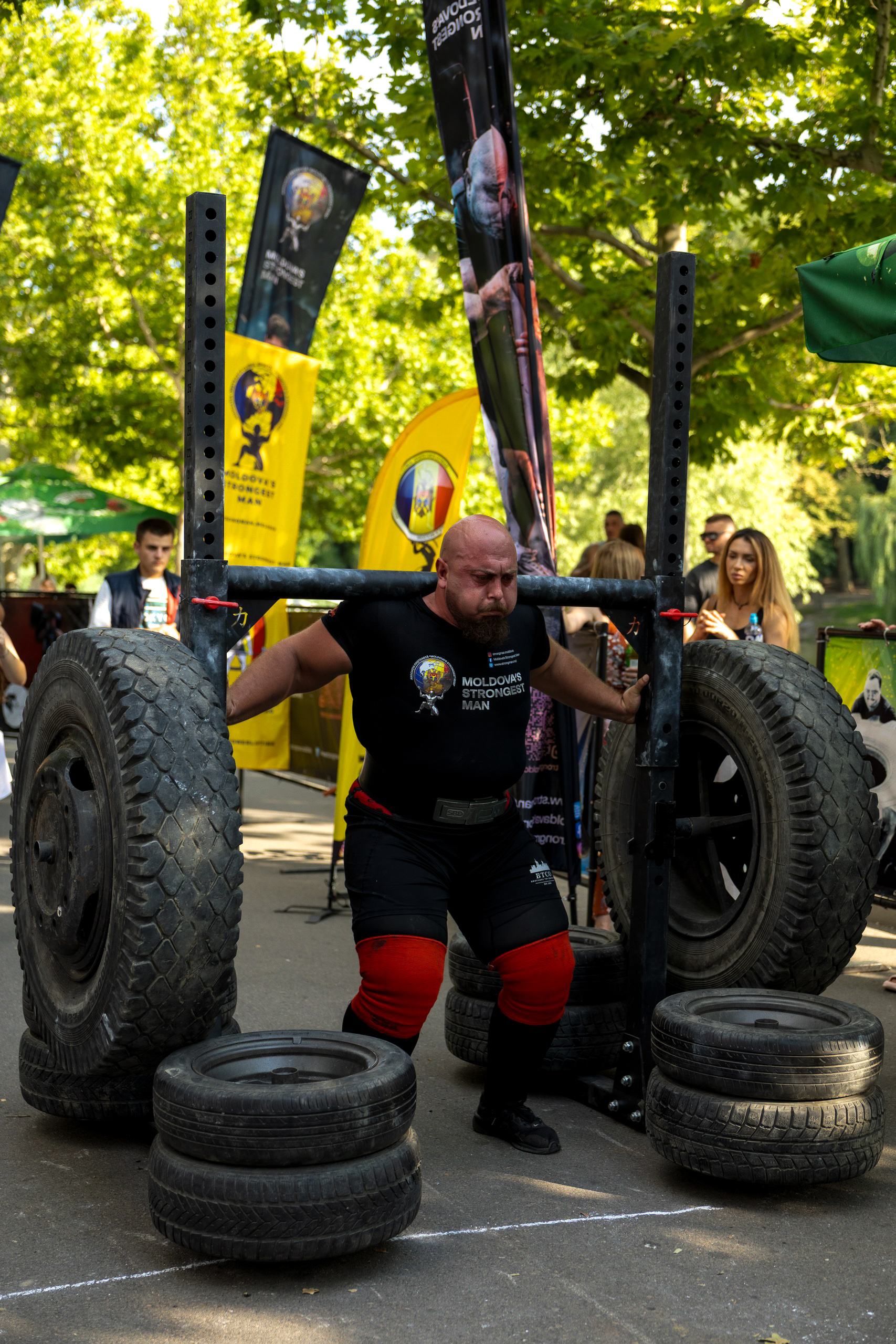
The yoke walk is one of the clearest demonstrations of the role of the legs in Strongman. The athlete must not only support a very heavy load but walk with it. The load is supported by the structure, yet every step causes a shift in the center of mass and changes pressure distribution between the feet.
During each step there is a phase in which one foot carries most of the load while the other must leave the ground and advance. The trunk and pelvis must stabilize while the knee and ankle control movement. If the step is too long, too short, or too fast for the load, energy is lost in unnecessary oscillation.
This leads to one of the key principles of loaded carries: speed is not simply a «fast legs» problem. It is a problem of position, balance, and mechanical economy. An athlete who takes efficient steps can move the same load at a lower cost than one who has to fight for balance on every step.
9. Farmer's Walk and Carries - Strength as a Sequence of Steps
The farmer's walk moves the problem from static strength toward repeated dynamic strength. The weights are held by the hands, but locomotion is produced through rapid alternation of support between the legs. Each step must be short enough to preserve control and efficient enough to create forward progress.
The load also produces moments that must be controlled in the frontal and transverse planes. The athlete is not simply moving forward. The athlete prevents excessive trunk lean, pelvic rotation, and loss of limb alignment. The legs work with the trunk and pelvic girdle musculature to turn the steps into controlled locomotion.
As fatigue rises, this coordination can degrade. The step becomes shorter or more chaotic, trunk position changes, and ground contact becomes less efficient. This is why specific conditioning and walking technique matter even for an athlete with enormous maximal strength.
10. Sled, Tire Flip, and Loading - The Legs in Horizontal Force Production
Many traditional strength exercises emphasize vertical movement. Strongman often adds horizontal components. Sled drags, sled pushes, and tire flips require the athlete to create force between the body and ground in a direction that does not coincide with simple vertical extension.
In these events, torso angle and tibial position become important. The ankle allows the knee and hip to settle into a configuration from which force can be directed forward. The foot must tolerate high pressure without slipping, while the thigh and hip musculature continue to produce force as the body moves.
The tire flip adds another strategic change: the object must be accelerated and rotated. Vertical force alone is not enough. The athlete must create a combination of leg drive and weight transfer through the trunk and arms, while the timing of the object's rotation depends on body position and the point of force application.
11. The Legs Under Fatigue - When Anatomy Becomes Strategy
Fatigue changes biomechanics. Not because muscles «forget» anatomy, but because the neuromuscular system has less capacity to produce and control force in exactly the same way. During a long carry or medley, the athlete may still have enough force for one step but not enough capacity to maintain the same precision for ten or twenty steps.
As fatigue rises, the body searches for solutions. It may change step length, increase torso lean, or redistribute plantar pressure. Some adaptations are effective and represent technical flexibility. Others increase mechanical cost and accelerate movement degradation.
For training, this means that executing a movement perfectly at the beginning of a set does not automatically demonstrate mastery of the movement under competition conditions. Specificity should include the fatigue relevant to the event. The legs must remain functional when heart rate is elevated, grip is tired, and the load is no longer comfortable.
12. Ankle Mobility and Knee Position - How Much Does It Matter?
Ankle mobility is often reduced to a single dorsiflexion measurement. In reality, the problem is more complex: available mobility matters, but so does active control, foot shape, hip position, and the exact demand of the movement.
In the squat, sufficient dorsiflexion can allow the knee to travel forward while the center of mass remains in an efficient position. If range is limited, the athlete may change stance or torso lean. Neither strategy is universally good or bad. They are ways the system reorganizes its levers.
In Strongman, this strategic flexibility matters. A rack squat, log squat, deadlift start, or loaded carry may require different configurations. The goal is not to force one position, but to have enough movement capacity and control to choose the position that produces the best balance between force and stability.
13. Symmetry, Asymmetry, and Lateral Control
Strongman frequently favors asymmetrical loading. A sandbag may sit higher on one shoulder, a Husafell stone may be carried centrally or laterally, and irregular objects can shift the load distribution from one step to the next. The legs must respond to this asymmetry without losing pelvic control.
Hip abductors, adductors, rotators, and calf muscles contribute to controlling this situation. There is no single muscle responsible for «knee alignment». Stability emerges from the cooperation of multiple structures and neuromuscular control. This is one reason unilateral exercises and asymmetrical loading variations can have value in Strongman preparation when dosed according to the objective.
14. The Legs and Force Transfer to the Trunk
However strong the legs are, they cannot lift the object by themselves. Force must travel through the pelvis and trunk. If the trunk deforms unnecessarily, part of the capacity produced by the legs is absorbed in movements that do not directly contribute to moving the load.
This explains the relationship between the episodes in the series. The legs are not an isolated chapter. They continue the work of the hips and posterior chain, and what they produce must be stabilized by the trunk and then transmitted toward the shoulder, elbow, forearm, and hand. In a deadlift, for example, the knee and hip contribute to raising the object, but the result depends on the entire chain remaining connected.
15. Why a Strongman Can Have Very Large Legs and Still Be Slow
Muscle mass is potential, not a guarantee of speed. A leg can contain a large amount of contractile tissue and still be less efficient if force is poorly coordinated, technique is uneconomical, or the athlete is not accustomed to producing force during movement.
In Strongman events, speed depends on several things at once: relative and absolute strength, rate of force development, postural control, center-of-mass position, step length and rhythm, functional limb stiffness, and the ability to repeat the movement cycle. Therefore, «more mass» does not automatically mean «faster».
A large and very strong athlete can be fast when coordination and technique are good enough. Likewise, a lighter athlete may be more efficient in a carry if he or she can move the center of mass with fewer unnecessary oscillations and better mechanical economy. Performance is the product of the system, not of a single muscle dimension.
16. What Strong Legs Really Mean for a Strongman
It means being able to produce high force from different joint angles. To control the knee and ankle. To maintain pelvic stability. To accelerate a load. To walk with it. To absorb force as you descend and retransmit it as you rise. To do all of this when fatigue begins to change execution.
The true strength of the lower limbs is therefore not measured only by a squat or deadlift. Those tests matter, but they are only windows into a much broader system. A Strongman needs strong extensors, but also efficient stabilizers; sufficient mobility, but also control; power, but also the capacity to repeat movement.
Conclusion
The legs and ankle are the mechanical foundation of a Strongman. Above them are the trunk, arms, and hands, but without a base capable of producing, absorbing, and transferring force, the rest of the chain cannot express its full potential. In squats and deadlifts, the legs produce extension. In yoke and farmer's walks, they turn force into locomotion. In sleds and tire flips, they direct force into the ground and forward. In loading, they combine strength, balance, and rapid changes in position.
The ankle and foot complete contact with the ground, but they also enable the entire chain to function efficiently. A strong Strongman is not merely an athlete who can lift a lot. It is an athlete who can turn pressure at the foot into movement, movement into force, and force into result. And that transformation starts from the ground up, with every contact between the foot and the floor.
More From The Journal
Training
The Science of Strongman Training - Episode X: Competition Programming
How to build a complete Strongman competition preparation block: calendar, events, volume, intensity, specificity, simulations, autoregulation, tapering and fatigue management.
Training
The Science of Strongman Training - Episode IX: Peaking
Peaking in Strongman: how to turn months of training into maximal competition performance by reducing fatigue, preserving adaptations and managing specificity.